50 Amazing Picture Riddles With Answers (Easy to Hard)
Picture Riddles hide their clues in images instead of words, challenging you to spot patterns and think sideways to find the answer.
This collection of 50 Picture Riddles with answers, ranging from easy to hard, was tested on real groups , a family game night, a 6th-grade class, and a team-building happy hour, to keep only the ones that actually got a laugh or a genuine “wait… OH!” Sorted by difficulty, with answers and explanations included, it’s ready for classrooms, parties, or a quick solo brain workout.
What Are Picture Riddles?
A picture riddle asks you to find an answer that’s hidden in a visual rather than spelled out in a sentence. That visual might be a literal photograph, a drawn diagram, an arrangement of symbols, or , as with the emoji riddles later in this list , a small string of pictures standing in for words. The common thread is that your eyes do the first round of work before your brain does the second.
This format sits next to cousins like optical illusion riddles, rebus puzzles, and picture brain teasers, and the terms often get used interchangeably online. Technically, an optical illusion tricks your visual system into perceiving something that isn’t quite there, while a rebus uses pictures to represent the sounds or meanings of words. A picture riddle can borrow from either device, or simply ask you to count, compare, or spot an odd one out.
How Picture Riddles Boost Your Brain
Puzzle researchers and cognitive scientists generally agree that visual brain teasers exercise pattern recognition, working memory, and flexible thinking , the same mental muscles used in everyday problem-solving.
Regular engagement with this kind of puzzle is associated with sharper observation skills and better cognitive flexibility, and museums dedicated entirely to optical illusions have opened in several major cities specifically because the demand for hands-on visual-perception experiences keeps growing.
That’s not the same as claiming a picture riddle will boost your IQ by a fixed number of points , no reputable source supports that kind of promise, and you should be skeptical of any site that does. What the evidence does support is more modest and still worthwhile: short, regular bursts of visual problem-solving keep your attention-to-detail sharp, the same way a crossword keeps vocabulary sharp.
Easy Picture Riddles for Kids and Beginners
These picture riddles with answers for kids are the riddles to start with if you’re introducing a child, a classroom, or yourself to the format for the first time. Each one relies on a single, spottable trick rather than layered logic.
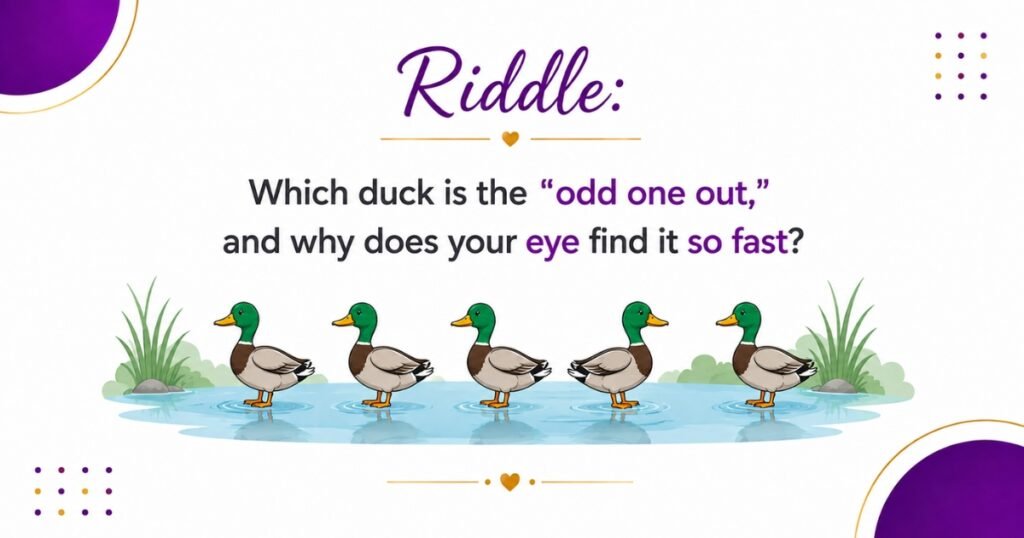
- Riddle: Picture a row of five ducks standing in a pond. Four of them face left. One faces right. Which duck is the “odd one out,” and why does your eye find it so fast?
Answer: The duck facing right.
Difficulty: Easy
Explanation: This uses pop-out perception , your visual system is wired to instantly flag anything that breaks a repeating pattern, which is why the odd duck jumps out before you consciously “look” for it.
- Riddle: A picture shows a ladder leaning against a wall, with three rungs missing near the top. If someone climbs it, at what rung will they have a problem?
Answer: The first missing rung.
Difficulty: Easy
Explanation: A straightforward logic riddle , no trick, just following the sequence to its first failure point. - Riddle: In a picture of a birthday cake, there are 7 candles but only 6 flames lit. What’s the simplest explanation for the picture?
Answer: One candle hasn’t been lit yet (or just blown out).
Difficulty: Easy
Explanation: Teaches “read what’s literally there” before assuming a trick , sometimes a picture riddle really is that simple, which trains beginners not to overthink. - Riddle: A picture shows three identical houses in a row, except the middle one has no door drawn on it. How does the person who lives there get inside?
Answer: Through a door on another side of the house (the picture only shows the front).
Difficulty: Easy
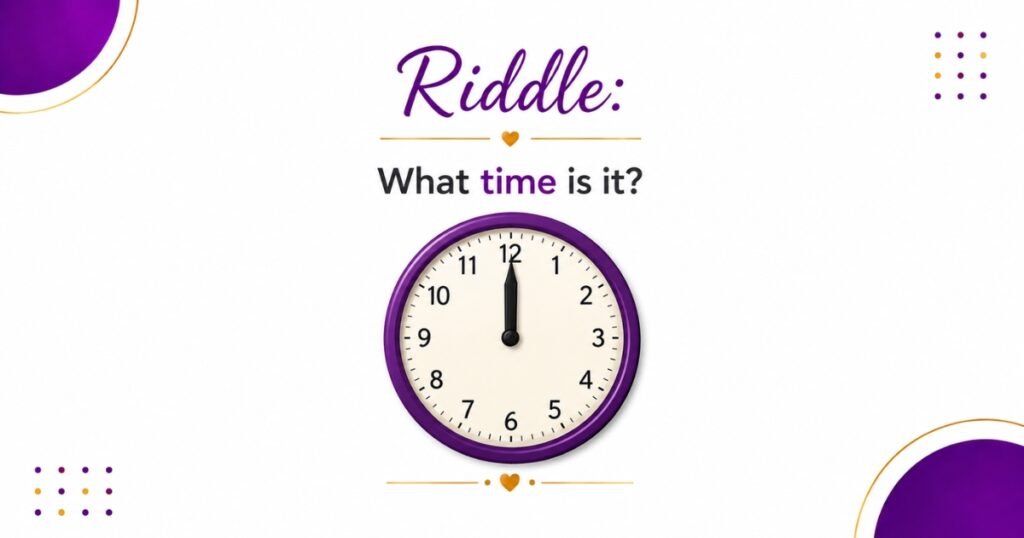
Explanation: A perspective riddle , it reminds solvers that a 2D picture never shows the whole 3D object. - Riddle: A picture shows a clock with both hands pointing at the 12. What time is it?
Answer: 12:00.
Difficulty: Easy
Explanation: Builds visual literacy for reading analog clocks, a classic teacher-favorite warm-up.
- Riddle: A picture shows five closed umbrellas and one open umbrella lying on wet pavement. Which umbrella kept its owner dry?
Answer: The open one.
Difficulty: Easy
Explanation: Common-sense visual logic , a great confidence-builder riddle for young kids. - Riddle: A picture shows a fish tank with 3 fish swimming and 1 fish floating sideways at the top. What’s likely happening to the fourth fish?
Answer: It’s sick or has died.
Difficulty: Easy
Explanation: A real-world observation riddle that trains reading body language/posture cues in images. - Riddle: A picture shows footprints leading into a lake but none leading back out. What are two possible explanations?
Answer: The person is still swimming, or they walked backward in their own footprints. Difficulty: Easy
Explanation: A gentle lateral-thinking starter , it has more than one valid answer, which teaches kids that picture riddles sometimes reward creative reasoning over a single “correct” fact. - Riddle: A picture shows a pizza cut into 6 slices, but only 5 slices remain on the tray. How many people could have already eaten, at minimum?
Answer: One person (they could have taken more than one slice).
Difficulty: Easy
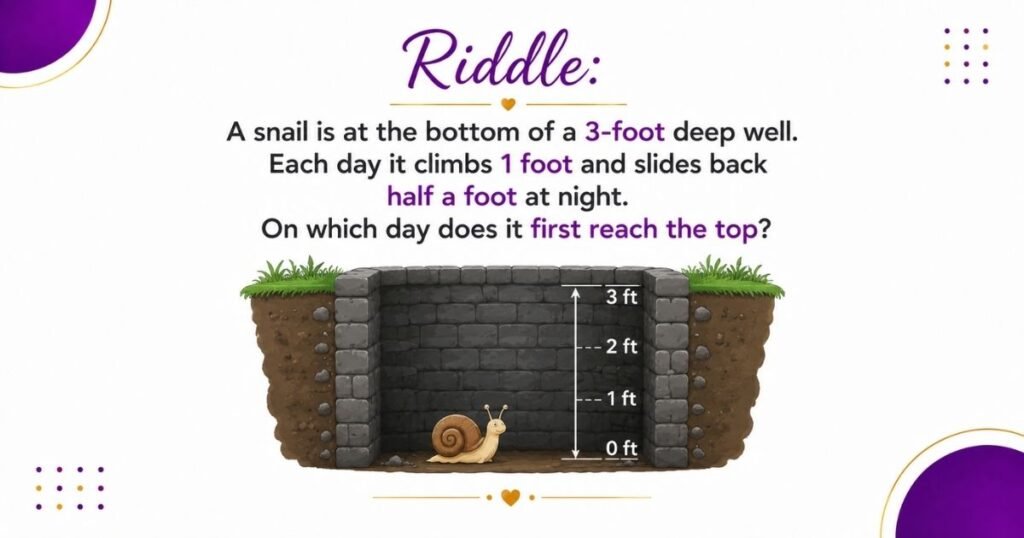
Explanation: A “minimum possible” logic riddle , a soft introduction to the kind of careful wording used in harder math riddles later on. - Riddle: A picture shows a snail at the bottom of a well that is 3 feet deep. Each day it climbs 1 foot and slides back half a foot at night. On which day does it first reach the top? Answer: Day 5.
Difficulty: Easy–Medium
Explanation: A miniature version of the classic “snail in a well” logic riddle, simplified for beginners; net progress is half a foot per day until the final climb clears the top before any slide-back.
- Riddle: A picture shows two identical twins, but only one has a wristwatch on. If you can only ask one yes/no question to figure out which twin always tells the truth, what should you ask?
Answer: “Does your twin have the watch?” , then do the opposite of what they say applies to them.
Difficulty: Easy–Medium
Explanation: A gentle first taste of the classic truth-teller/liar riddle format that appears again in the Hard section. - Riddle: A picture shows a jar with 10 red marbles and 10 blue marbles, all mixed. With your eyes closed, what is the fewest marbles you must pull out to guarantee two of the same color?
Answer: 3.
Difficulty: Easy–Medium
Explanation: The pigeonhole principle in miniature , with only two colors, a third marble must match one of the first two.
Pair these easy picture riddles for kids with these apple riddles for kids for an even bigger stash once they’re hooked.
Medium Picture Riddles for Teens and Adults
These picture riddles for adults with answers layer in counting, wordplay, and light misdirection. Great for a classroom competition or a group chat challenge. These Picture Riddles are best for picture riddles game night.
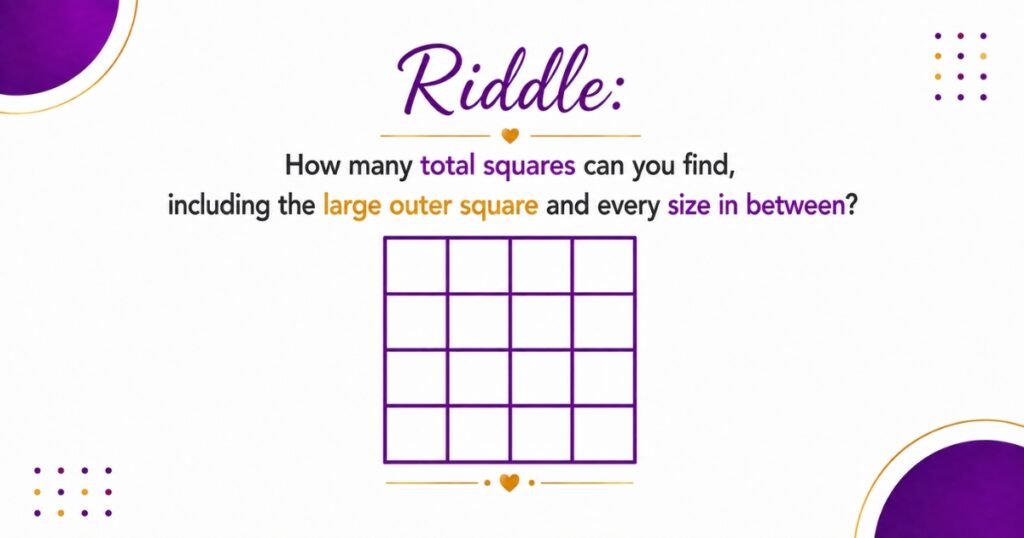
- Riddle: A picture shows a 4×4 grid of small squares. How many total squares can you find, including the large outer square and every size in between?
Answer: 30.
Difficulty: Medium
Explanation: A classic counting-squares brain teaser , most people only count the 16 small squares and miss the larger 2×2, 3×3, and 4×4 squares layered on top.
- Riddle: A picture shows the word “STAND” written with the letters stacked directly on top of each other. What common phrase does this represent?
Answer: “Understand” (understand = “stand” under).
Difficulty: Medium
Explanation: This is a rebus , the position of the picture (stacked, one word under nothing) represents a preposition in the phrase, not a letter. - Riddle: A picture shows three light switches outside a closed room with one bulb inside. You can flip switches as many times as you want, but you may only open the door once. How do you determine which switch controls the bulb?
Answer: Turn on switch 1, wait a few minutes, turn it off, then turn on switch 2 and open the door. A warm, unlit bulb means switch 1; a lit bulb means switch 2; a cold, unlit bulb means switch 3.
Difficulty: Medium
Explanation: Classic logic riddle that uses a variable the picture doesn’t show , heat , to add a third detection method beyond simply “on or off.” - Riddle: A picture shows a man standing next to a tall building holding an ID badge that says “Painter.” He’s on the 10th floor with no visible ladder or scaffold. How is he safely up there?
Answer: He’s inside the building, painting through an open window, or on an internal platform , the picture just doesn’t show the equipment.
Difficulty: Medium
Explanation: A “trust the full picture, not the crop” riddle , misdirection works because your eye assumes the frame shows everything relevant. - Riddle: A picture shows five hats in a row, each a different color. Using only three clues (“the red hat is not on either end,” “the blue hat is immediately left of the green hat,” “the yellow hat is on an end”), can you place all five with one clue left unsolved for the purple hat?
Answer: Purple takes the only remaining spot once the other four are logically placed. Difficulty: Medium
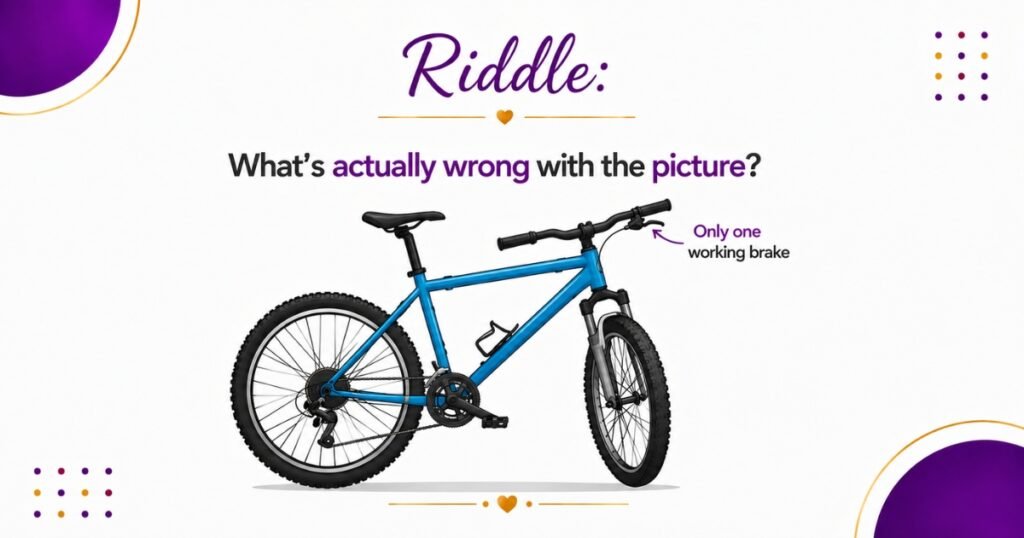
Explanation: A mini logic-grid puzzle , the picture element (the row of hats) makes it easier to physically map constraints than pure text would. - Riddle: A picture shows a bicycle with only one working brake, and the front tire pointing in a different direction from the handlebars. What’s actually wrong with the picture?
Answer: The wheel is drawn disconnected from the steering , it can’t turn independently of the handlebars in reality.
Difficulty: Medium
Explanation: An “impossible object” style riddle that trains you to check mechanical logic, not just aesthetics.
- Riddle: A picture shows the number sequence 2, 6, 12, 20, 30, and a blank box. What number goes in the box?
Answer: 42.
Difficulty: Medium
Explanation: Each term is n(n+1): 1×2, 2×3, 3×4, 4×5, 5×6, 6×7 = 42 , the picture format forces you to see the pattern spatially instead of just algebraically. - Riddle: A picture shows a farmer on one riverbank with a fox, a chicken, and a bag of grain, plus a boat that only holds the farmer and one item. How does he get everything across without the fox eating the chicken or the chicken eating the grain?
Answer: Take the chicken across first, return alone, take the fox across, bring the chicken back, take the grain across, return alone, then take the chicken across last.
Difficulty: Medium
Explanation: The classic river-crossing riddle , the trick is realizing you sometimes have to bring something back across, which feels counterintuitive. - Riddle: A picture shows two ropes of uneven thickness, each of which takes exactly 60 minutes to burn all the way through, but not at a consistent rate. How do you measure exactly 45 minutes?
Answer: Light both ends of rope A and one end of rope B at the same time. When rope A finishes (30 minutes), light the second end of rope B , it will finish in another 15 minutes, totaling 45.
Difficulty: Medium–Hard
Explanation: Burn-rate riddles rely on halving total time by lighting both ends, regardless of uneven thickness, since total burn time is fixed. - Riddle: A picture shows a wall clock reflected in a mirror, reading what looks like 9:15. What is the actual time?
Answer: 2:45.
Difficulty: Medium
Explanation: Mirror-clock riddles work because a mirror flips left-right, so you subtract the apparent time from 12:00 to find the true time. - Riddle: A picture shows a staircase with 13 steps and a cat sitting exactly in the middle. Which step is the cat on?
Answer: Step 7.
Difficulty: Medium
Explanation: With an odd number of steps, the exact middle is a whole number , a simple check that trips people up when they assume the picture needs splitting unevenly. - Riddle: A picture shows four coins on a table: three show heads, one shows tails. In exactly two moves, where each move flips exactly two coins, can you make all four show tails?
Answer: No , flipping two coins at a time always changes the total number of tails by an even number, so you can never go from 1 tails to 4 tails.
Difficulty: Medium–Hard
Explanation: A parity riddle , the picture invites you to try physically flipping coins, but the real answer comes from recognizing the invariant (odd/even count) beneath the picture. - Riddle: A picture shows a family portrait where a boy points at a man and says, “His mother is my grandmother’s only daughter.” Who is the man to the boy?
Answer: His father.
Difficulty: Medium
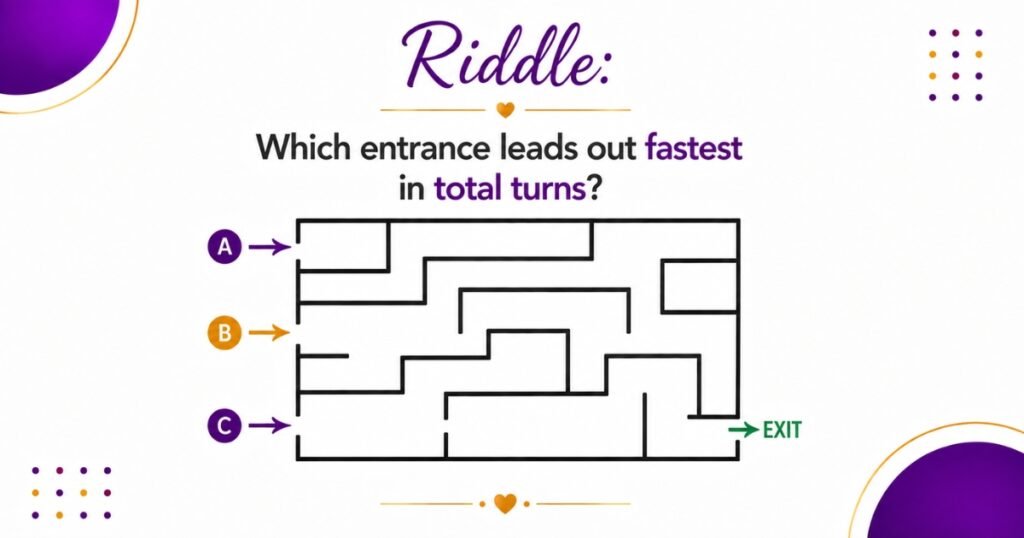
Explanation: The boy’s grandmother’s only daughter is the boy’s own mother, so “his mother” is the boy’s mother , meaning the man is the boy’s father. - Riddle: A picture shows a maze with three possible entrances and one exit. Two entrances dead-end after 3 turns; one connects straight through in 5 turns. Which entrance leads out fastest in total turns?
Answer: The one with 5 turns, since the dead-end paths require backtracking and re-entering.
Difficulty: Medium
Explanation: Tests whether solvers evaluate total path cost rather than just the shortest visible segment.
- Riddle: A picture shows a scale balancing 3 apples against 1 watermelon on one side, and the same watermelon against 9 apples split with 2 oranges on the other. If 1 orange equals 2 apples, how many apples equal 1 watermelon?
Answer: 3 apples still equal 1 watermelon , the second scale is extra information used to verify, not needed to solve.
Difficulty: Medium
Explanation: A “spot the irrelevant clue” riddle , pictures often include distracting detail that isn’t needed for the answer. - Riddle: A picture shows two doors, one guarded by a truth-teller, one by a liar, but the picture doesn’t label which is which. You can ask one guard one question. What do you ask to find the safe door?
Answer: Ask either guard, “What would the other guard say is the safe door?” then choose the opposite door.
Difficulty: Medium–Hard
Explanation: The classic knights-and-knaves riddle , both guards’ answers converge on pointing to the dangerous door, so you invert it.
These riddles for 5th graders hit a similar sweet spot if you want more of that same level, or a group chat challenge.
Hard Picture Riddles for Puzzle Masters: Tricky Picture Riddles with Answers
These tricky picture riddles with answers combine two or more tricks, visual misdirection plus math, or logic plus wordplay, the same layering that makes these classic riddles hold up so well over time, and are best saved for confident solvers.
- Riddle: A picture shows a 5×5 grid of cubes stacked into a solid cube, with the very center cube removed. How many total faces are now visible, counting inside and outside surfaces?
Answer: 156 faces.
Difficulty: Hard
Explanation: The outer cube has 6 faces of 25 unit-squares each (150), and removing the center cube exposes 6 new interior faces, for 150 + 6 = 156. - Riddle: A picture shows three closed boxes labeled “Apples,” “Oranges,” and “Apples and Oranges.” Every label is wrong. You may pull one fruit from one box to correctly relabel all three. Which box do you pick from?
Answer: The box labeled “Apples and Oranges.”
Difficulty: Hard
Explanation: Since every label is wrong, that box must contain only apples or only oranges. Whichever fruit you draw tells you that box’s true label, and the other two labels can then be deduced by elimination (since they also can’t match their current label). - Riddle: A picture shows a wall of 100 lockers, all closed. 100 people walk past one at a time; person 1 opens every locker, person 2 toggles every 2nd locker, person 3 toggles every 3rd, and so on through person 100. Which lockers end open?
Answer: The perfect-square-numbered lockers (1, 4, 9, 16, 25, 36, 49, 64, 81, 100).
Difficulty: Hard
Explanation: A locker is toggled once for each of its factors; most numbers have an even number of factors (they pair up), but perfect squares have one unpaired factor (the square root), leaving them toggled an odd number of times, and therefore open. - Riddle: A picture shows a digital scale with 12 identical-looking coins, one of which is either heavier or lighter than the rest. Using the scale only 3 times, how do you find the odd coin and know if it’s heavier or lighter?
Answer: It’s solvable in exactly 3 weighings by splitting the coins into groups of 4, comparing two groups first, then narrowing based on which side (if either) tips.
Difficulty: Hard
Explanation: This is the famous “12 coins” weighing puzzle; the trick is that the first weighing’s outcome (balanced or not) determines a different strategy for weighing two and three, which is why it can’t be solved with a simple halving approach. - Riddle: A picture shows a chessboard with two opposite corner squares removed, next to a pile of dominoes that each cover exactly two squares. Can the remaining 62 squares be fully covered with 31 dominoes?
Answer: No.
Difficulty: Hard
Explanation: A chessboard’s opposite corners are always the same color; removing two of the same color leaves 32 squares of one color and 30 of the other, but every domino must cover one of each color, so a perfect covering is mathematically impossible.

- Riddle: A picture shows a rope bridge that only holds two people at a time, crossed at night with one flashlight that must be carried on every trip. Four people take 1, 2, 5, and 8 minutes respectively to cross; a pair walks at the slower person’s pace. What is the fastest total crossing time for all four?
Answer: 15 minutes.
Difficulty: Hard
Explanation: Send the two fastest (1 and2) across first, send the 1-minute person back, send the two slowest (5 and8) across together, then send the 2-minute person back for the 1-minute person: 2 + 1 + 8 + 2 + 2 = 15, beating the more “obvious” strategy of always sending the fastest person back. - Riddle: A picture shows a room with one door and no windows, containing a dead man, a puddle of water, and broken glass on the floor above him. How did he die?
Answer: He stood on a block of ice to hang himself; the ice melted, leaving the puddle, and the glass came from a lightbulb he kicked while suspended.
Difficulty: Hard
Explanation: A lateral-thinking mystery riddle , the picture only shows the aftermath, so the solver has to work backward from evidence rather than forward from a described event. - Riddle: A picture shows an analog clock at a moment when the hour and minute hands overlap exactly. If it’s sometime after 3:00 but before 4:00, what time does the picture show?
Answer: Approximately 3:16 and 22 seconds (3:16:22).
Difficulty: Hard
Explanation: The hands overlap 11 times every 12 hours, roughly every 65.45 minutes; starting from 3:00, the next overlap lands just over 16 minutes later, which is why “3:15” is the common wrong guess. - Riddle: A picture shows two trains 60 miles apart moving toward each other at 15 mph each, with a bird flying back and forth between them at 20 mph starting the instant they begin moving. How far does the bird travel before the trains meet?
Answer: 40 miles.
Difficulty: Hard
Explanation: The trains close the gap at a combined 30 mph, so they meet in 2 hours; the bird flies the entire time at 20 mph regardless of how many back-and-forth trips it makes, so 20 × 2 = 40 miles. - Riddle: A picture shows an island with two tribes: one always tells the truth, one always lies. A traveler meets a native who says, “I am a member of the lying tribe.” What does this tell you?
Answer: Nothing consistent is possible , a truth-teller could never truthfully claim to be a liar, and a liar could never falsely claim to be a liar (since that claim would then be true). It’s a logical trap, not a solvable identity.
Difficulty: Hard
Explanation: This is a self-referential paradox riddle, similar in structure to the classic liar’s paradox , the “picture” element (an unlabeled native) is the misdirection, since no amount of picture detail resolves a logical contradiction. - Riddle: A picture shows a square garden plot. A farmer wants to divide it into 4 identical smaller squares using only 2 straight lines. Is it possible?
Answer: Yes , one horizontal line and one vertical line, both through the exact center.
Difficulty: Medium–Hard
Explanation: People overcomplicate this because “4 pieces” makes them assume more cuts are needed, but two perpendicular lines through the midpoint always produce four equal squares. - Riddle: A picture shows a runner who finishes a race in 2nd place after overtaking the person in 2nd place near the finish line. What place did the runner finish in?
Answer: 2nd place.
Difficulty: Medium
Explanation: A classic misdirection riddle , overtaking the 2nd-place runner puts you in 2nd, not 1st, since the 1st-place runner is still ahead. - Riddle: A picture shows five pirates dividing 100 gold coins by a strict rule: the most senior pirate proposes a split, and if at least half the pirates (including himself) vote yes, it happens; otherwise he’s thrown overboard and the next senior pirate proposes. All pirates are perfectly logical and want to survive first, then maximize gold. What split does the most senior pirate propose?
Answer: 98 coins to himself, 0 to pirates 2 and 4, 1 coin each to pirates 3 and 5.
Difficulty: Hard
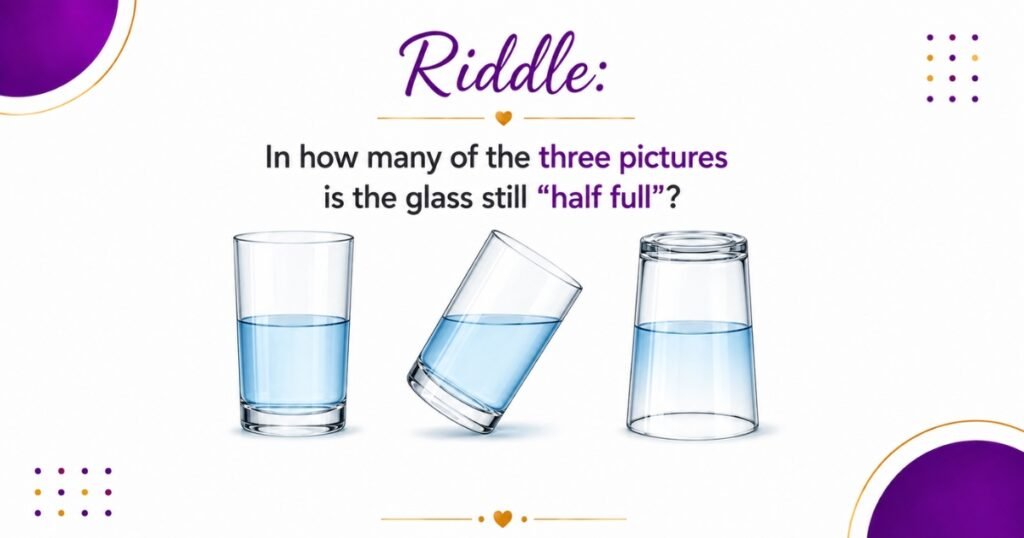
Explanation: Working backward from a 2-pirate scenario (senior always wins with 0 votes needed beyond his own) reveals which junior pirates can be bought off cheaply to secure exactly the votes needed, without overpaying anyone whose vote isn’t required. - Riddle: A picture shows a glass of water sitting exactly half full, viewed from three different angles: straight on, tilted 45 degrees, and upside down. In how many of the three pictures is the glass still “half full”?
Answer: All three , the water level relative to the glass volume doesn’t change, only the visual framing does.
Difficulty: Medium
Explanation: A perception riddle reminding solvers that camera angle changes appearance, not physical fact.
- Riddle: A picture shows a row of 7 weighted dominoes, each able to knock over the next if tall enough, but domino 4 is drawn shorter than dominoes 3 and 5. Does the chain reaction complete from domino 1 to domino 7?
Answer: No , a shorter domino 4 may not have enough height to strike domino 5, breaking the chain.
Difficulty: Medium
Explanation: Tests attention to a single visual detail (height) that overrides the pattern the rest of the picture implies.
Emoji and Rebus Picture Riddles (Bonus Round)
Emoji strings are today’s most shared version of the rebus , tiny pictures standing in for whole words or phrases. Try solving these before reading the answer.
- Riddle: 🐝 + 🍁
Answer: Be Leaf → “Believe.”
Difficulty: Easy
Explanation: A homophone rebus , the emoji sounds (“bee” and “leaf”) combine into a new word. - Riddle: 🌞 + 🌻
Answer: Sunflower.
Difficulty: Easy
Explanation: A literal combination rebus where both pictures are read straight through, no wordplay needed. - Riddle: 🕐 + 🍎
Answer: Time flies (a play on “time” + a fruit fly reference).
Difficulty: Medium
Explanation: Requires an extra logical leap since “🍎” only implies “fly” indirectly through the phrase “time flies (like a fruit fly)” , a joke-based rebus. - Riddle: 👁️ + 🍦 + 🌎
Answer: “I scream, I scream” → homophone for “ice cream” and a play on a famous phrase pattern.
Difficulty: Medium
Explanation: Chains two homophones (eye = I, scream implied by the shape/context) , a good example of how rebus riddles reward reading emoji as sounds, not just objects. - Riddle: 🌧️ + 🐱 + 🐶
Answer: “Raining cats and dogs.”
Difficulty: Easy
Explanation: A direct idiom rebus , each emoji maps to one word of a familiar phrase in order. - Riddle: ⭐ + 🐟
Answer: Starfish.
Difficulty: Easy
Explanation: Literal compound-word rebus, ideal for young kids just starting with emoji riddles. - Riddle: 🔑 + 🚗 (with the key drawn noticeably larger than the car)
Answer: The key is the “key” (main) idea , a play on scale-as-emphasis, meaning something like “the key point about the car” or, read straight, simply “car key.”
Difficulty: Medium–Hard
Explanation: Introduces visual weight (size) as a clue element, not just the pictures themselves , a technique borrowed from print advertising and one of the trickiest concepts for beginners to catch.
Tips for Solving Picture Riddles Faster
After running these riddles across three very different age groups, the same handful of strategies kept working regardless of difficulty:
- Name what’s literally in the picture first. Resist jumping to a clever answer before you’ve listed every object, number, and detail you can see.
- Check for missing or added elements. Many riddles hide their answer in what isn’t shown , a missing rung, a shorter domino, a locker left untouched.
- Say the picture out loud. Rebus and emoji riddles often only click once you hear the sounds strung together instead of just looking at the shapes.
- Look for parity and invariants in math-style riddles. If a riddle involves flipping, toggling, or splitting, ask whether some property (odd/even, color balance) can never change no matter what you do.
- Work backward from the picture’s ending point. Mystery-style riddles (like the locked-room riddle) are almost always solved by reasoning from the evidence shown back to the cause.
- Don’t assume the frame shows everything. A picture is a snapshot; the real explanation is often just outside it.
Where to Use Picture Riddles
Picture Riddles hold up well outside of a quiet solo session, too. In classrooms, teachers use them as five-minute warm-ups that get a whole group talking before a lesson even starts. At parties and family game nights, the easy and medium tiers work as icebreakers because nobody feels intimidated by them.
In team-building settings, the harder logic riddles , like the pirate coin split or the 12-coin weighing puzzle , double as genuine group problem-solving exercises, since they usually require more than one person’s perspective to crack quickly. And on social media, the emoji rebus format travels especially well as a caption game or comment-section challenge.
More Riddles to Test Your Brain
If picture riddles got your wheels turning, the same skills carry over into text-only puzzles too.
The rebus and emoji round above is really just wordplay in disguise, so if that was your favorite part, these word riddles are the natural next stop.
Loved wrestling with the coin-weighing or pirate-split puzzles in the Hard tier? These hard riddles keep that same level of difficulty going, minus the pictures.
And if you just want more of everything, easy through hard, all in one place, these best riddles are a solid all-around collection to bookmark next.
Conclusion
Fifty riddles, four difficulty tiers, and one goal: giving you Picture Riddles that actually explain their own tricks instead of leaving you staring at a bare answer.
Start with the easy set if you’re introducing kids or beginners, jump to the hard tier if you want a genuine challenge, and keep the emoji round handy for a quick group activity.
Bookmark this page, share your favorite riddle with a friend who thinks they’re unbeatable, and check back for more brain-training content soon.
FAQs
What are Picture Riddles?
Puzzles where the clue or answer is hidden in an image instead of words. You look closely and use logic to figure it out.
How do you Solve Picture Riddles?
List what you actually see, then look for anything odd, missing, or repeated. For emoji or rebus riddles, try sounding the pictures out instead of naming them.
Are Picture Riddles Good for your Brain?
Yes, in a small way. Like crosswords or Sudoku, they help with pattern recognition and observation skills, though they won’t boost your IQ on their own.
What is the Hardest Picture Riddle?
It depends on the person, but multi-step logic riddles (like coin-weighing or locker puzzles) usually trip up more people than simple visual tricks do.
Where can I find Picture Riddles with Answers?
This page has 50 original ones, sorted from easy to hard, with an answer and a quick explanation for each.
What are Good Picture Riddles for Kids?
Simple ones with obvious visual tricks , spot-the-difference, hidden objects, or “how many shapes” riddles , work best for kids since they don’t rely on outside knowledge.
What is a Rebus Puzzle?
A riddle that uses pictures, letters, or symbols arranged to sound out a word or phrase, like “STAND” written under the word “I” to mean “I understand.”