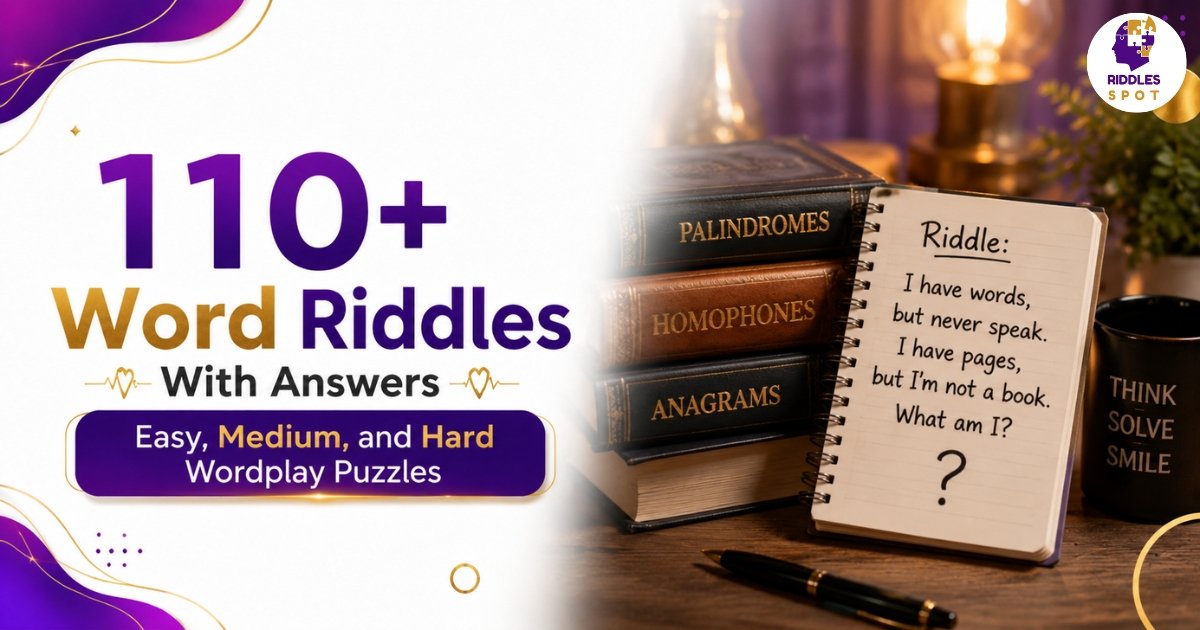
110+ Word Riddles With Answers: Easy, Medium, and Hard Wordplay Puzzles
Word Riddles turn language itself into a puzzle , playing with spelling, sound, and hidden meanings instead of straight logic.
This collection of 110+ word riddles, sorted from easy to hard, is ready for classrooms, family game night, or a quiet brain workout, with every answer explained so you know exactly why it works.
What Makes a Word Riddle Different From a Regular Riddle?
A regular riddle can be solved through logic or observation alone , “what gets bigger the more you take away” (a hole) rewards spatial reasoning. A true word riddle, by contrast, hinges specifically on English spelling, pronunciation, or letter structure.
Homophone riddles exploit words that sound alike but are spelled differently. Anagram riddles rearrange letters into a new word. Letter riddles hide a smaller word inside a bigger one, or play with how a word looks on the page.
Understanding this distinction helps you solve faster: when a riddle mentions “sounds like,” “spelled,” or “letters,” it’s usually a linguistic trick rather than a logic puzzle.
Easy Word Riddles for Kids and Beginners
These word riddles level 1 are ideal for classrooms, younger solvers, or anyone easing into wordplay for the first time.
- Riddle: What has a thumb and four fingers but isn’t alive?
Answer: A glove
Difficulty: Easy
Explanation: The riddle borrows body-part vocabulary metaphorically, tricking the mind into picturing a hand before revealing an object shaped like one. - Riddle: What gets wetter the more it dries?
Answer: A towel
Difficulty: Easy
Explanation: A paradox riddle , “wetter” and “dries” seem contradictory until you realize the towel absorbs the moisture it removes from something else. - Riddle: What has hands but can never clap?
Answer: A clock
Difficulty: Easy
Explanation: Reuses “hands” in its literal clock-part sense rather than the human-body sense the reader first assumes.
- Riddle: What has a bed but never sleeps?
Answer: A river
Difficulty: Easy
Explanation: “Bed” is a homonym here , a riverbed, not a place to sleep. - Riddle: What can you catch but never throw?
Answer: A cold
Difficulty: Easy
Explanation: Plays on the dual meaning of “catch” , receiving an illness versus catching a thrown object. - Riddle: What has a neck but no head?
Answer: A bottle
Difficulty: Easy
Explanation: Uses anatomical vocabulary for an object part, forcing solvers to picture shapes instead of bodies. - Riddle: What has teeth but can never bite?
Answer: A comb
Difficulty: Easy
Explanation: “Teeth” describes the comb’s thin prongs, not a mouth , a classic body-part misdirection. - Riddle: What kind of coat is always damp when you put it on?
Answer: A coat of paint
Difficulty: Easy
Explanation: Swaps the everyday meaning of “coat” (clothing) for its less common meaning (a layer of paint). - Riddle: What has a face but no eyes, and hands but no arms?
Answer: A clock
Difficulty: Easy
Explanation: Combines two body-part homonyms , face and hands , both belonging to a clock rather than a person. - Riddle: What travels around the world while staying in one corner?
Answer: A postage stamp
Difficulty: Easy
Explanation: The stamp physically stays glued to one corner of an envelope even as the letter itself crosses continents.
- Riddle: What has a ring but no finger?
Answer: A telephone
Difficulty: Easy
Explanation: “Ring” refers to the sound a phone makes, not a piece of jewelry. - Riddle: What is full of holes yet still holds water?
Answer: A sponge
Difficulty: Easy
Explanation: A logic-meets-word riddle , “full of holes” sounds like it should leak, but a sponge’s structure traps liquid anyway. - Riddle: What kind of tree fits in your hand?
Answer: A palm (tree)
Difficulty: Easy
Explanation: A pun on “palm,” which names both a tree species and the inside of your hand. - Riddle: What has one eye but cannot see?
Answer: A needle
Difficulty: Easy
Explanation: “Eye” refers to the small hole for thread, not an organ of sight. - Riddle: What has a spine but no bones?
Answer: A book
Difficulty: Easy
Explanation: “Spine” describes the bound edge of a book, reusing anatomical language for an everyday object. - Riddle: What word is pronounced the same even after you remove four of its five letters?
Answer: Queue
Difficulty: Easy
Explanation: Removing “ueue” leaves just “Q,” which is pronounced identically to the full word. - Riddle: What has many keys but can’t open a single lock?
Answer: A piano
Difficulty: Easy
Explanation: “Keys” refers to piano keys, not the metal kind , a straightforward homonym swap. - Riddle: What building has thousands of stories but never gets read?
Answer: A skyscraper
Difficulty: Easy
Explanation: “Stories” doubles as both narrative tales and building floors. - Riddle: What has a foot but no legs?
Answer: A ruler
Difficulty: Easy
Explanation: “Foot” refers to the unit of measurement, layered over the body-part meaning for misdirection. - Riddle: What five-letter word becomes shorter when you add two letters to it?
Answer: Short (add “ER” to make “shorter”)
Difficulty: Easy
Explanation: A self-referential riddle , the word “short” literally becomes the word “shorter.” - Riddle: What can run but never walks, has a mouth but never talks?
Answer: A river
Difficulty: Easy
Explanation: “Run” and “mouth” both have geographic meanings (a river runs; a river mouth is where it meets the sea). - Riddle: What word do all dictionaries always spell correctly?
Answer: Dictionary
Difficulty: Easy
Explanation: A self-referential joke riddle , the word itself is trivially spelled correctly within the dictionary that defines it. - Riddle: What has an ear but cannot hear?
Answer: A cornfield (an ear of corn)
Difficulty: Easy
Explanation: “Ear” refers to the corn cob, not the hearing organ. - Riddle: What kind of band never plays music?
Answer: A rubber band
Difficulty: Easy
Explanation: “Band” is reused from its musical-group meaning to its elastic-loop meaning. - Riddle: What gets bigger every time you take a step back from it, without it changing size at all?
Answer: Your shadow at sunset
Difficulty: Easy
Explanation: Plays on perceived versus actual size, a gentle introduction to riddles that mix perception with wordplay.
Medium Word Riddles to Sharpen Your Vocabulary
These riddles require a second look — the trick is rarely obvious on the first read, the same second-look habit that pays off in these classroom riddles when you want a broader lesson mix.
- Riddle: What five-letter word for “big” still leaves a real word behind after you remove its first and last letters?
Answer: Grand → Ran
Difficulty: Medium
Explanation: Removing the “G” and the “D” from “grand” leaves the standalone word “ran,” a satisfying letter-trimming trick. - Riddle: I am not alive, yet I grow; I don’t have lungs, yet I need air; I don’t have a mouth, yet water kills me. What am I?
Answer: Fire
Difficulty: Medium
Explanation: Personifies fire’s chemical needs (oxygen, fuel) as if it were a living thing, without using the word “fire” itself. - Riddle: What word starts with “e,” ends with “e,” but only contains one letter?
Answer: Envelope
Difficulty: Medium
Explanation: A literal-reading trick , an envelope physically contains one letter (a piece of mail), not one alphabet letter. - Riddle: What common English word contains three consecutive pairs of double letters?
Answer: Bookkeeper
Difficulty: Medium
Explanation: “Bookkeeper” stacks “oo,” “kk,” and “ee” back-to-back , a rare structural quirk in English spelling. - Riddle: Which word becomes its own opposite if you say it out loud incorrectly, yet is wrong when said correctly?
Answer: Wrong
Difficulty: Medium
Explanation: A self-referential paradox , the word “wrong” is correct when pronounced as intended and “wrong” only in the riddle’s playful logic. - Riddle: What eight-letter word can lose one letter at a time and still form a new word, all the way down to a single letter?
Answer: Starting → staring → string → sting → sing → sin → in → I
Difficulty: Medium
Explanation: A letter-ladder riddle that tests vocabulary breadth as much as cleverness, since each intermediate step must also be a real word. - Riddle: What word in the English language is always spelled incorrectly, no matter who writes it?
Answer: Incorrectly
Difficulty: Medium
Explanation: A linguistic joke , the word “incorrectly” is, by definition, “incorrectly” spelled according to the sentence’s own claim. - Riddle: I have branches but no fruit, trunk but no leaves, and a ring for every year, but I’m not a tree. What am I?
Answer: A bank
Difficulty: Medium
Explanation: Reuses tree vocabulary (branches, trunk, rings) as financial terminology (bank branches, trunk of cash, annual growth “rings”).
- Riddle: I am a word of three letters. Add two more, and there will be fewer of me. What word am I?
Answer: Few (add “ER” to make “fewer”)
Difficulty: Medium
Explanation: Adding the letters “ER” to “few” creates “fewer” , a word that means a smaller quantity even though it has gained letters. - Riddle: What word looks the same whether you view it right-side up or upside down?
Answer: SWIMS
Difficulty: Medium
Explanation: A visual-symmetry riddle , each letter in “SWIMS” maps onto another valid letter shape when flipped 180 degrees. - Riddle: What common English word has no rhyme in the entire language?
Answer: Orange (also accept “silver” or “purple”)
Difficulty: Medium
Explanation: Tests real vocabulary knowledge, since solvers must mentally search for rhymes and come up empty. - Riddle: What word describes a group of words that, together, only ever refers to itself?
Answer: This sentence (a self-referential sentence)
Difficulty: Medium
Explanation: Introduces solvers to self-reference, a favorite device in wordplay and logic riddles alike. - Riddle: What English word contains the hidden three-letter sequence “SIN” without meaning anything sinful?
Answer: Basin
Difficulty: Medium
Explanation: A hidden-word riddle that rewards scanning a word letter-by-letter rather than reading it as a whole. - Riddle: What small word meaning “a single item” is hidden inside the word “singleton”?
Answer: One (singletONE)
Difficulty: Medium
Explanation: Hidden-word riddles like this train solvers to spot smaller words nested inside longer ones, a core word-riddle skill. - Riddle: I am a six-letter word. Remove my silent first letter and I sound exactly the same. What word am I?
Answer: Knight (the silent “K” is dropped, and it still sounds like “night”)
Difficulty: Medium
Explanation: Silent-letter riddles like this rely on English’s quirky pronunciation rules rather than its spelling. - Riddle: What word means “to exist” and also names a small, buzzing insect when you change just one letter?
Answer: Be → Bee
Difficulty: Medium
Explanation: A homophone-plus-one-letter-change riddle that tests spelling precision alongside sound recognition. - Riddle: What do you call a word that reads the same forwards and backwards?
Answer: A palindrome (example: “level”)
Difficulty: Medium
Explanation: Introduces the vocabulary term for mirror-image words, useful for solving later palindrome riddles. - Riddle: What seven-letter word is spelled identically forwards and backwards and refers to a type of vehicle?
Answer: Racecar
Difficulty: Medium
Explanation: A concrete palindrome example that doubles as a vocabulary-building riddle about symmetry in language. - Riddle: What word for a tiny percentage sounds exactly like the number that precedes it?
Answer: Won (one) percent , homophone of “one”
Difficulty: Medium
Explanation: A number-homophone riddle, where “won” and “one” share identical pronunciation but different spelling and meaning. - Riddle: What single letter, when spoken aloud, is also a complete sentence about your own existence?
Answer: “I” (as in “I am”)
Difficulty: Medium
Explanation: Plays with the fact that a single pronoun-letter can stand in for a full grammatical subject. - Riddle: What small word meaning “moisture that falls from clouds” is hidden inside the word “brainstorm”?
Answer: Rain (bRAINstorm)
Difficulty: Medium
Explanation: Hidden-word riddles reward solvers who scan a longer word letter-by-letter instead of reading it as a single chunk. - Riddle: I have a spine, I have covers, I have many leaves, but I’m not a plant. What am I?
Answer: A book
Difficulty: Medium
Explanation: Layers three separate plant-vocabulary homonyms (spine, covers, leaves) onto one everyday object. - Riddle: What word meaning “having no stains” hides its own opposite inside it, once you remove the last four letters?
Answer: Spotless → Spot (a stain)
Difficulty: Medium
Explanation: Riddles like this show how English often buries a word’s opposite meaning inside a longer, related word. - Riddle: What three-letter word meaning “currently” spells a word meaning “achieved victory” when read backward?
Answer: Now → Won
Difficulty: Medium
Explanation: Letter-reversal riddles ask solvers to mentally flip a word and check whether the reversed result is still valid English. - Riddle: What is the only number whose letters, when spelled out, are in alphabetical order?
Answer: Forty
Difficulty: Medium
Explanation: F-O-R-T-Y appears in strict alphabetical sequence, a fact most solvers have never noticed despite using the word constantly.
Hard Word Riddles for Puzzle Experts: Word Riddles for Adults
These word riddles with answers for adults are the riddles that make a room go quiet. Save them for confident solvers.
- Riddle: What English word of eleven letters is one that almost everyone in the world pronounces incorrectly?
Answer: Incorrectly
Difficulty: Hard
Explanation: A self-referential trap , the “correct” pronunciation of “incorrectly” is, by the riddle’s own joke logic, the only incorrect one. - Riddle: What word becomes longer when its third letter is removed?
Answer: Lounger (remove the “u” to get “longer”)
Difficulty: Hard
Explanation: A counterintuitive letter-removal riddle , deleting a letter usually shortens a word, but here it produces the word “longer” itself. - Riddle: I am the beginning of eternity, the end of time and space, essential to every creation, and I surround every place. What letter am I?
Answer: The letter E
Difficulty: Hard
Explanation: Each clue points to a letter’s position within a word (bEginning, timE, spacE, creation, placE), not a meaning. - Riddle: What word, when pronounced correctly, always sounds wrong , but when “mispronounced,” sounds right?
Answer: Wrong
Difficulty: Hard
Explanation: A repeat of the paradox structure at a higher difficulty, since the phrasing here deliberately withholds the earlier hint pattern. - Riddle: What nine-letter word contains only one vowel?
Answer: Strengths
Difficulty: Hard
Explanation: Tests spelling recall under pressure, since most solvers assume a long word must contain multiple vowels. - Riddle: Which everyday English word contains the string “XOP” in the middle of it?
Answer: Saxophone
Difficulty: Hard
Explanation: A rare-letter-sequence riddle; “X” and “P” almost never sit beside each other in English outside this word.

- Riddle: What single anagram exists for the word “trinket”?
Answer: Knitter
Difficulty: Hard
Explanation: Anagram riddles at this level require solvers to mentally shuffle seven or more letters without paper , a genuine test of working memory. - Riddle: What letter is next in this sequence: M, A, M, J, J, A, S, O, ___?
Answer: N (the first letters of the months, March through November)
Difficulty: Hard
Explanation: A hybrid riddle that fuses word riddles with pattern recognition, the same blend of logic and observation that made the ancient Sphinx Riddle a classic outside the wordplay category, since the “code” is the initials of consecutive months. - Riddle: What is the difference, in exactly one letter, between “here” and “there”?
Answer: T
Difficulty: Hard
Explanation: A minimalist riddle where the entire answer is a single letter added to the front of one word to form another. - Riddle: How do you make the number “one” disappear using only one added letter?
Answer: Add a “G” to make “Gone”
Difficulty: Hard
Explanation: A clever letter-insertion riddle that reframes “disappearing” as a spelling transformation rather than a magic trick. - Riddle: What letter ends the word “everything,” appears twice in “eleven,” and shows up once in every “decade”?
Answer: The letter E
Difficulty: Hard
Explanation: Chains together three separate letter-position clues, forcing solvers to test candidate letters against every clue simultaneously. - Riddle: What five-letter word remains a valid word no matter which of its letters you remove first, second, or third, in sequence?
Answer: Stone → Tone → One (removing “S,” then “T,” leaves valid words at each stage)
Difficulty: Hard
Explanation: Unlike simpler letter-ladder riddles, this one requires every intermediate stage to remain grammatically valid, not just the final answer. - Riddle: What common five-letter word has every letter arranged in strict reverse-alphabetical order?
Answer: Wrong (W, R, O, N, G , each letter falls earlier in the alphabet than the one before it)
Difficulty: Hard
Explanation: Reverse-alphabetical riddles require checking each letter against the one before it, a slow, deliberate process even for strong spellers. - Riddle: What English word describes a person, has a hidden three-letter word for “small child” inside it, and starts with the letter K?
Answer: Kid is inside “Kidnapper”
Difficulty: Hard
Explanation: Nested-word riddles at this level use longer host words, making the embedded word harder to spot at a glance. - Riddle: What word for “a great man” becomes a word for “a great woman” when you keep adding one letter at a time from just two letters?
Answer: He → Her → Hero → Heroine
Difficulty: Hard
Explanation: A build-up riddle (the reverse of a letter-ladder) where each stage adds meaning as well as letters. - Riddle: What word for “the truth” is concealed inside the phrase “fact orientation” if you take only the first syllables?
Answer: Fact
Difficulty: Hard
Explanation: Syllable-based hidden-word riddles are harder than letter-based ones because solvers must first mentally divide the phrase into sound units.
- Riddle: Rearrange the letters of “ONSET” to find a unit of weight.
Answer: Stone
Difficulty: Hard
Explanation: “Onset” and “stone” share the exact same five letters, making this a clean anagram pair between an everyday word and a unit of weight used in the UK. - Riddle: What is the longest common English word that uses no repeated letters at all?
Answer: Uncopyrightable (15 letters, no repeats)
Difficulty: Hard
Explanation: A vocabulary-depth riddle; most solvers can name six or seven-letter examples but rarely reach into the teens. - Riddle: What word means “cheerful,” and becomes a smaller word meaning “content” when you drop its final syllable?
Answer: Gladly → Glad
Difficulty: Hard
Explanation: Syllable-dropping riddles test whether solvers can isolate word roots from their suffixes. - Riddle: What is the shortest English word that contains all five vowels exactly once?
Answer: Eunoia (six letters , a real word meaning “a well mind”)
Difficulty: Hard
Explanation: A niche vocabulary riddle that rewards solvers who know unusual or borrowed English words.
Letter and Alphabet Word Riddles: Word Riddles Brain Teasers
These brain teaser word riddles zoom in on individual letters, sequences, and the alphabet itself.
- Riddle: What word contains all 26 letters of the alphabet?
Answer: Alphabet (as a category, “pangram” sentences contain all 26 , the single word answer intended here is playful: “Alphabet” itself names the concept)
Difficulty: Medium
Explanation: A conceptual riddle rather than a literal one , no single common word truly contains all 26 letters, so the joke answer is the word for the letter system itself. - Riddle: What letter of the alphabet has the most water?
Answer: C (sounds like “sea”)
Difficulty: Easy
Explanation: A pure homophone riddle , the letter’s name sounds identical to a large body of water. - Riddle: What letter is an insect?
Answer: B (sounds like “bee”)
Difficulty: Easy
Explanation: Another single-letter homophone, useful for teaching young learners how letters can “sound like” whole words. - Riddle: What letter is a drink?
Answer: T (sounds like “tea”)
Difficulty: Easy
Explanation: Reinforces the letter-homophone pattern with a third familiar example. - Riddle: What letter can you find in a river but never in a lake?
Answer: R
Difficulty: Medium
Explanation: A literal spelling riddle , check the letters that appear in “river” but not in “lake.” - Riddle: What seven letters, read aloud one by one, form the sentence “oh, I see you are empty”?
Answer: O-I-C-U-R-M-T
Difficulty: Hard
Explanation: Letter-sound riddles like this stretch the reader’s ear, since each letter must be read phonetically rather than as spelling. - Riddle: What letter, added to the front of the word “each,” makes a word meaning “to instruct”?
Answer: T (each → teach)
Difficulty: Medium
Explanation: A simple front-loading riddle , one added letter turns an everyday word into a completely different, related word. - Riddle: What letter, when removed from the word “swine,” leaves behind a drink made from grapes?
Answer: S (swine → wine)
Difficulty: Medium
Explanation: A letter-removal riddle that pairs a farm animal with an unrelated word hiding inside its spelling. - Riddle: What capital letter looks exactly the same when reflected in a mirror?
Answer: A (also T, M, U, V, W, X, Y)
Difficulty: Easy
Explanation: A visual-symmetry riddle rather than a phonetic one, teaching the concept of line symmetry through familiar letterforms. - Riddle: What is the only letter that does not appear in any U.S. state name?
Answer: Q
Difficulty: Hard
Explanation: A geography-meets-spelling riddle that requires mentally scanning fifty proper nouns letter by letter. - Riddle: What letter, when you say its name aloud, is also a question about your own state of mind?
Answer: Y (sounds like “why”)
Difficulty: Easy
Explanation: Another letter-homophone riddle, this time turning a single letter into an entire interrogative word. - Riddle: What two letters, spoken together, mean “I agree”?
Answer: OK
Difficulty: Easy
Explanation: Tests recognition of abbreviations that function as complete words in everyday speech. - Riddle: What letter comes right after the “queen” of vowels in the alphabet?
Answer: F (E is often nicknamed for its frequency; the riddle plays loosely with “queen” as a nickname clue rather than a literal title)
Difficulty: Medium
Explanation: A playful riddle that mixes trivia about letter frequency with straightforward alphabet-sequence recall. - Riddle: What letter, removed from the word “shove,” leaves behind an old-fashioned word meaning “moved” (as in a ship that “hove into view”)?
Answer: S (shove → hove)
Difficulty: Hard
Explanation: This riddle intentionally uses an archaic word to push solvers toward a dictionary, reinforcing that word riddles can expand vocabulary, not just test it. - Riddle: What is the only letter that, on its own, forms a complete English word meaning “yes” in casual speech?
Answer: K (as a casual “okay”)
Difficulty: Easy
Explanation: Reinforces how single letters function as texting shorthand , a modern twist on the classic letter riddle.
Homophone and Wordplay Riddles: Word Riddles Game
Homophones , words that sound alike but differ in spelling and meaning , are the backbone of classic wordplay riddles. These are best for word riddles game.
- Riddle: What do you call a bear caught in the rain?
Answer: A drizzly bear (grizzly bear)
Difficulty: Easy
Explanation: A pun that swaps “grizzly” for “drizzly,” relying on near-identical sound rather than exact homophony. - Riddle: What do you call a very brave shellfish?
Answer: A crabby hero
Difficulty: Medium
Explanation: An original pun built by pairing an animal name (“crab”) with a near-homophone of “hero,” showing how new word riddles can be constructed from scratch. - Riddle: What do you call two banana peels?
Answer: A pair of slippers
Difficulty: Easy
Explanation: Plays on “pair” (two) sounding like “pear” (fruit), while “slippers” doubles as footwear and “things that make you slip.” - Riddle: Which is heavier , a pound of feathers or a “pound” at the bank?
Answer: Trick question , a British pound (currency) has no weight, so it isn’t comparable; the riddle exploits the double meaning of “pound”
Difficulty: Medium
Explanation: A classic misdirection riddle that uses a homograph (same spelling, different meaning) rather than a true homophone. - Riddle: What flower grows between your nose and your chin?
Answer: Tulips (two lips)
Difficulty: Easy
Explanation: “Tulips” sounds identical to “two lips,” a textbook homophone pun. - Riddle: What do you call a sleeping dinosaur?
Answer: A dino-snore
Difficulty: Easy
Explanation: Blends “dinosaur” and “snore” into a portmanteau pun rather than a true homophone. - Riddle: What sounds exactly like a single letter but names a body of water?
Answer: Sea (C)
Difficulty: Easy
Explanation: A repeat pattern of the letter-homophone riddle, reinforced here in a “wordplay” framing rather than an “alphabet” framing. - Riddle: What word meaning “to write your name” is a perfect homophone of a trigonometry term?
Answer: Sign (homophone of “sine”)
Difficulty: Hard
Explanation: “Sign” and “sine” are true homophones despite belonging to completely unrelated fields , everyday paperwork versus mathematics. - Riddle: What do you call cheese that isn’t yours?
Answer: Nacho cheese
Difficulty: Easy
Explanation: “Nacho cheese” sounds identical to “not-yo’ cheese” (“not your cheese”), making it a phrase-level homophone rather than a single-word one. - Riddle: What do you call an insect that never stops complaining?
Answer: A grumble-bee
Difficulty: Medium
Explanation: A constructed compound pun that fuses “grumble” with “bumblebee,” showing solvers how to build their own riddles by blending two real words that share a sound. - Riddle: What do you call an alligator wearing a vest?
Answer: An investigator (in-vest-igator)
Difficulty: Easy
Explanation: A hidden-word pun , “investigator” contains “vest” and “gator” back to back, so the riddle “hides” an alligator in plain sight. - Riddle: What do you call a fish with no eye?
Answer: A fsh (removing the letter “i,” which sounds like “eye”)
Difficulty: Medium
Explanation: A rare letter-for-homophone substitution riddle , the letter “i” is removed because it’s pronounced like “eye.” - Riddle: What word meaning “votes of consent” is a perfect homophone of the word for your seeing organs?
Answer: Ayes (as in “the ayes have it”), a homophone of “eyes”
Difficulty: Hard
Explanation: Parliamentary and voting vocabulary (“ayes”) gives advanced solvers a homophone they may not have encountered outside formal contexts. - Riddle: What do you call a cheese that’s feeling down?
Answer: Blue cheese
Difficulty: Easy
Explanation: Plays on “blue” meaning both a color of cheese mold and a synonym for sadness , one of the simplest wordplay devices, ideal for younger solvers. - Riddle: What sounds like a single letter but means “to observe carefully”?
Answer: Eye (I) , as in “keep an eye on it”
Difficulty: Easy
Explanation: Closes the homophone section by returning to the simplest device in the whole category , a single letter standing in for a whole verb phrase.
Anagram Word Riddles
Anagram riddles ask you to rearrange every letter of a word or phrase into something new.
- Riddle: Rearrange the letters of “LISTEN” to find a word meaning “hushed” or “peaceful.”
Answer: Silent
Difficulty: Medium
Explanation: A famous anagram pair , “listen” and “silent” share every letter, which is often used to teach that listening requires quiet. - Riddle: Rearrange “ASTRONOMER” into a two-word phrase describing exactly what an astronomer does at night.
Answer: Moon starer
Difficulty: Hard
Explanation: A rare “self-descriptive” anagram , the rearranged phrase literally describes the job the original word names. - Riddle: Rearrange “DORMITORY” to describe where you might sleep badly because of noise.
Answer: Dirty room
Difficulty: Hard
Explanation: “Dormitory” and “dirty room” are a well-known ten-letter anagram pair frequently used in advanced word-game collections. - Riddle: Rearrange “ELEVEN PLUS TWO” to find a math fact hidden in the letters.
Answer: Twelve plus one
Difficulty: Hard
Explanation: Both phrases equal thirteen and use exactly the same letters , a rare anagram where the meaning of both sides is also mathematically true. - Riddle: Rearrange “TRINKET” into a profession involving yarn.
Answer: Knitter
Difficulty: Medium
Explanation: A seven-letter anagram that rewards solvers who mentally sort letters alphabetically before searching for real words. - Riddle: Rearrange “THE EYES” to find a phrase meaning “they observe.”
Answer: They see
Difficulty: Medium
Explanation: A phrase-to-phrase anagram, proving that anagram riddles don’t need to resolve into a single word. - Riddle: Rearrange “A GENTLEMAN” into a two-word phrase describing exactly that kind of person.
Answer: Elegant man
Difficulty: Hard
Explanation: Another self-descriptive anagram , “a gentleman” and “elegant man” use identical letters and describe the same idea from two angles. - Riddle: Rearrange “SCHOOLMASTER” to find a place students sit for exams.
Answer: The classroom
Difficulty: Hard
Explanation: A twelve-letter anagram pair popular in advanced word-game collections because both phrases relate directly to education. - Riddle: Rearrange “CONVERSATION” into a three-word phrase that humorously describes what a conversation actually is.
Answer: Voices rant on
Difficulty: Hard
Explanation: This anagram is prized specifically because the rearranged phrase describes the original word’s own meaning , a rare “self-descriptive” anagram. - Riddle: Rearrange “PRESBYTERIAN” to find a phrase describing something people do at church.
Answer: Best in prayer
Difficulty: Hard
Explanation: Another self-descriptive anagram , the rearranged phrase directly relates to the meaning of the original word, which is what advanced anagram collectors look for.
Keep the Wordplay Going
The Chinese riddles collection takes the same love of language into a different script and sound system, with pinyin and translations included for each one.
If you’d rather stick with something closer to home, the book riddles lean on the same kind of clever, spine-and-page wordplay you just worked through above.
And if riddles about the natural world are more your speed, river riddles mix geography terms with the same homonym tricks you saw in this list.
How to Get Better at Solving Word Riddles?
Solving Word Riddles quickly is a skill, not a fixed talent — the same kind of quick, focused practice you’ll get from these homework riddles. Start by reading the riddle twice: the first pass for meaning, the second pass specifically hunting for double meanings in ordinary-looking words like “bed,” “face,” “ring,” or “bank.”
Say the riddle out loud if it isn’t solving on paper , many answers only reveal themselves as homophones once you hear them.
Finally, keep a running list of classic riddle “tells”: words like “spine,” “eye,” “neck,” “teeth,” “hands,” and “foot” almost always signal a body-part misdirection riddle rather than a genuine anatomical clue.
Conclusion
Word Riddles reward the kind of close, playful attention that ordinary reading skips past , and with 110+ riddles graded from easy to hard, there’s a fitting challenge here whether you’re warming up a classroom, filling a car ride, or hosting trivia night.
Bookmark this page, pick a difficulty tier, and try stumping a friend with one of the anagram or letter riddles above; they tend to get the strongest reactions.
FAQs
What is a Good Word Riddle?
One that uses a common word in an unexpected way , like a double meaning or hidden trick, so the answer feels obvious once you hear it.
What has Keys but no Locks?
A piano (or keyboard), the “keys” are for playing, not unlocking.
How Do you Solve Word Riddles?
Read it slowly, say it out loud, and look past the obvious meaning of each word, the trick is usually hiding in plain sight.
What is the Hardest Word Riddle?
Riddles built on anagrams, hidden letters, or self-referencing tricks (like “incorrectly” always being spelled incorrectly) tend to stump people the most.
Are Word Riddles Good for Kids?
Yes, they build vocabulary and reading comprehension by getting kids to think about multiple meanings of the same word.
What are some Easy Word Riddles for Kids?
Simple riddles about everyday objects , like “what has a face but no eyes” (a clock), work best for younger kids.
What’s a Good Short Riddle to Start a Game Night?
Try “what gets wetter the more it dries” (a towel), it’s quick, well-known, and gets everyone warmed up.