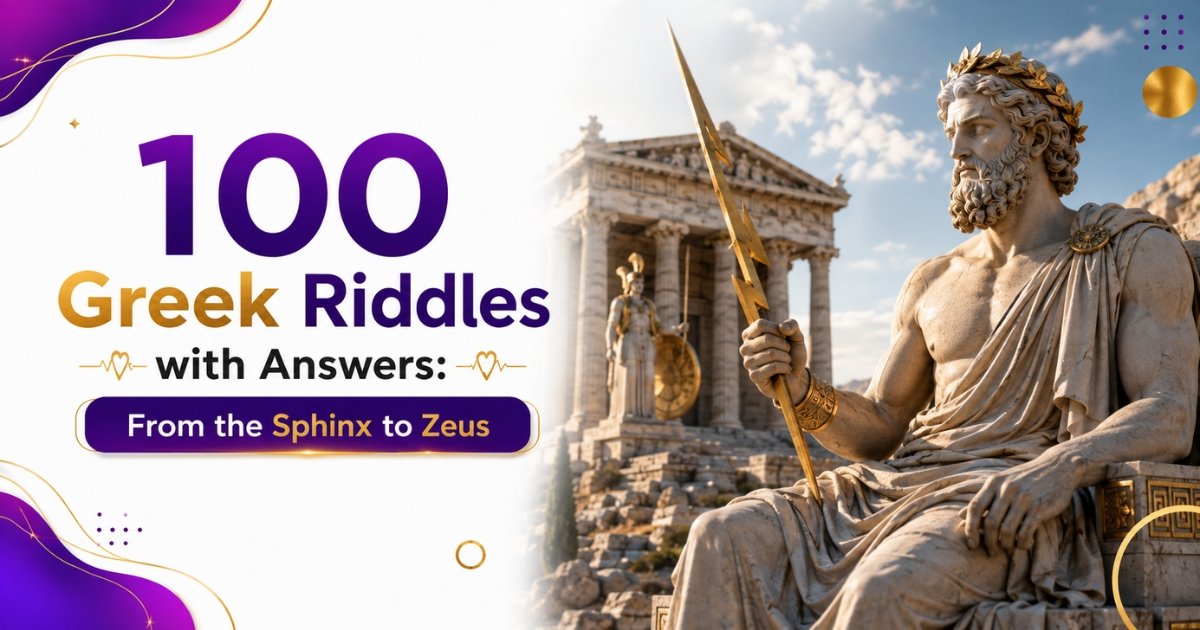
100 Greek Riddles with Answers: From the Sphinx to Zeus
Greek riddles with answers blend clever wordplay with mythology, history, and everyday logic, making them a favorite for classrooms, family game nights, and curious kids everywhere
This list groups 100 original riddles by theme and difficulty, so you can pick exactly what fits.
Easy Greek Riddles for Beginners
These warm-up greek riddles with answers use simple logic and everyday objects, making them a gentle entry point before diving into mythology-themed puzzles. They’re a great fit for younger kids or as a quick five-minute classroom warm-up activity
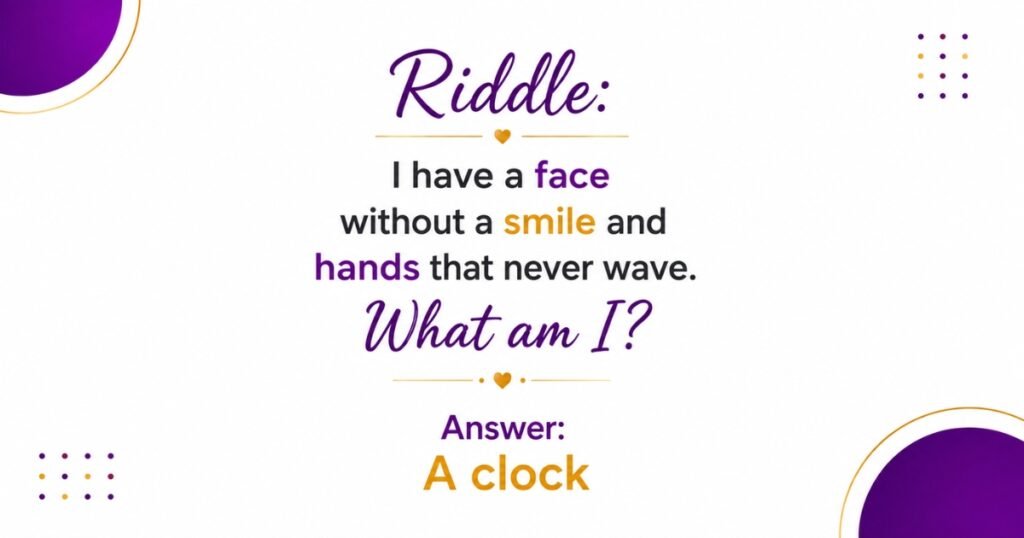
- Riddle: I have a face without a smile and hands that never wave. What am I?
Answer: A clock
Difficulty: Easy
Explanation: The riddle personifies an object, borrowing the words “face” and “hands” from the human body and reapplying them to a clock’s literal features. - Riddle: The more you take from me, the bigger I get. What am I?
Answer: A hole
Difficulty: Easy
Explanation: This works through reversed logic normally “taking” shrinks something, but removing material from a hole only enlarges it. - Riddle: I have cities but no houses, mountains but no trees, and water but no fish. What am I?
Answer: A map
Difficulty: Easy
Explanation: Each clue names something a map shows rather than something it physically contains, testing whether the reader can spot the difference between representation and reality. - Riddle: What gets sharper the more you use it, yet is never a knife?
Answer: Your brain
Difficulty: Easy
Explanation: This is a metaphor riddle “sharper” is borrowed from cutting tools to describe mental improvement through practice. - Riddle: I can be cracked, made, told, and played. What am I?
Answer: A joke
Difficulty: Easy
Explanation: The riddle strings together four verbs that only make sense together when paired with one specific noun, a classic list-style wordplay device. - Riddle: What has one head, one foot, and four legs?
Answer: A bed
Difficulty: Easy
Explanation: This forces the reader to count furniture parts (headboard, footboard, four legs) instead of body parts, flipping the expected meaning of the words. - Riddle: I go around the world but stay in one corner. What am I?
Answer: A postage stamp
Difficulty: Easy
Explanation: The paradox resolves once you realize the “traveling” is done by the letter, not the stamp itself, which stays fixed in place. - Riddle: What kind of room has no doors or windows?
Answer: A mushroom
Difficulty: Easy
Explanation: This is a compound-word riddle the answer hides the word “room” inside a completely unrelated object. - Riddle: I follow you all day but vanish at night. What am I?
Answer: Your shadow
Difficulty: Easy
Explanation: The riddle plays on the idea of a constant companion, then subverts it by explaining the “vanishing” through the absence of light. - Riddle: What has many teeth but cannot bite?
Answer: A comb
Difficulty: Easy
Explanation: “Teeth” is borrowed from anatomy and reapplied to an object’s shape, while “cannot bite” clarifies the metaphor isn’t literal.
Greek God and Goddess Riddles
Ancient Greeks Riddles didn’t just tell stories about their gods they wove them into wordplay too. These roman riddles use each god’s signature symbol or role as the clue, a technique that also builds topical authority around figures central to Greek mythology.
- Riddle: I rule from the tallest peak in Greece, and thunder is my calling card. Who am I? Answer: Zeus
Difficulty: Easy
Explanation: The clue relies on two well-known symbols of Zeus Mount Olympus and the thunderbolt rather than his name directly. - Riddle: My trident can shake the earth or calm the sea. Who am I?
Answer: Poseidon
Difficulty: Easy
Explanation: The riddle names Poseidon’s weapon and dual domain (sea and earthquakes) as indirect identifiers. - Riddle: An owl sits on my shoulder, and cities call me their protector. Who am I?
Answer: Athena
Difficulty: Medium
Explanation: This requires knowing Athena’s sacred animal (the owl) and her role as a patron of cities like Athens, layering two clues instead of one. - Riddle: I carry a lyre, drive the sun’s chariot in some tales, and speak in riddles at Delphi. Who am I?
Answer: Apollo
Difficulty: Medium
Explanation: The riddle stacks three separate Apollo associations music, light, and prophecy so the solver must recognize the overlap. - Riddle: I turned a stare into stone, though I never meant to be a monster. Who am I?
Answer: Medusa
Difficulty: Easy
Explanation: The twist (“never meant to be a monster”) hints at Medusa’s backstory as a cursed figure, adding a layer of mythological nuance to a simple clue. - Riddle: Winged sandals carry me between Olympus and the mortal world. Who am I? Answer: Hermes
Difficulty: Easy
Explanation: The riddle isolates Hermes’s most iconic symbol his winged sandals as the single defining clue. - Riddle: I preside over the harvest, and when I grieve, the fields grow cold. Who am I? Answer: Demeter
Difficulty: Medium
Explanation: This alludes to the myth of Demeter and Persephone (the origin story for winter) without naming it directly, rewarding readers who know the wider story. - Riddle: My forge burns beneath a volcano, and I craft weapons for gods and heroes alike. Who am I?
Answer: Hephaestus
Difficulty: Medium
Explanation: “Forge” and “volcano” work together as compound clues pointing to the god of blacksmiths and fire. - Riddle: I am queen beside the throne, though my husband’s wandering eye tests my patience often. Who am I?
Answer: Hera
Difficulty: Medium
Explanation: The clue references Hera’s role as Zeus’s wife and the recurring myth theme of her jealousy, without stating either fact plainly. - Riddle: Grapes and celebration follow wherever I go, and my festivals once filled Greek theaters. Who am I?
Answer: Dionysus
Difficulty: Medium
Explanation: This links Dionysus to both wine and the origin of Greek theater, a lesser-known fact that adds educational depth.
Legendary Greek Hero Riddles
Greek heroes are defined by a single unforgettable feat or flaw. These riddles isolate that one detail, turning each hero into a compact logic puzzle.
- Riddle: My only weak spot was a single heel, and it cost me everything. Who am I?
Answer: Achilles
Difficulty: Easy
Explanation: The riddle names the hero’s famous vulnerability directly, making this an accessible entry point into hero-based riddles. - Riddle: A ball of thread led me safely out of a monster’s maze. Who am I?
Answer: Theseus
Difficulty: Easy
Explanation: “Ball of thread” points to Ariadne’s thread from the Minotaur myth, a specific and memorable detail that anchors the clue. - Riddle: Twelve impossible tasks proved my strength to the world. Who am I? Answer: Heracles (Hercules)
Difficulty: Easy
Explanation: The number “twelve” is the key identifier here, referencing the well-known Twelve Labors. - Riddle: I sailed a decade home after war, tricked a giant, and resisted a singing shore. Who am I?
Answer: Odysseus
Difficulty: Medium
Explanation: This layers three separate episodes from the Odyssey (the long journey, the Cyclops, the Sirens) so solvers need broader story knowledge. - Riddle: A gleaming shield turned a monster’s gaze back on herself, saving my life. Who am I? Answer: Perseus
Difficulty: Medium
Explanation: The riddle describes the mechanism of the myth (a reflective shield used against Medusa) rather than naming Medusa outright, adding a layer of inference. - Riddle: I sought a golden hide across dangerous seas with a crew of legends. Who am I? Answer: Jason
Difficulty: Medium
Explanation: “Golden hide” is a paraphrase of the Golden Fleece, requiring the solver to translate the clue rather than match a name directly. - Riddle: I tamed a winged horse but flew too high in my pride. Who am I?
Answer: Bellerophon
Difficulty: Hard
Explanation: This is a lesser-known hero, so the riddle leans on a specific detail (the winged horse Pegasus) plus a moral theme (pride) to give solvers a fair chance. - Riddle: I led armies to Troy but let pride cost me dearly at home. Who am I?
Answer: Agamemnon
Difficulty: Hard
Explanation: The clue requires distinguishing Agamemnon from other Trojan War figures using his leadership role and his tragic homecoming. - Riddle: I fought bravely for Troy and fell to the hero with the weak heel. Who am I? Answer: Hector
Difficulty: Medium
Explanation: This riddle cross-references an earlier riddle in this list (Achilles), rewarding readers who are tracking connections across the article. - Riddle: I stole fire from the gods and paid for it eternally. Who am I?
Answer: Prometheus
Difficulty: Medium
Explanation: “Stole fire” is the single, unmistakable identifier for Prometheus, making this riddle solvable even for readers new to mythology.
Greek Monster and Creature Riddles
Mythical creatures make excellent riddle subjects because each one has a single defining, often visual, trait. These work particularly well for kids who enjoy imagining what the creature looks like.
- Riddle: I ask a question, and wrong answers cost travelers their lives. What am I?
Answer: The Sphinx
Difficulty: Easy
Explanation: The riddle describes the Sphinx’s function (a deadly question-asker) rather than her hybrid appearance, setting up the famous riddle-within-a-riddle later in this article. - Riddle: Cut off one of my heads, and two more grow back. What am I?
Answer: The Hydra
Difficulty: Medium
Explanation: This describes the Hydra’s regenerative power as a literal mechanic, which doubles as a memorable science-adjacent detail for kids. - Riddle: Half man, half bull, I waited in a maze for lost visitors. What am I?
Answer: The Minotaur
Difficulty: Easy
Explanation: The hybrid description (“half man, half bull”) is the most identifiable feature of this creature, making the riddle approachable. - Riddle: Three heads guard one gate, and none who enter may leave. What am I?
Answer: Cerberus
Difficulty: Medium
Explanation: “Three heads” and “one gate” work as paired clues pointing to Cerberus’s role guarding the entrance to the Underworld. - Riddle: My song is beautiful, but sailors who listen never sail again. What am I?
Answer: A Siren
Difficulty: Medium
Explanation: The riddle contrasts something pleasant (beautiful song) with something dangerous (never sailing again), a classic misdirection technique. - Riddle: Snakes replace my hair, and my stare turns flesh to stone. What am I?
Answer: Medusa (a Gorgon)
Difficulty: Easy
Explanation: Two highly visual traits snake hair and a petrifying gaze make this one of the easiest creature riddles to solve. - Riddle: Half woman, half bird, I sit on ledges no ship should approach. What am I?
Answer: A Harpy
Difficulty: Hard
Explanation: Harpies are less commonly known than Sirens, so the riddle relies on a precise hybrid description to keep the puzzle fair. - Riddle: I am part lion, part goat, part serpent, and I breathe fire. What am I?
Answer: The Chimera
Difficulty: Medium
Explanation: Listing three animal parts in sequence mirrors how the Chimera is traditionally described in myth, testing recall of a specific composite creature. - Riddle: I guard the golden apples at the edge of the world, coiled around a tree. What am I? Answer: Ladon (the dragon)
Difficulty: Hard
Explanation: This riddle rewards deeper mythology knowledge, since Ladon is a specific named dragon rather than a generic monster. - Riddle: I am a horse below the waist and wise beyond my years above it. What am I?
Answer: A Centaur (specifically Chiron)
Difficulty: Medium
Explanation: The riddle allows two valid answer levels general (centaur) or specific (Chiron) which works well for mixed-age groups.
Riddles from Greek Myths and Stories
These riddles lean on a full story rather than a single character trait, making them slightly harder solvers need to recall a sequence of events, not just one fact.
- Riddle: I flew on wings of feathers and wax, ignoring a warning about the sun. What happened to me?
Answer: Icarus fell into the sea when the wax melted.
Difficulty: Easy
Explanation: The riddle sets up a clear cause-and-effect chain (wax + sun = melting), which mirrors the moral lesson embedded in the original myth. - Riddle: I opened a box I was told never to open, and trouble spilled into the world. What is my name?
Answer: Pandora
Difficulty: Easy
Explanation: The forbidden-object structure is a familiar storytelling pattern, making the answer intuitive even for readers unfamiliar with the specific myth. - Riddle: I looked back at the wrong moment and lost my love forever. Who am I?
Answer: Orpheus
Difficulty: Medium
Explanation: “Looked back at the wrong moment” condenses an entire myth (Orpheus and Eurydice) into a single decisive action, which is the crux of the story. - Riddle: I push a boulder up a hill for eternity, only to watch it roll back down. Who am I? Answer: Sisyphus
Difficulty: Medium
Explanation: The riddle describes an endless, futile task the defining punishment of Sisyphus as a literal image rather than naming the punishment. - Riddle: Food and drink surround me always, yet I can never eat or drink. Who am I?
Answer: Tantalus
Difficulty: Medium
Explanation: The paradox of abundance paired with impossibility is the entire point of Tantalus’s punishment, and solving it requires spotting that contradiction. - Riddle: I hold the sky on my shoulders as punishment for choosing the losing side. Who am I?
Answer: Atlas
Difficulty: Easy
Explanation: “Hold the sky” is Atlas’s single most recognizable trait, making this an accessible myth-based riddle. - Riddle: I answered the Sphinx correctly but couldn’t escape the fate the prophecy foretold. Who am I?
Answer: Oedipus
Difficulty: Hard
Explanation: This riddle assumes prior knowledge of both the Sphinx riddle and the broader Oedipus prophecy, making it one of the more advanced entries. - Riddle: I guided lost souls but demanded a coin before crossing my river. Who am I?
Answer: Charon
Difficulty: Medium
Explanation: The riddle references the Greek burial custom of placing a coin with the dead, adding a real historical detail to the mythological clue. - Riddle: I was queen of spring and shadow both, splitting my year between two worlds. Who am I?
Answer: Persephone
Difficulty: Medium
Explanation: “Two worlds” alludes to Persephone’s time split between the Underworld and the surface, which is also the mythological explanation for the seasons. - Riddle: My curiosity opened a door meant to stay shut, and I could never close it again. Who am I?
Answer: Pandora
Difficulty: Medium
Explanation: This riddle revisits Pandora with a harder framing, focused on the emotional cause (curiosity) rather than the physical object, testing deeper comprehension.
Riddles About Ancient Greek Life
Beyond gods and monsters, everyday Greek life offers plenty of ancient greek riddles and answers material a good reminder that greek mythology riddles sat alongside real history, philosophy, and daily routines.
- Riddle: I gather in a circle to vote, argue, and shape the first democracy. What am I?
Answer: The Athenian Assembly
Difficulty: Hard
Explanation: This riddle connects mythology-adjacent content to real Greek history, reinforcing that ancient Greece wasn’t only myths; it also invented early democratic practice. - Riddle: I wear no shoes, ask endless questions, and was sentenced to drink poison for my ideas. Who am I?
Answer: Socrates
Difficulty: Hard
Explanation: The riddle references the “Socratic method” of endless questioning and Socrates’s historical execution by hemlock, blending philosophy with history. - Riddle: I burn every four years, and only the fastest, strongest, and bravest compete for my honor. What am I?
Answer: The ancient Olympic Games
Difficulty: Medium
Explanation: “Every four years” is the defining clue, connecting the ancient Olympics to the modern event kids are more likely to recognize. - Riddle: I am worn draped over one shoulder, made from a single piece of cloth. What am I? Answer: A chiton (ancient Greek garment)
Difficulty: Hard
Explanation: This riddle introduces real historical vocabulary, giving kids an authentic detail about how ancient Greeks actually dressed. - Riddle: I am carved from marble, standing tall with columns holding up my roof, built for a goddess. What am I?
Answer: The Parthenon
Difficulty: Medium
Explanation: The riddle combines architectural detail (marble, columns) with purpose (built for a goddess, Athena) to point to a specific, famous structure. - Riddle: I travel by ship with a hundred oars, and pirates fear my speed. What am I?
Answer: A Greek trireme
Difficulty: Hard
Explanation: This introduces the trireme, the standard ancient Greek warship, rewarding readers curious about Greek naval history. - Riddle: I am spoken at Delphi, but my words are riddles themselves, twisted and hard to trust. What am I?
Answer: A prophecy from the Oracle
Difficulty: Medium
Explanation: The riddle is self-referential a riddle about riddles since oracle prophecies were famously ambiguous and open to misinterpretation. - Riddle: I am poured before a meal to honor the gods, though I’m mostly wine and water. What am I?
Answer: A libation
Difficulty: Hard
Explanation: This teaches a specific ancient Greek religious custom (pouring a small drink offering) that rarely appears in kid-friendly riddle content. - Riddle: I hold plays and competitions, carved into a hillside so everyone can see the stage. What am I?
Answer: A Greek amphitheater
Difficulty: Medium
Explanation: The riddle emphasizes the hillside design, a real architectural feature used for acoustics, adding a factual layer to the puzzle. - Riddle: I am a story told without being written down for centuries, changing slightly with every teller. What am I?
Answer: A Greek myth passed by oral tradition
Difficulty: Hard
Explanation: This riddle is conceptual rather than character-based, testing whether readers understand how myths were originally shared before being written down.
Riddles About Ancient Greek Places
Real Greek geography inspired just as many stories as its gods did. These ancient greek riddles double as a light geography lesson.
- Riddle: I sit atop the tallest mountain in Greece, home to twelve powerful residents. What am I?
Answer: Mount Olympus
Difficulty: Easy
Explanation: “Twelve powerful residents” refers to the twelve Olympian gods, giving solvers a numeric clue to anchor the answer. - Riddle: Seekers climb my slopes for answers, though my priestess speaks in riddles of her own. What am I?
Answer: Delphi
Difficulty: Medium
Explanation: This riddle links back to the Oracle riddle from the previous section, reinforcing the same entity from a geographic angle. - Riddle: I am a labyrinth’s home, an island where a monster once prowled beneath a palace. What am I?
Answer: Crete
Difficulty: Medium
Explanation: The riddle uses “labyrinth” and “monster” as compound clues pointing to Crete, home of the Minotaur myth. - Riddle: My name means “wisdom’s city,” and an olive tree once won me for a goddess. What am I?
Answer: Athens
Difficulty: Medium
Explanation: This alludes to the myth of Athena and Poseidon competing for patronage of the city, a well-known founding legend. - Riddle: I am a narrow sea separating two continents, named for a king who leapt into my waters. What am I?
Answer: The Aegean Sea
Difficulty: Hard
Explanation: The riddle references the myth of King Aegeus, who is said to have given the sea its name after a tragic misunderstanding. - Riddle: Warriors trained hard within my walls, valuing discipline above nearly everything else. What am I?
Answer: Sparta
Difficulty: Easy
Explanation: “Discipline” and “warriors” are the most recognizable cultural markers associated with Sparta, making this an easy geography riddle. - Riddle: I am a mountain pass where a small force once held back a massive army for days. What am I?
Answer: Thermopylae
Difficulty: Hard
Explanation: This references the historical Battle of Thermopylae, requiring knowledge beyond mythology into real Greek military history. - Riddle: I am a city near a river, where a hero once returned home to face a riddle-asking beast. What am I?
Answer: Thebes
Difficulty: Medium
Explanation: The riddle connects Thebes to the Sphinx myth, reinforcing an entity introduced earlier in the article. - Riddle: I ring around a small city-state, dotted with hundreds of islands nearby. What am I? Answer: The Aegean archipelago (Greek islands)
Difficulty: Medium
Explanation: This riddle broadens the geography lesson beyond mainland Greece to its famous islands. - Riddle: I once housed a giant statue of a sun god, said to straddle my harbor entrance. What am I?
Answer: Rhodes (home of the Colossus of Rhodes)
Difficulty: Hard
Explanation: The riddle references one of the Seven Wonders of the Ancient World, adding an advanced historical detail for older kids.
Wordplay and Trick Riddles with a Greek Twist
This section is pure wordplay riddles built specifically to demonstrate a trick, pun, or misdirection technique, explained in detail so kids can learn to spot the mechanism themselves.
- Riddle: What did the Greek philosopher say when he finally found the answer he’d been searching for?
Answer: “Eureka!”
Difficulty: Easy
Explanation: This is a callback riddle it relies on knowing “Eureka” is a real historical exclamation (attributed to Archimedes), not an invented punchline. - Riddle: Why did the Minotaur do so poorly in school? Answer: He kept getting lost on the way to class.
Difficulty: Easy
Explanation: The humor comes from misdirection applying the Minotaur’s famous maze-wandering trait to an ordinary, relatable situation (being late to school). - Riddle: What do you call a Spartan who tells jokes?
Answer: A comedi-Sparta.
Difficulty: Easy
Explanation: This is a pun riddle, blending “comedian” and “Sparta” into a single invented word for comic effect. - Riddle: Why was Zeus always calm during storms?
Answer: Because he was the one causing them.
Difficulty: Medium
Explanation: The trick relies on inverted expectation we assume storms would worry someone, but Zeus controls them, flipping the logic. - Riddle: What has three feet but cannot walk, and once measured Greek poetry?
Answer: A metrical foot (as in poetic meter)
Difficulty: Hard
Explanation: This plays on the double meaning of “foot” a body part versus a unit of poetic rhythm used in ancient Greek verse. - Riddle: Why did Narcissus refuse to play cards?
Answer: He was too busy staring at his own reflection to look at his hand.
Difficulty: Medium
Explanation: The joke relies on knowing the myth of Narcissus, who fell in love with his own reflection, then applying that trait to an unrelated modern scenario. - Riddle: What do you call an owl who studies philosophy at Athena’s temple?
Answer: A wise-owl-osopher.
Difficulty: Easy
Explanation: This combines “owl” (Athena’s sacred animal) with “philosopher” into a blended pun word. - Riddle: Why did Hermes always win the race?
Answer: He had a good pair of “sole” support his winged sandals.
Difficulty: Medium
Explanation: The pun plays on “sole,” which sounds like the bottom of a shoe but is spelled differently, a homophone trick. - Riddle: What did Poseidon say to the misbehaving fish?
Answer: “Don’t make me trident again!”
Difficulty: Medium
Explanation: This is a homophone pun “trident” is played against “try it,” which only works when read aloud. - Riddle: Why don’t skeletons enjoy Greek tragedies?
Answer: They don’t have the guts for it.
Difficulty: Easy
Explanation: The riddle relies on a double meaning of “guts” literal anatomy versus the idiom for courage or emotional resilience.
Medium Challenge Greek Riddles
These greek riddle require connecting two or three details at once, making them a solid middle step between the easy warm-ups and the hardest riddles later in the list.
- Riddle: I am cursed to never have my prophecies believed, no matter how true they are. Who am I?
Answer: Cassandra
Difficulty: Medium
Explanation: The riddle hinges on an ironic curse being always truthful yet never believed which is the defining trait of Cassandra’s myth. - Riddle: I wove a tapestry each day and unraveled it each night to delay unwanted suitors. Who am I?
Answer: Penelope
Difficulty: Medium
Explanation: This riddle describes a specific, clever strategy from the Odyssey, rewarding readers who remember Penelope’s role beyond simply “Odysseus’s wife.” - Riddle: I guided a hero’s ship safely past deadly rocks with careful navigation advice. Who am I?
Answer: Circe (or alternatively, Athena, depending on the myth version)
Difficulty: Hard
Explanation: This riddle intentionally allows more than one valid mythological answer, teaching kids that Greek myths often have multiple retellings. - Riddle: My name is now a word for an overly proud, self-destructive flaw. What word am I? Answer: Hubris
Difficulty: Medium
Explanation: This riddle turns a mythological concept into a vocabulary lesson, since “hubris” is a term still used in English today. - Riddle: I am the thread that connects fate, spun, measured, and finally cut by three sisters. What am I?
Answer: The thread of life (spun by the Fates/Moirai)
Difficulty: Hard
Explanation: The riddle references the three Fates, a less commonly covered trio in kid-friendly riddle content, adding fresh topical ground. - Riddle: I was born fully grown from my father’s forehead, already armored for battle. Who am I?
Answer: Athena
Difficulty: Medium
Explanation: This revisits Athena with her unusual birth story instead of her earlier symbol-based clue, giving repeat exposure to the same entity from a new angle. - Riddle: I am the sound that returns your own words back to you across a canyon. What am I, and what nymph shares my name?
Answer: An echo, named for the nymph Echo
Difficulty: Medium
Explanation: The riddle links a common natural phenomenon to its mythological origin story, reinforcing vocabulary and myth together. - Riddle: I am the golden fruit that started a war between three goddesses over who was fairest. What am I?
Answer: The Apple of Discord
Difficulty: Hard
Explanation: This riddle references the mythological trigger for the Trojan War, a detail that connects several earlier hero riddles into a larger story arc. - Riddle: I carry messages between the living and the dead, moving faster than any mortal. Who am I?
Answer: Hermes
Difficulty: Medium
Explanation: This is a third appearance of Hermes in the list, each time from a different angle (symbol, then role, then speed), reinforcing entity recall through repetition. - Riddle: I am the underworld river that erases memory from anyone who drinks me. What am I?
Answer: The River Lethe
Difficulty: Hard
Explanation: This riddle introduces a specific underworld river beyond the commonly known River Styx, rewarding deeper mythological knowledge.
Hard Greek Riddles for Riddle Masters
The final section is reserved for the most advanced riddles, including the single most famous riddle in Greek mythology. Save these for confident riddle-solvers or classroom bonus rounds.
- Riddle: What walks on four legs in the morning, two legs at noon, and three legs in the evening?
Answer: A human being (crawling as a baby, walking as an adult, using a cane in old age)
Difficulty: Hard
Explanation: This is the legendary Riddle of the Sphinx the answer works by mapping “morning, noon, evening” onto the three stages of a human life, with “legs” reinterpreted as limbs and, later, a walking cane. - Riddle: I am the son of a Titan, forced to carry the heavens on my shoulders after choosing the wrong side of a war. Who am I, and what was that war called?
Answer: Atlas, punished after the Titanomachy (the war between Titans and Olympians)
Difficulty: Hard
Explanation: This riddle requires naming both the character and the specific mythological war, doubling the challenge compared to the earlier, simpler Atlas riddle. - Riddle: I am the seer who was blind but saw more truth than any sighted man in Thebes. Who am I?
Answer: Tiresias
Difficulty: Hard
Explanation: The paradox of blindness paired with clearer insight than others is the entire point of Tiresias’s mythological role as a prophet. - Riddle: I was a queen who chose loyalty to my brother’s burial rites over the law of my king. Who am I?
Answer: Antigone
Difficulty: Hard
Explanation: This riddle draws from Greek tragedy (Sophocles) rather than earlier myth, testing knowledge of Greek literature alongside mythology. - Riddle: I am the god of dreams, son of Sleep, able to appear in any human form. Who am I? Answer: Morpheus
Difficulty: Hard
Explanation: This riddle introduces a minor but culturally significant god Morpheus is also the root of the word “morphine” and the character name in The Matrix, a modern connection point for kids. - Riddle: I am the strait where a hero had to choose between a six-headed monster and a deadly whirlpool. Who faced this choice, and what were the two dangers?
Answer: Odysseus, choosing between Scylla and Charybdis
Difficulty: Hard
Explanation: “Between Scylla and Charybdis” is also a common English idiom meaning “stuck between two bad options,” giving this riddle a real modern-language payoff. - Riddle: I judge the souls of the dead alongside two other kings, deciding who reaches paradise. Who am I?
Answer: One of the three judges of the dead Minos, Rhadamanthus, or Aeacus
Difficulty: Hard
Explanation: This riddle accepts multiple correct answers, introducing the lesser-known trio of underworld judges as a group concept rather than a single character. - Riddle: I am the winged horse born from a Gorgon’s blood the moment she was slain. What am I?
Answer: Pegasus
Difficulty: Medium
Explanation: The riddle ties Pegasus’s origin directly to the earlier Medusa/Perseus riddles, rewarding readers who have followed the connected mythology throughout the article. - Riddle: I am the prophecy so feared that a king abandoned his own infant son to escape it yet it still came true. What is my name?
Answer: The prophecy of Oedipus
Difficulty: Hard
Explanation: This riddle assumes full knowledge of the Oedipus myth’s structure, making it one of the most demanding entries, best suited for older kids or classroom discussion. - Riddle: I am the word ancient Greeks used for a riddle itself where philosophers, oracles, and monsters all spoke in my form. What word am I?
Answer: Ainigma (αἴνιγμα)
Difficulty: Hard
Explanation: This final riddle is self-referential, asking readers to name the very concept they’ve been solving for the entire article, a fitting close, and the direct root of the modern English word “enigma.”
Explore More Riddle Collections
If you enjoyed working through these mythology-based riddles, there’s plenty more to explore on the site. If you’re planning to use these Greek riddles for a classroom party or celebration, our Birthday Riddles collection offers more ready-to-use riddles for party games and icebreakers.
For a different kind of storytelling-based riddle, our Disney Riddles page turns beloved characters and tales into the same kind of clue-based puzzles found throughout this list.
And if you’re looking to build out a themed riddle night around the calendar, our Holiday Riddles collection rounds out the mix with riddles tied to seasonal celebrations.
Bible riddles intertwine deep wisdom with playful inquiry, drawing from rich narratives and parables found within the scriptures. In contrast, dog riddles celebrate the joy and companionship these animals bring into our lives.
Conclusion
From the legendary Riddle of the Sphinx to playful puns about Poseidon, these 100 Greek riddles show just how much wordplay, wisdom, and pure fun ancient Greek culture packed into a simple question.
Whether you’re using these for a classroom mythology unit, a family game night, or a personal challenge to work through every difficulty level.
FAQS
What is the Riddle of the Sphinx and Its Answer?
The Sphinx asked travelers near Thebes what walks on four legs in the morning, two legs at noon, and three legs in the evening. The answer is a human being, since people crawl as babies, walk upright as adults, and use a cane in old age.
What is the Greek Word For Riddle?
The Greek word for riddle is ainigma (αἴνιγμα), which is also the root of the modern English word “enigma.”
Are Greek Riddles Good For Kids?
Yes Greek riddles work well for kids because they combine logic and wordplay with memorable mythology, making them useful for both entertainment and light classroom learning about gods, heroes, and ancient history.
What is the Hardest Greek Mythology Riddle?
Riddles involving lesser-known figures or multi-part myths such as the prophecy of Oedipus or the choice between Scylla and Charybdis tend to be the hardest, since they require knowing a full story rather than a single trait.
Why Did the Ancient Greeks Use Riddles?
Ancient Greeks used riddles to test intelligence and character, often tying them to mythology, philosophy, and even oracles, where correctly interpreting a riddle-like prophecy could carry real consequences.