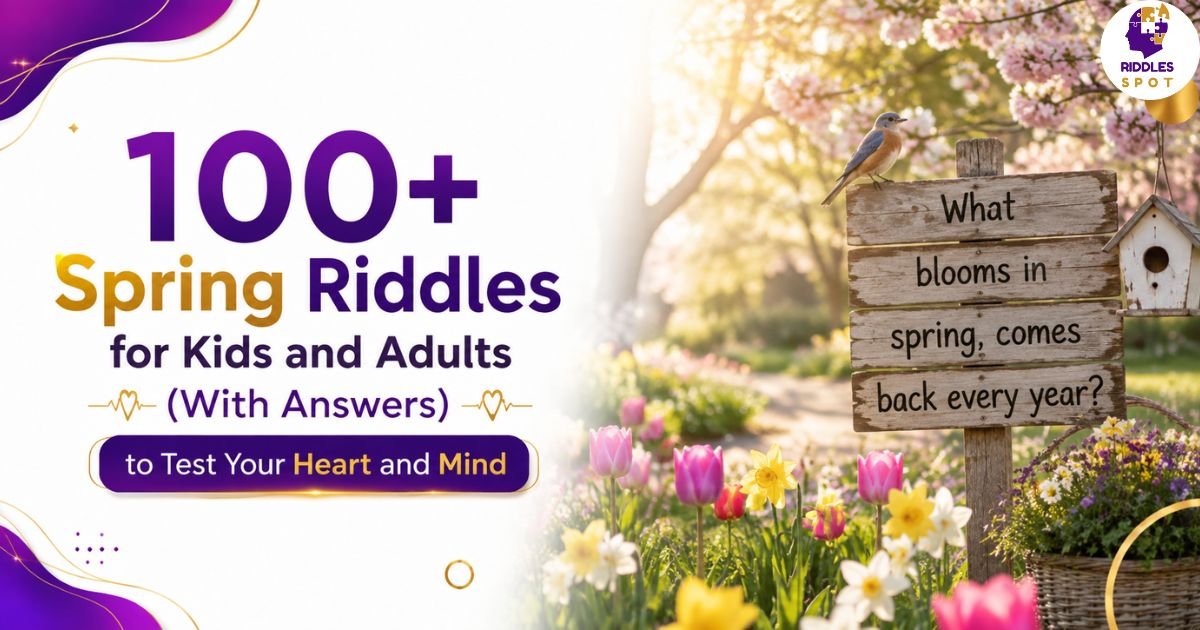
100+ Spring Riddles for Kids and Adults (With Answers)
Spring Riddles are fun brain teasers inspired by blooming flowers, rainy days, birds, bunnies, and all the signs of the season.
Perfect for kids and adults, these riddles combine clever wordplay with simple logic to entertain, encourage critical thinking, and bring smiles.
Whether you’re planning a classroom activity, adding fun to an Easter celebration, or looking for a quick family challenge, you’ll find the perfect spring riddle in this collection.
Why Spring Riddles Work So Well for Kids?
Spring riddles for kids succeed because the season hands writers so much raw material rain, mud, blooming flowers, hatching eggs, returning birds that puns practically write themselves.
Riddles differ from straight jokes because they force a short pause: the listener has to actively picture the clue (something that “falls but never gets hurt”) before the pun clicks into place.
That small mental workout is what teachers and speech-language therapists mean when they say riddles build inference skills, the ability to combine clues and background knowledge to reach a conclusion.
We’ve found spring riddles work in almost any low-prep setting:
- Tucked into a lunchbox note for an instant midday smile
- Used as a two-minute classroom brain-break between subjects
- Read aloud during the school pickup line or a long car ride
- Hidden inside plastic Easter eggs alongside candy for an extra layer of fun
- Posted as an Instagram caption or story poll during the first week of spring
Rain and Weather Riddles (Easy to Medium)
April showers give us more riddle material than almost any other spring theme, since rain, rainbows, thunder, and puddles are all things young kids already notice and love talking about.
- Riddle: What can run fast, but can’t walk?
Answer: Water.
Difficulty: Easy
Explanation: This works through simple personification “run” describes flowing water instead of legs moving. - Riddle: I fall from the sky but never get hurt. What am I?
Answer: Rain.
Difficulty: Easy
Explanation: The misdirection is “falling” kids picture a person tripping, not water dropping. - Riddle: What kind of bow can’t be tied?
Answer: A rainbow.
Difficulty: Easy
Explanation: A homophone pun “bow” as in ribbon versus “bow” hidden inside “rain-bow.” - Riddle: What goes up when the rain comes down?
Answer: An umbrella.
Difficulty: Easy
Explanation: Straightforward opposites-based logic rather than wordplay. - Riddle: Why is April the cleanest month?
Answer: Because of April showers.
Difficulty: Easy
Explanation: Plays on “shower” meaning both rain and bathing. - Riddle: What can fall without breaking, and pour without being a pitcher?
Answer: Rain.
Difficulty: Medium
Explanation: Two separate puns stacked in one riddle “fall” and “pour” both double as weather verbs. - Riddle: If ten kids squeeze under one umbrella, how does nobody get wet?
Answer: Because it wasn’t raining.
Difficulty: Medium
Explanation: A misdirection riddle the setup implies rain, but the real trick is that there wasn’t any.
- Riddle: What has ears but hears nothing during a spring storm?
Answer: A cornfield.
Difficulty: Medium
Explanation: Relies on the double meaning of “ears” (corn) versus ears that hear. - Riddle: I rumble after the flash but never leave a mark. What am I?
Answer: Thunder.
Difficulty: Easy
Explanation: Straight sequential logic thunder always follows lightning. - Riddle: What can make the sky look bruised, then bright, in the same afternoon?
Answer: A spring storm.
Difficulty: Medium
Explanation: “Bruised” is a metaphor for dark storm clouds, testing figurative-language comprehension. - Riddle: Why did the cloud go to therapy?
Answer: It had too much emotional baggage to keep raining on everyone.
Difficulty: Medium
Explanation: Anthropomorphism plus a pun on “raining on everyone” as both weather and mood. - Riddle: How does the ocean say hello during spring break?
Answer: It waves.
Difficulty: Easy
Explanation: Homophone pun between ocean “waves” and a friendly wave hello. - Riddle: What falls but never needs a bandage?
Answer: Rain.
Difficulty: Easy
Explanation: Misdirection “falls” suggests an injury, but no one gets hurt from rainfall. - Riddle: I have no legs, yet I race down the window glass every spring afternoon. What am I? Answer: A raindrop.
Difficulty: Medium
Explanation: Personifying a raindrop as a “racer” tests visualization skills. - Riddle: What kind of weather report never needs a forecaster in spring?
Answer: “It’s raining” because you can just look outside.
Difficulty: Hard
Explanation: A logic-based riddle rather than a pun; the humor comes from an obvious, deadpan answer. - Riddle: I melt the snow and wake the trees, I bring warm rain and buzzing bees, I’m the season between cold and heat what am I?
Answer: Spring
Difficulty: Easy
Explanation: This fits spring riddles for adults since it uses classic seasonal imagery (melting snow, rain, bees) that’s simple yet satisfying to piece together.
Flower and Garden Riddles (Easy to Medium)
Flower riddles borrow heavily from real botany tulips, sunflowers, and daffodils all lend themselves to puns because their names already sound like other words.
- Riddle: What flower is the best kisser?
Answer: Tulips (two-lips).
Difficulty: Easy
Explanation: A homophone pun splitting “tulips” into “two lips.” - Riddle: What gift does April give to May?
Answer: Flowers.
Difficulty: Easy
Explanation: References the classic saying “April showers bring May flowers.” - Riddle: What is yellow, ten feet tall, but not a giraffe?
Answer: A sunflower.
Difficulty: Easy
Explanation: Misdirection through shared traits (yellow, tall) before revealing the real answer. - Riddle: What type of flower do you plant in the dark?
Answer: A lightbulb.
Difficulty: Medium
Explanation: A trick to riddle a lightbulb isn’t a flower, but it does get “planted” in a socket and grows light. - Riddle: How did the daffodil win the race?
Answer: Petal to the metal.
Difficulty: Medium
Explanation: Homophone pun swapping “pedal” for “petal.” - Riddle: What do flowers and trampolines have in common?
Answer: They both love spring(s).
Difficulty: Medium
Explanation: A double meaning of “spring” as both the season and a coiled mechanism. - Riddle: I have petals, grow in gardens, and bees can’t resist me. What am I?
Answer: A flower.
Difficulty: Easy
Explanation: Definition-style riddle building descriptive vocabulary. - Riddle: What kind of garden does a baker grow?
Answer: A flour garden.
Difficulty: Easy
Explanation: Homophone pun between “flour” and “flower.” - Riddle: Why is the letter A like a flower?
Answer: Because a bee always comes after it.
Difficulty: Medium
Explanation: Wordplay on the alphabet the letter B follows A, and “bee” sounds like B. - Riddle: What did the tulip say to the rose during the race?
Answer: Petal to the metal.
Difficulty: Medium
Explanation: Same pun as the daffodil riddle, framed as dialogue for variety. - Riddle: Why was the gardener so calm in a crisis?
Answer: Because they always know how to get to the root of the problem.
Difficulty: Medium
Explanation: Double meaning of “root” as both a plant part and the source of an issue. - Riddle: What flowers grow between your nose and your chin?
Answer: Tulips (two-lips).
Difficulty: Easy
Explanation: A variant of the classic tulip/two-lips pun, framed anatomically. - Riddle: I open with the sun and close at night. What am I?
Answer: A flower.
Difficulty: Easy
Explanation: Describes heliotropism (how some flowers track sunlight) without naming it. - Riddle: What do you call a flower that runs on electricity?
Answer: A power plant.
Difficulty: Medium
Explanation: Pun on “plant” meaning both a flower and a factory. - Riddle: How can you tell spring flowers are friendly?
Answer: They’re always making new buds.
Difficulty: Easy
Explanation: Homophone pun between plant “buds” and friends (“buddies”). - Riddle: Flowers bloom and birds sing loud, I bring green grass and a fluffy cloud, after winter’s chill, I’m the season near what time of year am I here?
Answer: Spring
Difficulty: Easy
Explanation: This works well for spring riddles for kids since it uses easy, familiar images like flowers, birds, and clouds that children can quickly connect to the season.
Bird Riddles (Easy to Medium)
Robins, nests, and eggs return to yards every spring, giving this section plenty of natural, kid-friendly material.
- Riddle: What has to be broken before you can use it?
Answer: An egg.
Difficulty: Easy
Explanation: A classic misdirection riddle most things break when used, but an egg has to break first. - Riddle: Why are birds terrible gift-givers?
Answer: Because they’re cheap (cheap)
Difficulty: Easy
Explanation: Homophone pun between “cheap” and the sound birds make, “cheap.” - Riddle: Why did the police arrest the bird?
Answer: It was robbin’ (robin).
Difficulty: Medium
Explanation: Homophone pun on the bird species “robin” and the verb “robbing.” - Riddle: Why do birds fly south, then head back north in spring?
Answer: Because it’s too far to walk.
Difficulty: Easy
Explanation: Absurdist logic the answer treats flying as a practical choice rather than instinct. - Riddle: How does a bird find its nest on a treasure map?
Answer: The eggs mark the spot.
Difficulty: Medium
Explanation: Pun swapping pirate treasure’s “X marks the spot” for eggs. - Riddle: How do birds communicate with each other?
Answer: Twitter.
Difficulty: Medium
Explanation: A pun connecting bird chirping (“tweeting”) to the social platform once called Twitter.
- Riddle: Which superhero loves spring the most?
Answer: Robin.
Difficulty: Easy
Explanation: Double meaning of “Robin” as both a bird and Batman’s sidekick. - Riddle: I sing loudly in trees, and my name starts with a “C.” What am I?
Answer: A cardinal.
Difficulty: Medium
Explanation: Straightforward clue-based riddle that rewards knowing common spring birds. - Riddle: What do you call a spring chick that tells time?
Answer: A clock-a-doodle-doo.
Difficulty: Medium
Explanation: Blends “cock-a-doodle-doo” with “clock” for a portmanteau pun. - Riddle: Where do birds vacation during spring break?
Answer: Somewhere cheap (cheap).
Difficulty: Easy
Explanation: A second variation on the cheap/cheap homophone, reinforcing the same wordplay pattern. - Riddle: What kind of bird can lift the heaviest weights?
Answer: A crane.
Difficulty: Medium
Explanation: Double meaning of “crane” as both a bird and construction equipment. - Riddle: I have a beak but never bite. I build without hands. What am I?
Answer: A bird building a nest.
Difficulty: Medium
Explanation: Descriptive riddle that hides the answer inside neutral, everyday clues. - Riddle: I follow winter but come before summer’s heat, I fill the fields with flowers sweet, days grow longer, skies turn light blue what season am I, can you guess who?
Answer: Spring
Difficulty: Easy
Explanation: This fits spring riddles with answers since it uses simple seasonal order and imagery (after winter, before summer, flowers, longer days) that leads easily to the answer.
Bunny and Easter Riddles (Easy to Medium)
Easter and bunnies dominate late-spring searches, so this section leans into both animal riddles and holiday-specific wordplay.
- Riddle: What do you call the Easter Bunny the day after Easter?
Answer: Tired.
Difficulty: Easy
Explanation: Simple, literal logic: a full night of deliveries would exhaust anyone. - Riddle: What do you call a rabbit that tells jokes?
Answer: A funny bunny.
Difficulty: Easy
Explanation: A rhyming pun rather than a homophone. - Riddle: What do you get when you cross a bee and a rabbit?
Answer: A honeybunny.
Difficulty: Easy
Explanation: A blended-word (portmanteau) pun combining “honeybee” and “bunny.” - Riddle: Why did the Easter Bunny cross the road?
Answer: To prove he wasn’t chicken.
Difficulty: Medium
Explanation: A play on the classic “why did the chicken cross the road” riddle template, swapped for a spring character. - Riddle: What do you call a rabbit with fleas?
Answer: Bugs Bunny.
Difficulty: Medium
Explanation: Double meaning of “bugs” as both insects and the cartoon character’s name. - Riddle: What do you get when April showers land on Easter?
Answer: Wet eggs.
Difficulty: Easy
Explanation: Combines two spring themes rain and Easter eggs into one simple visual pun. - Riddle: I hop, I hide colorful things, and my ears are longer than my tail. Who am I?
Answer: The Easter Bunny.
Difficulty: Easy
Explanation: Descriptive riddle that leans on well-known holiday imagery. - Riddle: What do you call a well-dressed lion in spring?
Answer: A dandy lion (dandelion).
Difficulty: Medium
Explanation: Homophone pun splitting “dandelion” into “dandy” (well-dressed) and “lion.” - Riddle: Why did the egg hide during Easter?
Answer: Because it was a little chicken.
Difficulty: Easy
Explanation: Double meaning of “chicken” as both scared and the animal that lays eggs. - Riddle: How can you tell the Easter Bunny is bad at hide-and-seek?
Answer: He always leaves a basket of clues.
Difficulty: Medium
Explanation: Plays on the literal Easter egg hunt tradition as a joke about being a poor hider. - Riddle: What did the mother rabbit say to her kids before Easter?
Answer: “Hop to it!”
Difficulty: Easy
Explanation: Idiom-based pun “hop to it” means hurry up, and rabbits literally hop. - Riddle: What do you call a rabbit’s favorite dance move?
Answer: The bunny hop.
Difficulty: Easy
Explanation: References a real dance name that doubles as a description of rabbit movement. - Riddle: Where does the Easter Bunny get his eggs?
Answer: From an eggs-clusive supplier (exclusive).
Difficulty: Hard
Explanation: A homophone pun that requires recognizing “eggs” hidden inside “exclusive.” - Riddle: I’m the season of renewal, yet I bring allergies too; I thaw the frozen ground, but flood the rivers blue. I’m loved for my blossoms, cursed for my pollen what season, in this contrast, am I fallin’?
Answer: Spring
Difficulty: Medium
Explanation: This fits spring riddles for adults with answers since it plays on contrasting ideas (renewal vs. allergies, thawing vs. flooding) that require a bit more thought than a simple kids’ version.
Bug and Bee Riddles (Easy to Medium)
Bees, ladybugs, and butterflies emerge with the warm weather, making them a natural riddle category for younger kids especially.
- Riddle: I buzz around flowers collecting nectar. Who am I?
Answer: A bee.
Difficulty: Easy
Explanation: Direct, definition-style clue with no wordplay ideal for very young solvers. - Riddle: What do you call a bee that can’t make up its mind?
Answer: A maybee.
Difficulty: Easy
Explanation: Blended pun combining “maybe” and “bee.” - Riddle: What insect turns into a colorful flyer every spring?
Answer: A butterfly (from a caterpillar).
Difficulty: Medium
Explanation: Tests knowledge of metamorphosis rather than wordplay. - Riddle: I’m tiny, red with black spots, and I crawl across leaves. What am I?
Answer: A ladybug.
Difficulty: Easy
Explanation: Simple visual description riddle. - Riddle: What do bees do with their honey once it’s made?
Answer: They put it in a honeycomb.
Difficulty: Easy
Explanation: Factual, non-pun riddle about bee behavior.
- Riddle: Why did the bee go to the barber?
Answer: For a buzz cut.
Difficulty: Easy
Explanation: Pun on the sound bees make (“buzz”) and a haircut style (“buzz cut”). - Riddle: What do you call a beetle with no manners?
Answer: A rude bug.
Difficulty: Medium
Explanation: A rhyming pun on “ladybug,” swapping in “rude bug.” - Riddle: What always shows up uninvited at a spring picnic?
Answer: Ants.
Difficulty: Easy
Explanation: Observational humor grounded in real spring behavior rather than a pun. - Riddle: I spin silk, I have eight legs, and gardens are my favorite hunting ground. What am I? Answer: A spider.
Difficulty: Medium
Explanation: Descriptive riddle that tests basic insect and arachnid knowledge. - Riddle: Why don’t caterpillars ever get lost?
Answer: Because one day they turn into a map (a moth/butterfly no direct pun, plays on “found their way”).
Difficulty: Hard
Explanation: An abstract, wordplay-light riddle that relies on metaphor rather than a clean pun. - Riddle: Why did the flower stop blooming in the middle of spring? Because it ran out of “petal” power!
Answer: It’s a pun on “pedal power” (bicycle) vs. “petal power” (flower)
Difficulty: Easy
Explanation: This fits spring riddles and jokes since it combines a seasonal riddle format with a playful pun, giving it a fun joke-like twist that’s easy for readers to laugh at once they get the wordplay.
Baby Animal Riddles (Easy to Medium)
Spring is lambing and hatching season, so newborn animals show up across nearly every competitor list here they get their own dedicated section.
- Riddle: I am a baby sheep born in spring. What am I called?
Answer: A lamb.
Difficulty: Easy
Explanation: Direct vocabulary riddle. - Riddle: What did one lamb say to another?
Answer: “I love ewe” (you).
Difficulty: Easy
Explanation: Homophone pun between “ewe” (a female sheep) and “you.” - Riddle: What do you call a baby sheep that loves karate?
Answer: A lamb chop.
Difficulty: Medium
Explanation: Double meaning of “chop” as both a karate move and a cut of meat. - Riddle: Where do sheep go for their spring haircut?
Answer: The baa-baa shop.
Difficulty: Easy
Explanation: Homophone pun between “baa-baa” (sheep sound) and “barber.” - Riddle: I wake up after a long winter nap and check for my shadow. Who am I?
Answer: A groundhog.
Difficulty: Medium
Explanation: References the Groundhog Day tradition, testing seasonal/cultural knowledge. - Riddle: What do you call a lazy baby kangaroo in spring?
Answer: A pouch potato.
Difficulty: Medium
Explanation: Pun swapping “couch potato” for “pouch,” referencing a kangaroo’s pouch. - Riddle: I peck my way out of a shell to greet the spring sunshine. Who am I?
Answer: A chick.
Difficulty: Easy
Explanation: Descriptive riddle explaining the hatching process. - Riddle: What do you call a young horse born on a rainy spring morning?
Answer: A foal with a “wet” start.
Difficulty: Medium
Explanation: Vocabulary-based riddle testing knowledge of animal offspring names. - Riddle: I hop out of a burrow and nibble clover. Who’s my mother?
Answer: A rabbit.
Difficulty: Easy
Explanation: Simple descriptive clue riddle. - Riddle: What baby bird has the loudest wake-up call?
Answer: A rooster’s chick inherits the crow.
Difficulty: Hard
Explanation: Logic riddle relying on inherited traits rather than a pun. - Riddle: I make the flowers grow tall, I bring soft rain that seems to call, I come right after winter’s freeze what season brings the buzzing bees?
Answer: Spring
Difficulty: Easy
Explanation: This fits spring riddles for kids with answers since it uses simple, familiar clues (flowers, rain, bees, after winter) that children can easily connect to the season.
Spring Treat and Food Riddles (Easy to Medium)
Strawberries, jam, and picnic food round out the sensory side of spring. This section is a favorite for lunchbox notes.
- Riddle: Why was the strawberry sad?
Answer: Because his mom was in a jam.
Difficulty: Easy
Explanation: Double meaning of “jam” as both a fruit spread and a difficult situation. - Riddle: What do you call blueberries playing music together?
Answer: A jam session.
Difficulty: Medium
Explanation: Second “jam” pun, reinforcing the same wordplay pattern with a musical twist. - Riddle: What do you call scrambled eggs made in April?
Answer: Spring break-fast.
Difficulty: Medium
Explanation: Blended pun combining “breakfast” and “spring break.” - Riddle: When do you stop at green and go at red?
Answer: When you’re eating a watermelon.
Difficulty: Medium
Explanation: Misdirection the setup sounds like a traffic-light riddle, but the answer flips the colors’ meaning. - Riddle: Why do lemons love giving spring kisses?
Answer: Because they always make you pucker up.
Difficulty: Easy
Explanation: Plays on the physical reaction to sour lemons resembling a kissing face.
- Riddle: What did the picnic basket say when it arrived late to the park?
Answer: “Sorry, I got tangled up in the sandwich wrap.”
Difficulty: Medium
Explanation: Absurdist personification humor rather than a clean pun. - Riddle: What vegetable does a chicken plant every spring?
Answer: Eggplants.
Difficulty: Easy
Explanation: Wordplay splitting “eggplant” into “egg” (from a chicken) and “plant.” - Riddle: Why did the onion bounce when spring arrived?
Answer: Because it was a spring onion.
Difficulty: Easy
Explanation: Double meaning of “spring” as both the season and a bouncy motion. - Riddle: What’s a bee’s favorite spring dessert?
Answer: Honeycomb cake.
Difficulty: Easy
Explanation: A light, definition-style riddle with minimal misdirection. - Riddle: Why did the farmer bury coins before planting his crops?
Answer: He wanted his soil to be rich.
Difficulty: Medium
Explanation: Double meaning of “rich” as both wealthy and nutrient-dense soil. - Riddle: I’m the season of fresh starts and warmer nights, when jackets come off and the sun feels right; I bring prom flowers and finals stress too what season’s got mixed feelings brewing for you?
Answer: Spring
Difficulty: Medium
Explanation: This fits spring riddles for teens since it references relatable teen experiences (prom, finals, warmer nights) rather than simple nature imagery, making it more engaging for that age group.
Wordplay and Letter Riddles (Medium to Hard)
This category strips away animals and food entirely, testing pure language logic a good fit for slightly older kids or trivia nights.
- Riddle: How does the word “spring” end?
Answer: With a “G.”
Difficulty: Medium
Explanation: A literal, letter-based riddle that plays with the double meaning of “end.” - Riddle: What can be found in the middle of April and March, but not at the start or end of either?
Answer: The letter “R.”
Difficulty: Hard
Explanation: Requires spelling both words out and comparing letter positions a genuine logic puzzle. - Riddle: Which month of the year is the shortest?
Answer: May it only has three letters.
Difficulty: Medium
Explanation: Reframes “shortest” from calendar days to letter count, a classic misdirection. - Riddle: Does February March?
Answer: No, but April May.
Difficulty: Hard
Explanation: A layered pun treating “March” and “May” as both months and verbs (to march, to be permitted). - Riddle: An English word has six letters; remove one, and twelve remain. What is it?
Answer: Dozens.
Difficulty: Hard
Explanation: A pure logic riddle removing the “s” from “dozens” leaves “dozen,” which equals twelve. - Riddle: What word becomes shorter when you add two letters to it?
Answer: Short.
Difficulty: Hard
Explanation: A self-referential riddle where the word itself is the answer. - Riddle: What five-letter word becomes shorter when you remove two letters, yet the word “shorter” is spelled the same either way?
Answer: N/A trick clarification: the classic version is simply “short” plus “er.”
Difficulty: Hard
Explanation: Illustrates how spring riddle collections often include self-referential wordplay riddles for older solvers. - Riddle: What kind of tea is hardest to swallow every spring?
Answer: Reality.
Difficulty: Medium
Explanation: Homophone pun between “tea” and the letter “T,” which begins “truth” or “reality” jokes. - Riddle: I make the school windows stay open wide, I bring green grass where kids like to slide, I follow winter but come before the heat — what season makes recess extra sweet?
Answer: Spring
Difficulty: Easy
Explanation: This fits spring riddles for middle school since it uses relatable school-life clues (open windows, recess, grass) that middle schoolers can easily picture and connect to the season.
Hard Spring Riddles for Teens and Adults
Not every reader wants kid-level puns; this section is built for road-trip games, trivia nights, or classroom extension challenges.
- Riddle: I have roots that nobody sees, and I drink but never eat. In spring, I wear new greens each week. What am I?
Answer: A tree.
Difficulty: Hard
Explanation: Layers three separate clues (roots, drinking, new leaves) that must all point to the same answer. - Riddle: The more you take from me, the bigger I become in spring. What am I?
Answer: A hole being dug for planting.
Difficulty: Hard
Explanation: Counterintuitive logic riddle removing material increases the size of the space. - Riddle: I am not alive, yet I grow; I don’t have lungs, yet I need air; I don’t have a mouth, yet water kills me. What am I, and why does spring make more of me?
Answer: Fire spring’s dry winds and lightning increase wildfire risk.
Difficulty: Hard
Explanation: A traditional “living paradox” riddle template repurposed with a seasonal twist. - Riddle: Every spring I shed what once protected me, yet I feel more exposed and more free at the same time. What am I?
Answer: A snake shedding its skin.
Difficulty: Hard
Explanation: Uses emotional, abstract language to obscure a literal biological process.
- Riddle: I mark the exact midpoint between winter’s dark and summer’s light, when day and night briefly stand equal. What am I?
Answer: The vernal equinox.
Difficulty: Hard
Explanation: A definition riddle requiring astronomical knowledge, not wordplay good for older audiences. - Riddle: Farmers watch me closely each spring: too little of me and the crop fails; too much of me and the field floods. I fall, but I’m never broken. What am I?
Answer: Rain.
Difficulty: Hard
Explanation: Combines agricultural context with the same “falls but isn’t broken” logic used in the easier rain riddle, at a higher reading level. - Riddle: I have four faces but no eyes, four corners but no walls, and I turn without moving. Farmers and gardeners both depend on me every spring. What am I?
Answer: A calendar (or almanac).
Difficulty: Hard
Explanation: An abstract-object riddle where every clue is metaphorical, forcing the solver to reject literal interpretations. - Riddle: I hold both death and birth in balance, I melt what winter tried to seal, I split the year with equal light and dark before I let the heat congeal. What season, born of contrast, am I?
Answer: Spring
Difficulty: Hard
Explanation: This fits spring riddles hard since it uses abstract, poetic clues (balance of death/birth, equal light and dark referring to the equinox) rather than obvious imagery, making it harder to solve.
What Makes a Great Spring Riddle?
The riddles above use five recurring techniques, and recognizing them makes it easier to write your own:
- Homophones: words that sound alike but mean different things (tulips/two-lips, bow/rainbow)
- Misdirection: the setup implies one answer, but the real answer flips expectations (“falls but never gets hurt”)
- Double meanings: one word doing double duty (spring the season vs. spring the coil)
- Portmanteaus: two words blended into one (honeybunny, dandy lion)
- Pure logic: riddles with no pun at all, solved through reasoning alone (the letter “R” riddle)
Knowing these patterns is useful when writing your own riddles for a classroom or party, since most original riddles are really just a familiar technique applied to a new spring image.
How to Use These Spring Riddles?
A few tested, low-effort ways to get more mileage out of this list:
- Lunchbox notes: Write one riddle on a sticky note and let the answer be the “surprise” at recess
- Classroom brain-breaks: Read three riddles from a single theme (say, birds) as a two-minute transition activity
- Easter egg hunts: Tuck a folded riddle inside a few eggs alongside the candy, with the answer revealing a bonus prize location
- Road trips: Assign one theme per family member and see who can guess the most answers before the next rest stop
- Social media: Post the hard wordplay riddles as an Instagram Story poll the “hardest” category tends to get the most replies
More Riddles for Every Season and Skill Level
If the Bunny and Easter Riddles section got you in the holiday spirit, Holiday Riddles collection covers every celebration throughout the year with the same festive wordplay.
Fire Riddles for Kids collection has more logic puzzles and layered wordplay built for that same crowd.
And for a wider mix of curated riddle collections beyond spring, browse Time Riddles category for more themed sets like this one.
Conclusion
If you need a quick giggle for a lunchbox, a full lesson plan for a classroom, or a genuine stumper for a trivia night, this list of 100 Spring Riddles has something for every age and skill level.
Bookmark this page so it’s ready the next time April showers keep everyone stuck inside, and feel free to share your favorite riddle or a new one you invent in the comments below.
FAQs
What is a Good Spring Riddle?
A good spring riddle uses seasonal themes like rain, flowers, or birds with clever wordplay or simple logic to make the answer fun and surprising
What is the Answer to “What can run But never Walks”?
The answer is water because it can “run” by flowing but never walks.
Why are Spring Riddles Good for Kids?
They help kids build vocabulary, problem-solving, and critical-thinking skills while having fun with spring-themed clues.
What are Some Easy Spring Riddles for Kids?
Easy examples include “What kind of bow can’t be tied?” (A rainbow) and “What has to be broken before you can use it?” (An egg).
How do you Write your own Spring Riddle?
Choose a spring-themed object and create a clue using wordplay, a pun, or a double meaning.
What are Funny Spring Riddles for Kids?
They’re lighthearted, silly riddles about spring themes like flowers, rain, and bunnies, designed with playful humor that makes kids laugh while they guess.
What are Spring Jokes and Riddles for Kids?
They’re a fun mix of silly jokes and simple riddles centered on spring themes like flowers, rain, bunnies, and bees, made to be easy and entertaining for children.