101 Brain Teasers with Answers: From Easy Warm-Ups to Mind-Bending Puzzles
Brain Teasers are short puzzles that use logic, wordplay, or lateral thinking to challenge how you think, not what you know. Whether you think of them as brain teasers puzzles or brain teasers questions, they work the same muscle.
This collection has 101 original brain teasers organized into six sections, from Easy Warm-Ups to Hardest Challenges, each with its answer and a short explanation.
Why Brain Teasers Work: The Logic Behind the Fun
Brain teasers fall into a few recognizable categories, and knowing them makes you better at solving new ones on sight.
- Wordplay riddles hinge on double meanings, homophones, or letter tricks (like the classic “seven becomes even” riddle)
- Lateral thinking puzzles describe a strange scenario and ask you to find the one explanation that makes it make sense
- Math and logic puzzles use numbers, sequences, or deduction chains
- Visual/spatial riddles ask you to picture an object or scene in your head
Teachers use brain teasers as five-minute warm-ups because they activate working memory and cognitive flexibility before a lesson. Party hosts use them as icebreakers because a shared “aha” moment gets a room talking. And plenty of people just enjoy them scrolling social media between videos.
Whatever your reason for being here, the format below is the same for every entry: the riddle, then the answer, a difficulty rating, and a short note on why it works.
Easy Brain Teasers (Great Warm-Ups for Kids and Beginners)
These are designed to build confidence, quick “aha” moments rather than long chains of logic, and work well as the opening round in most brain teasers games.
- Riddle: What has a face and two hands but no arms or legs?
Answer: A clock.
Difficulty: Easy
Explanation: This works through simple misdirection, “face” and “hands” sound human, but the riddle is describing an object that borrows human vocabulary for its parts. - Riddle: I get smaller every time I take a bath. What am I?
Answer: A bar of soap.
Difficulty: Easy
Explanation: The riddle plays on the unexpected effect of an everyday action, most things don’t shrink from washing, which is exactly the twist. - Riddle: What has many keys but can’t open a single lock?
Answer: A piano.
Difficulty: Easy
Explanation: A one-word double meaning (“keys”) does all the work here, a classic beginner wordplay pattern. - Riddle: What kind of room has no doors or windows?
Answer: A mushroom.
Difficulty: Easy
Explanation: A hidden word riddle, the answer is buried inside the question itself (“mush-ROOM”). - Riddle: What has to be broken before you can use it?
Answer: An egg.
Difficulty: Easy
Explanation: The riddle relies on the unusual idea that “breaking” something is a required first step rather than a failure. - Riddle: What goes up but never comes down?
Answer: Your age.
Difficulty: Easy
Explanation: Solvers instinctively think of physical objects, so redirecting to an abstract concept (age) is the trick. - Riddle: What has one eye but cannot see?
Answer: A needle.
Difficulty: Easy
Explanation: Another borrowed-body-part riddle, the “eye” of a needle is a term most people know but rarely think about literally. - Riddle: What can you catch but not throw?
Answer: A cold.
Difficulty: Easy
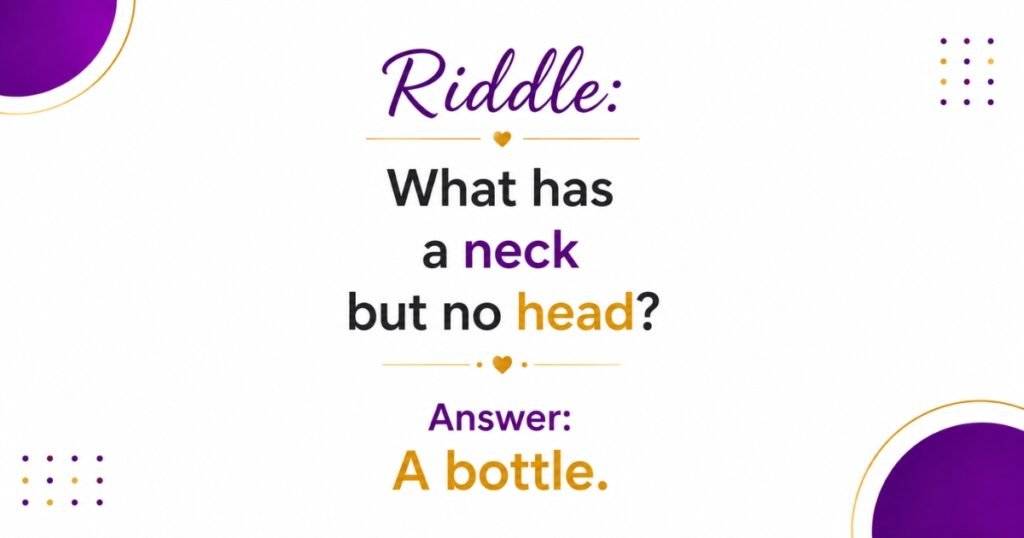
Explanation: This works because “catch” has two unrelated meanings, and the riddle leans on the sports meaning to mislead you toward the illness meaning. - Riddle: What has a neck but no head?
Answer: A bottle.
Difficulty: Easy
Explanation: Same family as the clock and needle riddles above, object vocabulary borrowed from the human body.
- Riddle: What building has the most stories?
Answer: A library.
Difficulty: Easy
Explanation: “Stories” doubles as floors of a building and narrative stories, a library naturally “has” both, the same wordplay that runs through our library riddles collection. - Riddle: What has hands but cannot clap?
Answer: A clock.
Difficulty: Easy
Explanation: A variation on the “face and hands” riddle above, proving how one core idea (clock body-part vocabulary) can generate multiple riddles. - Riddle: The more you take, the more you leave behind. What am I?
Answer: Footsteps.
Difficulty: Easy
Explanation: A gentle paradox, “taking” usually means removing something, but here taking steps creates something (footprints) instead. - Riddle: What has a thumb and four fingers but isn’t alive?
Answer: A glove.
Difficulty: Easy
Explanation: Continues the body-part-vocabulary pattern, this time applied to clothing rather than tools. - Riddle: I have branches but no fruit, trunk, or leaves. What am I?
Answer: A bank.
Difficulty: Easy
Explanation: “Branches” is the pivot word, most people picture a tree first, which is exactly the intended misdirection. - Riddle: What travels around the world while staying in one spot?
Answer: A stamp.
Difficulty: Easy
Explanation: The riddle separates the object from its function, the stamp itself never moves, but it travels by being attached to something else. - Riddle: What comes once in a minute, twice in a moment, but never in a thousand years?
Answer: The letter M.
Difficulty: Easy
Explanation: A letter-counting riddle, solvers must ignore the “time” framing and count literal letters in each word. - Riddle: What has a bed but never sleeps?
Answer: A river.
Difficulty: Easy
Explanation: “Bed” is repurposed as a geographic term (riverbed), continuing the everyday-word-double-meaning pattern. - Riddle: What can you break without ever touching it?
Answer: A promise.
Difficulty: Easy
Explanation: Shifts “break” from a physical action to an abstract one, which is the same twist as the egg riddle but applied emotionally instead of literally.
Classic Logic Riddles (Medium Difficulty)
These require a short chain of reasoning rather than a single wordplay flip, the step up that separates kids’ riddles from real brain teasers for adults, and the same territory covered in tricky riddles.
- Riddle: A man is looking at a portrait. Someone asks who it is. He says, “Brothers and sisters, I have none, but this man’s father is my father’s son.” Who is in the portrait?
Answer: His own son.
Difficulty: Medium
Explanation: “My father’s son” with no siblings means the speaker himself, so the portrait shows the speaker’s son. - Riddle: A father and son are in a car crash. The father dies, and the son is rushed to the hospital. The surgeon says, “I can’t operate on this boy, he’s my son.” How is this possible?
Answer: The surgeon is the boy’s mother.
Difficulty: Medium
Explanation: The riddle exposes an assumption (that “surgeon” implies male) rather than testing math or wordplay, a lateral-thinking staple. - Riddle: Two fathers and two sons go fishing. Each catches exactly one fish, yet they only bring home three fish total. How?
Answer: There are only three people: a grandfather, his son, and his grandson.
Difficulty: Medium
Explanation: The trick is realizing “two fathers and two sons” can describe three people if one person is counted twice (as both a father and a son). - Riddle: You enter a room with a match, a candle, a fireplace, and a gas lamp. What do you light first?
Answer: The match.
Difficulty: Medium
Explanation: A sequencing trap, everything else needs the match, so it must always come first regardless of what else is in the room. - Riddle: A woman gives a beggar 50 cents. The beggar is the woman’s own son. How can this be, with no trick or twist?
Answer: There’s no trick at all, a mother can simply be walking by and give money to her son, who happens to be experiencing homelessness. The riddle only feels paradoxical because we assume a “beggar” and a “mother’s son” can’t be the same person.
Difficulty: Medium
Explanation: This riddle relies entirely on the reader supplying an assumption (that a mother’s son couldn’t possibly be poor) that the riddle never actually states, the “impossible” scenario is only impossible in our heads. - Riddle: You’re in a race and you pass the person in second place. What place are you in now?
Answer: Second place.
Difficulty: Medium
Explanation: A common mistake is answering “first”, but passing second place only moves you into that spot, not past first place. - Riddle: How can you drop a raw egg onto a concrete floor without cracking it?
Answer: Concrete floors are very hard to crack.
Difficulty: Medium
Explanation: A grammar-based misdirection, “without cracking it” is read as protecting the egg, when the sentence can just as easily describe the floor. - Riddle: A man builds a rectangular house where every wall faces south. A bear walks by. What color is the bear?
Answer: White, the house is at the North Pole, so a polar bear is the only bear that could be nearby.
Difficulty: Medium
Explanation: The “every wall faces south” clue only makes geometric sense at the North Pole, which is the key deduction. - Riddle: There are three houses: one red, one blue, one white. The red house is to the left of the house in the middle. The blue house is to the right of the house in the middle. Where’s the white house?
Answer: Washington, D.C., the White House isn’t part of the three colored houses in the puzzle at all.
Difficulty: Medium
Explanation: A pure misdirection riddle, the logic setup is a red herring, and the punchline depends on a completely different meaning of “white house.” - Riddle: A man leaves home, makes three left turns, and returns home to find two masked men waiting. Who are they?
Answer: The catcher and the umpire, the man is running the bases in a baseball game.
Difficulty: Medium
Explanation: “Left turns” and “masked men” are both baseball clues in disguise, requiring the solver to picture the described path as a baseball diamond. - Riddle: A rooster lays an egg on the very top of a barn roof. Which way does it roll?
Answer: Roosters don’t lay eggs.
Difficulty: Medium
Explanation: A trap riddle, it invites you to calculate a physics answer (left or right) when the real flaw is in the premise itself. - Riddle: You have two ropes, each of which takes exactly 60 minutes to burn, but they burn unevenly. How do you measure exactly 45 minutes?
Answer: Light one rope at both ends and the other rope at one end simultaneously. When the first rope finishes burning (30 minutes), light the second end of the second rope. It will finish 15 minutes later, totaling 45 minutes.
Difficulty: Hard
Explanation: This is a classic time-halving puzzle, lighting both ends of a rope always halves its burn time regardless of how unevenly it burns. - Riddle: A farmer must move a fox, a chicken, and a bag of grain across a river using a boat that only holds him plus one item. Left alone, the fox eats the chicken and the chicken eats the grain. How does he get everything across safely?
Answer: Take the chicken across first, return empty, take the fox across, bring the chicken back, take the grain across, return empty, then take the chicken across last.
Difficulty: Hard
Explanation: The chicken is the “unstable” item because it threatens the grain and is threatened by the fox, so it has to be shuttled back and forth to keep the other two apart. - Riddle: You’re in a room with three switches, one of which turns on a bulb in the next room. You can only enter that room once. How do you determine which switch controls the bulb?
Answer: Turn on the first switch and wait a few minutes, then turn it off and turn on the second switch. Enter the room: if the bulb is on, it’s switch two; if it’s off but warm, it’s switch one; if it’s off and cold, it’s switch three.
Difficulty: Hard
Explanation: The riddle adds a third sense (touch, via heat) to a problem that seems to only involve sight, which is the entire trick.
Wordplay and Language Riddles
These reward attention to spelling, sound, and letter patterns rather than logic chains.
- Riddle: What five-letter word becomes shorter when you add two letters to it?
Answer: “Short”, adding “er” makes “shorter.”
Difficulty: Medium
Explanation: A self-referential wordplay riddle where the answer describes its own transformation. - Riddle: How can you turn the number 7 into an even number without using math?
Answer: Remove the “S” from “seven” and it becomes “even.”
Difficulty: Easy
Explanation: The riddle deliberately blocks the obvious (mathematical) path so the solver has to treat “seven” as a word, not a number. - Riddle: What word in the English language always loses its first letter when it’s pronounced?
Answer: “Queue”, it’s pronounced exactly like the letter Q.
Difficulty: Medium
Explanation: This tests spelling-versus-sound awareness, the written word has five letters, but the spoken word only “sounds” like one. - Riddle: What starts with an E, ends with an E, but only contains one letter?
Answer: An envelope.
Difficulty: Easy
Explanation: A category shift, “one letter” refers to a physical letter (mail) rather than an alphabet letter, which is the misdirection. - Riddle: What word reads the same forward and backward and describes a driver going fast around a track?
Answer: “Racecar.”
Difficulty: Easy
Explanation: A warm-up palindrome riddle before the harder symmetry riddle later in this section, the meaning of the word (someone who races) has nothing to do with the trick, which is purely about letter order.
- Riddle: What English word has three consecutive double letters?
Answer: “Bookkeeper” (or “bookkeeping”).
Difficulty: Hard
Explanation: A spelling-recall riddle, very few English words contain three back-to-back double-letter pairs, making this genuine trivia-adjacent challenge. - Riddle: What common English word contains all five vowels in order, exactly once each?
Answer: “Facetious” (and “abstemious”).
Difficulty: Hard
Explanation: Solvers need to mentally scan the alphabet order (a-e-i-o-u) against words they already know, which is a memory-plus-pattern challenge. - Riddle: I’m an odd number. Take away one letter and I become even. What number am I?
Answer: Seven.
Difficulty: Easy
Explanation: A near-duplicate of riddle #34, included here to show how the same core trick (letters, not math) can be phrased as a different question. - Riddle: I start with the letter K, but I sound exactly the same without it. What word am I?
Answer: “Knight”, remove the silent K and it’s pronounced identically to “night.”
Difficulty: Medium
Explanation: This riddle is built around a silent letter, removing a letter that was never pronounced in the first place doesn’t change how the word sounds, even though it changes the spelling. - Riddle: What do you call a word that’s spelled the same forwards and backwards?
Answer: A palindrome.
Difficulty: Easy
Explanation: More of a vocabulary check than a puzzle, but a useful bridge riddle before palindrome-based brain teasers. - Riddle: Name a common four-letter word that reads the same even when flipped upside down.
Answer: “Noon”, when written in a symmetrical font, flipping it upside down still reads “noon.”
Difficulty: Medium
Explanation: This combines the palindrome idea from #42 with visual symmetry, since “noon” also happens to look the same rotated 180 degrees. - Riddle: What is the only number that has the same number of letters as its value?
Answer: Four (“four” has four letters).
Difficulty: Medium
Explanation: A self-referential number riddle, the answer is the one number where the word and the value match. - Riddle: Which word in the dictionary is always spelled incorrectly?
Answer: “Incorrectly.”
Difficulty: Easy
Explanation: A pun riddle, it’s technically true, since the word “incorrectly” is itself spelled i-n-c-o-r-r-e-c-t-l-y, and that’s the “trick.” - Riddle: What can travel all around the world without ever leaving its corner?
Answer: A postage stamp.
Difficulty: Easy
Explanation: Similar mechanism to riddle #15, the object is passive, and it’s the letter it’s attached to that actually travels. - Riddle: I have keys but no locks, space but no room, and you can enter but you can’t go inside. What am I?
Answer: A keyboard.
Difficulty: Medium
Explanation: A layered wordplay riddle stacking three separate double-meaning clues (keys, space, enter) that all point to a computer keyboard. - Riddle: Forward I’m heavy, backward I’m not. What am I?
Answer: “Ton”, reversed it spells “not.”
Difficulty: Medium
Explanation: A reversal riddle where the meaning of the forward word (heavy) is deliberately unrelated to the meaning of the backward word (not), which is the misdirection.
Math and Number Brain Teasers
This set of math brain teasers leans on arithmetic, sequences, and number patterns rather than pure wordplay, similar to the numbers-first approach in math riddles.
- Riddle: A farmer has 17 sheep, and all but 9 die. How many are left?
Answer: 9.
Difficulty: Easy
Explanation: “All but 9” literally means 9 survive, the riddle counts on you doing subtraction (17 minus 9) instead of reading the sentence literally. - Riddle: If you have a bee in your hand, what’s in your eye?
Answer: Beauty, because “beauty is in the eye of the beholder,” and “beholder” sounds like “bee holder.”
Difficulty: Medium
Explanation: A homophone riddle disguised as a math-adjacent question, it isn’t really about numbers, but is often grouped here as a “trick question.” - Riddle: What is half of 8 if you cut it horizontally?
Answer: 0, cutting the number “8” horizontally through the middle leaves two “0” shapes.
Difficulty: Medium
Explanation: The riddle switches from arithmetic to shape-cutting mid-sentence, which is the misdirection. - Riddle: A clock’s minute and hour hands overlap exactly at 12:00. How many more times will they overlap before 12:00 the next day?
Answer: 10 times.
Difficulty: Hard
Explanation: The hands overlap roughly every 65 minutes rather than every 60, so over a 12-hour cycle they overlap 11 times total, meaning 10 more times after the initial overlap, the same clock-logic puzzle style found in time riddles. - Riddle: I am an odd number. Remove one letter and I become even. What number am I?
Answer: Seven (same logic family as #34/#40, included here under math since many readers search for it as a “number riddle”).
Difficulty: Easy
Explanation: This shows how one riddle can be filed under multiple categories depending on whether readers approach it as wordplay or math. - Riddle: A water lily doubles in size every day. It takes 30 days to cover an entire pond. On what day is the pond half covered?
Answer: Day 29.
Difficulty: Medium
Explanation: Because the lily doubles daily, the day before full coverage must be exactly half, a classic exponential-growth trap. - Riddle: You have a 3-gallon jug and a 5-gallon jug and need exactly 4 gallons of water. How do you measure it?
Answer: Fill the 5-gallon jug, pour it into the 3-gallon jug (leaving 2 gallons in the 5-gallon jug), empty the 3-gallon jug, pour the remaining 2 gallons into the 3-gallon jug, then refill the 5-gallon jug and top off the 3-gallon jug (which only needs 1 more gallon), leaving exactly 4 gallons in the 5-gallon jug.
Difficulty: Hard
Explanation: This is a classic “measuring puzzle” solved through a sequence of pours and transfers rather than a single calculation. - Riddle: Which number, when you double it and add 10, gives you 26?
Answer: 8.
Difficulty: Easy
Explanation: A straightforward algebra riddle included as a warm-up before the harder number puzzles later in this section.

- Riddle: A man buys a horse for $60, sells it for $70, buys it back for $80, and sells it again for $90. Did he make or lose money, and how much?
Answer: He made $20 in profit total.
Difficulty: Medium
Explanation: Tracking each transaction separately (+10, then -10 for buying back, then +10 again) shows the net gain, which trips people up if they only look at the final sale price. - Riddle: What comes next in the sequence: 2, 6, 12, 20, 30, ___?
Answer: 42 (each term is n × (n+1): 1×2, 2×3, 3×4, 4×5, 5×6, 6×7).
Difficulty: Hard
Explanation: Spotting that each number is a product of two consecutive integers reveals the underlying pattern. - Riddle: If two’s company and three’s a crowd, what are four and five?
Answer: Nine.
Difficulty: Easy
Explanation: A pure pun, the riddle sets up a proverb structure just to land on simple addition as the punchline. - Riddle: What is the next number in this sequence: 1, 11, 21, 1211, 111221, ___?
Answer: 312211 (each line describes the previous one aloud, “one 1,” “two 1s,” “one 2, one 1,” and so on).
Difficulty: Hard
Explanation: Known as the “look-and-say” sequence, this riddle requires reading each number as a description of the one before it rather than treating it mathematically.
Lateral Thinking Puzzles (Think Outside the Box)
- Riddle: A man is found dead in a locked room with no windows, along with a puddle of water and a rope hanging from the ceiling. How did he die?
Answer: He stood on a large block of ice, hanged himself, and the ice melted, leaving the puddle.
Difficulty: Hard
Explanation: The puzzle requires imagining a disappearing object (the ice) that explains all the physical evidence without needing another person involved. - Riddle: A man walks into a bar and asks the bartender for a glass of water. The bartender pulls out a gun and points it at him. The man says “thank you” and walks out. Why?
Answer: The man had hiccups; the shock of being threatened cured them, so he no longer needed the water.
Difficulty: Hard
Explanation: This puzzle only works if you suspend the “danger” framing and consider why someone might want to be startled rather than hurt. - Riddle: You’re in a sealed room with only a wooden table and a mirror. How do you escape?
Answer: Look in the mirror, see what you saw (the table), take the saw, and cut the table in half. Two halves make a whole, and you climb out through the hole.
Difficulty: Medium
Explanation: A classic pun-based lateral riddle, the “logic” is really a chain of homophones (“saw,” “whole/hole”) rather than literal problem-solving. - Riddle: A woman shoots her husband, then holds him underwater for several minutes, then hangs him, and afterward they enjoy dinner together. How?
Answer: She’s a photographer: she “shoots” a photo, develops it in water, and hangs it to dry.
Difficulty: Medium
Explanation: Every violent-sounding verb (shoots, holds underwater, hangs) has an innocent alternate meaning tied to photography, which is the entire riddle. - Riddle: Two men play five games of checkers. Each man wins the same number of games, and there are no ties. How?
Answer: They’re not playing each other; each is playing against other opponents.
Difficulty: Medium
Explanation: The riddle assumes the two men are playing against each other, but nothing in the wording actually states that. - Riddle: A man pushes his car and stops in front of a hotel, then tells the owner he’s bankrupt. Why?
Answer: They’re playing Monopoly.
Difficulty: Easy
Explanation: The scenario reads like real life until “bankrupt” and “hotel” hint that it’s a board game instead. - Riddle: You’re trapped in a room with two doors and two guards. One door leads to freedom, one to danger. One guard always lies, one always tells the truth, but you don’t know which is which or which door is which. You may ask one guard one question. What do you ask?
Answer: Ask either guard, “What would the other guard say is the safe door?” Then choose the opposite door.
Difficulty: Hard
Explanation: Both guards will point to the dangerous door once their answers are combined through the lie/truth filter, which is why picking the opposite works regardless of who you ask. - Riddle: A boy is walking home when it starts to rain. He has no umbrella and no hat, and yet not a single hair on his head gets wet. How?
Answer: He’s bald.
Difficulty: Easy
Explanation: The riddle relies on solvers assuming the boy has hair, when the question never actually says so. - Riddle: Every day, a man goes to the top floor of his apartment building by elevator, except on rainy days or when someone else is in the elevator, when he goes all the way up. On sunny days, when alone, he only rides partway up and walks the rest. Why?
Answer: He’s too short to reach the button for his floor, but he can reach it with an umbrella on rainy days, or ask another passenger to press it for him.
Difficulty: Hard
Explanation: This famous puzzle (a variant of a well-known lateral-thinking classic) hinges on a physical limitation the reader isn’t told directly, height, rather than any logical contradiction. - Riddle: A woman is looking at a photograph. Her friend asks who it is. She replies, “I have no sisters or brothers, but that woman’s mother is my mother’s daughter.” Who is in the photograph?
Answer: Her own daughter.
Difficulty: Medium
Explanation: “My mother’s daughter,” with no siblings, can only mean the speaker herself, so “that woman’s mother is [the speaker]” means the photo shows the speaker’s daughter. This mirrors riddle #19’s logic but swaps the generation, proving how the same reasoning skeleton can be reused with different family relationships. - Riddle: A cowboy rides into town on Friday, stays three days, and leaves on Friday. How?
Answer: “Friday” is the name of his horse.
Difficulty: Medium
Explanation: The riddle assumes “Friday” refers to the day both times, but the second mention is actually a proper noun. - Riddle: You see a boat filled with people, yet there isn’t a single person on board. How?
Answer: All the people on the boat are married; there isn’t a single (unmarried) person among them.
Difficulty: Medium
Explanation: A homograph riddle, “single” shifts from “one person” to “unmarried” mid-sentence.
Hardest Brain Teasers (For Puzzle Veterans)
This is where the list turns into genuine brain teasers for adults with answers, the kind built for puzzle veterans rather than a quick five-minute break
- Riddle: Four people need to cross a rickety bridge at night with one flashlight. The bridge holds at most two people at once, and anyone crossing must have the flashlight. Person A takes 1 minute, B takes 2, C takes 5, and D takes 10. What’s the fastest total time to get everyone across?
Answer: 17 minutes, send A and B across (2 min), send A back (1 min), send C and D across (10 min), send B back (2 min), then send A and B across again (2 min).
Difficulty: Hard
Explanation: The key insight is sending the two slowest people across together instead of separately, which avoids “wasting” their slow speed twice. - Riddle: You have 12 balls, identical in appearance. One is either heavier or lighter than the rest. Using a balance scale exactly three times, how do you find the odd ball and determine if it’s heavier or lighter?
Answer: Divide the balls into three groups of four. Weigh two groups against each other; the result (balanced or not) narrows the search, and two more careful weighings of smaller subsets isolate the exact ball and whether it’s heavy or light.
Difficulty: Hard
Explanation: This is a well-known information-theory puzzle: each weighing has three possible outcomes (left heavier, right heavier, balanced), and three weighings give enough combinations (27) to distinguish among all 24 possibilities (12 balls × heavy-or-light). - Riddle: A king has 1,000 bottles of wine, one of which is poisoned. The poison kills within 24 hours, even in a tiny amount. He has 10 prisoners he can use as testers and 24 hours before a big event. How does he find the poisoned bottle?
Answer: Number the bottles in binary from 1 to 1000 (needing 10 digits, since 2^10 = 1024). Each prisoner represents one binary digit; a prisoner drinks from every bottle that has a “1” in their assigned digit position. Whichever prisoners die reveal the poisoned bottle’s binary number.
Difficulty: Hard
Explanation: This puzzle uses binary encoding to let 10 prisoners “test” 1,000 bottles simultaneously instead of one at a time, since each subset of prisoners who die corresponds to exactly one bottle number. - Riddle: Three gods, A, B, and C, are called True, False, and Random, in some order. True always answers truthfully, False always lies, and Random answers randomly. You don’t know which god is which, and their answers come in an unknown language (“da” or “ja” for yes/no, but you don’t know which word means which). What three yes/no questions determine the identity of each god?
Answer: This is a famously difficult logic puzzle (sometimes called “The Hardest Logic Puzzle Ever”) whose full solution involves nested conditional questions designed to cancel out the unpredictability of Random. Because the complete solution is lengthy, it’s best explored as a standalone deep-dive rather than condensed here, but the core idea is to always phrase your question so that True and False would give the same answer regardless of which one you’re talking to, effectively neutralizing the lie.
Difficulty: Hard
Explanation: This riddle is included to show that not every brain teaser has a short answer, some, like this one, are genuinely graduate-level logic problems worth researching separately if you enjoy a serious challenge. - Riddle: You have two identical eggs and access to a 100-floor building. Eggs will break if dropped from or above a certain floor, and survive below it. Using the fewest possible drops in the worst case, how do you find the exact floor where eggs start breaking?
Answer: 14 drops in the worst case, using a strategy that starts by dropping the first egg from floor 14, then 27, then 39 (decreasing the gap by one each time) to balance the risk between the two eggs.
Difficulty: Hard
Explanation: This is the classic “egg drop” problem, the trick is realizing the first egg’s drop points must decrease in step size so that, however many times it breaks, the second egg never needs more total drops than the plan allows. - Riddle: You’re given a 5-liter jug and a 3-liter jug, both unmarked, and unlimited water. Without any other tools, how do you get exactly 1 liter?
Answer: Fill the 3-liter jug and pour it into the 5-liter jug. Fill the 3-liter jug again and pour into the 5-liter jug until it’s full (using only 2 more liters), leaving exactly 1 liter in the 3-liter jug.
Difficulty: Medium
Explanation: A simpler cousin of riddle #55, the same “pour and transfer” logic applies, just with different target amounts. - Riddle: A group of prisoners wear either a red or blue hat, and can see everyone else’s hat but not their own. No communication is allowed except that each prisoner must guess their own hat color out loud, one at a time, in a random order. What strategy guarantees the maximum number of correct guesses?
Answer: The first prisoner announces “red” if they see an even number of red hats among the others (or an agreed convention), sacrificing their own certainty to encode information. Every subsequent prisoner can then deduce their own hat color from the running count, guaranteeing all but the first prisoner answer correctly.
Difficulty: Hard
Explanation: This is a well-known parity-based logic puzzle where one person’s guess is used purely as a signal, not a guess about their own hat. - Riddle: You are given a rope long enough to reach the ground from a window 30 feet up, but the rope is only 20 feet long and can’t be stretched. There’s a knife nearby. How do you use the rope safely?
Answer: Cut the rope lengthwise into two thinner strands and tie them together, roughly doubling the usable length while keeping it strong enough to hold your weight.
Difficulty: Medium
Explanation: The riddle assumes rope length is fixed, but splitting a rope’s fibers lengthwise (rather than cutting it shorter) is the key insight.
Fun Visual and Riddle-Style Brain Teasers for Kids
This set of brain teasers for kids with answers leans on visual wordplay and everyday objects, perfect for a classroom or car-ride crowd.
- Riddle: What has a heart that doesn’t beat?
Answer: An artichoke.
Difficulty: Easy
Explanation: A gentle pun for younger solvers, “heart” refers to the edible center of the vegetable, not an organ. - Riddle: What can you keep after giving it to someone else?
Answer: Your word (a promise).
Difficulty: Easy
Explanation: This introduces kids to the idea of abstract “things” you can give without losing them, unlike physical objects. - Riddle: What has four wheels and flies?
Answer: A garbage truck.
Difficulty: Easy
Explanation: A misdirection pun, “flies” refers to insects attracted to garbage, not the truck actually flying. - Riddle: What gets wetter the more it dries?
Answer: A towel.
Difficulty: Easy
Explanation: A paradox riddle perfect for kids, the towel’s job (drying things) is exactly what makes it wetter. - Riddle: What has teeth but cannot bite?
Answer: A comb.
Difficulty: Easy
Explanation: Continues the body-part-vocabulary theme in a way that’s especially fun for younger audiences to picture.

- Riddle: What kind of coat can only be put on when wet?
Answer: A coat of paint.
Difficulty: Easy
Explanation: A category-shift riddle, “coat” moves from clothing to a layer of paint, a fun surprise for kids learning multiple word meanings. - Riddle: I have cities but no houses, mountains but no trees, and water but no fish. What am I?
Answer: A map.
Difficulty: Easy
Explanation: Teaches kids to think about representations of things rather than the real things themselves. - Riddle: What has a ring but no finger?
Answer: A telephone.
Difficulty: Easy
Explanation: Great for classroom use, kids enjoy learning that older phones “ring” the way jewelry doesn’t. - Riddle: What kind of tree can you carry in your hand?
Answer: A palm (as in the palm of your hand).
Difficulty: Easy
Explanation: A pun that works well for classroom vocabulary lessons about multiple-meaning words. - Riddle: What flying insect do you get if you take the word “beetle” and swap out its meaning for something that buzzes and makes honey?
Answer: A bee.
Difficulty: Easy
Explanation: A simple word-association riddle for younger kids, it swaps the category (bugs that crawl vs. bugs that fly and buzz) rather than relying on spelling tricks, making it an easier entry point for early readers. - Riddle: What building in your town has the most stories, but never gets taller?
Answer: A library (same wordplay idea as riddle #10, phrased for younger readers).
Difficulty: Easy
Explanation: A repeat of the “stories” double meaning, included in the kids’ section since it consistently tests well with younger classroom audiences. - Riddle: You can catch someone’s eye and throw someone a glance, but you never actually touch either one. What are “eye” and “glance” examples of here?
Answer: Idioms, figures of speech that don’t mean what their words literally say.
Difficulty: Medium
Explanation: A more abstract riddle for older kids, meant to build comfort with idiomatic expressions like “catching someone’s eye” without expecting a single physical object as the answer. - Riddle: What has one head, one foot, and four legs?
Answer: A bed.
Difficulty: Easy
Explanation: A classic body-part-vocabulary riddle (headboard, footboard, and four legs), fitting well alongside the “clock” and “needle” riddles from the Easy section. - Riddle: What kind of band never plays music?
Answer: A rubber band.
Difficulty: Easy
Explanation: A category-shift pun perfect for kids just learning that “band” can mean a musical group or a loop of material. - Riddle: What has a bottom at the top?
Answer: Your legs (or a pair of pants) , the “bottom” of your leg or pants is technically at the top when you’re wearing them, and your legs are attached at the top of your body.
Difficulty: Medium
Explanation: A playful, slightly silly riddle for classroom laughs that teaches positional vocabulary in an unexpected way. - Riddle: What can run but never walks, has a mouth but never talks, has a bed but never sleeps?
Answer: A river.
Difficulty: Medium
Explanation: Combines three separate double-meaning clues about a river (runs, mouth, bed) into one longer riddle for slightly older kids.
Riddles for Family Game Night and Social Media
This section is packed with funny brain teasers with answers built for group settings, the kind that spark debate at a party or a comment thread online, right alongside our dedicated family riddles.
- Riddle: For a group game: one player names three things, “something with an eye but no head,” “something with a bed but no pillow,” and “something with legs but no feet”, and the rest of the table has to name all three separately before time runs out. What are the three answers?
Answer: A needle (eye), a river (bed), and a table (legs).
Difficulty: Medium
Explanation: This works as a party format precisely because the three clues describe three different objects rather than one, the fun is in realizing you shouldn’t search for a single answer that fits all three. - Riddle: I shave every day, but my beard stays the same length. Who am I?
Answer: A barber.
Difficulty: Easy
Explanation: The riddle exploits the ambiguity of “my beard”, a barber shaves customers’ beards all day, not his own. - Riddle: What everyday object do you look into and see yourself, but if you touch it, all you feel is glass?
Answer: A mirror.
Difficulty: Easy
Explanation: Perfect for social media posts because the “trick” is the gap between what you see (your reflection) and what’s actually there (a flat surface), a good discussion-starter for comments about optical illusions in general. - Riddle: What can fill a room but takes up no space?
Answer: Light (or sound, depending on interpretation).
Difficulty: Medium
Explanation: An open-interpretation riddle, both “light” and “sound” are commonly accepted answers, which makes it especially good for sparking friendly disagreement at a party. - Riddle: The more of me you take, the more you leave behind. I have footsteps but no feet, and I follow you everywhere without a body. What am I?
Answer: Footsteps (or a shadow, depending on the version told).
Difficulty: Medium
Explanation: A closing riddle that deliberately echoes riddle #12, showing how blending two classic riddle skeletons together creates a slightly harder, more atmospheric version, ideal for ending a game night on a memorable note.
How to Use These Brain Teasers
- In the classroom: Use the Easy and Kids sections as five-minute warm-ups before a lesson on logic, vocabulary, or critical thinking.
- At family game night: Mix Medium and Hard riddles, and let each person “host” a round to keep everyone engaged.
- On social media: The open-interpretation riddles (like #99 and #100) tend to generate the most comments, since people enjoy debating the “right” answer.
- For solo brain training: Work through sections in order, Easy to Hard, to build the pattern-recognition skills that make later riddles easier to crack, or treat the whole collection as one long brain teasers quiz.
More Puzzles to Test Yourself
If the Wordplay and Language Riddles section was your favorite category, that same letter-and-sound trickery translates well into other languages too, so these Spanish riddles are worth a look if you want to try that same style with a twist.
The same goes for these Chinese riddles, which lean on similar pun-and-symbol logic in a different language entirely.
Fans of the Lateral Thinking Puzzles section, which lean on picturing a whole scene before the answer clicks, will likely enjoy these Harry Potter riddles, built on that same kind of scene-based detail-spotting.
If you’re looking for a themed set to work through next, these March riddles offer a similar range of easy-to-hard puzzles built around a specific time of year.
Conclusion
Whether you came here for a quick classroom warm-up, a family game night showdown, or a personal brain workout, these 101 brain teasers cover the full range, from one-line puns to genuine logic puzzles that reward careful, patient thinking.
Bookmark this page to revisit sections by difficulty, share your favorite riddle with a friend to see if they can crack it, and let us know in the comments which one stumped you the longest.
FAQs
What makes a Good Brain Reaser?
A good brain teaser has a fair answer that feels surprising in hindsight, it rewards a shift in perspective, not specialized knowledge.
What are the Different Types of Riddles?
Most riddles fall into five types: wordplay, lateral thinking, math/logic, visual, and classic “what am I” object riddles.
What are some Tricky Brain Teasers?
The trickiest ones hide an assumption rather than use hard math, like the surgeon riddle or the white house riddle, the challenge is realizing what you assumed that was never actually stated.
Do Brain Teasers actually Improve your Brain?
They engage memory, pattern recognition, and cognitive flexibility, and regular practice with varied puzzles is linked to sharper problem-solving over time.
What is the Hardest Brain Teaser ever?
“The Hardest Logic Puzzle Ever” (three gods) and the 12-balls balance puzzle are often cited as the hardest, since both need multi-step planning instead of one flash of insight.
How do you Solve a Brain Teaser?
Question your first assumption, reread the wording carefully, and try approaching the problem from a different angle before giving up.