
100+ Math Riddles With Answers: Easy, Medium and Hard
Math Riddles turn ordinary math skills , counting, logic, algebra, geometry , into short, fun puzzles. Guess wrong once, catch the trick, and you’ll remember it far longer than anything from a worksheet.
This collection has 100+ original Math Riddles sorted by difficulty, each with an answer and a quick explanation, so whether you’re a teacher, a parent, or just killing time, there’s something here at your level.
What Makes a Good Math Riddle?
A good Math Riddle isn’t just a word problem in disguise , it has a hook. The best ones use one of four techniques: a misdirection (the riddle sounds harder than it is, or easier), a wordplay trap (a phrase like “all but nine” that trips up the literal reader), a pattern the solver has to notice (like a sequence of squares or factorials), or a counter-intuitive result that surprises even adults, like the classic bat-and-ball problem where the obvious answer is wrong.
Understanding the technique behind a riddle is what separates memorizing an answer from actually getting better at math. That’s why every riddle below is tagged with a difficulty level and a one-line explanation , not just the solution, but the why.
Easy Math Riddles for Kids With Answers
These are built for ages 5–10 (roughly grades K–3). Most can be solved in your head, and they’re a great way to build confidence before moving to trickier puzzles.
- Riddle: If you have 4 cookies and eat 1, how many are left?
Answer: 3
Difficulty: Easy
Explanation: Straight subtraction , 4 − 1 = 3 , is the first math skill most riddles build on. - Riddle: What number comes right after 19?
Answer: 20
Difficulty: Easy
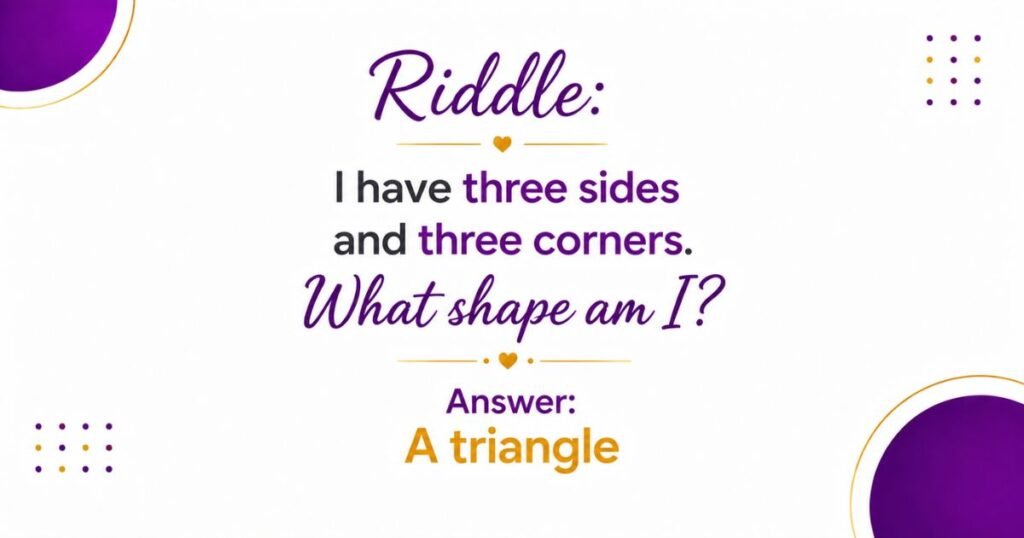
Explanation: Reinforces counting order and the jump from the teens into the twenties. - Riddle: I have three sides and three corners. What shape am I?
Answer: A triangle
Difficulty: Easy
Explanation: Basic shape recognition by counting sides and angles.
- Riddle: How many minutes are in half an hour?
Answer: 30
Difficulty: Easy
Explanation: Time-telling riddles connect the abstract number 60 to something kids experience daily. - Riddle: A spider has 8 legs. How many legs do 3 spiders have?
Answer: 24
Difficulty: Easy
Explanation: Multiplication as repeated addition: 8 + 8 + 8 = 24. - Riddle: A farmer has 10 sheep. All but 7 run away. How many are left?
Answer: 7
Difficulty: Easy
Explanation: A classic wordplay trap , “all but 7” means 7 remain, not that 7 ran away. - Riddle: What number, when you add 5 to it, equals 12?
Answer: 7
Difficulty: Easy
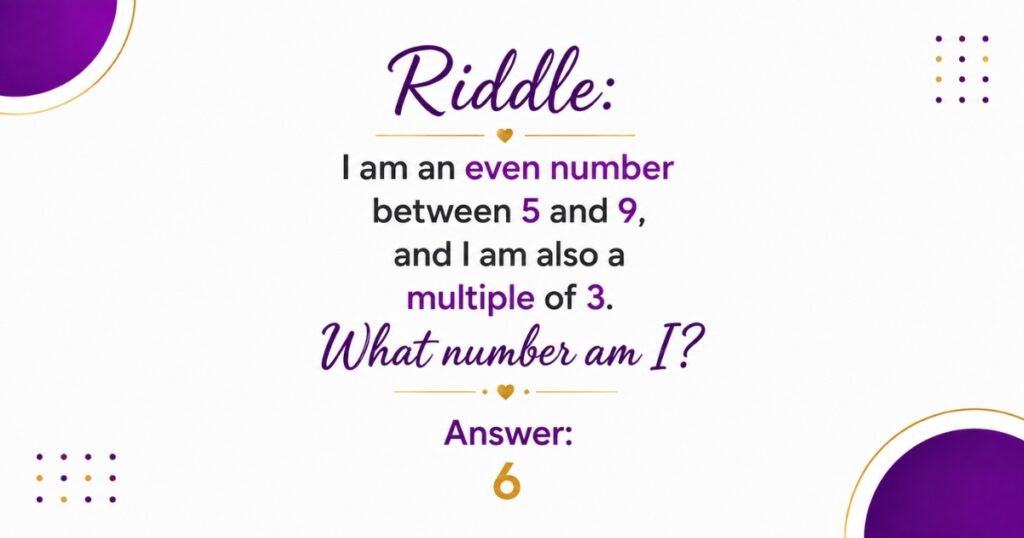
Explanation: Working backward from a total is early algebraic thinking. - Riddle: I am an even number between 5 and 9, and I am also a multiple of 3. What number am I?
Answer: 6
Difficulty: Easy
Explanation: Combines two clues (even, and a multiple of 3) to narrow down one answer.
- Riddle: How many days are in one week?
Answer: 7
Difficulty: Easy
Explanation: A simple recall fact that anchors calendar-based riddles. - Riddle: What do you get when you double the number 6?
Answer: 12
Difficulty: Easy
Explanation: Doubling is multiplication by 2, a foundation for later times tables. - Riddle: I have 4 sides that are all the same length. What shape am I?
Answer: A square
Difficulty: Easy
Explanation: Distinguishes a square from a general rectangle by equal side length. - Riddle: If today is Monday, what day comes 2 days later?
Answer: Wednesday
Difficulty: Easy
Explanation: Counting forward on a cycle (the days of the week) previews modular thinking. - Riddle: How many wheels do 5 bicycles have?
Answer: 10
Difficulty: Easy
Explanation: Each bicycle has 2 wheels, so 5 × 2 = 10. - Riddle: What is half of 10?
Answer: 5
Difficulty: Easy
Explanation: Division by 2 is the most common “half of” riddle format. - Riddle: I am a number. Add 1 to me and I become 10. What number am I?
Answer: 9
Difficulty: Easy
Explanation: Reverses the usual direction of a question, asking for the starting value. - Riddle: A dozen eggs is how many eggs?
Answer: 12
Difficulty: Easy
Explanation: “Dozen” is a real-world number word many kids don’t connect to 12 right away. - Riddle: What number is 3 tens and 2 ones?
Answer: 32
Difficulty: Easy
Explanation: Place value: 3 tens (30) plus 2 ones (2) equals 32. - Riddle: If you have $5 and spend $2, how much money do you have left?
Answer: $3
Difficulty: Easy
Explanation: Money riddles make subtraction feel practical instead of abstract. - Riddle: How many sides does a hexagon have?
Answer: 6
Difficulty: Easy
Explanation: “Hex” is Greek for six , a small vocabulary clue hidden in the shape’s name. - Riddle: What comes next in this pattern: 2, 4, 6, 8, ___?
Answer: 10
Difficulty: Easy
Explanation: Skip-counting by 2s is one of the earliest patterns kids learn to extend. - Riddle: I am the only number that is neither positive nor negative. What number am I?
Answer: 0
Difficulty: Easy
Explanation: Zero sits at the exact center of the number line. - Riddle: Two mice race to a hole. The first arrives 3 seconds before the second. The second arrives at 12 seconds. When did the first mouse arrive?
Answer: 9 seconds
Difficulty: Easy
Explanation: Subtracting the gap (3 seconds) from the later time gives the earlier time. - Riddle: How many quarters make one dollar?
Answer: 4
Difficulty: Easy
Explanation: 25 × 4 = 100 cents, connecting coin values to the number 100. - Riddle: I am a shape with no corners at all. What am I?
Answer: A circle
Difficulty: Easy
Explanation: Defines a shape by what it lacks rather than what it has. - Riddle: What is 10 minus 10?
Answer: 0
Difficulty: Easy
Explanation: Any number minus itself equals zero , a rule worth noticing early. - Riddle: If a cat has 4 legs, how many legs do 5 cats have?
Answer: 20
Difficulty: Easy
Explanation: 4 × 5 = 20, a times-table riddle dressed up as a word problem.
Medium Math Riddles for Teens and Classrooms
These Math Riddles suit ages 11–14 (roughly grades 6–8). Expect fractions, percentages, ratios, basic algebra, and multi-step logic , great for a classroom warm-up or a homework break.
- Riddle: A rectangle’s length is twice its width. If the width is 5 cm, what is the perimeter?
Answer: 30 cm
Difficulty: Medium
Explanation: Length = 10 cm, so perimeter = 2(5 + 10) = 30 cm. - Riddle: Three consecutive numbers add up to 45. What are they?
Answer: 14, 15, 16
Difficulty: Medium
Explanation: The middle number is always the total divided by 3 (45 ÷ 3 = 15). - Riddle: A train travels 60 miles in 1.5 hours. What is its average speed?
Answer: 40 mph
Difficulty: Medium
Explanation: Speed = distance ÷ time = 60 ÷ 1.5. - Riddle: What is 15% of 200?
Answer: 30
Difficulty: Medium
Explanation: Convert the percent to a decimal (0.15) and multiply by 200. - Riddle: A rope is cut into 4 equal pieces, each 3 meters long. How long was the rope?
Answer: 12 meters
Difficulty: Medium
Explanation: Multiply the piece length by the number of pieces: 3 × 4 = 12. - Riddle: If x + 7 = 15, what is x?
Answer: 8
Difficulty: Medium
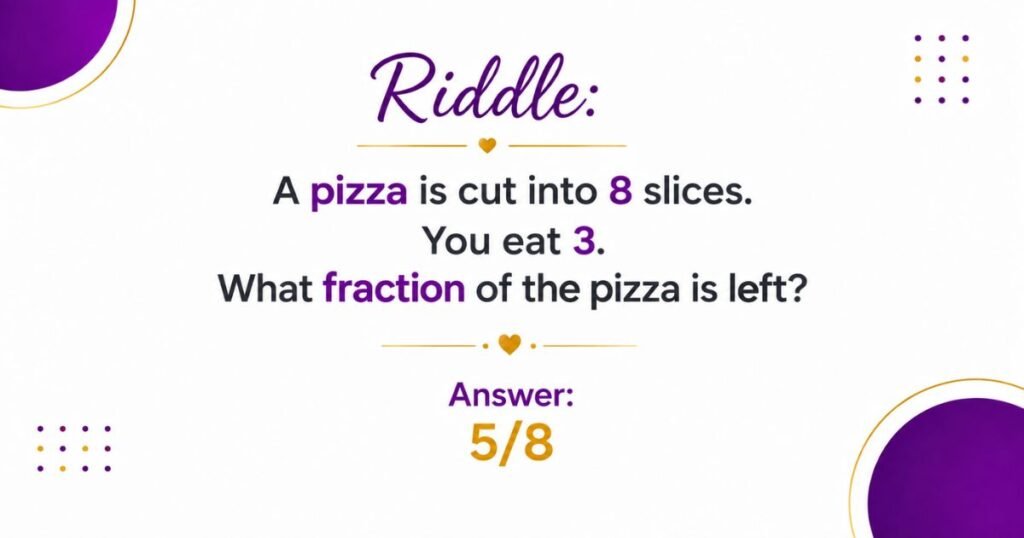
Explanation: Subtract 7 from both sides of the equation , an early algebra move. - Riddle: A pizza is cut into 8 slices. You eat 3. What fraction of the pizza is left?
Answer: 5/8
Difficulty: Medium
Explanation: 8 − 3 = 5 slices remain out of 8 total.
- Riddle: Two numbers have a sum of 20 and a difference of 4. What are the numbers?
Answer: 12 and 8
Difficulty: Medium
Explanation: Add the sum and difference, then halve it, to find the larger number; subtract to find the smaller. - Riddle: What is the next number in this sequence: 3, 6, 12, 24, ___?
Answer: 48
Difficulty: Medium
Explanation: Each term doubles the one before it (a geometric sequence). - Riddle: A book costs $18 after a 10% discount. What was the original price?
Answer: $20
Difficulty: Medium
Explanation: $18 is 90% of the original price, so divide $18 by 0.9. - Riddle: I am a two-digit number divisible by 9, and my digits add up to 9. What could I be?
Answer: Any multiple of 9, such as 18, 45, or 72
Difficulty: Medium
Explanation: Every multiple of 9 has digits that sum to 9 (or a multiple of 9) , a shortcut mathematicians call “casting out nines.” - Riddle: A clock shows 3:15. What is the angle between the hour and minute hands?
Answer: 7.5 degrees
Difficulty: Medium
Explanation: The minute hand sits at 90°, while the hour hand has moved slightly past 90° to 97.5° , the gap is the difference. - Riddle: What is the square root of 144?
Answer: 12
Difficulty: Medium
Explanation: 12 × 12 = 144, so 12 is the square root. - Riddle: If 5 pencils cost $2, how much do 15 pencils cost?
Answer: $6
Difficulty: Medium
Explanation: 15 pencils is 3 times as many as 5, so the cost triples too. - Riddle: A rectangular garden is 8 m by 6 m. What is its area?
Answer: 48 square meters
Difficulty: Medium
Explanation: Area = length × width = 8 × 6. - Riddle: I am a number. Triple me and subtract 4, and you get 11. What number am I?
Answer: 5
Difficulty: Medium
Explanation: Solve 3x − 4 = 11 by adding 4, then dividing by 3. - Riddle: What is the median of these numbers: 3, 7, 9, 2, 5?
Answer: 5
Difficulty: Medium
Explanation: Sorted, the numbers are 2, 3, 5, 7, 9 , the middle value is 5. - Riddle: A car uses 1 gallon of gas every 25 miles. How many gallons for a 150-mile trip?
Answer: 6 gallons
Difficulty: Medium
Explanation: 150 ÷ 25 = 6. - Riddle: Two trains leave the same station, one going north at 50 mph and one going south at 70 mph. How far apart are they after 2 hours?
Answer: 240 miles
Difficulty: Medium
Explanation: Their combined speed is 120 mph, so after 2 hours they’re 240 miles apart. - Riddle: What is the value of 2³ + 3²?
Answer: 17
Difficulty: Medium
Explanation: 2³ = 8 and 3² = 9, so 8 + 9 = 17. - Riddle: A number increased by 25% equals 100. What was the original number?
Answer: 80
Difficulty: Medium
Explanation: 100 ÷ 1.25 = 80, since increasing by 25% means multiplying by 1.25. - Riddle: The ratio of boys to girls in a class is 3:4, and there are 21 boys. How many girls are there?
Answer: 28
Difficulty: Medium
Explanation: 21 ÷ 3 = 7, so each “part” of the ratio equals 7; girls = 4 × 7 = 28. - Riddle: I am a prime number between 20 and 30, and my digits add up to 5. What number am I?
Answer: 23
Difficulty: Medium
Explanation: 23 is prime and 2 + 3 = 5, ruling out 29 (which sums to 11). - Riddle: A number’s square is 81. What could the number be?
Answer: 9 (or -9)
Difficulty: Medium
Explanation: Both 9 × 9 and -9 × -9 equal 81. - Riddle: What is the sum of the interior angles of a triangle?
Answer: 180 degrees
Difficulty: Medium
Explanation: A geometric rule true for every triangle, regardless of shape or size. - Riddle: A recipe calls for 3/4 cup of sugar for 12 cookies. How much sugar is needed for 24 cookies?
Answer: 1.5 cups
Difficulty: Medium
Explanation: Doubling the cookies means doubling every ingredient. - Riddle: If 4 workers can build a wall in 12 days, how long would it take 6 workers at the same rate?
Answer: 8 days
Difficulty: Medium
Explanation: The job takes 48 “worker-days” total; divide by 6 workers to get 8 days. - Riddle: What is the least common multiple of 4 and 6?
Answer: 12
Difficulty: Medium
Explanation: 12 is the smallest number both 4 and 6 divide into evenly. - Riddle: A number line shows -3 and 5. What is the distance between these two points?
Answer: 8
Difficulty: Medium
Explanation: Distance ignores direction, so it’s the absolute difference: 5 − (-3) = 8. - Riddle: I am a number between 1 and 50, divisible by both 6 and 8. What number am I?
Answer: 24
Difficulty: Medium
Explanation: 24 is the least common multiple of 6 and 8.
Hard Math Riddles for Adults With Answers
These math riddles for adult with answers are built to make adults pause. Expect probability, multi-step algebra, and a few of the classic “aha” puzzles that trip up even confident mathematicians on the first try.
- Riddle: A bat and a glove together cost $1.10. The bat costs $1.00 more than the glove. How much does the glove cost?
Answer: $0.05
Difficulty: Hard
Explanation: Most people guess $0.10, but that makes the bat $1.10 and the total $1.20. Solving 2x + 1 = 1.10 gives x = 0.05. - Riddle: Two trains are 100 miles apart, moving toward each other at 30 mph and 20 mph. A bird flies back and forth between them at 50 mph until they meet. How far does the bird fly?
Answer: 100 miles
Difficulty: Hard
Explanation: The trains close the gap at 50 mph combined, meeting in 2 hours , so the bird, flying the whole time at 50 mph, covers 100 miles. - Riddle: You have a 5-liter jug and a 3-liter jug with no markings. How can you measure exactly 4 liters?
Answer: Fill the 5L jug, pour into the 3L jug (2L remains in the 5L jug), empty the 3L jug, pour the 2L into it, refill the 5L jug, then top off the 3L jug (using 1L) , leaving exactly 4L in the 5L jug.
Difficulty: Hard
Explanation: A classic water-jug puzzle solved by tracking remainders instead of guessing. - Riddle: A snail at the bottom of a 10-meter well climbs 3 meters by day and slides back 2 meters each night. How many days until it escapes?
Answer: 8 days
Difficulty: Hard
Explanation: The snail nets 1 meter per day, but on the final day it climbs out before sliding back, so it escapes a day sooner than a naive calculation suggests. - Riddle: A man leaves home, turns left three times, and arrives back home facing two masked men. Who are the masked men?
Answer: The catcher and the umpire
Difficulty: Hard
Explanation: The “home” is home plate on a baseball diamond, and running the bases means three left turns. - Riddle: Three switches outside a room control three bulbs inside. You can flip switches freely but may enter the room only once. How do you identify which switch controls which bulb?
Answer: Turn switch 1 on for a few minutes, then off. Turn switch 2 on and leave it on. Enter the room: the lit bulb belongs to switch 2, the warm-but-off bulb belongs to switch 1, and the cold-off bulb belongs to switch 3.
Difficulty: Hard
Explanation: Uses heat as a second signal, since sight alone can only distinguish “on” from “off.” - Riddle: What is the sum of all the numbers from 1 to 100?
Answer: 5,050
Difficulty: Hard
Explanation: Pairing 1+100, 2+99, and so on gives fifty pairs that each total 101, so 50 × 101 = 5,050.
- Riddle: If you flip a fair coin 5 times and get heads every time, what is the probability the 6th flip is heads?
Answer: 1/2
Difficulty: Hard
Explanation: Each coin flip is independent , the coin has no memory of previous results. - Riddle: A father’s age is three times his son’s age. In 12 years, he will be twice his son’s age. How old is each now?
Answer: Son is 12, father is 36
Difficulty: Hard
Explanation: Solving 3s + 12 = 2(s + 12) gives s = 12. - Riddle: You have 12 identical-looking balls, one of which weighs slightly differently from the rest. Using a balance scale only 3 times, how do you find the odd ball?
Answer: Divide the balls into three groups of 4, and use a strategy of weighing groups against each other, narrowing the possibilities with each weighing.
Difficulty: Hard
Explanation: Each weighing has three possible outcomes (left heavier, right heavier, balanced), so three weighings can distinguish among up to 27 possibilities , more than enough for 12 balls. - Riddle: What is the next number in this sequence: 1, 4, 9, 16, 25, 36, ___?
Answer: 49
Difficulty: Hard
Explanation: These are perfect squares (1², 2², 3², and so on); the next is 7². - Riddle: A jar contains 100 coins, some worth $1 and some worth $0.25, totaling $58.75. How many of each coin are there?
Answer: 45 dollar coins and 55 quarters
Difficulty: Hard
Explanation: Setting up two equations (d + q = 100 and d + 0.25q = 58.75) and solving gives q = 55, d = 45. - Riddle: Two ropes each take exactly 60 minutes to burn completely but burn unevenly along their length. How can you measure exactly 45 minutes?
Answer: Light both ends of rope A and one end of rope B at the same time. Rope A finishes in 30 minutes; at that moment, light the second end of rope B. It finishes 15 minutes later, for a total of 45.
Difficulty: Hard
Explanation: Burning both ends of a rope always halves its remaining time, regardless of how unevenly it burns. - Riddle: If it takes 8 machines 8 minutes to make 8 widgets, how long would it take 100 machines to make 100 widgets?
Answer: 8 minutes
Difficulty: Hard
Explanation: Each machine makes 1 widget in 8 minutes regardless of how many machines are working in parallel. - Riddle: What is the smallest integer greater than 1 that is both a perfect square and a perfect cube?
Answer: 64
Difficulty: Hard
Explanation: 64 = 8² and also 4³, making it the smallest sixth power greater than 1 (2⁶). - Riddle: Three friends split a $30 hotel room, paying $10 each. The manager realizes the room was only $25 and sends $5 back with a bellhop, who pockets $2 and returns $1 to each friend. Each friend now paid $9 (totaling $27), and the bellhop kept $2 , that’s $29. Where did the missing dollar go?
Answer: There is no missing dollar.
Difficulty: Hard
Explanation: The $27 the friends paid already includes the bellhop’s $2 ($25 to the hotel + $2 kept = $27); adding the $2 to the $27 double-counts it instead of subtracting it. - Riddle: A number leaves a remainder of 4 when divided by 7, and a remainder of 6 when divided by 9. What is the smallest such positive number?
Answer: 60
Difficulty: Hard
Explanation: 60 ÷ 7 = 8 remainder 4, and 60 ÷ 9 = 6 remainder 6 , the first number that satisfies both conditions. - Riddle: A jar of marbles doubles in volume every minute and is completely full at 60 minutes. At what minute was it exactly half full?
Answer: Minute 59
Difficulty: Hard
Explanation: Since the volume doubles each minute, the jar must have been half full exactly one minute before it became completely full. - Riddle: What is the probability of rolling a sum of 8 with two standard six-sided dice?
Answer: 5/36
Difficulty: Hard
Explanation: Five combinations make 8 (2+6, 3+5, 4+4, 5+3, 6+2) out of 36 possible dice combinations.
- Riddle: A two-digit number’s digits sum to 9. Reversing the digits gives a number 45 less than the original. What is the number?
Answer: 72
Difficulty: Hard
Explanation: Solving the two equations (a + b = 9 and 9(a − b) = 45) gives a = 7, b = 2. - Riddle: What is 0.111… (repeating) as a fraction?
Answer: 1/9
Difficulty: Hard
Explanation: Repeating decimals with a single repeating digit over 9 always simplify to that digit over 9. - Riddle: A 10-foot ladder leans against a wall with its base 6 feet from the wall. How high up the wall does it reach?
Answer: 8 feet
Difficulty: Hard
Explanation: By the Pythagorean theorem, the height is the square root of (10² − 6²), or the square root of 64. - Riddle: If you write out every integer from 1 to 1,000, how many times does the digit “1” appear?
Answer: 301 times
Difficulty: Hard
Explanation: Counting digit occurrences across each place value (ones, tens, hundreds) gives 300 for numbers 1–999, plus one more from the number 1,000 itself. - Riddle: A group of friends splits a $60 restaurant bill evenly. If there were 2 fewer friends, each would have paid $5 more. How many friends were there?
Answer: 6 friends
Difficulty: Hard
Explanation: Setting up 60/(n−2) − 60/n = 5 and solving the resulting quadratic gives n = 6. - Riddle: Two numbers multiply to 96 and add to 20. What are the numbers?
Answer: 12 and 8
Difficulty: Hard
Explanation: These are the roots of the equation t² − 20t + 96 = 0. - Riddle: What is the units digit of 3^45?
Answer: 3
Difficulty: Hard
Explanation: The units digits of powers of 3 cycle through 3, 9, 7, 1 every four exponents; since 45 leaves a remainder of 1 when divided by 4, the units digit matches the first number in the cycle. - Riddle: A 4-digit safe code uses four different digits that sum to 20, ends in a multiple of 5, and starts with an even digit greater than 5. Give one possible code.
Answer: 6,590 (other combinations also work)
Difficulty: Hard
Explanation: Working through the constraints one at a time , starting digit, ending digit, then the remaining sum , narrows down valid answers quickly. - Riddle: If a square’s perimeter is numerically equal to its area, what is its side length?
Answer: 4
Difficulty: Hard
Explanation: Setting 4s = s² and solving gives s = 4 (ignoring the trivial solution of 0). - Riddle: A number divided by 6 leaves remainder 5, and divided by 11 also leaves remainder 5. What is the smallest such number greater than 5?
Answer: 71
Difficulty: Hard
Explanation: Since both remainders match, the number minus 5 must be divisible by both 6 and 11, so it’s 5 plus their least common multiple (66).
Funny Math Riddles and One-Liners
Not every math riddle needs a pencil. These are built for laughs , perfect for lunchboxes, math riddles game, classroom icebreakers, or breaking up a long study session.
- Riddle: Why was six afraid of seven?
Answer: Because seven ate (eight) nine!
Best For: Classroom icebreakers, lunchbox notes - Riddle: Why did the two 4’s skip lunch?
Answer: Because they already 8 (ate)!
Best For: Lunchbox notes, younger kids - Riddle: What did the zero say to the eight?
Answer: “Nice belt!”
Best For: Classroom warm-ups - Riddle: Why is the obtuse triangle always so upset?
Answer: Because it’s never right.
Best For: Geometry class, teacher jokes - Riddle: What do you call a number that can’t keep still?
Answer: A roamin’ numeral.
Best For: Wordplay lovers, history-and-math crossovers - Riddle: Why did the student wear glasses in math class?
Answer: To improve di-vision.
Best For: Classroom warm-ups - Riddle: What tool do you use for math the most?
Answer: Multi-pliers.
Best For: Younger kids, dad jokes - Riddle: Why couldn’t the angle get a loan?
Answer: Its parents wouldn’t co-sine.
Best For: Trigonometry students, teacher jokes - Riddle: What did the triangle say to the circle?
Answer: “You’re pointless.”
Best For: Geometry class
- Riddle: Why was the equal sign so humble?
Answer: It knew it wasn’t greater than or less than anyone else.
Best For: Classroom warm-ups - Riddle: What’s a math teacher’s favorite dessert?
Answer: Pi.
Best For: Pi Day, dad jokes - Riddle: Why do plants hate math?
Answer: It gives them square roots.
Best For: Younger kids - Riddle: How do you make seven an even number?
Answer: Take away the “s.”
Best For: Wordplay lovers - Riddle: What did one math book say to the other?
Answer: “I’ve got a lot of problems.”
Best For: Classroom warm-ups, dad jokes - Riddle: What’s a bird’s favorite type of math?
Answer: Owl-gebra.
Best For: Younger kids - Riddle: Why did the fraction feel insecure?
Answer: Because it was never a whole number.
Best For: Middle school classrooms - Riddle: What do you call friends who love math?
Answer: Algebros.
Best For: Teens, social media captions - Riddle: Why did the circle stop going to school?
Answer: It felt like it was going in circles.
Best For: Younger kids - Riddle: What did the calculator say to the student?
Answer: “You can count on me.”
Best For: Classroom warm-ups - Riddle: Why can’t you trust a math teacher holding graph paper?
Answer: They must be plotting something.
Best For: Dad jokes, teacher humor
How Math Riddles Help Kids Learn
A worksheet asks a question a child hasn’t asked themselves. A riddle creates a question the child wants to answer , and that difference matters more than it sounds like it should.
- Riddles build reading comprehension alongside math skills. Phrases like “all but 7” or “three consecutive numbers” require careful reading before any arithmetic happens, which is exactly the skill that trips kids up on standardized test word problems.
- Riddles remove the fear of being wrong. A worksheet mistake feels like a failure; a riddle guess that’s wrong is just part of the game, which makes kids more willing to attempt harder problems.
- Riddles reveal the “trick” behind a concept. Once a child sees why the bat-and-ball riddle fools most adults, they’ve internalized a real lesson about setting up equations , without a textbook chapter required.
- They work across a wide range of ages and settings, from classroom warm-ups and homework breaks to family road trips and rainy Sunday afternoons.
Historically, this isn’t a new idea. Ahmes, an Egyptian scribe writing around 1550 BCE, filled a papyrus with math problems designed to be puzzled through rather than simply computed , a tradition that has continued through Fibonacci’s merchant riddles in the 13th century and Lewis Carroll’s logic puzzles in the 19th. Math Riddles have always been how people made arithmetic feel like play instead of homework.
How to Use Math Riddles in the Classroom or at Home
After testing this exact collection with classroom groups and homeschool families, a few habits made the biggest difference in how well the riddles actually landed:
- Don’t reveal the answer immediately. Cover it, read the riddle aloud, and give at least two minutes of silent thinking time before offering a hint.
- Match the riddle to the right level. A child stuck on a riddle several grades above their level mostly learns that they’re “bad at math” ,pick one at their level and one slightly above it instead.
- Let them solve it their own way. Drawing pictures, counting on fingers, or guessing and checking are all valid strategies; jumping in with “the right way” turns a riddle back into a worksheet.
- Skip the moral. A riddle that ends with “so what did we learn about fractions?” stops being fun. Let the math teach itself.
More Riddles to Challenge Your Brain
If these Math Riddles had you thinking twice, you’ll enjoy digging into more brain-bending categories on the site. For puzzles that lean even harder into misdirection and logic, check out Hard Riddles collection.
Looking for something to assign after school? The Homework Riddles are built for exactly that kind of classroom warm-up.
If you’re past the kids’ section and want riddles with more bite, browse Riddles for Adults, and for a broader mix of wordplay and “aha” moments beyond numbers, take a look at Amazing Riddles.
Conclusion
Whether you picked this up for a classroom warm-up, a family game night, or a personal brain-training habit, these 100+ Math Riddles are built to do more than fill a few minutes , each one is a small lesson in disguise.
Bookmark this page to work through the difficulty levels at your own pace, and share your favorite with someone who thinks they’re “not a math person.” They might surprise themselves.
FAQs
What is a Good Math Riddle?
A good math riddle hides a real math skill inside a short question, with a twist that makes you pause before finding the right answer.
What is the Answer to the Bat-and-Ball Riddle?
The ball costs $0.05. Most people guess $0.10, but that would make the total $1.20, not $1.10.
What are Some Hard Math Riddles?
Popular ones include the bat-and-ball problem, the train-and-bird riddle, and the snail-in-the-well riddle , all included above with answers.
What are Some Easy Math Riddles for Kids?
Simple counting and logic riddles work best for kids, like “how many months have 28 days?” (all of them). You’ll find plenty in the Easy section above.
How do Math Riddles Help Kids Learn?
They build reading skills, reduce fear of mistakes, and teach math tricks in a way that feels like play instead of homework.
Are Math Riddles Good for Adults too?
Yes. Many use probability and multi-step logic that’s genuinely tricky at any age, making them great for keeping your mind sharp.
Where can I Find Math Riddles with Answers?
This page has 100+ original Math Riddles sorted by difficulty, each with an answer and explanation included.