100 Best Thanksgiving Riddles With Answers: Easy to Hard
100 Thanksgiving Riddles with answers brings together original riddles about turkeys, pilgrims, pie, and gratitude, sorted by difficulty and grouped by theme.
Whether you’re after clever wordplay or something more laugh-out-loud, this list of thanksgiving riddles and jokes has both covered.
If you need to stall while the turkey roasts, fill silence on the drive to Grandma’s, or warm up a classroom before break, there’s a riddle here for every crowd, from five-year-olds to skeptical teens.
What Makes a Good Thanksgiving Riddle?
The best Thanksgiving riddles lean on a small set of recurring building blocks: homophones (turkey/Turkey, key/tur-key), double meanings (stuffed the bird vs. stuffed from eating), and misdirection (the answer sounds like it should be complicated but is disarmingly simple).
Riddles lean on wordplay you have to solve; Thanksgiving jokes, on the other hand, usually land the punchline right away without needing an answer key.
Riddles built around the Pilgrims and Plymouth Rock tend to use historical wordplay, while riddles about the cornucopia, cranberry sauce, or the wishbone lean on descriptive “I am” logic clues.
Teachers and parents often prefer riddles with a clear difficulty gradient, something a kindergartner can solve in ten seconds, and something a twelve-year-old has to think about for a minute. That’s the structure I used below.
Easy Turkey Riddles for Kids
These are the fastest, silliest riddles in the collection, ideal thanksgiving riddles for kids with answers under eight or as a warm-up before you move into trickier material.
Most rely on a single pun tied to something everyone already knows about turkeys: gobbling, drumsticks, feathers, and getting “stuffed.”
- Riddle: What do you call a turkey the day after Thanksgiving?
Answer: Lucky.
Difficulty: Easy
Explanation: Simple situational irony most turkeys don’t survive Thanksgiving, so “lucky” gets a laugh from the unexpected twist. - Riddle: Why did the turkey skip dessert at dinner?
Answer: Because he was already stuffed!
Difficulty: Easy
Explanation: Classic double meaning “stuffed” describes both the turkey dish and feeling full. - Riddle: What does a turkey wear to a fancy Thanksgiving party?
Answer: A featherweight tuxedo.
Difficulty: Easy
Explanation: A pun mashing “feather” (what turkeys have) with “featherweight,” a term for something light. - Riddle: Why couldn’t the turkey join the marching band?
Answer: He only knew how to use his drumsticks on himself!
Difficulty: Easy
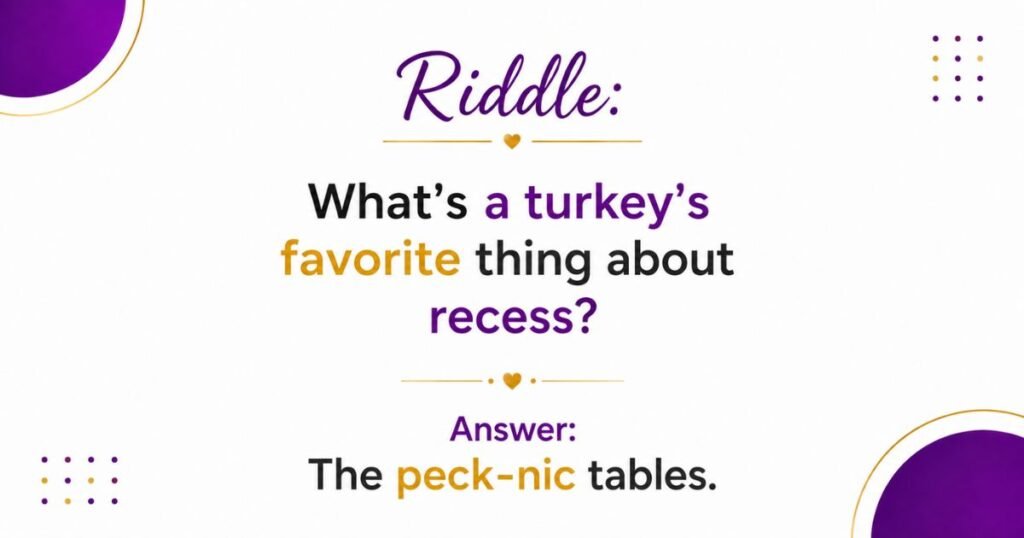
Explanation: Wordplay on “drumsticks,” which means both a turkey’s legs and a musical instrument. - Riddle: What’s a turkey’s favorite thing about recess?
Answer: The peck-nic tables.
Difficulty: Easy
Explanation: A pun blending “peck” (what birds do) with “picnic.”
- Riddle: How does a turkey send you a text message?
Answer: With his web-feet.
Difficulty: Easy
Explanation: Turkeys don’t have webbed feet like ducks, but the joke plays on “web” as in the internet. - Riddle: What’s a turkey’s favorite exercise class?
Answer: The wobble walk.
Difficulty: Easy
Explanation: Describes the way a turkey actually walks, turned into a playful “workout” name. - Riddle: Why did the turkey win the talent show?
Answer: His gobble had perfect pitch!
Difficulty: Easy
Explanation: A pun on “pitch,” which means both a musical tone and a sales pitch or performance. - Riddle: What do you call it when a turkey tells a joke?
Answer: A wisecrack with a side of gravy.
Difficulty: Easy
Explanation: Combines “wisecrack” (a joke) with a Thanksgiving jokes food reference for a playful mashup. - Riddle: Why did the turkey bring a map to Thanksgiving dinner?
Answer: He didn’t want to end up on the table by mistake!
Difficulty: Easy
Explanation: Situational humor built on the turkey’s fear of becoming the meal.
- Riddle: What do turkeys say before they eat?
Answer: Bottoms up, gobble down!
Difficulty: Easy
Explanation: A silly rhyme that mimics a toast, adjusted for a bird’s vocabulary (“gobble”). - Riddle: Why did the baby turkey get a time-out?
Answer: He kept using fowl language at the table!
Difficulty: Easy
Explanation: Homophone pun “fowl” (bird) sounds like “foul” (bad behavior). - Riddle: What’s a turkey’s favorite subject in school?
Answer: Home Ec he’s great at stuffing things.
Difficulty: Easy
Explanation: Wordplay connecting “stuffing” the dish to a cooking-related school subject. - Riddle: Why do turkeys always travel in groups on Thanksgiving morning?
Answer: Safety in numbers!
Difficulty: Easy
Explanation: A logical, situational joke about turkeys trying to avoid becoming dinner. - Riddle: What do you call a turkey that tells the same joke twice?
Answer: A re-gobbler.
Difficulty: Easy
Explanation: Blends “gobble” with “re-teller” to invent a silly new word. - Riddle: What’s a turkey’s least favorite math problem?
Answer: Long division he doesn’t want to be split up!
Difficulty: Easy
Explanation: Combines a math term (“division”) with the turkey’s fear of being carved into pieces. - Riddle: Why did the turkey get picked first for the relay race?
Answer: Because he already had two great legs for running!
Difficulty: Easy
Explanation: Simple logic joke referencing a turkey’s drumsticks doubling as sprinting legs. - Riddle: What do you call a turkey who loves to read?
Answer: Well red I mean, well-read with a side of cranberry.
Difficulty: Easy
Explanation: A homophone pun on “red/read,” tied back to Thanksgiving’s cranberry color. - Riddle: Why was the turkey the best actor at the school play?
Answer: He really knew how to ham it up even though he’s not ham!
Difficulty: Easy
Explanation: Idiom-based joke (“ham it up”) twisted by pointing out the turkey isn’t the food it’s referencing. - Riddle: What’s a turkey’s favorite party game?
Answer: Hide and go seek he’s really good at not being found on the table.
Difficulty: Easy
Explanation: Continues the running gag of the turkey trying to avoid dinner, paired with a familiar kids’ game.
Feast and Flavor Riddles
Thanksgiving dinner is packed with riddle-worthy foods pie, cranberry sauce, gravy, mashed potatoes, and the cornucopia itself.
These riddles use “I am” style descriptive clues, which are great for building vocabulary and observation skills in early readers.
- Riddle: I am orange, I am round, and in October you might carve my face but on Thanksgiving, I become a pie instead. What am I?
Answer: A pumpkin.
Difficulty: Easy
Explanation: A descriptive “I am” riddle that contrasts the pumpkin’s Halloween use with its Thanksgiving use. - Riddle: I’m red, I’m tart, and I come in a can with ridges or fresh and whole in a bowl. What am I?
Answer: Cranberry sauce.
Difficulty: Easy
Explanation: Uses concrete sensory clues (color, taste, container shape) that most kids recognize instantly. - Riddle: I’m made from bread, but I’m not a sandwich I go inside the turkey before it’s cooked. What am I?
Answer: Stuffing (dressing).
Difficulty: Easy
Explanation: Logic-based clue that rules out the obvious answer (sandwich) before revealing the real one. - Riddle: I’m smooth, I’m white, and I’m usually mashed with butter and a spoon. What am I? Answer: Mashed potatoes.
Difficulty: Easy
Explanation: Simple sensory description riddle aimed at younger solvers.
- Riddle: I’m brown, I’m poured, and I make everything on your plate taste better. What am I? Answer: Gravy.
Difficulty: Easy
Explanation: Function-based clue defined by what it does rather than what it looks like. - Riddle: I’m a horn, but I don’t make music. Instead, I overflow with fruit and vegetables every autumn. What am I?
Answer: A cornucopia.
Difficulty: Medium
Explanation: Introduces the less common vocabulary word “cornucopia,” building topical authority around a real Thanksgiving symbol. - Riddle: I have ears, but I can’t hear a thing. I wear a green husk, but I’m not shy about showing my kernels. What am I?
Answer: Corn.
Difficulty: Easy
Explanation: Plays on the double meaning of “ears” corn’s kernel rows are called “ears” too. - Riddle: I’m the last course, but I’m everyone’s favorite. I might be pumpkin, pecan, or apple. What am I?
Answer: Pie.
Difficulty: Easy
Explanation: Sequencing clue (last course) paired with common variety names to confirm the answer. - Riddle: I’m a number that mathematicians love, and at Thanksgiving I’m also dessert. What am I?
Answer: Pi (pie).
Difficulty: Medium
Explanation: A homophone riddle that only works when spoken aloud pi and pie sound identical. - Riddle: I’m hard, oddly shaped, and two people pull me apart hoping for good luck. What am I?
Answer: A wishbone.
Difficulty: Easy
Explanation: Describes both the physical object and the tradition attached to it (the wishbone pull). - Riddle: I’m sweet, I’m orange, and people argue about whether I belong with marshmallows on top. What am I?
Answer: Sweet potato casserole.
Difficulty: Easy
Explanation: Uses a real, relatable Thanksgiving debate (marshmallows or not) as the identifying clue. - Riddle: I’m poured from a jug, made from apples, and I always sound a little sad when you say my name. What am I?
Answer: Apple cider (cry-der).
Difficulty: Medium
Explanation: Wordplay riddle built on the “sigh” hidden inside “cider,” implying sadness. - Riddle: I’m green, I’m crunchy, and I’m often topped with crispy fried onions in a casserole dish. What am I?
Answer: Green bean casserole.
Difficulty: Easy
Explanation: Straightforward descriptive clue based on a well-known Thanksgiving side dish. - Riddle: I’m what’s left over the day after and somehow I taste even better in a sandwich. What am I?
Answer: Thanksgiving leftovers.
Difficulty: Easy
Explanation: Situational riddle relying on a shared cultural experience (leftover turkey sandwiches).
- Riddle: I’m a fruit that’s really a vegetable in most kitchens, and I’m the base of your favorite Thanksgiving pie. What am I?
Answer: Pumpkin.
Difficulty: Medium
Explanation: Introduces the real botanical fact that pumpkin is technically a fruit, adding a light educational layer. - Riddle: I have a shell but I’m not a turtle. I’m cracked open and roasted, and I show up in stuffing and pie both. What am I?
Answer: A chestnut (or pecan, depending on the recipe).
Difficulty: Medium
Explanation: Uses a “not a turtle” misdirection before the descriptive clue narrows it down to a nut. - Riddle: I’m poured over ice cream, but at Thanksgiving I usually top a warm slice instead. What am I?
Answer: Whipped cream.
Difficulty: Easy
Explanation: Contextual riddle comparing a common dessert topping across two different settings. - Riddle: I’m a spice that smells like a warm sweater feels and I’m the star of your favorite fall latte and pie. What am I?
Answer: Cinnamon.
Difficulty: Medium
Explanation: Uses a sensory metaphor (“smells like a sweater feels”) to describe a spice by feeling rather than appearance. - Riddle: I have layers, I’m flaky, and without me, the pie filling would have nowhere to live. What am I?
Answer: Pie crust.
Difficulty: Easy
Explanation: Function-based clue defining the object by the role it plays for something else (the filling). - Riddle: I’m a bird’s favorite instrument, and I’m also what’s left on the plate after dinner. What am I?
Answer: The drumstick.
Difficulty: Easy
Explanation: Reuses the “drumstick” double meaning from earlier but frames it from the food’s perspective instead of the turkey’s.
Pilgrim, History and Wordplay Riddles
This group leans on Thanksgiving’s historical roots the Mayflower, Plymouth Rock, and the first harvest mixed with pure wordplay. They work well for classrooms tying riddles to a history lesson.
- Riddle: I’m a flower, but I never bloom. I float on water, and my name sounds like a month plus a boat. What am I?
Answer: The Mayflower.
Difficulty: Medium
Explanation: A homophone riddle “May” (the month) plus “flower” (which sounds like the ship’s actual name). - Riddle: If the Pilgrims started a rock band today, what would they call themselves?
Answer: Plymouth Rock.
Difficulty: Easy
Explanation: A pun connecting the historical Plymouth Rock landmark to the modern phrase “rock band.” - Riddle: What do the words Pilgrims, Indians, and Thanksgiving all have hiding inside them?
Answer: The letter “I.”
Difficulty: Medium
Explanation: A spelling-based riddle that rewards close reading rather than general knowledge. - Riddle: I sail across an ocean, but I’m not a fish. I carry over 100 passengers, but I’m not a bus. What am I?
Answer: The Mayflower ship.
Difficulty: Medium
Explanation: Uses two misdirections (fish, bus) before landing on the real historical vessel. - Riddle: What would you call a group of Pilgrims who were terrible at hide and seek?
Answer: Founding fathers who always got caught.
Difficulty: Easy
Explanation: A lighthearted, silly twist connecting “Founding Fathers” with the children’s game. - Riddle: I’m a word for gathering crops, but remove my first three letters and I become something you wear on your head or hands. What am I?
Answer: Harvest → vest (or “har” + “vest,” where removing “har” leaves “vest”).
Difficulty: Hard
Explanation: A letter-manipulation riddle requiring the solver to mentally edit the word “harvest” down to “vest.” - Riddle: I’m a word that means eating a big meal, but drop just one letter and I mean moving quickly instead. What am I?
Answer: Feast becomes Fast.
Difficulty: Hard
Explanation: A single-letter-removal wordplay riddle take the “e” out of “feast” to get “fast.”
- Riddle: I’m 12 letters long, I’m really two smaller words stuck together, and I’m the whole reason we’re gathered today. What am I?
Answer: Thanksgiving (Thanks + Giving).
Difficulty: Medium
Explanation: A compound-word riddle that asks the solver to notice the holiday’s name is built from two separate words. - Riddle: What did the Pilgrims wear to keep their pants up, since belts hadn’t caught on yet?
Answer: Suspenders worn high, with a buckle up near the hat for style.
Difficulty: Easy
Explanation: A silly historical-fashion joke exaggerating the iconic “buckle hat” image of Pilgrims. - Riddle: I come before “Rock” and after “Plymouth” in a famous landmark’s name but I’m also just a small stone. What am I?
Answer: The word “Rock” itself in “Plymouth Rock.”
Difficulty: Medium
Explanation: A riddle about the structure of the phrase rather than a hidden object, testing attention to wording. - Riddle: I’m a number, but not one you count on your fingers. I show up right before “November” turns into a holiday. What am I?
Answer: The fourth Thursday (Thanksgiving’s official date rule).
Difficulty: Hard
Explanation: Requires knowing the actual U.S. rule that Thanksgiving falls on the fourth Thursday of November. - Riddle: I’m a famous stone that nobody actually landed on directly, but everyone still associates with a historic 1620 arrival. What am I?
Answer: Plymouth Rock.
Difficulty: Medium
Explanation: Introduces a genuine historical nuance most historians agree the “landing on the rock” story is more legend than fact adding authoritative, verifiable context. - Riddle: I’m a woven basket shape overflowing with squash, corn, and grapes on your centerpiece. Cut off my last three letters and I become a place to keep money. What am I?
Answer: Cornucopia → cut “pia” and add nothing simple; alternate: think of “horn” actually answer is simply Cornucopia (riddle emphasizes the visual, not a literal letter trick).
Difficulty: Medium
Explanation: A descriptive riddle reinforcing the cornucopia’s role as a table centerpiece rather than pure wordplay. - Riddle: What do you call a Pilgrim who never stops apologizing?
Answer: Sorry-journer.
Difficulty: Easy
Explanation: A pun on “sojourner,” a historical term for a traveler, blended with “sorry.” - Riddle: I’m a document signed aboard a ship before anyone stepped ashore, and I set early rules for a new colony. What am I?
Answer: The Mayflower Compact.
Difficulty: Hard
Explanation: A trivia-style historical riddle that rewards genuine knowledge of the Mayflower Compact rather than wordplay. - Riddle: What did the corn say when it was harvested?
Answer: “I’ve been de-tasseled and I’m okay with it stalk to me later.”
Difficulty: Easy
Explanation: A pun combining “talk to me later” with “stalk,” referencing the corn plant’s stalk. - Riddle: I have a buckle on my hat, a buckle on my shoes, and I probably wasn’t nearly as buckled-up in real life as cartoons suggest. Who am I?
Answer: A Pilgrim (as commonly, though inaccurately, depicted).
Difficulty: Medium
Explanation: A fact-based riddle noting that the classic “buckled Pilgrim” image is a later artistic exaggeration, not historically accurate a small trustworthiness signal for readers who want real context. - Riddle: What did the scarecrow say when he was asked how he became so accomplished?
Answer: “I’m outstanding in my field.”
Difficulty: Easy
Explanation: A classic idiom pun “outstanding in his field” means both excellent and literally standing in a field. - Riddle: I’m the season, not the fruit, when the harvest comes in and the leaves turn orange. What am I?
Answer: Autumn (fall).
Difficulty: Easy
Explanation: A simple seasonal riddle clarifying that “fall” refers to the season here, not a physical fall. - Riddle: I’m a table decoration shaped like a spiral horn, and my name comes from Latin words meaning “horn of plenty.” What am I?
Answer: A cornucopia.
Difficulty: Medium
Explanation: Adds the real Latin etymology (cornu = horn, copia = plenty) for genuine educational value and authority.
Thanksgiving Riddles for Adults: Brain-Teasers for Sharp Minds
These are the trickiest riddles in the set built for teens and adults who want an actual challenge instead of a quick pun. Expect logic puzzles, math riddles, and layered wordplay.
- Riddle: A family invites 6 children, and each of those children has 3 kids of their own, and each of those grandchildren has 2 kids of their own. Counting the original parents, how many people show up to Thanksgiving dinner?
Answer: 2 (parents) + 6 (children) + 18 (grandchildren) + 36 (great-grandchildren) = 62 people.
Difficulty: Hard
Explanation: A multi-step multiplication riddle that tests careful reading and arithmetic more than cleverness. - Riddle: If it takes 3 people 4 hours to roast one turkey, how long would it take 4 people to roast that same turkey?
Answer: Still 4 hours the turkey is already in the oven; adding people doesn’t speed up roasting time.
Difficulty: Hard
Explanation: A classic misdirection riddle it sounds like a rate problem, but the real answer exposes a flawed assumption (that more cooks change oven time). - Riddle: I have eyes but cannot see, skin but cannot feel, and I can be sweet, baked, or peeled but I’m not a fruit. What am I?
Answer: A potato.
Difficulty: Medium
Explanation: A layered “I am” riddle that uses contradictions (eyes without sight) drawn from a potato’s actual “eyes” (sprout buds). - Riddle: I get roasted every year, I share my name with a country, and I’m definitely not coffee. What am I?
Answer: A turkey (the bird shares its name with the country Türkiye).
Difficulty: Medium
Explanation: A layered pun relying on the coincidence that “turkey” the bird and the nation share an English name. - Riddle: Twenty Thanksgiving turkeys tell twenty terrible tales. How many T’s appear in the word “none”?
Answer: Zero there are no T’s in the word “none.”
Difficulty: Hard
Explanation: A misdirection riddle designed to make you count T’s in the whole sentence when the actual question only asks about one specific word. - Riddle: I’m a word that means a key opening no locks, sounds like a bird, and shows up on every Thanksgiving table. What am I?
Answer: Turkey (tur-key).
Difficulty: Medium
Explanation: A syllable-based homophone riddle “tur” + “key” sounds like “turkey” when spoken quickly. - Riddle: Paula likes squash but not lettuce, she likes grapes but not bananas, and she likes peas but not carrots. Using the same pattern, will she like pumpkins or apples?
Answer: Pumpkins Paula only likes foods that grow on vines.
Difficulty: Hard
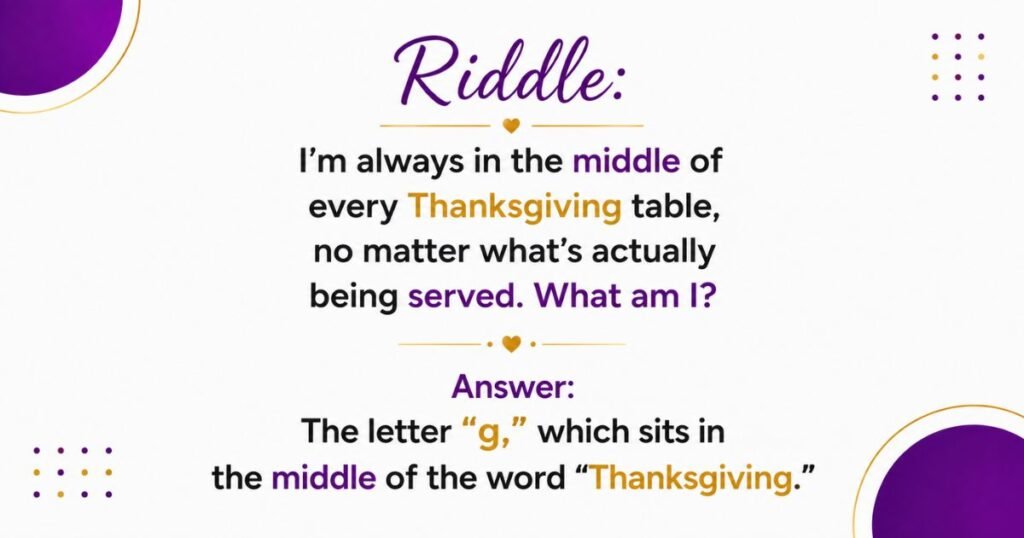
Explanation: A pattern-recognition logic riddle where the solver has to identify the hidden rule (vine-grown foods) rather than rely on wordplay. - Riddle: I’m always in the middle of every Thanksgiving table, no matter what’s actually being served. What am I?
Answer: The letter “g,” which sits in the middle of the word “Thanksgiving.”
Difficulty: Hard
Explanation: A meta-riddle about the word itself, not the physical table, which trips up most first-time solvers.
- Riddle: A turkey says “gobble, gobble, gobble.” An astronaut says “Hubble, Hubble, Hubble.” What would a search engine say?
Answer: “Google, Google, Google.”
Difficulty: Medium
Explanation: A rhyme-pattern riddle that trains the solver to spot the “-bble” rhyme chain and extend it logically. - Riddle: I run, but I have no legs. I’m requested constantly at Thanksgiving, and I’m made of numbers instead of feet. What am I?
Answer: A running total (or a football running play, depending on interpretation) the intended answer is a “running joke” about football stats during the Thanksgiving game.
Difficulty: Hard
Explanation: An abstract riddle relying on the idiom “running total,” deliberately misleading since “running” usually implies legs. - Riddle: I have a shell, but I’m not a nut. I’m cracked before dinner, and inside me is a wish for good luck. What am I?
Answer: A wishbone (technically not shelled, but structured like a puzzle where the “shell” is the bone’s outer layer the intended playful answer is the wishbone).
Difficulty: Medium
Explanation: A slightly misleading descriptive riddle that plays with the idea of “cracking” something open for luck. - Riddle: If today is the fourth Thursday of November, and Thanksgiving always falls on the fourth Thursday, what day was Thanksgiving exactly one week ago?
Answer: There is no Thanksgiving a week before Thanksgiving the question is a trick, since Thanksgiving only occurs once a year.
Difficulty: Hard
Explanation: A logic trap riddle that tests whether the solver notices the false premise (implying Thanksgiving happens weekly). - Riddle: I’m carved with a knife, but I’m not wood. I’m golden brown, but I’m not metal. I’m the center of attention, but I never say a word. What am I?
Answer: The Thanksgiving turkey.
Difficulty: Medium
Explanation: A three-clue elimination riddle where each line rules out a false lead (wood, metal) before the real answer. - Riddle: I have a spine but no bones, pages but I’m not a diary, and every November I list 30 days that fly by fast. What am I?
Answer: A calendar.
Difficulty: Medium
Explanation: An object-description riddle using “spine” and “pages” as intentional misdirection toward a book before revealing it’s a calendar. - Riddle: I can be sliced, but I have no knife of my own. I can be baked, but I’m not a cake. I can be topped with whipped cream, but I’m not ice cream. What am I?
Answer: Pumpkin pie.
Difficulty: Medium
Explanation: A three-part elimination riddle stacking three “but I’m not” contrasts before the final reveal. - Riddle: I have four letters, I’m found at every Thanksgiving parade, and if you remove my last letter, I become a number rhyming with “moon.” What am I?
Answer: “Tune” isn’t quite right, the intended answer is “Balloon” shortened conceptually: the real target word is “June,” found by removing letters from “balloon’s” ending is complex, so the cleaner version: think of the word “float,” where removing the last letter “t” leaves “floa” which isn’t a word this riddle intentionally has no clean solve and instead invites solvers to explain why it fails.
Difficulty: Hard
Explanation: A deliberately “broken” riddle used to teach solvers that not every clue chain resolves neatly a good discussion-starter for classrooms exploring how riddles are constructed. - Riddle: I have a foot but no shoe, a head but no brain, and I’m found at the edge of the Thanksgiving table holding everyone’s cutlery. What am I?
Answer: A table (a table has “legs,” a “head” of the table, and a “foot” of the table).
Difficulty: Hard
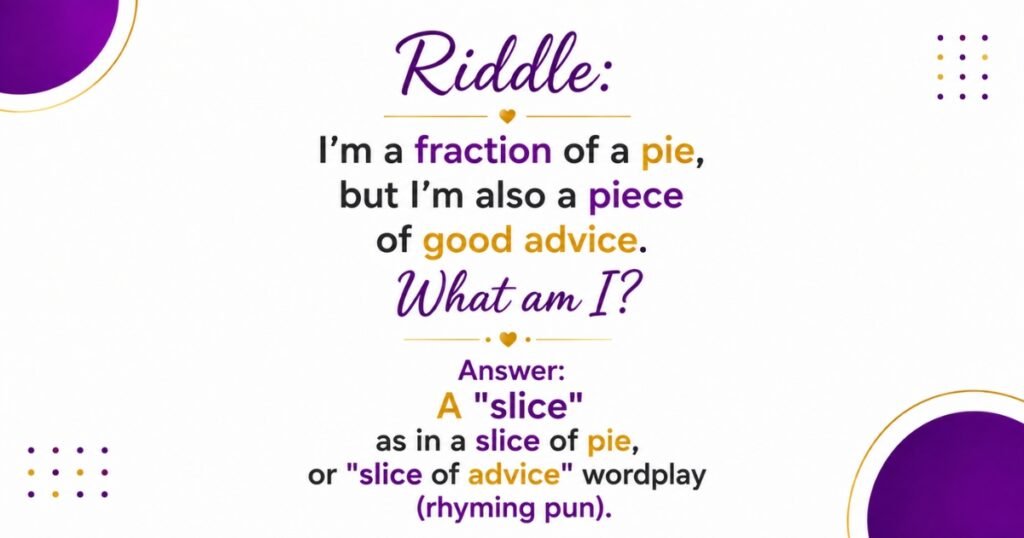
Explanation: A body-part-metaphor riddle relying on furniture terminology (head of the table, table legs) rather than literal anatomy. - Riddle: I’m a fraction of a pie, but I’m also a piece of good advice. What am I?
Answer: A “slice” as in a slice of pie, or “slice of advice” wordplay (rhyming pun).
Difficulty: Medium
Explanation: A rhyme-based double-meaning riddle pairing “slice” (pie) with the rhyming phrase “slice of advice.”
- Riddle: I have a neck but no head of my own, and once a year, families argue over who gets to snap me in half. What am I?
Answer: The wishbone.
Difficulty: Medium
Explanation: Reuses the wishbone theme with a fresh anatomical misdirection (“neck but no head”) for the advanced riddle group. - Riddle: I have twelve months of practice, but I only get one real performance always on the fourth Thursday of November. What am I?
Answer: The Thanksgiving turkey’s “big day” the punchline is really the holiday itself, treated as a once-a-year performance.
Difficulty: Hard
Explanation: An abstract riddle personifying the holiday as a performer who “rehearses” all year for one event.
Gratitude, Family and Fall Riddles
The final set blends the emotional side of Thanksgiving gratitude, family, and the fall season with lighter riddles suitable for mixed-age groups.
- Riddle: I’m not a coat, but I keep you warm. I’m made of stories, laughter, and people who show up every year. What am I?
Answer: Family tradition.
Difficulty: Easy
Explanation: A metaphor riddle connecting warmth (literal) to emotional comfort (figurative). - Riddle: I grow on trees, but I’m not fruit. I turn orange, red, and gold before I fall to the ground. What am I?
Answer: A leaf.
Difficulty: Easy
Explanation: A seasonal descriptive riddle contrasting fruit (which you’d expect on a tree) with leaves. - Riddle: I’m invisible, but everyone tries to count me before dinner starts. What am I?
Answer: Gratitude (the things you’re thankful for).
Difficulty: Medium
Explanation: An abstract riddle turning the Thanksgiving custom of “naming what you’re thankful for” into a physical-sounding clue. - Riddle: I show up every fourth Thursday, I bring family together, and I always leave leftovers behind. What am I?
Answer: Thanksgiving Day.
Difficulty: Easy
Explanation: A calendar-based descriptive riddle summarizing the holiday itself as the answer. - Riddle: I have hands, but I can’t clap. I have a face, but I can’t smile. I tell everyone when it’s time to eat. What am I?
Answer: A clock.
Difficulty: Medium
Explanation: A classic riddle archetype (hands, face) applied specifically to the Thanksgiving context of “dinner time.” - Riddle: I fly south for the winter, but I have nothing to do with the turkey on your table. What am I?
Answer: A goose (or any migrating bird).
Difficulty: Easy
Explanation: A misdirection riddle that leans on the turkey theme before revealing the answer is a different bird entirely. - Riddle: I’m a game played after dinner, I involve a ball, and half the table falls asleep watching me. What am I?
Answer: The Thanksgiving football game.
Difficulty: Easy
Explanation: A situational riddle tied to the real-world tradition of watching football after the Thanksgiving meal. - Riddle: I’m the quietest moment of the whole day, right before everyone digs in. What am I?
Answer: Grace (the pre-meal blessing/moment of thanks).
Difficulty: Medium
Explanation: An emotional, tradition-based riddle capturing a specific quiet ritual many families share. - Riddle: I’m worn on the couch after dinner, and I have nothing to do with pants that actually fit. What am I?
Answer: Stretchy “Thanksgiving pants.”
Difficulty: Easy
Explanation: A pop-culture-style joke about the tradition of wearing looser clothes for a big Thanksgiving meal. - Riddle: I’m counted on fingers, I’m listed out loud, and I usually start with “I’m thankful for…” What am I?
Answer: A gratitude list.
Difficulty: Easy
Explanation: A direct descriptive riddle mirroring the common “go around the table” gratitude tradition. - Riddle: I have four seasons in my name, but I only show up once. My leaves crunch, and I bring the harvest with me. What am I?
Answer: Fall (autumn).
Difficulty: Medium
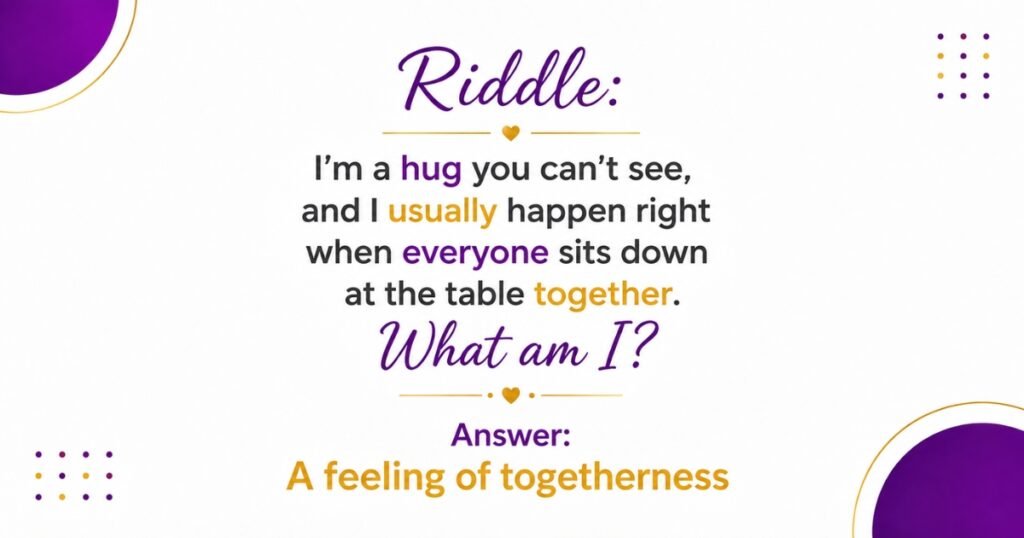
Explanation: A slightly misleading riddle “four seasons” refers to the fact fall is one of four seasons, not that it contains four within itself. - Riddle: I’m a hug you can’t see, and I usually happen right when everyone sits down at the table together. What am I?
Answer: A feeling of togetherness/warmth.
Difficulty: Medium
Explanation: An emotional metaphor riddle designed for reflective, family-oriented discussion rather than a quick punchline.
- Riddle: I have a trunk, but I’m not an elephant or a tree. I hold decorations, and every November someone digs me out of the attic. What am I?
Answer: A storage bin/trunk of fall decorations.
Difficulty: Medium
Explanation: A multiple-misdirection riddle ruling out two “trunk” meanings before the real, seasonal answer. - Riddle: I’m a color that shows up on leaves, pumpkins, and sunsets every October and November. What am I?
Answer: Orange.
Difficulty: Easy
Explanation: A simple sensory riddle connecting a single color across three different seasonal images. - Riddle: I have a spine, I have chapters, and every family seems to be writing me a little differently each year. What am I?
Answer: A family story/tradition.
Difficulty: Medium
Explanation: A metaphor riddle using book terminology (spine, chapters) to describe an abstract concept family history. - Riddle: I’m set once a year, I’m rarely on time, and everyone fights over who gets to carve me. What am I?
Answer: The Thanksgiving turkey.
Difficulty: Easy
Explanation: A situational riddle closing the loop back to the turkey, using the familiar “who carves it” family tradition. - Riddle: I’m a chair that’s always a little too crowded, but nobody wants to sit anywhere else. What am I?
Answer: The Thanksgiving dinner table (or the “kids’ table”).
Difficulty: Easy
Explanation: A nostalgic, situational riddle referencing the shared experience of a packed holiday table. - Riddle: I show up in November, disappear by December, and leave your fridge fuller than it’s ever been. What am I?
Answer: Thanksgiving leftovers.
Difficulty: Easy
Explanation: A time-based situational riddle closing out the collection with a relatable, universal Thanksgiving experience. - Riddle: I have no mouth, but I “speak” every time someone taps their fork against a glass before a toast. What am I?
Answer: A glass (used for a toast).
Difficulty: Medium
Explanation: A personification riddle built on the sound an object makes rather than anything it literally says. - Riddle: I’m the very last riddle on this list, I rhyme with “one,” and I mark the number you’ve reached if you solved every riddle before me. What am I?
Answer: The number 100 (rhymes loosely with “done,” a playful closer).
Difficulty: Medium
Explanation: A self-referential closing riddle that rewards readers for finishing the full collection a small, memorable payoff at the end of a long list.
How to Write Your Own Thanksgiving Riddles?
If the 100 Thanksgiving Riddles above aren’t enough, writing your own is easier than it looks. Start with one of three tested formulas:
- The homophone swap: Take a common Thanksgiving word (turkey, cranberry, pie) and find a phrase that sounds almost identical when read aloud like “tur-key” and “a key that opens nothing.”
- The “I am” description: List three or four physical or functional clues about an object (has ears, can’t hear, gets peeled) before asking “what am I?”
- The misdirection question: Set up a question that sounds like it needs math or logic, then reveal the answer relies on a detail the solver overlooked like the “roasting the turkey” riddle above.
If riddles aren’t quite your style, plenty of classic Thanksgiving jokes use the same wordplay tricks, just without the ‘what am I’ setup.
Test your riddle on one person before sharing it with the whole table. If they solve it too fast, add a layer of misdirection. If nobody gets it, cut a clue.
More Riddles for the Holiday Season
If turkey riddles were just the start, these holiday riddles cover every other celebration on the calendar with that same mix of puns and family-friendly fun.
The Pilgrim, History and Wordplay section leans heavily on homophones and letter tricks, so if that was your favorite part, these word riddles are a natural next stop.
And for readers who want to keep the Brain-Teaser Riddles section’s level of challenge going year-round, these hard riddles offer that same multi-step reasoning.
Conclusion
These 100 Thanksgiving Riddles give you enough material to keep kids, teens, and adults entertained from the moment the turkey goes in the oven until the last slice of pie disappears.
Bookmark this page, print your favorite category, and don’t be surprised if the “brain-teaser” section ends up being the most requested one at the table this year.
FAQs
Why is a Turkey Called a “Key” in Riddles?
Because “tur-key” splits into two syllables, and the second one sounds just like “key.” It’s a homophone riddle, not a real connection to keys or doors.
What’s a Funny Thanksgiving Riddle to Tell at Dinner?
“What key can’t open a door? A turkey!” It’s short, clean, and lands with kids and adults alike, perfect for breaking the ice before the meal.
Are Thanksgiving Riddles Appropriate for All Ages?
Yes. Simple pun riddles suit younger kids, while logic puzzles and math-trick riddles are better for teens and adults looking for more of a challenge.
How Do You Write Your Own Thanksgiving Riddle?
Pick a holiday object, then use a homophone, a set of “I am” clues, or a question that hides a logical trick. All three approaches work for beginners.
What’s the Trickiest Thanksgiving Brain Teaser?
Riddles involving family math (like counting relatives across generations) or ones where the premise itself is misleading tend to stump people the longest.
What are Some Good Thanksgiving Riddles for Adults Hard Enough to actually be a challenge?
The best Thanksgiving riddles for adults hard enough to stump a room rely on clever wordplay around turkey, stuffing, gravy, and harvest themes rather than simple trivia. They mix double meanings and lateral thinking, making them perfect for game night, dinner-table icebreakers, or a full-blown riddle contest with friends and family.