Tree Riddle: 70+ Best Riddles About Trees, Forests And Leaves (With Answers)
A Tree riddle is a short brain teaser where the hidden answer is a tree or a tree-related object like a leaf, forest, or acorn.
Most use wordplay on terms like “trunk,” “branches,” “bark,” and “rings” to build clever double meanings. Tree riddles are popular for classrooms, nature walks, and family game nights.
After running these riddles on nature walks, in elementary classrooms, and during long car rides past miles of forest, one thing always stands out: kids remember a tree riddle far longer than a plain fact about photosynthesis.
This guide collects 70 completely original tree riddles sorted from easy to hard plus a plain-English explanation of the wordplay, science, or logic behind each one, so the “aha” moment actually teaches something.
Why Tree Riddles Work So Well for Nature Learning?
Tree riddles succeed because trees already live a kind of double life in language. A trunk is also luggage storage. Bark is also a dog’s bark. Leaves are also pages in a book.
Rings are also jewelry. That built-in ambiguity is exactly what a good riddle needs, and it happens to make trees one of the richest subjects in the entire riddle genre.
That overlap is also why tree riddles are so useful in a classroom or nature program. Solving one requires the same skill as identifying a pun or catching wordplay in a poem: holding two meanings of a word in your head and figuring out which one actually fits the clue.
Layer in a few genuine science facts how tree rings reveal age, or how sap becomes maple syrup and a simple riddle turns into a memorable mini-lesson.
Easy Tree Riddles (Great for Kids and Beginners)
These riddles rely on a single, clear double meaning, so young solvers get a quick, satisfying “aha” moment.
- Riddle: I have a trunk but I’m not an elephant or a car. What am I
Answer: A tree.
Difficulty: Easy
Explanation: Plays on “trunk” the word for an elephant’s nose, a car’s storage space, and a tree’s main stem. - Riddle: I have branches but no bank account. What am I?
Answer: A tree.
Difficulty: Easy
Explanation: Contrast a tree’s limbs with a bank’s branch locations. - Riddle: I have leaves but I never read a book. What am I?
Answer: A tree.
Difficulty: Easy
Explanation: Plays on “leaves” as foliage rather than book pages. - Riddle: I have bark but I never make a sound. What am I?
Answer: A tree.
Difficulty: Easy
Explanation: Contrasts a tree’s protective bark with the sound a dog makes. - Riddle: I have rings but I’m not married. What am I?
Answer: A tree.
Difficulty: Easy
Explanation: A classic double-meaning riddle growth rings versus wedding rings - Riddle: I stand tall in a forest, but I have no legs. What am I?
Answer: A tree.
Difficulty: Easy
Explanation: A simple riddle highlighting height without the ability to walk - Riddle: Birds build their homes in me, but I’m not an apartment building. What am I? Answer: A tree.
Difficulty: Easy
Explanation: Introduces the idea of trees as natural homes for wildlife. - Riddle: I give you shade on a hot day without ever using an umbrella. What am I?
Answer: A tree.
Difficulty: Easy
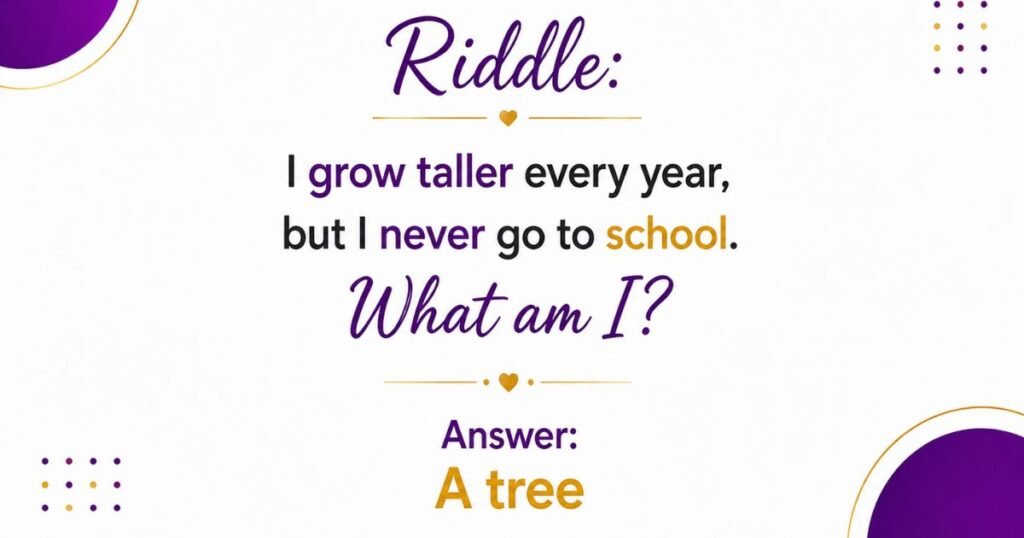
Explanation: Compares a tree’s canopy to a manmade umbrella. - Riddle: I grow taller every year, but I never go to school. What am I?
Answer: A tree.
Difficulty: Easy
Explanation: Playfully compares a tree’s yearly growth to a student’s grade progression.
- Riddle: My roots go down deep, but I never dig with a shovel. What am I?
Answer: A tree.
Difficulty: Easy
Explanation: Introduces the idea of roots growing without human tools - Riddle: I drop my leaves every fall, but I never feel embarrassed. What am I?
Answer: A deciduous tree.
Difficulty: Easy
Explanation: Introduces the word “deciduous” through a lighthearted twist on “dropping” something. - Riddle: I stay green all winter long, even when everyone else changes their coat. What am I? Answer: An evergreen tree.
Difficulty: Easy
Explanation: Introduces “evergreen” as a category, contrasted with deciduous trees that change color - Riddle: I’m a baby tree, but I never cry or need a nap. What am I?
Answer: A sapling.
Difficulty: Easy
Explanation: Introduces the term “sapling” for a young tree. - Riddle: You can climb me, but I’m not a ladder or a mountain. What am I?
Answer: A tree.
Difficulty: Easy
Explanation: A simple contrast riddle about climbable objects. - Riddle: I hold a swing, but I don’t go to the playground. What am I?
Answer: A tree.
Difficulty: Easy
Explanation: Ties into the common image of a tire swing hanging from a tree branch. - Riddle: I can grow apples, but I’m not a grocery store. What am I?
Answer: An apple tree.
Difficulty: Easy
Explanation: A straightforward riddle introducing a specific fruit-tree type. - Riddle: I turn sunlight into food, but I don’t have a kitchen. What am I?
Answer: A tree.
Difficulty: Easy
Explanation: Introduces the concept of photosynthesis in simple, kid-friendly terms. - Riddle: I make oxygen for you to breathe, but I never even take a breath myself. What am I? Answer: A tree.
Difficulty: Easy
Explanation: Highlights a tree’s role in producing oxygen, a basic and verifiable science fact. - Riddle: I’m decorated with lights and ornaments every December. What am I?
Answer: A Christmas tree.
Difficulty: Easy
Explanation: A seasonal riddle tied to a widely recognized holiday tradition. - Riddle: I’m a house built in the branches, perfect for kids to play in. What am I?
Answer: A treehouse.
Difficulty: Easy
Explanation: A compound-word riddle combining “tree” with “house.” - Riddle: I show your family’s history using branches instead of photos. What am I?
Answer: A family tree.
Difficulty: Easy
Explanation: Introduces the idiom “family tree” as a genealogy chart. - Riddle: I’m full of trees, but I’m not a garden or a park. What am I?
Answer: A forest.
Difficulty: Easy
Explanation: Distinguishes a forest from smaller, human-planted green spaces. - Riddle: I fall from trees in autumn and crunch under your feet. What am I?
Answer: A fallen leaf.
Difficulty: Easy
Explanation: Ties into the seasonal, sensory experience of walking through fall leaves. - Riddle: I’m small and hard, and squirrels love to bury me for winter. What am I?
Answer: An acorn.
Difficulty: Easy
Explanation: Introduces a specific tree seed alongside a well-known animal behavior. - Riddle: I hang from a pine tree and I’m full of seeds inside my scales. What am I?
Answer: A pinecone.
Difficulty: Easy
Explanation: Describes the structure and function of a pinecone in simple language. - Riddle: I stand tall through wind and rain, my branches reach but bring no pain, birds nest in me, kids climb my frame what am I, of forests fame?
Answer: A tree
Difficulty: Easy
Explanation: This fits tree riddles with answers since it uses simple, familiar imagery (branches, birds nesting, climbing) that makes the answer easy to guess.
Medium Tree Riddles (A Bit More of a Challenge)
This tier introduces real tree-science vocabulary and specific species, asking solvers to connect a description to a more precise answer.
- Riddle: I have leaves, a trunk, and roots, but I never leave my spot my whole life. What am I? Answer: A tree
.Difficulty: Medium
Explanation: Highlights a tree’s permanence, playing off the “leave” pun hidden inside “leaves.” - Riddle: I lose my leaves every autumn and grow them back every spring, without ever going shopping for new ones. What am I?
Answer: A deciduous tree.
Difficulty: Medium
Explanation: Reinforces the deciduous cycle with a playful “shopping” twist. - Riddle: Count my rings and you’ll know exactly how old I am, without ever asking me directly. What am I?
Answer: A tree.
Difficulty: Medium
Explanation: References the real scientific method of dendrochronology counting growth rings to determine a tree’s age. - Riddle: I’m the toughest layer protecting a tree, rougher than skin, yet the tree still “breathes” through me. What am I?
Answer: Bark.
Difficulty: Medium
Explanation: Introduces bark’s protective function while noting that trees exchange gases through small pores in it. - Riddle: I’m the sticky liquid inside a tree that some people boil down into syrup. What am I? Answer: Sap.
Difficulty: Medium
Explanation: Connects to the real process of making maple syrup from tree sap. - Riddle: I’m the tree that produces the syrup people pour on pancakes. What tree am I? Answer: A maple tree (specifically the sugar maple).
Difficulty: Medium
Explanation: A verifiable, specific fact about the source of maple syrup. - Riddle: My leaves droop low and sway like hair in the wind, and I often grow near water. What tree am I?
Answer: A weeping willow.
Difficulty: Medium
Explanation: A descriptive riddle for a distinct, easily recognizable tree species. - Riddle: I grow near the equator, have no branches until the very top, and my fruit contains sweet water inside. What tree am I?
Answer: A coconut palm tree.
Difficulty: Medium
Explanation: Combines geography and biology clues pointing to one specific, well-known tree. - Riddle: I’m one of the tallest living things on Earth, and I grow along the coast of California. What tree am I?
Answer: A coast redwood.
Difficulty: Medium
Explanation: References a real, verifiable fact coast redwoods are among the tallest trees on the planet. - Riddle: I’m shaped small on purpose, grown in a shallow pot, and I take years of careful trimming. What am I?
Answer: A bonsai tree.
Difficulty: Medium
Explanation: Introduces the Japanese art of bonsai cultivation - Riddle: I’m cut down, sliced into boards, and used to build houses and furniture. What have I become?
Answer: Lumber (timber).
Difficulty: Medium
Explanation: Traces a tree’s transformation into a building material. - Riddle: I’m what’s left in the ground after a tree is cut down, and kids sometimes count my rings. What am I?
Answer: A stump.
Difficulty: Medium
Explanation: Distinguishes a stump from the standing tree or the felled log. - Riddle: I’m the layer of dead leaves, twigs, and soil covering the ground beneath a forest’s trees. What am I?
Answer: The forest floor.
Difficulty: Medium
Explanation: Introduces an ecological term describing a forest’s lowest layer.
- Riddle: I’m the very top layer of a forest, where the leaves and branches meet the sky. What am I?
Answer: The canopy.
Difficulty: Medium
Explanation: Introduces the ecological term for a forest’s upper layer, often home to the most wildlife. - Riddle: A person who studies and cares for trees professionally is called what?
Answer: An arborist.
Difficulty: Medium
Explanation: Introduces the professional term for a tree-care expert. - Riddle:I’m the type of tree that keeps its needles all year, common on Christmas tree farms. What kind of tree am I?
Answer: A coniferous (evergreen) tree.
Difficulty: Medium
Explanation: Reinforces the evergreen/coniferous vocabulary through a familiar holiday context. - Riddle: I’m a tropical tree whose leaves are sometimes woven into hats and baskets. What tree am I?
Answer: A palm tree.
Difficulty: Medium
Explanation: Ties a well-known tree type to a real-world craft use. - Riddle: I’m the seed of an oak tree, and mighty oaks are said to grow from me. What am I? Answer: An acorn.
Difficulty: Medium
Explanation: Reinforces the popular saying “mighty oaks from little acorns grow.” - Riddle: I help trees “talk” to each other underground through a web of fungus. What am I sometimes nicknamed?
Answer: The “wood wide web” (a mycorrhizal fungal network).
Difficulty: Medium
Explanation: References real, documented forest science trees share nutrients and signals through underground fungal networks. - Riddle: I’m the process by which people replant trees in areas that were cut down or burned. What am I?
Answer: Reforestation.
Difficulty: Medium
Explanation: Introduces a real environmental term tied to forest conservation. - Riddle: I’m the opposite of reforestation cutting down forests without replanting. What am I?
Answer: Deforestation.
Difficulty: Medium
Explanation: A companion vocabulary riddle teaching the contrast between conservation and habitat loss. - Riddle: Some fruit trees only produce fruit if a nearby tree of the same kind helps fertilize their flowers. What’s this process called?
Answer: Cross-pollination.
Difficulty: Medium
Explanation: Introduces an agricultural concept relevant to orchards and fruit trees. - Riddle: I’m the thin, flat, green part of a tree that captures sunlight, and I usually fall off in autumn. What am I?
Answer: A leaf.
Difficulty: Medium
Explanation: A more detailed, science-based version of the classic leaf riddle. - Riddle: I’m a tall grass that people often mistake for a tree because of my height and woody-looking stem, even though I’m technically not one. What am I?
Answer: Bamboo.
Difficulty: Medium
Explanation: A classic misconception riddle bamboo is botanically a grass, not a tree, despite its tree-like appearance. - Riddle: I’m not one tree but thousands of genetically identical trunks connected by a single root system covering over 100 acres in Utah. What kind of tree am I, and what’s my nickname?
Answer: A quaking aspen clone, nicknamed “Pando.”
Difficulty: Medium
Explanation: References a real, scientifically documented organism Pando is considered one of the largest and oldest living organisms on Earth by some measures. - Riddle: Stand where the tallest shade is found, count three steps to your left on the ground, look low where the bark splits in two that’s where your next clue waits for you.
Answer: Search near a tree with split bark, three steps to the left of its shade
Difficulty: Medium
Explanation: This fits tree riddles for treasure hunt since it gives actionable, location-based clues (shade, steps, split bark) that guide players physically to the next hidden clue rather than just naming an object.
Hard Tree Riddles (Lateral Thinking, Science and Logic)
This tier leans on paradox, specific record-holding trees, real forest science, and a few math-logic riddles set in orchards and forests.
- Riddle: I am cut, yet I do not bleed. I am counted, yet I cannot speak. Look inside me and you’ll find every year I’ve lived, one ring at a time. What am I?
Answer: A tree (a cut trunk, showing its growth rings).
Difficulty: Hard
Explanation: A riddle-poem in the classic paradox style, referencing dendrochronology and the science of dating trees by their rings. - Riddle: I’m often called one of the oldest living organisms on Earth, found in the White Mountains of California, and I can live for nearly 5,000 years. What kind of tree am I? Answer: A Great Basin bristlecone pine.
Difficulty: Hard
Explanation: References a real, verifiable fact certain bristlecone pines are documented at nearly 4,800–5,000 years old, among the oldest known living trees. - Riddle: In India and parts of Southeast Asia, I’m a single tree that can look like an entire forest, because my branches grow their own roots down into the soil. What tree am I? Answer: A banyan tree.
Difficulty: Hard
Explanation: References the real, distinctive growth pattern of banyan trees, whose aerial roots form new trunks over time. - Riddle: A forest has three times as many pine trees as oak trees. If there are 240 trees in total, how many are oak trees?
Answer: 60 oak trees (and 180 pine trees).
Difficulty: Hard
Explanation: A ratio riddle: pine to oak is 3:1, splitting the forest into 4 equal parts of 60 trees one part oak, three parts pine. - Riddle: An orchard has 8 rows of apple trees with 12 trees in each row. A storm knocks down exactly a quarter of all the trees. How many are left standing?
Answer: 72 trees are left standing (96 total trees, minus 24 knocked down).
Difficulty: Hard
Explanation: A two-step multiplication and fraction riddle set in an orchard context. - Riddle: A young sequoia grows 2 feet per year for its first 20 years, then slows to half that rate for the next 30 years. How tall is it after 50 years?
Answer: 70 feet (40 feet in the first 20 years, plus 1 foot per year for 30 more years). Difficulty: Hard
Explanation: A multi-stage growth-rate riddle testing sequential calculation, loosely modeled on how young trees often grow faster than mature ones. - Riddle: I’m the invisible gas trees pull from the air and lock inside their wood as they grow, helping fight climate change. What am I?
Answer: Carbon dioxide (carbon).
Difficulty: Hard
Explanation: References the verifiable scientific process of carbon sequestration, in which trees absorb and store atmospheric carbon. - Riddle: I’m a Japanese practice of walking slowly and mindfully among trees to reduce stress, sometimes translated as “forest bathing.” What am I called?
Answer: Shinrin-yoku.
Difficulty: Hard
Explanation: References a real, documented Japanese wellness practice studied for its stress-reducing effects. - Riddle: I’m a decision-making diagram shaped like a tree, with branches representing different choices and outcomes. What am I called?
Answer: A decision tree.
Difficulty: Hard
Explanation: A conceptual riddle borrowing “tree” terminology from math, computer science, and business strategy. - Riddle: In computer science, I’m a structure made of “nodes” and “branches,” often used to organize data, and I’m named after a plant. What am I?
Answer: A tree (data) structure.
Difficulty: Hard
Explanation: A cross-disciplinary riddle showing how “tree” vocabulary extends into technology.
- Riddle: I’m wood that has been worn smooth and bleached pale after floating in a river or ocean for years. What am I?
Answer: Driftwood.
Difficulty: Hard
Explanation: A descriptive riddle about how water and time transform fallen wood. - Riddle: I’m the technique of peeling thin, curved layers of wood to make plywood, rather than sawing straight boards. What is this process called?
Answer: Veneering (rotary peeling).
Difficulty: Hard
Explanation: References real woodworking and manufacturing terminology used in plywood production. - Riddle: I’m a fungus that grows on dead or dying trees, often shaped like a shelf sticking out from the bark. What am I?
Answer: A bracket fungus (shelf fungus).
Difficulty: Hard
Explanation: Introduces a real forest-ecology detail about decomposition and fungi. - Riddle: I’m the layer just beneath a tree’s bark, and I’m responsible for the tree’s growth in width every year. What am I?
Answer: The cambium layer.
Difficulty: Hard
Explanation: References real tree biology the cambium is the growth layer that produces new wood and bark cells. - Riddle: I’m the world’s tallest tree species by verified height, and the tallest known individual of my kind is nicknamed “Hyperion.” What species am I?
Answer: Coast redwood (Sequoia sempervirens).
Difficulty: Hard
Explanation: References the real, documented record Hyperion, a coast redwood in California, is recognized as the tallest known living tree. - Riddle: I’m the largest tree on Earth by total volume, nicknamed “General Sherman,” and I grow in a California national park. What kind of tree am I?
Answer: A giant sequoia.
Difficulty: Hard
Explanation: References a real, well-documented fact General Sherman, a giant sequoia in Sequoia National Park, is recognized as the largest known tree by volume. - Riddle: I’m the scientific term for a tree that loses all its leaves at the same time each year, rather than gradually shedding and regrowing them. What term describes me?
Answer: Deciduous.
Difficulty: Hard
Explanation: A more precise, terminology-focused version of the earlier deciduous riddle, aimed at advanced solvers. - Riddle: I’m a wildfire’s biggest natural threat in a dry forest, because I mean rain is finally coming. What am I?
Answer: A storm (rain cloud).
Difficulty: Hard
Explanation: A lateral-thinking riddle connecting forest fire ecology to weather patterns. - Riddle: I’m cut from a tree, ground into pulp, pressed flat, and dried until I can hold ink. What have I become?
Answer: Paper.
Difficulty: Hard
Explanation: Traces the real papermaking process from raw wood pulp to a finished sheet. - Riddle: I have no plot, no characters, and no chapters, yet without me, no forest could ever grow, and no book could ever be printed. What connects a tree to a story?
Answer: Paper, made from wood pulp.
Difficulty: Hard
Explanation: A closing, reflective riddle linking two seemingly unrelated worlds trees and books through the real, verifiable papermaking process. - Riddle: I stand still yet travel through time in rings, I breathe for the earth though I have no lungs, I outlive generations, silent and tall what am I, that gives more than it takes from us all?
Answer: A tree
Difficulty: Medium
Explanation: This fits tree riddles with answers for adults since it uses reflective, poetic clues (time, breathing for earth, outliving generations) that require more thought than simple imagery aimed at kids.
How to Use These Riddles in a Classroom or Nature Program?
After testing this exact riddle set on nature walks and in reading groups, a few formats consistently work well:
- Trailhead warm-up: Open a nature walk or scout meeting with 3–5 Easy riddles to get the group thinking before you even reach the first tree.
- Species scavenger hunt: Use the Medium-tier species riddles (willow, redwood, palm, maple) as clues, then have kids find a matching photo or leaf sample.
- Science-class tie-in: The Hard-tier riddles about cambium, dendrochronology, and carbon sequestration pair naturally with a botany or ecology lesson.
- Math center rotation: The orchard and forest math riddles work well as a stand-alone logic station during a math block.
- Campfire trivia: Save the record-holding tree riddles (tallest, oldest, largest) for a closing round that rewards attentive listeners.
- Tree riddle where winds meet: I stand where the winds meet and start their dance, my branches sway to a windward stance, roots hold secrets deep in the ground.
- Tree riddle game: I stand tall with a story in every ring, I shelter birds and let them sing, no words I speak, yet I’m asked in every round.
More Nature Riddles to Explore
If the Easy Tree Riddles above were a hit with younger solvers, Homework Riddles category has plenty more age-appropriate picks for a classroom or nature-walk warm-up.
For another nature-themed collection built the same way, River Riddles list has 100 riddles about rivers, streams, and flowing water.
And for a wider mix of curated riddle collections beyond nature, browse Silence Riddles category for more themed sets like this one.
Conclusion
Tree riddles turn a simple walk through the woods, a classroom science unit, or a family road trip into a shared moment of curiosity.
With 70 original riddles spanning Easy to Hard, this collection gives you enough material for weeks of nature programs, lesson plans, or campfire trivia nights.
FAQs
What is a Good Riddle about a Tree?
A classic example is: “I have rings but I’m not married. What am I?” The answer is a tree; it works because “rings” describes both jewelry and a tree’s internal growth rings.
What am I Riddled with: I Have leaves But I’m not a Book?
The answer is a tree. Both trees and books have “leaves” foliage on one, pages on the other which is exactly the double meaning the riddle plays with.
What are Some Easy Tree Riddles for Kids?
Great starter riddles include “I have a trunk but I’m not an elephant or a car. What am I?” (a tree) and “I have bark but I never make a sound. What am I?” (also a tree). Both use simple, single-layer wordplay that young readers can solve quickly.
Why are Nature Riddles Good for Kids’ learning?
Great starter riddles include “I have a trunk but I’m not an elephant or a car. What am I?” (a tree) and “I have bark but I never make a sound. What am I?” (also a tree). Both use simple, single-layer wordplay that young readers can solve quickly.
What is the Answer to the Riddle “I Have Rings But I’m not Married”?
The answer is a tree. “Rings” refers to the growth rings visible in a tree’s trunk, which form one new ring for each year the tree has lived.
What makes Tree Riddles Hard?
Tree riddles hard use abstract, poetic, or scientific clues like growth rings, photosynthesis, or metaphorical imagery instead of obvious features like leaves or branches, making them tougher to solve
What is the Tree Riddle in Nier Replicant?
It refers to riddle or puzzle content associated with a tree-related element in the game, often discussed by fans in guides or forums for solving in-game puzzles.