
60 Long Riddles with Answers That Will Give Your Brain a Real Workout
Long Riddles are multi-sentence brain teasers, essentially story riddles, that build a small story or scenario before asking a question, unlike one-line riddles. Whether you call them riddles long or story-driven, they usually require you to track several details at once.
They usually require you to track several details at once and spot the single detail that unlocks the answer, which makes them a favorite for classrooms, road trips, and team-building exercises.
This list of 60 long riddles is sorted into four themed categories, a mix of long riddles for kids and long riddles for adults, so whether you want a slow-burn logic puzzle or a detective-style mystery, you’ll find the right challenge below.
What Makes a Riddle “Long” Instead of Short?
A long riddle isn’t just a short riddle with extra words; it’s built around a scenario with multiple moving parts, which is what separates it from a one-line pun. Where a short riddle might ask “What has a face but no eyes?”, a long riddle sets up a situation: a farmer, a locked room, a family of siblings and asks you to reason through several details before the answer clicks.
This structure borrows heavily from what puzzle researchers call situation puzzles and lateral thinking exercises, a term popularized by psychologist Edward de Bono to describe problem-solving that requires you to abandon your first assumption rather than calculate your way to an answer. Long riddles typically rely on one of four techniques:
- Hidden constraints, where the real challenge is a rule, you almost missed (like the classic Wolf-Goat-Cabbage river-crossing riddle)
- Red herrings, extra details included purely to distract you from the one fact that matters
- Sequential logic, where you have to work through steps in the correct order to reach the answer
- Perspective shifts, where the riddle only makes sense once you stop assuming the “obvious” role for each character
Recognizing which of these four techniques a riddle is using is the fastest way to get better at solving long, story-style riddles, since most of them reuse the same handful of structures in new settings.
Long Story Logic Riddles (Classic Style)
These are the riddles that started it all: situation-based puzzles that reward careful reading over quick guessing. Difficulty ratings are subjective and based on average audience feedback.
- Riddle: A farmer needs to cross a river with a wolf, a goat, and a head of cabbage. His boat can only carry himself plus one item at a time. If left alone together, the wolf will eat the goat, and the goat will eat the cabbage. How does the farmer get everything across the river safely?
Answer: He takes the goat across first and returns alone. Then he takes the wolf across, but brings the goat back with him. He leaves the goat and takes the cabbage across. Finally, he returns alone one last time to bring the goat over.
Difficulty: Medium
Explanation: This riddle hides its real challenge in a rule most people miss at first that the farmer is allowed to bring an item back with him, not just forward, which is the only way to keep the goat separated from both the wolf and the cabbage at every step. - Riddle: A father tells his three sons that whoever brings back something small enough to fit in a pocket, yet large enough to fill his empty bedroom, will inherit his land. The first son brings straw, but it only covers half the floor. The second son brings cloth, but it still leaves gaps. The third son wins instantly. What did he bring?
Answer: A candle. When lit, its light fills the entire room.
Difficulty: Medium
Explanation: The riddle relies on a perspective shift. Most people picture a physical object that needs to cover the floor, when the answer is actually about filling the room with something intangible, like light. - Riddle: Two guards stand in front of two doors. One door leads to freedom, the other to danger, but you don’t know which is which. One guard always tells the truth, and the other always lies, though you don’t know who is who either. You may ask only one question, directed at only one guard; to guarantee you pick the correct door. What do you ask?
Answer: Ask either guard, “Which door would the other guard say leads to danger?” Then choose the opposite door.
Difficulty: Hard
Explanation: This riddle uses a classic double-negation trick by asking about the other guard’s answer, both the truthful and lying guard end up pointing to the same wrong door, which you can then avoid. - Riddle: A girl has an equal number of brothers and sisters in her family. However, each of her brothers has only half as many brothers as sisters. How many brothers and sisters are in the family in total?
Answer: Four sisters and three brothers.
Difficulty: Medium
Explanation: This riddle requires setting up two separate equations from each sibling’s point of view: the girl counts herself among the sisters, but the brothers don’t count themselves among the brothers. - Riddle: A basket holds three white hats and two black hats. Three people, standing in a line so each can only see the hats of the people in front of them, each take a hat without looking at it. The person at the back can see both hats ahead of him and says he doesn’t know his own color. The middle person, who can only see the front person’s hat, also says she doesn’t know. The person at the front, who can’t see anyone’s hat, correctly announces his own color. What color is it, and how does he know?
Answer: White. If the back couldn’t tell his hat color, the two hats ahead of him weren’t both black. If the middle person also couldn’t tell, the front person’s hat isn’t black either, since that would have let her deduce her own color. That leaves white as the only option.
Difficulty: Hard
Explanation: This riddle is built entirely on sequential logic. Each person’s uncertainty becomes a clue for the next person, and the front person solves it purely by process of elimination from what the others didn’t know. - Riddle: A woman lives on the top floor of a tall apartment building. Every morning, she takes the elevator down to the ground floor. Every evening, she rides the elevator back up, but only to the halfway point, and walks the rest of the stairs, except on days when it rains. Why?
Answer: She’s too short to reach the button for her floor, but she can reach it with her umbrella on rainy days.
Difficulty: Medium
Explanation: This is a hidden-constraint riddle; the missing detail (her height) is never stated directly, so most people assume the elevator itself is broken instead of questioning her ability to reach the buttons. - Riddle: A man walks into a room with a match, and inside sits a candle, a fireplace, and an oil lamp, all unlit. Which does he light first?
Answer: The match.
Difficulty: Easy
Explanation: This riddle is a red herring exercise: the three unlit items pull your attention forward in time, but logically, nothing else can be lit before the match itself.
- Riddle: A prisoner is told he can choose one of two rooms. One room is filled with a fire that will burn him alive within a minute. The other room is filled with assassins holding loaded guns, ready to fire the moment he enters. Which room should he choose to survive?
Answer: The room with the assassins assuming they fired their guns a minute ago, since the riddle never says the guns are reloaded or fired the instant he enters.
Difficulty: Hard
Explanation: This riddle plants a hidden assumption about timing; most people picture the guns firing on entry, when the riddle’s wording actually leaves room to interpret the danger as having already passed. - Riddle: A man is stuck on a deserted island with nothing but a coconut tree, a monkey, and a bird. All three animals race to the top of the tree at the same time. Who reaches the banana first?
Answer: None of them, coconut trees grow bananas.
Difficulty: Easy
Explanation: This is a pure red herring riddle; every detail about the race is irrelevant once you notice the false premise buried in the final question. - Riddle: A woman gives a beggar fifty cents. The woman is the beggar’s sister, yet the beggar is not the woman’s brother. How is this possible?
Answer: The beggar is the woman’s sister.
Difficulty: Medium
Explanation: This riddle relies on a perspective shift around gendered assumptions; most listeners default to picturing the beggar as male without the riddle ever stating that. - Riddle: A man builds a house with four walls, each one facing south. A bear walks past the house. What color is the bear?
Answer: White, because the only place on Earth where every wall can face south is the North Pole, meaning the bear is a polar bear.
Difficulty: Hard
Explanation: This riddle uses a geography-based hidden constraint; the “four walls facing south” detail is the entire key, and once you place the house at the North Pole, the rest resolves logically. - Riddle: A traveler must cross a bridge that can only hold two people at a time. The group has one flashlight, and it’s the middle of the night, so anyone crossing without it must go at the slower pace of two who are already walking with it. There are four travelers who each cross at different individual speeds of 1, 2, 5, and 10 minutes. What is the fastest total time to get everyone across?
Answer: 17 minutes. Send the two fastest (1 and 2) across first, return the fastest (1), send the two slowest (5 and 10) across together, return the second-fastest (2), then send the two fastest (1 and 2) across again.
Difficulty: Hard
Explanation: This riddle requires sequential logic and a bit of counterintuitive strategy, sending the two slowest travelers together, rather than one at a time, saves the most total time. - Riddle: Every day, a man walks up to a tall building, rides the elevator to the top, and looks out over the city before going back down. One day, he takes the stairs instead. What happened?
Answer: The power went out, so the elevator wasn’t working.
Difficulty: Easy
Explanation: This riddle relies on a simple missing-cause structure; it withholds an obvious explanation (an elevator failure) to make the change in routine feel more mysterious than it is. - Riddle: A father and his son are in a car accident. The father dies instantly, and the son is rushed to the hospital in critical condition. The surgeon looks at the boy and says, “I can’t operate on him, he’s my son.” How is this possible?
Answer: The surgeon is the boy’s mother.
Difficulty: Medium
Explanation: This riddle is a well-known perspective-shift riddle designed to expose an unconscious assumption that a surgeon must be male. - Riddle: You’re in a room with three light switches, each controlling one of three light bulbs in a separate room that you cannot see into. You may flip the switches however you like, but you can only enter the other room one time. How do you determine which switch controls which bulb?
Answer: Turn on the first switch and leave it on for several minutes, then turn it off and turn on the second switch before entering the room. The bulb that’s lit is controlled by the second switch, the bulb that’s off but warm is controlled by the first switch, and the bulb that’s off and cool is controlled by the third.
Difficulty: Hard
Explanation: This riddle requires thinking beyond the binary on/off logic the setup implies, using heat as a hidden third variable to distinguish between two otherwise identical “off” outcomes.
[Image: An old wooden riverboat crossing a river at dusk, representing classic logic riddles] | Alt: “long story logic riddles wolf goat cabbage”
Long Detective and Mystery Riddles
These riddles read like tiny crime scenes, the heart of any good long riddles mystery collection, and they’re one of the best team-building activities for colleagues or classmates, right alongside our dedicated tricky riddles collection.
- Riddle: A man is found dead in a locked room, hanging from a rope tied to the ceiling. Below him is a puddle of water, but there’s no chair, ladder, or furniture anywhere in the room. How did he die?
Answer: He stood on a large block of ice to reach the rope, and the ice melted, leaving only the puddle.
Difficulty: Medium
Explanation: This riddle asks you to infer a missing object that no longer exists by the time the scene is discovered, a hallmark of “impossible crime” style riddles. - Riddle: A woman is found dead in a phone booth by a passerby, and there’s a stack of playing cards scattered around her feet. Nearby, a card reads “the queen wins.” What happened?
Answer: She was playing solitaire and had a heart attack; the phrase refers to the queen of hearts card, hinting at the cause of death.
Difficulty: Hard
Explanation: This riddle plants a pun as the crucial clue, “the queen wins” is meant to be read literally about cards, but it’s actually pointing to a heart-related cause of death, the same unsettling misdirection found in dark riddles. - Riddle: A detective is called to investigate a robbery at a bakery. The baker claims he was sleeping when the thief broke in through the back window, but the detective immediately arrests him. Why?
Answer: The baker said he was asleep, but flour dust on the windowsill was undisturbed, meaning nobody climbed through it. The baker was lying about how the thief got in.
Difficulty: Hard
Explanation: This riddle hides its key clue (the undisturbed flour) inside a mundane detail most readers skip past while focused on the baker’s alibi. - Riddle: A man is found dead at his desk with a tape recorder in his hand. When police press play, they hear him say, “I have nothing left to live for, so I am going to end it all now,” followed by a gunshot sound. The detective knows immediately it was not a suicide. How?
Answer: For the recording to capture the gunshot, someone else had to rewind the tape after his death; he couldn’t have pressed play, spoken, and then rewound the tape himself after being shot.
Difficulty: Hard
Explanation: This riddle relies on sequencing logic around a physical impossibility: the recorder’s play/rewind mechanics prove someone else was present after the shot was fired. - Riddle: A woman walks into her apartment and finds her husband dead on the floor next to a broken vase, water everywhere, and a bouquet of dead flowers nearby. The police rule it an accident, but she insists it was murder. She turns out to be right. What tipped her off?
Answer: The flowers were completely dead, meaning the vase had been empty of fresh water for days, not knocked over that same day as the “accident” claimed.
Difficulty: Medium
Explanation: This riddle uses a timeline inconsistency as its central clue the state of the flowers contradicts the supposed timing of the accident. - Riddle: Two identical twin brothers are questioned by police after a crime, and only one of them is guilty. They look and sound exactly alike, and both give identical alibis. The detective asks each one just one question separately and immediately knows who’s lying. What does he ask?
Answer: He asks each brother what the other brother would say if asked whether he committed the crime. The guilty brother, expecting his innocent twin to tell the truth, unintentionally reveals himself through the logic of his answer.
Difficulty: Hard
Explanation: This riddle borrows the same logical trick used in the two-guards riddle earlier in this list, applying the “ask about the other person’s answer” technique to a detective scenario instead of doors. - Riddle: A jewelry store is robbed overnight, and three employees are suspects. Employee A says, “I was home all night.” Employee B says, “A is telling the truth.” Employee C says, “B is lying.” Only one employee is telling the truth. Who robbed the store?
Answer: Employee A. If C is telling the truth, then B is lying, which means A is also lying, since B claimed A was honest.
Difficulty: Hard
Explanation: This riddle is a logic-chain puzzle where you have to test each statement against the others until only one consistent scenario remains. - Riddle: A man is discovered dead in a desert, lying face down with an unopened backpack next to him. There are no footprints anywhere nearby except his own, leading up to where he fell. How did he die?
Answer: He jumped out of an airplane, and his parachute, which was in the backpack, failed to open.
Difficulty: Medium
Explanation: This riddle omits the setting’s third dimension entirely; the absence of ground-level footprints besides his own is the clue that points upward instead of sideways. - Riddle: A security guard at a museum is found unconscious near a display case, and a valuable painting is missing. He claims he was attacked from behind and never saw the thief. The detective knows he’s lying almost immediately. Why?
Answer: The museum’s security cameras were mounted directly above the display case, meaning any real attacker would have been caught on film but the footage was never damaged or removed, revealing the guard staged it himself.
Difficulty: Hard
Explanation: This riddle hinges on an easily overlooked environmental detail (the camera placement) that contradicts the guard’s account once you stop to picture the room layout. - Riddle: A woman calls the police claiming her house was broken into while she slept upstairs, and she wants to report a burglary. When officers arrived, they find broken glass on the outside of a shattered window, but nothing missing from inside. What does this detail tell the detective?
Answer: The window was broken from the inside, since real break-ins leave glass scattered inward, not outward she staged the scene herself.
Difficulty: Medium
Explanation: This riddle uses a common forensic detail as its twist: the direction broken glass falls is one of the simplest, most overlooked clues in real investigative work. - Riddle: A hiker is found dead at the base of a cliff, and investigators rule it an accidental fall. His climbing partner insists it was murder. When asked why, she points to his backpack. What does she notice?
Answer: His rope was still neatly coiled inside the backpack instead of attached to his harness, meaning someone removed his safety gear before he fell.
Difficulty: Medium
Explanation: This riddle relies on procedural knowledge (climbers always clip in before a descent) as the missing piece that turns an “accident” into a murder. - Riddle: A chess grandmaster is found dead in his study, slumped over the board mid-game. The only other person in the house that night was his housekeeper, who insists she never entered the room. The detective proves she’s lying by looking at the chessboard. How?
Answer: The pieces were arranged in a position that could only occur if someone had made a move after the grandmaster’s estimated time of death, proving someone else touched the board.
Difficulty: Hard
Explanation: This riddle uses specialized knowledge (chess move sequences) as a timeline marker, similar to how Riddle 20 used flowers to establish an inconsistent timeline. - Riddle: A man reports his car stolen from his driveway overnight, but the detective notices the driveway is still lightly dusted with snow, undisturbed except for his own footprints leading to the front door. What does this prove?
Answer: No car actually left the driveway that night, since tire tracks would have disturbed the fresh snow, he’s lying about the theft.
Difficulty: Easy
Explanation: This is a straightforward physical-evidence riddle, similar to Riddle 18’s flour clue, where an undisturbed surface reveals a false story. - Riddle: A woman is poisoned at a dinner party attended by five guests, all of whom ate the same meal and drank from a shared pitcher. Only one guest, who drank the most, survived. The detective isn’t surprised. Why?
Answer: The poison was in the ice cubes, not the drink itself, so the guests who drank quickly and refilled often never let the ice fully melt, while others who sipped slowly absorbed more poison as their ice melted.
Difficulty: Medium
Explanation: This riddle hides the source of danger in something easy to overlook (the ice) rather than the more obvious suspect (the liquid itself). - Riddle: A wealthy collector’s safe is found open and empty, though there’s no sign of forced entry and only he knew the combination. His alibi places him out of the country at the time. The detective solves the case by asking one simple question. What does he ask?
Answer: He asks who the collector told the combination to before leaving revealing an accomplice who had access all along.
Difficulty: Medium
Explanation: This riddle intentionally leaves the answer more open-ended than most detective riddles on this list, since the real “twist” is realizing the solution lies in a question, not a hidden physical clue.
Long Math and Number Riddles
These riddles take longer to work through because they require you to actually calculate the answer, some of the more difficult riddles and hard long riddles in this list, not just spot a hidden assumption, so grab a pen if you want to check your work.
- Riddle: A cargo boat can carry a maximum of 49 total containers. The boat is currently loaded with a number of small containers and large containers, and there are 36 more small containers than large ones. How many large containers are on the boat?
Answer: 6.5 rounds down conceptually, but solved exactly: if L = large containers, then L + (L+36) = 49, so 2L = 13, meaning L = 6.5 since containers must be whole numbers, the riddle intentionally has no clean real-world solution, illustrating how some “long math riddles” are built to expose a flawed premise rather than solved cleanly.
Difficulty: Hard
Explanation: This riddle is included specifically because the math doesn’t resolve to a whole number, which is a deliberate technique used to teach solvers to double-check whether a riddle’s premise is even valid before assuming they made an arithmetic mistake. - Riddle: A grandmother, a mother, and a daughter go on a fishing trip together. They catch exactly three fish total, yet everyone still eats one whole fish each. How is this possible without anyone sharing?
Answer: There are only three people total; the mother is also a daughter to the grandmother, and the daughter is also a granddaughter, so “two mothers and two daughters” or similar phrasing describes just three people wearing different family roles.
Difficulty: Medium
Explanation: This riddle is a family-relationship logic riddle rather than a true math riddle, but it’s commonly grouped with number riddles because it initially reads like a counting problem, the same overlapping-roles trick found throughout family riddles. - Riddle: If you have 100 apples and give away 30% of them, then eat 10% of what remains, how many apples do you have left, rounded to the nearest whole number?
Answer: 63.
Difficulty: Medium
Explanation: This riddle tests multi-step percentage calculations, 30% of 100 leaves 70, and 10% of 70 is 7, leaving 63, a step many solvers skip by applying both percentages to the original 100 instead of recalculating. Note: Total is 63 after 100 minus 30 minus 7.
- Riddle: A snail sits at the bottom of a 30-foot well. Each day, it climbs 3 feet, but each night, it slides back 2 feet while resting. How many full days does it take the snail to reach the top?
Answer: 28 days. The snail makes 1 foot of net progress per day, but on day 28, it reaches the 30-foot mark during its climb before it can slide back that night.
Difficulty: Medium
Explanation: This riddle’s trap is applying simple net-progress math (1 foot per day times 30 days) without accounting for the fact that the snail exits the well mid-climb on the final day, before sliding back. - Riddle: A number is doubled, then 10 is added to the result. That new number is then tripled, and 5 is subtracted, giving the exact same value as the very first doubling-plus-ten step. What is the original number?
Answer: 15.
Difficulty: Hard
Explanation: This riddle requires setting up and solving the equation 2x + 10 = 3(2x + 10) − 5 in reverse, which trips up solvers who try to guess-and-check instead of working algebraically, the same algebra-first approach that runs through math riddles. - Riddle: Thirteen workers can build a barn in five days. If the same barn needs to be rebuilt using twenty-one workers instead, how many days will it take?
Answer: None, the riddle describes rebuilding a barn that’s already been mentioned as built, meaning the task is already complete by the time the second question is asked.
Difficulty: Medium
Explanation: This riddle is a classic misdirection dressed as a math problem. It invites you to calculate a work-rate ratio when the real answer depends on reading the sentence structure carefully instead. - Riddle: A father is currently three times as old as his daughter. In 12 years, he will only be twice her age. How old are they both right now?
Answer: The father is 36 and the daughter is 12.
Difficulty: Hard
Explanation: This riddle requires setting up two equations (F = 3D and F+12 = 2(D+12)) and solving them together, a two-variable system that catches solvers who try to work with only one equation at a time. - Riddle: You have two ropes, each of which takes exactly 60 minutes to burn completely, but they don’t burn at a consistent rate along their length. How do you measure exactly 45 minutes using only these two ropes and a lighter?
Answer: Light one rope at both ends and the second rope at one end simultaneously. The first rope will fully burn in 30 minutes. At that exact moment, light the second rope’s other end too, so it now burns from both ends, finishing in the remaining 15 minutes. 30 + 15 = 45.
Difficulty: Hard
Explanation: This riddle avoids relying on the rope’s burn rate at all, using timing intervals between two separate burns instead, which is the key insight most solvers miss. - Riddle: A merchant has a balance scale and nine identical-looking gold coins, but one is slightly lighter than the rest due to a flaw. Using the scale only twice, how does she identify the lighter coin?
Answer: Divide the coins into three groups of three. Weigh two groups against each other; if they balance, the lighter coin is in the third group. If not, it’s in the lighter group. Take that group of three and weigh two of those coins against each other if they balance, the third coin is the lighter one; if not, the lighter side reveals it.
Difficulty: Hard
Explanation: This riddle requires strategic grouping rather than brute-force testing, since testing coins one at a time would require far more than two weighings. - Riddle: If it takes 5 machines 5 minutes to make 5 widgets, how many minutes would it take 100 machines to make 100 widgets?
Answer: 5 minutes.
Difficulty: Medium
Explanation: This riddle is a classic rate-confusion trap. Each machine makes one widget in 5 minutes regardless of how many machines are working simultaneously, so scaling up the machines and widgets equally doesn’t change the time. - Riddle: A ladder hangs over the side of a ship, with rungs spaced exactly one foot apart. At low tide, 6 rungs are visible above the waterline. If the tide rises exactly 3 feet per hour, how many rungs are visible after 2 hours?
Answer: Still 6 rungs the ship and ladder rise with the tide, so the number of visible rungs never changes.
Difficulty: Medium
Explanation: This riddle hides its answer in a physics fact rather than arithmetic: boats float, so the ladder rises along with the water level instead of becoming submerged. - Riddle: Three friends split the cost of a hotel room that costs $30, paying $10 each. Later, the manager realizes the room was actually only $25 and sends a bellboy to refund $5. The bellboy, unable to split $5 evenly three ways, gives each friend $1 back and keeps $2 for himself. Each friend now paid $9, totaling $27, plus the $2 the bellboy kept equals $29. Where did the missing dollar go?
Answer: There is no missing dollar, the math is framed incorrectly. The $27 the friends paid already includes the bellboy’s $2, so adding them together double-counts money; the correct total is $27 paid minus $2 kept equals $25, the actual room cost.
Difficulty: Hard
Explanation: This is a famous “missing dollar” riddle built entirely around a flawed arithmetic setup, designed to teach solvers to question how numbers are being combined rather than trust the framing at face value. - Riddle: A rectangular garden is twice as long as it is wide. If the perimeter is 60 feet, what are the garden’s dimensions?
Answer: 10 feet wide and 20 feet long.
Difficulty: Medium
Explanation: This riddle requires translating a word relationship (length = 2 × width) into the perimeter formula (2L + 2W = 60) before solving, a step some solvers skip by guessing round numbers instead.
- Riddle: You flip a fair coin 20 times, and it lands on heads every single time. What are the odds the next flip is heads?
Answer: 50%.
Difficulty: Easy
Explanation: This riddle tests understanding of independent probability despite the surprising streak, each coin flip has no memory of previous flips, so the odds remain unchanged. - Riddle: A number sequence goes 3, 6, 4, 8, 6, 12, 10… What comes next, and what’s the pattern?
Answer: 20. The pattern alternates between multiplying by 2 and subtracting 2.
Difficulty: Hard
Explanation: This riddle requires spotting an alternating two-step pattern rather than a single consistent rule, which is significantly harder to identify than a standard arithmetic sequence.
Long Riddles with a Clever Twist Ending
This final section is reserved for riddles where the entire story exists to set up one satisfying final reveal, including a few funny long riddles with answers where the twist lands as a laugh rather than a gut-punch, read carefully, because the twist usually hides in the very last sentence.
- Riddle: A man walks into a bar and asks the bartender for a glass of water. Instead, the bartender pulls out a gun and points it directly at him. The man calmly says “thank you” and walks out without a word of complaint. Why?
Answer: The man had the hiccups, and the shock of seeing the gun cured them instantly.
Difficulty: Medium
Explanation: This riddle uses an alarming setup as a red herring; the entire scene is designed to make you assume danger when the real subject is a harmless medical remedy. - Riddle: Every night, a lighthouse keeper climbs to the top of his tower and lights a single candle, even though the lighthouse has a powerful electric lamp that works perfectly fine. One stormy night, a ship crashes into the rocks nearby. The next morning, the keeper is arrested. Why?
Answer: The keeper had been secretly turning off the electric lamp and using only a dim candle instead, deliberately causing ships to wreck so he could loot their cargo.
Difficulty: Hard
Explanation: This riddle plants an oddly specific habit early on that seems like harmless character detail, but it’s actually the entire motive revealed by the twist ending. - Riddle: A woman spends every evening writing long letters to a man she deeply loves, sealing them carefully, and mailing them the next morning. She has done this every single day for ten years. The man she writes to has never once responded. Why does she keep writing?
Answer: The letters are addressed to her late husband, and writing them is how she processes her grief, not something she expects him to answer.
Difficulty: Medium
Explanation: This riddle is designed to make you assume unrequited romance, but the twist reframes the entire situation as something quieter and more personal. - Riddle: A boy is afraid to fall asleep every night, so his parents finally ask him why. He explains that every time he closes his eyes, he sees a countdown clock ticking toward zero. They take him to a specialist, who solves the problem in one sentence. What does the specialist say?
Answer: “Stop checking your phone right before bed”, the boy had simply been staring at a countdown timer on a game app before turning off the lights, and the image was burned into his memory as he drifted off.
Difficulty: Medium
Explanation: This riddle sets up a scenario that sounds almost supernatural, but the twist grounds it in an ordinary, modern explanation that most readers overlook while imagining something more dramatic. - Riddle: A famous painter is found staring at a blank canvas every single day for a full year, never once picking up a brush. His assistant finally asks why. The painter’s answer becomes his most celebrated exhibit. What does he say?
Answer: He says he’s been finished with the piece the entire time the “blank” canvas is intentionally empty, and staring at it is part of the performance art itself, a statement on the pressure to constantly produce.
Difficulty: Hard
Explanation: This riddle uses your assumption that “art” requires visible output as the misdirection, and the twist subverts that assumption entirely. - Riddle: A man buys the exact same newspaper from the same stand every single morning, reads only the front page for about ten seconds, and throws it directly in the trash without reading further. This continues for years. One day, the vendor finally asks why. What’s the answer?
Answer: He’s checking the obituary section for his own name, since he’s convinced someone is trying to have him declared dead to steal his inheritance, and once he confirms he’s not listed, he has no interest in the rest of the paper.
Difficulty: Medium
Explanation: This riddle relies on withholding the man’s motive until the final sentence, letting the repetitive behavior feel more mysterious than it actually is. - Riddle: A woman enters an elevator on the 30th floor of her office building every single day and rides it down to the lobby. But every evening, she only rides the elevator up to the 15th floor, then takes the stairs the rest of the way except when someone else happens to also be riding to the 30th floor. What’s really going on?
Answer: She’s too short to reach the button for the 30th floor, but if someone else gets in, she asks them to press it for her instead.
Difficulty: Medium
Explanation: This riddle is a variation on the classic “short person and elevator” riddle used earlier in this list, but the twist here depends on a social workaround (asking someone else) rather than an umbrella. - Riddle: A chess champion loses every single match for an entire tournament season, yet at the award ceremony, he’s the one who receives the trophy. His opponents don’t complain at all. Why?
Answer: He’s being honored for organizing the charity tournament, not for his playing performance; the trophy is for sportsmanship and community contribution, not for winning games.
Difficulty: Easy
Explanation: This riddle sets up a competitive framing to make you assume the trophy must relate to skill, when the twist reveals an entirely separate category of recognition. - Riddle: A pilot announces mid-flight that the plane is now flying backward relative to the ground below, even though every instrument shows the plane moving forward at a steady speed. Passengers panic, but the pilot calmly explains there’s nothing wrong. What’s happening?
Answer: The plane is flying into an extremely strong headwind that’s stronger than the plane’s forward airspeed, so relative to the ground, it’s actually drifting backward, even though it’s moving forward through the air itself.
Difficulty: Hard
Explanation: This riddle relies on a real aviation phenomenon (ground speed versus airspeed) as its twist, which feels impossible until you separate the plane’s motion through the air from its motion relative to the earth below. - Riddle: A woman calls a locksmith in a panic, insisting she’s locked out of her own house. The locksmith arrives, looks at the door for a moment, and immediately tells her to check her other hand. She’s holding the key the whole time. Why didn’t she realize it?
Answer: She was so distracted searching her bag and pockets that she never noticed she’d been holding the key since she stepped outside a simple, everyday explanation for what felt like a crisis.
Difficulty: Easy
Explanation: This riddle’s “twist” is intentionally mundane, designed to demonstrate that not every long riddle needs an elaborate reveal to be satisfying. - Riddle: A marathon runner crosses the finish line dead last, far behind every other competitor, yet the crowd gives him the loudest standing ovation of the entire race. Why?
Answer: He’s finishing the race on crutches after breaking his leg partway through, refusing to quit, and the crowd is applauding his determination rather than his finishing time.
Difficulty: Easy
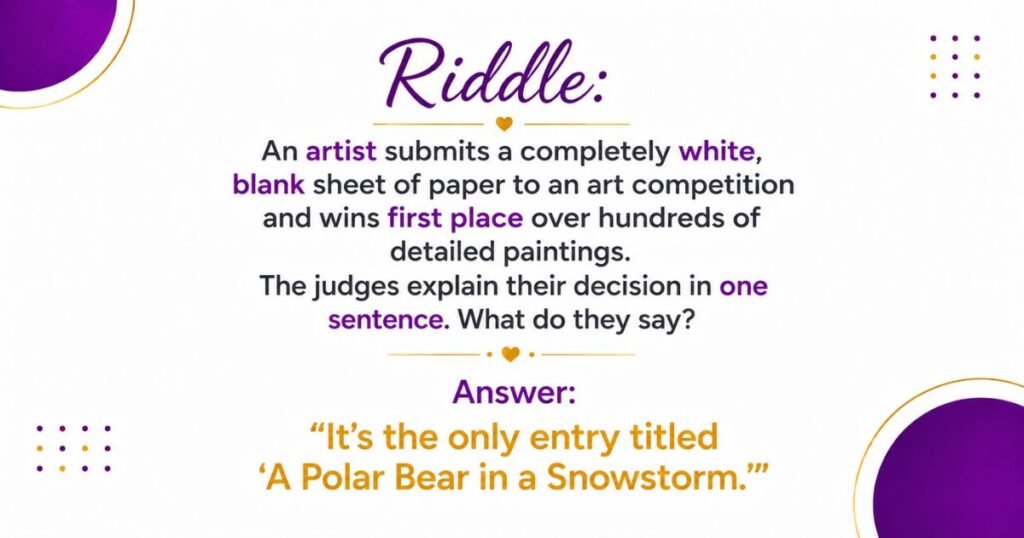
Explanation: This riddle uses the assumption that “loudest applause” must go to the winner as its misdirection, when the actual twist celebrates effort over outcome. - Riddle: An artist submits a completely white, blank sheet of paper to an art competition and wins first place over hundreds of detailed paintings. The judges explain their decision in one sentence. What do they say?
Answer: “It’s the only entry titled ‘A Polar Bear in a Snowstorm.'”
Difficulty: Medium
Explanation: This riddle is a classic conceptual-art joke reframed as a puzzle; the twist depends entirely on the title recontextualizing an otherwise blank submission.
- Riddle: A man spends thirty years building the same wooden ship inside a large glass bottle, piece by piece, through the tiny neck of the bottle. When he finally finishes, he immediately shatters the bottle. Why?
Answer: He was never trying to preserve the ship inside the bottle; the entire challenge was the process of building it through the narrow neck, and shattering it afterward was always part of his personal ritual to mark completion.
Difficulty: Medium
Explanation: This riddle subverts the assumption that the “ship in a bottle” craft is about the finished display, when the twist reframes the entire thirty-year effort as being about the process itself. - Riddle: A librarian removes exactly one book from the shelves every single day for a year, yet the library’s total book count never decreases. Why?
Answer: She’s removing a book to donate one and immediately replacing it with a newly acquired one, effectively swapping the collection instead of shrinking it.
Difficulty: Easy
Explanation: This riddle uses a subtraction assumption as its trap; most readers assume “removing” automatically means the total drops, without considering that something else could be added back at the same time. - Riddle: A man tells his friend that he’s read the exact same book every single night for the past ten years, cover to cover, without exception, and has memorized every single word. His friend asks why he doesn’t just read something new. The man’s answer reveals the entire point of this list of long riddles. What does he say?
Answer: “Because every time I read it, I notice something I missed the last nine hundred times”, a fitting closer, since long riddles work the same way: the details you overlook on the first pass are usually exactly where the answer was hiding all along.
Difficulty: Medium
Explanation: This riddle closes the list with a self-aware twist, tying the entire “read carefully, the details matter” theme of long riddles back into its own final answer.
How to Use Long Riddles for Classrooms, Parties, and Team-Building
Long riddles need a different pace than short ones, since the setup itself takes time to land:
- Classrooms: Read the riddle aloud slowly and let students ask clarifying questions before guessing most of the value comes from discussing the wrong turns, not just the final answer
- Family game nights: The Story Logic and Twist-Ending sections work best here, since they spark debate without requiring pen-and-paper math
- Office team-building: Detective and Mystery riddles are ideal for small groups, since talking through evidence together mirrors real collaborative problem-solving
- Road trips or flights: The Long Math section provides the longest-lasting entertainment, since it requires actual calculation rather than a quick guess
- Social media or trivia posts: Shorter long-riddles (Easy and Medium difficulty) get the most engagement, since more people can follow the story without losing interest
Keep the Streak Going
If the Detective and Mystery section had you piecing together clues one by one, these batman riddles offer a whole collection built around that same crime-scene style of thinking.
Long riddles reward the same patient, story-first reading that a good book does, so if you enjoyed following each scenario to its twist, these book riddles are a natural next stop.
If you want more of this same mix of logic, wordplay, and lateral thinking in one place, these amazing riddles round things out nicely.
Conclusion
Whether you worked through all 60 long riddles in one sitting or you’re saving this list to bring out gradually at classroom brain breaks, family game nights, or office team-building sessions, this collection covers both riddles for kids and riddles for adults, so you now have a difficulty-sorted collection built for exactly those moments.
Bookmark this page, challenge a friend to the detective section, and let us know in the comments which twist ending actually got you.
FAQs
What is a Good Long Riddle with an Answer?
The wolf, goat, and cabbage river-crossing riddle is one of the most well-known long riddles, since it has a clear story, a hidden constraint, and a satisfying step-by-step answer that rewards careful planning.
Why are Long Riddles Harder than Short Riddles?
Long riddles require you to hold multiple details in mind at once and figure out which one actually matters, while short riddles usually hinge on a single pun or double meaning you either catch or don’t.
What is the Classic Wolf, Goat, and Cabbage Riddle?
It’s a river-crossing puzzle where a farmer must transport a wolf, a goat, and cabbage across a river one at a time without leaving the wolf alone with the goat or the goat alone with the cabbage, solved by bringing an item back across the river at one point.
Are Long Riddles Good for Team-Building or Classrooms?
Yes. Their multi-step structure encourages group discussion and collaborative reasoning, which makes them especially effective for classrooms and office team-building compared to quick one-line riddles.
How do you get Better at Solving Long, Story-Style Riddles?
Practice identifying the four core techniques, hidden constraints, red herrings, sequential logic, and perspective shifts, since most long riddles reuse these same structures in new scenarios once you learn to recognize the pattern.
What Are Some Tricky Long Riddles?
The Detective and Mystery section above is full of tricky long riddles and long hard riddles that hinge on one overlooked detail, like the flour dust or the melted ice, rather than pure calculation.
Where Can I Find Long Riddles with Answers for Adults?
The Detective, Math, and Twist Ending sections above are built for adults, each with a full answer and explanation included right alongside the riddle.