75 Dark Riddles With Answers, Difficulty Levels, and Explanations
Dark Riddles are short puzzles that use death, night, ghosts, and darkness as their theme, often solved through wordplay or double meanings.
This collection brings together 75 dark riddles, sorted into Easy, Medium, Hard, and a bonus “classic double-meaning” tier, each with its answer, a difficulty rating, and a simple explanation of the wordplay behind it. So whether you’re stumped or just curious how the trick works, you won’t be left guessing.
What Makes a Riddle “Dark”?
A Dark Riddle isn’t just a riddle with a scary word dropped into it. It’s built around themes that most lighthearted riddles avoid , death, silence, decay, ghosts, graves, and the passage of time toward an ending.
What separates a good dark riddle from a cheap jump-scare is that the darkness lives in the logic, not just the vocabulary.
Take a classic dark riddle structure: the answer is something ordinary (a candle, a shadow, a clock), but the clues are phrased so the object sounds like it’s describing death, grief, or the supernatural.
That tension , reading something eerie, then realizing the answer is mundane , is what makes the riddle satisfying rather than just morbid.
Dark riddles typically fall into a few recognizable patterns:
- Personification of death or time , where an abstract idea (Death, Midnight, Silence) speaks in first person
- Object riddles with dark imagery , a candle, a shadow, a gravestone described without being named
- Idioms and double meanings , words like “grave,” “dead,” or “haunt” that mean one thing literally and another figuratively
- Existential or abstract riddles , harder puzzles built on concepts like entropy, extinction, or the “thread of life”
Understanding these patterns is the fastest way to get better at solving , and writing , Dark Riddles yourself.
Where Dark Riddles Come From?
Riddles built on death, darkness, and the unknown aren’t a modern invention , they’re rooted in the same oral folklore tradition that produced classic Spanish adivinanzas, Anglo-Saxon riddle poems, and the riddle contests found in ancient myth (the Sphinx’s riddle to Oedipus is arguably the original “dark riddle”).
Long before written literacy was common, riddles were a way to pass down cultural knowledge, test wit, and , often , cope with mortality through humor.
Gallows humor, the tendency to joke about death and hardship as a coping mechanism, feeds directly into this riddle tradition.
Campfire storytelling and Halloween games kept the format alive in English-speaking cultures, while Victorian-era mourning customs (elaborate rituals around death, grief, and remembrance) supplied much of the imagery , coffins, veils, epitaphs, tolling bells , that still shows up in dark riddles today.
Knowing this context matters for solvers: many hard dark riddles lean on old idioms or historical customs (like “a nail in the coffin” or the “graveyard shift”) that don’t make sense unless you know where the phrase came from.
Easy Dark Riddles With Answers
These short dark riddles are the best entry point if you’re new to dark riddles or introducing them to a classroom. They rely on clear imagery , bats, shadows, skeletons, candles , and the wordplay is direct enough that most solvers get the answer within a few seconds.
- Riddle: I have no flesh, no skin, no hair, but I still seem to smile everywhere I go.
Answer: A skull
Difficulty: Easy
Explanation: Skulls have a fixed, tooth-baring shape that looks like a grin , the riddle works because it plays on that unsettling but familiar image. - Riddle: I live in the ground and never see the sun, but I hold your name long after you’re done.
Answer: A gravestone
Difficulty: Easy
Explanation: The clue “hold your name” points directly at an engraved marker, making the logic simple to trace. - Riddle: I fly at night with silent wings, and hang upside down when morning brings.
Answer: A bat
Difficulty: Easy
Explanation: Two well-known bat facts , nighttime flight and upside-down roosting , are stated almost literally. - Riddle: The darker I am, the more people fear me, but turn on a light and you’ll never see me.
Answer: A shadow
Difficulty: Easy
Explanation: The riddle uses a simple contradiction (visible in dark, invisible in light) that’s actually the reverse of how shadows work, which is the trick , shadows need light to exist at all. - Riddle: I come once a month, round and bright, then disappear into the black of night.
Answer: The full moon
Difficulty: Easy
Explanation: “Once a month” and “round and bright” are direct descriptors of the lunar cycle. - Riddle: I wear a hood but I’m not a coat, I carry a scythe but I never gloat.
Answer: The Grim Reaper (Death)
Difficulty: Easy
Explanation: Two of the most iconic visual symbols of Death , the hood and the scythe , are named almost outright. - Riddle: I have a face but no eyes, hands but no fingers, and I strike at midnight to bring on frights.
Answer: A clock
Difficulty: Easy
Explanation: “Face” and “hands” are literal clock parts reused as a riddle’s classic misdirection. - Riddle: I’m black all over, I caw instead of sing, and old superstition says I’m an unlucky thing.
Answer: A crow
Difficulty: Easy
Explanation: Crows and ravens are tied to death omens in folklore, which the riddle states directly. - Riddle: I’m carved with a grin, lit up inside, on Halloween night I glow with pride.
Answer: A jack-o’-lantern
Difficulty: Easy
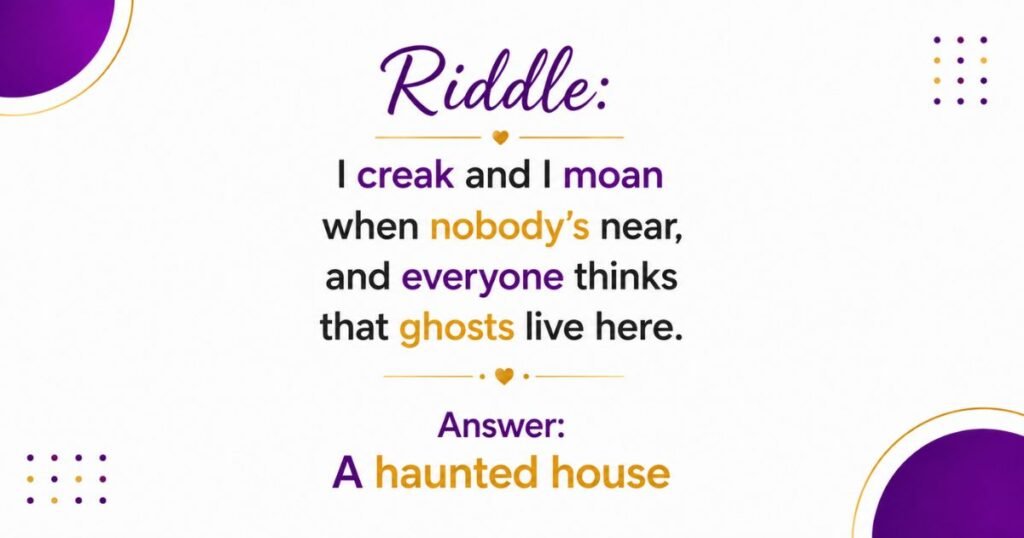
Explanation: The seasonal reference (Halloween) narrows the answer almost instantly. - Riddle: I creak and I moan when nobody’s near, and everyone thinks that ghosts live here.
Answer: A haunted house
Difficulty: Easy
Explanation: Creaking sounds and ghost assumptions are stock haunted-house tropes used at face value.
- Riddle: Eight legs I have, I spin in the dark, my web is my art, my bite leaves a mark.
Answer: A spider
Difficulty: Easy
Explanation: The leg count alone gives this one away for most solvers. - Riddle: I’m buried six feet below the ground, but I never make a single sound.
Answer: A coffin
Difficulty: Easy
Explanation: “Six feet below” is the standard burial-depth idiom, pointing straight at a coffin. - Riddle: I wear black and fly at night, I turn into smoke and give you a fright.
Answer: A vampire
Difficulty: Easy
Explanation: Turning into smoke or mist is a classic vampire-lore detail used literally here. - Riddle: I stir a pot and cackle with glee, on my broom I fly wild and free.
Answer: A witch
Difficulty: Easy
Explanation: Cauldron-stirring and broomstick-flying are the two most recognizable witch symbols. - Riddle: I’m white as snow but I’m not alive, I rattle and clack, I used to survive.
Answer: A skeleton
Difficulty: Easy
Explanation: “Used to survive” hints that this was once part of a living body , bones. - Riddle: I burn low and slow within a dark room, casting shadows and fighting the gloom.
Answer: A candle
Difficulty: Easy
Explanation: The riddle describes a candle’s function (light against darkness) almost word for word. - Riddle: I hoot in the night from high in a tree, and folklore says my call means death you’ll see.
Answer: An owl
Difficulty: Easy
Explanation: Owls are a long-standing death omen in folk superstition, referenced directly. - Riddle: I howl at the moon when the night turns cold, my legend says a beast within I hold.
Answer: A werewolf
Difficulty: Easy
Explanation: Moon-howling and a “beast within” are core werewolf-myth details stated plainly. - Riddle: I’m a place with no light, deep under the ground, where bones of the past are quietly found.
Answer: A crypt
Difficulty: Easy
Explanation: “Bones” and “under the ground” leave little room for another answer. - Riddle: I tick and I tock but I don’t have a heart, yet everyone says my strike is the start , of an ending.
Answer: Midnight
Difficulty: Easy
Explanation: The riddle plays on midnight as both a clock event and a symbolic turning point (the witching hour).
Medium Dark Riddles With Answers
These dark riddles for adults lean harder into abstract or ceremonial imagery , funerals, epitaphs, omens, curses. They require a bit more cultural knowledge than the Easy tier, which is exactly why they trip up beginners more often.
- Riddle: The more you feed me, the more I grow, yet I’m never full , I just swallow the glow.
Answer: Darkness
Difficulty: Medium
Explanation: “Swallowing the glow” is a metaphor for darkness overtaking light, which is trickier to picture than a concrete object. - Riddle: I have no life, yet I hold a name, a date, a story tied to a claim.
Answer: A gravestone (headstone)
Difficulty: Medium
Explanation: The riddle describes the information carved into a headstone rather than its physical shape, adding a layer of abstraction. - Riddle: I speak for the dead, though I have no voice; I’m carved into stone, not made by choice.
Answer: An epitaph
Difficulty: Medium
Explanation: “Speak … no voice” is a contradiction solvers must resolve by thinking of written, not spoken, words. - Riddle: I gather the living to remember the gone; we cry, we speak, then the day moves on.
Answer: A funeral
Difficulty: Medium
Explanation: The riddle describes the emotional ritual of a funeral rather than naming any object. - Riddle: I hold what’s left when the fire is done, ashes and silence where a life was once spun.
Answer: An urn
Difficulty: Medium
Explanation: “Ashes” after “fire” points to cremation, and the container is the answer , a two-step logic chain. - Riddle: I appear when you’re gone, I linger when you’re near, I’m the shape of your absence that people fear.
Answer: A ghost
Difficulty: Medium
Explanation: The riddle defines a ghost through paradox , present and absent at once , rather than describing its appearance. - Riddle: I’m the last thing you take before you go, quiet and short, then the silence will show.
Answer: A last breath
Difficulty: Medium
Explanation: Solvers must connect “take,” “quiet,” and “silence” to the act of breathing rather than a physical object. - Riddle: I count the years left, though I never speak; my sand keeps falling, my truth is bleak.
Answer: An hourglass
Difficulty: Medium
Explanation: The “sand falling” clue is concrete, but connecting it to counting down a lifespan (rather than just time) is the harder leap. - Riddle: I’m signed by the living but read by the dead’s kin; I decide what happens to all that has been.
Answer: A will (last will and testament)
Difficulty: Medium
Explanation: This requires knowing that a legal document, not a person, is “signed” before death and “read” after. - Riddle: I stand watch with wings of stone, over the dead, though I’m not alone.
Answer: A cemetery angel statue
Difficulty: Medium
Explanation: “Wings of stone” signals a statue, and the cemetery setting narrows it to a mourning angel specifically. - Riddle: I bring news no one wants to hear, spoken once, then printed each year , no, once, in ink and tear.
Answer: An obituary
Difficulty: Medium
Explanation: “News no one wants” and “printed” together point to a published death notice. - Riddle: I’m worn to honor the lost, a color of grief no matter the cost.
Answer: Mourning clothes (black attire)
Difficulty: Medium
Explanation: The riddle relies on cultural knowledge that black clothing traditionally signals mourning. - Riddle: I gather at night to speak with the dead, using a board with letters instead.
Answer: A séance
Difficulty: Medium
Explanation: “Board with letters” is a specific reference to a spirit board used in séances. - Riddle: I’m the sound of nothing after the bell, the pause before someone has news to tell.
Answer: Silence
Difficulty: Medium
Explanation: This riddle personifies an absence (silence) as if it were a physical thing, which is harder to visualize than an object. - Riddle: I appear before something terrible arrives, a sign in the sky before darkness thrives.
Answer: An omen
Difficulty: Medium
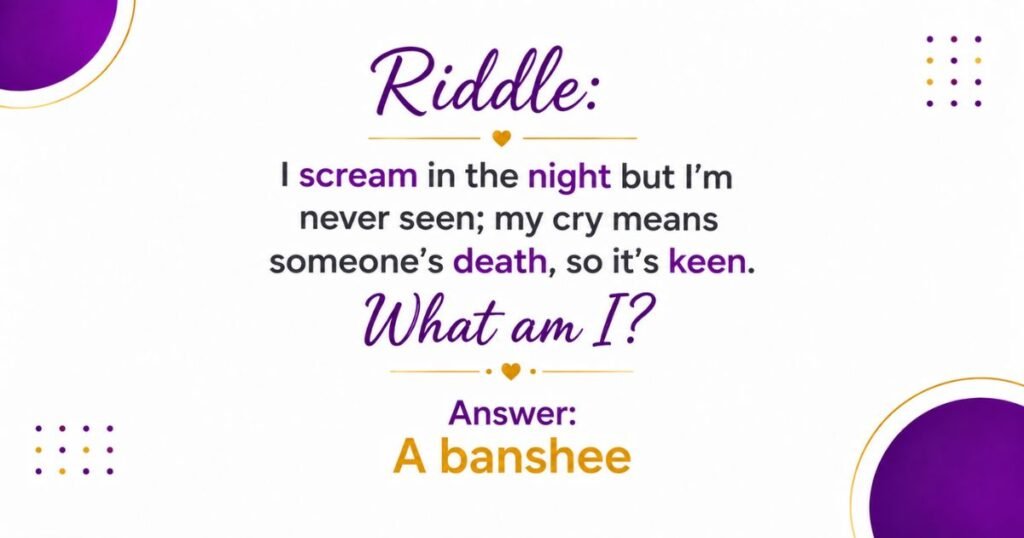
Explanation: The riddle requires connecting “sign” and “before” to the concept of foreshadowing, not a literal object. - Riddle: I scream in the night but I’m never seen; my cry means someone’s death, so it’s keen.
Answer: A banshee
Difficulty: Medium
Explanation: This draws on Irish folklore where an unseen wailing spirit foretells death , knowledge of the myth speeds up the solve.
- Riddle: I wear a long beak though I’m not a bird; I walked among plague, my mask is absurd.
Answer: A plague doctor’s mask
Difficulty: Medium
Explanation: Requires historical knowledge of the beaked masks worn by plague doctors, filled with herbs to mask the smell of disease. - Riddle: I’m carved from stone, I stand in a row, marking the names of those down below.
Answer: A row of tombstones (a cemetery)
Difficulty: Medium
Explanation: The plural framing (“in a row”) pushes solvers past a single gravestone toward the whole cemetery. - Riddle: I’m read at the service, though I speak of the past; I praise a life that could not last.
Answer: A eulogy
Difficulty: Medium
Explanation: “Read … praise a life” distinguishes this from an epitaph, since a eulogy is spoken aloud at a service. - Riddle: I’m cast on a house, a person, a place, bringing bad luck no matter the case.
Answer: A curse
Difficulty: Medium
Explanation: “Cast” is the key verb , it’s used almost exclusively with spells and curses, giving away the answer. - Riddle: I visit at midnight, I vanish by dawn, I’m seen through a window though the person is gone.
Answer: A phantom (apparition)
Difficulty: Medium
Explanation: The riddle’s timing clues (midnight to dawn) plus “person is gone” together describe a classic haunting sighting. - Riddle: I’m the last mark stamped before something goes bad , a date that reminds you your time was had.
Answer: An expiration date
Difficulty: Medium
Explanation: Dark Humor Riddles for Adults – The double meaning here (food expiring vs. a person’s time “expiring”) is what makes this riddle land as dark humor rather than a straightforward object riddle. - Riddle: I never age, but I measure all lives; when I stop, the story no longer thrives.
Answer: Time
Difficulty: Medium
Explanation: Personifying time as something that “stops” when a life ends requires abstract thinking rather than object recognition. - Riddle: I’m thrown into the grave as the coffin descends, a small handful marking how the story ends.
Answer: A handful of dirt
Difficulty: Medium
Explanation: This describes a specific burial custom (mourners tossing soil onto the coffin) that not every solver will know. - Riddle: I toll from a tower when someone has died, once for each year that they lived and tried.
Answer: A funeral bell (death knell)
Difficulty: Medium
Explanation: The custom of tolling a bell once per year of the deceased’s life is a specific historical detail that raises the difficulty.
Hard Dark Riddles With Answers
This tier of dark riddles for adults with answers is built for advanced learners and adults who are dark riddles obsessed fans. These riddles rely on abstract concepts, idioms, or scientific ideas rather than physical objects, so the “aha” moment takes real lateral thinking.
- Riddle: The closer I get, the more you fear me, though no one has ever truly seen me arrive.
Answer: Death
Difficulty: Hard
Explanation: There’s no concrete object to latch onto , solvers must recognize that the riddle personifies an inevitable, invisible force. - Riddle: I can be short or long, but once I’m cut, no hand can sew me back , every life must lose me eventually.
Answer: The thread of life
Difficulty: Hard
Explanation: This references the Greek myth of the Fates spinning, measuring, and cutting a life’s thread , without that context, it’s nearly unsolvable. - Riddle: I never lived, so I can’t die, yet I go out , and by the time you notice, I may have been gone for years already.
Answer: A star’s light
Difficulty: Hard
Explanation: This plays on the astronomical fact that starlight takes years to reach us, so a star can “die” long before we see it go dark. - Riddle: I am the space between two heartbeats, the pause where nothing at all repeats.
Answer: Silence
Difficulty: Hard
Explanation: Unlike the medium-tier silence riddle, this one demands recognizing silence as a literal gap in a biological rhythm, which is a more clinical, less intuitive image. - Riddle: I’m a job you clock into as the sun goes down, working among the quiet while the living sleep in town.
Answer: The graveyard shift
Difficulty: Hard
Explanation: This is a pure idiom riddle , the answer only works if you already know “graveyard shift” means overnight work, not literal grave-digging.
- Riddle: I’m the paper that makes an ending official, signed by a doctor, filed as a final initial.
Answer: A death certificate
Difficulty: Hard
Explanation: The riddle is deliberately dry and bureaucratic, which throws off solvers expecting spookier imagery. - Riddle: I have no body, yet I take up a place at every table where someone no longer sits.
Answer: Grief (or an empty chair)
Difficulty: Hard
Explanation: This is one of the most abstract riddles in the set , it asks solvers to picture an emotion occupying physical space. - Riddle: I switch off when a heart goes quiet, and doctors watch my flat, straight line in defiance of denial.
Answer: A flatline (heart monitor reading)
Difficulty: Hard
Explanation: Requires connecting medical imagery (a monitor’s flat line) to the moment of death rather than a symbolic object. - Riddle: I’m a language no one speaks anymore, buried in books behind history’s door. Answer: A dead language
Difficulty: Hard
Explanation: The wordplay hinges on “dead” applying to languages, not just people , a twist many solvers miss on the first pass. - Riddle: I’m a town with houses but no people inside, streets that are silent, doors open wide.
Answer: A ghost town
Difficulty: Hard
Explanation: The riddle never uses the word “ghost,” forcing solvers to infer the compound term from the description alone. - Riddle: I fall once a year from a branch, growing pale , a small death repeated, a yearly tale.
Answer: An autumn leaf
Difficulty: Hard
Explanation: This is a metaphor riddle: the “small death” is figurative, describing a leaf’s seasonal fall rather than an actual death. - Riddle: I swallow light and time itself too; nothing that enters ever comes back through.
Answer: A black hole
Difficulty: Hard
Explanation: Requires basic astrophysics knowledge (that light can’t escape a black hole’s gravity) rather than folklore. - Riddle: I was once common, now no more found, only in fossils and old photographs bound.
Answer: An extinct species
Difficulty: Hard
Explanation: The riddle applies “death” at the scale of an entire species rather than an individual, which is a bigger conceptual leap. - Riddle: I’m black like coal, I show your face at night, but crack me open and I show no light.
Answer: Obsidian
Difficulty: Hard
Explanation: Solvers need to know obsidian (volcanic glass) was historically used to make mirrors , a fairly obscure fact. - Riddle: I have no pulse, but once I did; hammer me in, and it means someone’s story is near its final skid.
Answer: A nail in the coffin (the idiom)
Difficulty: Hard
Explanation: This riddle answers with an idiom rather than a literal object, testing whether the solver knows the phrase’s figurative meaning. - Riddle: I’m the switch that no one wants to press, triggered by stillness, not by duress.
Answer: A dead man’s switch
Difficulty: Hard
Explanation: A niche mechanical/safety term , the switch that activates only when a person stops pressing it (like on a train or machine). - Riddle: I’m counted down by everyone, yet no one has ever seen my last number strike.
Answer: A lifetime (mortality)
Difficulty: Hard
Explanation: This is intentionally vague and philosophical , the “countdown” no one can witness firsthand is a metaphor for one’s own death. - Riddle: Left alone, all things fall toward disorder , I am the rule with no true reverse order.
Answer: Entropy
Difficulty: Hard
Explanation: A physics-concept riddle; entropy describes the tendency of systems to move toward disorder, often used as a poetic stand-in for decay and death. - Riddle: I’m what’s left when a candle burns all the way down , not the flame, not the wax, but the mark it leaves round.
Answer: Soot (a burn mark)
Difficulty: Hard
Explanation: The riddle deliberately excludes the two obvious answers (flame, wax) to force solvers toward the residue instead. - Riddle: I’m a number assigned to a spot in a row, but I never get called although names come and go.
Answer: An unclaimed cemetery plot number
Difficulty: Hard
Explanation: This requires picturing cemetery administration (numbered plots) rather than any visual or folkloric image, making it one of the driest, hardest riddles in the set.
Classic Double-Meaning Dark Riddles (Bonus)
This bonus set focuses on words that carry two meanings , one everyday, one dark , the same double-meaning structure that makes classic adivinanza-style riddles so satisfying to solve. These riddles are best for dark riddles game night.
- Riddle: I can mean a burial place, or I can mean “very serious.” What word am I?
Answer: Grave
Difficulty: Medium
Explanation: “Grave” works as both a noun (burial site) and an adjective (serious), which is the entire trick of the riddle. - Riddle: I can be the last cigarette in a pack, or slang for something that seals your fate. What am I?
Answer: A “coffin nail”
Difficulty: Medium
Explanation: “Coffin nail” is old slang for a cigarette, playing on the literal object (a nail in a coffin) and the health-risk implication. - Riddle: I can mean a battery with no charge, or the opposite of alive. What word am I?
Answer: Dead
Difficulty: Easy
Explanation: “Dead” applies equally to objects (a dead phone) and living things, which is what makes it a flexible double-meaning riddle. - Riddle: I can describe a fire with no more flame, or someone slowly losing their life. What word fits both?
Answer: Dying
Difficulty: Easy
Explanation: “Dying” (fire) and “dying” (person) share the same root idea of fading toward an end. - Riddle: I can be a set of keys that opens any lock, or the bare bones left after flesh is gone. What am I?
Answer: Skeleton
Difficulty: Medium
Explanation: “Skeleton key” and “skeleton” (bones) share the word but describe very different things , a classic double-meaning setup. - Riddle: I can mean to follow someone closely, or the dark shape that mimics your every move. What word am I?
Answer: Shadow
Difficulty: Easy
Explanation: “Shadow” as a verb (to shadow someone) and as a noun (a cast shadow) both fit the riddle’s description. - Riddle: I can be your favorite hangout spot, or a ghost’s favorite place to linger. What word means both?
Answer: Haunt
Difficulty: Medium
Explanation: “Haunt” as a noun (a favorite spot) and as a verb (what ghosts do) is the pivot the riddle relies on. - Riddle: I can be a newspaper’s archive room, or the place a body is examined after death. What word am I?
Answer: Morgue
Difficulty: Hard
Explanation: Newsroom slang borrowed the word “morgue” for old-article archives , a lesser-known double meaning that raises the difficulty.
- Riddle: I can be the ripples behind a boat, or the gathering held before a funeral. What word am I?
Answer: Wake
Difficulty: Medium
Explanation: “Wake” (boat ripples) and “wake” (pre-funeral gathering) are unrelated meanings that just happen to share a spelling. - Riddle: I can mean spooky and hard to understand, or literally relate to a burial vault. What word am I?
Answer: Cryptic
Difficulty: Hard
Explanation: “Cryptic” shares its root with “crypt,” and the riddle asks solvers to notice that shared origin rather than just the common meaning.
How to Solve a Dark Riddle?
Solving dark riddles gets easier once you recognize the recurring patterns instead of guessing at random. A few habits that consistently help:
- Separate the imagery from the answer. Dark riddles often describe something ordinary (a candle, a clock, a leaf) using unsettling language. Ask yourself: what physical object or everyday idea could this scary description actually be pointing at?
- Watch for idioms. Phrases like “graveyard shift” or “nail in the coffin” aren’t meant to be taken literally , if a riddle’s clues feel oddly specific to a phrase you’ve heard before, that’s usually the answer.
- Think in categories. Most dark riddles fall into a handful of buckets: time/mortality, funeral customs, folklore creatures, or double-meaning words. Narrowing which bucket you’re in cuts your guesses dramatically.
- Read it out loud. Rhyme and rhythm (a leftover from the oral folklore tradition these riddles come from) often hint at the answer’s syllable count or sound.
- Don’t overthink easy riddles. If a riddle names an obvious trait (flies at night, eight legs, hoots), the answer is usually literal, not a metaphor.
More Riddles to Test Your Wit
If the Hard and Bonus tiers here had you stuck, you’ll enjoy digging into the collection of hard riddles for more lateral-thinking puzzles that reward patience over quick guesses.
Dark Riddles also pair naturally with a Halloween Riddles for game night, so browse holiday riddles for more seasonal brain teasers to round out the fun.
If you’re building a riddle set specifically for grown-ups rather than a classroom, our riddles for adults collection leans into the same clever misdirection this list uses, just without the death-and-darkness theme.
How to Use Dark Riddles in Classrooms and Family Game Nights?
Dark riddles work well as a low-pressure warm-up activity, especially around Halloween. Here’s how they tend to get used in real settings:
- Classrooms: Teachers use the Easy tier as a five-minute bell-ringer activity before a lesson, since the riddles build vocabulary (bat, gravestone, shadow) without needing much explanation.
- Family game nights: Mixing Easy and Medium riddles keeps both kids and adults engaged , kids can usually solve the object riddles, while adults get pulled into the funeral-custom and folklore ones.
- Halloween parties: The Hard and Bonus tiers work well as a “stump the room” round, since they require lateral thinking rather than quick recall.
- One-on-one tutoring or ESL practice: Riddles that hinge on idioms (like “graveyard shift” or “coffin nail”) double as vocabulary lessons about figurative English.
Conclusion
Dark Riddles work best when the darkness lives in the logic, not just the vocabulary, a good one makes you flinch, then laugh at how ordinary the answer turns out to be.
This collection gives you 75 to work through, sorted so you can match riddles to your own level or your group’s, from a five-minute classroom warm-up to a genuine stump-the-room challenge.
FAQs
What is a Dark Riddle?
A riddle that uses death, darkness, or the supernatural as its theme, usually describing something scary to hide an ordinary answer.
Are Dark Riddles Appropriate for Kids?
Easy ones with safe imagery (bats, ghosts, pumpkins) work fine for kids. Harder, more abstract riddles suit teens and adults.
What Makes a Riddle “Dark” instead of just Tricky?
The subject matter. Dark Riddles center on mortality, night, or the supernatural, not just clever wordplay.
What’s an Example of a Hard Dark Riddle?
The toughest ones use abstract ideas , like time, silence, or entropy, that need outside knowledge, not just pattern recognition.
Where do Dark Riddles Come from?
Dark Riddles trace back to oral folklore and old riddle contests, later shaped by gallows humor and campfire storytelling.