143 Best Valentine Riddles with Answers for Couples and Classrooms
Valentine Riddles are short brain teasers and puns built around love, hearts, and February 14 traditions, from quick one-liner Valentine jokes to trickier “What am I?” puzzles. They’re a favorite way to add playfulness to cards, lunchboxes, and date nights alike.
Below you’ll find 143 original Valentine riddles, organized by difficulty, with the wordplay or logic behind each one explained.
Easy Valentine Riddles: Punny One-Liners Everyone Gets
These are the Valentine riddles and jokes that work best for kids, classroom exchanges, and lunchbox notes, the same kind of Valentine jokes one-liners that get passed around every February. Each one follows the classic “What did ___ say to its Valentine?” format, which is popular precisely because the setup trains your brain to expect a pun , so the punchline lands fast.
- Riddle: What did the bee say to its Valentine?
Answer: “You’re the bee’s knees, and I’m buzzing for you!”
Difficulty: Easy
Explanation: A pun on the old idiom “the bee’s knees,” reused literally because the speaker is a bee. - Riddle: What did the star say to its Valentine?
Answer: “You make my whole universe shine!”
Difficulty: Easy
Explanation: Plays on a star’s literal job (shining) as a metaphor for lighting up someone’s life. - Riddle: What did the cactus say to its Valentine?
Answer: “I’m stuck on you, even though I’m prickly!”
Difficulty: Easy
Explanation: “Stuck on you” is idiomatic for infatuation, reframed literally through a spiky cactus. - Riddle: What did the coffee cup say to its Valentine?
Answer: “You’re my favorite blend!”
Difficulty: Easy
Explanation: “Blend” doubles as a coffee term and a description of two people fitting well together. - Riddle: What did the WiFi router say to its Valentine?
Answer: “I’m feeling a strong connection!”
Difficulty: Easy
Explanation: “Connection” works as both a tech term and an emotional bond. - Riddle: What did the garden gnome say to its Valentine?
Answer: “You make my heart feel gnome-tastic!”
Difficulty: Easy
Explanation: A homophone pun swapping “gnome” for the start of “fantastic.” - Riddle: What did the comet say to its Valentine?
Answer: “You’re out of this world, and I’m falling for you!”
Difficulty: Easy
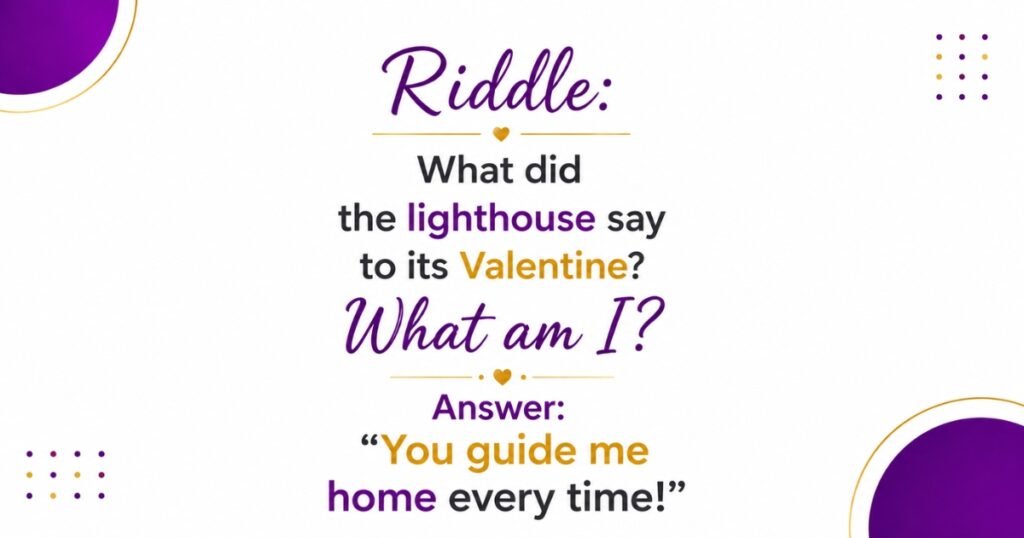
Explanation: “Falling for you” is reused literally since comets fall through the sky. - Riddle: What did the lighthouse say to its Valentine?
Answer: “You guide me home every time!”
Difficulty: Easy
Explanation: A lighthouse’s literal function (guiding ships home) becomes a metaphor for emotional guidance.
- Riddle: What did the kite say to its Valentine?
Answer: “I’m flying high whenever you’re around!”
Difficulty: Easy
Explanation: “Flying high” is idiomatic for happiness, reused literally through a kite. - Riddle: What did the campfire say to its Valentine?
Answer: “You spark something in me!”
Difficulty: Easy
Explanation: “Spark” works as both a literal fire term and a phrase for romantic attraction. - Riddle: What did the telescope say to its Valentine?
Answer: “I’ve got my eye on you!”
Difficulty: Easy
Explanation: A telescope’s literal purpose (viewing) doubles as the idiom for having a crush. - Riddle: What did the snail say to its Valentine?
Answer: “I’m slow, but I’m sure about you!”
Difficulty: Easy
Explanation: References “slow and steady,” recast as a snail’s own pace of commitment. - Riddle: What did the penguin say to its Valentine?
Answer: “You’re the only one I’ll waddle for!”
Difficulty: Easy
Explanation: “Waddle” replaces “walk,” playing on the idiom “I’d walk a mile for you.” - Riddle: What did the dolphin say to its Valentine?
Answer: “You make a splash in my heart!”
Difficulty: Easy
Explanation: “Make a splash” is idiomatic for making an impression, reused literally for a dolphin. - Riddle: What did the firefly say to its Valentine?
Answer: “You light up my night!”
Difficulty: Easy
Explanation: A firefly’s literal glow becomes a metaphor for someone brightening your mood. - Riddle: What did the jellyfish say to its Valentine?
Answer: “I’m stung by your charm!”
Difficulty: Easy
Explanation: Reframes a jellyfish’s sting as being “struck” by someone’s appeal. - Riddle: What did the koala say to its Valentine?
Answer: “I could hang around you forever!”
Difficulty: Easy
Explanation: “Hang around” is both a literal koala behavior and a phrase for enjoying someone’s company. - Riddle: What did the sloth say to its Valentine?
Answer: “I’ll never be too slow to say I love you!”
Difficulty: Easy
Explanation: Plays against a sloth’s stereotype for slowness to make an emotional point. - Riddle: What did the hedgehog say to its Valentine?
Answer: “You’ve gotten under my skin , in the best way!”
Difficulty: Easy
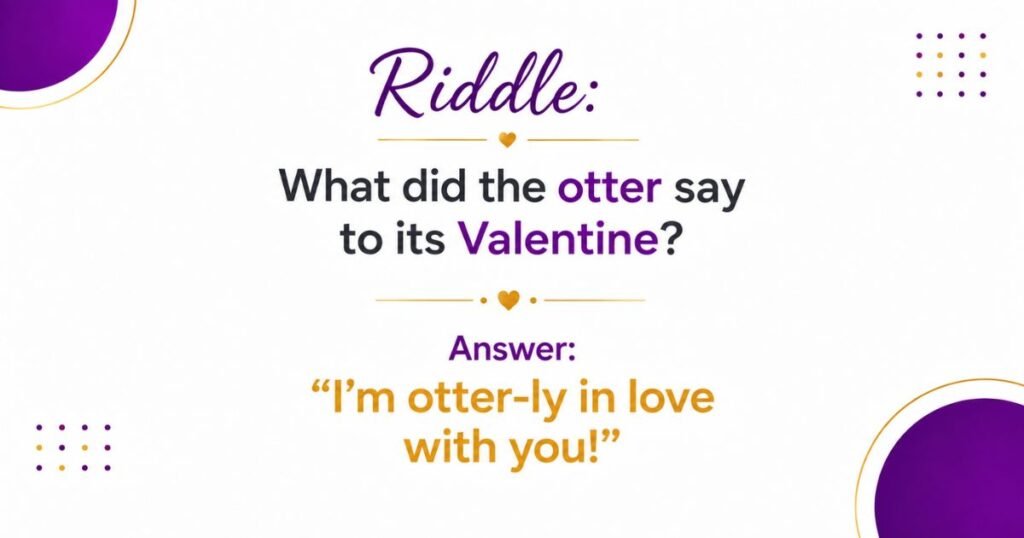
Explanation: “Under my skin” usually means annoyance, but the hedgehog’s spikes flip it into affection. - Riddle: What did the otter say to its Valentine?
Answer: “I’m otter-ly in love with you!”
Difficulty: Easy
Explanation: A homophone pun swapping “otter” for “utterly.”
- Riddle: What did the flamingo say to its Valentine?
Answer: “You make me want to flamingle!”
Difficulty: Easy
Explanation: Blends “flamingo” and “mingle” into one word. - Riddle: What did the peacock say to its Valentine?
Answer: “I’m showing off just for you!”
Difficulty: Easy
Explanation: References a peacock’s literal courtship display of feathers. - Riddle: What did the chameleon say to its Valentine?
Answer: “You bring out my true colors!”
Difficulty: Easy
Explanation: “True colors” is idiomatic for authenticity, reused literally through a color-changing chameleon. - Riddle: What did the unicorn say to its Valentine?
Answer: “You make ordinary days feel magical!”
Difficulty: Easy
Explanation: Leans on the unicorn’s mythical association with magic. - Riddle: What did the dragon say to its Valentine?
Answer: “You set my heart on fire!”
Difficulty: Easy
Explanation: A dragon’s literal fire-breathing becomes a metaphor for passion. - Riddle: What did the robot say to its Valentine?
Answer: “You’ve upgraded my whole system!”
Difficulty: Easy
Explanation: Tech vocabulary (“upgraded,” “system”) stands in for personal growth. - Riddle: What did the wizard say to its Valentine?
Answer: “You cast a spell on me!”
Difficulty: Easy
Explanation: “Cast a spell” is idiomatic for captivation, reused literally for a wizard. - Riddle: What did the pirate say to its Valentine?
Answer: “You’re the treasure I’ve been searching for!”
Difficulty: Easy
Explanation: A pirate’s literal treasure hunt becomes a metaphor for finding “the one.”
- Riddle: What did the astronaut say to its Valentine?
Answer: “You’re my whole galaxy!”
Difficulty: Easy
Explanation: Space vocabulary is used to express the size of the speaker’s feelings. - Riddle: What did the mermaid say to its Valentine?
Answer: “I’m hooked on you , no reel-y!”
Difficulty: Easy
Explanation: A double pun: “hooked” (fishing) and “reel-y” (homophone for “really”). - Riddle: What did the genie say to its Valentine?
Answer: “You’re my only wish come true!”
Difficulty: Easy
Explanation: References a genie’s literal job of granting wishes. - Riddle: What did the snowman say to its Valentine?
Answer: “You melt my heart, even though I shouldn’t let you!”
Difficulty: Easy
Explanation: “Melt my heart” is idiomatic for being moved, made literal since snowmen melt. - Riddle: What did the pumpkin say to its Valentine?
Answer: “You’re gourd-geous!”
Difficulty: Easy
Explanation: A homophone pun blending “gourd” (pumpkin family) and “gorgeous.” - Riddle: What did the taco say to its Valentine?
Answer: “Lettuce taco ’bout how much I love you!”
Difficulty: Easy
Explanation: Two homophone puns stacked together: “lettuce” for “let us” and “taco” for “talk.” - Riddle: What did the pizza say to its Valentine?
Answer: “I’m saucy about you!”
Difficulty: Easy
Explanation: “Saucy” doubles as a pizza ingredient and a playful, flirty tone. - Riddle: What did the avocado say to its Valentine?
Answer: “You had me at guac!”
Difficulty: Easy
Explanation: A play on the romantic-comedy line “you had me at hello,” swapped for guacamole.
Sweet and Sentimental Riddles: Classic “What Am I?” Puzzles About Love
This section leans into the traditional riddle format , a short poem that describes something without naming it. These work well for date-night games because they take a beat longer to solve than a one-liner joke, which sparks actual conversation.
- Riddle: I have no beat, yet I can race. I have no wings, yet I can soar when you walk into the room. What am I?
Answer: Your heartbeat (the feeling, not the organ)
Difficulty: Medium
Explanation: Uses contradiction (no beat, yet races) to point toward an emotional rather than literal answer. - Riddle: I can be stolen without a crime, given without losing anything, and broken without a sound. What am I?
Answer: A heart
Difficulty: Medium
Explanation: Each line describes a common idiom about love (“steal my heart,” “give my heart,” “broken heart”) stripped of its usual context. - Riddle: Press your lips to mine, and I disappear. I cost nothing, yet I’m treasured everywhere. What am I?
Answer: A kiss
Difficulty: Medium
Explanation: The vanishing act refers to how a kiss is momentary, while “treasured” hints at its emotional value. - Riddle: I bloom once a year in bright red, but I also come with thorns that will make you bleed. What am I?
Answer: A rose
Difficulty: Easy
Explanation: Straightforward description of a rose’s appearance and thorns, associated with Valentine’s Day gifting. - Riddle: I melt in warmth, I’m boxed in gold, and I’m often the first thing given when love is told. What am I?
Answer: Chocolate
Difficulty: Easy
Explanation: References the physical property of chocolate (melting) and its packaging as a classic Valentine gift. - Riddle: I flicker and dance but I’m not alive. Put me on a table for two, and romance will thrive. What am I?
Answer: A candle
Difficulty: Easy
Explanation: Describes a candle’s movement and its common use in setting a romantic mood, a theme also explored in candle riddles. - Riddle: I’m folded twice, sealed with care, and I say things out loud you’re too shy to share. What am I?
Answer: A love letter
Difficulty: Medium
Explanation: Describes the physical form of a letter and its emotional function. - Riddle: I freeze a moment forever, though time keeps on moving. I hang on your wall as proof that love is improving. What am I?
Answer: A photograph
Difficulty: Medium
Explanation: “Freeze a moment” is a common description of photography, tied here to a relationship’s growth. - Riddle: I can’t be bought, touched, or held, yet losing me can leave you feeling old. What am I?
Answer: A memory
Difficulty: Medium
Explanation: Contrasts the intangibility of memory with the emotional weight of losing one. - Riddle: I’m only as strong as the person who keeps me, and breaking me hurts worse than any physical injury. What am I?
Answer: A promise
Difficulty: Medium
Explanation: Plays on the idiom “break a promise,” reframed as something that can cause real pain. - Riddle: I wrap around you without any arms, and I feel warmer than any blanket in a storm. What am I?
Answer: A hug
Difficulty: Easy
Explanation: Describes the physical sensation of a hug without naming the act directly. - Riddle: I take no effort to give, yet I can turn someone’s whole day around in an instant. What am I?
Answer: A smile
Difficulty: Easy
Explanation: Highlights the low cost and high emotional impact of a smile. - Riddle: I watch from a distance, too nervous to speak, leaving small clues that only you might notice. What am I?
Answer: A secret admirer
Difficulty: Medium
Explanation: Describes classic secret-admirer behavior (watching, hinting) without naming the role. - Riddle: I’m a circle with no beginning and no end, worn on one finger to say “forever” to a friend. What am I?
Answer: A wedding ring
Difficulty: Easy
Explanation: The circle shape is a well-known symbol for eternity in wedding traditions. - Riddle: I’m celebrated every year on the same date, marking the day two people sealed their fate. What am I?
Answer: An anniversary
Difficulty: Easy
Explanation: Straightforward description of what an anniversary commemorates. - Riddle: I’m full of nerves, rehearsed lines, and a table for two , and I decide if there will be a second one. What am I?
Answer: A first date
Difficulty: Medium
Explanation: Lists common feelings and features of a first date, ending on its high-stakes outcome. - Riddle: I play on the radio, but I only mean something when it’s “our” version. What am I?
Answer: A love song
Difficulty: Easy
Explanation: Distinguishes a generic song from a couple’s personally meaningful one. - Riddle: I rhyme sometimes, but not always, and I’m often read out loud on one knee. What am I?
Answer: A poem
Difficulty: Medium
Explanation: References the tradition of reading a love poem during a proposal. - Riddle: I hold your secrets under a lock, and half my pages are just about one person. What am I?
Answer: A diary
Difficulty: Easy
Explanation: Describes a diary’s privacy feature and typical teenage romantic content. - Riddle: I’m soft, I’m stitched, and I’ve been hugged more times than I can count since the day I was given. What am I?
Answer: A teddy bear
Difficulty: Easy
Explanation: Common Valentine’s Day gift described by its texture and use. - Riddle: I need two people to happen, and once we start, the whole world seems to fade away. What am I?
Answer: Holding hands
Difficulty: Medium
Explanation: Describes the shared, immersive nature of the gesture without naming it. - Riddle: I happen in a split second across a crowded room, and somehow I can change everything. What am I?
Answer: Eye contact (love at first sight)
Difficulty: Medium
Explanation: References the “love at first sight” trope through the mechanics of a shared glance. - Riddle: I live in your stomach but I’m not hunger, and I show up right before you see someone you like. What am I?
Answer: Butterflies (nervous excitement)
Difficulty: Easy
Explanation: “Butterflies in your stomach” is a common idiom for nervous excitement described literally here. - Riddle: I’m the person who finishes your sentences and somehow still surprises you every day. What am I?
Answer: A soulmate
Difficulty: Medium
Explanation: Balances familiarity and surprise, two traits often used to describe a soulmate. - Riddle: I was there before the romance, and if the romance ends, I’m usually what’s left standing. What am I?
Answer: Friendship
Difficulty: Medium
Explanation: Points to the common idea that friendship underlies and outlasts romance. - Riddle: I’m a word people use a lot, but only some of them mean it “forever.” What am I?
Answer: Forever (or “always”)
Difficulty: Hard
Explanation: A self-referential riddle where the answer is the very word being described. - Riddle: I’m built slowly, in small moments, but I can collapse in a single lie. What am I?
Answer: Trust
Difficulty: Medium
Explanation: Contrasts the slow construction and fast destruction of trust in a relationship. - Riddle: Scientists have a name for me, but you’ll never feel me in a lab , only across a dinner table. What am I?
Answer: Chemistry (romantic chemistry)
Difficulty: Medium
Explanation: Plays on the dual meaning of “chemistry” as a science and as romantic connection. - Riddle: I’m small at first, like a tiny flame, but given enough time I can burn for a lifetime. What am I?
Answer: A spark (of love)
Difficulty: Easy
Explanation: Uses fire imagery to describe how attraction can grow into lasting love. - Riddle: I don’t come from a furnace, yet I can fill a whole house on a cold night. What am I?
Answer: Warmth (emotional warmth)
Difficulty: Medium
Explanation: Distinguishes literal heat from the emotional sense of “warmth.” - Riddle: I’m the feeling of coming back to the same person, no matter how far you’ve traveled. What am I?
Answer: Home (feeling like home)
Difficulty: Medium
Explanation: Reframes “home” from a place to a person. - Riddle: I’m wrapped arms and quiet breathing, and I need no words to say everything. What am I?
Answer: An embrace
Difficulty: Easy
Explanation: Describes the wordless comfort of physically holding someone close. - Riddle: I stretch across miles and time zones, and I’m heaviest the night before a goodbye. What am I?
Answer: Longing
Difficulty: Medium
Explanation: Ties the emotional weight of longing to the practical reality of distance and departures. - Riddle: I show up in small acts , a saved seat, a remembered order , long after the big gestures fade. What am I?
Answer: Devotion
Difficulty: Medium
Explanation: Distinguishes devotion (small, consistent acts) from grand romantic gestures. - Riddle: I’m the quiet feeling after someone remembers something you mentioned only once. What am I?
Answer: Gratitude (feeling appreciated)
Difficulty: Medium
Explanation: Describes the specific emotional payoff of feeling truly listened to. - Riddle: I have two names, and I’m most often heard right after “I do.” What am I?
Answer: Husband and wife (or “married”)
Difficulty: Medium
Explanation: Points to the pronouncement made at the end of a wedding ceremony.
Clever Wordplay Riddles: Valentine’s Riddles for Adults
This group is where things get more technical, every riddle here hinges on spelling, homophones, or hidden words rather than simple description. Readers who enjoy crosswords or word games tend to find this section the most satisfying, and it doubles as a solid source of Valentine’s jokes for adults.
- Riddle: Take away my first letter, and I’m still a place people go to fall in love. Take away my first two letters, and I’m what you do there. What word am I? (Hint: it’s a location.)
Answer: DATE → ATE → TE (best solved as “date,” “ate,” referencing the meal on a date)
Difficulty: Hard
Explanation: A layered letter riddle where removing letters from “date” reveals related words connected to the same activity. - Riddle: I’m a nine-letter word for a warm feeling toward someone, and I rhyme with “perfection.” What am I?
Answer: Affection
Difficulty: Medium
Explanation: A straightforward rhyme-and-letter-count clue pointing to one specific word. - Riddle: Add the letter “S” to the front of me, and a warm dessert becomes a term of endearment. What am I?
Answer: Weetheart → Sweetheart
Difficulty: Medium
Explanation: “Weet” isn’t a real word on its own, but the riddle plays on how “sweetheart” hides “sweet” plus “heart.” - Riddle: I’m the shortest month, but I hold the longest-running holiday about love. What month am I?
Answer: February
Difficulty: Easy
Explanation: A factual wordplay riddle referencing February’s length and its association with Valentine’s Day. - Riddle: Double me and I’m the date people scramble to plan around every year. What number am I?
Answer: 14 (as in February 14, though “double me” is a red herring , the answer is the date itself)
Difficulty: Hard
Explanation: A misdirection riddle: the “double me” clue tempts solvers toward math when the real answer is simply the calendar date. - Riddle: I’m a bunch of flowers on Valentine’s Day, but I also tend to show up right before a question gets popped on one knee. What two related things am I hinting at?
Answer: A bouquet and a proposal
Difficulty: Medium
Explanation: A word-association riddle connecting two traditions that commonly appear together, rather than a strict anagram. - Riddle: I’m the moment before “yes” or “no,” down on one knee with a box in hand. What am I?
Answer: A proposal
Difficulty: Easy
Explanation: Describes the classic physical staging of a marriage proposal.
- Riddle: I’m worn on the fourth finger of the left hand, long before any wedding happens. What am I?
Answer: An engagement ring
Difficulty: Easy
Explanation: References the specific finger tradition tied to engagement, distinct from a wedding ring. - Riddle: I’m sealed with a kiss, addressed by hand, and I never arrive fast enough for the person waiting. What am I?
Answer: A love letter
Difficulty: Medium
Explanation: “Sealed with a kiss” (SWAK) is a classic love-letter phrase used here as the key clue. - Riddle: Neither person has met the other, yet a friend swears we’re a perfect match. What kind of date am I?
Answer: A blind date
Difficulty: Easy
Explanation: Directly describes the defining feature of a blind date (strangers set up by a third party). - Riddle: I rise to your cheeks without asking permission, usually right after a compliment. What am I?
Answer: A blush
Difficulty: Easy
Explanation: Describes the involuntary physical reaction associated with the word. - Riddle: I’m a small feeling with a big name, and I usually last only a few weeks before fading or growing. What am I?
Answer: A crush
Difficulty: Easy
Explanation: Describes the short-term, undefined nature typically associated with a crush. - Riddle: I’m the opposite of a crush, and I show up right after love disappears. What am I?
Answer: Heartbreak
Difficulty: Easy
Explanation: Uses contrast (opposite of a crush) to lead solvers to the emotional low point of a relationship ending. - Riddle: I make phone calls expensive and video chats necessary, and I test a relationship more than almost anything else. What am I?
Answer: Long distance (a long-distance relationship)
Difficulty: Medium
Explanation: Lists practical consequences of physical separation to lead to the term. - Riddle: I only happen once a year, but I’m the reason for flowers, candlelight, and a nice restaurant reservation. What am I?
Answer: An anniversary
Difficulty: Easy
Explanation: Lists common anniversary traditions as clues. - Riddle: I’m spoken once, usually shakily, in front of family and friends, and I’m meant to last a lifetime. What am I?
Answer: Wedding vows
Difficulty: Medium
Explanation: Describes the emotional and public nature of exchanging vows. - Riddle: I’m the trip right after the wedding, and I’m usually somewhere with better weather than home. What am I?
Answer: A honeymoon
Difficulty: Easy
Explanation: Straightforward description of a honeymoon’s timing and typical destination. - Riddle: I’m formed under pressure, I’m nearly impossible to scratch, and I’m expected on one specific finger. What am I?
Answer: A diamond
Difficulty: Medium
Explanation: Describes the geological formation of a diamond alongside its cultural placement on a ring. - Riddle: I’m born in a shell, I’m round and pale, and I’m sometimes given instead of a diamond. What am I?
Answer: A pearl
Difficulty: Medium
Explanation: Describes a pearl’s origin and its role as an alternative romantic gift. - Riddle: I’m a flower pinned to a jacket, worn by only one person at a wedding , usually not the bride. What am I?
Answer: A boutonnière
Difficulty: Medium
Explanation: Names a specific wedding accessory by describing where and how it’s worn. - Riddle: I’m a song sung under a window, usually with a guitar, and usually a little embarrassing. What am I?
Answer: A serenade
Difficulty: Easy
Explanation: Describes the classic imagery associated with serenading someone. - Riddle: I’m a collection of songs made just for one person, and I used to require an actual cassette. What am I?
Answer: A mixtape
Difficulty: Medium
Explanation: References the pre-digital tradition of making a romantic mixtape. - Riddle: I don’t exist in real pharmacies, but fairy tales say I can make anyone fall in love. What am I?
Answer: A love potion
Difficulty: Easy
Explanation: Straightforward fantasy reference to the concept of a love potion. - Riddle: I introduce two people on purpose, hoping they’ll fall for each other. What role am I?
Answer: A matchmaker
Difficulty: Easy
Explanation: Directly describes the job of a matchmaker. - Riddle: I use compliments and eye contact as my main tools, and I’m often described as “harmless.” What am I?
Answer: Flirting
Difficulty: Easy
Explanation: Lists the common tools and social framing associated with flirting, the same territory covered in flirty riddles. - Riddle: I’m a quick close of one eye, and I can mean “just kidding” or “I like you,” depending on the moment. What am I?
Answer: A wink
Difficulty: Easy
Explanation: Describes the dual social meaning of the gesture. - Riddle: I appear when you smile, and some people spend money trying to fake me permanently. What am I?
Answer: A dimple
Difficulty: Medium
Explanation: References dimples appearing during smiles and the existence of cosmetic dimple surgery. - Riddle: I wear white, walk down an aisle, and try not to cry before I even reach the altar. Who am I?
Answer: A bride
Difficulty: Easy
Explanation: Describes classic wedding-day imagery associated with the bride. - Riddle: I stand at the altar first, and I’m usually more nervous than the person walking toward me. Who am I?
Answer: A groom
Difficulty: Easy
Explanation: Describes the groom’s position and stereotypical nervousness at a wedding. - Riddle: I give a speech I’ve rewritten five times, and I’m supposed to be the groom’s closest friend. Who am I?
Answer: The best man
Difficulty: Easy
Explanation: Describes the best man’s traditional wedding duty of giving a toast. - Riddle: I carry something small and shiny down the aisle, and I’m usually the most nervous person in the wedding party. Who am I?
Answer: The ring bearer
Difficulty: Easy
Explanation: Describes the ring bearer’s role and typical age-related nervousness. - Riddle: I scatter petals before anyone else walks down the aisle. Who am I?
Answer: The flower girl
Difficulty: Easy
Explanation: Names the specific wedding role responsible for scattering petals. - Riddle: I’m raised, clinked, and followed by a speech, usually right before dinner is served. What am I?
Answer: A toast
Difficulty: Easy
Explanation: Describes the physical act and timing of a wedding toast. - Riddle: I only happen once between two people, and everyone remembers exactly where it took place. What am I?
Answer: A first kiss
Difficulty: Medium
Explanation: Emphasizes the uniqueness and memorability associated with a first kiss. - Riddle: I’m the very first version of love, usually felt in a school hallway and rarely taken seriously by adults. What am I?
Answer: Puppy love
Difficulty: Easy
Explanation: Describes early, youthful romantic feelings often dismissed by grown-ups. - Riddle: I’m the person you call first with good news and last with bad news, and somehow I’m always awake for both. Who am I?
Answer: Your partner
Difficulty: Medium
Explanation: Describes the role a committed partner plays as a constant point of contact.
Hard Valentine Riddles: Brain Teasers for a Couples Challenge
These are the trickiest riddles in the collection , lateral-thinking puzzles and short logic problems dressed up in Valentine’s Day scenarios. They’re best saved for a game night where both partners can talk it through together, since almost none of them are solvable on a first read.
- Riddle: A man buys a dozen roses for his Valentine on the drive home. When he checks the vase the next morning, all twelve are still perfectly intact , yet the drive was long enough that a real rose would have wilted. How is this possible?
Answer: One or more of the roses were artificial (silk) flowers.
Difficulty: Hard
Explanation: A lateral-thinking riddle that hides the answer in an assumption solvers make automatically (that all the roses were real). - Riddle: Two mothers and two daughters go out for a Valentine’s dinner. They order three entrées, one for each person at the table, and no food goes to waste. How many people are actually at the table?
Answer: Three , a grandmother, her daughter, and her granddaughter.
Difficulty: Hard
Explanation: Classic family riddles rely on this same grandmother-daughter-granddaughter trick, where the middle person counts as both a mother and a daughter simultaneously - Riddle: A couple’s first date cost $50. Every year on their anniversary, they spend exactly $6 more than the year before to recreate it. How much will they spend on their tenth anniversary recreation of that date?
Answer: $104 (the 10th increase: $50 + 6×9 = $104)
Difficulty: Hard
Explanation: A straightforward arithmetic sequence riddle disguised as a sentimental scenario. - Riddle: A jeweler has three identical-looking ring boxes. One holds a real diamond ring, one holds a fake, and one is empty. Each box has a label, but all three labels are wrong. The box labeled “Empty” is the only one you’re allowed to open. How do you figure out what’s in every box?
Answer: Open the box labeled “Empty.” Since all labels are wrong, it must contain either the real or fake ring , whichever it is, that tells you the “Real” label is actually on the other item, and by elimination you can correctly relabel all three.
Difficulty: Hard
Explanation: A logic-deduction puzzle built on the single rule that every label is guaranteed false. - Riddle: Two people are exactly the same age, born on the same day of the same year, to the same parents, yet they are not twins. How is this possible?
Answer: They’re part of a set of triplets (or more) , being one of three or more siblings born together doesn’t make any two of them “twins” by definition.
Difficulty: Hard
Explanation: Plays on the strict definition of “twins” (exactly two) versus the broader concept of multiple births. - Riddle: A florist has red, pink, and white roses. She wants to make bouquets where no two roses of the same color sit next to each other in a row of 9 roses, using 3 of each color. Is this possible, and if so, how?
Answer: Yes , alternate the colors in a repeating pattern, for example: red, pink, white, red, pink, white, red, pink, white.
Difficulty: Hard
Explanation: A constraint-satisfaction puzzle solvable by recognizing that a repeating three-color cycle avoids adjacent duplicates. - Riddle: A couple always says “I love you” to each other exactly twice a day , once in the morning and once before bed. Over exactly one non-leap year, how many times do they say it in total?
Answer: 730 times (2 × 365)
Difficulty: Medium
Explanation: A simple multiplication riddle that tests careful reading rather than complex math. - Riddle: You’re seated at a round table for a Valentine’s dinner with 7 other couples (16 people total). If everyone shakes hands with everyone else exactly once, except no one shakes hands with their own partner, how many handshakes happen in total?
Answer: 112 handshakes. There are 120 possible handshakes among 16 people in total; subtracting the 8 excluded couple-pairs leaves 112.
Difficulty: Hard
Explanation: A combinatorics riddle where solvers must subtract excluded pairs from the total possible handshake count. - Riddle: A restaurant offers a “Sweetheart Special”: for every 2 desserts a couple orders, they get a 3rd free. A couple wants 10 desserts total to bring home. What is the minimum number of desserts they need to actually pay for?
Answer: 7 desserts paid for. Every 2 paid desserts earns 1 free one, so 6 paid desserts earn 3 free (9 total); one more paid dessert brings the total to exactly 10, for 7 paid overall.
Difficulty: Hard
Explanation: A “buy X get Y free” ratio riddle that requires working backward from the desired total. - Riddle: A couple exchanges gifts wrapped in identical boxes: one holds chocolate, one holds a scarf, and one holds concert tickets. The chocolate isn’t in Box A. The scarf isn’t in Box B, and it also isn’t in Box C. Which box holds the scarf?
Answer: Box A holds the scarf (since it’s ruled out of B and C, and A isn’t ruled out for the scarf).
Difficulty: Medium
Explanation: A basic process-of-elimination logic puzzle using given negative constraints. - Riddle: A couple is renewing their vows on their anniversary. The wife is currently twice as old as she was when they first got married, and the husband is 3 years older than her. If she was 24 when they married, how old is the husband now?
Answer: 51 (wife is now 48, since 24 × 2 = 48; husband is 48 + 3 = 51)
Difficulty: Medium
Explanation: A two-step age-based math riddle requiring sequential calculation. - Riddle: You send 5 Valentine’s cards to 5 different friends, and each friend sends exactly one card back to you and one to each other friend (but not to themselves). How many total cards are exchanged among the group of 6 people (you plus 5 friends), assuming everyone follows the same rule?
Answer: 30 cards (6 people × 5 cards each = 30, since each person sends to everyone but themselves)
Difficulty: Hard
Explanation: A permutation-style riddle solved by multiplying the number of senders by the number of valid recipients each. - Riddle: A couple has been together for a number of years that is a prime number. In 6 years, the number of years they’ll have been together will also be a prime number. What is the smallest possible number of years they’ve currently been together (greater than 1)?
Answer: 5 years (5 is prime, and 5 + 6 = 11, which is also prime)
Difficulty: Hard
Explanation: A number-theory riddle requiring solvers to test small prime numbers until both conditions are satisfied. - Riddle: Three couples go to a movie for Valentine’s Day and sit in a single row of 6 seats. Each couple insists on sitting together. How many different seating arrangements are possible?
Answer: 48 arrangements (3! ways to order the couples × 2³ ways for each couple to sit internally = 6 × 8 = 48)
Difficulty: Hard
Explanation: A permutations riddle that treats each couple as one “block,” then accounts for internal ordering within each block. - Riddle: You have two identical candles, each of which burns down completely in exactly 60 minutes , but neither burns at a steady rate. Using only these two candles and a lighter (no clock, no watch), how do you accurately measure exactly 45 minutes?
Answer: Light candle one at both ends and candle two at one end only, starting at the same moment. Candle one burns out after exactly 30 minutes (burning from both ends always halves the total time, no matter how unevenly it burns). The instant candle one finishes, light candle two’s remaining end as well , with 30 minutes of wax left at a single-end pace, burning it from both ends now finishes it in half that time, or 15 more minutes. 30 + 15 = 45 minutes total.
Difficulty: Hard
Explanation: A classic lateral-thinking measurement puzzle , burning a candle at both ends always halves its total time, regardless of uneven burn rate, because the two flames meet exactly halfway through the total duration. - Riddle: A couple wants to split a box of 24 chocolates so that one person gets exactly twice as many as the other, with none left over. How many chocolates does each person get?
Answer: 8 and 16
Difficulty: Easy
Explanation: A basic ratio riddle solved by dividing 24 into a 1:2 split. - Riddle: On Valentine’s Day, a card shop sells only two types of cards: funny ($3) and romantic ($5). A customer spends exactly $29 and buys at least one of each type. How many of each card did they buy?
Answer: 8 funny cards and 1 romantic card (8×$3 + 1×$5 = $24 + $5 = $29).
Difficulty: Hard
Explanation: A Diophantine-style riddle (two unknowns, one equation) solved by testing whole-number combinations until the total matches exactly. - Riddle: A couple’s wedding is scheduled 100 days from the day they got engaged. If they got engaged on a Tuesday, what day of the week is the wedding?
Answer: Thursday (100 ÷ 7 = 14 remainder 2, so count 2 days forward from Tuesday: Wednesday, Thursday)
Difficulty: Medium
Explanation: A modular arithmetic riddle using the 7-day week cycle to find the remainder. - Riddle: A couple buys a heart-shaped box of chocolates containing milk and dark chocolate pieces that look identical from the outside. There are twice as many milk chocolate pieces as dark. If there are 27 pieces total, how many are dark chocolate?
Answer: 9 dark chocolate pieces (and 18 milk)
Difficulty: Easy
Explanation: A ratio riddle solved by dividing the total into a 1:2 split (27 ÷ 3 = 9). - Riddle: A couple is 24 years old combined when you add their ages, and one partner is exactly twice the age of the other. How old is each partner?
Answer: 8 and 16
Difficulty: Medium
Explanation: A simultaneous-equation riddle solvable by testing a 1:2 ratio that sums to 24. - Riddle: A couple is planning a surprise proposal and needs to know which of 8 identical-looking gift bags contains the ring box, which is very slightly heavier than the others. They have a balance scale and can only use it twice. How do they find the heavier bag?
Answer: Split the 8 bags into three groups: 3, 3, and 2. Weigh the two groups of 3 against each other. If they balance, the ring is in the group of 2 , weigh those two against each other to find the heavier one. If the groups of 3 don’t balance, take the heavier group of 3, weigh any two of those bags against each other; if they balance, the third bag is the one, and if not, the heavier one is the answer.
Difficulty: Hard
Explanation: A classic “find the odd weight” balance-scale puzzle, solvable in two weighings by splitting the group into thirds rather than halves. - Riddle: A couple wants to seat 8 guests (4 couples) around a rectangular table for a Valentine’s dinner, with exactly 3 seats on each long side and 1 seat at each end. If no couple can sit directly across from each other, is a valid arrangement possible?
Answer: Yes , as long as each couple is deliberately separated by seating them on different sides or staggered positions, avoiding any direct opposite pairing; one valid layout places each partner on a different long side, offset by at least one seat.
Difficulty: Hard
Explanation: A spatial-constraint riddle where solvers must reason about table geometry rather than calculate a single numeric answer. - Riddle: A Valentine’s Day trivia contest has 20 questions. Each correct answer is worth 5 points, and each wrong answer costs 2 points (no penalty for skipping, and every question was answered). A contestant finishes with exactly 65 points. How many did they get right?
Answer: 15 correct and 5 wrong (15×5 − 5×2 = 75 − 10 = 65).
Difficulty: Hard
Explanation: A scoring-system riddle solved with simultaneous equations: setting up 5c − 2w = 65 alongside c + w = 20 and solving for both unknowns. - Riddle: A couple takes turns paying for date night. She pays on odd-numbered dates (1st, 3rd, 5th…) and he pays on even-numbered dates. After 15 dates, how many has each person paid for?
Answer: She’s paid for 8 dates, he’s paid for 7.
Difficulty: Easy
Explanation: A simple odd/even counting riddle across a set range of numbers. - Riddle: A jewelry store is having a Valentine’s sale: buy one ring, get the second at half price. A customer buys two rings originally priced at $200 each. How much do they pay in total? Answer: $300 ($200 for the first, $100 for the half-price second)
Difficulty: Easy
Explanation: A straightforward percentage-discount riddle. - Riddle: Four couples are trying to cross a bridge at night for a surprise Valentine’s picnic. The bridge holds at most 2 people at a time, and they only have one flashlight, which must be used for every crossing. Individual crossing times are 1, 2, 5, and 10 minutes for one member of the fastest couple, and their partners cross in the same times as each other respectively. What is the minimum total time for all 8 people to cross?
Answer: With four people (1, 2, 5, 10 minutes) needing to cross in pairs with one flashlight shared between two crossing trips, the classic minimum solution for the 4-person version is 17 minutes; scaling to 8 people (as two full groups) doubles the crossings needed, giving a combined minimum of 34 minutes if the groups cross sequentially.
Difficulty: Hard
Explanation: A variation on the classic “bridge and torch” logic puzzle, where the key insight is sending the two fastest people back and forth to shuttle the flashlight efficiently. - Riddle: A Valentine’s Day gift shop wraps every gift in either red or pink paper. Exactly half the gifts are red. If 3 more gifts were wrapped in pink (with the red count staying the same), pink would make up 60% of all gifts. How many total gifts are there right now?
Answer: 12 total gifts (6 red, 6 pink). Adding 3 pink gives 9 pink out of 15 total, and 9 ÷ 15 = 60%.
Difficulty: Hard
Explanation: An algebraic percentage riddle solved by setting up and solving a single linear equation for the original total. - Riddle: A couple’s favorite restaurant offers a Valentine’s tasting menu with 5 courses. They want to try every possible order of courses across future visits, but can only visit once a month. How many months will it take to try every possible ordering of the 5 courses?
Answer: 120 months (5! = 120)
Difficulty: Medium
Explanation: A factorial riddle testing whether solvers know that arranging 5 distinct items has 5! total orderings. - Riddle: You’re on a blind date with identical twins, and you know one twin always tells the truth while the other always lies , but not which is which. You may ask only one twin one question. You ask, “Would your twin say tonight is our anniversary?” They answer “No.” Is tonight actually the anniversary?
Answer: Yes, tonight is the anniversary. Whichever twin you asked, their answer is guaranteed to be the opposite of the truth: if you asked the truth-teller, they’d honestly report the liar’s false answer; if you asked the liar, they’d lie about the truth-teller’s honest answer. Either path inverts the real answer, so “No” means the true answer is “Yes.”
Difficulty: Hard
Explanation: A knights-and-knaves style logic riddle where routing the question through “what would the other person say” guarantees an inverted answer no matter which twin responds. - Riddle: A box of Valentine’s chocolates has 6 rows of 6 chocolates. Everyone in a group of 9 people wants to eat the same number of whole chocolates, with none left over. Is this possible, and if so, how many does each person get?
Answer: Yes , 36 chocolates ÷ 9 people = 4 chocolates each.
Difficulty: Easy
Explanation: A simple divisibility riddle confirming that 36 divides evenly by 9. - Riddle: A couple met exactly 3,650 days ago. Assuming no leap years were skipped in that stretch, roughly how many years have they been together?
Answer: 10 years (3,650 ÷ 365 = 10)
Difficulty: Easy
Explanation: A simple division riddle converting days into years. - Riddle: A Valentine’s Day scavenger hunt has 7 clues. Each clue takes twice as long to solve as the one before it, and the first clue takes 2 minutes. How long does the entire hunt take if all clues are solved back-to-back?
Answer: 254 minutes (2+4+8+16+32+64+128 = 254)
Difficulty: Hard
Explanation: A geometric-sequence riddle requiring solvers to sum a doubling pattern across 7 terms. - Riddle: A restaurant has 5 tables reserved for Valentine’s Day, each seating exactly one couple. If each couple can be seated at any of the 5 tables, and no two couples can share a table, how many different ways can the 5 couples be assigned to the 5 tables?
Answer: 120 ways (5! = 120)
Difficulty: Medium
Explanation: A permutations riddle testing whether solvers recognize a factorial arrangement problem. - Riddle: Two people are trying to guess each other’s Valentine’s Day gift without asking directly. One gives 3 true clues and 1 false clue; the other must identify which clue is false using only logic, since all 4 clues can’t be true if they point to different gifts. If the true clues all describe something “wrapped in red paper, roughly book-sized, and giftable to a reader,” which clue is most likely false: “It’s edible,” “It’s a novel,” “It’s wrapped in blue paper,” or “It fits in a bag”?
Answer: “It’s wrapped in blue paper” is the false clue, since it directly contradicts the “wrapped in red paper” detail established by the other three consistent clues.
Difficulty: Medium
Explanation: A contradiction-based logic riddle where solvers must spot the one clue that conflicts with an established consistent detail. - Riddle: A Valentine’s Day charity event sells raffle tickets for a couple’s getaway. Tickets cost $5 each, and a total of $1,875 was raised (375 tickets sold). Exactly half of the ticket buyers bought 2 tickets each, and the other half bought exactly 1 ticket each. How many people bought tickets in total?
Answer: 250 people (125 people bought 2 tickets each = 250 tickets; 125 people bought 1 ticket each = 125 tickets; 250 + 125 = 375 tickets, matching $1,875 ÷ $5).
Difficulty: Hard
Explanation: A multi-step word problem combining division and ratio-splitting; it’s included as the collection’s final and most challenging brain teaser, best worked through with pen and paper as a couple.
Riddles to Pair With Your Valentine’s Day
If the punny one-liners at the top of this list were your favorite, these love riddles offer more of that same sweet, giggly energy for kids and families, or work just as well as valentine riddles for friends at a Galentine’s gathering.
Several riddles above lean on rings and proposals, so if that’s the section you lingered on, these ring riddles are a natural next read.
If you’re looking for a spicier take on the same “sounds naughtier than it is” wordplay used throughout this list, these dirty riddles push that same joke format further for an adults-only game night.
Conclusion
Whether you need a quick pun for a lunchbox note, a sweet riddle to slip into a card, or a genuinely hard brain teaser to challenge your partner over dinner, these 143 Valentine riddles give you a full range to choose from.
Bookmark this page before February 14 rolls around, and share your favorite riddle with someone who could use a laugh , or a challenge , today.
FAQs
What is a Good Valentine’s Day Riddle?
“What did one candle say to the other on Valentine’s Day? I’m stuck on you!” Simple puns like this work best , a quick setup, a sweet payoff.
What is the Answer to the Riddle “What has a Heart that doesn’t Beat”?
The King of Hearts (in a deck of cards) , it has a heart symbol but doesn’t actually beat.
Are Valentine Riddles good for Kids?
Yes , pun-based ones like “What did the bee say to its Valentine? You’re the bee’s knees!” are easy for kids to follow and fun to guess.
What Valentine’s Day Riddle Answer is “Cupid”?
“Which of Santa’s reindeer shows up on Valentine’s Day?”, Cupid, since he’s both a reindeer and the god of love.
How do I write my own Valentine’s Day Riddle?
Pick a love symbol (heart, rose, ring), describe it with vague clues, and end with “What am I?”
What is a Valentine’s Day Riddle for Adults?
“I’m sweet, I’m small, and I come with a note , cut me open and read what I wrote. What am I?” (A conversation heart candy.)
What are Some Short Valentine’s Day Riddles with Answers?
“What do you call a very small Valentine? A valen-tiny!” Short pun riddles like this are the easiest to remember and share.