100 Family Riddles With Answers: Fun for All Ages
Family riddles are short, clever brain teasers built around everyday family life parents, siblings, grandparents, and shared traditions.
They blend simple logic with playful wordplay, making them ideal for game nights, road trips, and holiday gatherings.
That’s the goal of this collection: 100 completely original family riddles, each one rated by difficulty and explained.
Easy Family Riddles for Kids
Easy fun family riddles are the perfect place to start, especially when younger children are playing along.
These riddles for family game night lean on everyday objects and simple logic, so everyone, including first-time riddle-solvers, can join in and feel like part of the fun.
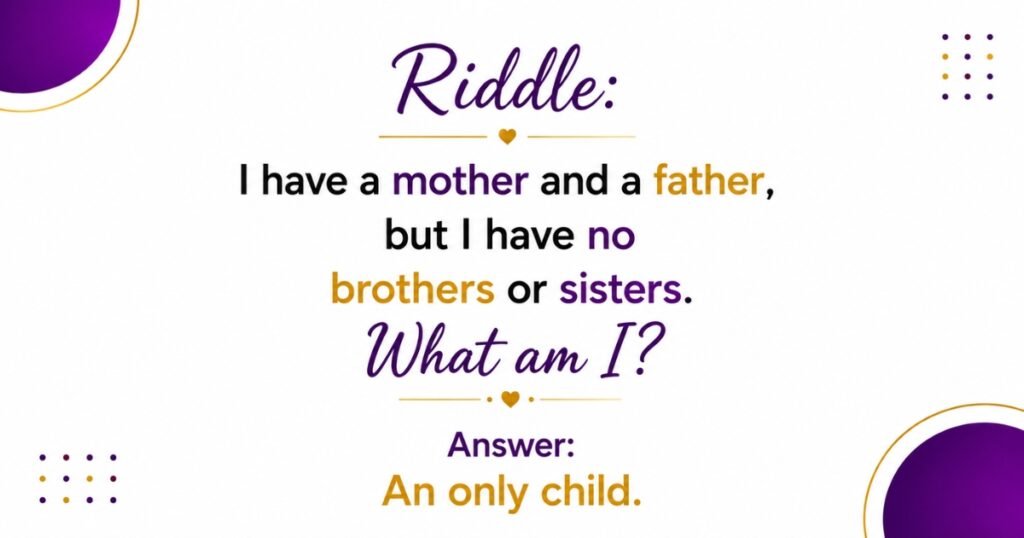
- Riddle: I have a mother and a father, but I have no brothers or sisters. Who am I?
Answer: An only child.
Difficulty: Easy
Explanation: The riddle rules out siblings directly, so the only family member left who fits “child of two parents” is an only child. - Riddle: I sit at the head of the table but I never eat. What am I?
Answer: A chair.
Difficulty: Easy
Explanation: “Sitting” is used literally for an object rather than a person, which is the simple misdirection here. - Riddle: I hang on the wall and show every family member’s face, but I’m not a mirror. What am I?
Answer: A family photo.
Difficulty: Easy
Explanation: The riddle borrows mirror-like imagery (showing faces) to disguise a simple household object. - Riddle: I keep the whole family on schedule, but I have no legs to walk with. What am I? Answer: A calendar.
Difficulty: Easy
Explanation: “Keeping on schedule” hints at time-management without naming a clock or watch directly. - Riddle: I’m made by mom or dad, but I don’t have any parents myself. What am I?
Answer: A meal.
Difficulty: Easy
Explanation: The wordplay swaps “made by” from a creation sense (cooking) into a birth sense, then resolves back to cooking. - Riddle: I get passed down through generations, but you can’t hold me in your hand. What am I? Answer: A family tradition.
Difficulty: Easy
Explanation: “Passed down” usually implies a physical object, but here it points to something intangible. - Riddle: I’m full of shoes but I’m not a shoe store. What am I?
Answer: A front hallway closet.
Difficulty: Easy
Explanation: The riddle uses an unexpected comparison (a shoe store) to make you picture a household space instead. - Riddle: Everyone in the family has one, but no two are exactly alike. What is it?
Answer: A name.
Difficulty: Easy
Explanation: The logic relies on uniqueness a trait every name shares despite being common to everyone. - Riddle: I light up the room during a family dinner, but I’m not a lamp. What am I?
Answer: A candle.
Difficulty: Easy
Explanation: The riddle narrows “light source” down through the dinner-table context, ruling out a ceiling lamp. - Riddle: I’m the one thing every family fights over on movie night, but I can’t talk. What am I? Answer: The remote control.
Difficulty: Easy
Explanation: The humor comes from a common real-life scenario (arguing over the remote) rather than pure wordplay.
Funny Family Riddles
Funny family riddles with answers are built for laughs first and logic second. These fun family riddles rely on puns and playful misdirection a classic joke-writing technique where the punchline flips your expectations at the last second.
- Riddle: Why did the family calendar go to therapy?
Answer: It had too many dates.
Difficulty: Easy
Explanation: This uses a pun “dates” means both calendar entries and romantic outings. - Riddle: What did the little spoon say to the big spoon at the family dinner table?
Answer: “Stop stirring up trouble!”
Difficulty: Easy
Explanation: “Stirring” plays on both the literal cooking action and the idiom for causing drama. - Riddle: Why did the family portrait refuse to smile?
Answer: It was too busy being framed.
Difficulty: Medium
Explanation: “Framed” doubles as both a photo frame and the phrase for being wrongly blamed. - Riddle: What do you call it when grandpa tells the same story for the tenth time?
Answer: A rerun.
Difficulty: Easy
Explanation: The joke borrows TV terminology to describe a familiar family habit a technique called misdirection. - Riddle: Why did the family’s Wi-Fi refuse to work during dinner?
Answer: It needed a break from the family, too.
Difficulty: Easy
Explanation: The punchline personifies the router, giving it the same need for downtime as a tired family member. - Riddle: What did the sock say to the other sock in the family laundry pile?
Answer: “We make a great pair when we can find each other.”
Difficulty: Easy
Explanation: The pun on “pair” plays against the well-known family struggle of losing single socks. - Riddle: Why did the family’s minivan get promoted?
Answer: It had been driving everyone’s schedule for years.
Difficulty: Medium
Explanation: The joke uses “driving” in both the literal sense and the sense of managing a busy household. - Riddle: Why did the leftovers get invited to the family reunion?
Answer: Because they were part of the family by now.
Difficulty: Easy
Explanation: This is a callback joke it relies on the shared experience of leftovers lasting long enough to feel like a fixture. - Riddle: What do you call a nap taken by the whole family at once?
Answer: A group project.
Difficulty: Easy
Explanation: Borrowing school terminology for a shared family activity is the misdirection here. - Riddle: Why did the family board game get grounded?
Answer: It kept causing arguments after bedtime.
Difficulty: Easy
Explanation: The joke personifies the board game and applies a parenting punishment (“grounded”) to it instead of a person.
Sibling Riddles
Riddles about brothers and sisters tend to land hardest, since most families instantly recognize the dynamic being described. This section leans on shared sibling experiences borrowed clothes, hand-me-downs, and constant comparisons.
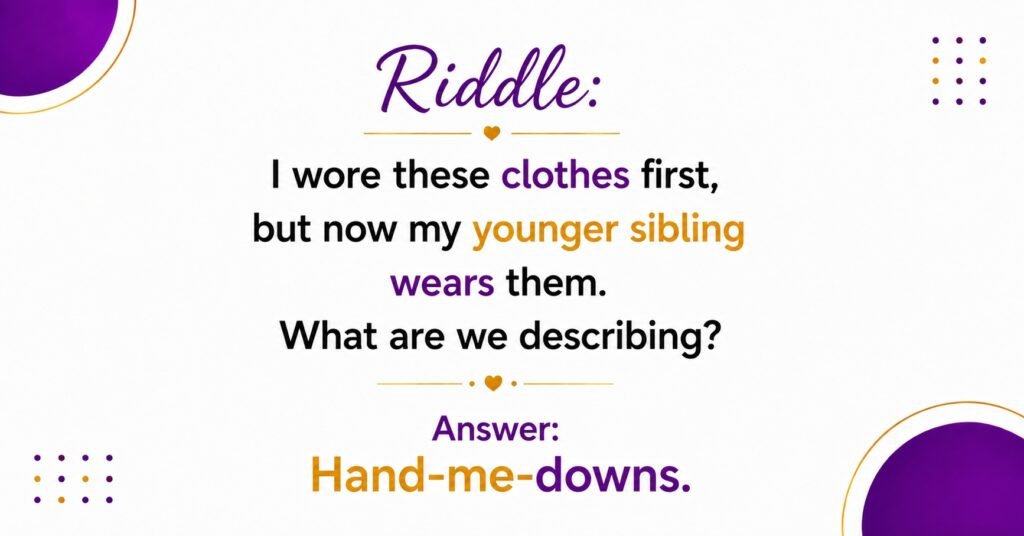
- Riddle: I wore these clothes first, but now my younger sibling wears them. What are we describing?
Answer: Hand-me-downs.
Difficulty: Easy
Explanation: The riddle relies on a common family logic chain older kids outgrow clothes, younger kids inherit them. - Riddle: I share your last name and half your genes, but I’m not your twin. Who am I? Answer: A sibling.
Difficulty: Easy
Explanation: The riddle uses genetic language to narrow the answer down without naming “brother” or “sister” directly. - Riddle: I always get blamed first, even when I didn’t do it. Who am I?
Answer: The older sibling.
Difficulty: Easy
Explanation: This plays on a widely recognized family stereotype rather than a logic puzzle. - Riddle: I copy everything you do, but I’d never admit it. Who am I?
Answer: A younger sibling.
Difficulty: Easy
Explanation: The riddle relies on relatable sibling behavior instead of wordplay. - Riddle: We share a room, a bathroom, and sometimes even a birthday, but we’re not the same person. Who are we?
Answer: Siblings (or twins).
Difficulty: Medium
Explanation: Listing shared resources builds toward the answer through elimination ruling out “same person.” - Riddle: I’m the referee for every disagreement, but I have no whistle. Who am I?
Answer: The middle child.
Difficulty: Medium
Explanation: The riddle borrows sports terminology (“referee”) to describe a family role, which is the misdirection. - Riddle: I know all your secrets, but I only tell them when I’m mad at you. Who am I?
Answer: A sibling.
Difficulty: Easy
Explanation: The logic relies on a familiar sibling dynamic trust that’s conditional on staying on good terms. - Riddle: We started as strangers to each other before we could even talk, but we grew up side by side. Who are we?
Answer: Siblings raised together.
Difficulty: Medium
Explanation: The riddle plays with the idea that siblings don’t choose each other, yet become each other’s closest companions. - Riddle: I finish your sentences, but I’ve never been you. Who am I?
Answer: A sibling who knows you well.
Difficulty: Easy
Explanation: This relies on the familiarity siblings develop from years of shared conversation. - Riddle: I’m shorter than you now, but I might not be forever. Who am I?
Answer: A younger sibling.
Difficulty: Easy
Explanation: The riddle hints at the common family experience of a younger sibling eventually growing taller.
Parent Riddles
These riddles celebrate what moms and dads do every day, often the tasks that go unnoticed until you try to describe them in riddle form.
- Riddle: I wake up before everyone else and go to sleep after everyone else. Who am I? Answer: A parent.
Difficulty: Easy
Explanation: The riddle uses a relatable daily routine to point directly at a parent’s role. - Riddle: I can fix a scraped knee, a broken toy, and a bad day, all before lunch. Who am I? Answer: Mom or Dad.
Difficulty: Easy
Explanation: Listing three unrelated “fixes” (physical, mechanical, emotional) builds toward a parent by elimination. - Riddle: I say “we’ll see” but I usually mean no. Who am I?
Answer: A parent.
Difficulty: Easy
Explanation: The humor comes from a widely recognized parenting phrase rather than wordplay. - Riddle: I carry the whole family’s schedule in my head, but I’ve never studied memory training. Who am I?
Answer: A parent.
Difficulty: Medium
Explanation: The riddle contrasts an impressive skill with the casual way parents develop it out of necessity. - Riddle: I’ve told the same bedtime story a hundred times, but I still add a new detail each time. Who am I?
Answer: A parent.
Difficulty: Easy
Explanation: This relies on a common parenting habit rather than logical deduction. - Riddle: I know exactly how much milk is left without opening the fridge. Who am I?
Answer: A parent.
Difficulty: Medium
Explanation: The riddle exaggerates a mundane household awareness that parents develop through repetition. - Riddle: I’m the first to celebrate your wins and the first to comfort your losses. Who am I? Answer: A parent.
Difficulty: Easy
Explanation: Pairing two opposite emotional roles narrows the answer to someone consistently present. - Riddle: I can hear a whisper from two rooms away, but only when it’s about dessert. Who am I?
Answer: A parent.
Difficulty: Easy
Explanation: The exaggeration (selective super-hearing) is the joke’s engine here. - Riddle: I’ve packed a thousand lunches, but I’ve never once been thanked for the crust I cut off. Who am I?
Answer: A parent.
Difficulty: Medium
Explanation: The riddle relies on a small, specific, relatable detail (cutting off crusts) to point to a parent. - Riddle: I taught you to ride a bike, tie your shoes, and drive a car, but I never once took a class to do it. Who am I?
Answer: A parent.
Difficulty: Easy
Explanation: Listing skills taught without formal training builds toward the answer through pattern recognition.
Grandparent Riddles
Grandparents bring history, patience, and often the best stories in the family. These riddles honor that role specifically.
- Riddle: I remember a world without smartphones, but I still learned to video call you. Who am I?
Answer: A grandparent.
Difficulty: Easy
Explanation: The riddle contrasts an older era with modern technology adoption to point to a grandparent. - Riddle: I’ve told the same story about “when I was your age” more times than anyone can count. Who am I?
Answer: A grandparent.
Difficulty: Easy
Explanation: This leans on a widely recognized grandparent stereotype rather than a logic trick. - Riddle: I keep candy in places no one else thinks to check. Who am I?
Answer: A grandparent.
Difficulty: Easy
Explanation: The humor relies on a familiar family memory rather than wordplay. - Riddle: I’m older than your parents, but I still call to check if you’ve eaten today. Who am I? Answer: A grandparent.
Difficulty: Easy
Explanation: The riddle combines age and a caring habit to arrive at the answer. - Riddle: I have a recipe that’s never been written down, yet everyone in the family can taste when it’s missing an ingredient. Who am I?
Answer: A grandparent.
Difficulty: Medium
Explanation: The riddle points to oral family tradition knowledge passed down without documentation. - Riddle: I hold the answers to questions about relatives you’ve never met. Who am I?
Answer: A grandparent.
Difficulty: Easy
Explanation: This relies on the grandparent’s role as the family’s living history book. - Riddle: I never learned to text in short form, but I still send the longest, warmest messages in the family group chat. Who am I?
Answer: A grandparent.
Difficulty: Easy
Explanation: The contrast between an old-fashioned communication style and a modern platform is the joke here. - Riddle: I have more patience for your questions than anyone else in the house. Who am I? Answer: A grandparent.
Difficulty: Easy
Explanation: This relies on a well-known family trait rather than deduction. - Riddle: I remember your parents’ first steps the same way I now remember yours. Who am I? Answer: A grandparent.
Difficulty: Medium
Explanation: The riddle uses generational repetition (parent, then child) to point to someone who has lived through both. - Riddle: I’m the family member most likely to say “one more slice won’t hurt.” Who am I? Answer: A grandparent.
Difficulty: Easy
Explanation: The riddle plays on a common, affectionate grandparent stereotype around food and indulgence.
Family Game Night Riddles
These fun family riddles are built to be read out loud, competition-style the kind that spark a friendly “I got it first!” moment around the table.
- Riddle: I bring the whole family to the table, but I never eat a single bite. What am I? Answer: A board game.
Difficulty: Easy
Explanation: The wordplay parallels a dinner-table gathering with a game-table gathering. - Riddle: I have dozens of pieces, but I only work when everyone plays fair. What am I? Answer: A family board game.
Difficulty: Easy
Explanation: “Pieces” hints at a puzzle or game, while “playing fair” ties it back to family rules. - Riddle: I get shuffled, dealt, and argued over, but I never leave the table. What am I? Answer: A deck of cards.
Difficulty: Easy
Explanation: The three verbs (shuffled, dealt, argued over) are all specific to card games, narrowing the answer quickly. - Riddle: I keep score, but I never play a single round myself. What am I?
Answer: A scoreboard or scorepad.
Difficulty: Easy
Explanation: The riddle separates the act of scoring from the act of playing to isolate the object. - Riddle: I roll across the table, but I’m not a ball. Families watch my number closely. What am I?
Answer: A die (dice).
Difficulty: Easy
Explanation: “Roll” is used literally here, and the “number” clue narrows it to dice rather than a ball. - Riddle: I hide answers that only the quickest hand can find first. What am I?
Answer: A buzzer-style trivia game.
Difficulty: Medium
Explanation: The riddle describes competitive trivia mechanics without naming the game directly. - Riddle: I have categories, cards, and a timer, but I never run out of questions on my own. What am I?
Answer: A trivia game.
Difficulty: Medium
Explanation: Listing structural features (categories, cards, timer) builds toward the answer by elimination. - Riddle: I turn a living room into a courtroom every time someone lands on my space. What am I?
Answer: A property-trading board game (like Monopoly-style games).
Difficulty: Medium
Explanation: “Courtroom” hints at the disputes that famously arise from property and money-based board games. - Riddle: I’m drawn on paper, guessed by everyone, and never look quite right on the first try. What am I?
Answer: A drawing/guessing game (like Pictionary-style games).
Difficulty: Medium
Explanation: The riddle describes the mechanics of sketch-and-guess games without naming a brand. - Riddle: I bring out everyone’s competitive side, even the family member who swears they don’t care about winning. What am I?
Answer: Family game night itself.
Difficulty: Easy
Explanation: This riddle zooms out from a single object to describe the shared family experience as a whole.
Holiday and Celebration Family Riddles
Holiday riddles bring families together more than almost any other occasion. This riddles about family section ties riddles to shared celebrations rather than everyday moments.
- Riddle: I bring the whole family to one table once a year, and I’m always followed by leftovers. What am I?
Answer: A holiday feast.
Difficulty: Easy
Explanation: The clue about leftovers narrows a general “family meal” down to a holiday-scale feast. - Riddle: I get passed around the room, but I’m never the same twice. What am I?
Answer: A holiday photo album or a gift.
Difficulty: Medium
Explanation: “Never the same twice” plays on either changing photos each year or a different gift each time. - Riddle: I light up the family home once a year, but I’m not the sun. What am I?
Answer: Holiday lights.
Difficulty: Easy
Explanation: The riddle rules out a natural light source to point toward decorative lighting. - Riddle: I bring cousins together who otherwise only see each other in photos. What am I? Answer: A family reunion.
Difficulty: Easy
Explanation: The riddle uses the specific relationship (cousins, rarely seen) to point to a reunion rather than a daily gathering. - Riddle: I’m baked once a year, but everyone claims to have the family’s “real” recipe for me. What am I?
Answer: A holiday dish or dessert.
Difficulty: Medium
Explanation: The riddle plays on the common family debate over whose version of a recipe is authentic. - Riddle: I make the whole family dress the same, even the ones who complain about it. What am I?
Answer: Matching holiday outfits or pajamas.
Difficulty: Easy
Explanation: This relies on a well-known modern family tradition rather than a logic puzzle. - Riddle: I’m wrapped, hidden, and eventually forgotten under furniture until next year. What am I?
Answer: A holiday gift.
Difficulty: Easy
Explanation: The final clue (forgotten under furniture) is a playful, relatable exaggeration that confirms the gift theme. - Riddle: I bring one extra chair to the table every single year, just in case. What am I?
Answer: A family tradition of setting a place for anyone who might show up.
Difficulty: Medium
Explanation: The riddle describes a specific, less common but real family custom of hospitality. - Riddle: I get toasted to, even though I can’t hear a word of it. What am I?
Answer: A family member’s health, memory, or achievement (the subject of a toast). Difficulty: Medium
Explanation: “Toasted to” plays on the celebratory speech tradition rather than food. - Riddle: I only come out of the closet once a year, and the whole family knows exactly which box I’m in. What am I?
Answer: Holiday decorations.
Difficulty: Easy
Explanation: The riddle relies on the shared family knowledge of where seasonal items are stored.
Road Trip Family Riddles
Long car rides are one of the most common places families actually use road trip riddles. This family riddle section with road trip riddles with answers is built specifically for that setting, with riddles short enough to read from the front seat.
- Riddle: I count down the miles, but I never move an inch myself. What am I?
Answer: A mile marker or GPS screen.
Difficulty: Easy
Explanation: The riddle separates the counting function from physical movement to isolate the object. - Riddle: I hold snacks, games, and arguments over legroom, all at once. What am I?
Answer: The back seat of the car.
Difficulty: Easy
Explanation: Listing three unrelated but familiar road-trip elements narrows the answer to a shared space. - Riddle: I get asked “are we there yet” more than any other question in the car. What am I (or who)?
Answer: The driver, or the car itself.
Difficulty: Easy
Explanation: This plays on the classic road-trip phrase rather than a logic puzzle. - Riddle: I play the same songs on repeat until everyone knows the words, whether they want to or not. What am I?
Answer: The car radio or road-trip playlist.
Difficulty: Easy
Explanation: The riddle relies on a shared road-trip experience rather than wordplay. - Riddle: I mark how far you’ve traveled, but I reset to zero at the start of every trip. What am I?
Answer: A trip odometer.
Difficulty: Medium
Explanation: The distinction between a regular odometer and a trip odometer is the key logical clue. - Riddle: I get passed from the front seat to the back seat, but I’m never a person. What am I? Answer: A snack bag or bottle of water.
Difficulty: Easy
Explanation: The riddle rules out a person to isolate an everyday object passed during travel. - Riddle: I show the family where to go, but I’ve never once been inside the car. What am I? Answer: A road sign.
Difficulty: Medium
Explanation: The riddle separates the guiding function from a GPS (which is inside the car) to point to an outdoor sign. - Riddle: I fill up the trunk before the trip and empty out by the end of it. What am I?
Answer: Luggage or snacks.
Difficulty: Easy
Explanation: The riddle uses a before-and-after contrast (full trunk, empty trunk) to hint at consumable or unpacked items. - Riddle: I’m the last thing checked before leaving the driveway, every single time. What am I? Answer: The seatbelt (or the gas tank).
Difficulty: Medium
Explanation: The riddle points to a habitual pre-trip check rather than a single obvious answer. - Riddle: I turn a three-hour drive into a memory the family still talks about years later. What am I?
Answer: A road trip itself.
Difficulty: Easy
Explanation: This riddle zooms out to describe the shared experience rather than a single object inside the car.
Family Memory and Bonding Riddles
These riddles lean into the emotional side of family life the things that can’t be bought or replaced, only shared.
- Riddle: I grow every year, but I’m never planted in soil. What am I?
Answer: A family’s collection of memories.
Difficulty: Medium
Explanation: The riddle borrows plant-growth language to describe something abstract that accumulates over time. - Riddle: I’m shared at every reunion, but I’m never the same story twice. What am I?
Answer: A family story or anecdote.
Difficulty: Easy
Explanation: The riddle plays on how family stories change slightly with each retelling. - Riddle: I’m found in old boxes, but I hold more value than anything sold in a store. What am I?
Answer: Family keepsakes or photographs.
Difficulty: Medium
Explanation: The contrast between physical storage location and emotional value is the riddle’s engine. - Riddle: I connect people who’ve never even met each other. What am I?
Answer: A family tree or shared last name.
Difficulty: Medium
Explanation: The riddle points to a connection that exists without direct personal interaction. - Riddle: I get stronger every time the family faces something hard together. What am I? Answer: Family bond or trust.
Difficulty: Medium
Explanation: The riddle describes an abstract quality that builds through shared adversity. - Riddle: I show up in old photos, but I never age a day once I’m captured. What am I? Answer: A memory or a photograph.
Difficulty: Easy
Explanation: The riddle contrasts real-time aging with a frozen moment in a photo. - Riddle: I’m passed from grandparent to parent to child, but I’m not an object. What am I? Answer: A family tradition, value, or story.
Difficulty: Medium
Explanation: The riddle rules out physical objects to point to something intangible passed across generations. - Riddle: I make an ordinary Tuesday dinner feel important, just because everyone’s there. What am I?
Answer: Family time together.
Difficulty: Easy
Explanation: This relies on the emotional weight of togetherness rather than a logic trick. - Riddle: I can’t be packed in a suitcase, but every family takes me on every trip. What am I? Answer: Family memories.
Difficulty: Easy
Explanation: The riddle uses a physical impossibility (packing memories) to point toward something abstract. - Riddle: I’m the one thing every family builds that no other family can copy exactly. What am I?
Answer: A family’s own story or identity.
Difficulty: Medium
Explanation: The riddle emphasizes uniqueness every family’s shared history is different, even with similar traditions.
Hard Family Riddles (Brain Teasers)
This final section is for teens and adults who want a bigger challenge. These riddles require more careful reading the answer often hinges on the smallest detail in the clue.
- Riddle: I connect three generations, but I only exist because two people made a choice a long time ago. What am I?
Answer: A family line (descent from a single couple).
Difficulty: Hard
Explanation: The riddle requires tracing backward recognizing that every family’s existence depends on one original decision to start it. - Riddle: I have no age of my own, but I make everyone in the family feel older or younger depending on who’s speaking. What am I?
Answer: Birth order (being the “oldest” or “youngest”).
Difficulty: Hard
Explanation: The riddle plays on relative, not absolute, age a family role shifts depending on comparison. - Riddle: I disappear the moment everyone agrees, but I grow the longer everyone argues. What am I?
Answer: A family disagreement or tension.
Difficulty: Hard
Explanation: The riddle uses an inverse relationship (agreement shrinks it, argument grows it) as the core logic. - Riddle: I was inherited by you, yet I existed long before you were born. What am I?
Answer: A family trait, name, or tradition.
Difficulty: Medium
Explanation: The riddle plays on inheritance that isn’t material traits or names predate the person who receives them. - Riddle: The closer I get to being forgotten, the harder the family works to keep me alive. What am I?
Answer: A family tradition or recipe at risk of dying out.
Difficulty: Hard
Explanation: The riddle describes an inverse-effort relationship fading things sometimes get the most active protection. - Riddle: I am proof of a promise no one signed on paper. What am I?
Answer: Family loyalty or trust.
Difficulty: Hard
Explanation: The riddle contrasts a formal, written agreement with an informal, unspoken family commitment. - Riddle: I was named before I could speak, and I’ll answer to it long after I stop hearing it from the people who gave it to me. What am I?
Answer: Your name, given by your family.
Difficulty: Medium
Explanation: The riddle uses timing (before speech, after loss) to build toward the idea of a name outliving those who gave it. - Riddle: I repeat myself in every generation, yet I’m never told the exact same way twice. What am I?
Answer: A family story or tradition passed down.
Difficulty: Hard
Explanation: The riddle plays on repetition with variation a hallmark of oral family history. - Riddle: I can be broken by silence just as easily as by shouting. What am I?
Answer: Family communication or trust.
Difficulty: Hard
Explanation: The riddle points out that both extremes no communication and hostile communication can damage the same thing. - Riddle: I am the only thing every family has in equal amount, no matter how much or little they own. What am I?
Answer: Time together.
Difficulty: Hard
Explanation: The riddle closes the collection by contrasting material wealth (unequal) with shared time (equal for everyone, regardless of resources), which is the entire spirit of the article.
Keep the Riddle Fun Going
Once you’ve worked through all 100 of these, there’s more to keep family game night stocked all year. If the road trip section was a hit, our Car Riddles collection is built specifically for long drives with the kids.
Craving more brain teasers in the same spirit as the “Hard Family Riddles” section? Our Time Riddles dig into similar reflective, generation-spanning themes.
And if you just need something quick to read aloud at the table, our Short Riddles collection is built for exactly that fast, one-breath format.
Chinese riddles frequently intertwine natural imagery and philosophical concepts, reflecting the deep-rooted connection between language and culture. Alcohol riddles often reflect cultural nuances, cleverly wrapped in humor and a splash of wit.
Conclusion
Family riddles work because they turn ordinary time together into something a little more memorable a shared laugh, a stumped grandparent, a kid who finally beats mom to the answer.
Whether you’re planning a road trip, a holiday dinner, or just a quiet weeknight, this collection of 100 original riddles gives every generation something to enjoy together.
FAQS
What are Some Good Family Riddles?
Good family riddles are short, clean, and easy to read aloud, with answers that make everyone kids, parents, and grandparents feel included. The best ones, like the 100 above, mix everyday objects with family roles so there’s something for every age.
Are Riddles Good For Family Bonding?
Yes. Riddles give families a shared activity that requires no screens or setup, and solving them together especially at the dinner table or during a car ride naturally sparks conversation and laughter.
What is a Riddle About Family?
A riddle about family is a short brain teaser where the answer is a family member, role, object, or tradition like a parent, sibling, grandparent, or family gathering described through clues rather than named directly.
How do You Make Family Riddles Fun for All Ages?
Mix difficulty levels in the same session. Start with easy riddles so younger kids can join in, then move into funny or hard riddles so teens and adults stay challenged too.
What are Easy Family Riddles For Kids?
Easy family riddles for kids usually describe familiar household objects or routines like a dining table, a family photo, or a calendar using simple, direct clues that don’t require advanced logic to solve.