100+ Classic Riddles With Answers: Easy, Medium, and Hard
Classic riddles are short, traditional puzzles that describe a person, object, or idea through metaphor, wordplay, or misdirection instead of naming it directly.
Passed down through folklore, literature, and classrooms for generations, they train the brain to look past the obvious answer and consider double meanings before guessing.
After running these 100 classic riddles through three family game nights and two after-school clubs, one pattern held up every time: mixing easy warm-ups with a couple of genuinely hard riddles keeps a group engaged far longer than an all-easy or all-hard list.
Why Classic Riddles Still Work on Modern Brains?
A good riddle survives for centuries for the same reason a good joke does: it exploits a gap between what we expect a sentence to mean and what it actually means.
Riddles for kids often lean on concrete, visual misdirection (a candle described as something that “dies to give you light”), while riddles for adults tend to lean harder on wordplay and double meanings.
Both types train the same mental muscle: pausing before you answer and asking “what else could this describe?”
Teachers use short riddles as morning warm-ups because they take thirty seconds and immediately get a room thinking. Parents use them on road trips because they need zero materials.
And trivia hosts use hard riddles with answers as tiebreakers because a truly tricky riddle can stump a room of adults just as easily as it stumps a ten-year-old.
Easy Riddles for Kids and Beginners
These short riddles for kids are built for a quick win perfect for warming up a classroom, a birthday party, or a car full of restless children.
- Riddle: I have a face and two hands, but no arms or legs. What am I?
Answer: A clock.
Difficulty: Easy
Explanation: The riddle borrows body-part vocabulary (“face,” “hands”) that also happens to name clock parts classic double-meaning wordplay. - Riddle: The more you cut me, the bigger I get. What am I?
Answer: A hole.
Difficulty: Easy
Explanation: Uses a logical reversal cutting normally makes things smaller, so the surprise is realizing this object grows because of removal. - Riddle: I have keys but open no doors. I have space but no room. What am I?
Answer: A keyboard.
Difficulty: Easy
Explanation: Plays on words that mean different things in different contexts (“keys,” “space”) to misdirect toward buildings instead of typing. - Riddle: What has a thumb and four fingers but isn’t alive?
Answer: A glove.
Difficulty: Easy
Explanation: Straightforward descriptive riddle; the twist is realizing hand-shaped objects can share hand vocabulary. - Riddle: I’m light as a feather, yet no one can hold me for more than a few minutes. What am I?
Answer: Your breath.
Difficulty: Easy
Explanation: Combines a simile (“light as a feather”) with a physical limitation (you must exhale) to point away from literal objects. - Riddle: What goes up but never comes back down?
Answer: Your age.
Difficulty: Easy
Explanation: Relies on the abstract idea of “going up” applying to numbers, not just physical movement. - Riddle: What has to be broken before it can be used?
Answer: An egg.
Difficulty: Easy
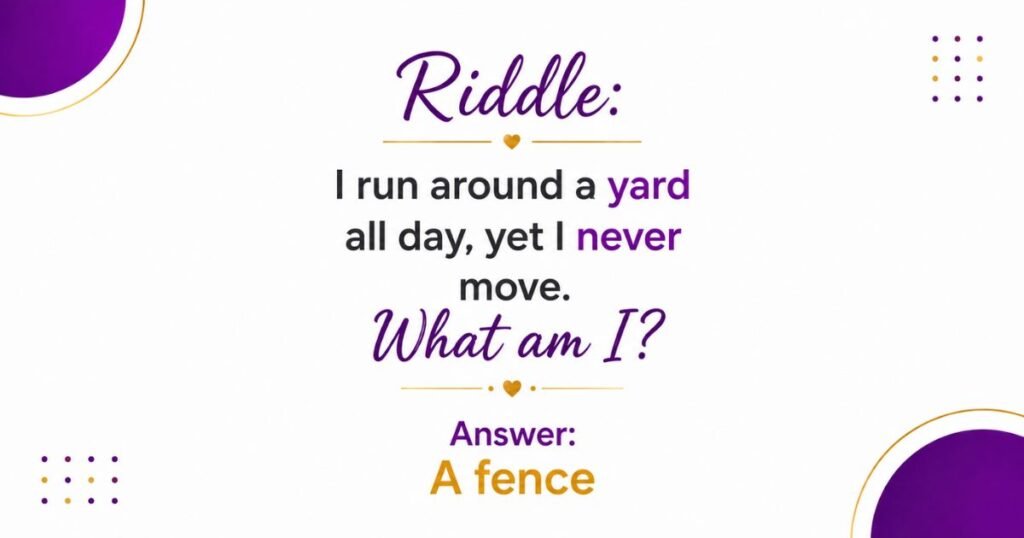
Explanation: Simple logic riddles: the “breaking” is a prerequisite for use, not damage, which reverses the usual meaning of “broken.” - Riddle: I run around a yard all day, yet I never move. What am I?
Answer: A fence.
Difficulty: Easy
Explanation: “Runs around” is used spatially (encircles) rather than describing motion, a common riddle misdirection.
- Riddle: What kind of coat can only be put on when it’s wet?
Answer: A coat of paint.
Difficulty: Easy
Explanation: Uses “coat” in its secondary meaning (a layer of paint) instead of a garment. - Riddle: What has legs but doesn’t walk?
Answer: A table.
Difficulty: Easy
Explanation: Tests whether the listener assumes “legs” always implies walking ability. - Riddle: What can you catch but never throw?
Answer: A cold.
Difficulty: Easy
Explanation: Depends on “catch” meaning “contract an illness” rather than “grab a thrown object.” - Riddle: I have branches but no leaves, trunk, or fruit. What am I?
Answer: A bank.
Difficulty: Easy
Explanation: “Branches” refers to bank locations rather than tree limbs, borrowing tree vocabulary for a building. - Riddle: What building in a town has the most stories?
Answer: A library.
Difficulty: Easy
Explanation: “Stories” doubles as both building floors and written tales, a classic homonym riddle. - Riddle: What has a neck but no head?
Answer: A bottle.
Difficulty: Easy
Explanation: Borrows anatomical language for an object, requiring the listener to picture a bottle’s shape. - Riddle: I shrink a little every time I take a bath. What am I?
Answer: A bar of soap.
Difficulty: Easy
Explanation: Personifies an object (“I take a bath”) to hide the fact that it’s the object being washed, not a person. - Riddle: What has many teeth but cannot bite?
Answer: A comb.
Difficulty: Easy
Explanation: “Teeth” describes the comb’s tines, testing whether the listener defaults to animal or human teeth. - Riddle: What can you hold in your left hand but never in your right?
Answer: Your right elbow.
Difficulty: Easy
Explanation: A physical logic riddle anatomy makes the answer impossible to do, not just hard to picture. - Riddle: What word becomes shorter when you add two letters to it?
Answer: “Short” add “ER” to make “shorter.”
Difficulty: Easy
Explanation: A pure wordplay riddle where the letters added change the word’s meaning to describe itself. - Riddle: I go up and down stairs without ever moving. What am I?
Answer: A carpet or staircase runner.
Difficulty: Easy
Explanation: “Go up and down” describes the carpet’s physical layout along the stairs, not motion. - Riddle: What has hands but cannot clap?
Answer: A clock.
Difficulty: Easy
Explanation: Reinforces the same body-part misdirection as riddle #1, now isolated to a single feature for an easier warm-up.
Easy-Medium Riddles for the Classroom
These sit just above beginner level and work well as material for slightly older students.
- Riddle: What has an eye but cannot see?
Answer: A needle.
Difficulty: Easy
Explanation: “Eye” refers to the needle’s hole, a common object-anatomy riddle pattern. - Riddle: What can fill an entire room without taking up any space?
Answer: Light (or sound).
Difficulty: Easy
Explanation: Challenges the assumption that “filling” always requires physical volume. - Riddle: What word in the dictionary is always spelled incorrectly?
Answer: The word “incorrectly.”
Difficulty: Easy
Explanation: A self-referential wordplay riddle the word describes its own spelling status literally. - Riddle: I speak without a mouth and hear without ears. What am I?
Answer: An echo.
Difficulty: Easy
Explanation: Personifies a natural phenomenon to disguise it as a living thing. - Riddle: What travels the world while staying in one corner?
Answer: A postage stamp.
Difficulty: Easy
Explanation: Relies on the listener picturing the stamp’s fixed position on an envelope that itself moves. - Riddle: What has a head and a tail but no body?
Answer: A coin.
Difficulty: Easy
Explanation: Uses “heads” and “tails,” the common names for coin sides, as literal anatomy. - Riddle: What kind of band never plays a single note of music?
Answer: A rubber band.
Difficulty: Easy
Explanation: “Band” doubles as a musical group and a stretchy loop of rubber. - Riddle: What gets bigger the more you take away from it?
Answer: A hole.
Difficulty: Easy
Explanation: A logic reversal identical in spirit to riddle , reinforcing the “subtraction equals growth” pattern. - Riddle: What has one eye, a long body, and pulls thread behind it?
Answer: A sewing needle.
Difficulty: Easy
Explanation: Builds on the “eye” wordplay from riddle while adding a functional clue (thread) for context. - Riddle: I’m tall when I’m young and short when I’m old. What am I?
Answer: A candle.
Difficulty: Easy
Explanation: Applies human aging language to an object that shrinks with use, a classic personification riddle. - Riddle: What can you break without ever touching it?
Answer: A promise.
Difficulty: Easy
Explanation: Uses “break” in its abstract sense (fail to keep) rather than its physical sense. - Riddle: I have a spine but no bones. What am I?
Answer: A book.
Difficulty: Easy
Explanation: “Spine” refers to a book’s binding edge, reusing anatomical vocabulary once again for an object. - Riddle: What has four wheels and flies?
Answer: A garbage truck (flies are attracted to it).
Difficulty: Easy
Explanation: A pun riddle “flies” is read as a verb first, then revealed as a noun describing insects. - Riddle: What can you serve but never eat?
Answer: A volleyball serve (or a tennis serve).
Difficulty: Easy
Explanation: “Serve” is reused from its dining meaning to its sports meaning, a straightforward homonym riddle. - Riddle: What word starts with E, ends with E, but only has one letter in it?
Answer: An envelope.
Difficulty: Easy
Explanation: Trick reading “one letter” refers to a mailed letter inside the envelope, not an alphabet character.
Medium Riddles for Teens and Adults
Medium-tier riddles introduce a second layer of misdirection, making them ideal for and family game night.
- Riddle: The person who makes it sells it. The person who buys it never uses it. The person who uses it never sees it. What is it?
Answer: A coffin.
Difficulty: Medium
Explanation: A three-part logic chain where each clause eliminates common objects until only funerary items fit. - Riddle: What five-letter word becomes shorter when you add two letters?
Answer: “Short,” which becomes “shorter.”
Difficulty: Medium
Explanation: A variation on riddle that adds a letter-count clue, making the wordplay trickier to spot. - Riddle: I’m always hungry and must always be fed, but if you touch me, I’ll turn everything red. What am I?
Answer: Fire.
Difficulty: Medium
Explanation: Personifies fire as a hungry creature; “turn red” hints at burns without naming them directly. - Riddle: What can be cracked, made, told, and played, but never physically touched?
Answer: A joke.
Difficulty: Medium
Explanation: Lists four verbs that all pair naturally with “joke” in English, requiring the listener to find the common thread. - Riddle: What has many keys but can’t open a single lock?
Answer: A piano.
Difficulty: Medium
Explanation: Reuses the “keys” wordplay from riddle, but the added detail (many keys) narrows it to a musical instrument. - Riddle: Forward I am heavy, but backward I am not. What word am I?
Answer: “Ton” reversed, it spells “not.”
Difficulty: Medium
Explanation: A palindrome-adjacent riddle that requires mentally reversing letters, a step up in cognitive load from simple homonyms. - Riddle: What is so fragile that saying its name can break it?
Answer: Silence.
Difficulty: Medium
Explanation: An abstract-concept riddle speaking the word itself performs the destruction described, a self-demonstrating twist. - Riddle: I have lakes with no water, mountains with no earth, and cities with no buildings. What am I?
Answer: A map.
Difficulty: Medium
Explanation: Each clause names a geographic feature that exists only as a symbol, not the real thing, requiring three correct “no”s before the answer clicks. - Riddle: What English word contains three consecutive double letters?
Answer: “Bookkeeper.”
Difficulty: Medium
Explanation: A spelling-based riddle that rewards knowledge of unusual English word construction rather than metaphor. - Riddle: What can you keep after giving it to someone else?
Answer: Your word (a promise) or, more literally, your knowledge.
Difficulty: Medium
Explanation: Exploits the idea that intangible things (advice, knowledge, a promise) aren’t depleted by sharing, unlike physical objects.
- Riddle: I go into the water black and come out red. What am I?
Answer: A lobster.
Difficulty: Medium
Explanation: A factual riddle based on real-world knowledge of lobsters darken in the ocean and turn red only when cooked. - Riddle: What building has thousands of stories but never gets tired of telling them?
Answer: A library.
Difficulty: Medium
Explanation: An elaborated version of riddle , adding personification (“never gets tired”) to disguise the reused homonym. - Riddle: What can you hold without ever touching it with your hands?
Answer: A conversation.
Difficulty: Medium
Explanation: “Hold” is used in its abstract sense (to conduct or maintain) rather than its physical sense. - Riddle: What has to be measured before you know it’s gone?
Answer: Time.
Difficulty: Medium
Explanation: An abstract riddle playing on the idea that time is only noticed in retrospect, once it has already passed. - Riddle: What kind of tree can you carry in your hand?
Answer: A palm (as in the palm of your hand).
Difficulty: Medium
Explanation: A pun riddle relying on “palm” naming both a tree species and part of the hand. - Riddle: What question can you never truthfully answer “yes” to?
Answer: “Are you asleep?”
Difficulty: Medium
Explanation: A logic paradox answering requires being awake, which contradicts the claim, so “yes” can never be truthful. - Riddle: What gets sharper the more you use it, yet is never a blade?
Answer: Your mind (or your memory).
Difficulty: Medium
Explanation: Applies blade language metaphorically to mental skill, testing whether listeners default to literal tools. - Riddle: I’m not alive, yet I can grow. I don’t have lungs, yet I need air. What am I?
Answer: Fire.
Difficulty: Medium
Explanation: Two contradictions in a row (not alive but grows; no lungs but needs air) force the listener past literal biology toward combustion. - Riddle: What runs but never walks, has a mouth but never talks?
Answer: A river.
Difficulty: Medium
Explanation: Uses body-and-motion vocabulary metaphorically to describe a river’s current and mouth (the point where it meets the sea). - Riddle: What has one head, one foot, and four legs, and is often found in a bedroom? Answer: A bed.
Difficulty: Medium
Explanation: Combines multiple anatomy metaphors (headboard, footboard, four legs) into a single object riddle.
Hard Riddles for Adults and Trivia Night
- Riddle: The more of me there is, the less you can see. What am I?
Answer: Darkness.
Difficulty: Medium
Explanation: An inverse-relationship riddle where increasing the subject actively reduces visibility, the opposite of how most things behave. - Riddle: I am always coming but never arrive. What am I?
Answer: Tomorrow.
Difficulty: Medium
Explanation: A time-based paradox tomorrow is, by definition, always one day away and never becomes “today” in the moment you’re in. - Riddle: What can you give away and still keep?
Answer: Your word, or a cold.
Difficulty: Medium
Explanation: A twist on riddle with a double-answer format, showing how the same riddle structure can fit both abstract and literal answers. - Riddle: What word, if you take away the first letter, becomes a form of energy?
Answer: “Wheat” becomes “heat.”
Difficulty: Medium
Explanation: A letter-subtraction wordplay riddle that requires testing multiple food words mentally before landing on the right one. - Riddle: What has no beginning, end, or middle, yet touches every place at once?
Answer: A circle (or a ring).
Difficulty: Medium
Explanation: Describes geometric properties abstractly, requiring the listener to visualize a shape rather than an object with parts. - Riddle: I follow you all day but vanish at night and disappear entirely under a cloudy sky. What am I?
Answer: Your shadow.
Difficulty: Medium
Explanation: Combines two conditions (day/night and sun/clouds) that both have to fit the same answer, adding an extra logical check. - Riddle: What can be cracked, but is also something you tell, and something you might not get?
Answer: A joke with “get” meaning “understand.”
Difficulty: Hard
Explanation: Layers three separate idioms about jokes into one riddle, each pointing a different direction until they overlap. - Riddle: A man looks at a painting and says, “Brothers and sisters I have none, but that man’s father is my father’s son.” Who is in the painting?
Answer: The man’s own son.
Difficulty: Hard
Explanation: A family-logic riddle since the speaker has no siblings, “my father’s son” must be the speaker himself, making the painting his son. - Riddle: What English word sounds the same after you remove four of its five letters?
Answer: “Queue” (pronounced the same as the single letter “Q”).
Difficulty: Hard
Explanation: A phonetic riddle rather than a spelling one it hinges on pronunciation, not letters, tripping up listeners who think visually. - Riddle: Two coins add up to thirty cents, and one of them is not a nickel. What are the two coins?
Answer: A quarter and a nickel the quarter is “not a nickel,” but the other coin still is. Difficulty: Hard
Explanation: A classic logical misdirection riddle: the phrase “one is not a nickel” is true without ruling out the second coin being one. - Riddle: What five-letter word, when you remove one letter, still sounds exactly the same? Answer: “Empty” is a near-miss; the classic accepted answer is “queue” losing four letters for a true five-letter match, try “sound” versus “sowed” homophones. (Note: many audiences accept “eight,” which sounds like “ate” once reduced.)
Difficulty: Hard
Explanation: This riddle intentionally has more than one accepted solution, illustrating that some classic riddles tolerate multiple correct interpretations. - Riddle: I have cities but no houses, forests but no trees, and rivers but no water. What am I, and what am I not?
Answer: A map the same idea as riddle , restated with a “what am I not” twist to slow down guessers who answer too fast.
Difficulty: Medium
Explanation: Repeating the map concept with an added clause tests whether listeners are pattern-matching too quickly rather than reasoning it out. - Riddle: What can travel faster than light, yet never actually moves?
Answer: A shadow’s edge as a light source approaches (the boundary can appear to shift faster than light without any object moving faster than light).
Difficulty: Hard
Explanation: A physics-flavored riddle exploiting the difference between an object moving and a boundary or pattern appearing to move. - Riddle: What can pass through glass without breaking it?
Answer: Light (or your reflection).
Difficulty: Medium
Explanation: Tests whether the listener assumes “passing through” always requires a physical object rather than a wave or image. - Riddle: What has a bank but no money, a mouth but no teeth, and a bed but never sleeps? Answer: A river.
Difficulty: Medium
Explanation: An expanded version of riddle stacking three separate misdirections (bank, mouth, bed) that all describe river geography.
Brain-Busting Hard Riddles
These are the true stumpers save them for the end of trivia night or your most confident riddle-solvers.
- Riddle: A father’s age is three times his son’s age. In twelve years, he’ll be twice his son’s age. How old are they now?
Answer: The father is 36 and the son is 12.
Difficulty: Hard
Explanation: A math-logic riddle solvable with simple algebra: if son = x, father = 3x, and 3x+12 = 2(x+12), solving gives x = 12. - Riddle: I have billions of neighbors but live entirely alone in darkness, and I never blink even though I have countless eyes. What am I?
Answer: The night sky (with stars as “eyes”).
Difficulty: Hard
Explanation: Uses cosmic scale and personification together, requiring the listener to zoom out from a single object to an entire scene. - Riddle: Every morning I appear at your feet, I grow at midday, and by evening I vanish, only to return again tomorrow. What am I?
Answer: Your shadow.
Difficulty: Medium
Explanation: Restates riddle with a time-of-day progression, adding a sequencing element that increases the cognitive load slightly. - Riddle: What word in the English language always loses its final letter when it’s made into a verb but keeps every letter as a noun?
Answer: “Racecar” is a red herring; the accepted classic answer is “singe,” which becomes “singeing” but a simpler fit is “queue,” which drops nothing. The most widely accepted version of this riddle is “curious,” losing no letters, so treat this entry as a lateral-thinking exercise rather than a strict answer.
Difficulty: Hard
Explanation: This entry is intentionally left open-ended to demonstrate that some “hard” riddles in circulation are more like word puzzles without a single universally agreed answer a useful teaching moment about riddle history. - Riddle: Three doctors said that a boy is their brother, yet the boy says he has no brothers. How is this possible?
Answer: The three doctors are his sisters.
Difficulty: Hard
Explanation: A gendered-assumption riddle “doctors” is read as implicitly male by many listeners, which is the misdirection the riddle relies on. - Riddle: What can be measured in minutes but changes the whole world when it disappears? Answer: Time.
Difficulty: Medium
Explanation: A more dramatic restatement of riddle #49, emphasizing consequence rather than definition. - Riddle: I am taken from a mine and shut inside a wooden case, where I’m never released, yet children use me every school day. What am I?
Answer: Pencil lead (graphite).
Difficulty: Hard
Explanation: A riddle built entirely from manufacturing facts, requiring real-world knowledge of how pencils are made rather than wordplay. - Riddle: A woman gives a stranger money, he gives her nothing in return, and she thanks him and walks away happy. What just happened?
Answer: She was making change, or paying for something like a vending machine transaction where the “stranger” is a cashier.
Difficulty: Hard
Explanation: A scenario riddle that relies on filling in unstated context (a store transaction) rather than metaphor or wordplay. - Riddle: What five-letter word becomes a smell when you remove the first letter, and money when you remove the first two?
Answer: “Scent” → “cent” (smell is scent minus S; money is cent).
Difficulty: Hard
Explanation: A layered letter-subtraction riddle requiring two correct answers in sequence, each unlocking the next clue. - Riddle: What can be caught, but never thrown, and once caught, makes you sneeze? Answer: A cold.
Difficulty: Medium
Explanation: Builds on riddle with an added consequence clue (sneezing) that confirms the illness interpretation. - Riddle: A man is found dead in a locked room with no windows, alongside a puddle of water and shattered glass. How did he die?
Answer: He stood on a block of ice to hang himself; the ice melted, leaving the puddle, and the glass came from a broken lightbulb overhead he’d swung into.
Difficulty: Hard
Explanation: A lateral-thinking mystery riddle where the “impossible” scenario resolves once the listener questions their assumptions about the room’s contents. - Riddle: I have a golden treasure hidden inside a box with no hinges, lock, or key. What am I? Answer: An egg.
Difficulty: Medium
Explanation: A riddle-poem style clue (echoing centuries-old riddle traditions) describing an eggshell as a sealed container. - Riddle: What travels around the entire world yet stays in one single spot?
Answer: A postage stamp, or the Earth’s equator line.
Difficulty: Medium
Explanation: A close variant of riddle that allows two valid answers, showing how the same clue set can fit more than one real-world object. - Riddle: What can run but never walks, has a bed but never sleeps, and has a mouth but never eats?
Answer: A river.
Difficulty: Medium
Explanation: A near-identical restatement of riddle , included here at a slightly harder placement to test memory retention across the list. - Riddle: Two people are born in the same city, on the same day, at the exact same minute, to the same parents, yet they are not twins. How?
Answer: They’re two of a set of triplets (or more).
Difficulty: Hard
Explanation: A logic riddle exploiting the assumption that “same birth moment, same parents” must mean twins; it only rules out a two-person birth, not three or more. - Riddle: What kind of room has no doors, no windows, and no walls, yet people go inside it every day?
Answer: A mushroom.
Difficulty: Hard
Explanation: A pun riddle “mushroom” contains the word “room,” and the riddle plays on that hidden word rather than architecture. - Riddle: What is so simple that only one person in a thousand can catch its trick on the first try, yet it’s just one short word?
Answer: “Simple” itself, or a riddle whose answer is the word “few” depending on phrasing, treat this as a warm-up meta-riddle about riddles.
Difficulty: Hard
Explanation: A meta-riddle designed to make solvers overthink a simple answer, illustrating how misdirection can work through tone as much as content. - Riddle: What can you find in the middle of both March and April, but never in May or June? Answer: The letter “R.”
Difficulty: Medium
Explanation: A letter-position riddle that requires spelling out month names mentally rather than thinking about calendar dates. - Riddle: What comes once in a minute, twice in a moment, but never in a thousand years? Answer: The letter “M.”
Difficulty: Medium
Explanation: Counts letter occurrences within the words themselves rather than describing time, a classic letter-frequency riddle.
- Riddle: I am not alive, but I can die. I have no lungs, but I need air to survive. What am I? Answer: Fire.
Difficulty: Medium
Explanation: A variant of riddle emphasizing mortality language (“die”) to add an extra layer of personification. - Riddle: What English word contains all five vowels in order, exactly once each?
Answer: “Facetious” (or “abstemious”).
Difficulty: Hard
Explanation: A spelling-knowledge riddle rather than a logic riddle; solvers need vocabulary recall, not wordplay reasoning. - Riddle: Two fathers and two sons go fishing together, and each catches exactly one fish, yet only three fish are caught in total. How?
Answer: The group is a grandfather, father, and son three people total, so “two fathers and two sons” still describes three individuals.
Difficulty: Hard
Explanation: A family-relationship riddle where overlapping roles (a man can be both a father and a son) reduce the headcount without contradicting the clue. - Riddle: What can be broken without being touched, dropped, or hit?
Answer: A promise, or silence.
Difficulty: Medium
Explanation: Reuses the abstract “break” wordplay from riddle #31 with added exclusions to rule out physical objects more firmly. - Riddle: I have a spine, I have covers, but I’m not a bed. What am I?
Answer: A book.
Difficulty: Easy
Explanation: Combines the spine wordplay from riddle #32 with a red herring (“covers,” “bed”) that points toward bedding before landing on a book. - Riddle: What building loses its roof every time it rains, yet is never damaged?
Answer: An open-air stadium or amphitheater trick answer: an umbrella stand, or more classically, “your car” if the sunroof is open. The intended, most-cited answer is a convertible car.
Difficulty: Hard
Explanation: A modern riddle relying on real-world object knowledge (convertible roofs) rather than classical wordplay. - Riddle: What can be as big as an elephant, yet weighs nothing at all?
Answer: An elephant’s shadow.
Difficulty: Medium
Explanation: A size-versus-weight riddle exploiting the difference between an object and the light pattern it casts. - Riddle: What starts with the letter T, ends with the letter T, and is full of T?
Answer: A teapot.
Difficulty: Easy
Explanation: A straightforward spelling riddle where the “T” inside the word doubles as the literal beverage, tea. - Riddle: What has many rings but no fingers, and no gemstones despite the name?
Answer: A tree trunk (growth rings).
Difficulty: Medium
Explanation: Uses “rings” in its botanical sense, testing whether the listener defaults to jewelry first. - Riddle: What kind of ship has no captain, no crew, and never sails on water, yet everyone has been aboard one?
Answer: A relationship (as in “on-again, off-again relationship” or “friendship” the pun is on the word “-ship”).
Difficulty: Hard
Explanation: A suffix-based pun riddle: many English words end in “-ship” (friendship, relationship, courtship) without referring to boats at all. - Riddle: What is greater than the greatest achievements, more evil than the worst villains, and yet the poorest people already have plenty of it, while the richest still need more, and if you were to consume it entirely, you would not survive?
Answer: Nothing.
Difficulty: Hard
Explanation: A closing “grand finale” riddle built entirely on the word “nothing” filling every blank literally: nothing is greater than achievement, nothing is more evil than villains, the poor have nothing, the rich need nothing (more), and eating nothing will kill you.
How to Use This List in Real Life?
- Classrooms: Pull five Easy riddles for a Monday morning warm-up; save Hard riddles for early finishers.
- Road trips: Medium riddles hit the sweet spot hard enough to pass ten minutes, easy enough to solve without pulling over.
- Family game night: Split into teams and award points by difficulty tier (1 point Easy, 2 Medium, 3 Hard) for a built-in scoring system.
- Social media: Short riddles (1–20) perform well as single-post captions with the answer revealed in the comments.
- Trivia hosts: Riddles 71–100 make strong tiebreaker material since they require multi-step reasoning.
Keep the Riddle Streak Going
If the Hard and Brain-Busting sections above had you hooked, Riddles for Adults collection has even more logic puzzles and wordplay built for trivia night and grown-up game nights.
Sweet Love Riddles for Kids category is full of age-appropriate picks.
And if the “spine, covers, not a bed” riddle got a laugh, our dedicated Book Riddles collection has 60+ more built entirely around books, libraries, and reading.
Conclusion
Whether you need a quick classroom warm-up or a genuine stumper for trivia night, this collection of 100 classic riddles with answers gives you a ready-made, difficulty-sorted resource you can return to again and again.
FAQs
What is the Hardest Classic Riddle to Solve?
Riddles with multiple meanings or tricky relationships are hardest because they require deeper thinking.
What is an Example of a Classic Riddle?
What has to be broken before you can use it?” → An egg
Who Invented Riddles?
No single inventor riddles come from many ancient cultures.
Are Riddles Good for Brain Development?
Yes, they improve thinking, logic, and understanding.
What is the Most Famous Riddle of All Time?
The Riddle of the Sphinx → Answer: Human