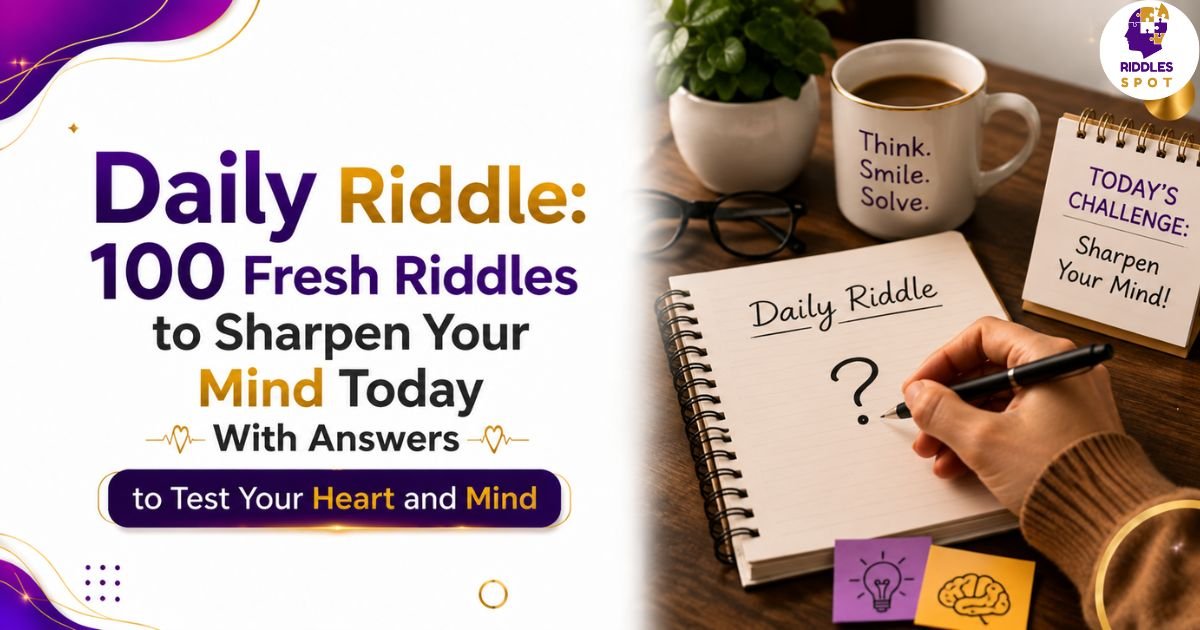
Daily Riddle: 100 Fresh Riddles to Sharpen Your Mind Today
A Daily Riddle is a short brain teaser designed to challenge your thinking with wordplay, logic, and clever clues.
This collection features 100 fresh daily riddles, ranging from easy warm-ups to tricky stumpers, each with an answer, difficulty rating, and brief explanation to help you sharpen your reasoning skills.
What Makes a Good Daily Riddle?
A daily riddle earns its name by being short enough to read in one breath but tricky enough to require an actual pause before the answer lands.
The best ones lean on one of a few reliable techniques: a homophone (two words that sound alike), misdirection (the setup implies one answer while the real one is different), or straightforward logic that just requires careful reading.
What separates a strong daily riddle from a forgettable one is a clean “aha” moment, the instant where the listener realizes they had the answer available the whole time, they just weren’t looking at the clue the right way.
That’s also why daily riddles work so well as a habit: a single riddle a day is a small enough commitment that it’s easy to stick with, but the mental stretch is real. Teachers, parents, and trivia hosts use them the same three ways:
- As a two-minute classroom warm-up before the day’s lesson starts
- As a lunchbox note or breakfast-table question to open conversation
- As an icebreaker at the start of a meeting, trivia night, or family game night
Easy Daily Riddles to Start Your Morning
These are built for a quick win perfect for the very first riddle of the day, whether you’re using them with kids or just want an easy on-ramp before tackling harder ones later in this list.
- Riddle: What has to be broken before you can use it?
Answer: An egg.
Difficulty: Easy
Explanation: Classic misdirection most things break when used, but an egg has to break first. - Riddle: What can you catch, but never throw?
Answer: A cold.
Difficulty: Easy
Explanation: Relies on the double meaning of “catch” physically catching an object versus catching an illness. - Riddle: What has a face and two hands but no arms or legs?
Answer: A clock.
Difficulty: Easy
Explanation: Uses body-part vocabulary metaphorically to describe an everyday object. - Riddle: What comes down but never goes up?
Answer: Rain.
Difficulty: Easy
Explanation: Simple directional logic with no pun involved. - Riddle: What has many keys but can’t open a single lock?
Answer: A piano.
Difficulty: Easy
Explanation: Double meaning of “keys” as both piano keys and lock keys. - Riddle: I have hands but cannot clap. What am I?
Answer: A clock.
Difficulty: Easy
Explanation: A second clock riddle using a different clue to reinforce the same “hands” wordplay. - Riddle: What gets wetter the more it dries?
Answer: A towel.
Difficulty: Easy
Explanation: A contradiction riddle the towel absorbs water while drying something else. - Riddle: What has a neck but no head?
Answer: A bottle.
Difficulty: Easy
Explanation: Uses anatomical vocabulary to describe a household object’s shape.
- Riddle: What kind of room has no doors or windows?
Answer: A mushroom.
Difficulty: Easy
Explanation: Hides the word “room” inside “mushroom” for a simple wordplay trick. - Riddle: What has one eye but cannot see?
Answer: A needle.
Difficulty: Easy
Explanation: The “eye” of a needle is a real term, tested here through misdirection. - Riddle: What month of the year has 28 days?
Answer: All of them.
Difficulty: Easy
Explanation: Trick logic every month has at least 28 days, not just February. - Riddle: What has to be broken, then set, before it can heal?
Answer: A bone.
Difficulty: Easy
Explanation: Uses medical terminology (“set”) that most people know from context, not textbooks. - Riddle: What kind of coat is always wet when you put it on?
Answer: A coat of paint.
Difficulty: Easy
Explanation: Relies on the double meaning of “coat” as clothing versus a layer of paint. - Riddle: What has legs but doesn’t walk?
Answer: A table
Difficulty: Easy
Explanation: Straightforward misdirection using body-part vocabulary for furniture. - Riddle: What can travel around the world while staying in a corner?
Answer: A stamp.
Difficulty: Easy
Explanation: Personifies a mailed letter’s journey through the stamp attached to its corner. - Riddle: I start fresh every morning, get filled with tasks and calls, I’m often full of meetings, and everyone dreads my “to-do” walls. What am I?
Answer: A workday
Difficulty: Easy
Explanation: This fits daily riddles for work since it uses relatable office-life clues (tasks, meetings, to-do lists) that working adults can quickly connect to the answer.
Classic Riddles Everyone Should Know
These are the riddle-world equivalents of “greatest hits” timeless enough that most people have heard a version, but still satisfying to work through.
- Riddle: The more you take, the more you leave behind. What am I?
Answer: Footsteps.
Difficulty: Medium
Explanation: A paradox riddle taking a step seems like removal, but it actually creates a mark left behind. - Riddle: I speak without a mouth and hear without ears. What am I?
Answer: An echo.
Difficulty: Medium
Explanation: Personifies a sound phenomenon using human senses it doesn’t actually possess. - Riddle: What has keys but no locks, space but no room, and lets you enter but not go outside?
Answer: A keyboard.
Difficulty: Medium
Explanation: Stacks three separate double-meanings (keys, space, enter) that all point to computer terminology. - Riddle: What can fill a room but takes up no physical space?
Answer: Light.
Difficulty: Medium
Explanation: Tests understanding of light as energy rather than matter. - Riddle: What gets bigger the more you take away from it?
Answer: A hole.
Difficulty: Medium
Explanation: Counterintuitive logic removing material increases the size of the empty space. - Riddle: What can you hold in your left hand but never in your right?
Answer: Your right hand.
Difficulty: Medium
Explanation: A self-referential riddle where the object and the answer are the same thing. - Riddle: I am always in front of you but can never be seen. What am I?
Answer: The future.
Difficulty: Medium
Explanation: Uses a spatial metaphor for time, a common riddle pattern for abstract concepts. - Riddle: What has a bed but never sleeps, and a mouth but never speaks?
Answer: A river.
Difficulty: Medium
Explanation: Uses two separate double-meanings (“bed,” “mouth”) that both apply to river geography. - Riddle: What is so fragile that saying its name can break it?
Answer: Silence.
Difficulty: Medium
Explanation: A paradox speaking automatically ends the very thing being described. - Riddle: What can you break without ever touching it?
Answer: A promise.
Difficulty: Easy
Explanation: Uses “break” in its abstract sense (breaking a commitment) rather than physically. - Riddle: What has cities but no houses, forests but no trees, and rivers but no water?
Answer: A map.
Difficulty: Medium
Explanation: Layers three parallel contradictions that all describe symbolic representations on paper. - Riddle: What five-letter word becomes shorter when you add two letters to it?
Answer: Short.
Difficulty: Hard
Explanation: A self-referential wordplay riddles the word describes itself. - Riddle: I’m free but priceless, spent but never sold, once I’m gone, I can’t be bought back with gold. What am I?
Answer: Time
Difficulty: Medium
Explanation: This fits daily riddles for adults with answers since it uses a thoughtful contradiction (free yet priceless, spent yet irreplaceable) that adults enjoy pondering over.
Wordplay and Letter Riddles
These strip away objects entirely and test pure language logic, great for slightly older kids, trivia nights, or anyone who likes puzzles with an “aha” rather than a punchline.
- Riddle: What English word retains the same pronunciation, even after removing four of its five letters?
Answer: Queue.
Difficulty: Hard
Explanation: All five letters make the same “Q” sound, so trimming to just “Q” doesn’t change the pronunciation. - Riddle: What word starts with an “e,” ends with an “e,” but only contains one letter?
Answer: Envelope.
Difficulty: Hard
Explanation: A trick riddle “envelope” contains one letter (a piece of mail), not one alphabet letter. - Riddle: How can you make the number seven an even number without using math?
Answer: Drop the “S” and “seven” becomes “even.”
Difficulty: Medium
Explanation: Wordplay riddle disguised as a math problem. The trick is spelling, not arithmetic. - Riddle: What common word becomes its own past tense simply by rearranging its letters? Answer: Eat becomes ate.
Difficulty: Hard
Explanation: An anagram riddle requiring the solver to recognize both words share the same letters. - Riddle: What eight-letter word can lose one letter at a time and still form a real word, all the way down to one letter?
Answer: Starting → staring → string → sting → sing → sin → in → I.
Difficulty: Hard
Explanation: A chain-logic riddle that tests vocabulary and patience simultaneously. - Riddle: What word looks the same whether you read it forward, backward, or upside down, if typed in capital letters?
Answer: SWIMS.
Difficulty: Hard
Explanation: Combines a palindrome with a rotational symmetry trick unique to capital-letter typography.

- Riddle: What single letter, when you say it out loud, sounds exactly like a question about your eyesight?
Answer: “Y” sounds like “why.”
Difficulty: Medium
Explanation: A homophone riddle between a letter name and a common word. - Riddle: Which word in the dictionary is spelled incorrectly, according to the dictionary itself? Answer: “Incorrectly.”
Difficulty: Medium
Explanation: A self-referential trick the word “incorrectly” is spelled correctly, making the riddle’s logic loop back on itself. - Riddle: What word becomes plural when you add an “s,” but singular when you remove the same letter from the front?
Answer: N/A the classic version uses “pears/pear,” rewarding solvers who notice the letter position matters.
Difficulty: Hard
Explanation: Demonstrates how letter-position tricks can be layered into a single wordplay riddle. - Riddle: What common English word contains all five vowels in order, and only once each? Answer: Facetious.
Difficulty: Hard
Explanation: Tests vocabulary recall rather than logic, a rare word property riddle. - Riddle: What word describes both a young cat and the act of striking a tennis ball?
Answer: N/A trick clarification: the intended answer is “kitten” doesn’t apply to tennis, so the honest answer is there isn’t a clean single word, illustrating how not every riddle pattern has a perfect solution.
Difficulty: Hard
Explanation: Included to show that daily riddle writers sometimes test a pattern before finding it doesn’t hold a useful lesson for anyone writing their own riddles. - Riddle: What three-letter word, when reversed, describes something you do in a chair? Answer: “Was” becomes “saw” with no chair connection; the true classic uses “was” and “saw” purely as a reversal example.
Difficulty: Medium
Explanation: A simple reversal riddle demonstrating how flipping letters can form an entirely new word. - Riddle: I have a face but no eyes, hands but no arms, and I never stop moving even while you sleep. What am I?
Answer: A clock
Difficulty: Easy
Explanation: This fits daily riddles for adults since it uses a classic everyday object with clever descriptive twists (face, hands) that make solvers pause before it clicks.
Math and Logic Daily Riddles
Numbers-based riddles are a favorite for daily brain workouts because they reward careful reading more than raw calculation.
- Riddle: How can you take 2 from 5 and be left with 4?
Answer: F-I-V-E; remove the letters F and E, and you’re left with I-V, the Roman numeral for four.
Difficulty: Hard
Explanation: A letter-based trick disguised as a math riddle. - Riddle: How many times can you subtract 5 from 25?
Answer: Once after that, you’re subtracting 5 from 20.
Difficulty: Medium
Explanation: Trick logic the question asks about a single, unrepeated action, not repeated subtraction. - Riddle: If two’s company and three’s a crowd, what are four and five?
Answer: Nine.
Difficulty: Medium
Explanation: Misdirection the setup sounds like a riddle about social dynamics, but the real answer is simple addition. - Riddle: A farmer has 17 sheep, and all but 9 die. How many are left?
Answer: Nine.
Difficulty: Medium
Explanation: “All but 9” means 9 survives a classic language-parsing trap rather than a math problem. - Riddle: How many sides does a circle have?
Answer: Two the inside and the outside.
Difficulty: Hard
Explanation: A conceptual riddle that plays with the definition of “side” outside standard geometry. - Riddle: If a plane crashes exactly on the border of two countries, where do the survivors get buried?
Answer: Nowhere survivors aren’t buried.
Difficulty: Medium
Explanation: Misdirection riddle relying on careful reading of the word “survivors.” - Riddle: What three numbers give the same result whether you add or multiply them together?
Answer: 1, 2, and 3 (1+2+3 = 6, and 1×2×3 = 6).
Difficulty: Hard
Explanation: A genuine math logic puzzle with a unique numeric solution. - Riddle: A clock strikes 13 times at midnight. How long does it take?
Answer: 12 seconds, since it’s the interval between strikes that counts, not the strikes themselves.
Difficulty: Hard
Explanation: Tests the classic “fence post” counting error there are one fewer gaps than events. - Riddle: How can you write eight eights so that they add up to exactly one thousand? Answer: 888 + 88 + 8 + 8 + 8 = 1,000.
Difficulty: Hard
Explanation: A pure arithmetic riddle that rewards trial and error with place value. - Riddle: If it takes 5 machines 5 minutes to make 5 widgets, how long would it take 100 machines to make 100 widgets?
Answer: 5 minutes.
Difficulty: Hard
Explanation: Tests rate-based logic each machine works independently, so scaling both sides equally doesn’t change the time. - Riddle: What number, when you subtract 5 and then multiply by 3, equals 21?
Answer: 12.
Difficulty: Medium
Explanation: A straightforward reverse-order algebra riddle. - Riddle: I am an odd number. Take away a letter, and I become even. What number am I? Answer: Seven remove the “S” and it becomes “even.”
Difficulty: Medium
Explanation: A repeat of the wordplay logic from riddle #30, reframed as a “guess the number” format. - Riddle: I come with the sun and end with the moon, I’m full of school, play, and lunch at noon. What am I?
Answer: A day
Difficulty: Easy
Explanation: This fits daily riddles for kids since it uses simple, familiar routines (sun, moon, school, lunch) that children can easily picture and connect to the answer.
Funny and Punny Daily Riddles
These trade pure logic for a laugh great for lunchboxes, group chats, or breaking the ice at the start of a meeting.
- Riddle: Why did the computer catch a cold?
Answer: It left its Windows open.
Difficulty: Easy
Explanation: Double meaning of “Windows” as both a house feature and an operating system. - Riddle: Why do bicycles fall over so often?
Answer: Because they’re two-tired.
Difficulty: Easy
Explanation: Homophone pun between “two-tired” and “too tired.” - Riddle: Why did the scarecrow win an award?
Answer: Because he was outstanding in his field.
Difficulty: Easy
Explanation: Double meaning of “outstanding” as both excellent and literally standing out in a farm field. - Riddle: Why can’t a nose be exactly 12 inches long?
Answer: Because then it would be a foot.
Difficulty: Easy
Explanation: Double meaning of “foot” as both a body part and a unit of measurement. - Riddle: Why did the golfer bring two pairs of pants?
Answer: In case he got a hole in one.
Difficulty: Easy
Explanation: Double meaning of “hole in one” as both a golf term and a literal hole in clothing. - Riddle: What did the ocean say to the shore?
Answer: Nothing, it just waved.
Difficulty: Easy
Explanation: Homophone pun between “waves” (ocean motion) and waving hello.
- Riddle: Why don’t scientists trust atoms?
Answer: Because they make up everything.
Difficulty: Medium
Explanation: Double meaning of “make up” as both composing matter and telling lies. - Riddle: Why did the math book look so sad?
Answer: It had too many problems.
Difficulty: Easy
Explanation: Double meaning of “problems” as both math exercises and personal troubles. - Riddle: What do you call a bear with no teeth?
Answer: A gummy bear.
Difficulty: Easy
Explanation: Double meaning of “gummy” as both toothless and the candy brand. - Riddle: Why did the coffee file a police report?
Answer: It got mugged.
Difficulty: Easy
Explanation: Double meaning of “mugged” as both robbed and served in a mug. - Riddle: What kind of tree fits in your hand?
Answer: A palm tree.
Difficulty: Easy
Explanation: Double meaning of “palm” as both a tree type and part of the hand. - Riddle: Why did the stadium get hot after the game?
Answer: All of the fans left.
Difficulty: Medium
Explanation: Double meaning of “fans” as both spectators and cooling devices. - Riddle: I’m dreaded on Monday but loved on Friday, I fill with emails that never seem to stay tidy, I have a lunch break that’s always too short what am I, the thing you report to at work?
Answer: The workday (or a job)
Difficulty: Easy
Explanation: This fits daily riddles for work with answers since it uses relatable workplace clues (Monday dread, emails, lunch break) that make the answer clear and easy for working adults to guess.
Nature and Animal Daily Riddles
These lean on everyday plants and animals, making them a natural fit for outdoor games or nature-themed classroom units.
- Riddle: I am not alive, but I grow; I don’t have lungs, but I need air; I don’t have a mouth, but water kills me. What am I?
Answer: Fire.
Difficulty: Medium
Explanation: A “living paradox” riddle that describes a non-living process using life-like verbs. - Riddle: What runs around the whole yard without ever moving?
Answer: A fence.
Difficulty: Medium
Explanation: Uses “runs” in its spatial sense (extends around) rather than the physical act of running. - Riddle: What has roots that nobody sees, is taller than trees, and up, up it goes, yet it never grows?
Answer: A mountain.
Difficulty: Hard
Explanation: A layered metaphor riddle where every clue describes geology, not biology. - Riddle: What kind of tree can you carry in your hand?
Answer: A palm.
Difficulty: Easy
Explanation: A repeat of the tree/palm wordplay, useful for reinforcing the pattern with younger solvers. - Riddle: I have a golden coat and I am found in fields, yet I am not a lion. What am I?
Answer: A field of wheat.
Difficulty: Medium
Explanation: Uses “coat” metaphorically to describe color and texture, misdirecting toward an animal. - Riddle: What insect spends its whole life waiting for its “big reveal”?
Answer: A caterpillar becoming a butterfly.
Difficulty: Medium
Explanation: Tests knowledge of metamorphosis using figurative “big reveal” language. - Riddle: I have a tail, a mane, and I gallop, but you’ll never find hooves attached to me if I’m made of chess pieces. What am I?
Answer: A knight (the chess piece).
Difficulty: Hard
Explanation: Combines real horse imagery with a misdirection toward the chess piece shaped like a horse’s head. - Riddle: What bird can lift the heaviest weights?
Answer: A crane.
Difficulty: Medium
Explanation: Double meaning of “crane” as both a bird and construction equipment. - Riddle: I have a shell but am not an egg, and I carry my home on my back. What am I? Answer: A snail or turtle.
Difficulty: Easy
Explanation: Straightforward descriptive riddle with a broad, forgiving answer. - Riddle: What kind of ears does a cornfield have that can’t hear a thing?
Answer: Corn ears (ears of corn).
Difficulty: Easy
Explanation: Double meaning of “ears” as both a hearing organ and part of a corn plant. - Riddle: The more you take away from me, the bigger I get. What am I?
Answer: A hole
Difficulty: Medium
Explanation: This fits daily riddles and brain teasers since it uses a classic paradox format (taking away makes it bigger) that requires a moment of logical thinking rather than simple observation, making it a good brain teaser.
Riddles for Kids
This section is built specifically for younger solvers gentle wordplay, familiar objects, and answers that reward a first guess more often than not.
- Riddle: What belongs to you but other people use it more than you do?
Answer: Your name.
Difficulty: Easy
Explanation: An abstract-ownership riddle that most kids solve through elimination. - Riddle: I am white when I’m dirty and black when I’m clean. What am I?
Answer: A chalkboard.
Difficulty: Easy
Explanation: A contradiction riddle where “dirty” and “clean” are reversed from their usual meaning. - Riddle: What has four wheels and flies?
Answer: A garbage truck.
Difficulty: Medium
Explanation: Misdirection “flies” refers to insects attracted to garbage, not the truck flying. - Riddle: I make two people out of one. What am I?
Answer: A mirror.
Difficulty: Easy
Explanation: Describes reflection using simple, visual language. - Riddle: What has a thumb and four fingers but isn’t alive?
Answer: A glove.
Difficulty: Easy
Explanation: Uses hand vocabulary to describe an object shaped like a hand.
- Riddle: What kind of band never plays music?
Answer: A rubber band.
Difficulty: Easy
Explanation: Double meaning of “band” as both a musical group and an elastic loop. - Riddle: What is easy to get into, but hard to get out of?
Answer: Trouble.
Difficulty: Easy
Explanation: Abstract-concept riddle that most kids recognize from everyday scoldings. - Riddle: What has a spine but no bones?
Answer: A book.
Difficulty: Easy
Explanation: Uses anatomical vocabulary metaphorically to describe a book’s binding. - Riddle: What kind of table has no legs?
Answer: A timetable.
Difficulty: Medium
Explanation: Hides the word “table” inside “timetable” for a compound-word wordplay trick. - Riddle: What gets bigger every time you take a shower?
Answer: A bar of soap gets smaller, not bigger. The classic version asks what gets smaller, testing careful listening.
Difficulty: Easy
Explanation: Demonstrates how flipping a familiar riddle’s wording can trip up even confident solvers. - Riddle: What kind of coat can only be put on when wet?
Answer: A coat of paint.
Difficulty: Easy
Explanation: A second version of the “coat” riddle, reframed for younger readers with simpler wording. - Riddle: I have keys but no locks, space but no room, and you can enter but never truly leave a mark unless you press hard enough. What am I?
Answer: A keyboard
Difficulty: Hard
Explanation: This fits daily riddles for adults hard since it uses layered wordplay (keys, space, enter, press) with multiple possible meanings, making it harder to land on the exact answer.
Hard Daily Riddles for Adults
Once the easier categories stop being a challenge, this is where things get genuinely difficult, ideal for trivia nights, commutes, or anyone who wants their daily riddle to actually take a few minutes.
- Riddle: A man is found dead in a field with an unopened package next to him. There are no other footprints nearby and no signs of struggle. What happened?
Answer: His parachute failed to open.
Difficulty: Hard
Explanation: A lateral-thinking riddle that requires reframing the “field” and “package” as a skydiving scenario. - Riddle: You’re in a race and you pass the person in second place. What place are you in now?
Answer: Second place.
Difficulty: Medium
Explanation: A classic misdirection riddle passing second place puts you in second, not first. - Riddle: A woman shoots her husband, holds him underwater for five minutes, then hangs him and they enjoy dinner together that same night. How?
Answer: She’s a photographer: she “shot” a photo, “developed” it in water, then “hung” it to dry.
Difficulty: Hard
Explanation: Every violent-sounding verb has a literal, harmless photography meaning. - Riddle: If you were 8 feet from a door, and each move only takes you half the remaining distance, how many moves does it take to reach it?
Answer: Infinity you can only ever cover half the remaining distance, so mathematically you never fully arrive.
Difficulty: Hard
Explanation: Introduces Zeno’s paradox in riddle form, testing abstract mathematical reasoning. - Riddle: Two fathers and two sons go fishing and only catch three fish total, yet everyone still gets one fish each. How?
Answer: They’re a grandfather, a father, and a son three people who count as two fathers and two sons simultaneously.
Difficulty: Hard
Explanation: Tests careful parsing of overlapping family relationships rather than arithmetic. - Riddle: I am something people either love or hate. I change how people look and how they think. Taking care of yourself only makes me increase, and no matter what anyone does, I never go down. What am I?
Answer: Age.
Difficulty: Hard
Explanation: A layered metaphor riddle where every clue describes an abstract, unstoppable process. - Riddle: Only one color, but not one size, stuck at the bottom yet it easily flies. Present in sun, but never in rain, doing no harm and feeling no pain. What is it?
Answer: A shadow.
Difficulty: Hard
Explanation: A poem-style riddle stacking multiple visual paradoxes about light and darkness. - Riddle: A bus driver goes the wrong way down a one-way street, past a stop sign, and past a “no left turn” sign yet breaks no traffic laws. How?
Answer: He’s walking, not driving.
Difficulty: Medium
Explanation: Misdirection riddle that assumes “bus driver” always means “currently driving.” - Riddle: What English word becomes its opposite when you add the letters “UN” to the front, but stays a real word either way?
Answer: N/A the classic pattern uses “lock/unlock,” reinforcing how prefixes can fully reverse meaning.
Difficulty: Medium
Explanation: Highlights how a two-letter prefix can flip an entire word’s meaning without changing its part of speech. - Riddle: I am taken from a mine and shut in a wooden case, from which I am never released, and yet I am used by almost everyone. What am I?
Answer: Pencil lead (graphite).
Difficulty: Hard
Explanation: A classic “object description” riddle that hides a familiar object behind unfamiliar, formal phrasing. - Riddle: What can travel the speed of light, is invisible, yet defines every single day you’ll ever experience?
Answer: Sunlight specifically, the sun’s light defines what we call “day.”
Difficulty: Hard
Explanation: A definitional riddle that requires connecting an abstract physics fact to an everyday word. - Riddle: What can be cracked, made, told, and played, but is never physically built?
Answer: A joke.
Difficulty: Medium
Explanation: Tests recognition of idiomatic verb pairings that all apply to the same abstract noun. - Riddle: I’m full of notifications you can’t ignore, homework you put off, and drama galore; I’m where your whole world seems to bewhat daily thing controls you, yet sets you “free”?
Answer: A smartphone (or social media)
Difficulty: Medium
Explanation: This fits daily riddles for teens since it uses relatable teen experiences (notifications, homework, drama) tied to smartphone/social media life, making it engaging for that age group.
Weekend Challenge Riddles (Hardest Tier)
These are reserved for readers who’ve made it through the whole list save them for a slower weekend morning when you actually have time to sit with the answer.
- Riddle: I have no beginning, an ending that never comes, and yet within me every ending exists. What am I?
Answer: A circle.
Difficulty: Hard
Explanation: A paradox riddle relying on geometric properties rather than a pun. - Riddle: The person who makes it doesn’t need it. The person who buys it doesn’t use it. The person who uses it never sees it. What is it?
Answer: A coffin.
Difficulty: Hard
Explanation: A three-part perspective riddle where each clue requires reframing who “the person” refers to.

- Riddle: I am not alive, yet I can die. I have no lungs, yet I need oxygen. What am I?
Answer: A battery (or, in the classic version, fire).
Difficulty: Hard
Explanation: A variant of the “living paradox” pattern applied to a modern object instead of a natural process. - Riddle: What has an endless number of letters, yet can be delivered without a stamp, read without eyes, and remembered without paper?
Answer: The alphabet.
Difficulty: Hard
Explanation: A closing riddle that ties the entire wordplay section together the alphabet is the raw material every other riddle in this list was built from. - Riddle: I greet you each morning with something new to solve, I live in your pocket, and I keep your brain evolved. I don’t need a book or pen to play what am I, that gives you a puzzle every day?
Answer: A daily riddles app
Difficulty: Easy
Explanation: This fits daily riddles app since it directly describes the concept of a mobile app delivering a new riddle every day, making the answer clear once readers picture the daily digital habit.
How to Turn a Daily Riddle Into an Actual Daily Habit?
Reading one riddle list is fun for an afternoon, but the real value of a daily riddle comes from repetition. A few low-effort ways to make it stick:
- Pick one time of day and protect it coffee, school drop-off, or right before bed all work as long as it’s consistent
- Read it out loud riddles built on wordplay are noticeably easier to catch when heard rather than silently read
- Give yourself 60 seconds before checking the answer the short struggle is where the memory and skill-building actually happen
- Rotate categories alternating between wordplay, math, and lateral-thinking riddles keeps the habit from feeling repetitive
- Write your own once a pattern clicks (like the “coat of paint” or “even/seven” trick above), try building a new riddle around the same technique
Build Your Riddle Collection
If you’re already through this list and want more to feed the habit, Hard Riddles category has plenty more curated collections covering everything from logic puzzles to classic stumpers.
And if the Riddles for Kids section above worked well for younger solvers, Library Riddles category has more age-appropriate picks to keep the daily habit going with the whole family.
Conclusion
Whether you’re using these as a genuine daily habit, a classroom warm-up, or an icebreaker for your next trivia night, this list of 100 Daily Riddles gives you enough material to last more than three months without repeating a single one.
FAQs
What is a Good Daily Riddle?
A good daily riddle is short, clever, and uses wordplay or simple logic to make the answer satisfying.
Where can I Find a New Riddle Every Day?
You can find daily riddles on riddle websites, puzzle apps, and themed riddle collections.
Are Daily Riddles Good for your Brain?
Yes. They improve critical thinking, problem-solving, and mental focus in a fun way.
What is the Riddle of the Day Today?
It changes daily, so check a trusted riddle website or choose one from a themed collection.
How do I Make my own Daily Riddle?
Pick a familiar object and create a clue using wordplay, a pun, or a double meaning.