
100 Color Riddles (With Answers) for Kids and Adults
Color Riddles are short brain teasers that describe an object, feeling, or idiom tied to a specific color from simple “what color am I” clues for kids to tricky wordplay riddles built on color idioms for adults. They’re popular for classrooms, color-theory lessons, and party games.
After running color-themed riddle rounds in elementary classrooms and using them as icebreakers at trivia nights, one thing stands out: the simplest color riddles work through description, while the best riddles for older kids and adults work through idiom and misdirection phrases like “caught red-handed” or “green with envy” hide a color inside meaning nobody thinks to look for.
Easy Color Riddles for Kids
Young kids solve color riddles best when the clue points to something they already know: fruit, animals, weather, everyday objects. These riddles for kids work through pure description rather than wordplay, so solving one feels instant rather than tricky.
- Riddle: I’m the color of the sky on a clear, sunny afternoon. What color am I?
Answer: Blue
Difficulty: Easy
Explanation: Pure descriptive riddle one familiar image, one answer. - Riddle: I’m the color of a ripe banana and a school bus. What am I?
Answer: Yellow
Difficulty: Easy
Explanation: Uses two unrelated but equally familiar objects to confirm the answer. - Riddle: I’m the color of fresh snow and a glass of milk. What am I?
Answer: White
Difficulty: Easy
Explanation: Sensory-pairing riddle for early readers. - Riddle: I’m the color of grass in summer and the leaves on most trees. What am I?
Answer: Green
Difficulty: Easy
Explanation: Nature-based descriptive riddle. - Riddle: I’m the color of a ripe strawberry and a stop sign. What am I?
Answer: Red
Difficulty: Easy
Explanation: Combines food and a real-world signal object. - Riddle: I’m the color of the ocean on a clear day and blueberries in a bowl. What am I? Answer: Blue
Difficulty: Easy
Explanation: Reinforces blue through two different natural sources. - Riddle: I’m the color of a pumpkin and a basketball. What am I?
Answer: Orange
Difficulty: Easy
Explanation: Seasonal and sports-object pairing. - Riddle: I’m the color of milk chocolate and a tree trunk. What am I?
Answer: Brown
Difficulty: Easy
Explanation: Food-and-nature pairing riddle. - Riddle: I’m the color of a starless night sky and a crow’s feathers. What am I?
Answer: Black
Difficulty: Easy
Explanation: Introduces a slightly more abstract image (night sky) alongside a concrete one (crow). - Riddle: I’m the color of cotton candy and a flamingo’s feathers. What am I?
Answer: Pink
Difficulty: Easy
Explanation: Playful pairing riddle for younger kids. - Riddle: I’m the color of grapes on the vine and a king’s royal robe. What am I?
Answer: Purple
Difficulty: Easy
Explanation: Introduces the “royal” association with purple. - Riddle: I’m the color you get when you mix blue and yellow paint together. What am I? Answer: Green
Difficulty: Easy
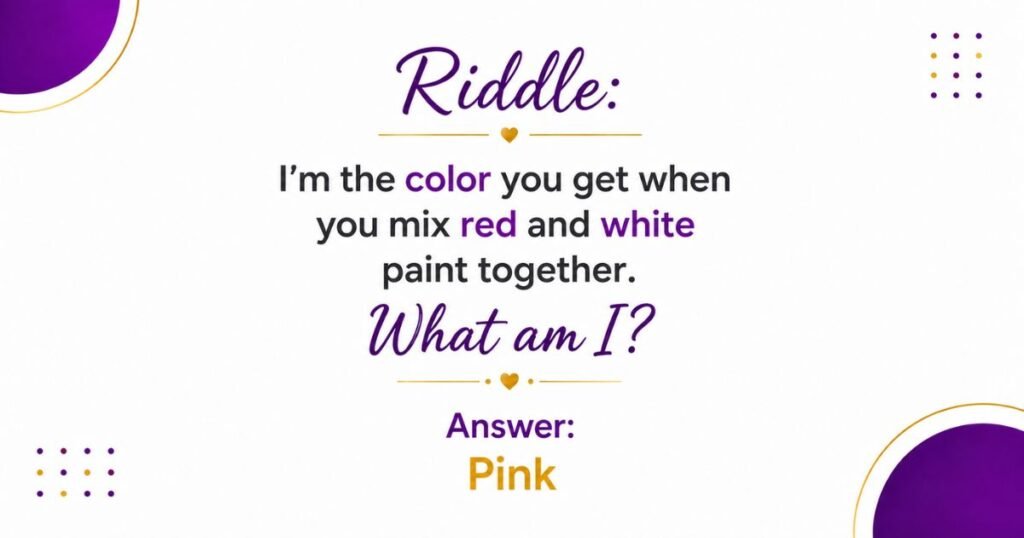
Explanation: First simple color-mixing riddle, a gentle bridge into color theory. - Riddle: I’m the color you get when you mix red and white paint together. What am I? Answer: Pink
Difficulty: Easy
Explanation: Second color-mixing riddle, reinforcing the mixing concept.
- Riddle: I’m the color of an overcast sky and an elephant’s skin. What am I?
Answer: Gray
Difficulty: Easy
Explanation: Weather-and-animal pairing riddle. - Riddle: I’m made of every color at once, and I appear in the sky after it rains. What am I? Answer: A rainbow
Difficulty: Easy
Explanation: Introduces the rainbow as an “all colors” concept. - Riddle: I’m the color of a fire truck and a fresh tomato. What am I?
Answer: Red
Difficulty: Easy
Explanation: Repeats red through a vehicle and a vegetable. - Riddle: I’m the color of a lemon and a rubber duck. What am I?
Answer: Yellow
Difficulty: Easy
Explanation: Second yellow riddle with different reference objects. - Riddle: I’m the color of a baby pig and bubblegum. What am I?
Answer: Pink
Difficulty: Easy
Explanation: Second pink riddle for reinforcement. - Riddle: I’m the color of a stop light on top, and my color at the bottom means go. What two colors am I?
Answer: Red (stop) and green (go)
Difficulty: Easy
Explanation: Introduces a two-answer riddle tied to a real-world signal system. - Riddle: I’m the color of the sun as it sets low near the horizon. What am I?
Answer: Orange
Difficulty: Easy
Explanation: Nature-based riddle with a slightly more descriptive scene. - Riddle: I’m the color of a police car’s lights, along with red. What am I?
Answer: Blue
Difficulty: Easy
Explanation: Real-world object riddle with a paired color. - Riddle: I’m the color of a peeled banana’s inside and a school bus’s outside. What am I? Answer: Yellow
Difficulty: Easy
Explanation: Inside/outside contrast riddle using the same fruit reference. - Riddle: I’m the color that a chameleon can become to hide in the grass. What am I?
Answer: Green
Difficulty: Easy
Explanation: Introduces the idea of camouflage tied to color. - Riddle: I’m the color of a crayon box’s darkest shade, and I show up at night without any light. What am I?
Answer: Black
Difficulty: Easy
Explanation: Reinforces black through the “darkest” framing. - Riddle: I’m the color you get when you mix all the crayons in the box together. What am I? Answer: Brown (or a muddy gray-brown)
Difficulty: Easy
Explanation: Closes the Easy section with a fun, slightly messy color-mixing fact kids can test themselves. - Riddle: I’m the color of grass and leaves so bright, I mix blue and yellow to come to light. What color am I?
Answer: Green
Difficulty: Easy
Explanation: This fits color riddles for kids since it uses simple, familiar clues (grass, leaves, mixing colors) that children can easily connect to the answer.
Medium Color Riddles for Family Game Night
Medium riddles add a layer of wordplay or a gentle logic twist. Expertise matters here: a riddle “works” when it uses a color fact or a double meaning the solver has to actively think through, rather than just recognize.
- Riddle: What color is a compliment and a shy person’s cheeks at the same time?
Answer: Red (blushing)
Difficulty: Medium
Explanation: Wordplay riddle connecting an emotion (embarrassment) to a color. - Riddle: I’m black when you buy me, red when you use me, and gray when you throw me away. What am I?
Answer: Charcoal
Difficulty: Medium
Explanation: Classic transformation riddles the color changes as the object is used, not the object itself. - Riddle: What color is a shadow, no matter what color the object casting it is?
Answer: Black (or gray)
Difficulty: Medium
Explanation: Tests a science fact through riddle logic a shadow’s color doesn’t depend on the object. - Riddle: I have every color, but I’m made of light, not paint, and I only appear when sunlight passes through raindrops. What am I?
Answer: A rainbow
Difficulty: Medium
Explanation: Adds a light-science layer to the earlier, simpler rainbow riddle. - Riddle: What two colors combine to make purple?
Answer: Red and blue
Difficulty: Medium
Explanation: Basic color-theory riddle, testing primary-to-secondary color mixing. - Riddle: What two colors combine to make orange?
Answer: Red and yellow
Difficulty: Medium
Explanation: Second color-mixing riddle, reinforcing primary color combinations. - Riddle: What color do you get if you mix all three primary colors of light together?
Answer: White
Difficulty: Medium
Explanation: Distinguishes light-mixing (additive) from paint-mixing (subtractive) a real color-science distinction. - Riddle: What color do you get if you mix all three primary colors of paint together?
Answer: Brown or black (a muddy dark shade)
Difficulty: Medium
Explanation: Pairs with the riddle above to show light and paint mix differently. - Riddle: I’m a fruit that looks green on the outside, but I share my name with an orange-ish color inside. What fruit am I?
Answer: A cantaloupe (or a similar melon with orange flesh)
Difficulty: Medium
Explanation: Inside/outside contrast riddle using a specific fruit. - Riddle: What is a cheerleader’s favorite color?
Answer: Yeller (a play on “yellow”)
Difficulty: Medium
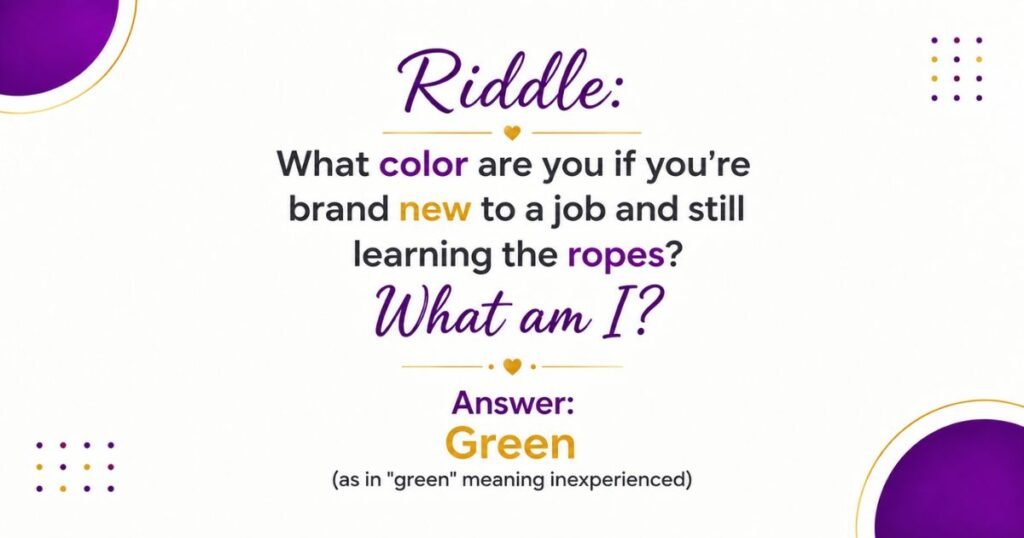
Explanation: Pun riddle “yeller” sounds like someone who yells, disguising the color “yellow.” - Riddle: What color are you if you’re brand new to a job and still learning the ropes?
Answer: Green (as in “green” meaning inexperienced)
Difficulty: Medium
Explanation: Introduces idiom-based riddles by using “green” to mean inexperienced rather than the literal color.
- Riddle: What color describes a day with no clouds, sunshine, and clear skies, when someone says they feel great?
Answer: Rosy (as in “rosy outlook” or “in the pink”)
Difficulty: Medium
Explanation: Early idiom riddle connecting mood to a color word. - Riddle: What is the name for the seven colors that appear in order in a rainbow, from red to violet?
Answer: ROYGBIV (Red, Orange, Yellow, Green, Blue, Indigo, Violet)
Difficulty: Medium
Explanation: Tests memory of the standard rainbow color order and its common acronym. - Riddle: What color is traditionally used to represent a “warning” or “caution,” found on road signs and warning labels?
Answer: Yellow
Difficulty: Medium
Explanation: Real-world design-convention riddle. - Riddle: What color is often used to represent danger, stop signs, and emergency alerts? Answer: Red
Difficulty: Medium
Explanation: Pairs with the yellow riddle above to reinforce color-coding logic. - Riddle: What color of belt is often the very first rank earned in many martial arts, before any colored belts?
Answer: White
Difficulty: Medium
Explanation: Real-world tradition riddle outside the usual color-object format. - Riddle: What is black and white and read all over, but isn’t a zebra?
Answer: A newspaper (read/red is a homophone play)
Difficulty: Medium
Explanation: Classic homophone riddle “read” sounds like “red,” creating the twist. - Riddle: What color do most limes and unripe bananas share?
Answer: Green
Difficulty: Medium
Explanation: Connects two different fruits through a shared unripe-color trait. - Riddle: What color is a rose usually associated with romance and Valentine’s Day?
Answer: Red
Difficulty: Medium
Explanation: Cultural-association riddle tied to a specific object and occasion. - Riddle: What color, when it appears in a “flag,” means a warning at a beach that swimming may be dangerous?
Answer: Red
Difficulty: Medium
Explanation: Real-world signal riddle from beach safety systems. - Riddle: What single color is made by combining every visible wavelength of light at once? Answer: White
Difficulty: Medium
Explanation: Light-science riddle explaining why white light contains a full color spectrum. - Riddle: What color has zero light in it at all, technically making it the absence of color rather than a color itself?
Answer: Black
Difficulty: Medium
Explanation: Introduces the science distinction between black as an absence of light versus a pigment mixture. - Riddle: What is a chameleon’s most famous ability, tied entirely to color?
Answer: Changing color to blend into its surroundings (camouflage)
Difficulty: Medium
Explanation: Animal-fact riddle building on the earlier chameleon riddle. - Riddle: What common household spice shares its name with a shade of orange-yellow? Answer: Saffron (or turmeric)
Difficulty: Medium
Explanation: Food-and-color-name riddle, adding an unexpected everyday connection. - Riddle: What color, in most Western weddings, is traditionally worn by the bride?
Answer: White
Difficulty: Medium
Explanation: Cultural-tradition riddle closing the Medium section on a real-world custom. - Riddle: I’m present in every rainbow yet absent in black, I can calm a room or spark a heated attack, artists chase me but can never quite catch my full range what am I, ever-shifting, impossible to arrange?
Answer: Color
Difficulty: Medium
Explanation: This fits color riddles for adults since it uses abstract ideas (color’s emotional effect, its infinite range) rather than pointing to one specific color, requiring more thought to solve.
Hard Color Riddles for Teens and Adults
Hard riddles in this collection lean on color idioms English phrases that use a color word to mean something entirely different from the literal shade. Trustworthiness matters here: idiom meanings shift by region and context, so this section sticks to widely recognized, standard American English usage.
- Riddle: I mean being caught in the act of doing something wrong, and I contain a color. What phrase am I?
Answer: Red-handed
Difficulty: Hard
Explanation: Idiom riddle “red-handed” traces back to the image of blood-stained hands after a crime. - Riddle: I mean feeling jealous of someone else’s success, and I contain a color. What phrase am I?
Answer: Green with envy
Difficulty: Hard
Explanation: Idiom riddle referencing the old association between the color green and sickness or jealousy. - Riddle: I mean feeling sad or down, and I contain a color. What phrase am I?
Answer: Feeling blue
Difficulty: Hard
Explanation: Idiom riddle tied to a centuries-old link between the color blue and melancholy. - Riddle: I mean a small, harmless untruth, and I contain a color. What phrase am I?
Answer: A white lie
Difficulty: Hard
Explanation: Idiom riddle where “white” signals purity or harmlessness rather than an actual color. - Riddle: I mean the outsider or disgraced member of a family or group, and I contain a color. What phrase am I?
Answer: The black sheep
Difficulty: Hard
Explanation: Idiom riddle referencing rare black-wool sheep, historically considered less valuable than white-wool sheep. - Riddle: I mean being in good health or doing well financially, and I contain a color. What phrase am I?
Answer: In the pink (of health)
Difficulty: Hard
Explanation: Idiom riddle where “pink” represents peak condition, an older usage than most solvers expect. - Riddle: I mean an unexpected positive outcome hidden inside a bad situation, and I contain a color. What phrase am I?
Answer: A silver lining
Difficulty: Hard
Explanation: Idiom riddle referencing the bright edge of a storm cloud. - Riddle: I mean a rare event, since I only happen once in a very long while, and I contain a color. What phrase am I?
Answer: Once in a blue moon
Difficulty: Hard
Explanation: Idiom riddle referencing the rare occurrence of a second full moon in one calendar month. - Riddle: I mean extremely pleased or delighted, and I contain a color. What phrase am I? Answer: Tickled pink
Difficulty: Hard
Explanation: Idiom riddle pairing a physical sensation (tickling) with a color signaling delight. - Riddle: I mean becoming suddenly and intensely angry, and I contain a color. What phrase am I?
Answer: Seeing red
Difficulty: Hard
Explanation: Idiom riddle tied to red’s long association with rage and heightened emotion. - Riddle: I mean a natural skill for gardening, and I contain a color. What phrase am I?
Answer: A green thumb
Difficulty: Hard
Explanation: Idiom riddle where green reflects plant life rather than the gardener’s actual thumb. - Riddle: I mean cowardly, and I contain a color, even though the phrase has nothing to do with an actual animal’s belly. What phrase am I?
Answer: Yellow-bellied
Difficulty: Hard
Explanation: Idiom riddle where yellow signals cowardice, a usage dating back to 19th-century American slang. - Riddle: I mean a situation with no clear right or wrong answer, and I contain a color. What phrase am I?
Answer: A gray area
Difficulty: Hard
Explanation: Idiom riddle where gray sits between the “black and white” extremes of clarity.
- Riddle: I mean something that happens with no warning at all, and I contain a color. What phrase am I?
Answer: Out of the blue
Difficulty: Hard
Explanation: Idiom riddle referencing the empty, unmarked blue sky as a symbol of the unexpected. - Riddle: I mean a fantastic chance that shouldn’t be missed, and I contain a color. What phrase am I?
Answer: A golden opportunity
Difficulty: Hard
Explanation: Idiom riddle where “golden” signals rare value, borrowing from the metal’s worth. - Riddle: I mean giving official permission for something to proceed, and I contain a color, borrowed from a traffic signal. What phrase am I?
Answer: Giving the green light
Difficulty: Hard
Explanation: Idiom riddle directly borrowing traffic-signal logic into everyday approval language. - Riddle: I mean completely honest, with nothing hidden or exaggerated, and I contain two colors combined into one phrase. What phrase am I?
Answer: Black and white (as in “it’s black and white”)
Difficulty: Hard
Explanation: Idiom riddle using two contrasting colors to mean total clarity, the opposite of a “gray area.” - Riddle: I mean a person’s true, often less flattering personality, revealed after hiding it, and I contain a color. What phrase am I?
Answer: Showing your true colors
Difficulty: Hard
Explanation: Idiom riddle referencing old ships that flew flags (“colors”) of a different nation to deceive enemies before revealing their true flag. - Riddle: I mean an extremely rare or unusual event, and I contain a mythical bird, but I’m classified as a color idiom because of the bird’s association with fire-red plumage. What phrase am I?
Answer: As rare as a phoenix (a stretch idiom, often replaced by “once in a blue moon” in modern usage)
Difficulty: Hard
Explanation: A trickier, less common idiom included to acknowledge that not every rare-event phrase is strictly color-based testing the solver’s ability to spot a near-miss. - Riddle: I mean paperwork and procedural delays that slow down official processes, and I contain a color. What phrase am I?
Answer: Red tape
Difficulty: Hard
Explanation: Idiom riddle referencing the literal red ribbon once used to bind official legal documents in Britain. - Riddle: A designer mixes cyan, magenta, yellow, and black ink to print a photo. What is this four-color printing system called?
Answer: CMYK
Difficulty: Hard
Explanation: Technical color-theory riddle testing knowledge of the standard subtractive printing model. - Riddle: A screen displays color using red, green, and blue light combined at different intensities. What is this system called
Answer: RGB (the additive color model)
Difficulty: Hard
Explanation: Technical color-theory riddle pairing with the CMYK riddle to contrast screen versus print color systems. - Riddle: I’m the color positioned directly across from red on a standard color wheel, making us “complementary” colors. What color am I?
Answer: Green
Difficulty: Hard
Explanation: Color-theory riddle testing understanding of complementary color pairs. - Riddle: I’m the color positioned directly across from blue on a standard color wheel. What color am I?
Answer: Orange
Difficulty: Hard
Explanation: Second complementary-pair riddle, reinforcing the color wheel concept from riddle 73. - Riddle: I mean someone with royal or aristocratic ancestry, and I contain a color, tracing back to visible veins on pale, unweathered skin. What phrase am I?
Answer: Blue blood
Difficulty: Hard
Explanation: Idiom riddle with real historical roots The phrase originated in Spain, describing nobility whose pale skin showed blue veins more visibly than sun-darkened commoners. - Riddle: I’m the color of the sky on a clear day, and also the color of sadness, they say. What color am I?
Answer: Blue
Difficulty: Easy
Explanation: This fits color riddles with answers since it uses two familiar associations (sky and sadness) that clearly point to the same color, making it easy to solve.
Color Riddles for Classroom and Game Night
These riddles are built for group settings: read them aloud in a classroom during a color unit, use them as trivia questions at a party, or drop a few into a text thread. Real-world use cases matter here: teachers report these work especially well as five-minute warm-ups before an art or science lesson.
- Riddle: What color do you get when you mix red, yellow, and blue paint all together in equal amounts?
Answer: A muddy brown or gray
Difficulty: Medium
Explanation: Reinforces the primary-color-mixing concept in a party-quiz format. - Riddle: How many colors are traditionally listed in a standard rainbow?
Answer: Seven
Difficulty: Easy
Explanation: Quick-fire trivia riddle for classroom warm-ups. - Riddle: What color is the “go” light on a traffic signal?
Answer: Green
Difficulty: Easy
Explanation: Simple real-world object riddle for younger classroom groups. - Riddle: What are the three primary colors of paint that can’t be created by mixing any other colors?
Answer: Red, yellow, and blue
Difficulty: Medium
Explanation: Foundational color-theory trivia for an art-class warm-up. - Riddle: What are the three secondary colors, made by mixing two primary colors together? Answer: Green, orange, and purple
Difficulty: Medium
Explanation: Pairs directly with the primary-colors riddle above. - Riddle: What color is most commonly associated with the flag of a stop sign shape, an octagon, in the United States?
Answer: Red
Difficulty: Easy
Explanation: Real-world sign riddle for a quick classroom question. - Riddle: In sports, what color card does a referee show for the most serious foul in soccer, resulting in ejection?
Answer: Red
Difficulty: Easy
Explanation: Sports-trivia riddle useful for a mixed-age game night. - Riddle: What color card in soccer serves as a warning, one step below ejection?
Answer: Yellow
Difficulty: Easy
Explanation: Pairs with the red card riddle above for a two-question set. - Riddle: What color is a “black box” flight recorder actually painted, despite its name? Answer: Orange
Difficulty: Medium
Explanation: Fun trivia riddle exposing a well-known naming mismatch it’s painted bright orange for visibility after a crash. - Riddle: What color is Earth often called from space, due to how much of its surface is covered in ocean?
Answer: The Blue Planet
Difficulty: Easy
Explanation: Science-trivia riddle suited for a classroom Earth-science tie-in. - Riddle: What color do most plants appear, due to the chlorophyll that helps them absorb sunlight?
Answer: Green
Difficulty: Easy
Explanation: Science-based riddle connecting biology and color. - Riddle: What two colors, when combined, are found on the flag of Canada alongside white? Answer: Red and white (Canada’s flag uses only red and white)
Difficulty: Medium
Explanation: Geography-trivia riddle for a themed game night round.
- Riddle: What color is most associated with royalty in Western history, due to how expensive the original dye once was?
Answer: Purple
Difficulty: Medium
Explanation: Historical-context riddle purple dye was once so costly only royalty could afford it. - Riddle: What color are most fire hydrants painted in many U.S. cities to make them easy to spot in an emergency?
Answer: Red (though colors vary by city and water pressure code)
Difficulty: Easy
Explanation: Everyday-object trivia riddle for a classroom safety unit. - Riddle: What color is a ripe blueberry on the outside, despite its name suggesting a different shade?
Answer: A deep blue-purple
Difficulty: Easy
Explanation: Simple observational riddle for younger players. - Riddle: What color does litmus paper turn when dipped in an acidic solution?
Answer: Red (or pink)
Difficulty: Hard
Explanation: Science-classroom riddle connecting color to a chemistry concept. - Riddle: What color does litmus paper turn when dipped in a basic (alkaline) solution? Answer: Blue
Difficulty: Hard
Explanation: Pairs with the acid riddle above for a two-part chemistry trivia set. - Riddle: What color is commonly used on maps and globes to represent bodies of water? Answer: Blue
Difficulty: Easy
Explanation: Simple cartography riddle for a geography-themed round. - Riddle: What color combination makes up the classic checkerboard pattern used in racing flags?
Answer: Black and white
Difficulty: Easy
Explanation: Sports-trivia riddle for a game-night round. - Riddle: What color is most associated with the phrase “code” used for a medical emergency involving cardiac arrest in many U.S. hospitals?
Answer: Blue (Code Blue)
Difficulty: Hard
Explanation: Real-world professional-terminology riddle, adding an unexpected layer of authority to the collection. - Riddle: What color is used on recycling bins in many communities to separate them from regular trash bins?
Answer: Blue (though this varies by municipality)
Difficulty: Easy
Explanation: Everyday civic-knowledge riddle. - Riddle: What color do most school buses share across the United States, chosen specifically for visibility?
Answer: Yellow (officially “National School Bus Glossy Yellow”)
Difficulty: Medium
Explanation: Trivia riddle with a specific, verifiable naming fact behind a familiar object. - Riddle: What two colors combine on most countries’ medical or pharmacy cross symbols? Answer: Green and white (in many countries) or red and white (in others, like the Red Cross) Difficulty: Medium
Explanation: International-symbol riddle acknowledging regional variation. - Riddle: What color is most often used worldwide to represent environmental or eco-friendly branding?
Answer: Green
Difficulty: Easy
Explanation: Marketing and branding trivia riddle, closing the collection with a modern, real-world example. - Riddle: After solving 99 color riddles, what color are you most likely picturing right now if you were just asked to “think of a color” with no other clues?
Answer: Red or blue (studies on color association consistently show these are the two most commonly named “first colors” people think of)
Difficulty: Medium
Explanation: A reflective closing riddle that ties the whole collection together with a real psychological pattern rather than a fixed factual answer. - Riddle: I’m born when all colors unite as one, yet I vanish the instant true darkness has won. I’m not on the color wheel, yet I frame every hue what am I, neither shade nor tint, but true?
Answer: White (white light, made of all colors combined, yet absent in true darkness)
Difficulty: Hard
Explanation: This fits hard color riddles since it relies on a science-based twist (white light being a combination of all colors) rather than an obvious visual clue, making it tricky to solve.
How to Use These Color Riddles
Riddles work best when matched to the room. For a classroom color unit, start with the Easy set and move into the Medium color-mixing riddles once the basics click. Teachers report these work especially well as a five-minute warm-up before an art or science lesson.
For trivia nights or family game night, the idiom-based Hard section turns a simple color quiz into a genuine language lesson, since most adults use phrases like “red tape” or “blue blood” without ever thinking about where they came from.
Explanations matter more than most collections admit. A riddle handed over with just an answer teaches nothing; understanding that “black sheep” comes from the rarity of black wool, or that a “black box” flight recorder is actually painted orange, is what turns a quick guess into something worth remembering.
More Riddles for Kids and Adults
If the idiom-based Hard Color Riddles for Teens and Adults section got you thinking Time Riddles collection has more wordplay and logic puzzles built for that same crowd.
Ring Riddles category has plenty more age-appropriate picks to round out a classroom warm-up.
And for a wider mix of curated riddle collections beyond color, browse Time Riddles category for more themed sets like this one.
Conclusion
Whether you need a quick classroom warm-up or a genuine wordplay challenge for trivia night, this collection of 100 Color Riddles covers every age and skill level from “what color is the sky” to the hidden meaning behind “red tape.”
FAQs
What is a Good Color Riddle?
A good color riddle uses a familiar image, idiom, or color-theory fact like a rainbow, a color-mixing result, or a phrase such as “green with envy” paired with a small logical twist, so the answer feels satisfying rather than obvious
What are Some Easy Color Riddles for Kids?
Easy color riddles for kids describe something a child already recognizes, like the sky, a lemon, or grass, and ask them to name the color, since younger solvers respond to recognition rather than layered wordplay.
What Color Riddle has the Answer “Charcoal”?
The riddle “I’m black when you buy me, red when you use me, and gray when you throw me away” answers to charcoal, since its color changes through each stage of use, from unlit briquette to glowing ember to spent ash.
How do you Make Color Riddles Harder for Adults?
Harder color riddles for adults typically rely on idioms (like “red-handed” or “blue blood”), color-theory facts (like complementary colors or the RGB/CMYK systems), or historical context behind why a certain color became associated with a meaning.
What are Common Color Idioms Used in Riddles?
Common color idioms include “red-handed” (caught in the act), “green with envy” (jealous), “feeling blue” (sad), “white lie” (harmless untruth), “black sheep” (outsider), and “once in a blue moon” (a rare event).
Why are Color Riddles for Kids with Answers good for learning?
They help children connect colors with familiar things around them, making it a fun way to build vocabulary and observation skills at the same time.
How do you Play a Color Riddle Game?
One person reads out clues describing a color (like objects or feelings associated with it), and others try to guess the correct color before time runs out or clues run low.