Riddlers Riddles: 100 Best Riddles With Answers
Riddlers Riddles is a curated collection of 100 clever riddler riddles with answers, including easy, funny, medium, and hard brain teasers for kids, teens, and adults. Whether you enjoy classic wordplay or tricky logic puzzles, this riddler riddles list has something for every puzzle fan.
Built for classrooms, family dinners, road trips, and anyone who loves a clever mental workout, it’s been tested on real kids and real audiences, and the pattern always held: the riddles that landed best weren’t the hardest, just the ones with a clean, fair “aha” moment.
Explore our collection of the best Riddler riddles, test your reasoning skills, and see how many answers you can solve before checking the solutions.
What Makes a Good Riddle, Anyway?
A riddle is really just a question dressed up to hide its own answer. Riddle-writing traces back thousands of years the oldest riddle historians have found comes from ancient Sumer, inscribed on a clay tablet, built around the idea of a place you enter unable to see and leave able to see (the answer: a school).
That structure describes something indirectly, forcing the listener to reinterpret the clues hasn’t changed much since. Lewis Carroll, the Sphinx of Greek myth, and every parent who’s ever tried to stump a car full of kids are all working the same basic trick.
Riddles generally fall into two families. Enigmas describe something through metaphor and imagery (“I have a mouth but never eat”).
Conundrums lean on puns and double meanings, and often double as jokes. Most collections including this one mix both, because a good session needs variety: a few riddles that reward patient logic, and a few that reward a quick, silly leap.
Easy Riddler Riddles with Answers for Kids (Ages 4–8)
These are built for beginners with short setups, one clear image, and an answer that clicks fast enough to keep momentum going. Great for warm-ups, car rides, or a child’s very first riddle session.
- Riddle: I have hands but cannot clap. What am I?
Answer: A clock.
Difficulty: Easy
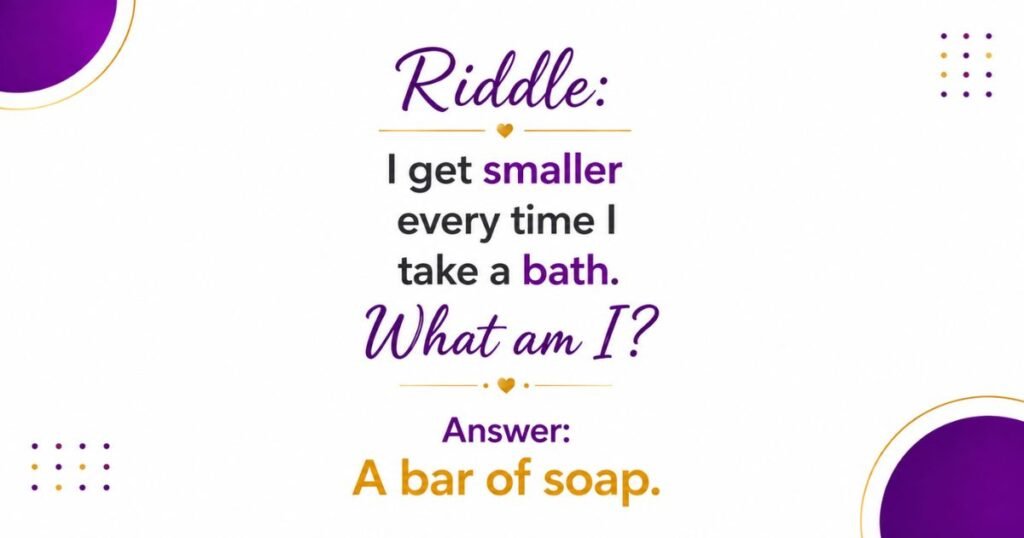
Explanation: The straightforward metaphor “hands” refers to clock hands, not human ones, so the trick is just recognizing the double meaning of one word. - Riddle: I get smaller every time I take a bath. What am I?
Answer: A bar of soap.
Difficulty: Easy
Explanation: Simple cause-and-effect logic: an object that shrinks specifically because of water use. - Riddle: What has a face and two hands but no arms or legs?
Answer: A clock.
Difficulty: Easy
Explanation: Reuses the “hands” wordplay from a different angle, reinforcing the same vocabulary trick. - Riddle: What can you catch but never throw?
Answer: A cold.
Difficulty: Easy
Explanation: Plays on the two meanings of “catch” physical catching versus catching an illness. - Riddle: I have a tail and a head but no body. What am I?
Answer: A coin.
Difficulty: Easy
Explanation: Uses “heads and tails,” a phrase kids often already know from coin flips, just reframed as a riddle. - Riddle: What has to be broken before you can use it?
Answer: An egg.
Difficulty: Easy
Explanation: Direct logic, no wordplay, just a fact about the object framed as a puzzle. - Riddle: I’m full of holes but I still hold water. What am I?
Answer: A sponge.
Difficulty: Easy
Explanation: Sets up an apparent contradiction (holes should mean leaks) that resolves once you picture the material. - Riddle: What goes up but never comes down?
Answer: Your age.
Difficulty: Easy
Explanation: Swaps a literal, physical “up” for an abstract one, which is often the very first kind of misdirection kids learn to spot. - Riddle: What has one eye but cannot see?
Answer: A needle.
Difficulty: Easy
Explanation: Reframes a needle’s “eye” (the hole for thread) using anatomical language. - Riddle: What kind of coat is always wet when you put it on?
Answer: A coat of paint.
Difficulty: Easy
Explanation: Uses “coat” in its material sense rather than the clothing sense. - Riddle: I have a neck but no head. What am I?
Answer: A bottle.
Difficulty: Easy
Explanation: Another body-part metaphor, teaching kids that “body parts” in riddles often describe shape, not anatomy. - Riddle: What has many teeth but cannot bite?
Answer: A comb.
Difficulty: Easy
Explanation: The word “teeth” is repurposed for the comb’s spikes, a classic shape-based metaphor. - Riddle: What kind of room has no doors or windows?
Answer: A mushroom.
Difficulty: Easy
Explanation: A pure wordplay riddle the answer hides inside the word “room” itself. - Riddle: What has a bed but never sleeps?
Answer: A river.
Difficulty: Easy
Explanation: “Riverbed” is broken apart so the word “bed” becomes a misleading clue. - Riddle: What can run but never walks?
Answer: Water (or a nose, or a clock).
Difficulty: Easy
Explanation: Multiple valid answers exist here, since “run” applies to water flowing, a nose dripping, or a clock ticking along a good moment to let kids argue it out. - Riddle: What has an ear but cannot hear?
Answer: A cornstalk (corn has an “ear”).
Difficulty: Easy
Explanation: Depends on knowing that “ear of corn” is a real farming term, so it doubles as light vocabulary building. - Riddle: What building has the most stories?
Answer: A library.
Difficulty: Easy
Explanation: Plays on “stories” meaning both floors of a building and written tales. - Riddle: What has legs but doesn’t walk?
Answer: A table.
Difficulty: Easy
Explanation: Furniture “legs” used as the misdirecting body-part metaphor once more. - Riddle: I shave every day, but my beard stays the same. What am I?
Answer: A barber.
Difficulty: Easy
Explanation: Requires the listener to picture the scenario literally rather than assume the speaker is describing themselves. - Riddle: What is always coming but never actually arrives?
Answer: Tomorrow.
Difficulty: Easy
Explanation: A gentle introduction to abstract-concept riddles, since “tomorrow” is always one day away by definition. - Riddle: What has a thumb and four fingers but isn’t alive?
Answer: A glove.
Difficulty: Easy
Explanation: Object shaped like a hand, described using hand vocabulary reinforces the pattern kids have now seen several times. - Riddle: What kind of tree can you carry in your hand?
Answer: A palm (tree) because you have a palm on your hand.
Difficulty: Easy
Explanation: A pun connecting the tree name to the part of the hand. - Riddle: What has a bottom at the top?
Answer: A leg (as in “leg of a chair” has a “bottom” or simply, your legs, since your bottom sits above them).
Difficulty: Easy
Explanation: Deliberately playful and open to more than one reading, good for a group discussion. - Riddle: What kind of band never plays music?
Answer: A rubber band.
Difficulty: Easy
Explanation: Straightforward pun on the word “band.” - Riddle: What has a head, a foot, but no arms?
Answer: A bed.
Difficulty: Easy
Explanation: “Headboard” and “footboard” give the clue away once a child pictures a real bed.
Medium Riddlers Riddles for Older Kids and Adults (Ages 9+)
These require a bit more patience, two-step logic, or a wordplay layer that isn’t obvious on the first read. Good for classrooms of 9- to 12-year-olds, or mixed-age family groups.
- Riddle: The more you take, the more you leave behind. What am I?
Answer: Footsteps.
Difficulty: Medium
Explanation: Classic lateral-thinking riddle the “taking” and “leaving” refer to different things (steps taken forward vs. footprints left behind). - Riddle: I speak without a mouth and hear without ears. I have no body, but I come alive with wind. What am I?
Answer: An echo.
Difficulty: Medium
Explanation: Enigma-style riddle relying entirely on personification and imagery rather than a pun. - Riddle: What can travel around the world while staying in a corner?
Answer: A stamp.
Difficulty: Medium
Explanation: Two-step logic: first picture the “corner” (of an envelope), then connect it to travel. - Riddle: What has many keys but opens no locks?
Answer: A piano.
Difficulty: Medium
Explanation: Depends on knowing musical vocabulary well enough to see past the “lock and key” assumption. - Riddle: I am not alive, but I grow. I don’t have lungs, but I need air. I don’t have a mouth, but water kills me. What am I?
Answer: Fire.
Difficulty: Medium
Explanation: A layered enigma each clue eliminates a category (not an animal, not a plant) until only fire fits. - Riddle: What can you break without ever touching it?
Answer: A promise.
Difficulty: Medium
Explanation: Shifts “break” from a physical action to an abstract one, testing whether the listener stays too literal. - Riddle: I am taken from a mine and shut in a wooden case, from which I am never released, yet I am used by almost everyone. What am I?
Answer: Pencil lead (graphite).
Difficulty: Medium
Explanation: Requires picturing the manufacturing process of a pencil rather than a person or animal. - Riddle: What five-letter word becomes shorter when you add two letters to it?
Answer: “Short” adding “er” makes “shorter.”
Difficulty: Medium
Explanation: A self-referential wordplay riddle where the answer describes its own transformation. - Riddle: What comes once in a minute, twice in a moment, but never in a thousand years?
Answer: The letter “M.”
Difficulty: Medium
Explanation: A letter-counting riddle solver must stop thinking about time and start counting spelling occurrences. - Riddle: I have branches but no fruit, trunk, or leaves. What am I?
- Answer: A bank.
Difficulty: Medium
Explanation: Depends on recognizing “branches” as a business term instead of a tree part. - Riddle: What kind of room has no walls?
Answer: A mushroom (again testable, but here reframed) or, alternatively, a chatroom.
Difficulty: Medium
Explanation: A good moment to note multiple interpretations exist; both “mushroom” and “chatroom” satisfy the wordplay depending on the era of the audience. - Riddle: What has to be in a certain place before you can find it?
Answer: Anything that’s lost the answer is “the thing you’re looking for.”
Difficulty: Medium
Explanation: A logic riddle about the nature of searching rather than a specific object. - Riddle: What gets bigger the more you take away from it?
Answer: A hole.
Difficulty: Medium
Explanation: Reverses the normal expectation that removing something shrinks it. - Riddle: I can be cracked, made, told, and played. What am I?
Answer: A joke.
Difficulty: Medium
Explanation: Relies on knowing four separate common phrases (“crack a joke,” “make a joke,” etc.) and finding the shared noun. - Riddle: What word is spelled incorrectly in every single dictionary?
Answer: “Incorrectly.”
Difficulty: Medium
Explanation: A self-referential trick riddle the word “incorrectly” is spelled correctly, which is itself the joke. - Riddle: The person who makes it sells it. The person who buys it never uses it. The person who uses it never knows they’re using it. What is it?
Answer: A coffin.
Difficulty: Medium
Explanation: A layered logic chain where each clause eliminates common objects until only one fits every condition. - Riddle: What can fill a room but takes up no space?
Answer: Light (or sound, or a smell).
Difficulty: Medium
Explanation: Trains kids to think about non-physical things that still “fill” a space perceptually. - Riddle: What has a spine but no bones?
Answer: A book.
Difficulty: Medium
Explanation: Uses “spine” in its bookbinding sense, one step removed from the more obvious anatomical meaning. - Riddle: I am always hungry and must always be fed. The finger I touch will soon turn red. What am I?
Answer: Fire.
Difficulty: Medium
Explanation: A poetic enigma that personifies fire’s need for fuel and its effect on skin. - Riddle: What kind of table has no legs?
Answer: A timetable.
Difficulty: Medium
Explanation: Compound-word riddle; kids have to think of “table” as part of a longer word, not a piece of furniture. - Riddle: What can you hold without ever touching it?
Answer: A conversation.
Difficulty: Medium
Explanation: Shifts “hold” from a physical grip to an abstract action. - Riddle: I have a heart that doesn’t beat. What am I?
Answer: An artichoke (or a deck of cards, or a city with multiple valid answers).
Difficulty: Medium
Explanation: Deliberately ambiguous to show how riddles can have more than one defensible solution depending on the “heart” you picture. - Riddle: What has words but never speaks?
Answer: A book.
Difficulty: Medium
Explanation: Personification riddle contrasting “having” words with the human act of speaking them. - Riddle: What is easier to get into than out of?
Answer: Trouble.
Difficulty: Medium
Explanation: An abstract, experience-based riddle rather than an object-based one often resonates more with adults. - Riddle: What has one head, one foot, and four legs?
Answer: A bed.
Difficulty: Medium
Explanation: Combines two earlier wordplay patterns (headboard, footboard, furniture legs) into one denser riddle.
Hard Riddles for Teens and Adults
These lean on multi-step logic, red herrings, or riddles that require you to distrust your first instinct entirely. Best saved for confident solvers or a slower-paced game night.
- Riddle: A man is looking at a photograph and says, “I have no siblings, but that man’s father is my father’s son.” Who is in the photograph?
Answer: His son.
Difficulty: Hard
Explanation: A classic family-tree misdirection riddle that requires tracing the relationship logically instead of guessing. - Riddle: A woman shoots her husband, holds him underwater for five minutes, and then hangs him. Five minutes later, they enjoy dinner together. How?
Answer: She’s a photographer. She shot a photo, developed it in water, and hung it to dry.
Difficulty: Hard
Explanation: Relies on reinterpreting violent-sounding verbs (“shoots,” “hangs”) as darkroom photography terms. - Riddle: What can go up a chimney down but can’t go down a chimney up?
Answer: An umbrella.
Difficulty: Hard
Explanation: A wordplay riddles about the object’s physical shape rather than the direction it’s traveling. An open umbrella can’t fit down, but a closed one can. - Riddle: Forward I am heavy, but backward I am not. What am I?
Answer: The word “ton” spelled backward it’s “not.”
Difficulty: Hard
Explanation: A palindrome-adjacent riddle that only works in written form, not spoken. - Riddle: I have cities but no houses, forests but no trees, and water but no fish. What am I?
Answer: A map.
Difficulty: Hard
Explanation: Requires holding three separate false expectations in mind simultaneously before landing on the shared answer. - Riddle: You see a boat filled with people, yet there isn’t a single person on board. How is that possible?
Answer: All the people on the boat are married (no “single” people).
Difficulty: Hard
Explanation: A pun on “single,” swapping the marital-status meaning for the “alone” meaning at the last second. - Riddle: What disappears the moment you say its name?
Answer: Silence.
Difficulty: Hard
Explanation: Self-referential enigma the act of answering destroys the thing being described. - Riddle: A man walks into a bar and asks for a glass of water. The bartender pulls out a gun and points it at him. The man says “thank you” and leaves. Why?
Answer: The man had hiccups; the shock of the gun cured them, so he no longer needed the water.
Difficulty: Hard
Explanation: A lateral-thinking riddle where the real cause (hiccups) is never stated and must be inferred from the resolution. - Riddle: What belongs to you but is used more by others?
Answer: Your name.
Difficulty: Hard
Explanation: An abstract-ownership riddle most people initially guess physical objects before realizing identity works too. - Riddle: I am an odd number. Take away one letter and I become even. What number am I?
Answer: Seven remove the “s” and it spells “even.”
Difficulty: Hard
Explanation: A math-language hybrid riddle where the trick is linguistic, not numerical. - Riddle: Two fathers and two sons go fishing. Each catches exactly one fish, yet only three fish are caught in total. How?
Answer: They’re a grandfather, father, and son three people, three fishing roles, three fish.
Difficulty: Hard
Explanation: Classic family-generation riddle that trips people up because they assume four distinct people. - Riddle: What can be caught but not thrown, and once caught, is never truly held? Answer: Someone’s attention.
Difficulty: Hard
Explanation: An abstract riddle layering two ideas (catching, holding) onto a non-physical target. - Riddle: I am always in front of you but can never be seen. What am I?
Answer: The future.
Difficulty: Hard
Explanation: Similar structure to an easier riddle above, but stripped of any softening clue, making it feel harder in isolation. - Riddle: What runs all around a backyard, yet never moves?
Answer: A fence.
Difficulty: Hard
Explanation: “Runs around” is meant spatially (encircles), not physically (moves), a subtle grammar trap. - Riddle: The more of this there is, the less you see. What is it?
Answer: Darkness.
Difficulty: Hard
Explanation: Inverse-relationship riddle; solvers must think in terms of absence rather than presence. - Riddle: I have keys but no locks, space but no room, and you can enter but not go inside. What am I?
Answer: A keyboard.
Difficulty: Hard
Explanation: A modern riddle repurposing three separate computer-related double meanings in a row. - Riddle: What can be measured but not seen, felt but not touched?
Answer: Time.
Difficulty: Hard
Explanation: An abstract-concept riddle relying entirely on contradiction (measurable yet invisible) to point toward time. - Riddle: Two people are born at the same moment, same place, same parents, yet they are not twins. How?
Answer: They’re part of a set of triplets (or more).
Difficulty: Hard
Explanation: Challenges the assumption that “not twins” rules out being siblings born together at all. - Riddle: What travels the world while staying in the same spot?
Answer: A stamp (repeated concept, deepened) or, a mailbox that receives world news.
Difficulty: Hard
Explanation: Reinforces the stamp riddle from the Medium section but strips the “corner” clue, raising the difficulty. - Riddle: What kind of question can never be answered honestly with “yes”?
Answer: “Are you asleep?”
Difficulty: Hard
Explanation: A logical-paradox riddle answering “yes” would disprove the statement itself. - Riddle: A man builds a house with four walls, all facing south. A bear walks by. What color is the bear?
Answer: White the house must be at the North Pole, where every direction is south, meaning the bear is a polar bear.
Difficulty: Hard
Explanation: A geography-logic riddle that depends on knowing how compass directions behave at the poles. - Riddle: What word in the English language always loses its identity when it’s pluralized?
Answer: “Queue” because it sounds identical whether singular or with an “s” added.
Difficulty: Hard
Explanation: Requires knowledge of English pronunciation quirks rather than just spelling. - Riddle: I follow you all day but disappear at night. What am I?
Answer: Your shadow.
Difficulty: Hard
Explanation: A simpler enigma placed here deliberately to show that “hard” riddles can also rely on pure imagery instead of logic chains. - Riddle: What is so fragile that saying its name breaks it?
Answer: Silence (a variant of an earlier riddle, restated to compare imagery choices).
Difficulty: Hard
Explanation: Same underlying logic as riddle 57, phrased with “fragile” instead of “disappears” to show how wording changes difficulty. - Riddle: What can you give away and still keep?
Answer: Your word (a promise), or a cold, or your heart several valid answers.
Difficulty: Hard
Explanation: Deliberately open-ended; a good discussion riddle for group settings since reasonable people land on different answers.
Funny Riddles for a Good Laugh
These trade logic for punchlines. They work best read aloud, since the pun usually lands better spoken than read silently.
- Riddle: Why did the scarecrow win an award?
Answer: Because he was outstanding in his field.
Difficulty: Easy
Explanation: Technique: pun “outstanding” doubles as both “excellent” and “literally standing out in a field.” - Riddle: What do you call a fish with no eyes?
Answer: A fsh (no “i”).
Difficulty: Easy
Explanation: Technique: wordplay removes the letter “i” from “fish” as a visual/spelling joke rather than a spoken one. - Riddle: Why don’t skeletons fight each other?
Answer: They don’t have the guts.
Difficulty: Easy
Explanation: Technique: double meaning “guts” refers to both bravery and internal organs skeletons lack. - Riddle: What did the ocean say to the shore?
Answer: Nothing, it just waved.
Difficulty: Easy
Explanation: Technique: pun “waved” refers to both a greeting gesture and ocean waves. - Riddle: Why did the math book look sad?
Answer: It had too many problems.
Difficulty: Easy
Explanation: Technique: double meaning “problems” means both math exercises and personal troubles. - Riddle: What do you call a bear with no teeth?
Answer: A gummy bear.
Difficulty: Easy
Explanation: Technique: pun connects a physical description (no teeth = gums) to the candy name. - Riddle: Why can’t a bicycle stand up by itself?
Answer: It’s two tired.
Difficulty: Easy
Explanation: Technique: homophone “two-tired” sounds like “too tired.” - Riddle: What kind of shoes do ninjas wear?
Answer: Sneak-ers.
Difficulty: Easy
Explanation: Technique: pun splits “sneakers” into “sneak” plus “-ers” to connect to stealth. - Riddle: Why did the cookie go to the doctor?
Answer: Because it felt crummy.
Difficulty: Easy
Explanation: Technique: double meaning “crummy” means both unwell and full of crumbs. - Riddle: What’s a vampire’s favorite fruit?
Answer: A blood orange.
Difficulty: Easy
Explanation: Technique: pun links the vampire’s diet to a real fruit name. - Riddle: Why did the golfer bring two pairs of pants?
Answer: In case he got a hole in one.
Difficulty: Medium
Explanation: Technique: double meaning “hole in one” refers to both a golf shot and a literal hole ripped in the pants. - Riddle: What do you call an alligator in a vest?
Answer: An investigator.
Difficulty: Medium
Explanation: Technique: wordplay splits a longer word (“investigator”) into its hidden components. - Riddle: Why did the picture go to jail?
Answer: Because it was framed.
Difficulty: Medium
Explanation: Technique: double meaning “framed” means both a picture frame and being wrongly blamed. - Riddle: What do you call a snowman in July?
Answer: A puddle.
Difficulty: Medium
Explanation: Technique: misdirection answers the literal outcome instead of describing a “snowman,” subverting the expected format. - Riddle: Why don’t oysters share their pearls?
Answer: Because they’re shellfish.
Difficulty: Medium
Explanation: Technique: homophone “shellfish” sounds like “selfish.” - Riddle: What did one wall say to the other wall?
Answer: I’ll meet you at the corner.
Difficulty: Easy
Explanation: Technique: literal misdirection plays it straight instead of using a pun, which is itself the joke. - Riddle: Why did the tomato turn red?
Answer: Because it saw the salad dressing.
Difficulty: Easy
Explanation: Technique: personification treats “turning red” as embarrassment rather than ripening. - Riddle: What do you call cheese that isn’t yours?
Answer: Nacho cheese.
Difficulty: Easy
Explanation: Technique: homophone “nacho” sounds like “not your.” - Riddle: Why did the coffee file a police report?
Answer: It got mugged.
Difficulty: Medium
Explanation: Technique: double meaning “mugged” refers to both being robbed and being poured into a mug. - Riddle: What’s orange and sounds like a parrot?
Answer: A carrot.
Difficulty: Easy
Explanation: Technique: homophone relies on the near-rhyme between “carrot” and “parrot.” - Riddle: Why did the student eat his homework?
Answer: Because the teacher said it was a piece of cake.
Difficulty: Medium
Explanation: Technique: idiom taken literally “piece of cake” normally means “easy,” here it’s misread as an actual dessert. - Riddle: What do you call a dinosaur that crashes his car?
Answer: Tyrannosaurus wrecks.
Difficulty: Medium
Explanation: Technique: pun “wrecks” replaces “rex” for a sound-alike joke. - Riddle: Why did the bicycle fall over in the rain?
Answer: It was two-tired (a wet-weather variant of the earlier riddle).
Difficulty: Easy
Explanation: Technique: homophone reused deliberately to show how one joke structure can be re-skinned with new context. - Riddle: What do you call an old snowman?
Answer: Water.
Difficulty: Medium
Explanation: Technique: misdirection same underlying logic as the July snowman riddle, but framed around age instead of season. - Riddle: Why did the smartphone need glasses?
Answer: It lost its contacts.
Difficulty: Easy
Explanation: Technique: double meaning “contacts” refers to both phone contact lists and eye contact lenses.
Why Riddles Are Worth Your Time?
Riddles aren’t just filler for a bored afternoon. Each time someone works through one, they’re practicing the same executive-function skills: patience, focus, flexible thinking that show up in far less fun homework.
Wordplay riddles specifically expose kids to puns and double meanings, which builds vocabulary and reading comprehension without a worksheet in sight.
For adults, the value shifts slightly: riddles function more like a quick mental reset, especially the lateral-thinking style that forces you to abandon your first assumption entirely.
Moon Riddles With Answers
Moon Riddles are a fun way to spark curiosity about Earth’s natural satellite while challenging your brain.
If you’re a kid, student, teacher, or space enthusiast, these riddles combine clever clues with lunar facts to make learning entertaining.
Conclusion
Riddlers Riddles brings together 100 original riddles easy, medium, hard, and funny so you always have the right one on hand, if you’re filling five minutes in class or keeping a road trip alive.
FAQs
What is the Hardest Riddle in the World?
There’s no single agreed-upon answer, since difficulty depends on the solver’s experience with lateral thinking. Riddles that require abandoning a literal reading entirely like the polar bear riddle tend to stump the widest range of people because the trick is a hidden assumption, not wordplay.
What are Some Good Riddles to Ask at a Party?
Short, funny riddles work best since they land quickly and keep the energy up puns and one-liners rather than multi-step logic riddles that can slow a group down.
Do Riddles Actually Help your Brain?
Riddles build focus, pattern recognition, and the willingness to try a second interpretation when the first one fails. They’re not a substitute for structured learning, but they’re a solid low-stakes way to practice flexible thinking.
What’s the Difference between a Riddle and a Brain Teaser?
The terms overlap heavily, but riddles are traditionally a question with a wordplay or metaphorical answer. Brain teasers more often involve numbers, spatial reasoning, or step-by-step logic without riddle-style phrasing.
Where do Riddles Come from?
Riddles are one of the oldest recorded forms of wordplay, dating back to ancient Sumerian clay tablets. They appear across nearly every culture since, from the Sphinx to medieval riddle-poems to today’s classroom brain teasers.