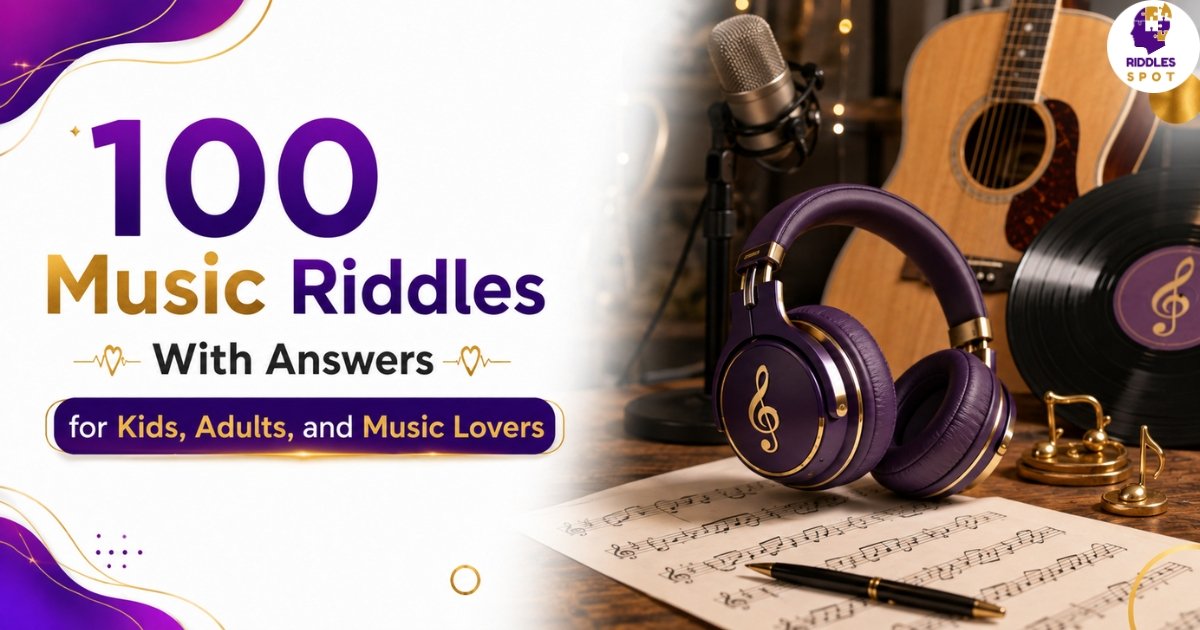
100 Music Riddles With Answers for Kids, Adults, and Music Lovers
Music riddles are short brain teasers built around instruments, songs, notes, or musicians, usually solved through wordplay, puns, or clever description.
They challenge you to guess an object or idea, like a piano, a guitar, or a genre, from clues that sound like they’re about something else entirely.
After testing riddles like these with classrooms full of restless third-graders and with adult trivia teams who take their puns very seriously, one thing is consistent: a good music riddle gets a groan and a laugh in the same breath.
What Makes a Good Music Riddle?
A strong music riddle usually leans on one of three tricks: a pun (words that sound alike but mean different things), a misdirection (clues that sound like they describe one thing but actually describe another), or a piece of real music trivia dressed up as a mystery.
Riddles about instruments tend to work best with kids because the answer is something concrete they can picture, a piano, a drum, a guitar.
Riddles about music theory or famous musicians tend to land better with teens and adults, since they lean on background knowledge rather than just wordplay.
Easy Music Riddles for Kids
These riddles use simple, everyday language and instrument names that most kids will already recognize.
They’re a solid opener for a classroom warm-up or a car ride game, since almost everyone gets at least a few right away, which keeps the energy up.
- Riddle: What has keys but can’t open a single door?
Answer: A piano.
Difficulty: Easy
Explanation: “Keys” describes both piano keys and door keys, so the riddle borrows one word for two totally different objects. - Riddle: What instrument do you keep in your mouth but never eat?
Answer: A harmonica.
Difficulty: Easy
Explanation: The riddle plays on the fact that harmonicas are played with the mouth, which sounds like a hint about food. - Riddle: I have strings, but I’m not a puppet or a kite. What am I?
Answer: A guitar.
Difficulty: Easy
Explanation: “Strings” is shared by guitars, puppets, and kites, so ruling out the wrong two narrows it down. - Riddle: What do you call a drum that never stops talking?
Answer: A rattle-drum (it just won’t stop rattling on).
Difficulty: Easy
Explanation: This one is a straightforward pun on “rattle,” which describes both a drum sound and nonstop chatter. - Riddle: I have a bow but I never shoot an arrow. What am I?
Answer: A violin.
Difficulty: Easy
Explanation: “Bow” is the trick word, it’s both the tool used to play a violin and the weapon used to shoot arrows. - Riddle: What kind of music do balloons hate the most?
Answer: Pop music.
Difficulty: Easy
Explanation: Balloons “pop,” and “pop” is also a music genre, the joke is entirely in that overlap. - Riddle: What instrument sounds best underwater?
Answer: A cymbal (it makes a big splash).
Difficulty: Easy
Explanation: The humor comes from imagining a literal splash rather than the sound the cymbal usually makes. - Riddle: What has a neck but no head, and sings when you strum it?
Answer: A guitar.
Difficulty: Easy
Explanation: Guitars have a “neck” in name only, so the riddle uses body-part language to disguise the instrument. - Riddle: What do you call a cow that plays an instrument?
Answer: A moo-sician.
Difficulty: Easy
Explanation: A simple sound-alike pun blending “moo” with “musician.” - Riddle: I have 88 keys but I can’t type a single word. What am I?
Answer: A piano.
Difficulty: Easy
Explanation: This riddle borrows the word “keys” again, this time contrasting piano keys with keyboard keys used for typing. - Riddle: What do you call a fish who plays music?
Answer: A bass (both the fish and the instrument share the name).
Difficulty: Easy
Explanation: “Bass” is pronounced two different ways in English, once for the fish and once for the low musical tone or instrument. - Riddle: What instrument do skeletons like best?
Answer: The trom-bone.
Difficulty: Easy
Explanation: Splitting “trombone” into “trom” and “bone” makes the pun obvious once you hear it out loud. - Riddle: What do you call two friends who love singing together?
Answer: A duet (do it).
Difficulty: Easy
Explanation: “Duet” sounds like “do it,” a classic homophone-style riddle for younger kids. - Riddle: What has strings but can also fly in the wind?
Answer: A kite (not the guitar this time, the twist is the misdirection).
Difficulty: Easy
Explanation: This riddle deliberately points toward music before revealing the answer is actually a kite, teaching kids not to assume too fast. - Riddle: What kind of song does a mummy like?
Answer: Wrap music.
Difficulty: Easy
Explanation: “Wrap” (what mummies do) sounds exactly like “rap,” a music genre. - Riddle: What do you call a music teacher who never stops smiling?
Answer: A treble-maker with a good sense of humor (treble sounds like “trouble”).
Difficulty: Easy
Explanation: “Treble” (a music term for high pitch) is a near-homophone for “trouble,” giving the pun its punch. - Riddle: What has a bell, is full of air, but is not a balloon or a church?
Answer: A trumpet.
Difficulty: Easy
Explanation: Trumpets have a “bell” shape at the end, borrowing a word usually associated with churches.
- Riddle: What runs but never walks, and often keeps a beat?
Answer: A drum machine or a river of rhythm, the intended answer is a metronome, which “runs” in the sense of operating.
Difficulty: Easy
Explanation: “Runs” is used the way you’d say a machine “runs,” not the way a person runs. - Riddle: What do you call a snail that plays guitar?
Answer: A slow strummer.
Difficulty: Easy
Explanation: The joke leans on the snail’s reputation for being slow, paired with “strumming” a guitar. - Riddle: What instrument is always ready to help you count?
Answer: A metronome.
Difficulty: Easy
Explanation: A metronome’s whole job is keeping a steady, countable beat, so the riddle just describes its function plainly. - Riddle: What do you call a music class full of ghosts?
Answer: A haunt-monica session (harmonica pun).
Difficulty: Easy
Explanation: Blending “haunt” with “harmonica” creates a silly Halloween-flavored pun. - Riddle: What has feet but no legs, and helps a poem or a song keep its rhythm?
Answer: A metrical foot (used in both poetry and song lyrics).
Difficulty: Easy
Explanation: “Foot” as a unit of rhythm is a real music and poetry term, which surprises most kids who only think of feet as body parts. - Riddle: What do you call an alligator who loves jazz?
Answer: A snap-py player (snapping its jaws to the beat).
Difficulty: Easy
Explanation: The riddle connects an alligator’s snapping jaws to “snapping” your fingers along to jazz. - Riddle: What instrument can you find in your ears?
Answer: A drum (your eardrum).
Difficulty: Easy
Explanation: “Eardrum” hides a real instrument name inside an everyday body part. - Riddle: What do you call a chicken that sings opera?
Answer: A hen-or (tenor).
Difficulty: Easy
Explanation: “Hen-or” is a playful, kid-friendly homophone stretch for “tenor,” a singing voice type.
Medium Music Riddles About Instruments
This next set of 25 leans harder on real instrument facts, so solvers need a bit more music knowledge, great for a school music unit or a slightly older group.
NLP entities like the piano, guitar, and violin show up again here, but the riddles ask for more specific reasoning.
- Riddle: I have a scroll but no paper, a neck but no head, and a bridge but no water below it. What am I?
Answer: A violin.
Difficulty: Medium
Explanation: Violins genuinely have parts called the scroll, neck, and bridge, the riddle is describing the instrument literally, which is what makes it tricky. - Riddle: I am the largest instrument in the brass family, yet I have the lowest voice of them all. What am I?
Answer: A tuba.
Difficulty: Medium
Explanation: This one relies on knowing that instrument size and pitch are often inversely related, bigger usually means lower. - Riddle: I sit low in an orchestra, played with a bow like my bigger cousin, but I’m held between the knees instead of under the chin. What am I?
Answer: A cello.
Difficulty: Medium
Explanation: Comparing the cello to “its bigger cousin” (the double bass) and “smaller cousin” (the violin) tests whether solvers know the string family lineup. - Riddle: I have valves like a trumpet but a much lower, rounder sound, and I loop around your body when you play me. What am I?
Answer: A French horn.
Difficulty: Medium
Explanation: The looping shape and valve mechanism are specific enough that only someone who knows brass instruments will get there quickly. - Riddle: My name means “little” in Italian, and I’m basically a smaller, higher-pitched flute. What am I?
Answer: A piccolo.
Difficulty: Medium
Explanation: “Piccolo” literally translates to “small” in Italian, a fact most solvers don’t know until they hear the riddle. - Riddle: I have a reed in my mouth, a single one, and I sound darker and rounder than my double-reed cousin the oboe. What am I?
Answer: A clarinet.
Difficulty: Medium
Explanation: The single-reed versus double-reed distinction is real woodwind trivia that separates clarinets from oboes and bassoons. - Riddle: I stand upright, I’m often called “grand,” and my secret is sitting right out in the open where anyone can see it. What am I?
Answer: A piano.
Difficulty: Medium
Explanation: “Secret in the open” hints at the exposed hammers and strings you can see if you lift a grand piano’s lid. - Riddle: I have two shells that fit in one hand, and you’ll usually hear me keeping time in flamenco music. What am I?
Answer: Castanets.
Difficulty: Medium
Explanation: Castanets are specifically tied to Spanish and flamenco tradition, which is the clue that narrows down the answer. - Riddle: I’m a woodwind, but people often mistake me for metal because of how I shine. What am I?
Answer: A flute.
Difficulty: Medium
Explanation: Flutes are classified as woodwinds for historical reasons even though modern ones are made of metal, a fact that trips people up. - Riddle: I have a mouthpiece, a bell, and a slide instead of valves. What am I?
Answer: A trombone.
Difficulty: Medium
Explanation: The slide, rather than valves, is the specific detail that separates trombones from trumpets and tubas. - Riddle: I’m played by striking bars of wood, and my name comes from Greek words meaning “wood” and “sound.” What am I?
Answer: A xylophone.
Difficulty: Medium
Explanation: “Xylo” means wood and “phone” means sound in Greek, a small etymology lesson hiding inside a riddle. - Riddle: I have pedals like a piano, but I’m strapped to your chest and I breathe by squeezing. What am I?
Answer: An accordion.
Difficulty: Medium
Explanation: The “breathing by squeezing” clue describes the accordion’s bellows, which is what actually produces its sound. - Riddle: I’m a stringed instrument from Hawaii, smaller than a guitar, with a cheerful, bright sound. What am I?
Answer: A ukulele.
Difficulty: Medium
Explanation: Naming the origin (Hawaii) and comparing it directly to a guitar makes this identifiable once you think of size and tone. - Riddle: I keep the beat for a marching band without playing a single melody note. What am I?
Answer: A snare drum.
Difficulty: Medium
Explanation: The riddle leans on the snare drum’s job description, rhythm only, no melody, which is true of most percussion. - Riddle: I have a triangular body, three strings, and I’m a distant cousin of the guitar from Russia. What am I?
Answer: A balalaika.
Difficulty: Medium
Explanation: The specific shape and Russian origin are the giveaways for this less common stringed instrument.
- Riddle: I’m a keyboard instrument, but I use pipes and air instead of hammers and strings, and you’ll often hear me in a church. What am I?
Answer: An organ.
Difficulty: Medium
Explanation: Comparing pipes-and-air to hammers-and-strings draws a direct line between an organ and a piano so solvers can spot the difference. - Riddle: I’m held like a violin but played with a bow across my four strings while resting on your shoulder, and I’m bigger than a viola. What am I?
Answer: A violin is smaller, the intended answer here is a viola, which sits between violin and cello in size.
Difficulty: Medium
Explanation: The riddle tests whether solvers know the size order of the string family: violin, viola, cello, double bass. - Riddle: I’m a percussion instrument made of a hollow gourd covered in beads, shaken instead of struck. What am I?
Answer: A shekere.
Difficulty: Medium
Explanation: This West African instrument is less familiar, so the riddle spells out both the material and the playing technique. - Riddle: I have a body shaped like a pear, a short neck, and I’m often played in Middle Eastern and North African music. What am I?
Answer: An oud.
Difficulty: Medium
Explanation: The pear-shaped body and short neck are the exact features that distinguish an oud from a guitar or lute. - Riddle: I’m a brass instrument named after a hunting call, even though I now live in orchestras and jazz bands. What am I?
Answer: A French horn (originally used for hunting calls).
Difficulty: Medium
Explanation: French horns descend from hunting horns, a historical fact that explains the “hunting call” clue. - Riddle: I have 47 or more strings and a foot pedal for every note, and I’m often seen in a symphony orchestra looking like a giant triangle. What am I?
Answer: A harp.
Difficulty: Medium
Explanation: The pedal mechanism and triangular shape are specific harp features that rule out other stringed instruments. - Riddle: I’m struck with mallets, made of metal bars, and I sound brighter and more metallic than my wooden cousin. What am I?
Answer: A glockenspiel.
Difficulty: Medium
Explanation: Comparing it to a “wooden cousin” (the xylophone) highlights the metal-versus-wood distinction between the two similar-looking instruments. - Riddle: I’m a wind instrument played sideways instead of straight up and down, unlike most of my woodwind family. What am I?
Answer: A flute.
Difficulty: Medium
Explanation: Most woodwinds are played vertically, so the sideways playing position is the specific detail that identifies a flute. - Riddle: I have no strings, no reeds, and no keys, yet a person can carry an entire tune using just me. What am I?
Answer: The human voice.
Difficulty: Medium
Explanation: By ruling out strings, reeds, and keys, the riddle leads solvers to realize the instrument is the body itself. - Riddle: I keep a steady beat, but I have no drumhead and no strings, just a ticking arm or a blinking light. What am I?
Answer: A metronome.
Difficulty: Medium
Explanation: Describing the ticking arm (mechanical) or blinking light (digital) covers both classic and modern metronome designs.
Hard Music Riddles and Brain Teasers for Adults
These 25 riddles lean on music theory, history, and multi-step logic, making them a good fit for trivia nights, road trips with adults, or anyone who wants more of a challenge than a simple pun.
- Riddle: I am not a sound, yet without me there would be chaos in every song. I tell musicians exactly when to stay silent. What am I?
Answer: A rest (musical rest symbol).
Difficulty: Hard
Explanation: This tests knowledge of music notation, a “rest” is a symbol for silence, which is counterintuitive since most people associate music entirely with sound. - Riddle: I have no body of my own, yet I decide how fast or slow every note in a piece will feel. What am I?
Answer: Tempo.
Difficulty: Hard
Explanation: Tempo is an abstract musical concept rather than an object, which makes it harder to guess than a physical instrument. - Riddle: In a major scale, I am the seventh note, and I always feel like I’m pulling toward the note that comes right after me. What am I?
Answer: The leading tone.
Difficulty: Hard
Explanation: This requires knowing music theory terminology, the “leading tone” specifically describes that pull toward resolution in a scale. - Riddle: I stand at the front, wave my arms, but never play a note myself, yet the whole orchestra depends on me. What am I?
Answer: A conductor.
Difficulty: Hard
Explanation: The riddle emphasizes the conductor’s silent but essential role, which surprises people who assume every performer must make sound. - Riddle: I am the distance between two notes with the same letter name, and I’m often called the most basic interval in music. What am I?
Answer: An octave.
Difficulty: Hard
Explanation: This is a direct definition of “octave” phrased as a riddle, testing whether the solver knows the term rather than just the sound. - Riddle: I’m a term borrowed from Italian meaning “little,” used to describe both a small flute and a soft musical dynamic marking. What two things am I?
Answer: Piccolo (the instrument) and piano (the dynamic marking meaning “soft”).
Difficulty: Hard
Explanation: This riddle plays a double game with Italian musical vocabulary, since “piano” as a dynamic marking is unrelated to the piano instrument. - Riddle: I’m a chord built from three notes stacked in thirds, and I’m the basic building block of most Western harmony. What am I?
Answer: A triad.
Difficulty: Hard
Explanation: Understanding “stacked in thirds” requires basic music theory knowledge of how chords are constructed. - Riddle: I repeat a musical idea, but each time I bring it back slightly higher or lower in pitch. What technique am I?
Answer: A sequence.
Difficulty: Hard
Explanation: A musical “sequence” is a specific compositional technique, distinct from a simple repeated melody. - Riddle: I’m the space between the staff lines, and there are four of us in treble clef, spelling a common word. What word do I spell?
Answer: FACE.
Difficulty: Hard
Explanation: This is real music-reading trivia, the treble clef spaces do spell out F-A-C-E from bottom to top. - Riddle: I’m named after a French word for “smooth,” and I tell a singer or player to connect notes without any gaps. What am I?
Answer: Legato.
Difficulty: Hard
Explanation: “Legato” comes from Italian, not French, and the mismatch is intentional, the riddle rewards a solver who catches the error and answers anyway based on the definition given. - Riddle: I mark the moment a piece of music briefly changes its home key before often returning. What am I?
Answer: Modulation.
Difficulty: Hard
Explanation: Modulation is an advanced theory term describing a shift between musical keys, which is a step up from basic note or instrument riddles. - Riddle: I’m a wind instrument, and my double reed vibrates so intensely that players sometimes turn red in the face. What am I?
Answer: An oboe or bassoon (double-reed instruments).
Difficulty: Hard
Explanation: Both the oboe and bassoon share the double-reed mechanism, so this riddle intentionally allows for either correct answer. - Riddle: I’m the study of how sound behaves in a room, and I decide whether a concert hall sounds warm or harsh. What field am I?
Answer: Acoustics.
Difficulty: Hard
Explanation: This moves beyond instruments and theory into the physics of sound, a field musicians and engineers both rely on. - Riddle: I’m a form where a short melody is introduced, then repeated by other voices entering one after another, like “Row, Row, Row Your Boat.” What form am I?
Answer: A round (or canon).
Difficulty: Hard
Explanation: Rounds and canons are specific compositional structures, and the familiar example makes the abstract definition concrete. - Riddle: I’m the fastest tempo marking in Italian, faster even than “allegro.” What am I?
Answer: Presto.
Difficulty: Hard
Explanation: Ranking Italian tempo markings from slowest to fastest is classic music theory trivia, and “presto” typically tops the list. - Riddle: I’m a chord that sounds unresolved and tense until it moves to a more stable chord. What tension am I creating?
Answer: Dissonance.
Difficulty: Hard
Explanation: Dissonance versus consonance is a core music theory concept describing how “settled” or “unsettled” a chord feels.
- Riddle: I hold the low notes down in a jazz combo, whether I’m an upright instrument or an electric one with four or more strings. What am I?
Answer: A bass (upright bass or bass guitar).
Difficulty: Hard
Explanation: The riddle allows for two valid instruments since both fill the same harmonic role in a jazz ensemble. - Riddle: I’m the term for playing a note slightly before or after the beat for stylistic effect, common in jazz and blues. What am I?
Answer: Syncopation (or, more specifically, playing “behind” or “ahead of” the beat).
Difficulty: Hard
Explanation: Syncopation, a rhythmic technique that shifts emphasis off the expected beat, giving genres like jazz their swing. - Riddle: I’m the smallest interval in traditional Western music, the distance from one key to the very next key on a piano. What am I?
Answer: A half step (semitone).
Difficulty: Hard
Explanation: This tests basic interval knowledge, the half step is the foundational building block for all other intervals. - Riddle: I’m a set of seven notes arranged with a specific pattern of whole and half steps, forming the backbone of most Western songs. What am I?
Answer: A major scale.
Difficulty: Hard
Explanation: The specific whole-step/half-step pattern is what defines a major scale versus a minor or modal scale. - Riddle: I’m the term for a piece written for a solo instrument accompanied by a full orchestra, often showing off the soloist’s skill. What am I?
Answer: A concerto.
Difficulty: Hard
Explanation: A concerto specifically pairs a soloist against an orchestra, distinct from a symphony where no one instrument is featured alone. - Riddle: I’m the pause a conductor can hold for as long as they like, marked with a symbol that looks like an eye. What am I?
Answer: A fermata.
Difficulty: Hard
Explanation: The fermata symbol does resemble a half-closed eye, and it grants the conductor control over exactly how long a note or rest lasts. - Riddle: I describe a melody that moves by skips and leaps rather than smoothly step by step. What kind of melodic motion am I?
Answer: Disjunct motion.
Difficulty: Hard
Explanation: “Disjunct” is the specific music theory term contrasted with “conjunct” motion, which moves in smooth, stepwise fashion. - Riddle: I’m a term for a musician who can play music without needing to read written notation, relying instead on their ear. What skill am I describing?
Answer: Playing by ear.
Difficulty: Hard
Explanation: This distinguishes ear-trained musicians from those who rely solely on sheet music, a real and valued skill in many genres. - Riddle: I’m the term for the overall structure of a piece, verse, chorus, bridge, that a songwriter maps out before writing lyrics. What am I?
Answer: Song form (or song structure).
Difficulty: Hard
Explanation: Understanding “verse-chorus-bridge” as a formal structure is a foundational songwriting concept rather than a single musical term.
Music Riddles for Bands, Songs, and Wordplay Fans
The final 25 riddles focus on bands, songs, and pure wordplay, the kind of riddle that works well shared on social media captions or read aloud at a party, since most people only need a little music trivia to get there.
- Riddle: I’m a British band named after a small, buzzing insect, famous for songs about love and yeah, yeah, yeah. Who am I?
Answer: The Beatles.
Difficulty: Medium
Explanation: “Beatles” is a deliberate misspelling of “beetles,” blending the insect with the word “beat,” which is exactly the kind of wordplay the band’s name is famous for. - Riddle: I’m a rock band named after a metal that’s heavier than most, and my drummer keeps time under Jack Black’s fictional stage persona in a movie about the “School of Rock.” Who might I be thinking of?
Answer: Led Zeppelin (heavy metal pioneers, though the movie reference is separate trivia).
Difficulty: Hard
Explanation: This riddle combines a band’s genre-defining reputation with a pop-culture reference, requiring two pieces of knowledge instead of one. - Riddle: I share my name with a type of coin and a shade of a metal, and I’m also a band known for hits like “Clocks” and “Yellow.” Who am I?
Answer: Coldplay.
Difficulty: Medium
Explanation: The riddle hides “cold” (a temperature) and “play” (an action) inside the band name, which is only obvious once you say it out loud. - Riddle: My name is a flower, but I’m also a legendary singer known for hits like “Purple Rain.” Who am I?
Answer: Prince (associated with royalty rather than a flower, making this a deliberate red herring).
Difficulty: Medium
Explanation: The riddle intentionally misleads toward a flower name before revealing the real connection is to royal titles. - Riddle: What do you call it when a catchy pop song and a case of the measles have something in common?
Answer: They’re both “catchy.”
Difficulty: Easy
Explanation: This is a pun on “catchy,” which describes both memorable music and contagious illness. - Riddle: What do you call a song that keeps returning to the same short musical phrase throughout, especially common in minimalist and dance music?
Answer: A loop (or riff).
Difficulty: Medium
Explanation: Both “loop” and “riff” describe repeated musical phrases, and the riddle allows either as a correct answer depending on genre context. - Riddle: What do a harmonica repair job and a court case have in common?
Answer: Everyone’s relieved when the case is closed.
Difficulty: Easy
Explanation: The word “case” refers to both a harmonica’s protective case and a legal case, giving the pun its double meaning. - Riddle: I’m a genre born in New Orleans that blends improvisation, syncopation, and brass instruments into a swinging sound. What genre am I?
Answer: Jazz.
Difficulty: Medium
Explanation: New Orleans, improvisation, and syncopation are all specific historical and stylistic markers that point clearly to jazz. - Riddle: What do you call a song stuck permanently in your head, playing on repeat even when there’s no music around?
Answer: An earworm.
Difficulty: Easy
Explanation: “Earworm” is an actual English term for this exact phenomenon, so the riddle is really testing vocabulary rather than pure wordplay. - Riddle: I’m a genre that began in Jamaica, known for an off-beat guitar rhythm called the “skank.” What genre am I?
Answer: Reggae.
Difficulty: Medium
Explanation: The Jamaican origin and specific off-beat guitar technique are defining features that separate reggae from ska or dancehall. - Riddle: What do you call the moment in a song when everything drops away except one instrument or voice?
Answer: A breakdown (or a solo, depending on context).
Difficulty: Medium
Explanation: Both terms describe a stripped-down moment in a song, and either answer reflects real production and performance vocabulary. - Riddle: I’m a two-word term for copying a short piece of one song into a new one, common in hip-hop production. What am I?
Answer: A sample.
Difficulty: Medium
Explanation: “Sampling” is standard hip-hop and electronic production terminology for reusing a recorded snippet. - Riddle: What kind of music genre is the national anthem of most countries typically classified under?
Answer: March (a marching band style, not a country genre despite the wordplay temptation).
Difficulty: Medium
Explanation: Most national anthems are structured as marches, which surprises people expecting a more dramatic or classical answer. - Riddle: I’m a music video format that dominated MTV in the 1980s, mixing performance footage with a loose storyline. What am I?
Answer: A music video.
Difficulty: Easy
Explanation: This riddle is a straightforward historical description rather than wordplay, testing knowledge of MTV-era music culture. - Riddle: What’s the difference between a piano and a fish?
Answer: You can tune a piano, but you can’t “tuna” fish.
Difficulty: Easy
Explanation: “Tuna” and “tune a” sound identical, making this a classic homophone pun. - Riddle: I’m a record format that spins at 33 and a third revolutions per minute, popular before CDs and streaming. What am I?
Answer: A vinyl LP.
Difficulty: Medium
Explanation: The specific rotation speed is real vinyl trivia that separates an LP from a 45 or 78 RPM record. - Riddle: What genre gets its name from a Spanish word meaning “flame,” known for passionate guitar and rhythmic hand claps?
Answer: Flamenco.
Difficulty: Medium
Explanation: “Flamenco” doesn’t literally translate to “flame,” but the fiery association is a common (if inexact) way people remember the genre’s energy. - Riddle: I’m the technical word for a song’s main, most memorable section that usually repeats and often carries the title. What am I?
Answer: The chorus (or hook).
Difficulty: Easy
Explanation: The chorus is the section of a song most listeners can sing from memory, which is exactly why it’s called the “hook.” - Riddle: What do you call a musical group performing without any of its members physically present, using only recorded tracks?
Answer: A playback (or lip-sync) performance.
Difficulty: Medium
Explanation: This distinguishes live performance from playback, a real and sometimes controversial distinction in the music industry. - Riddle: I’m a French word meaning “small song,” often used to describe a light, catchy pop tune. What word am I?
Answer: Ditty (an English word with a similar meaning, since “chanson” is the actual French term).
Difficulty: Hard
Explanation: This riddle rewards solvers who know that “ditty” carries the same light, casual meaning even though its roots aren’t literally French. - Riddle: What do you call a musician who plays more than one instrument during the same live performance?
Answer: A multi-instrumentalist.
Difficulty: Easy
Explanation: This is a direct vocabulary riddle describing a common skill among session musicians and singer-songwriters. - Riddle: I’m the term for singing without any instrumental accompaniment at all. What style am I?
Answer: A cappella.
Difficulty: Medium
Explanation: “A cappella” literally translates from Italian to “in the manner of the chapel,” referencing its origins in unaccompanied church singing. - Riddle: What do you call the small, quiet venue where up-and-coming musicians often play their very first shows?
Answer: An open mic.
Difficulty: Easy
Explanation: The open mic is a real, common first step for new performers, making this more a trivia question than a pun. - Riddle: I’m the term for a band’s very first officially released collection of songs. What am I?
Answer: A debut album.
Difficulty: Easy
Explanation: “Debut” specifically marks a first release, distinguishing it from a band’s later work. - Riddle: What do you call it when an entire audience sings a chorus back to the performer without being asked?
Answer: A singalong.
Difficulty: Easy
Explanation: This closes the list on a communal note, the exact moment that makes live music feel shared rather than performed.
How to Use Music Riddles in Classrooms and Parties?
Music teachers often open class with two or three riddles instead of a formal warm-up, it settles a room faster than asking for quiet, because kids want to shout out the answer.
For a birthday party or family game night, try splitting the group into teams and awarding points by difficulty level, so easy riddles are worth one point and hard ones are worth three.
For a road trip, skip straight to the Wordplay and Band section, since those riddles don’t require anyone to see an instrument to picture the answer.
More Riddles to Keep the Fun Going
If this style of humor works for you, there’s more where that came from. Looking for a broader mix to pull from at your next hangout.
Our Riddles to Ask Friends collection is built for exactly the kind of low-stakes, high-context settings this list works best in.
And if you’re looking to mix things up with the seasons, check out our April riddles for something a little different to share at your next gathering.
Conclusion
If you needed a quick classroom warm-up, a stack of car-ride entertainment, or a real music theory challenge for a trivia team, these 100 music riddles cover the full range from silly puns to genuine music history.
Bookmark this page so it’s ready the next time you need a riddle on short notice, and share your favorite with a friend who thinks they know everything about music, the harder riddles in the list have a way of humbling even lifelong musicians.
FAQs
What is a Good Music Riddle?
A good music riddle usually hides its answer behind a pun or a piece of real music trivia, something like asking what has “keys but can’t open a door” (a piano) or what a mummy’s favorite music genre is (wrap/rap music).
What has 88 Keys but can’t Open a Single Door?
A piano. Standard pianos have 88 keys, and the riddle plays on the double meaning of “keys” as both piano keys and door keys.
Why are Music Riddles Good for Kids?
Music riddles introduce real instrument names, music vocabulary, and basic wordplay in a low-pressure, game-like format. They also work well as classroom transitions, since guessing an answer out loud tends to re-focus a group faster than a standard instruction to quiet down.
What are Some Funny Music Riddles with Answers?
Classic examples include “What type of music are balloons afraid of? Pop music” and “What’s the difference between a piano and a fish? You can tune a piano, but you can’t tuna fish.” Both rely on a pun rather than deep music knowledge, which is why they land with almost any age group.
How Do You Write Your Own Music Riddle?
Start with a music word that has a double meaning, like “key,” “scale,” “bar,” “rest,” or “note”, and build a description around the non-musical meaning of that word before revealing the musical answer.