100 What Am I Riddles with Answers for Kids and Adults
“What Am I riddles” are short brain teasers that describe an object, animal, or idea through a list of clues, then ask the listener to name it.
They rely on wordplay, misdirection, and multiple meanings, making them a favorite for classrooms, family game nights, and quick mental warm-ups of any age.
What Are “What Am I Riddles”?
“What Am I questions/riddle” are short verbal puzzles told in the first person; the object or idea is “speaking” and giving clues about itself, and the listener has to guess its identity.
This format traces back to the oldest riddle traditions in recorded history, including the riddle of the Sphinx, and it remains popular today because it forces the brain to switch from literal thinking to lateral thinking in just a few seconds.
The format also works beautifully for riddles for kids, because the clues can be adjusted for vocabulary level without changing the structure of the game itself.
Easy What Am I Riddles with Answers for Kids
These “riddles for kids what am I” use simple, everyday objects that young children will recognize immediately. They’re ideal for a classroom icebreaker or morning meeting game.
Difficulty: Easy.
Explanation: A clock has hands and a face, but they’re parts of the clock, not human features.
Difficulty: Easy.
Explanation: A candle burns down as it’s used, and wind can blow out its flame.
Difficulty: Easy.
Explanation: A shadow appears in light and disappears when it’s dark.
Difficulty: Easy.
Explanation: An umbrella opens to keep you dry and closes when it’s no longer needed.
Difficulty: Easy.
Explanation: Eggs have shells that must be cracked before cooking.
Difficulty: Easy.
Explanation: A mirror reflects your face without taking a picture.
Difficulty: Easy.
Explanation: A pencil becomes shorter as you write with it.
Difficulty: Easy.
Explanation: A snowman is often dressed with a scarf and melts in warm weather.
Difficulty: Easy.
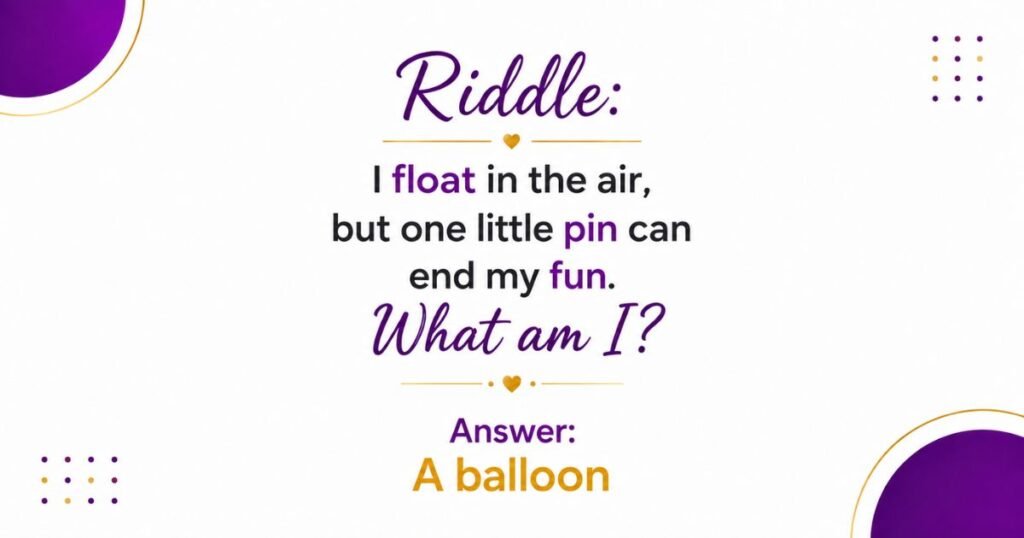
Explanation: A balloon floats until it’s popped by a sharp object.
Difficulty: Easy.
Explanation: A toothbrush cleans your teeth without eating anything.
Difficulty: Easy.
Explanation: A key unlocks doors and is small enough to carry easily.
Difficulty: Easy.
Explanation: A rainbow is visible after rain but can’t be reached or touched.
Difficulty: Easy.
Explanation: Books have pages and tell stories through written words.
Difficulty: Easy.
Explanation: Shoes protect your feet but can’t move without someone wearing them.
Difficulty: Easy.
Explanation: Stars are visible at night and hidden by daylight.
Difficulty: Easy.
Explanation: Ice melts into water when it warms up.
Difficulty: Easy.
Explanation: A kite stays in the air with the help of wind and a string.
Difficulty: Easy.
Explanation: The moon shines by reflecting sunlight.
Difficulty: Easy.
Explanation: A backpack carries books but only goes where its owner takes it.
Difficulty: Easy.
Explanation: Bubbles pop as soon as they’re touched.
Difficulty: Easy.
Explanation: A staircase has steps, but it stays in one place.
Difficulty: Easy.
Explanation: A sponge absorbs water and is commonly used in the kitchen.
Difficulty: Easy.
Explanation: An alarm clock wakes you with a sound instead of a voice.
Difficulty: Easy.
Explanation: A single puzzle piece becomes meaningful when connected to the others.
Difficulty: Easy.
Explanation: Crayons are available in many colors and soften or melt in heat.
Difficulty: Easy.
Explanation: A spider web catches insects even though it has no hands.
Difficulty: Easy.
Explanation: A small seed can grow into a large plant or tree.
Difficulty: Easy.
Explanation: A piggy bank stores coins and is often made in the shape of a pig.
Difficulty: Easy.
Explanation: Popcorn kernels expand into fluffy popcorn when heated.
Difficulty: Easy.
Explanation: A snail carries its shell wherever it goes and is known for moving slowly.
Read More: Book Riddles: 60+ Best Riddles About Books, Libraries and Reading
Medium What Am I Riddles for Family Game Night
These riddles step up the wordplay and require a bit more lateral thinking, great for family game night or a road trip riddle round.
Difficulty: Medium.
Explanation: Coins have a head and a face, but they aren’t living things.
Difficulty: Medium.
Explanation: Footprints are left behind as you walk and can disappear when it rains.
Difficulty: Medium.
Explanation: A secret is no longer a secret once it’s shared.
Difficulty: Medium.
Explanation: A map represents large places while remaining small enough to fold.
Difficulty: Medium.
Explanation: A comb’s “teeth” help arrange hair but aren’t real teeth.
Difficulty: Medium.
Explanation: A glove has finger-shaped sections without any bones.
Difficulty: Medium.
Explanation: People move up and down a staircase, but the staircase stays still.
Difficulty: Medium.
Explanation: Flipping an hourglass restarts the flow of sand and the timing.
Difficulty: Medium.
Explanation: An echo repeats sounds by reflecting them, not by speaking.
Difficulty: Medium.
Explanation: A needle’s “eye” is the hole used for threading.
Difficulty: Medium.
Explanation: A calendar contains 12 months and is replaced yearly.
Difficulty: Medium.
Explanation: A ruler measures length but never changes its own size.
Difficulty: Medium.
Explanation: A bathroom scale displays your weight each day.
Difficulty: Medium.
Explanation: Glasses improve vision by sitting on your nose and ears.
Difficulty: Medium.
Explanation: A fan cools people by moving air but doesn’t experience temperature like humans.
Difficulty: Medium.
Explanation: The temperature reading changes while the thermometer stays in place.
Difficulty: Medium.
Explanation: A mailbox holds other people’s letters until they’re collected.
Difficulty: Medium.
Explanation: A zipper’s interlocking teeth fasten clothing together.
Difficulty: Medium.
Explanation: A match ignites with one strike and is quickly used up.
Difficulty: Medium.
Explanation: A paperclip keeps papers together without adhesive.
Difficulty: Medium.
Explanation: A whisper stops being a whisper if it’s spoken loudly.
Difficulty: Medium.
Explanation: A recipe provides instructions without doing the cooking.
Difficulty: Medium.
Explanation: A password grants access and is usually hidden as you enter it.
Difficulty: Medium.
Explanation: A compass needle always points toward magnetic north.
Difficulty: Medium.
Explanation: An anchor holds a ship in place without moving on its own.
Difficulty: Medium.
Explanation: A lighthouse guides ships with its flashing light.
Difficulty: Medium.
Explanation: A telescope makes distant objects appear much closer.
Difficulty: Medium.
Explanation: A bow produces music but doesn’t play by itself.
Difficulty: Medium.
Explanation: A hammer is a tool that depends on a person to build things.
Difficulty: Medium.
Explanation: Nails are struck with a hammer to keep structures secure.
Difficulty: Medium.
Explanation: Scissors have two blades designed for cutting everyday materials.
Difficulty: Medium.
Explanation: An envelope protects a letter until it’s opened.
Difficulty: Medium.
Explanation: A stamp stays on an envelope as it travels long distances through the mail.
Difficulty: Medium.
Explanation: A doormat is designed to collect dirt from shoes.
Difficulty: Medium.
Explanation: Chalk wears down into dust as you write on a board.
Hard What Am I Riddles for Adults and Riddle Masters
These riddles trade physical objects for abstract ideas, tricky wordplay, and genuine misdirection, a solid step up for riddles for adults.
Difficulty: Hard.
Explanation: Fire constantly consumes fuel, leaving behind black ash or char.
Difficulty: Hard.
Explanation: Time is invisible and cannot be held, yet everyone eventually runs out of it.
Difficulty: Hard.
Explanation: Every fingerprint is unique but serves the same purpose of identification.
Difficulty: Hard.
Explanation: Silence exists only when sound disappears, making it impossible to “catch.”
Difficulty: Hard.
Explanation: Yesterday is part of the past and can only exist in memory.
Difficulty: Hard.
Explanation: Adding “er” creates “shorter,” making the statement a clever play on words.
Difficulty: Hard.
Explanation: A question mark ends a question and resembles a hook.
Difficulty: Hard.
Explanation: Every English word is formed using the 26 letters of the alphabet.
Difficulty: Hard.
Explanation: Breath exists only while it’s inside or leaving your body.
Difficulty: Hard.
Explanation: Ideas have no physical weight but can transform the world.
Difficulty: Hard.
Explanation: Memories exist only in the mind but can vividly recall past experiences.
Difficulty: Hard.
Explanation: Zero has no value alone but increases a number’s value when placed after it.
Difficulty: Hard.
Explanation: Rumors often become exaggerated as they’re shared.
Difficulty: Hard.
Explanation: Dreams fade quickly once you wake up or try to remember them.
Difficulty: Hard.
Explanation: Reflections depend on light and reflective surfaces.
Difficulty: Hard.
Explanation: Wind is invisible, but its effects are easy to observe.
Difficulty: Hard.
Explanation: Gravity keeps everything in place without being visible.
Difficulty: Hard.
Explanation: Different languages shape the way people communicate and think.
Difficulty: Hard.
Explanation: Debt usually grows over time until it’s repaid.
Difficulty: Hard.
Explanation: Promises are easy to make but difficult to restore once broken.
Difficulty: Hard.
Explanation: Past events cannot change, but their interpretation often does.
Difficulty: Hard.
Explanation: Written notes become music only when performed.
Difficulty: Hard.
Explanation: The horizon always appears to stay the same distance away.
Difficulty: Hard.
Explanation: Déjà vu is the strange feeling that you’ve experienced the present moment before.
Answer: A riddle.
Difficulty: Hard.
Explanation: A riddle exists only until it’s solved.
Difficulty: Hard.
Explanation: The truth remains unchanged despite different opinions.
Difficulty: Hard.
Explanation: Pi is an infinite, non-repeating decimal used to measure circles.
Difficulty: Hard.
Explanation: A photograph captures one moment that can be viewed repeatedly.
Difficulty: Hard.
Explanation: A library contains countless written voices without speaking aloud.
Difficulty: Hard.
Explanation: The internet connects people worldwide but has no physical boundaries.
Difficulty: Hard.
Explanation: Regret comes after decisions and cannot change the past.
Difficulty: Hard.
Explanation: Patience is free but often disappears in frustrating situations.
Answer: Curiosity.
Difficulty: Hard.
Explanation: Curiosity drives discovery despite the famous proverb warning against it.
Difficulty: Hard.
Explanation: Tomorrow always becomes today once it arrives.
Difficulty: Hard.
Explanation: When rotated sideways, the number 8 resembles the infinity symbol (∞).
Read More: 100 Dog Riddles With Answers: Easy, Funny and Hard
How to Host Your Own “What Am I” Riddle Night?
Running these riddles with a group is simple: read the clues one at a time instead of all at once, pausing after each line so the group can guess early if they spot it.
In classroom testing, giving a small hint after 30 seconds (like naming the category, object, animal, or idea) kept younger kids engaged without giving away the full answer immediately.
For a themed riddle party or scavenger hunt, try mixing three or four easy riddles as warm-ups before introducing a hard one as the “boss level” of the round, it builds momentum and keeps the difficulty curve from feeling like a wall.
Conclusion
If you’re running a classroom icebreaker, filling a quiet car ride, or just looking to flex your brain before bed, these 100 “What Am I riddles” cover every skill level from first-grade simple to genuinely tricky.
FAQs
What is a Good “What Am I” Riddle to Start With?
A simple, physical-object riddle is the best entry point, something like the candle or clock riddles above, where the clues describe a familiar item’s obvious traits.
How Do You Play the “What Am I” Riddle Game?
One person reads the clues aloud, one line at a time, and the rest of the group calls out guesses as soon as they think they know the answer. If nobody guesses correctly after a minute or so, the reader can offer a category hint (object, animal, or idea) before revealing the answer.
What are Some Easy “What Am I” Riddles for Kids?
Riddles built around everyday classroom or household objects, clocks, candles, umbrellas, mirrors, and shoes, tend to work best for younger children, since the clues map directly onto things they see every day.
Are “What Am I” Riddles Good for the Classroom?
Yes, they’re a low-prep way to sharpen vocabulary, encourage descriptive thinking, and give students a quick mental warm-up between lessons.
What Makes a “What Am I” Riddle Tricky to Solve?
The hardest riddles usually describe an abstract idea (like time, silence, or a memory) rather than a physical object, or they rely on a specific piece of wordplay, like a double meaning or a proverb reference, that the solver has to recognize first.