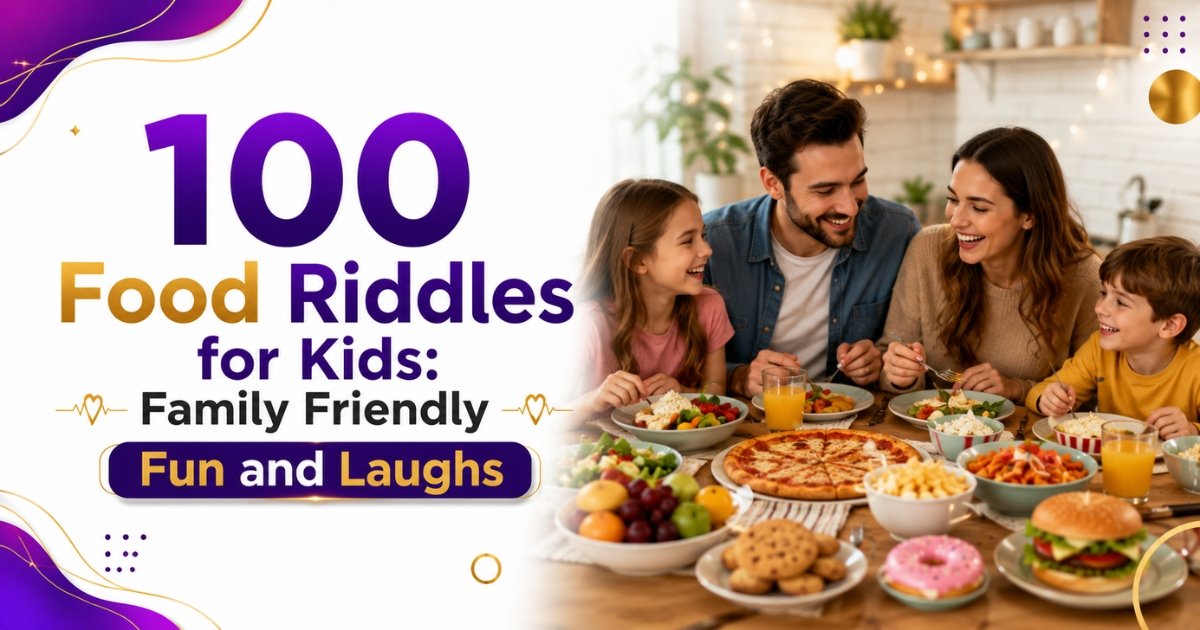
100 Food Riddles for Kids: Family Friendly Fun and Laughs
Food riddles are short, kid-friendly brain teasers where the answer is a fruit, vegetable, snack, or meal. They use clues about color, shape, taste, or how a food is used, challenging kids to think sideways before landing on the answer.
Every one of the 100 food riddles below comes with a difficulty rating and a short explanation of the wordplay or logic behind it.
What Are Food Riddles?
Food riddle are riddles where the hidden answer is something you’d find in the kitchen, garden, or lunchbox: a fruit, vegetable, snack, or dish.
A food riddles for kids like “I have a peel, but I’m not a banana” nudges kids to think about what else has a peel, which is exactly the kind of lateral thinking that makes riddles good for building vocabulary and reasoning skills.
Easy Fruit & Veggie Riddles for Kids
These riddles about food use simple, familiar clues about color, shape, and taste, perfect for younger kids or as an opening riddle for a classroom activity.

Difficulty: Easy
Explanation: Uses a well-known saying as the main clue, which most kids recognize right away.
Difficulty: Easy
Explanation: Combines a shape clue (“curved like a smile”) with a well-known animal association.
Difficulty: Easy
Explanation: Straightforward color-and-structure clue.
Difficulty: Easy
Explanation: Descriptive clue tied to a familiar use case (cake topping).
Difficulty: Easy
Explanation: Points to two forms of the same fruit (juice and raisins) as the clue.
Difficulty: Easy
Explanation: Classic animal-association clue.
Difficulty: Easy
Explanation: Before-and-after (outside vs. inside) visual clue.
Difficulty: Medium
Explanation: Misdirects with “book” before revealing the twist about crying.
Difficulty: Easy
Explanation: Visual shape clue plus a relatable kid behavior.
Difficulty: Easy
Explanation: Lists two common forms (sliced fresh, pickled) as the clue.
Difficulty: Medium
Explanation: Seasonal, holiday-specific clue that requires connecting color and tradition.
Difficulty: Easy
Explanation: Position-based clue (“first thing in the bowl”).
Difficulty: Easy
Explanation: Descriptive shape-and-container clue.
Difficulty: Medium
Explanation: Requires knowing a less common dish name, making it trickier than the other easy riddles.
Difficulty: Easy
Explanation: Straightforward color-and-growth clue.
Difficulty: Medium
Explanation: The classic fruit-vs-vegetable debate is the twist that makes this trickier than it looks.
Difficulty: Medium
Explanation: Plays on the double meaning of “eyes” (potato sprouts vs. real eyes).
Difficulty: Easy
Explanation: Texture-and-season clue.
Difficulty: Medium
Explanation: A genuinely unusual fact (seeds on the outside) that most kids don’t know, adding a layer of surprise.
Difficulty: Easy
Explanation: Before-and-after clue linking grapes to their dried form.
Difficulty: Easy
Explanation: Pop-culture reference clue (a famous cartoon).
Difficulty: Easy
Explanation: Seasonal/tradition-based clue distinct from the earlier rabbit-carrot riddle.
Difficulty: Medium
Explanation: Corrects a common assumption (fruit vs. vegetable), which adds a small logic twist.
Difficulty: Easy
Explanation: A simple, relatable dinner-table observation.
Difficulty: Easy
Explanation: Shape-and-occasion clue that reinforces recognition through a familiar treat.
Meals & Snacks Riddles for Kids
This section moves from raw ingredients to finished dishes and snacks: sandwiches, breakfast foods, and classroom-favorite treats.

Difficulty: Easy
Explanation: Simple structural description.
Difficulty: Easy
Explanation: Shape-and-topping clue that most kids recognize instantly.
Difficulty: Easy
Explanation: Texture-and-shape clue plus a common condiment pairing.
Difficulty: Easy
Explanation: Combines a sound clue (“pop”) with a well-known setting.
Difficulty: Easy
Explanation: Action-based clue (“cracked open”) plus a typical breakfast pairing.
Difficulty: Easy
Explanation: Cooking-method clue (“flipped”) plus a familiar topping.
Difficulty: Easy
Explanation: Weather-based association clue.
Difficulty: Easy
Explanation: Descriptive ingredient-and-shape clue.
Difficulty: Easy
Explanation: Sound-and-setting clue (sizzle, cookout).
Difficulty: Medium
Explanation: Requires connecting a preparation method (grated, fried) to a specific breakfast side.
Difficulty: Easy
Explanation: Occasion-based clue most kids know from experience.
Difficulty: Easy
Explanation: Rules out the wrong kind of “pie” before landing on the real answer.
Difficulty: Easy
Explanation: Lunchbox-specific clue that’s instantly familiar to kids.
Difficulty: Easy
Explanation: Shape-and-action clue (“twirled”).
Difficulty: Easy
Explanation: Descriptive structural clue.
Difficulty: Medium
Explanation: Requires connecting “tall cardboard can” to a specific snack packaging detail.
Difficulty: Easy
Explanation: Ingredient-and-shape clue tied to a familiar snack.
Difficulty: Easy
Explanation: Shape-and-pairing clue.
Difficulty: Easy
Explanation: Combines a cooking method with a classic food pairing.
Difficulty: Easy
Explanation: Temperature-and-container clue.
Difficulty: Easy
Explanation: Texture-contrast clue (crispy outside, soft inside).
Difficulty: Easy
Explanation: Shape clue (“ring with a hole”).
Difficulty: Easy
Explanation: Time-based texture clue (soggy if you wait).
Difficulty: Medium
Explanation: Structural (layers) clue requiring a bit more food knowledge than the easy tier.
Difficulty: Easy
Explanation: Shape-and-pairing clue.
Funny Food Riddles for Kids
These food riddles with answers lean on puns and silly wordplay, making them a good pick for classroom laughs or a family dinner joke break.
Difficulty: Easy
Explanation: A pun that swaps one fruit’s mood for another fruit’s color/name.
Difficulty: Easy
Explanation: A pun on “dressing” (clothing vs. salad topping).
Difficulty: Easy
Explanation: Homophone pun on “peeling” and “feeling.”
Difficulty: Easy
Explanation: Double meaning of “crack” (egg shell breaking vs. revealing a secret).
Difficulty: Easy
Explanation: Uses the common phrase “smart cookie” as the punchline.
Difficulty: Medium
Explanation: Homophone pun between “pie” and the math symbol “pi.”
Difficulty: Medium
Explanation: Classic homophone pun between “fungi” and “fun guy.”
Difficulty: Easy
Explanation: Homophone pun on “nacho” and “not your.”
Difficulty: Easy
Explanation: Double meaning of “juice” (car fuel slang vs. fruit juice).
Difficulty: Medium
Explanation: Homophone pun on “peel” and “appeal.”
Difficulty: Easy
Explanation: Double meaning of “chop” (karate move vs. cut of meat).
Difficulty: Medium
Explanation: Homophone pun on “stalk” (corn stalk vs. walking around/”stalking” a dance floor).
Difficulty: Easy
Explanation: Double meaning of “crummy” (feeling unwell vs. full of bread crumbs).
Difficulty: Medium
Explanation: Pun on “a head” of lettuce and being “ahead” in a race.
Difficulty: Easy
Explanation: Homophone pun on “ketchup” and “catch up.”
Difficulty: Medium
Explanation: Double meaning of “green” (pea’s color vs. the idiom “green with envy”).
Difficulty: Medium
Explanation: Sound-alike pun combining “potato” (tater) with “a tune.”
Difficulty: Easy
Explanation: Wordplay splitting “watermelon” into “water” + “melon.”
Difficulty: Medium
Explanation: Double meaning of “slapstick” (comedy style vs. bananas slipping).
Difficulty: Easy
Explanation: Double meaning of “stuffed” (a sandwich with filling vs. feeling full).
Difficulty: Easy
Explanation: Double meaning of “crumbly” (biscuit texture vs. emotional state).
Difficulty: Medium
Explanation: Wordplay on “edge” (a slice’s crust edge vs. the idiom “on edge”).
Difficulty: Medium
Explanation: Homophone pun on “grate” (cheese grater) and “great.”
Difficulty: Medium
Explanation: Double meaning of “core” (apple core vs. “core feedback”).
Difficulty: Medium
Explanation: Double meaning of “rooting” (carrot’s root vs. cheering someone on).
Tricky Food Brain Teasers for Kids
These riddles lean on logic, paradox, or multi-step thinking, and work best with older kids (roughly ages 9–12) who’ve already warmed up on the easier sections.
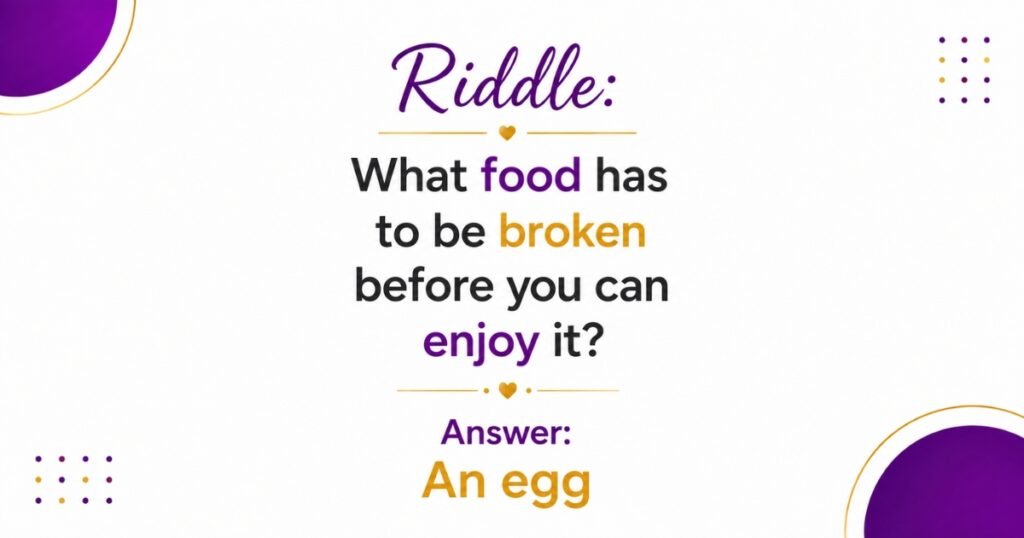
Difficulty: Easy
Explanation: A simple action-based riddle where “broken” is the literal clue.
Difficulty: Medium
Explanation: Hides the word “room” inside “mushroom” as a wordplay clue.
Difficulty: Easy
Explanation: Classic riddle logic, the container, not the food, is the answer.
Difficulty: Hard
Explanation: A multi-step process riddle that requires tracing a food’s journey from farm to table.
Difficulty: Medium
Explanation: Plays on the double meaning of “caught” (catching a fish vs. catching an illness).
Difficulty: Medium
Explanation: Hides the word “nut” inside “donut” as a wordplay clue.
Difficulty: Medium
Explanation: Plays on the contrast between a shrinking supply and a feeling that it never runs out.
Difficulty: Easy
Explanation: Straightforward logic riddle pointing out that food has no feelings, despite action-heavy verbs.
Difficulty: Hard
Explanation: A three-step transformation riddle (liquid → whipped → melted) that takes extra reasoning to trace.
Difficulty: Hard
Explanation: A true paradox, honey famously never spoils, yet people still describe old jars as “aged.”
Difficulty: Medium
Explanation: Requires separating “breaks” from a literal fall, focusing instead on tearing.
Difficulty: Medium
Explanation: A paradox riddle contrasting “full of holes” with “whole.”
Difficulty: Medium
Explanation: Requires picturing a specific dessert that combines two opposite temperatures.
Difficulty: Medium
Explanation: Uses “layers like an onion” as a red herring before landing on a sweeter answer.
Difficulty: Medium
Explanation: Focus on transformation through melting, a slightly more abstract clue than a direct description.
Difficulty: Medium
Explanation: Combines a growing-location clue with a common preparation method.
Difficulty: Medium
Explanation: Tests understanding that one food can have two very different flavor versions.
Difficulty: Hard
Explanation: References the real botanical-vs-culinary debate about tomatoes, adding a factual layer to the riddle.
Difficulty: Medium
Explanation: “Flipped, folded, stacked” mimics language usually used for paper or books, misdirecting from the food answer.
Difficulty: Hard
Explanation: A process-based riddle that requires knowing how a specific food is made, not just what it looks like.
Difficulty: Medium
Explanation: Tests knowledge of multiple cooking styles for one ingredient.
Difficulty: Hard
Explanation: Requires connecting an onomatopoeia (the sound) to a specific cereal’s marketing.
Difficulty: Hard
Explanation: Connects a food shape to a math vocabulary word, requiring cross-subject thinking.
Difficulty: Medium
Explanation: A classic misdirection riddle; the trick isn’t about the dessert, it’s about the impossible comparison.
Difficulty: Medium
Explanation: A closing riddle that plays on “ends” (the list) versus an appetite that “never stops” (a joke about wanting more).
How to Use These Riddles with Kids
Difficulty ratings are subjective and based on average audience feedback, every child solves puzzles at their own pace, so use “Easy,” “Medium,” and “Hard” as a starting guide rather than a strict rule.
Explore More Riddles for Every Occasion
If your kids had fun with these food riddles, there are plenty more brain teasers to keep the fun going. Check out our Fire Riddles for a hot and fiery challenge.
Curl up with our Book Riddles for a bookworm-friendly brain teaser session.
Looking for a bigger challenge? Our Amazing Riddles collection has plenty of jaw-dropping puzzles to keep the whole family guessing.
Conclusion
These 100 food riddles give teachers, parents, and kids a ready-made way to turn snack time, a classroom transition, or a family dinner into a few extra minutes of laughing and thinking.
Each riddle includes a difficulty rating and a short explanation, you can match the right riddle to the right child and actually walk them through the “aha” moment instead of just handing over the answer.
FAQs
What are Some Good Food Riddles For kids?
Good food riddles for kids use simple, familiar clues about color, shape, or taste, like “I’m long, yellow, and curved like a smile. What am I?” (Answer: A banana). Easy riddles work best for younger kids, while puns and multi-step riddles suit older ones.
What Food Riddle Has the Answer “An Egg”?
A common one is: “What food has to be broken before you can enjoy it?” The answer is an egg, since you have to crack the shell before cooking or eating it.
What Vegetable Riddles are Good For kids?
Simple vegetable riddles work well when they use one clear clue, like a carrot’s crunch, a broccoli’s tree-like shape, or an onion’s crying-inducing layers.
How do Food Riddles Help kids Learn?
Food riddles build vocabulary and logical thinking by asking kids to connect indirect clues (color, shape, sound, or use) to a familiar answer, which strengthens reasoning and descriptive language skills.
Are Food Riddles Good For Classroom Activities?
Yes. They work well as quick brain breaks between lessons and pair naturally with nutrition or food-group lessons, since the answers are foods kids already recognize.