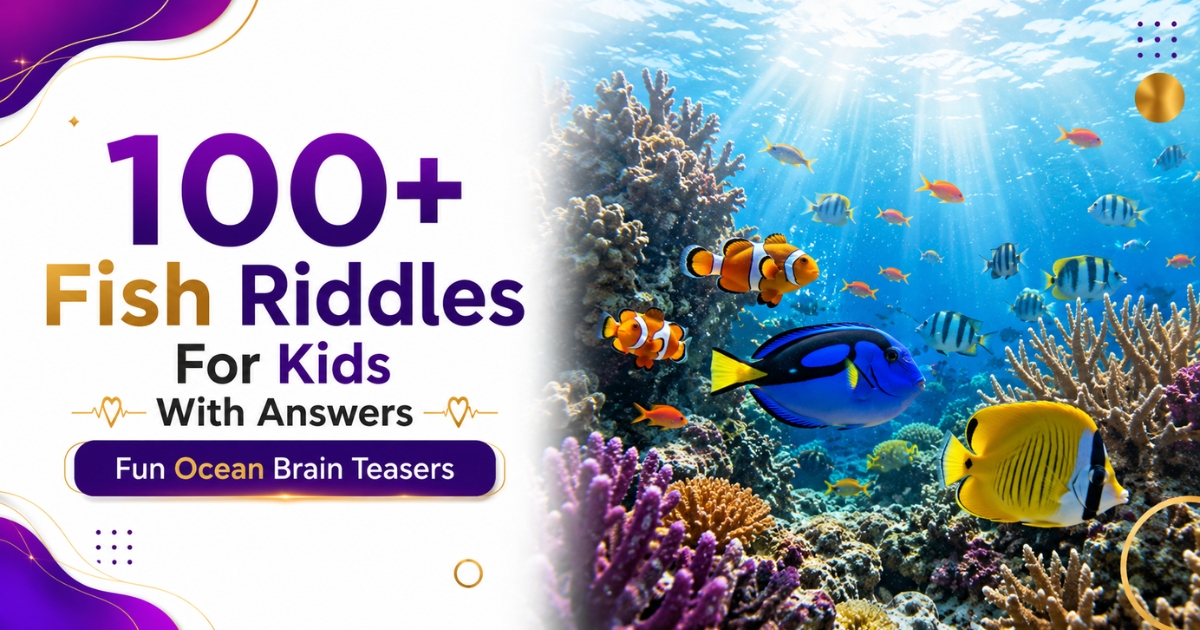
100 Fish Riddles for Kids: Fun Ocean Brain Teasers
Fish riddles are short brain teasers that describe a fish, fish body part, or ocean creature through clues about its habitat, appearance, or behavior without naming it directly.
They’re a favorite for classrooms, ocean-themed science units, aquarium trips, and family game nights, because they mix quick thinking with real facts about how fish live underwater.
Easy Fish Riddles for Little Kids
These easy riddles about fish for kids work well for preschool and early elementary audiences. Each one leans on a simple, familiar fish trait so young solvers get a quick win before moving into trickier riddles later on.
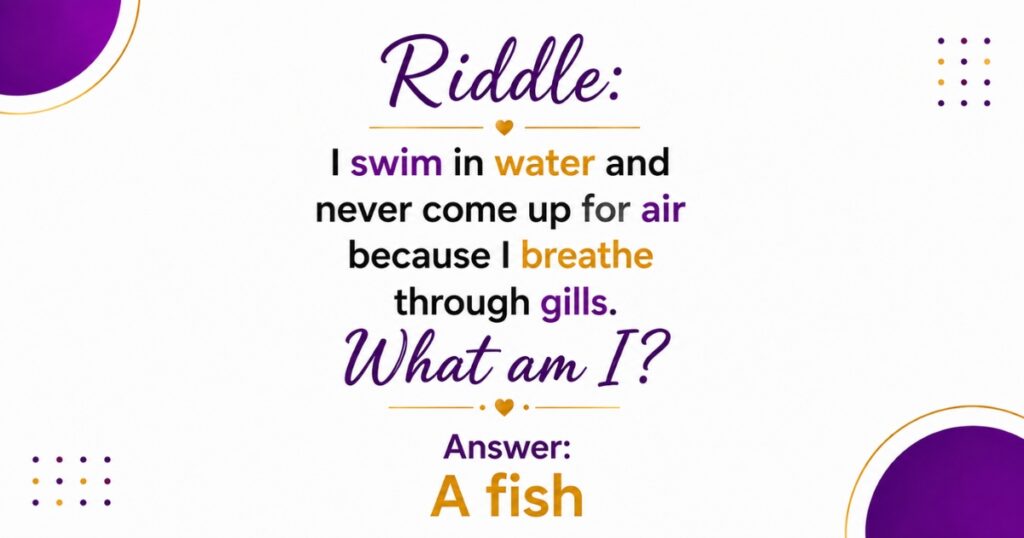
Difficulty: Easy
Explanation: Introduces gills as the key clue, teaching real fish biology through a simple description.
Difficulty: Easy
Explanation: Uses two familiar body parts (fins, tail) as direct, visual clues.
Difficulty: Easy
Explanation: Describes scales through texture and function rather than naming them outright.
Difficulty: Easy
Explanation: Ties the answer to a household object (a fishbowl) most kids recognize immediately.
Difficulty: Easy
Explanation: Uses a real, slightly surprising biological fact as the main clue.
Difficulty: Easy
Explanation: Plays on the double meaning of “school” as both a group of fish and a place of learning.
Difficulty: Easy
Explanation: A simple contrast clue (no air-breathing) that most kids can solve quickly.
Difficulty: Easy
Explanation: Describes the physical motion of swimming as the clue rather than naming a body part.
Difficulty: Easy
Explanation: Uses setting (a home tank) to distinguish a pet fish from a wild one.
Difficulty: Easy
Explanation: Introduces the vocabulary word “cold-blooded” as light science content.
Difficulty: Easy
Explanation: A visual, function-based clue about balance.
Difficulty: Easy
Explanation: Describes a common feeding behavior kids may have seen at a pond or aquarium.
Difficulty: Easy
Explanation: Introduces the concept of egg-laying animals as a light biology clue.
Riddles About Ocean Fish
This section covers ocean fishing riddles, featuring some of the most recognizable saltwater creatures, a great fit for aquarium trips or an ocean-themed classroom unit.
Difficulty: Medium
Explanation: Uses a surprising size-vs-diet contrast as the key logic twist.
Difficulty: Easy
Explanation: A single vivid defense behavior makes this an easy visual riddle.
Difficulty: Medium
Explanation: References a real symbiotic relationship, adding an authoritative science detail.
Difficulty: Medium
Explanation: Combines shape, habitat, and a defense feature for a slightly layered clue.
Difficulty: Easy
Explanation: Uses two of the most iconic, easily pictured shark traits.
Difficulty: Hard
Explanation: Requires knowledge of a specific deep-sea species and its bioluminescent lure.
Difficulty: Medium
Explanation: Introduces camouflage as a real survival adaptation.
Difficulty: Medium
Explanation: Uses a “flying” metaphor to describe a manta ray’s distinctive wing-like fins.
Difficulty: Easy
Explanation: A direct name-in-appearance clue that’s easy for kids to connect.
Difficulty: Medium
Explanation: Introduces the concept of light zones in the ocean.
Difficulty: Easy
Explanation: A scale-based clue (thousands, miles) that reinforces schooling behavior.
Difficulty: Medium
Explanation: Highlights a specific, real camouflage ability unique to certain flatfish.
Difficulty: Medium
Explanation: Uses a name-association clue (tiger) tied to a visible physical trait (stripes).
Riddles About Freshwater Fish
Not all fish live in the ocean, these freshwater fish riddle cover rivers, lakes, and ponds, giving the list a well-rounded habitat range.
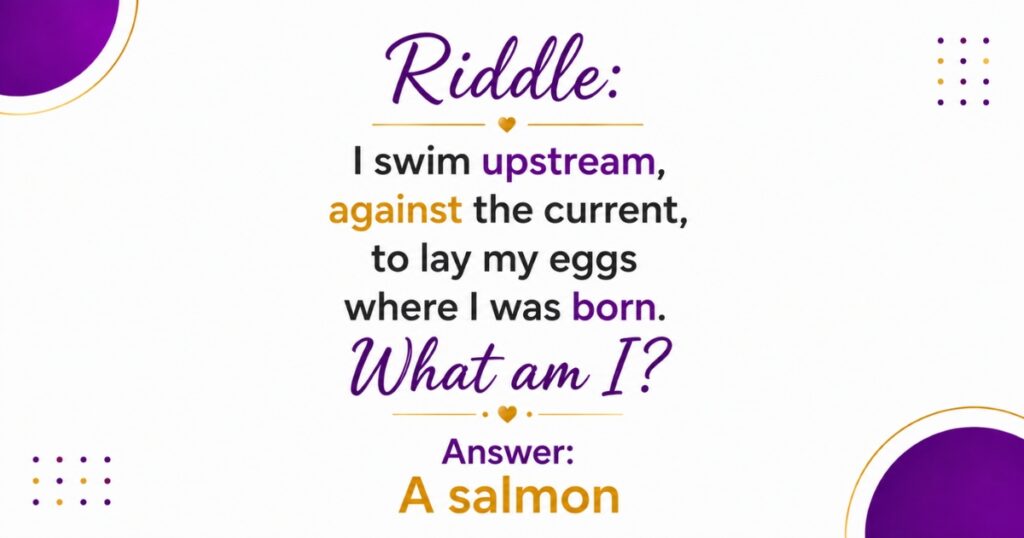
Difficulty: Medium
Explanation: Describes a real migration behavior (spawning upstream) as the central clue.
Difficulty: Easy
Explanation: Uses a distinct, easily-pictured physical feature (whiskers).
Difficulty: Easy
Explanation: A straightforward appearance-based clue for a common pet species.
Difficulty: Medium
Explanation: Combines habitat and diet clues.
Difficulty: Medium
Explanation: Ties the answer to a common childhood fishing experience.
Difficulty: Easy
Explanation: A second whisker-based riddle with added detail about size and habitat.
Difficulty: Medium
Explanation: Describes a specific, observable behavior anglers often mention.
Difficulty: Medium
Explanation: Uses a specific color detail to distinguish this species from a generic trout.
Difficulty: Easy
Explanation: Adds a real care-fact twist (goldfish need more space than people assume).
Difficulty: Hard
Difficulty: Medium
Explanation: Combines schooling behavior with a size and color clue.
Difficulty: Medium
Explanation: Adds a nocturnal behavior detail, layering onto the earlier catfish riddles.
Riddles About Fish Body Parts and Senses
A good short riddle about fish usually focuses on one body part or sense and describes its job in plain language. For example, “I help a fish breathe by pulling oxygen straight out of the water. What am I?” (Gills). This next batch is built entirely around that formula.
Difficulty: Easy
Explanation: A direct function-based clue for one of the most important fish organs.
Difficulty: Easy
Explanation: Uses the “armor” comparison to make a biology term easy to picture.
Difficulty: Medium
Explanation: Introduces specific fin vocabulary tied to a balance function.
Difficulty: Hard
Explanation: References a real sensory organ most kids haven’t learned about yet, making it one of the trickier body-part riddles.
Difficulty: Medium
Explanation: Names a specific fin type rather than just “the tail.”
Difficulty: Easy
Explanation: Reinforces the earlier “no eyelids” fact from riddle #5 in a new context.
Difficulty: Hard
Explanation: Introduces a specific anatomical term, appropriate for older kids or science-focused classrooms.
Difficulty: Medium
Explanation: Names a specific fin pair and its steering function.
Difficulty: Medium
Explanation: Describes a real protective coating most kids have felt but never named.
Difficulty: Hard
Explanation: Introduces an internal organ and its buoyancy function, a more advanced science fact.
Difficulty: Medium
Explanation: Highlights a fish sense kids often overlook.
Difficulty: Hard
Explanation: Completes the breathing-process picture started in riddle #39, requiring kids to connect two related body parts.
Funny and Punny Fish Riddles
Every good riddle collection needs a laugh these use classic wordplay techniques like puns and misdirection, which is part of what makes them stick with kids.
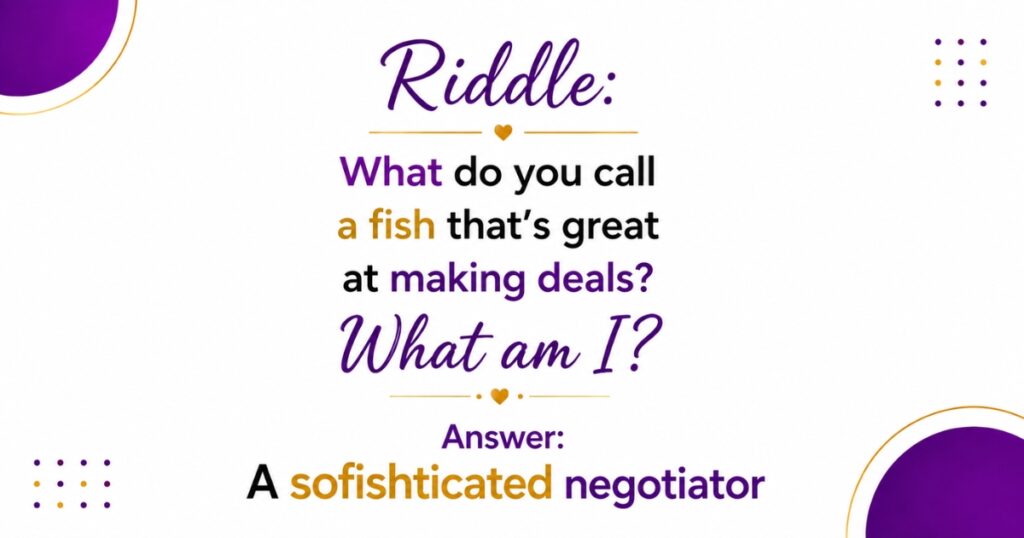
Difficulty: Medium
Explanation: A pun blending “fish” into “sophisticated” a classic sound-alike wordplay technique.
Difficulty: Easy
Explanation: Combines a real fish name (kingfish) with royal imagery for an easy double-meaning joke.
Difficulty: Medium
Explanation: A pun swapping “friends” for “fin-ds,” using the fish’s fin as the wordplay hook.
Difficulty: Easy
Explanation: A homophone pun on “dam” (a river structure) and the exclamation it sounds like.
Difficulty: Easy
Explanation: Uses the double meaning of “net” (a fishing net vs. a tennis net) as the punchline.
Difficulty: Medium
Explanation: A homophone pun matching a real fish species (sturgeon) to the word “surgeon.”
Difficulty: Easy
Explanation: A pun on “bass” the fish versus “bass” the musical instrument (same spelling, different pronunciation).
Difficulty: Medium
Explanation: A pun blending “shellfish” with “selfish” for a layered wordplay joke.
Difficulty: Medium
Explanation: A spelling-based joke remove the letter “i” (eye) from “fish” to get “fsh.”
Difficulty: Easy
Explanation: Plays on “caught,” which works both as fishing vocabulary and as getting caught in a lie.
Difficulty: Medium
Explanation: A second pun on “school,” reinforcing the wordplay from riddle #6 in a new context.
Difficulty: Medium
Explanation: Plays on “dry spell” meaning both a stretch without rain and, literally, no water for a fish.
Difficulty: Easy
Explanation: A pun swapping “fin” for the word “win,” tying it back to gratitude.
Riddles About Fish Habitats and Behavior
Difficulty: Medium
Explanation: Describes an ambush-hunting behavior tied to camouflage.
Difficulty: Hard
Explanation: References a specific nest-building behavior (called a “redd”) known mainly to more advanced young naturalists.
Difficulty: Easy
Explanation: Explains the survival reason behind schooling, adding a real behavioral fact.
Difficulty: Hard
Explanation: Introduces a real daily migration pattern used by many ocean fish species.
Difficulty: Hard
Explanation: Describes a real symbiotic relationship between species on a coral reef.
Difficulty: Hard
Explanation: References a verified, somewhat surprising biological fact about clownfish social structure.
Difficulty: Medium
Explanation: Introduces tide pools as a distinct coastal habitat.
Difficulty: Medium
Explanation: Expands on the migration clue from riddle #27 with a specific distance detail.
Difficulty: Medium
Explanation: Describes a hiding behavior distinct from the burying behavior in riddle #64.
Difficulty: Medium
Explanation: Reinforces the light-zone concept from riddle #23 with a specific term.
Difficulty: Easy
Explanation: A simple behavior-based clue, contrasting instinct with human navigation tools.
Difficulty: Hard
Explanation: A “trick” riddle that corrects a common misconception jellyfish aren’t classified as true fish.
Medium Fish Riddles That Make Kids Think
These riddles lean more on wordplay and lateral thinking than direct fish facts, making them a good next step once the easier riddles start to feel too simple.
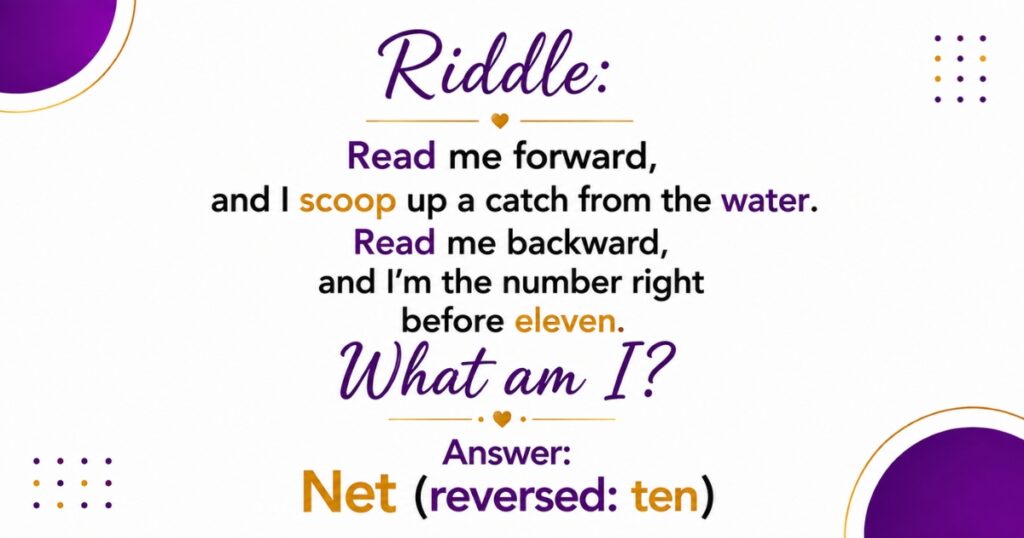
Difficulty: Hard
Explanation: A classic forward/backward spelling riddle that pairs a fishing tool with a hidden number.
Difficulty: Medium
Explanation: Uses the double meaning of “bed” (a riverbed vs. a place to sleep).
Difficulty: Easy
Explanation: A classic “has X but never Y” riddle format built around fish anatomy.
Difficulty: Medium
Explanation: A pun on “selfish” sounding like “self-fish,” a play on an impossible catch.
Difficulty: Medium
Explanation: Uses a “what I’m not” structure to rule out other animal classes first.
Difficulty: Easy
Explanation: A simple spelling-clue riddle appropriate for very early readers.
Difficulty: Hard
Explanation: A triple-meaning wordplay riddle stacking three separate definitions of common words onto one answer.
Difficulty: Medium
Explanation: Plays on the double meaning of “spine” (backbone vs. courage) and “head” (body part vs. mind).
Difficulty: Easy
Explanation: A pun on “waved,” tying ocean waves to a friendly greeting gesture.
Difficulty: Easy
Explanation: Plays on the idea that swimming is instinctual for fish, not a learned skill like it is for people.
Difficulty: Medium
Explanation: A pun connecting “schooled” (being taught) to a school of fish.
Difficulty: Easy
Explanation: A homophone pun on “reel” (fishing equipment) and “real.”
Hard Fish Riddles for Family Game Night
For older kids and full family game nights, these riddles lean on real, sometimes surprising fish science facts the kind of details that make adults pause too.
Difficulty: Hard
Explanation: Reinforces the classification fact from riddle #75 with an added detail about lacking bones.
Difficulty: Medium
Explanation: Plays on the phrase “hold your breath,” which doesn’t apply the same way to gill-breathing animals.
Answer: A shark
Difficulty: Hard
Explanation: References real electroreceptor organs (ampullae of Lorenzini) that sharks use to detect prey.
Difficulty: Hard
Explanation: Explains the real biological mechanism (bioluminescent bacteria) behind an anglerfish’s glowing lure.
Difficulty: Hard
Explanation: Introduces a verified cold-adaptation fact about antifreeze proteins in certain polar fish species.
Difficulty: Medium
Explanation: Describes the eel’s unusually flexible, elongated body shape.
Difficulty: Medium
Explanation: A real, well-documented fact about electric eels’ specialized electric organs.
Difficulty: Hard
Explanation: Describes the seahorse’s unusual bony-plated body and unique swimming style.
Difficulty: Hard
Explanation: References a well-known but still surprising fact male seahorses carry and “give birth” to their young.
Difficulty: Hard
Explanation: Highlights a rare fish species that spends significant time out of water.
Difficulty: Hard
Explanation: A more detailed variation of riddle #69, focused on the birth-order detail of clownfish sex change.
Difficulty: Hard
Explanation: References a real, frequently cited statistic about a shark’s extraordinarily sensitive sense of smell.
Difficulty: Hard
Explanation: Uses a verifiable evolutionary timeline fact to close the list on an impressive, discussion-worthy note.
Explore More Riddles for Every Occasion
If your kids enjoyed diving into these fish riddles, there’s plenty more to keep the brain teasers flowing. Check out our Riddles for Adults for a more challenging round.
Fetch some fun with our Dog Riddles for a paws-itively good time. Want to stay in the water theme? Our River Riddles collection has plenty more aquatic puzzles to keep the whole family guessing.
Conclusion
Whether you need a quick classroom warm-up, a stack of cards for an ocean-unit lesson, or something to stump the whole family on a long car ride.
These 100 fish riddles cover every difficulty level and habitat, from goldfish bowls to the deep sea.
FAQS
What are Some Easy Fish Riddles For Kids?
Easy fish riddles for kids describe simple, familiar fish traits like gills, fins, or scales using one or two obvious clues, such as “I have fins to help me swim and a tail to help me steer. What am I?” (A fish). These work best for preschool and early elementary ages.
What is a Good Short Riddle About Fish?
A good short fish riddle uses one vivid detail and a quick payoff, such as: “I help a fish breathe by pulling oxygen straight out of the water. What am I?” (Gills). Short riddles like this are ideal for classroom warm-ups or quick car-ride games.
How Do You Make Your Own Fish Riddle?
Pick a fish, body part, or habitat, list two or three real facts about it, and rewrite those facts as first-person clues, saving the most obvious hint for last so the answer isn’t given away immediately.
Are Fish Riddles Good For Classrooms or Ocean Units?
Yes, fish riddles work especially well for ocean-themed science units and classroom warm-ups because they combine real biology facts like gills, schooling behavior, or camouflage with a quick, engaging guessing game.
What is The Hardest Fish Riddle?
The hardest fish riddles tend to rely on real, lesser-known science facts, such as a shark’s ability to sense electric fields or a male seahorse carrying its own eggs, since both require specific knowledge beyond basic fish appearance.