100 River Riddles for Kids | Easy and Hard with Answers!
River Riddles is a collection of 100 original riddles built entirely around rivers, streams, and flowing water each paired with an answer, a difficulty rating, and an explanation of the wordplay or geography term behind it.
After testing an early version on a river-themed field trip and a few classroom sessions, one thing was clear: rivers are almost too easy to write riddles about, since words like “bed,” “mouth,” and “banks” already do double duty.
Every twist and turn seemed to hide another pun just waiting to be caught. If you’re stumped or smiling, each the river riddle invites you to look at water and words a little differently.
Why Rivers Make Such Good Riddle Material?
Rivers show up in riddle collections more than almost any other natural feature, and it’s not a coincidence.
English river vocabulary is unusually rich in body-part metaphors a river has a mouth, a bed, and a bank, and it “runs” without legs.
That’s four separate wordplay opportunities baked into ordinary geography terms before a riddle writer even gets creative.
Add in the fact that major rivers like the Nile have shaped entire civilizations, and you’ve got both linguistic playfulness and genuine historical weight to draw from.
Easy River Riddles for Adults and Kids (Ages 4–8)
Short, image-based riddles perfect for a first introduction to river vocabulary great for a classroom geography unit or a car ride along a scenic route.
- Riddle: I have a bed but never sleep. What am I?
Answer: A river.
Difficulty: Easy
Explanation: Relies on “riverbed,” a real geography term, reframed as a body-part metaphor. - Riddle: I have a mouth but never eat. What am I?
Answer: A river.
Difficulty: Easy
Explanation: “River mouth” is the actual term for where a river meets the sea, hidden behind ordinary anatomy language. - Riddle: I have banks but no money. What am I?
Answer: A river.
Difficulty: Easy
Explanation: Plays on the two unrelated meanings of “bank” a financial institution versus the land alongside water. - Riddle: I run all day and night but never get tired. What am I?
Answer: A river.
Difficulty: Easy
Explanation: Uses “run” in its flowing-water sense instead of the human physical sense.
- Riddle: I start small in the mountains and grow bigger the farther I travel. What am I?
Answer: A river.
Difficulty: Easy
Explanation: Describes real river geography (headwaters to mouth) without naming it directly. - Riddle: I can be crossed by a bridge but I’m not a road. What am I?
Answer: A river.
Difficulty: Easy
Explanation: Straightforward elimination riddle teaches the idea that bridges cross more than roads. - Riddle: I flow but I don’t have legs or wheels. What am I?
Answer: A river.
Difficulty: Easy
Explanation: Removes the obvious ways something might “move” to isolate the idea of flowing. - Riddle: I end where the sea begins. What am I?
Answer: A river.
Difficulty: Easy
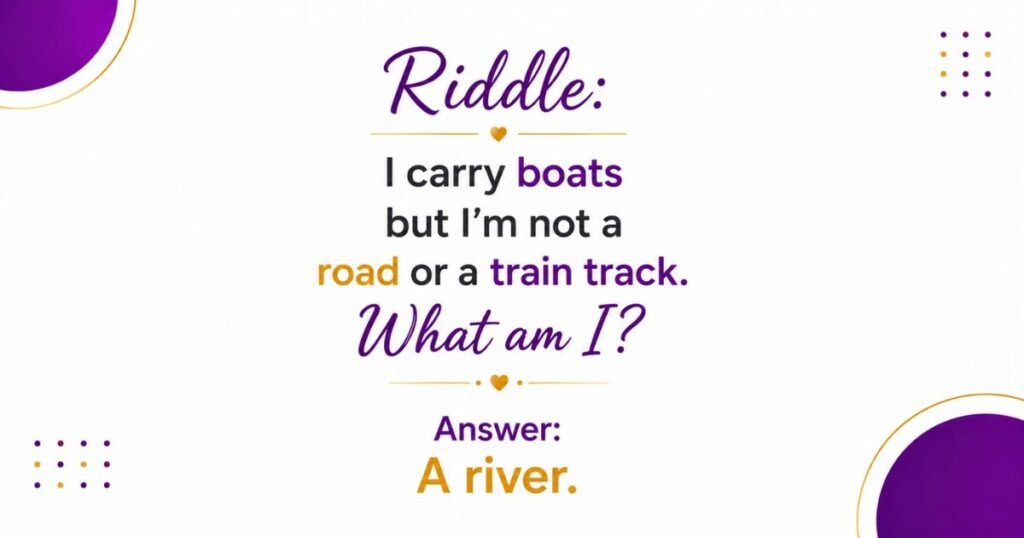
Explanation: A gentle geography clue about where rivers empty out. - Riddle: I carry boats but I’m not a road or a train track. What am I?
Answer: A river.
Difficulty: Easy
Explanation: Reinforces the “carries things without being a road” pattern from riddle 6, building the same skill twice. - Riddle: Fish live inside me, but I’m not a fish tank. What am I?
Answer: A river.
Difficulty: Easy
Explanation: Uses elimination logic to steer kids away from the most obvious guess. - Riddle: I twist and turn but I never get dizzy. What am I?
Answer: A river.
Difficulty: Easy
Explanation: Personifies a river’s winding shape using a human sensation it can’t actually feel. - Riddle: I can be wide as a lake or thin as a stream, but I’m always moving. What am I?
Answer: A river.
Difficulty: Easy
Explanation: Introduces the idea that river size varies while the defining trait motion stays constant. - Riddle: I have a current but I’m not electricity. What am I?
Answer: A river.
Difficulty: Easy
Explanation: Plays on “current” meaning both electrical flow and water flow. - Riddle: Ducks float on me, but I’m not a pond. What am I?
Answer: A river.
Difficulty: Easy
Explanation: A soft elimination riddle distinguishing moving water from still water. - Riddle: I get bigger every time another stream joins me. What am I?
Answer: A river.
Difficulty: Easy
Explanation: Introduces the real concept of a tributary in plain language before the term itself is used later in the list. - Riddle: I can flood a town, but I don’t do it on purpose. What am I?
Answer: A river.
Difficulty: Easy
Explanation: Introduces a real-world consequence of rivers (flooding) as the identifying clue. - Riddle: I’m named on maps, but I’m not a country or a city. What am I?
Answer: A river.
Difficulty: Easy
Explanation: Reminds kids that maps label natural features, not just places people live. - Riddle: People fish in me, swim in me, and boat on me, all at once. What am I?
Answer: A river.
Difficulty: Easy
Explanation: Uses a list of common river activities as the identifying clue instead of wordplay. - Riddle: I flow downhill without anyone pushing me. What am I?
Answer: A river.
Difficulty: Easy
Explanation: Introduces gravity as the invisible force behind river flow, a light science tie-in. - Riddle: I separate two towns, but I’m not a fence or a wall. What am I?
Answer: A river.
Difficulty: Easy
Explanation: Reinforces elimination logic used throughout this section naming what it isn’t before what it is. - Riddle: I can be muddy brown or crystal clear, depending on the day. What am I?
Answer: A river.
Difficulty: Easy
Explanation: Ties the riddle to a real observable trait kids may have noticed firsthand. - Riddle: I have rapids but I’m not angry. What am I?
Answer: A river.
Difficulty: Easy
Explanation: Plays on the coincidental overlap between “rapid” (fast) and the word “rabid,” which younger kids often mishear. - Riddle: I freeze on top in winter but keep moving underneath. What am I?
Answer: A river.
Difficulty: Easy
Explanation: A seasonal science fact reframed as a riddle clue. - Riddle: I have a delta, but I don’t fly a plane. What am I?
Answer: A river.
Difficulty: Easy
Explanation: Introduces the word “delta” in its geography sense before the airline pun becomes the punchline in a later section. - Riddle: I can carve a canyon given enough time. What am I?
Answer: A river.
Difficulty: Easy
Explanation: References real erosion science (like the Colorado River and the Grand Canyon) as the clue.
Medium River Riddles for Older Kids and Adults
These lean harder on river vocabulary and require connecting two clues instead of one.
- Riddle: I divide countries without walls and connect cities without bridges. What am I?
Answer: A river.
Difficulty: Medium
Explanation: Two-part contradiction riddle dividing and connecting are opposite actions, both true of a river depending on how it’s used. - Riddle: I’m born in the mountains but die in the sea. The farther I travel, the wider I become. What am I?
Answer: A river.
Difficulty: Medium
Explanation: Personifies a river’s full life cycle from source to mouth in a single clue chain. - Riddle: What travels around the world but always stays in its own bed?
Answer: A river.
Difficulty: Medium
Explanation: Reuses the classic “travels the world while staying in one place” riddle structure, swapping the usual stamp answer for a river’s bed.
- Riddle: I have a branch, but I’m not a tree. What am I?
Answer: A river (a river branch, or tributary).
Difficulty: Medium
Explanation: Requires knowing that “branch” is used informally for a smaller river joining a larger one. - Riddle: I can be tamed by a dam, but I always find a way around. What am I?
Answer: A river.
Difficulty: Medium
Explanation: References real hydrology dams control but rarely fully stop a river’s persistence. - Riddle: I have a mouth that opens wide but never speaks or eats. What am I?
Answer: A river.
Difficulty: Medium
Explanation: A denser version of the Easy “mouth” riddle, adding a second negation to raise difficulty. - Riddle: Cities are built on my banks, yet I never visit them. What am I?
Answer: A river.
Difficulty: Medium
Explanation: Plays on personifying a river as something that could “visit,” only to deny it that ability. - Riddle: What has a delta but never flies anywhere?
Answer: A river.
Difficulty: Medium
Explanation: Sets up a misdirection toward the airline before landing on the geography term. - Riddle: I quench the fields I never touch. What am I?
Answer: A river (through irrigation).
Difficulty: Medium
Explanation: Requires knowing that irrigation channels carry river water to fields the river itself never physically reaches. - Riddle: I can be crossed on foot when I’m shallow, but I can also sink a ship. What am I?
Answer: A river.
Difficulty: Medium
Explanation: Introduces the idea that depth changes a river’s danger, requiring the solver to hold two contradictory images at once. - Riddle: I have a source but I’m not a company, and a mouth but I’m not an animal. What am I?
Answer: A river.
Difficulty: Medium
Explanation: Double negation riddle stacking two separate river-vocabulary tricks in one clue. - Riddle: I carry silt downstream and build new land where I stop. What am I?
Answer: A river (forming a delta).
Difficulty: Medium
Explanation: Describes the actual geological process of delta formation without naming it, testing real science knowledge. - Riddle: What grows a new branch every time it rains upstream?
Answer: A river (via a new tributary or flood channel).
Difficulty: Medium
Explanation: Combines the “branch” wordplay with an actual hydrology fact about rainfall increasing tributary flow. - Riddle: I can be named after a person but I’ve never met them. What am I?
Answer: A river (many rivers are named after explorers or historical figures).
Difficulty: Medium
Explanation: Requires general knowledge that geographic features are often named after people who never “met” the place itself in a literal sense. - Riddle: I flow one direction only, yet sailors use me to go both ways. What am I?
Answer: A river.
Difficulty: Medium
Explanation: References the real navigational fact that boats travel upstream and downstream despite current only flowing one way. - Riddle: What has rapids, a mouth, and a bed, but has never been to sleep or the dentist?
Answer: A river.
Difficulty: Medium
Explanation: Stacks three separate river-vocabulary tricks used earlier in the list into one combined riddle. - Riddle: I can be the border between two nations without a single guard standing on me. What am I?
Answer: A river.
Difficulty: Medium
Explanation: References the real-world fact that rivers frequently serve as natural political borders. - Riddle: What loses water to the sky all day, yet never runs dry?
Answer: A river (evaporation is offset by continuous inflow).
Difficulty: Medium
Explanation: Requires connecting evaporation science to the concept of continuous replenishment from upstream sources. - Riddle: I can be measured in miles, but I never stand still long enough to be measured twice the same way. What am I?
Answer: A river.
Difficulty: Medium
Explanation: A subtler riddle about how river length and course can shift slightly over time due to erosion and flooding. - Riddle: What is always downstream of yesterday’s rain?
Answer: A river’s current water level.
Difficulty: Medium
Explanation: A more abstract riddle connecting weather cause to river effect, useful for a light science discussion. - Riddle: I have tributaries, but I’ve never adopted anyone. What am I?
Answer: A river.
Difficulty: Medium
Explanation: A pun-adjacent riddle that plays on “tribute” sounding vaguely like family language, even though it isn’t etymologically related. - Riddle: What can be dammed, diverted, and dredged, but never truly stopped?
Answer: A river.
Difficulty: Medium
Explanation: Uses three real engineering terms in a row to build toward the answer through accumulation rather than a single clue. - Riddle: I reflect the sky above me but I’m always looking downstream. What am I?
Answer: A river.
Difficulty: Medium
Explanation: A poetic personification riddle blending a real optical property (reflection) with an invented sense of direction. - Riddle: What has more than one mouth if enough tributaries join it near the coast?
Answer: A river delta.
Difficulty: Medium
Explanation: Extends the “mouth” wordplay to explain why deltas sometimes have multiple river mouths, a genuine geography fact. - Riddle: I can be young near the mountains and old near the sea, all in the same day. What am I?
Answer: A river.
Difficulty: Medium
Explanation: Uses “young” and “old” river terminology (a real concept in fluvial geomorphology describing a river’s stage) as the hidden trick.
Hard River Riddles with Answers for Teens and Adults
These require multi-step logic or a willingness to abandon the obvious river answer entirely.
- Riddle: A farmer must cross a river with a fox, a chicken, and a bag of grain. His boat can only carry him and one item at a time. Left alone, the fox will eat the chicken, and the chicken will eat the grain. How does he get everything across safely?
Answer: He takes the chicken across first, returns alone, takes the fox across, brings the chicken back, takes the grain across, then returns for the chicken.
Difficulty: Hard
Explanation: One of the oldest documented logic puzzles in the world, this river-crossing riddle isn’t wordplay at all it’s a genuine constraint-satisfaction problem that has been used in classrooms and puzzle books for centuries. - Riddle: What crosses a river every day without ever getting wet?
Answer: A bridge (or a shadow).
Difficulty: Hard
Explanation: A misdirection riddle solvers expect a living thing that crosses, when the answer is a structure or an intangible. - Riddle: I run through a valley but I have no legs, and I speak to no one but I’m never silent. What am I?
Answer: A river.
Difficulty: Hard
Explanation: Combines two separate personification tricks (running, speaking) that both need reinterpreting non-literally. - Riddle: Two boats leave opposite banks of a river at the same time and pass each other at a point closer to one bank than the other. What does this tell you about the river or the boats?
Answer: Nothing about the river itself it depends entirely on the boats’ relative speeds, not the river’s width or current, which is the trick of the riddle.
Difficulty: Hard
Explanation: A logic riddle designed to make solvers hunt for a river-related answer when the real answer is about relative speed, a classic false-clue structure.

- Riddle: What kind of river never actually moves, no matter how fast it flows?
Answer: A river on a map (or in a photograph).
Difficulty: Hard
Explanation: Plays on the difference between a real river and its static representation, a more abstract riddle than most in this list. - Riddle: I split into two, then rejoin myself further downstream, creating an island in between. What have I formed?
Answer: A braided river (creating a river island, or “eyot”).
Difficulty: Hard
Explanation: References a genuine, less commonly known hydrology term a braided or anastomosing river channel making this riddle more educational than most. - Riddle: What always flows toward the sea but never actually leaves its own country?
Answer: A river that starts and ends within the same nation’s borders.
Difficulty: Hard
Explanation: A geography-logic riddle requiring solvers to think about specific real rivers (like the Thames) rather than rivers in general. - Riddle: I have no voice, yet ancient people believed I could speak prophecy. Priests once listened to my rapids for answers. What civilization might have believed this of me?
Answer: Ancient Egypt and the Nile (or various river-oracle traditions across ancient cultures).
Difficulty: Hard
Explanation: A historically grounded riddle that rewards knowledge of how ancient civilizations treated rivers as sacred or prophetic, adding real authoritativeness to the puzzle format. - Riddle: What is the only kind of river that can flow uphill?
Answer: None, truly but a tidal bore can appear to push water upstream against the normal current.
Difficulty: Hard
Explanation: A trick riddle designed to test whether solvers know about tidal bores, a real and dramatic river phenomenon where incoming tides reverse a river’s visible flow. - Riddle: I am a river by name but I have never once been wet. What am I?
Answer: A dry riverbed (an ephemeral or intermittent river, common in desert regions).
Difficulty: Hard
Explanation: References the real geographic category of rivers that only carry water seasonally, a fact often missing from general riddle collections. - Riddle: What river feature can trap a boat permanently without a single rock or current involved?
Answer: A dried-up river channel (the boat is left stranded when the water recedes, as has happened on shrinking rivers and lakes).
Difficulty: Hard
Explanation: Requires ruling out the two most obvious hazards (rocks, current) to land on the less intuitive answer of the water simply disappearing. - Riddle: I flow in two directions on the same day, twice a day, without a single drop of extra rain. What kind of river am I?
Answer: A tidal river, where ocean tides reverse the flow direction near the mouth.
Difficulty: Hard
Explanation: A genuine hydrology riddle about tidal rivers, which behave differently than most people assume a “normal” river should. - Riddle: What has carried empires on its back but never felt a single crown?
Answer: A river (many empires, like ancient Egypt along the Nile, were built around river trade and agriculture).
Difficulty: Hard
Explanation: A historical-metaphor riddle rewarding knowledge of how rivers shaped civilization rather than pure wordplay. - Riddle: I can vanish completely for months, then reappear exactly where I left off. What kind of river am I?
Answer: An intermittent or seasonal river.
Difficulty: Hard
Explanation: A variant of riddle 60’s concept, testing whether the same fact can be recognized when phrased differently. - Riddle: What natural feature can be legally two different countries at once, down the middle?
Answer: A border river, split down its centerline (thalweg) between two nations.
Difficulty: Hard
Explanation: Introduces the real legal/geographic concept of a “thalweg” boundary line without naming the term outright. - Riddle: I have no engine, yet I can move a fully loaded barge for a thousand miles. What am I?
Answer: A river current.
Difficulty: Hard
Explanation: Highlights the real economic role of river currents in transportation, distinct from the river itself as a landform. - Riddle: What can be both the reason a city was built and the reason it later flooded?
Answer: A river.
Difficulty: Hard
Explanation: A dual-nature riddle requiring the solver to hold two opposite outcomes (benefit and disaster) as both true of the same subject. - Riddle: I am measured from my source to my mouth, but no two people ever agree exactly on my length. What am I?
Answer: A river (river length measurements famously vary due to disputes over where a river’s true source lies, as with the Nile versus Amazon debate).
Difficulty: Hard
Explanation: References a real, ongoing geographic controversy the Nile-versus-Amazon “world’s longest river” debate that most riddle collections never touch. - Riddle: What natural boundary has started more wars over fishing rights than over the water itself?
Answer: A river (or shared river system between bordering nations).
Difficulty: Hard
Explanation: A geopolitics-adjacent riddle rewarding awareness of real river-resource disputes rather than pure wordplay. - Riddle: What can be dammed for electricity, drained for farmland, and dredged for shipping, yet still be called “wild” in its upper reaches?
Answer: A river.
Difficulty: Hard
Explanation: A cumulative riddle stacking multiple real human uses of rivers before landing on the paradox that parts of the same river can remain untouched.
Funny River Riddles and Puns
These trade geography for punchlines read them aloud for the best effect.
- Riddle: Why did the river refuse to fight?
Answer: Because it always went with the flow.
Difficulty: Easy
Explanation: Technique: double meaning “go with the flow” means both literal water movement and staying easygoing. - Riddle: What did the river say when it finally reached the sea?
Answer: “I’m dam tired.”
Difficulty: Easy
Explanation: Technique: pun “dam” swaps in for “darn,” referencing a real river structure. - Riddle: Why don’t rivers ever get lost?
Answer: They always follow their own current events.
Difficulty: Medium
Explanation: Technique: double meaning “current events” refers to both news and the literal water current. - Riddle: What do you call a river that tells jokes?
Answer: Hilarious it’s always cracking up the banks.
Difficulty: Medium
Explanation: Technique: pun “cracking up the banks” plays on riverbank erosion and the phrase “cracking up” meaning laughing.
- Riddle: Why did the river bring a lawyer?
Answer: It had a lot of legal tributaries I mean, disputes.
Difficulty: Medium
Explanation: Technique: pun “tributaries” sounds close enough to “disputes” contextually to work as wordplay in the setup. - Riddle: What’s a river’s favorite subject in school?
Answer: Current events.
Difficulty: Easy
Explanation: Technique: double meaning reuses “current” as both a school subject and a water term. - Riddle: Why did the fish avoid the river bank?
Answer: It didn’t want to overdraw its account.
Difficulty: Medium
Explanation: Technique: pun “bank” and “overdraw” both work in financial and river contexts simultaneously. - Riddle: What did the delta say to the river?
Answer: “Thanks for always making a deposit.”
Difficulty: Medium
Explanation: Technique: double meaning “deposit” refers to both a bank transaction and sediment deposited at a river delta. - Riddle: Why did the stream break up with the river?
Answer: It felt like it was always the tributary, never the main event.
Difficulty: Medium
Explanation: Technique: wordplay “tributary” is stretched to imply a secondary, less important role in a relationship. - Riddle: What do you call a river with a great sense of humor?
Answer: Punny water.
Difficulty: Easy
Explanation: Technique: homophone “punny water” sounds like “funny water.” - Riddle: Why did the river get a job at the bank?
Answer: It already had all the right connections.
Difficulty: Easy
Explanation: Technique: pun plays on “bank” meaning both financial institution and riverbank. - Riddle: What did the ocean say to the river?
Answer: Nothing, it just let the river run its mouth.
Difficulty: Medium
Explanation: Technique: double meaning “run its mouth” means both talking too much and a river’s actual mouth flowing into the sea. - Riddle: Why don’t rivers ever pay their bills on time?
Answer: They’re always a little behind on their current account.
Difficulty: Medium
Explanation: Technique: pun “current account” is a real banking term reused for its water-flow meaning. - Riddle: What’s a river’s least favorite kind of weather?
Answer: A dam drought.
Difficulty: Easy
Explanation: Technique: homophone “dam” stands in for “darn” once more, paired with a genuine river hazard. - Riddle: Why did the canoe break up with the river?
Answer: It said the relationship felt too one-current.
Difficulty: Medium
Explanation: Technique: pun “one-current” is built to sound like “one-sided.” - Riddle: What do you call a river that’s great at math?
Answer: One with a lot of natural log(s) floating in it.
Difficulty: Medium
Explanation: Technique: pun “log” refers to both floating tree logs and the mathematical logarithm function. - Riddle: Why did the river start a band?
Answer: It already had great flow.
Difficulty: Easy
Explanation: Technique: double meaning “flow” describes both musical rhythm (especially in rap) and water movement. - Riddle: What did the small stream say to the big river?
Answer: “I’ll be your tributary forever.”
Difficulty: Medium
Explanation: Technique: wordplay “tributary” is used both in its geography sense and to sound vaguely like a romantic pledge. - Riddle: Why did the river refuse to gossip?
Answer: It didn’t want to be caught up in bad currents.
Difficulty: Medium
Explanation: Technique: double meaning “bad currents” swaps in for “bad company” or rumors. - Riddle: What do you call a nervous river?
Answer: A little rapid-fire.
Difficulty: Easy
Explanation: Technique: pun “rapids” (fast-moving river sections) combines with “rapid-fire” to describe anxious speech. - Riddle: Why did the river get promoted?
Answer: It always went above and beyond its banks.
Difficulty: Medium
Explanation: Technique: double meaning “above and beyond” is an idiom repurposed literally as flooding over riverbanks. - Riddle: What’s a river’s favorite kind of story?
Answer: One with a lot of twists and turns.
Difficulty: Easy
Explanation: Technique: double meaning describes both a river’s winding shape and a plot’s complexity. - Riddle: Why did the river join a support group?
Answer: It needed help managing its constant ups and downs during flood season.
Difficulty: Medium
Explanation: Technique: double meaning “ups and downs” refers to both emotional struggles and water-level changes. - Riddle: What do you call a river that loves to sing?
Answer: A babbling brook with a record deal.
Difficulty: Easy
Explanation: Technique: pun “babbling brook” is a real descriptive term for a small, noisy stream. - Riddle: Why did the map get embarrassed?
Answer: Because the river showed off all its curves.
Difficulty: Easy
Explanation: Technique: personification a lighthearted joke about a winding river’s shape on a map. - Riddle: What did the river say during the drought?
Answer: “I’m really struggling to keep my head above water or any water at all.”
Difficulty: Medium
Explanation: Technique: idiom taken literally “keep your head above water” usually means coping, here it’s read as an actual water-level problem. - Riddle: Why did the river refuse to argue?
Answer: It preferred to just let things flow.
Difficulty: Easy
Explanation: Technique: double meaning reuses the “go with the flow” idiom from riddle 71 with a slightly different setup for variety. - Riddle: What do you call a river that tells the same joke twice?
Answer: A repeat current.
Difficulty: Medium
Explanation: Technique: homophone “repeat current” sounds close to “recurrent,” a real word meaning happening again. - Riddle: Why did the river bring an umbrella?
Answer: In case it ran into more of itself upstream.
Difficulty: Medium
Explanation: Technique: absurdist misdirection plays on rain feeding a river as if the river were avoiding “itself.” - Riddle: What’s the most emotional part of a river?
Answer: The mouth it’s always the first to speak up when it reaches the sea.
Difficulty: Easy
Explanation: Technique: double meaning closes the list by returning to the “mouth” wordplay used in the very first riddle, giving the collection a full-circle ending.
Funny Basketball Riddles
Basketball riddles are a fun and exciting way to challenge your mind while celebrating one of the world’s most popular sports.
If you’re a young fan just learning the game or an experienced player who loves a good brain teaser, these riddles offer entertainment for all ages.
From clever questions about basketballs, hoops, dribbling, and slam dunks to funny wordplay about famous basketball moments, each riddle is designed to make you think, laugh, and learn.
Why River Riddles Are Worth Sharing?
River riddles do double duty in a way most riddle categories can’t match. The wordplay itself bed, bank, mouth, current, branch is drawn directly from real geography vocabulary, so solving one of these riddles quietly reinforces terms kids will see again in a science or social studies class.
For adults, river riddles hit differently: several of the Hard-tier riddles above aren’t wordplay at all, but genuine logic puzzles or lightly disguised facts about hydrology, geopolitics, and history the kind of riddle that rewards someone who already knows a bit about the Nile-versus-Amazon length debate or how a tidal bore works.
Mixing accessible kid riddles with a few riddles that require real background knowledge is what makes this list work for a mixed-age group instead of just one audience.
Conclusion
River Riddles brings together 100 original riddles easy, medium, hard, and funny built entirely around the wordplay and science hiding inside everyday river vocabulary. If you were after a quick river riddle for the classroom or a deeper riddle about river geography and history, this collection works for kids and adults alike.
That’s what makes riddles about rivers so satisfying: real words like bed, mouth, and banks already do double duty. So next time you cross a bridge, the river riddle you just solved might make you look at it a little differently.
FAQ
What is the Answer to the Riddle “I Have a Bed but Never Sleep, a Mouth but Never Eat”?
The answer is a river. It’s a common river riddle because “riverbed” and “river mouth” are real geography terms, reframed here as if they were human body parts.
What are Some Good Riddles about Rivers for Kids?
Short, image-based riddles work best for younger kids ones describing a single river feature like a bank, a current, or a bridge crossing.
Why do so Many Riddles use Rivers as the Answer?
River vocabulary is unusually rich in double meanings a river has a mouth, a bed, and banks, none of which mean what they’d mean anywhere else. That built-in wordplay makes rivers a popular subject for riddle writers.
What’s the Difference between a River Riddle and a Water Riddle?
Water riddles are a broader category covering rain, oceans, ice, or steam. River riddles specifically use river vocabulary bed, bank, mouth, current, tributary as their core wordplay device.
What is the Classic River-Crossing Logic Puzzle?
It’s a puzzle where a person must ferry a fox, a chicken, and a bag of grain across a river one item at a time, never leaving the fox with the chicken or the chicken with the grain.