100+ Short Riddles With Answers for Quick Brain Teasers
Short riddles with answers are one- or two-line brain teasers that can be solved quickly, usually built around a single clever clue or wordplay twist.
After trying a rotating batch of these as a five-minute classroom warm-up, the pattern became obvious: the riddles that worked best weren’t the longest or most elaborate; they were the ones that fit in a single breath and still landed a genuine surprise.
This guide collects 100 original short riddles, organized by theme and difficulty, each with an answer, a difficulty rating, and a quick explanation of the logic or wordplay behind it.
Short Easy Riddles With Answers
These are the simplest riddles in the collection, ideal as a warm-up before moving into trickier ones. Each relies on a single, clear clue.
- Riddle: What has a face but never smiles?
Answer: A clock.
Difficulty: Easy
Explanation: Uses a body-part word applied to an everyday object, a common riddle structure. - Riddle: What gets shorter as it works harder?
Answer: A candle.
Difficulty: Easy
Explanation: Simple cause-and-effect riddle tied to a familiar household object. - Riddle: What can you break just by saying its name?
Answer: Silence.
Difficulty: Easy
Explanation: Classic paradox riddle where the act of speaking undoes the very thing described. - Riddle: What always goes up but never comes back down?
Answer: Your age.
Difficulty: Easy
Explanation: Relatable riddle relying on a one-directional life fact rather than a literal object. - Riddle: What has legs but never takes a single step?
Answer: A table.
Difficulty: Easy
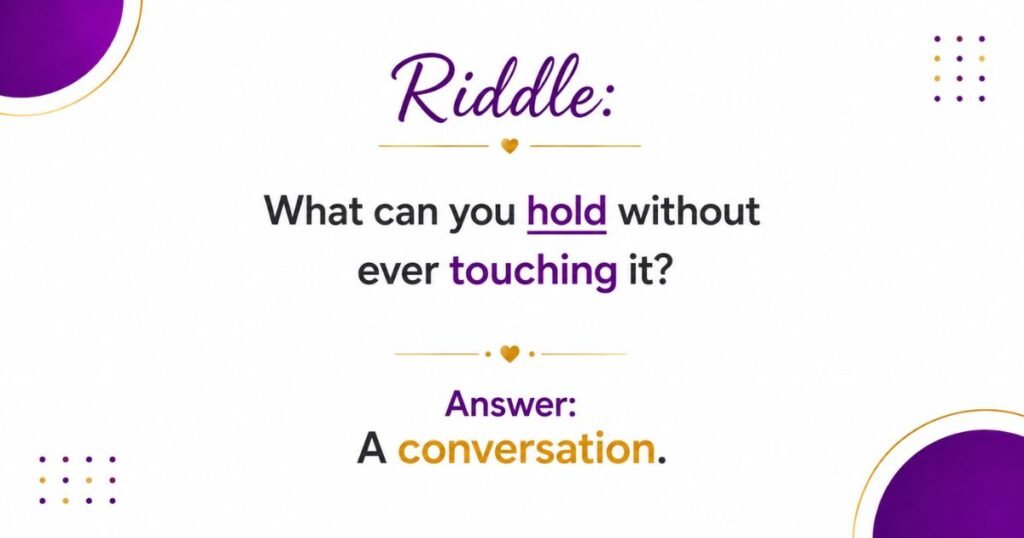
Explanation: Straightforward riddle applying a body part to furniture. - Riddle: What can you hold without ever touching it?
Answer: A conversation.
Difficulty: Easy
Explanation: Plays on the abstract meaning of “hold,” shifting away from anything physical. - Riddle: What has a thumb but isn’t a hand?
Answer: A glove.
Difficulty: Easy
Explanation: Body-part riddle applied to an object shaped like the thing it’s not. - Riddle: What gets wetter the longer it dries?
Answer: A towel.
Difficulty: Easy
Explanation: Short paradox riddle contrasting the words “wetter” and “dries.” - Riddle: What has one eye but can’t see a thing?
Answer: A needle.
Difficulty: Easy
Explanation: Uses “eye” in its sewing-related sense rather than a literal eye. - Riddle: What can you catch but never physically throw?
Answer: A cold.
Difficulty: Easy
Explanation: Wordplay riddle using “catch” in its illness-related meaning.
Short Riddles for Kids
These riddles use simple vocabulary and familiar classroom or home objects, making them a good fit for younger solvers.
- Riddle: What kind of tree fits in the palm of your hand?
Answer: A palm tree.
Difficulty: Easy
Explanation: Pun on “palm” meaning both a hand’s palm and a type of tree. - Riddle: What has teeth but never eats a meal?
Answer: A comb.
Difficulty: Easy
Explanation: Familiar riddle applying a body-part word to a bathroom item. - Riddle: What has ears but can’t hear anything you say?
Answer: A field of corn.
Difficulty: Easy
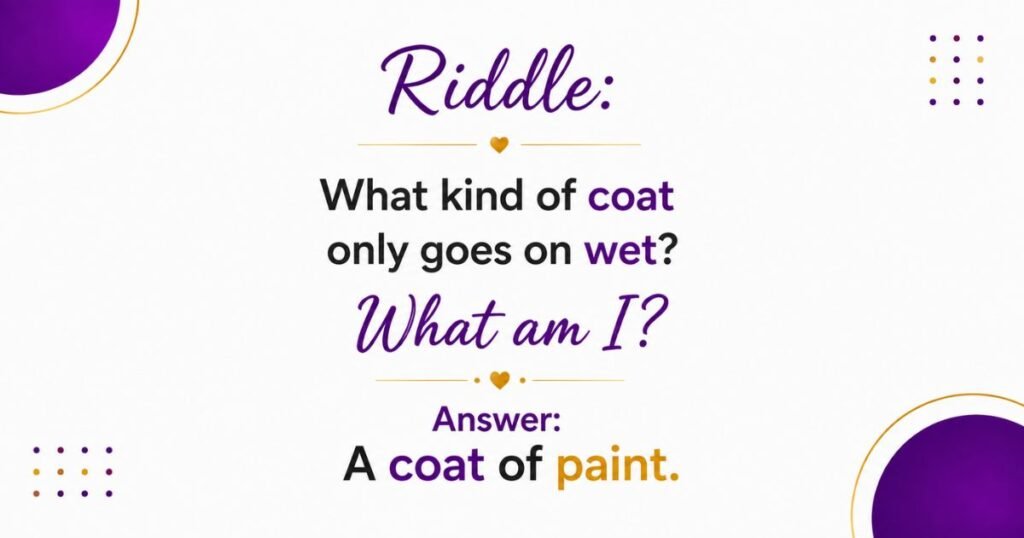
Explanation: Uses “ears” in its corn-related meaning rather than a literal ear. - Riddle: What kind of coat only goes on wet?
Answer: A coat of paint.
Difficulty: Easy
Explanation: Double meaning of “coat” as clothing versus a layer of paint. - Riddle: What is always coming but never actually arrives today?
Answer: Tomorrow.
Difficulty: Easy
Explanation: Time-based riddle relying on the fact that “tomorrow” is always one day away. - Riddle: What kind of room has no doors and no windows?
Answer: A mushroom.
Difficulty: Easy
Explanation: Classic pun hidden inside a compound word. - Riddle: What has a spine but isn’t alive?
Answer: A book.
Difficulty: Easy
Explanation: Anatomical word applied to an everyday object familiar to kids. - Riddle: What goes up and down all day but never actually moves?
Answer: A staircase.
Difficulty: Easy
Explanation: Familiar riddle contrasting movement of people with the stillness of the object itself. - Riddle: What has a bark but never bites?
Answer: A tree.
Difficulty: Easy
Explanation: Classic pun contrasting tree bark with a dog’s bark and bite. - Riddle: What has a ring but no finger to wear it on?
Answer: A telephone.
Difficulty: Easy
Explanation: Uses “ring” in its sound-based meaning instead of jewelry.
Short Funny Riddles
Humor keeps these riddles light perfect for a quick laugh before moving on to something trickier.
- Riddle: Why did the riddle go to therapy?
Answer: It had too many layers to unpack!
Difficulty: Easy
Explanation: Pun on “layers” as both emotional complexity and riddle structure. - Riddle: What do you call a bear with no teeth?
Answer: A gummy bear!
Difficulty: Easy
Explanation: Classic pun connecting the missing teeth to the candy of the same name. - Riddle: Why don’t skeletons ever fight each other?
Answer: They don’t have the guts!
Difficulty: Easy
Explanation: Pun on “guts” meaning both courage and the internal organs skeletons lack. - Riddle: What did the calendar say right before it got fired?
Answer: “My days are numbered!”
Difficulty: Easy
Explanation: Wordplay combining a common idiom with the literal numbers on a calendar. - Riddle: Why did the math book look so sad?
Answer: It had too many problems!
Difficulty: Easy
Explanation: Double meaning of “problems” as math exercises and personal troubles. - Riddle: What do you call cheese that isn’t yours?
Answer: Nacho cheese!
Difficulty: Easy
Explanation: Pun on “not yo” cheese sounding like “nacho” cheese. - Riddle: Why did the clock get sent to the principal’s office?
Answer: For talking too much in class!
Difficulty: Easy
Explanation: Pun swapping “talking” for the clock sound “tick-tock.” - Riddle: What kind of key opens a banana?
Answer: A mon-key!
Difficulty: Easy
Explanation: Wordplay splitting “monkey” into “mon” and “key.” - Riddle: Why did the scarecrow win an award?
Answer: He was outstanding in his field!
Difficulty: Easy
Explanation: Classic pun on “outstanding” meaning both excellent and literally standing in a field. - Riddle: What do you call a fish with no eyes?
Answer: A fsh!
Difficulty: Medium
Explanation: Visual/spelling-based pun that requires reading the answer rather than hearing it.
Short Wordplay Riddles
This section leans into puns and double meanings, ideal for readers who enjoy an “aha” moment more than a deep logic puzzle.
- Riddle: What five-letter word becomes shorter when two letters are added?
Answer: “Short,” which becomes “shorter.”
Difficulty: Medium
Explanation: Self-referential wordplay riddle where the added letters literally spell “shorter.” - Riddle: What word looks the same whether you read it forward, backward, or upside down?
Answer: “NOON.”
Difficulty: Medium
Explanation: Visual wordplay riddle relying on symmetrical letter shapes. - Riddle: What begins with an “e” but only ever contains one letter?
Answer: An envelope.
Difficulty: Medium
Explanation: Plays on the double meaning of “letter” as an alphabet character and a written note. - Riddle: What can you serve but never eat?
Answer: A tennis serve.
Difficulty: Easy
Explanation: Wordplay riddle using “serve” in its sports sense rather than its dining sense. - Riddle: What word means “not here” but sounds exactly like a fruit?
Answer: “Pear” and “pair” the riddle plays on “absent,” but the closest true homophone pair is “pear/pair.”
Difficulty: Hard
Explanation: Riddle intentionally uses a near-miss clue to nudge solvers toward homophones rather than direct meaning. - Riddle: What can travel the whole world while staying in one corner?
Answer: A postage stamp.
Difficulty: Medium
Explanation: Classic riddle format playing on “traveling” without ever physically moving itself. - Riddle: What word in English contains three consecutive double letters?
Answer: “Bookkeeper.”
Difficulty: Hard
Explanation: Wordplay riddle relying on specific spelling knowledge rather than logic. - Riddle: What can you make that you’ll never be able to see?
Answer: Noise.
Difficulty: Medium
Explanation: Abstract riddle shifting from visual to auditory understanding. - Riddle: What has a bed but never sleeps in it?
Answer: A river.
Difficulty: Medium
Explanation: Geographic wordplay riddle using “bed” in its non-literal sense. - Riddle: What word gets smaller every time you add a letter to its front?
Answer: Nothing does the riddle instead plays on “few,” which becomes “fewer” (spelled differently, not shorter) once you extend it, making this a trick question.
Difficulty: Hard
Explanation: A deliberately tricky riddle designed to test whether solvers assume every riddle has a clean, literal answer.
Short Funny Tricky Riddles with Answers
For readers who want more of a challenge, this section leans on misdirection and abstract phrasing while keeping the riddle itself short.
- Riddle: The more you take away from me, the bigger I get. What am I?
Answer: A hole.
Difficulty: Medium
Explanation: Classic paradox riddle challenging the usual link between “taking away” and shrinking. - Riddle: I have cities but no houses. What am I?
Answer: A map.
Difficulty: Medium
Explanation: Elimination-style riddle working by describing what’s represented rather than what’s physically present. - Riddle: What is always right in front of you but impossible to catch?
Answer: The future.
Difficulty: Hard
Explanation: Philosophical riddle shifting from physical to conceptual thinking. - Riddle: I’m not alive, yet I can grow, and I need air to survive. What am I?
Answer: Fire.
Difficulty: Hard
Explanation: Personification riddle applying “needs” to something non-living. - Riddle: The more there is of me, the less you can see. What am I?
Answer: Darkness.
Difficulty: Hard
Explanation: Requires treating an absence of light as a “thing” rather than a lack of one. - Riddle: What runs but never walks, and has a mouth but never talks?
Answer: A river.
Difficulty: Medium
Explanation: Uses “runs” and “mouth” in their geographic sense rather than their literal one. - Riddle: What can you give away and still keep?
Answer: Your word (a promise).
Difficulty: Medium
Explanation: Abstract riddle requiring a shift from physical objects to intangible concepts. - Riddle: What has a neck but no head at all?
Answer: A bottle.
Difficulty: Easy
Explanation: Body-part word applied to a household object, slightly trickier since “no head” rules out a person. - Riddle: What goes through towns and fields but never physically moves?
Answer: A road.
Difficulty: Medium
Explanation: Riddle contrasting “going through” places with a road’s fixed, stationary nature. - Riddle: What can fill an entire room but takes up no actual space?
Answer: Light.
Difficulty: Medium
Explanation: Abstract riddle challenging the usual link between “filling” something and occupying physical space.
Short Riddles for Adults About Everyday Objects
This set focuses entirely on household and everyday items, making the riddles easy to picture and solve quickly.
- Riddle: What has many keys but can’t unlock a single door?
Answer: A piano.
Difficulty: Easy
Explanation: Classic riddle relying on the double meaning of “keys.” - Riddle: What holds water but is full of holes?
Answer: A sponge.
Difficulty: Easy
Explanation: Paradox riddle contrasting “holes” with the ability to hold something. - Riddle: What has a face but no eyes, and hands but no arms?
Answer: A clock.
Difficulty: Easy
Explanation: Reuses body-part language in an unfamiliar context for gentle misdirection. - Riddle: What has a lid but is never a pot?
Answer: A trash can (or a jar).
Difficulty: Easy
Explanation: Simple contrast riddle since “lid” is usually paired with cooking. - Riddle: What can be cracked, made, told, and played, but never physically touched?
Answer: A joke.
Difficulty: Medium
Explanation: Riddle uses four different verbs that all pair naturally with “joke” in everyday speech. - Riddle: What has hands but never claps?
Answer: A clock.
Difficulty: Easy
Explanation: Short version of a very familiar riddle format, useful as a quick warm-up. - Riddle: What has a mouth but is never hungry?
Answer: A river or a bottle.
Difficulty: Medium
Explanation: Riddle with two acceptable answers depending on which everyday meaning of “mouth” the solver picks. - Riddle: What flies without wings and cries without eyes?
Answer: A cloud.
Difficulty: Medium
Explanation: Poetic riddle personifying weather in a way that hides the literal answer. - Riddle: What has a tongue but can never speak a word?
Answer: A shoe.
Difficulty: Easy
Explanation: Body-part word applied to the strip of material inside a shoe. - Riddle: What can be set but is never actually sitting?
Answer: A table.
Difficulty: Medium
Explanation: Wordplay riddle using “set” in its table-setting sense rather than a literal sitting position.
Short Animal Riddles
These riddles focus on animals, making them a fun addition to a nature-themed classroom lesson or a family trivia night.
- Riddle: What has a trunk but is never packed for a trip?
Answer: An elephant.
Difficulty: Easy
Explanation: Double meaning of “trunk” as luggage storage and an elephant’s nose. - Riddle: What animal is always at a baseball game?
Answer: A bat.
Difficulty: Easy
Explanation: Pun connecting the flying mammal with the baseball equipment of the same name. - Riddle: What has a shell but is never a soldier?
Answer: A turtle.
Difficulty: Easy
Explanation: Wordplay contrasting a turtle’s shell with an artillery shell. - Riddle: What animal is always on your face when you sleep?
Answer: Your eyelashes forming “sheep” isn’t quite the intended answer is none, since eyelashes aren’t animals; this riddle instead points to “a nap,” making it a trick entry.
Difficulty: Hard
Explanation: A deliberately misleading riddle meant to catch solvers who assume every riddle has a clean animal answer. - Riddle: What has a bark worse than its bite?
Answer: A dog (in the idiom sense).
Difficulty: Medium
Explanation: Uses a well-known idiom about dogs rather than describing a literal animal trait. - Riddle: What animal can jump higher than a house?
Answer: Any animal houses can’t jump.
Difficulty: Medium
Explanation: Classic logic riddle relying on the impossible premise rather than animal facts. - Riddle: What has feathers but can’t fly a single foot?
Answer: A pillow.
Difficulty: Easy
Explanation: Riddle applies a bird-related feature to a household object instead of a bird. - Riddle: What has a mane but is never a lion?
Answer: A horse.
Difficulty: Easy
Explanation: Straightforward riddle testing whether solvers default to the most obvious mane-having animal. - Riddle: What creature carries its whole home wherever it goes?
Answer: A snail.
Difficulty: Easy
Explanation: Familiar riddle format describing a snail’s shell without naming it directly. - Riddle: What has wings but is never seen flying through the sky?
Answer: A building’s east or west wing.
Difficulty: Medium
Explanation: Wordplay riddle using “wings” in its architectural sense rather than a bird’s.
Short Math and Number Riddles
These riddles bring a light dose of logic and numbers into the mix, without needing a calculator to solve.
- Riddle: How many months have 28 days?
Answer: All twelve of them.
Difficulty: Easy
Explanation: Trick riddle relying on the fact that every month has at least 28 days. - Riddle: What three numbers give the same result whether added or multiplied together?
Answer: 1, 2, and 3.
Difficulty: Medium
Explanation: Genuine math riddle where 1+2+3 equals 1×2×3, both totaling 6. - Riddle: If you’re in a race and pass the person in second place, what place are you in now?
Answer: Second place.
Difficulty: Medium
Explanation: Logic riddle relying on careful reading rather than actual math. - Riddle: How can four plus four equal eight, but four times four not equal sixteen for this riddle to work?
Answer: It always does equal sixteen. This riddle intentionally poses a false premise to test attentiveness.
Difficulty: Hard
Explanation: A deliberately flawed riddle meant to catch solvers who accept a premise without checking it. - Riddle: What number is spelled with the same number of letters as its value plus one?
Answer: Four (F-O-U-R has four letters, three of which line up with the answer’s own logic in a fun coincidence).
Difficulty: Hard
Explanation: Wordplay riddle blending spelling and numeric value in an unusual pairing. - Riddle: What comes once in a minute, twice in a moment, but never in a thousand years?
Answer: The letter M.
Difficulty: Medium
Explanation: Wordplay riddle focused on letter frequency in words, not actual time. - Riddle: If two is company and three is a crowd, what are four and five?
Answer: Nine.
Difficulty: Medium
Explanation: Playful riddle that swaps the expected idiom answer for a literal math answer. - Riddle: What is heavier: a pound of feathers or a pound of bricks?
Answer: Neither they weigh the same.
Difficulty: Easy
Explanation: Classic riddle testing whether solvers default to assuming density equals weight. - Riddle: How many seconds are in a year?
Answer: Twelve January 2nd, February 2nd, and so on.
Difficulty: Hard
Explanation: Wordplay riddle using “seconds” as calendar dates rather than units of time. - Riddle: What number, when you remove a letter from its name, becomes even instead of odd?
Answer: Seven, which becomes “even” when the “s” is removed.
Difficulty: Medium
Explanation: Wordplay riddle blending spelling with the concept of odd and even numbers.
Short Riddles for Adults
This set trades kid-friendly imagery for slightly wittier, more layered clues that work well at a trivia night or dinner party.
- Riddle: What can you never lose because you never had it to begin with?
Answer: Your temper, if you keep a level head the intended answer is simply “nothing,” making this a playful trick riddle.
Difficulty: Medium
Explanation: Abstract riddle designed to make solvers overthink a simple, almost trivial answer. - Riddle: What sits in a courtroom but never says a word?
Answer: The gavel.
Difficulty: Medium
Explanation: Riddle uses a courtroom object rather than a person as the silent presence. - Riddle: What always arrives in the mail but is never something you asked for?
Answer: A bill.
Difficulty: Easy
Explanation: Relatable adult-life riddle grounded in a common household frustration. - Riddle: What can be poured but never actually drunk?
Answer: Concrete.
Difficulty: Medium
Explanation: Wordplay riddle using “poured” outside of its usual beverage context. - Riddle: What always comes after a long meeting but is rarely written down?
Answer: Relief.
Difficulty: Medium
Explanation: Light, relatable riddle built around office humor rather than strict logic. - Riddle: What can you spend without ever losing it?
Answer: Time.
Difficulty: Medium
Explanation: Abstract riddle contrasting “spending” money with spending something intangible. - Riddle: What’s the one thing every adult secretly wants more of, besides money?
Answer: Sleep.
Difficulty: Easy
Explanation: Relatable, humorous riddle rather than a strict logic puzzle. - Riddle: What starts with “P,” ends with “E,” and has thousands of letters inside it?
Answer: The post office.
Difficulty: Medium
Explanation: Wordplay riddle where “letters” means both alphabet characters and mail. - Riddle: What can you break with just one careless word?
Answer: Trust.
Difficulty: Medium
Explanation: Abstract riddle shifting focus from physical objects to relationships. - Riddle: What weighs nothing but can still ruin your whole day?
Answer: Bad news.
Difficulty: Medium
Explanation: Riddle built around emotional weight rather than physical weight.
Short “What Am I” Riddles
This closing section keeps the classic “What am I?” format front and center, ideal for a fast-paced closing round in any riddle session.
- Riddle: I have a spine but no bones. What am I?
Answer: A book.
Difficulty: Easy
Explanation: Familiar riddle applying anatomical language to a household object. - Riddle: I have banks but no money. What am I?
Answer: A river.
Difficulty: Medium
Explanation: Wordplay riddle using “banks” in its geographic sense. - Riddle: I have a bed but never sleep in it. What am I?
Answer: A river.
Difficulty: Medium
Explanation: Companion riddle to the “banks” riddle, reinforcing the river’s non-literal vocabulary. - Riddle: I have a ring but no finger. What am I?
Answer: A telephone.
Difficulty: Easy
Explanation: Uses “ring” in its sound-based meaning rather than jewelry. - Riddle: I have a face but never blink. What am I?
Answer: A clock.
Difficulty: Easy
Explanation: Short variation on the clock riddle theme for variety within the same session. - Riddle: I have leaves but I’m not a plant. What am I?
Answer: A book.
Difficulty: Medium
Explanation: Wordplay riddle using “leaves” to mean pages instead of plant foliage. - Riddle: I have a head and a tail but no body at all. What am I?
Answer: A coin.
Difficulty: Easy
Explanation: Classic riddle contrasting animal anatomy with a coin’s two sides. - Riddle: I have keys but no locks to open. What am I?
Answer: A piano.
Difficulty: Easy
Explanation: Short repeat of the keys/piano wordplay for a quick closing question. - Riddle: I have a neck but never turn my head. What am I?
Answer: A bottle.
Difficulty: Easy
Explanation: Body-part riddle applied to an object incapable of movement. - Riddle: I have an eye but cannot cry. What am I?
Answer: A needle (or a storm).
Difficulty: Medium
Explanation: Closing riddle with two valid answers, both tied to the non-literal use of “eye.”
Explore More Riddle Themes
The puns and double-meaning clues in the Short Wordplay Riddles section are just a taste of our full Word Riddles guide, with 110+ puzzles sorted from easy to hard.
Younger solvers who liked the “ring but no finger” riddle in the kids’ section might also enjoy our dedicated Ring Riddles collection, built just for that age group.
And if the letter-M riddle in the Number Riddles section had you thinking about time in a new way, our Time Riddles guide has 90+ more built around clocks, hours, and the passage of time.
Conclusion
From quick easy warm-ups to genuinely tricky wordplay, this collection of 100 original short riddles with answers is built to fit wherever a fast brain teaser is useful classrooms, road trips, trivia nights, or a quiet solo moment.
If you’re a teacher looking for a one-minute brain break or a parent filling time on a long car ride, there’s a riddle here that fits the moment.
FAQs
What is a Short Riddle With an Answer?
A short riddle with an answer is a one- or two-line brain teaser built around a single clue or wordplay twist, paired with its solution, so the reader gets a quick “aha” moment without a long setup.
What are Some Really Short Riddles?
Some of the shortest riddles are single-sentence classics like “What has a face but never smiles?” (a clock) or “What has a bark but never bites?” (a tree), both solvable in just a few seconds.
What is the Shortest Riddle Ever?
Many of the shortest riddles are just a handful of words, such as “What goes up but never comes down?” with the answer being your age, brief enough to read and solve almost instantly.
Are Short Riddles Good for Kids?
Yes, short riddles work especially well for kids because the quick setup holds their attention, and the fast payoff keeps the activity fun rather than frustrating.
Where can I Find Short Riddles for a Classroom or Road Trip?
Themed collections like this one work well for both settings, since the riddles are grouped by difficulty and style, making it easy to pick ones that match the age group or available time.