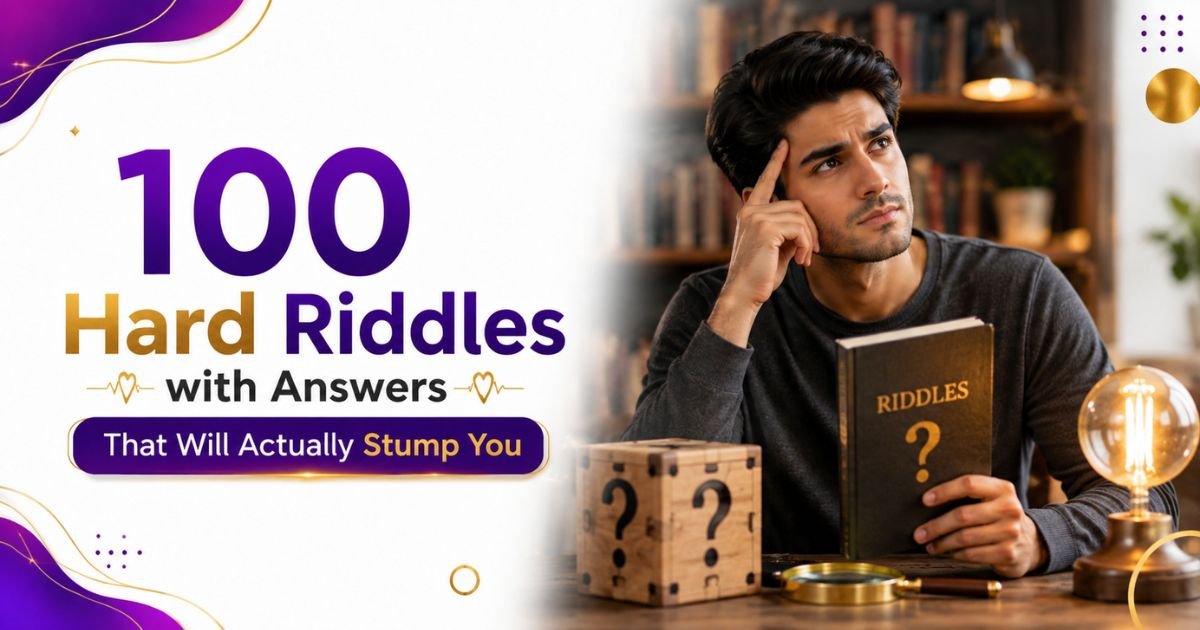
100 Hard Riddles with Answers That Will Actually Stump You
Hard riddles are wordplay or logic puzzles designed to mislead you before revealing a surprisingly simple answer.
They work by encouraging literal thinking, using misdirection, or hiding wordplay in plain sight, and the moment the answer clicks, it feels obvious in hindsight.
What Makes a Riddle Hard? (Quick Answer)
A riddle earns the label “hard riddle” when it does one (or more) of three things: it hides wordplay inside an ordinary-sounding sentence, it uses misdirection to steer your brain toward the wrong category of answer, or it demands a purely literal reading when everything about the phrasing suggests you should think abstractly.
After testing these riddles with mixed groups of adults and teens during casual trivia nights, the riddles that stumped people longest were almost never the ones with complicated logic, they were the ones with a simple answer hiding behind a confusing question.
Understanding this pattern is honestly the single best trick for solving tricky riddles faster.
Warm-Up Hard Riddles (Tricky But Gettable)
These are the best hardest riddles and hard riddles for adults who want a real challenge without diving into full brain-teaser territory.
They’re a solid warm-up before the harder sections below, and they work great as hard riddles for kids aged 10 and up too.
- Riddle: I speak without a mouth and hear without ears. I have no body, but wind gives me life. What am I?
Answer: An echo.
Difficulty: Medium.
Explanation: This riddle uses personification by giving human abilities to an echo. The mention of wind hints that it’s a sound, not a living thing. - Riddle: I have cities but no houses, mountains but no trees, and water but no fish. What am I?
Answer: A map.
Difficulty: Medium.
Explanation: The clues describe places without their real features, leading you to think of a representation rather than an actual location. - Riddle: The more you take from me, the bigger I get. What am I?
Answer: A hole.
Difficulty: Easy-Medium.
Explanation: Removing material makes a hole larger instead of smaller, creating the twist. - Riddle: What has a face and two hands but no arms or legs?
Answer: A clock.
Difficulty: Easy-Medium.
Explanation: It relies on the double meanings of “face” and “hands,” which are parts of a clock. - Riddle: What can travel around the world while staying in one corner?
Answer: A stamp.
Difficulty: Medium.
Explanation: The stamp stays attached to a letter while the letter travels around the world. - Riddle: I’m light as a feather, yet the strongest person can’t hold me for more than a few minutes. What am I?
Answer: Your breath.
Difficulty: Medium.
Explanation: “Hold” refers to holding your breath, not carrying an object. - Riddle: What gets wetter the more it dries?
Answer: A towel.
Difficulty: Medium.
Explanation: A towel becomes wetter because it absorbs water while drying something else. - Riddle: What has many keys but can’t open a single lock?
Answer: A piano.
Difficulty: Medium.
Explanation: The word “keys” refers to piano keys instead of door keys.
- Riddle: What has to be broken before you can use it?
Answer: An egg.
Difficulty: Easy-Medium.
Explanation: An egg must be cracked open before it can be cooked or eaten. - Riddle: I follow you all day but disappear at night. What am I?
Answer: Your shadow.
Difficulty: Easy-Medium.
Explanation: A shadow follows you in light but disappears in darkness. - Riddle: What comes down but never goes up?
Answer: Rain.
Difficulty: Easy-Medium.
Explanation: Rain naturally falls from the sky, making the simple answer easy to overlook. - Riddle: What has one eye but cannot see?
Answer: A needle.
Difficulty: Medium.
Explanation: The “eye” is the hole used for threading, not a real eye. - Riddle: What kind of room has no doors or windows?
Answer: A mushroom.
Difficulty: Medium.
Explanation: It’s a wordplay riddle where “room” is hidden inside the word “mushroom.” - Riddle: What invention lets you look right through a wall?
Answer: A window.
Difficulty: Easy-Medium.
Explanation: People often overthink the clue instead of choosing the simplest invention. - Riddle: What has a neck but no head?
Answer: A bottle.
Difficulty: Medium.
Explanation: The “neck” refers to the narrow top part of a bottle. - Riddle: What has hands but cannot clap?
Answer: A clock.
Difficulty: Medium.
Explanation: The “hands” are the clock’s pointers, not human hands. - Riddle: What can you catch but not throw?
Answer: A cold.
Difficulty: Medium.
Explanation: “Catch” refers to getting sick, not catching a physical object. - Riddle: What runs but never walks, has a mouth but never talks?
Answer: A river.
Difficulty: Medium.
Explanation: A river “runs” with flowing water, and its “mouth” is where it ends. - Riddle: What has a thumb and four fingers but isn’t alive?
Answer: A glove.
Difficulty: Easy-Medium.
Explanation: A glove has the shape of a hand but is not a living thing. - Riddle: What goes up but never comes down?
Answer: Your age.
Difficulty: Medium.
Explanation: Age only increases over time, making it an abstract rather than physical answer.
Read More: 100 Library Riddles for Kids: Fun, Easy and Brain-Teasing Puzzles About Books
Truly Hard Riddles with Answers
This is where things start to get genuinely tough. These really hard riddles and hard riddles with answers are the ones that regularly stump adults at trivia nights, expect a few “wait, what?” reactions.
- Riddle: You measure my life in hours, and I serve you by expiring. I’m quick when thin, slow when fat, and wind is my enemy. What am I?
Answer: A candle.
Difficulty: Hard.
Explanation: Every clue is metaphorical rather than literal, and “expiring” pushes you toward something biological instead of an object that burns down. - Riddle: What English word retains the same pronunciation after removing four of its five letters?
Answer: Queue, remove “ueue” and you’re left with the letter “Q,” pronounced the same way.
Difficulty: Hard.
Explanation: A pure wordplay riddle relying on English’s odd habit of using silent or redundant letters for pronunciation. - Riddle: What English word has three consecutive double letters?
Answer: Bookkeeper.
Difficulty: Hard.
Explanation: Requires scanning for compound words, since most single words don’t have three back-to-back double-letter pairs. - Riddle: This belongs to you, but everyone else uses it more than you do. What is it?
Answer: Your name.
Difficulty: Hard.
Explanation: Ownership riddles are hard because we associate “belonging to you” with physical possession, not identity.
- Riddle: What word becomes shorter when you add two letters to it?
Answer: Short, add “er” to make “shorter.”
Difficulty: Hard.
Explanation: A self-referential wordplay riddle; the trick is realizing the riddle is describing itself. - Riddle: What can fill a room but takes up no space?
Answer: Light (or sound).
Difficulty: Hard.
Explanation: Contradicts the assumption that filling something always requires physical space. - Riddle: I have keys but no locks, and space but no rooms. You can enter, but you can’t go outside. What am I?
Answer: A keyboard.
Difficulty: Hard.
Explanation: It combines three keyboard-related terms, keys, space, and enter, to mislead you into thinking about a building. - Riddle: What can you hold in your right hand but never in your left?
Answer: Your left hand.
Difficulty: Hard.
Explanation: A clever logic trap that makes you search for an object instead of thinking about your own body. - Riddle: What has to be broken, but is never picked up?
Answer: A promise.
Difficulty: Hard.
Explanation: The riddle shifts “broken” from a physical object to an abstract concept. - Riddle: What five-letter word becomes shorter when you add two letters to it?
Answer: Short, add “er” to make “shorter.”
Difficulty: Hard.
Explanation: Another self-referential wordplay riddle that rewards careful reading. - Riddle: What can be cracked, made, told, and played, all without being physical?
Answer: A joke.
Difficulty: Hard.
Explanation: Multiple unrelated verbs all apply to the same abstract noun, creating strong misdirection. - Riddle: What kind of tree can you carry in your hand?
Answer: A palm.
Difficulty: Hard.
Explanation: A pun based on “palm,” which is both a type of tree and part of your hand. - Riddle: What has an endless supply of letters but starts empty?
Answer: A mailbox.
Difficulty: Hard.
Explanation: “Letters” refers to mail rather than alphabet letters, making the clue deceptive. - Riddle: What is so fragile that saying its name breaks it?
Answer: Silence.
Difficulty: Hard.
Explanation: Speaking the word immediately destroys the silence, making the answer demonstrate itself. - Riddle: What word looks the same upside down and backward?
Answer: SWIMS.
Difficulty: Hard.
Explanation: This is a visual wordplay riddle that depends on the appearance of the letters. - Riddle: What can you break without ever touching it?
Answer: A promise (or someone’s heart, or the silence).
Difficulty: Hard.
Explanation: The answer is abstract, showing that not everything broken is a physical object. - Riddle: What has a bed but never sleeps, and a mouth but never eats?
Answer: A river.
Difficulty: Hard.
Explanation: It combines two common river features, bed and mouth, to mislead you with body-part references. - Riddle: What goes through cities and fields but never moves?
Answer: A road.
Difficulty: Hard.
Explanation: The road passes through many places, yet it remains completely still. - Riddle: What can be given but kept at the same time?
Answer: Your word (a promise), or advice.
Difficulty: Hard.
Explanation: The riddle challenges the idea that giving something away means you no longer have it. - Riddle: I’m always in front of you but can’t be seen. What am I?
Answer: The future.
Difficulty: Hard.
Explanation: The future is always ahead of you in time, but it can never be seen. - Riddle: What has many teeth but cannot bite?
Answer: A comb (or a zipper, or a saw).
Difficulty: Hard.
Explanation: “Teeth” refers to parts of everyday objects rather than real teeth. - Riddle: The person who makes it doesn’t want it. The person who buys it doesn’t use it. The person who uses it doesn’t know it. What is it?
Answer: A coffin.
Difficulty: Hard.
Explanation: Each clue eliminates the obvious possibilities until only a coffin fits. - Riddle: What can be measured but has no length, width, or height?
Answer: Temperature (or time).
Difficulty: Hard.
Explanation: The riddle reminds you that not everything measurable has physical dimensions. - Riddle: What word begins and ends with “E” but only has one letter?
Answer: An envelope.
Difficulty: Hard.
Explanation: The “letter” refers to mail inside the envelope, not a letter of the alphabet. - Riddle: What has a spine but no bones?
Answer: A book.
Difficulty: Hard.
Explanation: The “spine” is the binding of a book rather than part of a skeleton. - Riddle: What can you keep after giving it to someone else?
Answer: Your word.
Difficulty: Hard.
Explanation: You can give someone your word while still keeping your promise. - Riddle: What building has the most stories?
Answer: A library.
Difficulty: Hard.
Explanation: “Stories” refers to books rather than the number of floors. - Riddle: What can run but never walks, has a bank but no money?
Answer: A river.
Difficulty: Hard.
Explanation: “Run” and “bank” both have different meanings when describing a river. - Riddle: What has a ring but no finger?
Answer: A telephone.
Difficulty: Hard.
Explanation: “Ring” refers to the sound a telephone makes, not a piece of jewelry. - Riddle: What is easy to get into but hard to get out of?
Answer: Trouble.
Difficulty: Hard.
Explanation: This riddle uses an everyday expression rather than a physical object.
Genius-Level Riddles (Nearly Impossible)
These are the top 10 hardest riddle ever and hardest riddles in the world style entries and beyond, the ones that make even seasoned puzzle fans pause.
- Riddle: A man is found dead in a locked room with no windows. The only things in the room are a puddle of water and a table. How did he die?
Answer: He stood on a block of ice to hang himself; the ice melted, leaving the puddle.
Difficulty: Hard.
Explanation: This mystery riddle requires you to notice what’s missing instead of focusing only on what’s present. - Riddle: A woman shoots a photograph of her husband, holds it underwater for five minutes, then hangs it up to dry. Explain.
Answer: She’s developing a photograph in a darkroom, not committing a crime.
Difficulty: Hard.
Explanation: The riddle relies on the double meanings of words like “shoot,” “underwater,” and “hang.” - Riddle: Three doctors all say Paul is their brother, yet Paul insists he has no brothers. Who’s lying?
Answer: No one, the three doctors are Paul’s sisters.
Difficulty: Hard.
Explanation: It plays on the common assumption that doctors are male. - Riddle: A girl has as many brothers as sisters, but each of her brothers has only half as many brothers as sisters. How many siblings are in the family?
Answer: Four sisters and three brothers.
Difficulty: Hard.
Explanation: You must solve the relationships from both a girl’s and a brother’s perspective. - Riddle: A is the brother of B. B is the brother of C. C is the father of D. How is D related to A?
Answer: A is D’s uncle.
Difficulty: Hard.
Explanation: Family relationship puzzles become trickier when names are replaced with letters. - Riddle: What are the next three letters in this sequence: O, T, T, F, F, S, S?
Answer: E, N, T.
Difficulty: Hard.
Explanation: They are the first letters of the words Eight, Nine, and Ten.
- Riddle: How is the number seven different from every other number between one and ten?
Answer: “Seven” is the only number with two syllables.
Difficulty: Hard.
Explanation: The answer depends on the word itself, not its mathematical properties. - Riddle: First think of the color of clouds. Then the color of snow. Then the color of a full moon. Now answer quickly: What do cows drink?
Answer: Water.
Difficulty: Hard.
Explanation: Repeating white objects primes people to mistakenly answer “milk.” - Riddle: What word in the dictionary is always spelled incorrectly?
Answer: “Incorrectly.”
Difficulty: Hard.
Explanation: It’s a self-referential riddle where the answer describes itself. - Riddle: What can go up a chimney down but can’t go down a chimney up?
Answer: An umbrella.
Difficulty: Hard.
Explanation: “Up” and “down” describe whether the umbrella is open or closed, not the direction of travel. - Riddle: What comes once in a minute, twice in a moment, but never in a thousand years?
Answer: The letter M.
Difficulty: Hard.
Explanation: The riddle is about counting letters, not measuring time. - Riddle: A father and son are in a car crash. The father dies, and the son is rushed to surgery. The surgeon says, “I can’t operate, this is my son.” How is this possible?
Answer: The surgeon is the boy’s mother.
Difficulty: Hard.
Explanation: This classic riddle exposes unconscious gender stereotypes. - Riddle: Two fathers and two sons go fishing. They each catch one fish, yet only three fish are caught in total. How?
Answer: They are a grandfather, a father, and a son.
Difficulty: Hard.
Explanation: There are only three people, but they form two father-son relationships. - Riddle: You’re in a room with no doors or windows, only a mirror and a table. How do you escape?
Answer: Look in the mirror, see what you saw, take the saw, cut the table in half, two halves make a hole, and climb through the hole.
Difficulty: Hard.
Explanation: This is a chain of puns rather than a realistic escape plan. - Riddle: What has one head, one foot, and four legs?
Answer: A bed.
Difficulty: Hard.
Explanation: The riddle uses furniture terms that also describe body parts. - Riddle: I am not alive, but I grow. I don’t have lungs, but I need air. I don’t have a mouth, but water kills me. What am I?
Answer: Fire.
Difficulty: Hard.
Explanation: Each clue describes how fire behaves while making it sound like a living thing. - Riddle: What can travel faster than the speed of light?
Answer: Your imagination (or a thought).
Difficulty: Hard.
Explanation: The riddle sounds scientific but expects an abstract answer. - Riddle: Forward I am heavy, but backward I am not. What am I?
Answer: The word ton.
Difficulty: Hard.
Explanation: Spelled backward, ton becomes not. - Riddle: What is at the end of a rainbow?
Answer: The letter W.
Difficulty: Hard.
Explanation: It’s asking for the last letter of the word “rainbow,” not the end of the real rainbow. - Riddle: What occurs twice in a week, once in a year, but never in a day?
Answer: The letter E.
Difficulty: Hard.
Explanation: The solution comes from counting letters in the words. - Riddle: I have branches but no fruit, trunk, or leaves. What am I?
Answer: A bank.
Difficulty: Hard.
Explanation: “Branches” refers to bank locations instead of parts of a tree. - Riddle: What kind of coat is always wet when you put it on?
Answer: A coat of paint.
Difficulty: Hard.
Explanation: “Coat” means a layer of paint rather than clothing. - Riddle: What is always coming but never actually arrives?
Answer: Tomorrow.
Difficulty: Hard.
Explanation: Once tomorrow arrives, it becomes today. - Riddle: What can you serve but never eat?
Answer: A tennis ball (or a volleyball).
Difficulty: Hard.
Explanation: “Serve” refers to sports rather than serving food. - Riddle: The more of me there is, the less you see. What am I?
Answer: Darkness.
Difficulty: Hard.
Explanation: More darkness means less visibility. - Riddle: What has a heart that doesn’t beat?
Answer: An artichoke (or a deck of cards).
Difficulty: Hard.
Explanation: “Heart” refers to a part of the object, not a living organ. - Riddle: What five-letter word, when you remove one letter, still sounds the same?
Answer: Plumb → Plum.
Difficulty: Hard.
Explanation: The silent B doesn’t change the pronunciation. - Riddle: What can be broken but is never physically held, and can be hurt but has no body?
Answer: Feelings.
Difficulty: Hard.
Explanation: The riddle combines two emotional expressions into one abstract answer. - Riddle: What building in a city has the most floors, yet nobody actually walks on most of them?
Answer: A parking garage.
Difficulty: Hard.
Explanation: Most floors are used for parking vehicles rather than walking. - Riddle: You see a house with four walls, all facing south. A bear walks by. What color is the bear?
Answer: White.
Difficulty: Hard.
Explanation: The house must be at the North Pole, where the only bears are polar bears.
Hard Math and Logic Riddles
Unlike the wordplay riddles above, this section leans into number logic and difficult riddles with answer. These 50 hard riddles with answers style math puzzles reward patience over cleverness with language.
- Riddle: If eleven plus two equals one, what does nine plus five equal?
Answer: Two, think of a clock face: 11 + 2 = 1 o’clock, so 9 + 5 = 2 o’clock.
Difficulty: Hard.
Explanation: The hidden context is a clock, where numbers wrap around after 12 instead of following normal arithmetic. - Riddle: How can you write eight eights so they add up to exactly one thousand?
Answer: 888 + 88 + 8 + 8 + 8 = 1,000.
Difficulty: Hard.
Explanation: You must group the eights creatively instead of adding them individually. - Riddle: A man is four times as old as his daughter. In 20 years, he’ll be twice her age. How old are they now?
Answer: The father is 40, and the daughter is 10.
Difficulty: Hard.
Explanation: This is an algebra puzzle where both the current and future ages must satisfy the clues. - Riddle: A father and son’s ages add up to 66. The father’s age is the son’s age with the digits reversed. What are three possible ages?
Answer: 51 and 15, 42 and 24, or 60 and 6.
Difficulty: Hard.
Explanation: More than one age pair fits the conditions, so you must check every possibility. - Riddle: What two positive whole numbers give a one-digit result when multiplied, but a two-digit result when added?
Answer: 1 and 9.
Difficulty: Hard.
Explanation: Their product is 9, while their sum is 10. - Riddle: You need to boil an egg for exactly two minutes, but you only have a three-minute and a five-minute hourglass. How do you time it?
Answer: Start both hourglasses together. When the three-minute hourglass finishes, begin boiling the egg. When the five-minute hourglass finishes, exactly two minutes have passed.
Difficulty: Hard.
Explanation: The trick is measuring the difference between the two timers rather than using either one alone. - Riddle: Three cards are laid in a row. A two is to the right of a king. A diamond is to the left of a spade. An ace is to the left of a heart, and a heart is to the left of a spade. Identify the three cards.
Answer: Ace of Diamonds, King of Hearts, Two of Spades.
Difficulty: Hard.
Explanation: Every clue must be satisfied at the same time, making it a classic logic puzzle. - Riddle: George, Helen, and Steve drink coffee. Bert, Karen, and Dave drink soda. Does Elizabeth drink coffee or soda?
Answer: Coffee.
Difficulty: Hard.
Explanation: The coffee drinkers all have the letter E twice in their names, and so does Elizabeth.
- Riddle: A rope burns unevenly and takes exactly 60 minutes to burn end to end. How do you measure exactly 45 minutes using two such ropes?
Answer: Light one rope at both ends and the second rope at one end. When the first rope burns out after 30 minutes, light the other end of the second rope. It burns out 15 minutes later, making 45 minutes total.
Difficulty: Hard.
Explanation: Lighting both ends changes the remaining burn time even if the rope burns unevenly. - Riddle: A lily pad in a pond doubles in size every day. It takes 20 days to cover the whole pond. On what day was it half-covered?
Answer: Day 19.
Difficulty: Hard.
Explanation: Since the lily pad doubles each day, it must have been half the pond one day before it was full. - Riddle: How many times can you subtract 5 from 25?
Answer: Once.
Difficulty: Hard.
Explanation: After the first subtraction, you’re subtracting from 20 instead of 25. - Riddle: A man leaves home, makes three left turns, and returns home to find two masked men waiting. Who are they?
Answer: The catcher and the umpire.
Difficulty: Hard.
Explanation: The man is running the baseball bases, not driving or walking home. - Riddle: If you have a 3-gallon jug and a 5-gallon jug with no markings, how do you measure exactly 4 gallons?
Answer: Fill the 5-gallon jug, pour into the 3-gallon jug until it’s full, empty the 3-gallon jug, pour the remaining 2 gallons into it, refill the 5-gallon jug, then fill the 3-gallon jug with 1 more gallon. Four gallons remain in the 5-gallon jug.
Difficulty: Hard.
Explanation: The puzzle requires carefully tracking each pour until the correct amount remains. - Riddle: A farmer has 17 sheep. All but 9 die. How many are left?
Answer: 9.
Difficulty: Hard.
Explanation: “All but 9” means exactly 9 sheep survive. - Riddle: You have two ropes and a lighter. Each rope takes exactly one hour to burn, but not at a consistent rate. How do you measure exactly 30 minutes?
Answer: Light one rope at both ends. It will burn completely in exactly 30 minutes.
Difficulty: Hard.
Explanation: Burning both ends cuts the total burn time in half, regardless of the uneven burn rate. - Riddle: A man builds a house with four walls, all facing north. What runs around the house?
Answer: A fence.
Difficulty: Hard.
Explanation: The wall directions are a distraction, the obvious answer is simply a fence. - Riddle: Divide 30 by half and add 10. What do you get?
Answer: 70.
Difficulty: Hard.
Explanation: Dividing by one-half is the same as multiplying by two, so 30 × 2 = 60, then add 10. - Riddle: A clock strikes 6 in 5 seconds. How long does it take to strike 12?
Answer: 11 seconds.
Difficulty: Hard.
Explanation: Twelve strikes have 11 intervals between them, and the intervals determine the time. - Riddle: How many months have 28 days?
Answer: All 12.
Difficulty: Hard.
Explanation: Every month has at least 28 days, not just February. - Riddle: You’re in a race and you overtake the person in second place. What position are you in now?
Answer: Second place.
Difficulty: Hard.
Explanation: By passing the runner in second place, you take their position, you don’t automatically move into first.
Read More: 100 Basketball Riddles for Kids and Adults (With Answers)
How to Get Better at Solving Hard Riddles?
Solving impossible riddles faster isn’t about being naturally clever, it’s a skill you build through pattern recognition.
After running these riddles with classroom groups and trivia teams, three techniques consistently helped people improve fastest:
- Question every assumption. If a riddle mentions “hands,” “face,” “keys,” or “bank,” check for a non-human meaning first.
- Say it out loud. Wordplay riddles (like the “silence” or “incorrectly” riddles above) often only click when spoken aloud.
- Look for hidden math. Number-based hard riddles rarely involve complex math, they usually hide a simple trick in the phrasing itself.
- Don’t stop at the first answer. Several riddles here (like the father-son age riddle) have more than one valid solution.
Conclusion
Hard riddles are designed to push the boundaries of your problem-solving abilities, making it an engaging way to spend your time alone or with friends.
If you’re a seasoned riddle master or a curious beginner, the answers provided will help you gauge your progress and keep you motivated.
FAQs
What is the Hardest Riddle in the World?
There’s no single agreed-upon “hardest riddle,” since difficulty depends on how a person’s brain processes wordplay versus logic.
How Do You Solve Hard Riddles?
Start by questioning your first assumption, since most hard riddles work by nudging you toward an obvious but wrong category of answer.
What Makes a Riddle “Hard” Instead of Easy?
A riddle becomes hard when it stacks multiple misdirection techniques together, wordplay, contradiction, and false assumptions, instead of relying on just one trick.
Are Hard Riddles Good for Kids or Only Adults?
Many hard riddles work well for kids age 10 and up, especially the wordplay-based ones in the warm-up section.