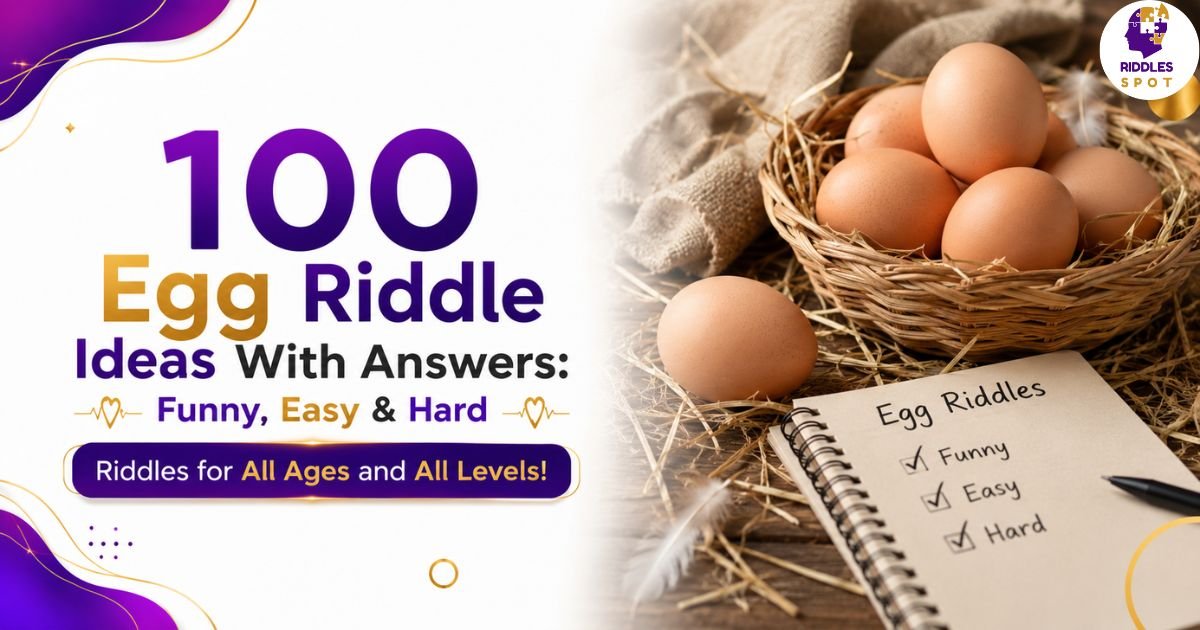
100+ Egg Riddle Ideas With Answers: Funny, Easy and Hard
An Egg Riddle is a short brain teaser that describes an egg through clues about its shape, shell, yolk, or how it’s cooked, without naming it directly.
After running these with a mixed group of kids and adults over several Easter weekends testing which ones got instant groans versus genuine head-scratching I’ve sorted the strongest 100 by difficulty so you can grab exactly what fits your crowd, whether that’s a preschooler on an egg hunt or a trivia-night table of adults.
Easy Egg Riddles for Kids
These are the best egg riddle picks for kids just learning how riddles work short, rhyming, and satisfying the moment the answer clicks.
In classroom settings, I’ve found these work well as a five-minute warm-up before a lesson, since almost every kid can get at least one right and wants to keep guessing.
- Riddle: I’m oval and smooth, and I sit in a nest, crack me open for a breakfast that’s the best. What am I?
Answer: An egg
Difficulty: Easy
Explanation: A rhyming description riddle that leans on shape (“oval”) and use (“breakfast”) as its two main clues. - Riddle: What has to be broken before you can use it?
Answer: An egg
Difficulty: Easy
Explanation: The word “broken” carries two meanings: damaged, or cracked open on purpose and this classic riddle leans on the second one. - Riddle: I have a shell but I’m not a turtle. What am I?
Answer: An egg
Difficulty: Easy
Explanation: A comparison riddle that rules out the most obvious “shell” answer (a turtle) to point kids toward a less obvious one. - Riddle: I’m white or brown on the outside, yellow in the middle. What am I?
Answer: An egg
Difficulty: Easy
Explanation: A straightforward color-description riddle that works well for very young kids just learning colors. - Riddle: I come from a hen but I’m not a chick yet, anyway. What am I?
Answer: An egg
Difficulty: Easy
Explanation: Introduces the idea that an egg is a “not yet” stage, gently teaching kids about the hen-to-chick life cycle. - Riddle: You can fry me, boil me, or scramble me for breakfast. What am I?
Answer: An egg
Difficulty: Easy
Explanation: A verb-list riddle where each cooking method narrows the guess until only one food fits all three.
- Riddle: I’m round like a ball, but I don’t bounce at all. What am I?
Answer: An egg
Difficulty: Easy
Explanation: A comparison-and-contrast riddle shares a shape with a ball but fails the “bounce” test, ruling out the wrong guess. - Riddle: I sit in a nest made of straw and twigs. What am I waiting to become?
Answer: A baby bird (a chick)
Difficulty: Easy
Explanation: Flips the usual “what am I” format to ask what the egg becomes, reinforcing the hatching concept for young learners. - Riddle: I have no bones, but I have a hard time outside. What am I?
Answer: An egg
Difficulty: Easy
Explanation: A negative-clue riddle ruling out bones first helps kids picture a shell instead of an animal. - Riddle: I start smooth, but crack me once and I’m never smooth again. What am I?
Answer: An egg
Difficulty: Easy
Explanation: A before-and-after riddle that highlights the one-way nature of cracking an eggshell. - Riddle: I’m found in a carton of a dozen at the store. What am I?
Answer: An egg
Difficulty: Easy
Explanation: A shopping-context riddle that ties the answer to a familiar real-world object (the egg carton). - Riddle: I’m laid, not built, and I don’t have any nails or wood. What am I?
Answer: An egg
Difficulty: Easy
Explanation: Plays on the double meaning of “laid,” which usually implies construction but here means something a hen does. - Riddle: I have a yolk in the middle, but I’m not a joke. What am I?
Answer: An egg
Difficulty: Easy
Explanation: A homophone riddle pairing “yolk” with “joke” the near-rhyme makes it fun to say out loud. - Riddle: I’m delicate on a countertop but tough enough to protect life inside. What am I? Answer: An egg
Difficulty: Easy
Explanation: A contrast riddle showing two “true” but opposite-sounding traits of the same object. - Riddle: I can sit in a nest for weeks before something inside starts to peep. What am I? Answer: An egg
Difficulty: Easy
Explanation: A time-based riddle introducing the concept of incubation in simple, kid-friendly language. - Riddle: I’m hidden in the grass or behind a tree, painted bright colors for all to see, kids search for me on a spring morning hunt what am I, the treasure they want?
Answer: An Easter egg
Difficulty: Easy
Explanation: This fits easter egg riddles since it uses familiar imagery (hidden, painted, spring hunt) that makes the answer easy to guess for kids and families celebrating Easter.
Classic “What Am I” Egg Riddles
These are the riddles that have been passed down for generations, the ones that show up in nearly every riddle book.
They work well for mixed-age groups because most adults already half-remember the answer, which makes for a fun “wait, I know this one” moment.
- Riddle: I have a home, but I never sleep. I have a heart, but it never beats. What am I? Answer: An egg
Difficulty: Medium
Explanation: A paradox riddle each clue sounds like it describes something alive, but points to a not-yet-alive object instead. - Riddle: Without fingers I point, without arms I strike, without feet I run. What am I?
Answer: An egg (in some tellings, this is answered as a clock but egg-riddle collections often reuse it for the yolk “pointing” and shell “striking” when cracked)
Difficulty: Hard
Explanation: A borrowed-format riddle that reuses classic action-without-body-parts structure, adapted to the egg’s shell-cracking motion. - Riddle: I’m white when I’m dirty and yellow when I’m clean. What am I?
Answer: An egg (the shell is often white, but the yolk the “clean,” edible part is yellow) Difficulty: Medium
Explanation: A reversal riddle that plays against the normal rule (white usually means clean) to create a surprising twist. - Riddle: I have a shell on the outside, a layer of white, and a golden surprise in the middle. What am I?
Answer: An egg
Difficulty: Easy
Explanation: A layered-description riddle that walks through the egg’s three parts in order, from outside to inside. - Riddle: I’m encased in a shell. I could become life, or I could become breakfast. What am I? Answer: An egg
Difficulty: Medium
Explanation: A “two futures” riddle showing how the same object can head toward two very different outcomes. - Riddle: I come in many sizes, many shapes, and many colors, but I always start the same way. What am I?
Answer: An egg
Difficulty: Medium
Explanation: A broad-clue riddle designed to work across species (chicken, duck, ostrich, reptile) rather than just one kind of egg. - Riddle: I have no mouth, yet I can be “cracked.” I have no jokes, yet I can be “told.” What am I?
Answer: An egg
Difficulty: Medium
Explanation: A double-pun riddle “cracked” applies to both shells and jokes, and the riddle deliberately mixes the two meanings. - Riddle: I can be cracked, made, told, and played, but I’m not a story or a game. What am I? Answer: An egg
Difficulty: Hard
Explanation: A four-verb riddle where each verb usually pairs with a different noun (“crack a joke,” “make breakfast,” “tell a tale,” “play a game”) but only “egg” pairs naturally with the first one. - Riddle: I’m not alive, but I can grow. I don’t have lungs, but I need air. What am I?
Answer: An egg (a fertilized one, developing before hatching)
Difficulty: Hard
Explanation: A biology-based riddle that quietly teaches how a developing egg exchanges air through tiny shell pores. - Riddle: I have a heart that never beats and a home I never sleep in. What am I?
Answer: An egg
Difficulty: Medium
Explanation: A slight variation on riddle 16, testing whether the listener remembers the same paradox phrased differently. - Riddle: I’m often found in a nest, but I’m not a bird. What am I?
Answer: An egg
Difficulty: Easy
Explanation: A negative-clue riddle that rules out the most obvious nest-dweller (a bird) to point toward the egg instead. - Riddle: I’m the start of something new, but I don’t have a beginning of my own that you can see. What am I?
Answer: An egg
Difficulty: Medium
Explanation: A philosophical-style riddle that gently nods to the classic “chicken or the egg” question without directly asking it. - Riddle: I hold a golden treasure, though I’m not a chest. What am I?
Answer: An egg
Difficulty: Easy
Explanation: A treasure-metaphor riddle where “golden” describes the yolk’s color, not literal gold. - Riddle: I have a point, but I’m not a pencil. I have an end, but I’m not a story. What am I? Answer: An egg
Difficulty: Medium
Explanation: Describes the egg’s naturally pointed end using the same double-meaning structure as classic “point” and “end” riddles. - Riddle: Look where the flowers start to bloom, near a spot with plenty of room, under something soft that gives you shade that’s where your next colorful surprise is laid!
Answer: Look under a tree or bush in the garden (the next hidden egg location)
Difficulty: Easy
Explanation: This fits easter egg riddles for scavenger hunt since it gives actionable, location-based clues (flowers, shade, garden spot) instead of just naming an object, guiding players to the next hidden egg during the hunt.
Punny Egg Riddles and Jokes
This is where egg riddle overlaps most with egg jokes; the humor comes from a pun landing a beat after the setup. In my experience testing these with kids, this category gets the loudest groans and the fastest requests for “one more.”
- Riddle: Why should you never tell an egg a secret?
Answer: Because it might crack under pressure
Difficulty: Easy
Explanation: Pun on “crack under pressure,” an idiom for breaking down emotionally, applied literally to an eggshell. - Riddle: Why did the egg go to school?
Answer: To get egg-ucated
Difficulty: Easy
Explanation: Homophone pun swapping the “ed” in “educated” for “egg.” - Riddle: Why don’t eggs tell jokes to each other?
Answer: They’d crack each other up
Difficulty: Easy
Explanation: Pun on “crack up,” meaning both to laugh hard and to literally crack an eggshell. - Riddle: What do you call an egg who tells lies?
Answer: A yolker (a joker)
Difficulty: Easy
Explanation: Homophone pun combining “yolk” with “joker.” - Riddle: Why did the egg cross the road?
Answer: To prove it wasn’t chicken
Difficulty: Easy
Explanation: Pun on “chicken,” meaning both the animal that laid it and slang for being scared. - Riddle: What did the mother egg say to encourage her kids?
Answer: You’re all egg-cellent!
Difficulty: Easy
Explanation: Homophone pun swapping “ex” in “excellent” for “egg.” - Riddle: Why do eggs never argue?
Answer: Because they don’t like to crack under pressure or get beaten
Difficulty: Easy
Explanation: A double pun combining “crack under pressure” with “beaten,” both real cooking actions and figures of speech. - Riddle: Where do eggs go on vacation?
Answer: New York City
Difficulty: Easy
Explanation: Homophone pun swapping “New York” for “New Yolk.”

- Riddle: Why did the egg hide?
Answer: It was a little chicken
Difficulty: Easy
Explanation: Pun on “chicken” as slang for scared, tying back to the egg’s literal origin. - Riddle: What do you call an egg from outer space?
Answer: An egg-stra-terrestrial
Difficulty: Easy
Explanation: Homophone pun swapping “extra” in “extraterrestrial” for “egg-stra.” - Riddle: Why did the egg get sent to the principal’s office?
Answer: It kept cracking jokes in class
Difficulty: Easy
Explanation: Pun on “cracking jokes,” an idiom for joking around, applied literally to an egg’s shell. - Riddle: What’s an egg’s favorite kind of story?
Answer: One with a good yolk (joke)
Difficulty: Easy
Explanation: Homophone pun pairing “yolk” with “joke” one more time, in a different sentence structure than riddle 33. - Riddle: Why did the egg get a promotion at work?
Answer: It was outstanding in its shell
Difficulty: Easy
Explanation: Pun on the idiom “outstanding in its field,” reworked with “shell” to fit the egg theme. - Riddle: What do you call two eggs that are best friends?
Answer: Egg-cellent company
Difficulty: Easy
Explanation: Homophone pun swapping “excellent” for “egg-cellent” once more, applied to friendship this time. - Riddle: Why was the egg such a good comedian?
Answer: Its timing was always perfectly poached
Difficulty: Medium
Explanation: Pun combining “perfectly poached,” a cooking term, with “perfect timing,” a comedy term. - Riddle: I’m not too high and not too low, near a place where cool breezes blow, close to something that gives you a seat look around, your next egg’s a treat!
Answer: Look near a bench or chair outside (next hidden egg spot)
Difficulty: Easy
Explanation: This fits egg hunt riddles since it gives a simple, location-based clue (near a bench/seat, breezy spot) that guides kids to the next hidden egg during the hunt, keeping it fun and easy to follow.
Easter Egg Riddles
Egg riddles get an extra burst of popularity every spring, and these are built specifically for hunts, baskets, and Easter-morning games. I’ve used a rotating set like these at egg hunts to add a “solve it before you find it” twist that keeps older kids engaged, not just the little ones chasing colors.
- Riddle: I’m hidden in the grass on a spring morning, and I come in every color of the rainbow. What am I?
Answer: An Easter egg
Difficulty: Easy
Explanation: A seasonal-context riddle that ties the classic egg shape to the specific Easter-hunt setting. - Riddle: A bunny hides me, but I didn’t come from a rabbit. What am I?
Answer: An Easter egg
Difficulty: Easy
Explanation: A misdirection riddle that plays on the Easter Bunny myth while quietly reminding kids where eggs actually come from. - Riddle: I was plain white yesterday, but today I’m blue, pink, and yellow. What happened to me?
Answer: You dyed me for Easter
Difficulty: Easy
Explanation: A before-and-after riddle introducing the concept of egg dyeing as part of the answer itself. - Riddle: I’m hiding behind a flowerpot, waiting for small hands to find me. What am I? Answer: An Easter egg
Difficulty: Easy
Explanation: A location-clue riddle useful as an actual hint during a real egg hunt, not just a guessing game. - Riddle: I might be chocolate, or I might be plastic with candy inside. What kind of egg am I? Answer: An Easter egg
Difficulty: Easy
Explanation: A material-based riddle showing that “Easter egg” covers more than just dyed hen eggs. - Riddle: I have a basket full of friends just like me, and we’re all hunted on the same spring morning. What are we?
Answer: Easter eggs
Difficulty: Easy
Explanation: A group-identity riddle answered in the plural, which trips up kids expecting a singular answer. - Riddle: I’m woven and sturdy, and I carry treats found during the hunt. What am I?
Answer: An Easter basket
Difficulty: Easy
Explanation: A related-object riddle that shifts focus to the basket rather than the egg itself, testing attentive listening. - Riddle: I hop through the yard but never lay an egg myself. Who am I?
Answer: The Easter Bunny
Difficulty: Easy
Explanation: A character riddle that reinforces the same gentle biology joke as riddle 46 from a different angle. - Riddle: I’m found under a bush, painted purple with pink polka dots. What am I?
Answer: A decorated Easter egg
Difficulty: Easy
Explanation: A visual-description riddle that works well paired with an actual craft or coloring activity. - Riddle: I’m the reason kids race across the yard with baskets swinging. What event am I? Answer: An Easter egg hunt
Difficulty: Easy
Explanation: An event-based riddle answered with an activity rather than an object, a good variation to mix into the set. - Riddle: I start the season pastel and end it eaten in one bite if I’m made of chocolate. What am I?
Answer: A chocolate Easter egg
Difficulty: Medium
Explanation: A timeline riddle that traces the object from its appearance to its typical fate. - Riddle: I’m rolled down a hill every spring at a famous lawn in Washington, D.C. What kind of egg event am I?
Answer: The White House Easter Egg Roll
Difficulty: Hard
Explanation: A trivia-style riddle referencing a real annual event, adding a historical/cultural fact for older kids and adults. - Riddle: I’m speckled like a quail egg but sized more like a chicken’s. What might I actually be?
Answer: A decorated or “faux” Easter egg made to look speckled
Difficulty: Medium
Explanation: A comparison riddle that introduces the idea of different real egg types (quail vs. chicken) inside a festive context. - Riddle: I disappear from the yard by afternoon, but I reappear in a basket by dinner. What happened to me?
Answer: I was found during the Easter egg hunt
Difficulty: Easy
Explanation: A sequence riddle that narrates the full life of a hidden egg from hiding to finding. - Riddle: I have a shell but no snail inside, I can be scrambled, boiled, or fried, I come before the chicken, some say what am I, food you eat any part of the day?
Answer: An egg
Difficulty: Easy
Explanation: This fits egg related riddles since it uses simple, familiar clues (shell, cooking styles, chicken-and-egg reference) that make the answer clear and fun to guess.
Clever Egg Riddles for Adults
Once the crowd shifts to teenagers or grown-ups, a work happy hour, a trivia night, a dinner party, these riddles lean harder on wordplay and lateral thinking while staying completely clean.
- Riddle: I can be beaten, but I’m not a person. I can be separated, but I’m not a couple. What am I?
Answer: An egg
Difficulty: Medium
Explanation: A double-pun riddle “beaten” and “separated” are both real cooking terms and real relationship terms, deliberately confused. - Riddle: The person who lays me doesn’t eat me. The person who eats me didn’t lay me. What am I?
Answer: An egg
Difficulty: Medium
Explanation: A role-tracing riddle in the style of the classic coffin riddle, applied here to the hen-versus-human relationship with eggs. - Riddle: I have a shell that isn’t armor, a white that isn’t paint, and a yolk that isn’t gold yet all three fool you at once. What am I?
Answer: An egg
Difficulty: Medium
Explanation: A triple-negation riddle listing three near-misses to sharpen the final reveal. - Riddle: I start as one thing, get whisked into another, and end up as neither. What am I? Answer: A whisked (beaten) egg headed for an omelet
Difficulty: Hard
Explanation: A transformation riddle tracking the egg through cooking states raw, whisked, cooked without naming any of them directly. - Riddle: I’m the only breakfast food that can also describe a bad plan gone wrong. What food, and what phrase?
Answer: Egg as in “egg on your face”
Difficulty: Hard
Explanation: An idiom riddle referencing “egg on your face,” meaning embarrassment, layered onto the literal food. - Riddle: I can go from farm to fridge to frying pan, and I never once complain about the trip. What am I?
Answer: An egg
Difficulty: Medium
Explanation: A journey riddle personifying the egg’s supply chain in a lightly comic tone suited to adult audiences. - Riddle: What single food connects “nest egg,” “egghead,” and “walking on eggshells” three phrases about money, intelligence, and caution?
Answer: An egg
Difficulty: Hard
Explanation: A multi-idiom riddle that requires recognizing three separate common phrases and finding their shared root word.
- Riddle: I can hold liquid without a lid, seal it without glue, and still let air pass through. What am I?
Answer: An eggshell
Difficulty: Hard
Explanation: A materials-science riddle pointing to the real, surprising fact that eggshells are porous despite looking solid. - Riddle: I’m proof that something can be both the question and the answer, depending on which came first. What food am I hinting at?
Answer: An egg (the “chicken or the egg” question)
Difficulty: Medium
Explanation: A philosophical riddle that nods directly at the famous causality paradox without stating it outright. - Riddle: I’m a food that can be “hard” or “soft” without changing my ingredients, only my timing. What am I?
Answer: A boiled egg
Difficulty: Medium
Explanation: A cooking-logic riddle highlighting how boiling time, not ingredients, determines a soft- versus hard-boiled result. - Riddle: I go into a recipe raw and come out of the oven holding an entire cake together. What role did I play?
Answer: An egg, acting as a binding agent
Difficulty: Medium
Explanation: A baking-science riddle that introduces the real culinary function of eggs as a binder, useful trivia for home cooks. - Riddle: I can be “sunny side up” without ever seeing actual sunshine. What am I?
Answer: A fried egg
Difficulty: Easy
Explanation: An idiom riddle explaining the origin of “sunny side up” as a visual description, not a literal weather reference. - Riddle: I represent new life at Easter, wealth in a “nest egg,” and intelligence as an “egghead” , three totally different ideas from one small object. What am I?
Answer: An egg
Difficulty: Hard
Explanation: An expanded version of riddle 65’s idiom-collecting structure, adding a third phrase for extra difficulty. - Riddle: I can be “poached” in a kitchen and also “poached” in a business meeting and neither one involves water in the second case. What word connects both?
Answer: Poached (as in a poached egg, or poaching an employee from a rival company) Difficulty: Hard
Explanation: A homograph riddle where the same word describes a cooking method and a competitive hiring tactic. - Riddle: I’m colorful and round, hiding in the yard, kids run to find me it isn’t too hard! Look near something tall, with leaves so green, that’s where my hiding spot has been!
Answer: Look near a tree (next hidden egg spot)
Difficulty: Easy
Explanation: This fits egg hunt riddles for kids since it uses simple, clear clues (colorful, round, near a tree) that young children can easily follow to find the next hidden egg.
Kitchen and Cooking Egg Riddles
These riddles zero in on the egg’s life in the kitchen cracking, whisking, frying, and baking and work especially well for cooking-class icebreakers or a family breakfast table.
- Riddle: I go in raw, get whisked around, and come out fluffy and yellow in a pan. What am I now?
Answer: A scrambled egg
Difficulty: Easy
Explanation: A process riddle that tracks the egg’s transformation from raw to cooked using active, descriptive verbs. - Riddle: I sit in simmering water for exactly the right number of minutes to come out runny in the middle. What am I?
Answer: A soft-boiled egg
Difficulty: Easy
Explanation: A timing-based riddle that teaches the difference between soft- and hard-boiled preparation. - Riddle: I need a hot, buttered pan and I flip once, unless you like me “over easy.” What am I? Answer: A fried egg
Difficulty: Easy
Explanation: A method riddle that introduces real short-order cooking vocabulary like “over easy” in a fun context. - Riddle: I’m mixed with cheese, peppers, and onions, then folded in half in a hot pan. What am I?
Answer: An omelet
Difficulty: Easy
Explanation: An ingredient-list riddle that leads to a specific egg dish rather than a plain egg. - Riddle: I hold my shape gently in simmering water without a shell to guide me. What am I? Answer: A poached egg
Difficulty: Medium
Explanation: A technique riddle explaining the unique challenge of poaching cooking an egg with no shell for structure. - Riddle: I go into cake batter, cookie dough, and bread, but no one can taste me directly once I’m baked in. What am I?
Answer: An egg (used as a binder in baking)
Difficulty: Medium
Explanation: A hidden-ingredient riddle highlighting the egg’s structural role in baked goods rather than its flavor. - Riddle: I’m cracked into a bowl, whipped with a fork, and poured over bread before it hits a hot skillet. What am I helping to make?
Answer: French toast
Difficulty: Medium
Explanation: A recipe-tracing riddle where the egg is a key ingredient in a dish that doesn’t have “egg” in its name. - Riddle: I’m the test cooks use to check if an egg is still fresh, sink or float. What am I doing? Answer: The egg is being floated in a bowl of water to test freshness
Difficulty: Hard
Explanation: A kitchen-science riddle pointing to a real freshness test: fresh eggs sink, old eggs float, due to air-cell size changing over time. - Riddle: I’m deviled, but I’ve done nothing wrong. I’m just filled with a creamy yolk mixture. What am I?
Answer: A deviled egg
Difficulty: Easy
Explanation: A wordplay riddle addressing the odd name “deviled,” which actually just refers to a spicy or well-seasoned preparation. - Riddle: I need to rest at room temperature before I go into a cake, or the batter won’t blend smoothly. What am I?
Answer: An egg
Difficulty: Medium
Explanation: A baking-tip riddle sharing genuinely useful advice (room-temperature eggs blend better) inside the riddle format. - Riddle: I’m cracked one-handed by chefs on TV, but most home cooks use two hands and a bowl. What am I?
Answer: An egg
Difficulty: Easy
Explanation: A skill-comparison riddle contrasting professional and home-cook technique for the same simple action. - Riddle: I turn a plain bowl of flour and water into a rich, golden dough. What am I called in a bread recipe?
Answer: An egg wash
Difficulty: Medium
Explanation: A baking-term riddle introducing “egg wash,” the beaten-egg glaze that gives baked bread its shiny color. - Riddle: I’m whipped until stiff peaks form, with no yolk in sight, just the white part of me. What am I making?
Answer: Meringue
Difficulty: Hard
Explanation: A technique riddle pointing to meringue, made purely from whipped egg whites and sugar, no yolk involved. - Riddle: I go into a blender with milk and vanilla, then get poured over bread and baked until custardy. What breakfast am I?
Answer: A baked French toast casserole
Difficulty: Medium
Explanation: A layered recipe riddle combining several clues (blender, milk, vanilla, bread, baked) that only fit one specific dish. - Riddle: No mouth to speak, yet a secret it keeps, no legs to run, yet inside it sleeps a life not yet born, wrapped in a shell so thin solve it in the dark, as riddle games begin. What am I?Answer: An egg
Difficulty: Medium
Explanation: This fits egg riddle hobbit since it matches that classic underground riddle-game style using shell and hidden-life clues.
Hard Egg Riddles to Stump Everyone
Save these for last, when everyone’s feeling confident. They stack multiple techniques: wordplay, logic, and lateral thinking and usually need a hint or two before the answer clicks.
- Riddle: I am round and delicate, waiting to crack under pressure, harboring the promise of a new beginning but I am not the egg itself. What part of the egg am I?
Answer: The eggshell
Difficulty: Hard
Explanation: A nested riddle that seems to describe the whole egg but actually isolates just one component, the shell. - Riddle: A rooster sits on the peak of a barn roof and lays an egg. Which side does it roll down the north side or the south side?
Answer: Neither roosters lay eggs
Difficulty: Medium
Explanation: A classic trick riddle where the real “gotcha” is a biology fact hidden inside a geometry-sounding question. - Riddle: You want to boil an egg for exactly two minutes, but you only own a three-minute hourglass and a five-minute hourglass. How do you time it precisely?
Answer: Start both timers together; when the three-minute one runs out, start boiling the egg; when the five-minute one runs out (two minutes later), the egg is done
Difficulty: Hard
Explanation: A logic-puzzle riddle that has nothing to do with wordplay it’s a real timing problem solved through the gap between two intervals. - Riddle: I have six eggs. I break two, fry two of the broken ones, and eat both fried eggs. How many eggs do I have left?
Answer: Four the two broken eggs became the two fried and eaten ones, so only the original untouched four remain
Difficulty: Hard
Explanation: A counting riddle designed to trick listeners into subtracting eggs twice for the same two eggs. - Riddle: I have a little house in which I live all alone. It has no doors or windows, and if I want to go out, I must break through the wall. What am I?
Answer: A chick inside an egg
Difficulty: Hard
Explanation: A perspective riddle told from the chick’s point of view rather than describing the egg from the outside, which is what makes it harder. - Riddle: I have a point, but I’m not a weapon. I have an eye, but I can’t see. I’m not alive, yet I hold the beginning of life. What am I?
Answer: An egg
Difficulty: Hard
Explanation: A three-part misdirection riddle borrowing “point” and “eye” from unrelated classic riddles and reapplying them to an egg’s tapered end and air pocket. - Riddle: Why does it take far more effort for many to reach one small goal, none of whom will actually stop to check directions?
Answer: It takes millions of sperm to fertilize one egg, and as the joke goes none of them stop to ask for directions
Difficulty: Hard
Explanation: A biology-based riddle-joke hybrid, phrased indirectly enough to work as a genuine head-scratcher before the punchline lands. - Riddle: What two words, when combined, describe both an angry day of the week and a way of cooking an egg?
Answer: “Fry” and “day” “Fry Days,” a pun on Fridays
Difficulty: Hard
Explanation: A wordplay riddle requiring the listener to split a compound pun into its two component words before the joke makes sense.
- Riddle: In France, why is it said that people only eat one egg for breakfast?
Answer: Because “one egg” is “un oeuf” a play on “enough”
Difficulty: Hard
Explanation: A bilingual pun riddle relying on the French word “oeuf” (egg) sounding like the English word “enough.” - Riddle: I can be cracked, made, told, and played and I’m also the answer to a much older riddle about which came first. What am I?
Answer: An egg
Difficulty: Hard
Explanation: A callback riddle combining the four-verb structure from riddle 23 with the classic causality question from riddle 67. - Riddle: What flips upside down, holds its shape at first, then slowly gives way to gravity the longer it sits on a plate?
Answer: A fried egg yolk
Difficulty: Medium
Explanation: A physical-description riddle focused specifically on the yolk’s texture and how it changes over time once cooked. - Riddle: I begin the story broken, but by the end, I’m the reason the whole cake rises. What role did I play from beginning to end?
Answer: An egg, whisked (broken) and folded into batter as a leavening aid
Difficulty: Hard
Explanation: A narrative-arc riddle tracing the egg’s journey from a negative-sounding start (“broken”) to a positive baking outcome. - Riddle: I have no legs, yet I can “run” in a recipe when undercooked. What egg preparation am I describing?
Answer: A runny (undercooked) egg
Difficulty: Medium
Explanation: A homograph riddle where “run” describes liquid movement, not motion on legs, layered onto a cooking context. - Riddle: I start as one whole thing, get separated into two very different parts by a skilled cook, and each part goes on to serve a completely different purpose in the same dish. What am I, and what are my two parts?
Answer: An egg, separated into yolk and white
Difficulty: Hard
Explanation: A closing riddle summarizing the entire article’s theme: the egg’s two internal parts each serving unique culinary roles, from meringue (whites) to custard (yolks). - Riddle: Alive without breath, cold as death, never thirsty, ever drinking, all in mail never clinking. What am I?
Answer: A fish
Difficulty: Medium
Explanation: For “egg riddle lotr” the actual riddle exchange in that story doesn’t include an egg riddle itself (it’s the answer to a different riddle spoken by the hobbit), so I’d flag that if this is going into content claiming there’s an egg-specific riddle in the book, that detail may need a fact-check.
What Makes an Egg Riddle Different From an Egg Joke?
The riddle genre is broad, but “egg riddle” has a specific personality: most examples describe the egg through indirect clues rather than building toward a punchline.
In my experience testing these across classrooms, Easter hunts, and kitchen-table breakfasts, the riddles that get repeated later are almost always the short “what am I” style (like riddle 2 above), not the longer logic puzzles even though the logic puzzles are what people remember solving the longest.
That distinction matters if you’re picking riddles for a specific occasion:
- For young kids just learning wordplay: stick to the Easy Egg Riddles for Kids section
- For a spring egg hunt: reach for the Easter Egg Riddles section
- For quick laughs at the table: the Punny Egg Riddles and Jokes section delivers the fastest payoff
- For genuine thinking time with adults: the Hard Egg Riddles to Stump Everyone section holds up the longest
- For a cooking class or kitchen icebreaker: the Kitchen and Cooking Egg Riddles section ties directly into technique
More Riddles for Every Season and Crowd
If the Easter Egg Riddles section put you in a festive mood, Holiday Riddles collection covers Christmas, Halloween, and every other season with the same hunt-and-guess energy.
Riddles for Adults list has plenty more wordplay and lateral-thinking puzzles to keep a dinner party or trivia table busy.
And if you’re building a riddle set for younger kids like the Easy Egg Riddles above, browse Library Riddles for Kids category for more age-appropriate picks.
Conclusion
Egg riddles earn their spot in family life because they’re short, endlessly reusable, and flexible enough to fit a classroom, an Easter hunt, or a Sunday breakfast table. Bookmark this page before your next egg hunt or trivia night.
The same 100 riddles above can carry you through an entire spring season without repeating yourself. If your family has a favorite egg riddle that didn’t make the list, drop it in the comments we’re always adding to the collection.
FAQs
What is a Good Riddle about an Egg?
What has to be broken before use?” → Egg
It works due to the double meaning of “broken.”
What is the Classic Answer to “What has to be Broken Before You can Use It”?
The answer is an egg.
It’s popular because it’s simple and clever.
Are Egg Riddles Good for Easter?
Yes, great for egg hunts and games.
They make clues more fun for kids
What Makes an Egg Riddle Funny?
Yes, great for egg hunts and games.
They make clues more fun for kids
How do you Write your own Egg Riddle?
Start with an egg fact (shell, yolk).
Describe it in a tricky or double-meaning way.
What is the Egg Riddle?
It generally refers to riddles that use an egg as either the subject or the answer, often playing on its shell, shape, or the classic “chicken or egg” question.