100 Funny Riddles with Answers Kids Will Love to Solve
Funny riddles with answers are short question-and-answer puzzles built around a pun, wordplay twist, or silly misdirection instead of a straightforward logic puzzle.
A classic example: “What did one wall say to the other wall? I’ll meet you at the corner!” They work well for kids, parties, and family game nights because the payoff is a laugh, not just a solved puzzle.
Below are 100 completely original funny riddles with answers, grouped by theme and graded Easy, Medium, or Hard, with a short explanation.
Easy Funny Riddles for Little Laughs
These are the gentlest funny riddles with answers in the set short setups, one clear pun, and an answer most kids will get within a guess or two.
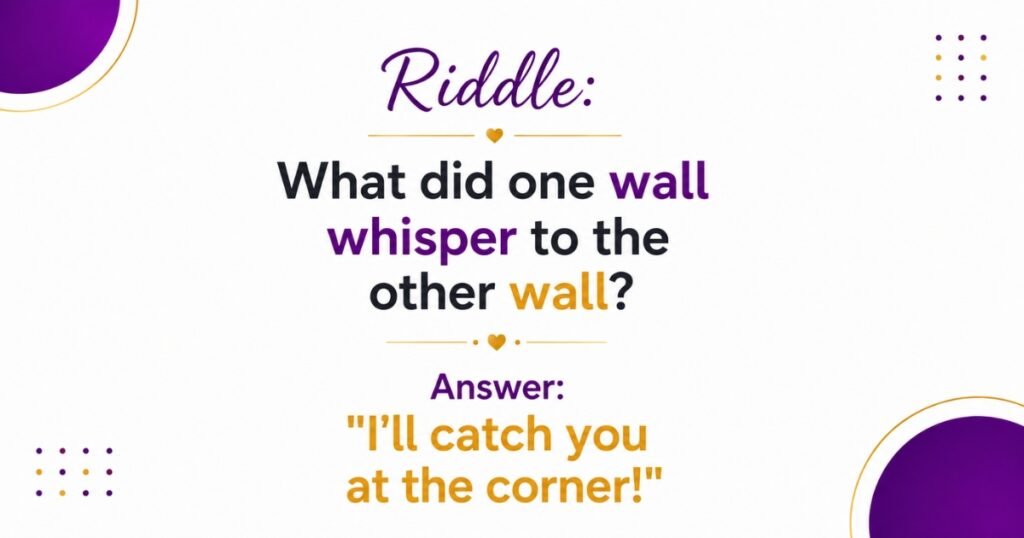
- Riddle: What did one wall whisper to the other wall?
Answer: “I’ll catch you at the corner!”
Difficulty: Easy
Explanation: A pun on “corner,” a spot where two walls physically meet, treated like a meeting point between two people. - Riddle: Why did the cookie visit the doctor?
Answer: Because it was feeling crumbly.
Difficulty: Easy
Explanation: “Crumbly” sounds like “grumbly” (feeling unwell) while also describing a cookie falling apart into crumbs. - Riddle: What do you call a sleeping dinosaur?
Answer: A dino-snore.
Difficulty: Easy
Explanation: A blended pun combining “dinosaur” with “snore,” describing the sound of sleeping. - Riddle: Why did the balloon go to school?
Answer: To get a little more air in its head.
Difficulty: Easy
Explanation: Plays on the idiom “air in your head” (meaning silly), applied literally to a balloon filled with air. - Riddle: What kind of key can’t open any door?
Answer: A monkey.
Difficulty: Easy
Explanation: A homophone pun “mon-key” sounds like “monkey,” misdirecting from the expected metal object. - Riddle: Why did the picture go to jail?
Answer: Because it was framed.
Difficulty: Easy
Explanation: “Framed” means both wrongly accused and literally placed inside a picture frame. - Riddle: What do you call a can opener that doesn’t work?
Answer: A can’t opener.
Difficulty: Easy
Explanation: A sound-alike pun swapping “can” for “can’t,” describing a broken tool. - Riddle: Why did the broom get a promotion?
Answer: Because it was outstanding at sweeping people off their feet.
Difficulty: Easy
Explanation: Combines the idiom “sweep someone off their feet” with the broom’s literal job of sweeping. - Riddle: What did the little tree say to the big tree at the party?
Answer: “Leaf me alone, I’m having fun!”
Difficulty: Easy
Explanation: A homophone pun on “leaf” and “leave,” reinforcing tree vocabulary. - Riddle: Why did the light bulb fail the test?
Answer: Because it wasn’t very bright that day.
Difficulty: Easy
Explanation: “Bright” describes both intelligence and the light bulb’s literal job of shining. - Riddle: What do you call a dog that can do magic tricks?
Answer: A labra-cadabra-dor.
Difficulty: Easy
Explanation: A blended pun combining “Labrador” with the magic word “abracadabra.” - Riddle: Why did the teddy bear turn down dessert?
Answer: Because it was already stuffed.
Difficulty: Easy
Explanation: “Stuffed” means both full from eating and literally filled with stuffing, as in a teddy bear. - Riddle: What do you call a fish with no eyes?
Answer: A fsh.
Difficulty: Easy
Explanation: A visual/spelling pun remove the letter “i” (which looks like an eye) from “fish” and you get “fsh.” - Riddle: Why did the clock in the classroom get sent to the principal’s office?
Answer: For tocking too much during the lesson.
Difficulty: Easy
Explanation: A homophone pun on “tock” (the sound a clock makes) and “talk,” describing classroom disruption.
Animal-Themed Funny Riddles
Animals are a favorite subject for riddles funny because their names and sounds are so easy to pun on.
- Riddle: What do you call a bear with no teeth?
Answer: A gummy bear.
Difficulty: Easy
Explanation: A double meaning “gummy” describes both a toothless mouth and the candy called a gummy bear. - Riddle: Why don’t elephants use computers?
Answer: Because they’re afraid of the mouse.
Difficulty: Easy
Explanation: “Mouse” refers to both the computer accessory and the small animal elephants are stereotypically startled by. - Riddle: What do you call a fish wearing a tiny bowtie?
Answer: So-fish-ticated.
Difficulty: Medium
Explanation: A blended pun combining “fish” with “sophisticated,” describing a fancy, well-dressed fish. - Riddle: Why did the chicken join a band?
Answer: Because it already had the drumsticks.
Difficulty: Easy
Explanation: “Drumsticks” refers to both a chicken’s leg and a musical instrument, creating the double meaning. - Riddle: What do you get when you cross a snowman and a vampire?
Answer: Frostbite.
Difficulty: Easy
Explanation: “Frostbite” combines the cold of a snowman with the “bite” of a vampire into one real word. - Riddle: Why do bees have sticky hair?
Answer: Because they use a honeycomb.
Difficulty: Easy
Explanation: A pun on “honeycomb,” which is both a hive structure and a play on the word “comb” used for hair. - Riddle: What did the mother owl say to her noisy owlet?
Answer: “Owl be quiet in a minute, just let me finish this hoot.”
Difficulty: Medium
Explanation: A homophone pun on “owl” and “I’ll,” matching the animal’s name to the phrase. - Riddle: Why don’t oysters share their pearls?
Answer: Because they’re a little shellfish.
Difficulty: Medium
Explanation: A homophone pun on “shellfish” and “selfish,” referencing the oyster’s shell. - Riddle: What do you call a group of musical whales?
Answer: An orca-stra.
Difficulty: Medium
Explanation: A blended pun combining “orca” with “orchestra,” matching the whale species to a musical group. - Riddle: Why did the spider go to the computer?
Answer: To check its website.
Difficulty: Easy
Explanation: “Website” refers to both a spider’s web and an internet site, creating the pun. - Riddle: What do you call a pig that does karate?
Answer: A pork chop.
Difficulty: Easy
Explanation: “Chop” refers to both a karate strike and a cut of pork, doubling the meaning. - Riddle: Why did the cat sit on the computer?
Answer: To keep an eye on the mouse.
Difficulty: Easy
Explanation: “Mouse” plays on the computer accessory and the animal cats chase, just like the earlier elephant riddle from a different angle. - Riddle: What do you call an alligator in a vest?
Answer: An investigator.
Difficulty: Medium
Explanation: A blended pun hiding “gator” inside “investigator,” with the vest clue supporting the wordplay.
Food and Snack Funny Riddles
Snack-time is a natural setting for quick jokes and riddles these all lean on food-based puns.
- Riddle: Why did the banana go to the doctor?
Answer: Because it wasn’t peeling well.
Difficulty: Easy
Explanation: A homophone pun on “peeling” and “feeling,” tied to a banana’s peel. - Riddle: What do you call cheese that isn’t yours?
- Answer: Nacho cheese.
Difficulty: Easy
Explanation: A homophone pun on “nacho” and “not your,” describing ownership through a snack food name. - Riddle: Why did the tomato turn red?
Answer: Because it saw the salad dressing.
Difficulty: Easy
Explanation: Plays on blushing (turning red from embarrassment) triggered by seeing something “dressed.” - Riddle: What do you call fake spaghetti?
Answer: An impasta.
Difficulty: Easy
Explanation: A homophone pun on “impasta” and “imposter,” matching the fake-food theme. - Riddle: Why did the orange stop rolling down the hill?
Answer: Because it ran out of juice.
Difficulty: Easy
Explanation: “Ran out of juice” means both losing energy and literally being an orange without its juice. - Riddle: What do you call a sad strawberry?
Answer: A blueberry.
Difficulty: Easy
Explanation: “Blue” means both sad and the color of a different berry, connecting mood to a fruit name. - Riddle: Why did the grape stop in the middle of the road?
Answer: Because it ran out of juice too.
Difficulty: Easy
Explanation: Reuses the “ran out of juice” wordplay with a different fruit to reinforce the pattern for younger kids. - Riddle: What did the egg say to the boiling water?
Answer: “It’s going to take me a while to get egg-cited about this.”
Difficulty: Medium
Explanation: A homophone pun on “egg-cited” and “excited,” built around the egg character. - Riddle: Why did the cracker go to the doctor?
Answer: Because it was feeling a little crumby.
Difficulty: Easy
Explanation: A homophone pun on “crumby” and “crummy” (feeling unwell), tied to crackers making crumbs. - Riddle: What do you call a dog that only eats vegetables?
Answer: A collie-flower.
Difficulty: Medium
Explanation: A blended pun combining the dog breed “collie” with “cauliflower.” - Riddle: Why did the muffin go to therapy?
Answer: Because it kept having crumby thoughts.
Difficulty: Medium
Explanation: Reuses “crumby/crummy” wordplay in a new setup, reinforcing the pun pattern with a different punchline context. - Riddle: What kind of cup can’t hold water?
Answer: A cupcake.
Difficulty: Easy
Explanation: “Cup” is used literally in “cupcake,” but the compound word has nothing to do with holding liquid. - Riddle: Why don’t melons get married?
Answer: Because they cantaloupe.
Difficulty: Medium
Explanation: A homophone pun on “cantaloupe” and “can’t elope,” a classic wedding-themed wordplay riddle.
School and Everyday Object Funny Riddles
These riddles and jokes turn ordinary school and household objects into punchlines.
- Riddle: Why did the math book look sad?
Answer: Because it was full of problems.
Difficulty: Easy
Explanation: “Problems” means both math exercises and personal troubles. - Riddle: What did the pencil say to the eraser?
Answer: “You’re really good at rubbing me the right way.”
Difficulty: Easy
Explanation: Plays on “rubbing the right way,” an idiom for pleasing someone, applied literally to an eraser’s function. - Riddle: Why did the computer go to the doctor?
Answer: Because it caught a virus.
Difficulty: Easy
Explanation: “Virus” describes both a computer problem and an illness, a common tech-vocabulary pun. - Riddle: What do you call a belt made of watches?
Answer: A waist of time.
Difficulty: Medium
Explanation: A homophone pun on “waist” (body part) and “waste,” combined with a belt’s location. - Riddle: Why did the stapler get a trophy?
Answer: Because it always holds things together under pressure.
Difficulty: Easy
Explanation: “Holds things together under pressure” describes both the stapler’s mechanical action and a personality trait. - Riddle: What did the calculator say to the confused student?
Answer: “You can always count on me.”
Difficulty: Easy
Explanation: “Count on” means both to rely on someone and to literally perform counting. - Riddle: Why did the backpack quit its job?
Answer: Because it was tired of being taken for granted and for books.
Difficulty: Medium
Explanation: A play on “taken for granted,” paired with the literal job of carrying books. - Riddle: What do you call a chalkboard that tells riddle jokes?
Answer: A wisecracker.
Difficulty: Medium
Explanation: “Wisecracker” describes someone funny, while “crack” also nods to chalkboards being made of slate that can crack. - Riddle: Why did the ruler get invited to every party?
Answer: Because it always knows how to measure up.
Difficulty: Easy
Explanation: “Measure up,” an idiom for meeting expectations, applied literally to a ruler’s job. - Riddle: What did the glue stick say at graduation?
Answer: “I guess this is where we stick together!”
Difficulty: Easy
Explanation: “Stick together” means both staying close as friends and glue’s literal function. - Riddle: Why did the whiteboard go to the eye doctor?
Answer: Because it kept seeing spots after being erased.
Difficulty: Medium
Explanation: “Seeing spots” is a phrase for blurry vision, applied to marker residue left behind on a whiteboard. - Riddle: What do you call scissors that just got back from vacation?
Answer: Well-rested and ready to cut loose.
Difficulty: Medium
Explanation: “Cut loose,” meaning to relax and have fun, is applied literally to scissors and cutting.
Pun-Powered Funny Riddles
This set leans hardest into pure wordplay perfect for kids who already love puns and are ready for a slightly bigger stretch.
- Riddle: What do you call a boomerang that doesn’t come back?
Answer: A stick.
Difficulty: Easy
Explanation: The humor comes from the boomerang losing its one defining feature, leaving only a plain stick. - Riddle: Why did the golfer bring two pairs of pants?
Answer: In case he got a hole in one.
Difficulty: Medium
Explanation: “Hole in one” is a golf term, reinterpreted literally as a hole ripped in his pants. - Riddle: What do you call a droid that takes the long way around?
Answer: R2-Detour.
Difficulty: Medium
Explanation: A sound-alike pun swapping “D2” for “Detour” while keeping the droid-naming pattern familiar. - Riddle: Why did the scarecrow win an award?
Answer: Because he was outstanding in his field.
Difficulty: Easy
Explanation: “Outstanding in his field” means both excellent at his job and literally standing in a farm field. - Riddle: What did the ocean say to the shore?
Answer: Nothing it just waved.
Difficulty: Easy
Explanation: “Waved” refers to both a greeting gesture and an ocean wave, doubling the meaning. - Riddle: Why did the bicycle fall over?
Answer: Because it was two-tired.
Difficulty: Easy
Explanation: A homophone pun on “two-tired” (referring to the bike’s two tires) and “too tired.” - Riddle: What do you call a can of soup that helps other cans?
Answer: A good Samaritan broth.
Difficulty: Hard
Explanation: A layered pun combining “broth” with the phrase “good Samaritan,” a reference kids will need explained the first time. - Riddle: Why did the smartphone need glasses?
Answer: Because it lost all its contacts.
Difficulty: Medium
Explanation: “Contacts” refers to both phone contact numbers and contact lenses, requiring both meanings to land the joke. - Riddle: What do you call an alligator detective?
Answer: An investi-gator.
Difficulty: Medium
Explanation: A near-repeat of the earlier “gator” pun, reused with a different setup to reinforce the wordplay pattern. - Riddle: Why do seagulls fly over the ocean?
Answer: Because if they flew over the bay, they’d be bagels.
Difficulty: Hard
Explanation: A homophone pun on “bay” and “bagel,” which is one of the trickier sound-alike jumps in the set. - Riddle: What do you call a sleepwalking nun?
Answer: A roman-catholic (a “romin'” walking while asleep, hinting at “roamin'”).
Difficulty: Hard
Explanation: A homophone pun on “roamin'” (wandering) and “Roman,” layered onto the phrase “Roman Catholic.” - Riddle: Why did the calendar feel overworked?
Answer: Because it had way too many dates.
Difficulty: Medium
Explanation: “Dates” refers to both calendar days and romantic outings, giving the joke riddles its double meaning.
Silly “What Am I” Funny Riddles
These funny jokes and riddles use first-person clues, asking the listener to guess an object or idea from a string of silly riddles hints.
- Riddle: I have a face and two hands, but I don’t have arms or legs. I never get tired of going in circles. What am I?
Answer: A clock.
Difficulty: Easy
Explanation: Reuses body-part vocabulary (face, hands) applied to an object, a classic riddle format made funnier by the “never get tired” line. - Riddle: I’m always hungry and must always be fed, but if you give me water, I’ll die instead. What am I?
Answer: Fire.
Difficulty: Medium
Explanation: Personifies fire as a hungry creature, using contradiction (needing fuel but dying from water) for comic effect. - Riddle: I have keys but no locks, space but no room, and I love a good typo. What am I? Answer: A keyboard.
Difficulty: Easy
Explanation: Combines classic keyboard homographs (“keys,” “space”) with a playful, modern final clue about typos. - Riddle: I’m full of holes but I still hold water, and I squeak when you squeeze me in the tub. What am I?
Answer: A sponge.
Difficulty: Easy
Explanation: The contradiction (holes yet holds water) is the riddle’s core logic, with the squeaky bath detail added for a lighter, sillier tone. - Riddle: I get shorter every time I do my job, and I leave a little gray trail behind. What am I? Answer: A pencil.
Difficulty: Easy
Explanation: Describes a pencil’s graphite trail and wear-down process without naming it directly. - Riddle: I have a thumb and four fingers, but I’ve never once given a high five. What am I? Answer: A glove.
Difficulty: Easy
Explanation: Sets up expected hand behavior (high five) only to reveal the “hand” is actually an inanimate glove. - Riddle: I run all day and never get tired, but I never actually leave the kitchen. What am I? Answer: A refrigerator.
Difficulty: Medium
Explanation: “Run” plays on the appliance’s motor running constantly versus the physical act of running somewhere. - Riddle: I have a spine but no bones, and I love a good plot twist. What am I?
Answer: A book.
Difficulty: Easy
Explanation: “Spine” and “plot twist” are both book-related terms used together for a lighthearted double clue. - Riddle: I can be cracked, told, and played, but I’m never taken too seriously. What am I? Answer: A joke.
Difficulty: Medium
Explanation: Strings together three different verbs that only make sense together when applied to the word “joke.” - Riddle: I have a bed but never sleep in it, and a mouth but I’ve never once said a word. What am I?
Answer: A river.
Difficulty: Medium
Explanation: Reuses classic riverbank vocabulary (bed, mouth) but frames it with a playful, silly tone through the “never said a word” line. - Riddle: I go up when the rain comes down, and I have ribs but no bones. What am I? Answer: An umbrella.
Difficulty: Medium
Explanation: “Ribs” refers to an umbrella’s structural spokes, paired with the up/down contrast with rain for a playful rhythm. - Riddle: I have a neck but no head, and I hold your favorite fizzy drink. What am I?
Answer: A bottle.
Difficulty: Easy
Explanation: A body-part misdirection riddle grounded with a specific, kid-friendly detail (fizzy drink) for extra silliness.
Party and Group Game Funny Riddles
These funny jokes or riddles work especially well read aloud in a group, since the punchlines are quick and easy for everyone to react to at once.
- Riddle: How do you organize a fantastic space party?
Answer: You planet.
Difficulty: Medium
Explanation: A homophone pun on “planet” and “plan it,” matching the space theme to party planning. - Riddle: What did the calendar say when it got attacked?
Answer: “May day! May day!”
Difficulty: Medium
Explanation: A homophone pun on “May Day” (the month) and “mayday” (a distress call). - Riddle: How do you leave a casino with a small fortune?
Answer: You go in with a large one.
Difficulty: Medium
Explanation: A logic-based punchline rather than wordplay the joke flips expectations about winning versus starting funds. - Riddle: Why do divers always fall backward off the boat?
Answer: Because if they fell forward, they’d still be on the boat.
Difficulty: Easy
Explanation: A simple logic joke falling “forward” off a boat’s edge just lands you back inside it. - Riddle: What’s the fastest way to double your money?
Answer: Fold it in half and put it in front of a mirror.
Difficulty: Medium
Explanation: Plays on “double” meaning both increase in value and visually appear twice via reflection. - Riddle: What do you call an elevator in a very small country?
Answer: A quick trip you just press the button.
Difficulty: Medium
Explanation: The humor comes from a mundane, anticlimactic answer subverting the expectation of a clever twist. - Riddle: Why did the party balloon get invited everywhere?
Answer: Because it always knew how to lighten the mood.
Difficulty: Easy
Explanation: “Lighten the mood” is an idiom for cheering people up, paired with a balloon’s literal lightness (helium). - Riddle: What do zombies eat at a birthday party?
Answer: Ghoul scout cookies.
Difficulty: Easy
Explanation: A homophone-style pun on “Ghoul” and “Girl,” reworking a familiar cookie brand into a Halloween-party joke. - Riddle: Why was the birthday cake so worried?
Answer: Because it was afraid of getting roasted.
Difficulty: Medium
Explanation: “Roasted” means both being cooked and being teased, playing on both meanings in a party context. - Riddle: What do you get when you cross a party and a math test?
Answer: A pop quiz with confetti.
Difficulty: Medium
Explanation: A lighter observational joke blending two unrelated events (party and test) for a silly mash-up image. - Riddle: Why did the confetti cannon get a standing ovation?
Answer: Because it really knew how to make an entrance.
Difficulty: Easy
Explanation: “Make an entrance,” an idiom for a dramatic arrival, applied to a literal burst of confetti. - Riddle: What did the DJ say when the music stopped working?
Answer: “Looks like we hit a sound barrier.”
Difficulty: Medium
Explanation: “Sound barrier” is reused from its aerospace meaning to describe a literal audio problem at a party.
Tricky-But-Funny Riddles for Sharper Kids
These riddles take one extra step of thinking before the punchline lands better suited to older kids or a family game night crowd that likes a bit of a challenge.
- Riddle: A farmer had 15 cows, and all but 8 ran away. How many did he have left, and why did the remaining cows look nervous?
Answer: 8 cows and they looked nervous because they realized they were now easier to count.
Difficulty: Hard
Explanation: Combines a classic “all but” listening riddle with an added silly twist for extra laughs beyond the math trick. - Riddle: What did one math teacher say to another after a long day of grading funny riddles instead of tests?
Answer: “At least these problems have punchlines instead of proofs.”
Difficulty: Hard
Explanation: A meta-joke that plays on “problems” meaning both math exercises and riddles, requiring the listener to track two contexts at once. - Riddle: Why did the robot go on a diet after telling too many riddles?
Answer: Because it had a byte too many.
Difficulty: Hard
Explanation: A homophone pun on “byte” (computer data) and “bite” (a portion of food), which younger kids may need explained. - Riddle: A man leaves home, turns left three times, and returns home to find two masked strangers waiting. Why isn’t he scared, and what’s the joke twist?
Answer: He’s playing baseball the “masked strangers” are the catcher and umpire.
Difficulty: Hard
Explanation: A classic lateral-thinking riddle format, given a comic edge by phrasing the answer as a joke twist rather than a straight reveal. - Riddle: Why did the smartphone break up with the calculator?
Answer: Because it felt like it was being taken for granted every time someone needed to “add” something up.
Difficulty: Hard
Explanation: Plays on “add up” meaning both a math operation and a relationship “adding up” (making sense), a two-layer pun for older kids. - Riddle: Two students are asked to split 10 candies evenly, but one gets 7 and the other gets 3, and both are happy. How?
Answer: The one with 7 candies is allergic to chocolate and traded 4 of them back for stickers instead.
Difficulty: Hard
Explanation: A logic-and-punchline hybrid students expect an even 5-5 split, but the silly twist reframes what “fair” means. - Riddle: Why did the librarian get kicked out of the comedy club?
Answer: Because every joke she told needed to be returned in two weeks.
Difficulty: Hard
Explanation: Combines library due-date logic with stand-up comedy in an unexpected mash-up for the punchline. - Riddle: What do you call a riddle that tells you the answer before you finish reading the question, but you laugh anyway?
Answer: A pre-dictable joke and also this riddle right here.
Difficulty: Hard
Explanation: A self-referential riddle where the joke comments on its own structure, a step up in abstraction from the earlier riddles. - Riddle: Why did the two math riddles refuse to sit together at the party?
Answer: Because together, their problems would multiply.
Difficulty: Hard
Explanation: “Multiply” plays on both the math operation and the idiom for a problem getting worse when combined with another. - Riddle: A teacher says, “I always tell exactly one funny riddle and one true fact every day, but never in the same sentence.” Today she said, “Fish can’t actually cheer up a blueberry.” Was that the riddle or the fact?
Answer: It’s the riddle referencing the earlier “sad strawberry” joke, since fish and blueberries were never actually connected.
Difficulty: Hard
Explanation: A callback riddle that rewards kids who remember an earlier joke in the article, adding a layer of continuity humor. - Riddle: Why did the class clown get an A+ on the riddle test?
Answer: Because every one of his answers was technically correct, just also hilarious.
Difficulty: Medium
Explanation: A lighter closing joke about the overlap between being funny and being right, tying back to the article’s whole theme. - Riddle: What’s the best way to end 100 funny riddles?
Answer: With one more but maybe it’s time to go tell these to someone who hasn’t heard them yet!
Difficulty: Easy
Explanation: A self-aware closing riddle that breaks the fourth wall, wrapping up the list with a nudge toward sharing it, echoing the “party riddle” format used earlier in the article.
How to Use Funny Riddles at Parties, School, and Home
A few simple funny riddle habits keep a riddle session fun instead of dragging on:
- Read the setup slowly, then pause. Give the group three to five seconds to guess before revealing the punchline the pause is half the fun.
- Mix difficulty levels. Open with two or three Easy riddles to warm up the room before trying a Hard one.
- Let kids take turns reading. Handing the riddle card to a different kid each round keeps everyone engaged, not just the adult running the game.
- Save the Tricky-But-Funny section for older kids or mixed adult-and-kid groups, since a few of those riddles need a beat of explanation the first time.
Keep the Laughs Coming
If this batch had your group cracking up, there’s plenty more where that came from. Get spooky-silly with the Halloween riddles collection, packed with ghost, witch, and pumpkin puns in the same playful style.
Want something for every celebration on the calendar? The holiday riddles roundup covers the year’s biggest occasions with the same mix of easy and tricky wordplay. Baby riddles are short guessing games built around baby-related clues, cribs, bottles, lullabies, or baby animals
And if you’re looking for something a little more seasonal right now, the April riddles collection brings the same punny energy to spring, April Fools’ pranks, and Earth Day.
Conclusion
These 100 funny riddles with answers give parents, teachers, and party hosts a ready-made joke bank sorted by theme and difficulty.
So there’s always a punchline that fits the moment whether that’s a classroom brain break, a birthday party, or a long car ride.
FAQS
What are Some Funny Riddles With Answers?
Funny riddles with answers are short question-and-answer puzzles built on a pun or wordplay twist, like “What did one wall say to the other? I’ll meet you at the corner!” The 100 riddles above are grouped by theme animals, food, school objects, and more to make finding a good one fast.
What is a Good Funny Riddle For Kids?
A good funny riddle for kids has a short setup and one clear pun kids can catch quickly, such as “Why did the cookie go to the doctor? Because it was feeling crumbly.” Easy riddles like this work well for ages 5 and up.
Why Do Riddles Make People Laugh?
Riddles make people laugh because they set up one expected meaning of a word or phrase, then flip to a second, unexpected meaning for the punchline the surprise of being “fooled” is what triggers the laugh, similar to how a joke’s punchline works.
What’s the Difference Between a Riddle and a Joke?
A riddle is phrased as a question the listener tries to answer before being told, while a joke is usually told straight through to the punchline without expecting a guess funny riddles with answers sit in between, combining a riddle’s question format with a joke’s pun-based payoff.
What is the Funniest Short Riddle?
The funniest short riddles are usually the ones with a single clean pun and no extra explanation needed, such as “What do you call fake spaghetti? An impasta!” short riddles like this tend to land the fastest with any age group.