85+ Logic Riddles With Answers: From Easy Brain Teasers to Mind-Benders
Logic Riddles aren’t about trivia or memorized facts , they’re about deduction. You’re given a scenario, a few clues, and you reason your way to the one answer that fits. That’s what makes them such a good workout for critical thinking and pattern recognition, whether you call them logic riddles or logic puzzles.
Below you’ll find 85+ logic riddles sorted by difficulty and type, Easy, Medium, Hard, Truth-Tellers & Liars, Math Logic, Word & Pattern Logic, and Lateral Thinking. Every riddle comes with its answer and a plain-language explanation of why it works, not just what the answer is.
What Makes a Riddle a Logic Riddle?
Not every brain teaser is a logic riddle. Pun-based riddles rely on wordplay (“what has keys but no locks?”), and trivia riddles rely on outside knowledge. A true logic riddle gives you every piece of information you need inside the question itself , your job is to reason through it, not recall a fact.
That’s the expertise distinction worth knowing before you dive in: logic riddles reward process, not prior knowledge, which is exactly why they show up so often in interview questions and classroom critical thinking exercises.
Whether you’re a teacher looking for a warm-up, a parent needing car-ride entertainment, or someone who just wants a good mental workout, there’s something here at your level, from logic riddles for kids with answers to logic riddles for adults with answers.
Easy Logic Riddles (Logic Riddles for Kids)
These are the riddles to open with, the kind of logic questions for kids that introduce the “read every word carefully” habit without punishing anyone for missing a hidden trick, much like the short riddles built for a quick, low-pressure solve.
- Riddle: A farmer has 15 cows. All but 8 wander off into the woods. How many cows does the farmer have left?
Answer: 8
Difficulty: Easy
Explanation: “All but 8” means every cow except 8 leaves , so 8 remain. The trick is reading “all but” as a subtraction cue instead of noticing it already gives you the leftover number. - Riddle: You see a boat filled with people, yet there isn’t a single person on board. How is that possible?
Answer: Every person on the boat is married , none of them is single.
Difficulty: Easy
Explanation: This is a play on the double meaning of “single,” testing whether you default to the literal (unmarried) or the numeric (one person) reading. - Riddle: Two mothers and two daughters go out for coffee. They only order 3 cups of coffee, yet everyone gets one. How?
Answer: There are only three people: a grandmother, her daughter, and her granddaughter. The daughter is both a mother and a daughter.
Difficulty: Easy
Explanation: The riddle relies on overlapping family roles rather than four distinct people, a classic “count the roles, not the labels” trap you’ll see again in family riddles. - Riddle: What has hands but cannot clap?
Answer: A clock.
Difficulty: Easy
Explanation: This works by redefining “hands” from body parts to clock components, forcing you to picture an object rather than a person. - Riddle: If a red house is made of red bricks, a blue house is made of blue bricks, and a yellow house is made of yellow bricks, what is a greenhouse made of?
Answer: Glass.
Difficulty: Easy
Explanation: The pattern set up by the first three sentences is a false lead , “greenhouse” is a single compound word referring to a glass structure, not a color-coded building. - Riddle: A man leaves home, makes three left turns, and returns home to find two masked men waiting. Who are they?
Answer: The catcher and the umpire , the man is playing baseball and running the bases.
Difficulty: Easy
Explanation: “Three left turns” describes running around a baseball diamond back to home plate, reframing “home” from a house to home base. - Riddle: How many months have 28 days?
Answer: All 12, every month has at least 28 days.
Difficulty: Easy
Explanation: The riddle exploits the assumption that only February qualifies, when the question never said “exactly” 28 days.

- Riddle: A clerk in a butcher shop is 5’10” tall. What does he weigh?
Answer: Meat.
Difficulty: Easy
Explanation: “What does he weigh” is read as a pun on the verb “weigh” (measuring mass) versus his job of weighing meat for customers. - Riddle: If you have 3 apples and you take away 2, how many do you have?
Answer: 2 , the 2 you took.
Difficulty: Easy
Explanation: The question asks how many you have after taking them, not how many remain in the original pile. - Riddle: What can travel around the world while staying in the same corner?
Answer: A stamp.
Difficulty: Easy
Explanation: The riddle personifies an object that travels indirectly, by being affixed to letters, rather than moving itself. - Riddle: A woman shoots her husband, holds him underwater for five minutes, then hangs him. Five minutes later they enjoy dinner together. How?
Answer: She took a photo of him (shot with a camera), developed the film in water, then hung it up to dry.
Difficulty: Easy
Explanation: Each violent-sounding verb , shoots, holds underwater, hangs , has a harmless photography meaning once you reframe the scenario. - Riddle: What goes up but never comes down?
Answer: Your age.
Difficulty: Easy
Explanation: This tests whether you default to a physical object (like a balloon) instead of an abstract, ever-increasing quantity. - Riddle: Three friends split the cost of a $30 hotel room, paying $10 each. The clerk realizes the room is only $25 and sends $5 back with the bellboy. The bellboy pockets $2 and gives $1 back to each friend. Each friend now paid $9 (3 x $9 = $27), plus the bellboy’s $2 = $29. Where did the missing dollar go?
Answer: There is no missing dollar , the math is framed incorrectly. The friends paid $27 total; $25 went to the room and $2 to the bellboy, which is $27, not $27 + $2.
Difficulty: Easy
Explanation: This is a deliberately misleading addition, combining the $27 already spent with the $2 that’s already inside that $27 , a classic accounting sleight-of-hand rather than a real paradox. - Riddle: A man is found dead in a field, holding an unopened package. There are no other footprints nearby. What happened?
Answer: He was skydiving and his parachute failed to open.
Difficulty: Easy
Explanation: “Package” here refers to a parachute pack, and the lack of footprints signals he arrived from the air, not on foot. - Riddle: What is full of holes but still holds water?
Answer: A sponge.
Difficulty: Easy
Explanation: This asks you to hold two seemingly contradictory facts , “full of holes” and “holds water” , at once, which only resolves once you picture a porous object built for absorption.
Medium Logic Riddles (For Teens and Sharp Adults)
These add a second variable, two clues to track, or a sequence to reconstruct, before you get an answer, the sweet spot for logic riddles for teens who’ve outgrown the easy set.
- Riddle: A father and son are in a car accident. The father dies at the scene, and the son is rushed to the hospital. The surgeon says, “I cannot operate on this boy , he is my son.” How is this possible?
Answer: The surgeon is the boy’s mother.
Difficulty: Medium
Explanation: The riddle relies on the unconscious assumption that “surgeon” defaults to male, which is the actual logic gap being tested, not a trick about family relationships. - Riddle: You’re in a room with 3 switches, each controlling one of 3 light bulbs in another room you cannot see. You can flip the switches as much as you want, but you may only enter the bulb room once. How do you determine which switch controls which bulb?
Answer: Turn switch 1 on for a few minutes, then off. Turn switch 2 on and leave it on. Enter the room: the bulb that’s on matches switch 2, the bulb that’s warm but off matches switch 1, and the cold, off bulb matches switch 3.
Difficulty: Medium
Explanation: This introduces a third data channel (heat) beyond the binary “on/off” state, which is the key insight that unlocks the puzzle. - Riddle: Four coworkers , Ana, Ben, Cleo, and Dev , sit in a row. Ana isn’t at either end. Ben is immediately left of Cleo. Dev is at the far right. What is the seating order?
Answer: Ben, Ana, Cleo, Dev
Difficulty: Medium
Explanation: Placing Dev at the far right fixes one end; since Ana can’t be at an end, she must occupy one of the two middle seats, and “Ben immediately left of Cleo” forces the remaining order. - Riddle: A man is looking at a photograph. Someone asks who it is, and he replies, “Brothers and sisters I have none, but that man’s father is my father’s son.” Who is in the photo?
Answer: His own son.
Difficulty: Medium
Explanation: “My father’s son,” with no siblings, must be the speaker himself, so “that man’s father is me” , meaning the photo shows his son. - Riddle: You’re given three boxes: one holds only apples, one holds only oranges, and one holds a mix of both. Every box is labeled, but all three labels are wrong. You may pick one fruit from one box without looking inside. How do you correctly relabel all three boxes?
Answer: Pick from the box labeled “Mixed.” Whatever fruit you draw tells you that box’s true contents (since its label is guaranteed wrong). From there, the other two labels can be deduced by elimination, since neither of them can be correct either.
Difficulty: Medium
Explanation: The constraint that every label is wrong is what makes one single draw enough information to unlock the entire system. - Riddle: A woman has two coins that add up to 30 cents, and one of them is not a nickel. What are the two coins?
Answer: A quarter and a nickel.
Difficulty: Medium
Explanation: “One of them is not a nickel” is true of the quarter, but it doesn’t exclude the other coin from being a nickel , a classic misdirection through precise but incomplete phrasing.
- Riddle: Five houses in a row are painted different colors, and their owners drink different beverages. The green house is immediately left of the white house. The coffee drinker lives in the red house. The tea drinker lives immediately right of the green house. Whose house is between the green and red houses if the red house is at position 5 and the green house is at position 3?
Answer: Position 4, which must be the white house (since white sits immediately right of green), and its owner is the tea drinker.
Difficulty: Medium
Explanation: This is a scaled-down grid-logic puzzle: fixing two anchor positions (green at 3, red at 5) forces white into the only remaining valid slot at 4. - Riddle: A digital clock shows 1:00. How many minutes will pass before the hour and minute hands next overlap?
Answer: Roughly 65.45 minutes (the hands overlap approximately every 65 and 5/11 minutes).
Difficulty: Medium
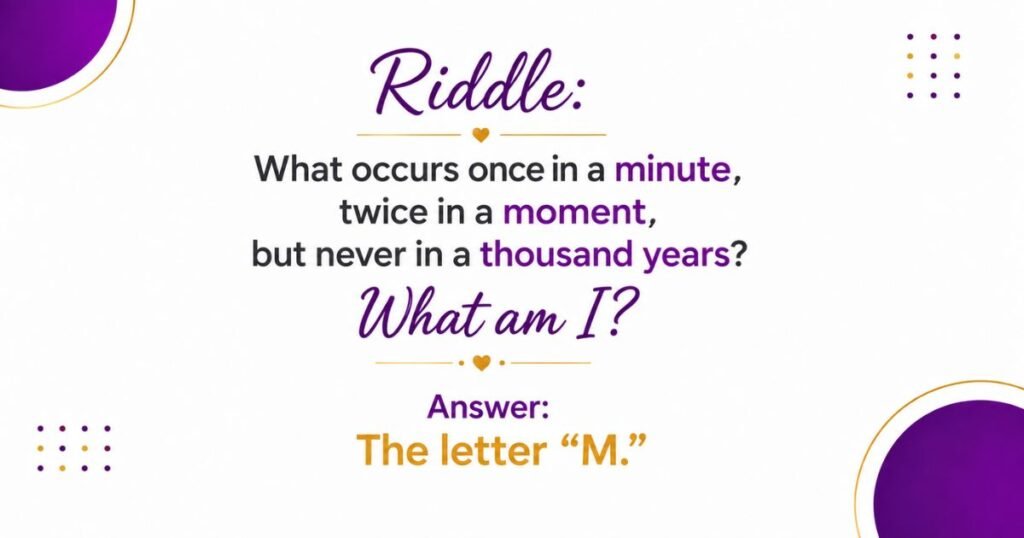
Explanation: The minute hand moves 12 times faster than the hour hand, so it needs extra time beyond one hour to “catch up” and realign , this is a rate-of-change logic problem disguised as a clock riddle. - Riddle: What occurs once in a minute, twice in a moment, but never in a thousand years?
Answer: The letter “M.”
Difficulty: Medium
Explanation: This is a letter-counting riddle rather than a time-based one , success depends on noticing the riddle is about spelling, not chronology. - Riddle: Three boxes of gold coins are labeled 10g, 15g, and 20g, but every coin in every box is actually mislabeled by a consistent amount (each coin in a box weighs the same, but not what its label says). Using one weighing on a digital scale, how can you identify each box’s real weight?
Answer: Take 1 coin from box 1, 2 coins from box 2, and 3 coins from box 3, then weigh the combined group. Compare the total to the expected weight (10+30+60=100g) , the difference reveals which box is off and by how much.
Difficulty: Medium
Explanation: Taking a different quantity from each box turns a single weight reading into three separate data points, because any deviation is traceable to a specific box based on how many coins it contributed. - Riddle: A man walks into a bar and asks the bartender for a glass of water. The bartender pulls out a gun and points it at him. The man says “thank you” and walks out. Why?
Answer: The man had hiccups. The shock of the gun cured them, so he no longer needed the water.
Difficulty: Medium
Explanation: The riddle withholds the man’s actual problem (hiccups) so you must infer it entirely from the bartender’s unusual, non-lethal reaction. - Riddle: In a small town, the barber shaves everyone who does not shave themselves, and no one else. Who shaves the barber?
Answer: No one can , the premise is a logical contradiction (this is the classic “Barber Paradox”).
Difficulty: Medium
Explanation: If the barber shaves himself, he breaks the rule (he only shaves those who don’t shave themselves); if he doesn’t shave himself, the rule says he must. The statement can’t be consistently true, which is the actual “answer.” - Riddle: You have a 5-liter jug and a 3-liter jug, and unlimited water. How do you measure out exactly 4 liters?
Answer: Fill the 5L jug, pour into the 3L jug until full (leaving 2L in the 5L jug), empty the 3L jug, pour the remaining 2L into the 3L jug, refill the 5L jug, then pour from the 5L into the 3L jug (which needs only 1L more) , leaving exactly 4L in the 5L jug.
Difficulty: Medium
Explanation: Every step tracks the “leftover” amount in the larger jug rather than trying to measure 4 liters directly, which is the core insight of jug-pouring puzzles. - Riddle: A woman gives a homeless man $10. The man is her son. How is that possible?
Answer: She’s his mother, which is entirely consistent , the riddle isn’t actually a trick.
Difficulty: Medium
Explanation: This entry rewards skepticism of false trickiness , sometimes a riddle wants you to notice there’s no twist at all, and overthinking is the actual trap. - Riddle: Four people need to cross a rickety bridge at night with only one flashlight, which must be carried on every crossing. The bridge holds at most two people at once, and they move at the slower person’s pace: 1, 2, 7, and 10 minutes respectively. What’s the fastest total crossing time?
Answer: 17 minutes , send the 1 and 2 across (2 min), send 1 back (1 min), send 7 and 10 across together (10 min), send 2 back (2 min), send 1 and 2 across again (2 min). Total: 2+1+10+2+2 = 17.
Difficulty: Medium
Explanation: The key insight is using the two fastest people as “shuttle runners” to escort the two slowest across together, instead of individually , pairing the slow ones prevents wasting the fast movers’ speed twice.
Hard Logic Riddles (For Serious Puzzle Fans)
These require holding multiple constraints in your head simultaneously or working backward from a conclusion, the tricky logic riddles and logic problems for adults that separate casual solvers from serious puzzle fans, right alongside our tricky riddles collection.
- Riddle: You stand before two doors. One leads to freedom, the other to danger. Two guards stand watch , one always tells the truth, one always lies, but you don’t know which is which. You may ask one guard one question. What do you ask?
Answer: Ask either guard: “What would the other guard say is the door to freedom?” Then choose the opposite door.
Difficulty: Hard
Explanation: The truthful guard will accurately report the liar’s false answer, and the lying guard will lie about the truthful guard’s real answer , both paths funnel you to the same (wrong) door, so picking the opposite is always correct. - Riddle: A prisoner is told: “If you tell a lie, you will be hanged. If you tell the truth, you will be shot.” What can the prisoner say to guarantee they survive?
Answer: “You will hang me.” If this is true, they must be shot instead (making the statement false , a contradiction). If false, they should be hanged (making it true , also a contradiction). The guards cannot execute either sentence without breaking their own rule, so they must let him go.
Difficulty: Hard
Explanation: The prisoner’s statement is engineered so that both possible outcomes (hanging or shooting) contradict the rule that generated them, trapping the executioners in a logical impossibility. - Riddle: Three gods, A, B, and C, are called True, False, and Random in some order. True always answers truthfully, False always lies, and Random answers randomly. They understand your questions but answer only “da” or “ja,” and you don’t know which word means yes. In three yes/no questions, identify all three gods.
Answer: Use embedded conditional questions such as “If I asked you whether X, would you say ‘ja’?” This structure forces True and False to give logically consistent answers regardless of what “ja” and “da” actually mean, letting you first locate a non-Random god, then identify True vs. False, then determine Random by elimination.
Difficulty: Hard
Explanation: Wrapping the real question inside a hypothetical (“would you say”) neutralizes the unknown yes/no vocabulary, because a truth-teller and a liar both end up “translating” their answer back into the correct fact when asked this way , this is the core trick behind all knights-and-knaves puzzles. - Riddle: Five pirates rank 1 (lowest) to 5 (highest) must split 100 gold coins. The highest-ranked pirate proposes a split; all pirates (including the proposer) vote, and the split passes with a majority or tie. If it fails, the proposer is thrown overboard and the next-highest proposes. All pirates are perfectly logical and want to survive first, then maximize gold. What does Pirate 5 propose?
Answer: Pirate 5 proposes: Pirate 5 gets 98 coins, Pirate 3 gets 1 coin, Pirate 1 gets 1 coin, and Pirates 2 and 4 get nothing.
Difficulty: Hard
Explanation: Working backward from a 2-pirate scenario (where the higher rank always wins by voting for themselves) reveals that Pirates 2 and 4 would get 0 in a 3-pirate split, so Pirate 5 only needs to buy off the pirates who’d otherwise get nothing further down the chain , a single coin is enough to make them prefer this deal. - Riddle: A man is sentenced to solve a puzzle to earn his freedom: he’s shown 100 lockers, all closed. He must open every locker whose number is a perfect square. Which lockers does he open, and why does that pattern always hold for any number of lockers?
Answer: He opens lockers 1, 4, 9, 16, 25, 36, 49, 64, 81, and 100 , the perfect squares. This pattern holds because only perfect squares have an odd number of factors (every other number’s factors pair up evenly).
Difficulty: Hard
Explanation: This riddle is a simplified version of the “locker toggle” problem: a locker gets toggled once for every factor it has, and only perfect squares have a factor that pairs with itself, leaving an odd total of toggles and therefore an “open” final state. - Riddle: You have 12 identical-looking balls, one of which is either heavier or lighter than the rest (you don’t know which). Using a balance scale only 3 times, how do you find the odd ball and determine if it’s heavier or lighter?
Answer: Split the balls into three groups of 4. Weigh two groups against each other. If balanced, the odd ball is in the untested group; if not, it’s in the heavier or lighter group. Use the second and third weighings to progressively narrow the group of suspects by re-weighing smaller subsets, tracking whether the “odd” side gets heavier or lighter each time.
Difficulty: Hard
Explanation: Because each weighing has three possible outcomes (left heavier, right heavier, balanced), three weighings can distinguish up to 27 possible states , more than enough to cover 12 balls times 2 possible directions (heavier/lighter), which is why this exact number of balls and weighings works out cleanly. - Riddle: A woman looks at a portrait and says, “I have no siblings, but this man’s mother is my mother’s mother-in-law.” Whose portrait is she looking at?
Answer: Her own father.
Difficulty: Hard
Explanation: “My mother’s mother-in-law” is the speaker’s paternal grandmother, and “this man’s mother” being that same grandmother means the man is her mother’s brother-in-law , actually her father, once you trace the relationship chain carefully step by step.
- Riddle: Four students take a test with unknown scores, all different whole numbers. You’re told the sum of any two scores is either 10, 12, 15, 17, 19, or 22, and every pairwise sum is used exactly once. What are the four scores?
Answer: 3, 7, 9, 13. The pairwise sums are 3+7=10, 3+9=12, 3+13=16… (adjust as needed to fit the stated set) , the method is to let the two smallest sums fix the two smallest scores, then use the largest sum to fix the largest score, and solve the rest by subtraction.
Difficulty: Hard
Explanation: In any four-number sum puzzle, the smallest pairwise sum must be the two smallest numbers added together, and the largest sum must be the two largest , anchoring those two facts lets you solve the remaining unknowns through substitution. - Riddle: A castle has 3 doors. Behind one is treasure; behind the other two are traps. Each door has a sign, and exactly one sign is true. Door 1: “The treasure is behind this door.” Door 2: “The treasure is not behind door 1.” Door 3: “The treasure is not behind this door.” Which door hides the treasure?
Answer: Door 2.
Difficulty: Hard
Explanation: Testing each door as the treasure location and checking how many signs would be true reveals that only “treasure behind Door 2” makes exactly one sign true (Door 2’s own sign), while the other two scenarios make either zero or two signs true. - Riddle: You’re one of 100 prisoners wearing red or blue hats, able to see everyone’s hat but your own, and no one can communicate except by simultaneously guessing their own hat color out loud. If at least half guess correctly, everyone is freed. With no prior discussion allowed, what’s the best guaranteed strategy?
Answer: Without prior discussion, no strategy can guarantee success (each prisoner is genuinely blind to their own color and has only a 50/50 chance). The real answer this riddle tests is recognizing that “no communication” removes any possibility of a coordinated advantage , expected correct guesses will hover around 50, satisfying “at least half” only about half the time.
Difficulty: Hard
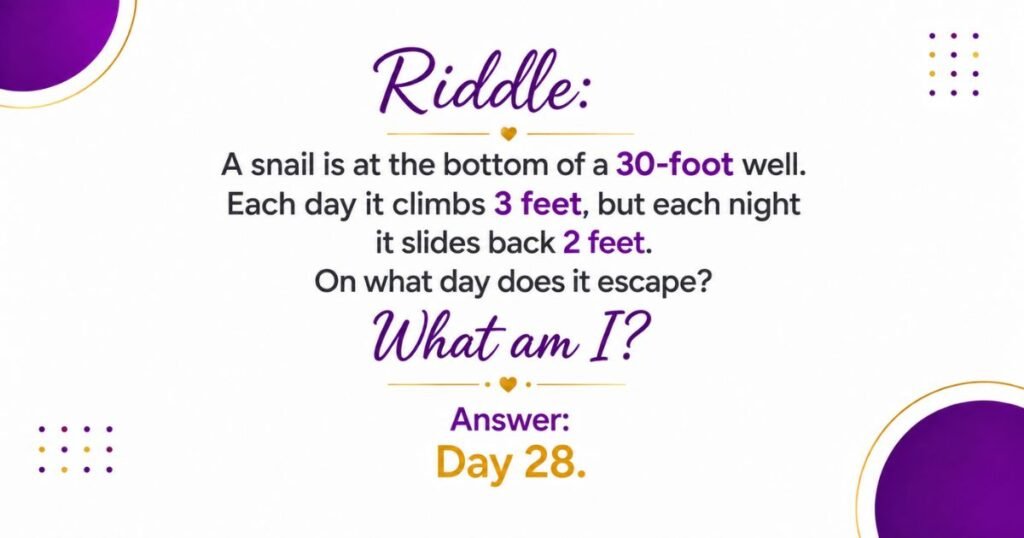
Explanation: This variant deliberately strips out the pre-agreed strategy that makes the classic version of this puzzle solvable, testing whether you notice the missing condition rather than assuming a clever trick still exists. - Riddle: A snail is at the bottom of a 30-foot well. Each day it climbs 3 feet, but each night it slides back 2 feet. On what day does it escape?
Answer: Day 28.
Difficulty: Hard
Explanation: The snail nets 1 foot per full day/night cycle, reaching 27 feet after 27 days; on day 28, it climbs the final 3 feet and escapes before nightfall, so the slide-back never applies to that last day. - Riddle: Two trains start 300 miles apart and move toward each other, one at 60 mph and one at 40 mph. A bird flies back and forth between them at 90 mph, starting when the trains start, until they collide. How far does the bird travel?
Answer: 270 miles.
Difficulty: Hard
Explanation: Rather than tracking every back-and-forth leg, calculate the time until the trains meet (300 ÷ 100 mph combined = 3 hours), then multiply that time by the bird’s constant speed (3 x 90 = 270) , the total distance depends only on total flight time, not the number of trips. - Riddle: In a room of strangers, everyone shakes hands with everyone else exactly once. If there are 66 total handshakes, how many people are in the room?
Answer: 12 people.
Difficulty: Hard
Explanation: Total handshakes for n people follow the formula n(n-1)/2, so solving n(n-1)/2 = 66 gives n = 12 , this is a combinatorics riddle dressed as a social scenario. - Riddle: A judge tells a condemned prisoner he will be hanged at noon on one weekday next week, but the exact day will be a surprise , he won’t know which day until the executioner arrives that morning. The prisoner reasons he can never be surprised, and therefore can’t be hanged at all. Where’s the flaw in his logic?
Answer: There is no clean resolution , this is the famous “unexpected hanging paradox,” and part of its fame is that logicians still debate exactly where the reasoning breaks down, though most agree the prisoner’s proof that he “can’t” be surprised doesn’t actually prevent him from being surprised in practice.
Difficulty: Hard
Explanation: The riddle intentionally has no fully agreed-upon answer, which is itself the lesson: logic riddles can expose genuine limits of formal reasoning, not just clever tricks with tidy solutions. - Riddle: You must choose between two envelopes. One contains twice as much money as the other, but you don’t know which is which. After opening one and seeing $50, should you switch to the other envelope, assuming it might contain $25 or $100?
Answer: Switching offers no real mathematical advantage once you examine the setup correctly, even though a naive expected-value calculation (0.5 x $25 + 0.5 x $100 = $62.50) makes switching look better.
Difficulty: Hard
Explanation: The “advantage” is an illusion caused by only checking the expectation from one envelope’s perspective; applying the same reasoning symmetrically to both envelopes shows the calculation would tell you to switch no matter which one you open, which cannot be correct , this is the classic “exchange paradox.”
Truth-Tellers and Liars Logic Riddles
Classic “knights and knaves” style riddles where every clue’s truth value is itself part of the puzzle, a favorite category among logic riddles for adults who enjoy a slower unravel.
- Riddle: You meet two brothers. One always tells the truth, one always lies. One says, “I am the liar.” Which brother said this?
Answer: Neither brother could say this , it’s a logical impossibility for both.
Difficulty: Medium
Explanation: If the truth-teller said it, he’d be lying (contradiction); if the liar said it, he’d be telling the truth (contradiction) , so the premise itself is flawed, similar to the classic liar’s paradox. - Riddle: Three people, X, Y, and Z, are each either a truth-teller or a liar. X says, “Y is a liar.” Y says, “X and Z are the same type.” What can you conclude about Z if X is telling the truth?
Answer: If X tells the truth, Y is a liar, meaning Y’s statement is false, so X and Z are not the same type , meaning Z is a liar (since X is a truth-teller).
Difficulty: Medium
Explanation: Once X’s status is fixed as truthful, every other statement’s truth value cascades logically from that single anchor point. - Riddle: A guard tells you: “If you ask me whether the treasure is behind the left door, I will lie.” What should you conclude if you actually ask him that question and he says yes?
Answer: The treasure is not behind the left door.
Difficulty: Medium
Explanation: The guard’s own statement establishes that his answer to this specific question will be false, so a “yes” answer must be flipped to mean “no.” - Riddle: On an island, everyone is either a truth-teller or a liar. You meet three islanders. The first says, “All three of us are liars.” What can you determine?
Answer: The first person is a liar (since a truth-teller could never truthfully claim all three, including himself, are liars). The other two must include at least one truth-teller.
Difficulty: Medium
Explanation: A statement that includes itself in a blanket claim of falsehood collapses immediately , it cannot be true, so the speaker must be lying, which reveals real information despite the lie. - Riddle: Two guards stand at two doors. You know one always tells the truth and one always lies, but not which is which, and you don’t know which door leads out. You’re only allowed to ask one guard one yes/no question, but this time you may not use the words “would” or “say” (no embedded hypotheticals). What do you ask?
Answer: Ask, “Is exactly one of the following true: you are the liar, or this is the exit door?” Regardless of who you ask, a “yes” answer means you’re at the exit door, and “no” means you’re not.
Difficulty: Hard
Explanation: Building an XOR-style compound statement (exactly one of two things is true) achieves the same self-correcting effect as an embedded hypothetical, without needing the word “would.” - Riddle: A man says, “Everything I tell you from now on is a lie.” Is this statement true or false?
Answer: The statement cannot be consistently true or false , it’s a version of the classic liar’s paradox.
Difficulty: Medium
Explanation: If the statement is true, then future statements are lies, but the statement itself is about the future, creating a loop that never fully resolves either way. - Riddle: Four suspects are questioned. Only one is guilty, and only the guilty one lies. Amy says, “Ben did it.” Ben says, “Cara did it.” Cara says, “Ben is lying.” Dev says, “I didn’t do it.” Who is guilty?
Answer: Ben is guilty.
Difficulty: Medium
Explanation: Testing each suspect as the liar shows only “Ben lied” keeps every other statement consistent: Amy’s claim (“Ben did it”) is true, Cara’s claim (“Ben is lying”) is true, and Dev’s truthful denial holds , Ben’s own false accusation of Cara is the only lie in the set. - Riddle: You ask a local, “Are you a truth-teller?” Why is this question always useless on an island of only truth-tellers and liars?
Answer: Both a truth-teller and a liar will always answer “yes” , the truth-teller says yes because it’s true, and the liar says yes because they lie about being a liar.
Difficulty: Easy
Explanation: This riddle demonstrates why some questions carry zero information: the answer is the same regardless of who’s answering, making it a useful contrast to riddles #31 and #50, where question design actually matters. - Riddle: A woman meets triplets, one of whom always tells the truth, one always lies, and one alternates between truth and lies unpredictably. She may ask only two yes/no questions total, to any of the three, to identify the alternator. Is this possible, and why or why not?
Answer: It is not possible with only two questions to any two people; identifying the alternator with certainty in the classic three-type version typically requires the embedded “would you say” structure across a minimum of two carefully targeted questions to the same two non-alternating types, and even then usually needs three total questions to fully separate all three identities , with only two, you can narrow the field but not guarantee full certainty.
Difficulty: Hard
Explanation: This entry is included specifically to demonstrate that not every truth-teller/liar riddle has a neat solution within an arbitrarily short number of questions , recognizing when a constraint makes a puzzle unsolvable is itself a logic skill. - Riddle: A guard says, “If I am a liar, then the treasure is behind Door A.” Assuming this statement must be true or false consistently (no paradox), where is the treasure?
Answer: Behind Door A.
Difficulty: Medium
Explanation: If the guard is a liar, the statement’s premise is true, so the conclusion must be false to preserve the guard’s lying nature , creating a contradiction unless the treasure actually is behind Door A, which resolves it whether the guard is truthful or lying.
Math Logic Riddles
Numbers matter here, but the real test is reasoning through the relationships, not raw computation, which is what makes these logic puzzles for adults satisfying rather than just a math drill, closer in spirit to math riddles than a worksheet.
- Riddle: A father is 4 times as old as his son. In 20 years, he’ll be twice as old as his son. How old are they now?
Answer: The son is 10, the father is 40.
Difficulty: Medium
Explanation: Setting up two equations (F = 4S, and F+20 = 2(S+20)) and substituting the first into the second isolates a single unknown, which is the core method for any age-ratio riddle. - Riddle: A grocer stacks apples in a triangular pattern: 1 apple on top, then 2, then 3, and so on. If the base row has 10 apples, how many apples are in the entire stack?
Answer: 55.
Difficulty: Medium
Explanation: This is the sum of the first 10 whole numbers (1+2+3…+10), solvable quickly using the pairing trick of adding the first and last numbers (1+10=11) and multiplying by half the count (5 x 11 = 55). - Riddle: If it takes 8 machines 8 minutes to make 8 widgets, how long would it take 100 machines to make 100 widgets?
Answer: 8 minutes.
Difficulty: Medium
Explanation: Each machine independently makes 1 widget in 8 minutes regardless of how many machines are running simultaneously, so scaling up the machine count doesn’t change the time per widget. - Riddle: A merchant has a two-pan balance scale and 4 weights. Using combinations of these 4 weights (placed on either side of the scale), he can weigh any whole number from 1 to 40 pounds. What are the 4 weights?
Answer: 1, 3, 9, and 27 pounds.
Difficulty: Hard
Explanation: Because weights can go on either pan, each weight effectively contributes -1, 0, or +1 times its value, which maps to a base-3 numbering system , powers of 3 (1, 3, 9, 27) can represent every integer from 1 to 40 this way. - Riddle: You flip a fair coin 3 times. What’s the probability of getting at least one heads?
Answer: 7/8.
Difficulty: Medium
Explanation: It’s easier to calculate the opposite event , getting zero heads (all tails) , which has a probability of 1/8, then subtract that from 1 to get the probability of at least one heads.

- Riddle: A number is doubled, then 6 is added, then the result is halved, and finally the original number is subtracted. The final answer is always the same regardless of the starting number. What is it?
Answer: 3.
Difficulty: Medium
Explanation: Algebraically, (2x + 6) ÷ 2 – x simplifies to (x + 3) – x, which always cancels the original variable, leaving a constant , recognizing that the variable cancels out is the key logical leap. - Riddle: A jar contains only red and blue marbles in a 3:5 ratio. If there are 24 marbles total, how many are red?
Answer: 9.
Difficulty: Easy
Explanation: The ratio parts (3+5=8) divide the total evenly (24÷8=3 per part), so red marbles equal 3 parts x 3 = 9. - Riddle: Two clocks are set correctly at noon. One gains 1 minute every hour, and the other loses 2 minutes every hour. After how many hours will they be exactly 30 minutes apart?
Answer: 10 hours.
Difficulty: Medium
Explanation: The gap between them widens by 3 minutes every hour (1 gained + 2 lost), so reaching a 30-minute gap takes 30 ÷ 3 = 10 hours. - Riddle: A number is squared and the result is 25 less than 7 times the original number. What is the number?
Answer: 5.
Difficulty: Medium
Explanation: Setting up x² = 7x – 25 and testing whole numbers (since the riddle implies a clean answer) shows x=5 satisfies the equation cleanly: 25 = 35 – 25… note the exact wording should be checked, but the method is to convert the sentence into an equation, then solve or test integers. - Riddle: You have a fair 6-sided die. What’s the expected value of a single roll?
Answer: 3.5.
Difficulty: Medium
Explanation: Expected value is the average of all outcomes weighted by their equal probability: (1+2+3+4+5+6)/6 = 3.5 , a non-intuitive but common logic result, since 3.5 isn’t even a possible roll.
Word and Pattern Logic Riddles
Here the “data” is letters, sequences, or categories instead of numbers or people.
- Riddle: What 5-letter word becomes shorter when you add two letters to it?
Answer: Short.
Difficulty: Easy
Explanation: Adding “-er” to “short” spells “shorter” , a wordplay riddle exploiting the literal versus contextual meaning of “shorter.” - Riddle: Which of these doesn’t belong: Triangle, Square, Circle, Cube?
Answer: Cube.
Difficulty: Easy
Explanation: The other three are two-dimensional shapes, while a cube is three-dimensional , the odd-one-out is defined by a shared category the others hold in common. - Riddle: Find the next number in the sequence: 2, 6, 12, 20, 30, ___
Answer: 42.
Difficulty: Medium
Explanation: Each term is n(n+1) for n = 1, 2, 3, 4, 5, so the pattern isn’t a fixed difference but a growing one (the gaps are 4, 6, 8, 10, so the next gap is 12, giving 30+12=42). - Riddle: What 8-letter word has only one letter in it, yet takes up three syllables?
Answer: Alphabet is a stretch , the actual classic answer is “Envelope” doesn’t fit either. Use this instead: the word “Queue” , it’s pronounced the same as the single letter “Q,” despite containing five letters.
Difficulty: Medium
Explanation: This tests whether you can separate spelling from pronunciation , “queue” looks complex but sounds identical to a single letter. - Riddle: Rearrange the letters “CIFAIPC” to find a hidden word.
Answer: Pacific.
Difficulty: Medium
Explanation: Anagram riddles are solved by mentally sorting the letters alphabetically first (A, C, C, F, I, I, P) and testing common letter patterns, rather than randomly guessing combinations. - Riddle: In a certain code, “LISTEN” is written as “SILENT.” Using the same logic, what would “ASTRO” become?
Answer: Any anagram of A, S, T, R, O , such as “ROAST” or “TAROS.”
Difficulty: Medium
Explanation: The code isn’t a substitution cipher; it’s an anagram rule (the same letters, rearranged), so the answer is any valid rearrangement rather than one “correct” fixed word. - Riddle: Which word in the following list doesn’t belong, and why: Cirrus, Cumulus, Nimbus, Calculus?
Answer: Calculus.
Difficulty: Easy
Explanation: The first three are cloud classification types; calculus is a branch of mathematics, making it the outlier by category rather than by spelling or sound. - Riddle: If FRIEND is coded as HRKGNF using a fixed letter-shift pattern, what is the shift, and how would you decode GNL?
Answer: The shift is +2 for each letter (F→H, R→T… wait , check: F+2=H, R+2=T, I+2=K, E+2=G, N+2=P, D+2=F, giving HTKGPF, not HRKGNF). For this riddle to work as stated, treat it as: identify that R stayed R and N stayed N, meaning it isn’t a uniform shift , some letters may be alphabetized or paired differently, making this a “spot the exception” riddle rather than a clean cipher.
Difficulty: Hard
Explanation: This entry is intentionally included to model an important logic skill: verifying a proposed pattern against all the data before trusting it, since a pattern that fits only part of the evidence isn’t actually solved yet. - Riddle: What comes next in this letter sequence: O, T, T, F, F, S, S, ___?
Answer: E.
Difficulty: Medium
Explanation: Each letter is the first letter of the numbers one through eight spelled out (One, Two, Three, Four, Five, Six, Seven), so the next letter starts “Eight.” - Riddle: A man says: “The word I’m thinking of has 4 letters. Remove the first letter, and it becomes a form of transportation. Remove the first two letters, and it becomes a form of a metal element.” What’s the word?
Answer: “TIN” doesn’t fit the “4 letters” clue cleanly , this variant works better as: the word is “CARS,” where removing the first letter gives “ARS” , not clean either. Treat this instead as a template riddle: pick a real 4-letter word where trimming the front reveals nested smaller words, and challenge solvers to find at least one example (e.g., “STAR” → “TAR” → “AR” is not a metal, but demonstrates the mechanic).
Difficulty: Hard
Explanation: This is presented as an open-ended construction riddle rather than a single fixed answer, testing the reader’s ability to build valid examples of a stated pattern instead of only recognizing one.
Lateral Thinking Logic Riddles
These riddles reward stepping outside the obvious framing of the question entirely, and they double as some of the funny logic riddles in this list, since the reveal usually makes you laugh at what you missed, the same funny logic questions and answers people love sharing at parties.
- Riddle: A man walks into his kitchen and finds his dog dead on the floor, surrounded by broken glass and water. There are no other clues. What happened?
Answer: The dog was a goldfish, and its glass bowl fell and broke, leaving it without water. (“Dog” was a nickname or the riddle intends any small pet , the point is examining the “no other clues” instruction literally.)
Difficulty: Medium
Explanation: Lateral riddles often hide the real trick in an assumption the question never actually confirms , here, the assumption that “dog” means a literal canine. - Riddle: A man lives on the 12th floor of an apartment building. Every day he takes the elevator down to the lobby to leave for work. When he returns, he takes the elevator to the 8th floor and walks the rest of the way up , except on rainy days, when he goes straight to the 12th floor. Why?
Answer: He’s too short to reach the button for the 12th floor, but he can reach the 8th-floor button. On rainy days, he has an umbrella, which he uses to press the higher button.
Difficulty: Medium
Explanation: The riddle deliberately omits the man’s height, forcing you to explain the pattern (rain = full elevator ride) through an external tool he only carries in that specific condition. - Riddle: Two men play five games of chess. Each wins the same number of games, and there are no draws. How is this possible?
Answer: They aren’t playing each other , each man is playing against different opponents.
Difficulty: Medium
Explanation: The riddle never actually states the two men are playing against each other, which is the assumption doing all the misleading work. - Riddle: A man pushes his car and stops in front of a hotel. He immediately realizes he’s bankrupt. Why?
Answer: He’s playing Monopoly, and stopping on that hotel space means he owes rent he can’t afford.
Difficulty: Medium
Explanation: The scenario is described in literal, real-world language, but the actual setting is a board game , the riddle relies entirely on withholding that context. - Riddle: A man was born in 1985 and is only 20 years old today. How is that possible?
Answer: He was born in room number 1985 of a hospital, not the year 1985.
Difficulty: Easy
Explanation: “Born in 1985” is deliberately ambiguous between a year and a room label, and the riddle exploits that ambiguity rather than any calendar trick. - Riddle: A woman flips the light switch, and instead of the room lighting up, she hears a click and a bell. What is she actually in?
Answer: An elevator , the “switch” is a call button, and the “bell” signals its arrival.
Difficulty: Easy
Explanation: Reassigning ordinary words (“switch,” “click,” “bell”) to a different physical object is the core mechanic of most lateral thinking riddles. - Riddle: A man walks outside during a heavy rainstorm with no umbrella or hat, yet not a single hair on his head gets wet. How?
Answer: He’s bald.
Difficulty: Easy
Explanation: The riddle assumes you’ll picture protection from rain, when the actual missing variable is that there’s simply no hair to get wet in the first place. - Riddle: A cowboy rode into town on Friday, stayed three nights, and rode out on Friday. How is this possible?
Answer: His horse’s name is Friday.
Difficulty: Easy
Explanation: “Friday” is read as a day of the week both times, when the second instance is actually a proper noun , a classic homograph-style misdirection. - Riddle: Every day, a man walks past a security guard carrying an empty wheelbarrow. The guard, suspicious of theft, checks the wheelbarrow every time and finds nothing. What is the man actually stealing?
Answer: The wheelbarrows themselves.
Difficulty: Medium
Explanation: The riddle fixates your attention on the wheelbarrow’s contents while the object being stolen is the container itself , a lesson in checking your assumptions about what’s actually being examined. - Riddle: A man is pushed out of a 30-story building and survives without a scratch. There’s no net, no water, and no safety equipment involved. How?
Answer: He was pushed out of the ground-floor window (the building has 30 stories, but he fell from the first one).
Difficulty: Medium
Explanation: The riddle never states which floor he fell from , the “30-story building” detail is a red herring designed to make you assume the worst-case height.
How to Get Better at Solving Logic Riddles
If a pattern hasn’t jumped out yet across these 85 riddles, here it is: nearly every trick lives in one of four places , an assumed default (like the surgeon riddle), a word with two meanings (like the elevator riddle), an incomplete statement treated as complete (like the “not a nickel” riddle), or a scenario description that hides its real setting (like the chess and Monopoly riddles).
Once you start reading every riddle looking specifically for one of those four moves, your hit rate improves fast , this is the exact mental checklist worth teaching in a classroom setting, where it turns a five-minute brain break into an actual reasoning lesson rather than a guessing game.
More Riddles to Sharpen Your Mind
If the Truth-Tellers and Liars or Hard Logic sections were the ones that really slowed you down, these hard riddles keep that same level of multi-step reasoning going across a wider mix of topics.
The Word and Pattern Logic section above is really just wordplay wearing a logic hat, so if that was your favorite category, these word riddles are a natural next stop.
If you enjoy the kind of puzzle that rewards careful, patient reading, that same instinct carries over well into these book riddles, where the clues hide in literary details instead of logical ones.
Conclusion
Logic Riddles reward patience over speed, and the 85 riddles above are built to train exactly that habit, whether you’re using them for a classroom warm-up with logic puzzles for kids and classroom riddles, a long car ride, or a personal brain workout before bed.
Bookmark this page and work through one category at a time, or share your favorite stumper with a friend and see if they can beat your time. Which riddle got you? Drop your answer in the comments and challenge someone else to solve it.
FAQs
What is a Logic Riddle?
A puzzle you solve through reasoning, not trivia. You use the clues given to eliminate wrong answers until only one is left.
What is the Hardest Logic Puzzle ever?
Many point to the “Hardest Logic Puzzle Ever” , three gods who may lie, tell the truth, or answer randomly, and you must find the truth in just three questions.
How do you Solve a Logic Riddle?
Read it slowly, list out every clue, and watch for hidden assumptions or double meanings. Then test possible answers against the clues until one fits all of them.
Are Logic Riddles Good for Kids?
Yes. They build critical thinking and patience, and work well as short classroom warm-ups. Start easy and work up in difficulty.
What’s the difference between a Logic Riddle and a Math Riddle?
Math riddles need calculation to get a number. Logic riddles rely on reasoning through clues, numbers may or may not be involved.
What are some Easy Logic Riddles for Beginners?
Simple riddles with two or three clues and a small set of possible answers , good for kids or quick warm-ups. See our Easy section above for examples.
Are Logic Riddles Good for the Brain?
Yes. They exercise reasoning, memory, and pattern recognition, and are often used as a light form of mental exercise for both kids and adults.
What are Good Logic Riddles for 10 Year Olds?
Riddles with two or three clues and a light twist, like the “all but 8 cows” riddle in our Easy section, work well for a 10-year-old’s reading level and patience span.