90+ Biology Riddles With Answers (For Kids, Students and Adults)
Riddles are a fun way to learn biology, no memorizing required, just clues, wordplay, and a little logical thinking.
This collection of 90+ Biology Riddles with answers covers the human body, animals, plants, cells, and genetics, and a few microbiology riddles, sorted by difficulty so there’s something for every age.
Each riddle comes with its answer and a quick explanation, so you’ll know exactly why it works. Perfect for classroom warm-ups, homeschool lessons, trivia nights, or keeping kids entertained on a long car ride.
What Makes a Good Biology Riddle?
A strong biology riddle does two things at once: it hides a real scientific fact behind a clue, and it rewards the solver with a genuine “aha” moment when the fact clicks into place. The best Biology Riddles with answers for kids lean on familiar body parts and animals, while riddles for teens and adults can lean into genetics, cellular biology, or scientific terminology, the kind you’ll find across most science riddles collections.
Most biology riddles fall into one of three styles:
- “What am I?” riddles , a first-person description of an organ, cell, or organism that you have to identify
- Wordplay riddles , jokes and puns that rely on double meanings of scientific terms (like “cell” meaning both a biology unit and a jail room)
- Logic riddles , clues that require you to reason through biological facts step by step, rather than just recognizing a pun
Understanding which style you’re working with makes solving , and writing , Biology Riddles much easier. Below, every riddle is labeled by difficulty so you can pick the right level for your audience, whether that’s a 2nd-grade science class or an adult trivia night.
Easy Biology Riddles for Kids Biology Riddles for High School Kids
These are the gentlest entry point into Biology Riddles , ideal for elementary classrooms, homeschool science mornings, or the first few minutes of a family game night. Each one points to a body part or basic body function that young kids already know by name, so the “aha” moment comes fast.
- Riddle: I have thirty-two friends who live inside a red house and come out to greet your food. What am I?
Answer: Teeth
Difficulty: Easy
Explanation: The “red house” is the mouth, and the thirty-two friends are the standard number of adult teeth , a classic riddle that leans on counting and everyday anatomy. - Riddle: You use me to see the world, but I never see myself without help. What am I?
Answer: Your eyes
Difficulty: Easy
Explanation: This works on simple logic , eyes let you see everything except themselves, which is why mirrors exist. - Riddle: I pump all day and all night, and I never take a break, or you’re in trouble. What am I?
Answer: The heart
Difficulty: Easy
Explanation: Straightforward factual riddle built on the heart’s constant, involuntary beating. - Riddle: I grow all your life, even after you’re gone, but I can be trimmed down to size. What am I?
Answer: Hair and nails
Difficulty: Easy
Explanation: Plays on the common myth that hair and nails “keep growing” after death , in reality, skin dehydration just makes them look longer, which is a fun teaching moment. - Riddle: I let you smell fresh cookies and warn you about smoke, all through two small holes. What am I?
Answer: Your nose
Difficulty: Easy
Explanation: Direct functional clue pointing to the sense of smell. - Riddle: I’m soft, I’m pink, and I help you taste, talk, and swallow. What am I?
Answer: Your tongue
Difficulty: Easy
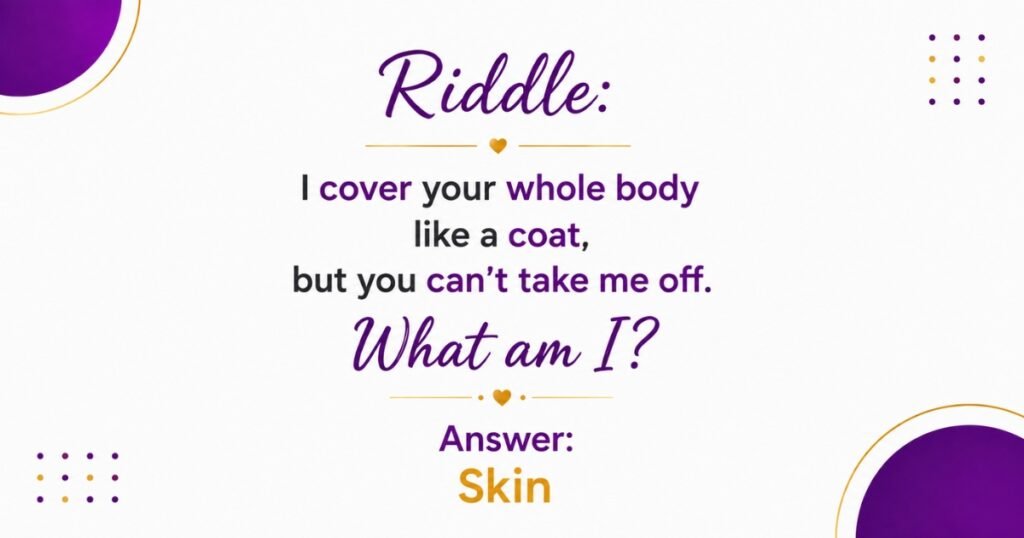
Explanation: Lists the tongue’s three major jobs in a simple, memorable rhythm for young readers. - Riddle: I cover your whole body like a coat, but you can’t take me off. What am I?
Answer: Skin
Difficulty: Easy
Explanation: Uses a coat metaphor to describe skin as the body’s largest organ and outer covering.
- Riddle: Bend me, twist me, but don’t snap me , I let your knee do its job. What am I?
Answer: A joint (like the knee joint)
Difficulty: Easy
Explanation: Introduces the concept of joints as flexible connectors between bones. - Riddle: I’m on the ends of your fingers and toes, hard as tiny shields. What am I?
Answer: Fingernails and toenails
Difficulty: Easy
Explanation: Simple descriptive riddle using the “shield” metaphor for nails’ protective function. - Riddle: Two of us hang low on the sides of your head, and we never stop listening. What are we?
Answer: Ears
Difficulty: Easy
Explanation: Basic anatomy riddle focused on hearing as a constant, passive sense. - Riddle: I turn food into fuel in a dark, squishy factory below your ribs. What am I?
Answer: Your stomach
Difficulty: Easy
Explanation: The “factory” metaphor introduces digestion in kid-friendly language. - Riddle: I’m the reason you jump when something scares you, and I control everything you do without asking. What am I?
Answer: The brain
Difficulty: Easy
Explanation: Introduces the brain’s role as the body’s control center in a relatable, reflex-based example. - Riddle: I hold you up, but you can’t see most of me. What am I?
Answer: Your skeleton
Difficulty: Easy
Explanation: Simple structural riddle about the skeletal system as internal support. - Riddle: Squeeze me shut when you sneeze, or you’ll blink me open every few seconds anyway. What am I?
Answer: Your eyelids
Difficulty: Easy
Explanation: Combines a voluntary reflex (sneezing) with an involuntary one (blinking) around the same body part. - Riddle: I’m ten little helpers who let you wave, hold, and write. What are we?
Answer: Your fingers
Difficulty: Easy
Explanation: Counting-based riddle listing common everyday hand functions, in the same spirit as math riddles that lean on numbers as the clue.
Easy Biology Riddles About Animals and Plants
Animals and plants are a natural next step once kids master body-part riddles , these lean on familiar creatures and everyday nature facts, making them ideal for a homeschool nature unit or an outdoor science walk.
- Riddle: I start my life swimming with a tail, and I end it hopping without one. What am I?
Answer: A frog
Difficulty: Easy
Explanation: Describes metamorphosis from tadpole to adult frog in simple before-and-after terms. - Riddle: I make my own food using sunlight, and I never have to chase dinner. What am I?
Answer: A plant
Difficulty: Easy
Explanation: Introduces photosynthesis as the process that lets plants “feed themselves” without hunting. - Riddle: I carry my house on my back everywhere I go, and I’m never in a hurry. What am I?
Answer: A snail
Difficulty: Easy
Explanation: Uses the shell-as-house metaphor paired with the snail’s well-known slow pace. - Riddle: I change my coat with the seasons, going from brown to white and back again. What am I?
Answer: An Arctic hare or Arctic fox
Difficulty: Easy
Explanation: Refers to seasonal camouflage, a real adaptation in several Arctic animals. - Riddle: I sting to protect my home, but I only get to do it once. What am I?
Answer: A honeybee
Difficulty: Easy
Explanation: Points to the fact that honeybees lose their stinger and die after stinging, unlike wasps. - Riddle: I breathe through my skin and love damp places, but too much sun dries me out. What am I?
Answer: A frog or earthworm
Difficulty: Easy
Explanation: Describes cutaneous respiration, found in amphibians and some invertebrates. - Riddle: I drink through my roots and breathe through tiny holes in my leaves. What am I?
Answer: A plant
Difficulty: Easy
Explanation: Introduces stomata, the microscopic pores plants use for gas exchange. - Riddle: I glow in the dark without a battery, using a chemical trick in my body. What am I?
Answer: A firefly
Difficulty: Easy
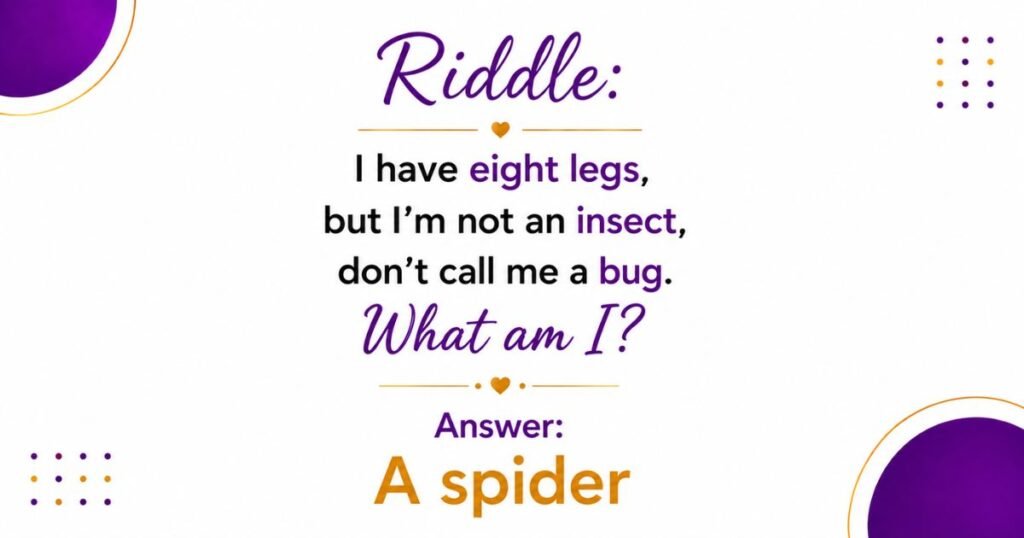
Explanation: References bioluminescence, the natural chemical light production seen in fireflies. - Riddle: I have eight legs, but I’m not an insect , don’t call me a bug. What am I?
Answer: A spider
Difficulty: Easy
Explanation: Teaches the arachnid vs. insect distinction through leg count.
- Riddle: I sleep through winter so I don’t have to find food in the cold. What am I?
Answer: A hibernating animal (like a bear)
Difficulty: Easy
Explanation: Introduces hibernation as an energy-saving survival strategy. - Riddle: I lose my leaves every fall and grow them back every spring. What am I?
Answer: A deciduous tree
Difficulty: Easy
Explanation: Basic plant-cycle riddle distinguishing deciduous trees from evergreens. - Riddle: I can regrow my tail if a predator grabs it. What am I?
Answer: A lizard
Difficulty: Easy
Explanation: References autotomy, the defensive tail-dropping ability seen in many lizard species. - Riddle: I turn from a caterpillar into something with wings inside a case I build myself. What am I?
Answer: A butterfly
Difficulty: Easy
Explanation: Describes metamorphosis and the chrysalis stage in kid-friendly terms. - Riddle: I follow the sun across the sky all day, then turn back east by morning. What am I?
Answer: A sunflower
Difficulty: Easy
Explanation: Refers to heliotropism, the sun-tracking behavior of young sunflowers. - Riddle: I live underwater but I still have to come up for air. What am I?
Answer: A dolphin or whale
Difficulty: Easy
Explanation: Distinguishes air-breathing marine mammals from gill-breathing fish.
What Is a Good Biology Riddle for Kids?
A good biology riddle for kids uses a body part, animal, or plant the child already recognizes, keeps the clue to two or three short lines, and rewards a correct guess with a genuine fact , not just a pun.
The riddles in the two sections above were chosen specifically because they map onto ideas most kids encounter by age seven or eight: teeth, eyes, frogs, bees, and sunflowers.
Teachers who use riddles as a five-minute warm-up often find that starting with an animal riddle (rather than a body-part riddle) lowers the stakes, since there’s no “wrong” personal answer , it’s purely a guessing game about the natural world. From there, moving into body-part riddles naturally opens the door to a short anatomy lesson.
Medium Biology Riddles About Body Systems and Senses
Once the basics are covered, medium-difficulty riddles push a little further into how body systems actually work , nerves, blood, senses, and reflexes , making this section a good fit for upper elementary through middle school.
- Riddle: I carry messages faster than any mail service, using electricity instead of a stamp. What am I?
Answer: A nerve (or the nervous system)
Difficulty: Medium
Explanation: Compares electrical nerve impulses to a messaging system, introducing the speed of neural signals. - Riddle: I’m red, I’m liquid, and I deliver oxygen door-to-door throughout your body. What am I?
Answer: Blood
Difficulty: Medium
Explanation: Focuses on blood’s role in oxygen transport via red blood cells. - Riddle: I’m the reason your hand jerks back from a hot stove before you even think about it. What am I?
Answer: A reflex
Difficulty: Medium
Explanation: Introduces the reflex arc, which bypasses conscious thought for faster reaction time. - Riddle: I’m shaped like a walnut and store the memory of everything you’ve ever learned. What am I?
Answer: The brain
Difficulty: Medium
Explanation: Uses the walnut shape comparison (referring to the brain’s folded cortex) as the wordplay hook. - Riddle: I filter your blood all day and turn the waste into something you flush away. What am I?
Answer: A kidney
Difficulty: Medium
Explanation: Describes the kidney’s filtration role in forming urine. - Riddle: I inflate like two balloons every time you breathe in. What am I?
Answer: Your lungs
Difficulty: Medium
Explanation: Uses a balloon metaphor for lung expansion during inhalation. - Riddle: I taste sweet, sour, salty, bitter, and one more flavor most people forget. What am I?
Answer: Your tongue (the fifth taste is umami)
Difficulty: Medium
Explanation: Tests knowledge of the five basic tastes, including the lesser-known umami. - Riddle: I’m a clear layer over your eye that keeps out dust without blocking your view. What am I?
Answer: The cornea
Difficulty: Medium
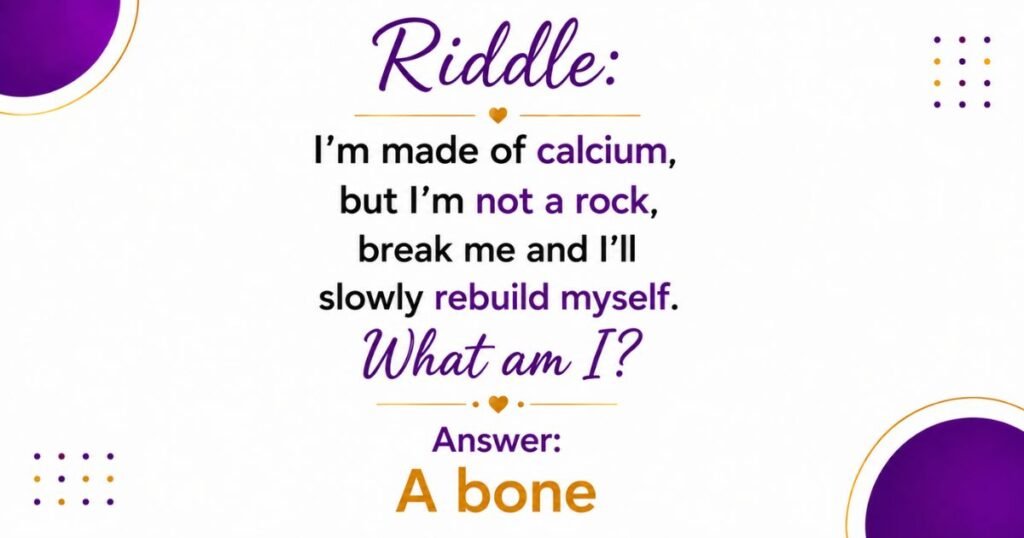
Explanation: Introduces the cornea by name rather than just “the eye,” adding a step of specificity. - Riddle: I’m made of calcium, but I’m not a rock , break me and I’ll slowly rebuild myself. What am I?
Answer: A bone
Difficulty: Medium
Explanation: References bone’s mineral composition and its natural ability to heal itself.
- Riddle: I squeeze food along a twisting tube for about thirty feet before I’m done with it. What am I?
Answer: The digestive system (intestines)
Difficulty: Medium
Explanation: Uses the real approximate length of the human intestinal tract as the clue. - Riddle: I’m a tiny hammer, anvil, and stirrup working together where you can’t see them. What am I?
Answer: The bones of the middle ear
Difficulty: Medium
Explanation: Names the three smallest bones in the human body by their actual anatomical nicknames. - Riddle: I control your body temperature like a thermostat, tucked deep inside your brain. What am I?
Answer: The hypothalamus
Difficulty: Medium
Explanation: Introduces a specific brain structure and its temperature-regulating job. - Riddle: I protect you from germs, and I remember every invader I’ve ever fought. What am I?
Answer: The immune system
Difficulty: Medium
Explanation: References immune memory, the basis for how vaccines and past infections build resistance. - Riddle: I’m a muscle that never gets tired, even though I work every second of your life. What am I?
Answer: The heart
Difficulty: Medium
Explanation: A step up from the easy heart riddle , this one specifically tests knowledge that the heart is a muscle, not just an organ. - Riddle: I stretch when you’re full and shrink when you’re empty, holding roughly a liter at once. What am I?
Answer: The stomach
Difficulty: Medium
Explanation: Adds a real capacity figure to test more specific stomach knowledge.
Medium Biology Riddles About Cells, Genetics, and Plants
This group moves from organs into the microscopic and genetic world , ideal for late-elementary through high school students who are starting to learn about cells and heredity.
- Riddle: I’m the smallest unit of life, and everything living is built from millions of me. What am I?
Answer: A cell
Difficulty: Medium
Explanation: Direct definitional riddle introducing the cell as biology’s basic building block. - Riddle: I’m the control center of the cell, holding all the instructions inside. What am I?
Answer: The nucleus
Difficulty: Medium
Explanation: Compares the nucleus to a control room, reinforcing its role in storing genetic information. - Riddle: I’m twisted like a ladder and carry the blueprint for every living thing. What am I?
Answer: DNA
Difficulty: Medium
Explanation: References DNA’s double-helix, ladder-like structure and its role as genetic blueprint. - Riddle: I’m the powerhouse that turns food into energy inside every cell. What am I?
Answer: The mitochondria
Difficulty: Medium
Explanation: Uses the classic “powerhouse of the cell” description that ties directly to mitochondria’s energy-producing function. - Riddle: You got 23 of me from your mom and 23 from your dad, and together we make you unique. What am I?
Answer: A chromosome
Difficulty: Medium
Explanation: Tests knowledge of human chromosome number and inheritance pattern. - Riddle: I turn sunlight, water, and air into food, releasing the oxygen you breathe as a bonus. What am I?
Answer: Photosynthesis
Difficulty: Medium
Explanation: Full-process riddle naming the inputs and outputs of photosynthesis rather than just “a plant.” - Riddle: I’m a short section of DNA that decides things like eye color or blood type. What am I?
Answer: A gene
Difficulty: Medium
Explanation: Distinguishes a gene (a specific DNA segment) from DNA as a whole molecule. - Riddle: I’m green, I live inside plant cells, and I capture sunlight for a living. What am I?
Answer: Chlorophyll (in a chloroplast)
Difficulty: Medium
Explanation: Names the specific pigment responsible for light absorption in plants. - Riddle: I divide myself in two to make more of me, without needing a partner. What am I?
Answer: A cell (cell division/mitosis)
Difficulty: Medium
Explanation: Introduces asexual cell reproduction through mitosis. - Riddle: I’m the reason siblings can look alike but never identical, unless they share every gene. What am I?
Answer: Genetic inheritance
Difficulty: Medium
Explanation: Distinguishes fraternal similarity from the genetic identity seen only in identical twins.
- Riddle: I’m a plant’s version of a skeleton, holding it upright without any bones. What am I?
Answer: The cell wall (or stem structure)
Difficulty: Medium
Explanation: Compares the rigid plant cell wall to an animal skeleton’s supportive role. - Riddle: I’m a scientist who sailed on a ship called the Beagle and came home with a big idea about survival. Who am I?
Answer: Charles Darwin
Difficulty: Medium
Explanation: Historical/biographical riddle referencing Darwin’s voyage and theory of natural selection. - Riddle: I let oxygen and carbon dioxide swap places on a leaf’s underside. What am I?
Answer: Stomata
Difficulty: Medium
Explanation: Builds on the earlier “tiny holes” riddle by naming the structure directly. - Riddle: I’m the reason a mule can’t have babies of its own. What am I?
Answer: Genetic incompatibility (chromosome mismatch)
Difficulty: Medium
Explanation: References the biological reason mules, a horse-donkey hybrid, are typically sterile. - Riddle: I store extra sugar for a plant, often underground, and you might eat me for dinner. What am I?
Answer: A root vegetable (like a potato or carrot)
Difficulty: Medium
Explanation: Connects plant energy storage to familiar root vegetables.
Hard Biology Riddles for Teens and Adults: Tricky Biology Riddles with Answers
These tricky biology riddles with answers for adults lean on specific scientific vocabulary and lesser-known facts, making them a strong fit for high school biology classes, science trivia nights, or adults who want a genuine challenge, right alongside chemistry riddles and other hard science riddles.
- Riddle: I’m a process where a cell splits its chromosomes into four unique sets instead of two. What am I?
Answer: Meiosis
Difficulty: Hard
Explanation: Tests the distinction between meiosis (which produces four genetically distinct sex cells) and mitosis (which produces two identical cells). - Riddle: I’m the only human cell that has no nucleus once fully grown, so I can’t repair my own DNA. What am I?
Answer: A red blood cell
Difficulty: Hard
Explanation: References the unique biology of mature red blood cells, which eject their nucleus to carry more oxygen. - Riddle: I’m an enzyme that unzips the DNA double helix so it can be copied. What am I?
Answer: Helicase
Difficulty: Hard
Explanation: Names a specific enzyme involved in DNA replication, testing molecular biology vocabulary.
- Riddle: I’m the fluid-filled sac around a developing bird embryo that cushions it like a shock absorber. What am I?
Answer: The amniotic sac (amnion)
Difficulty: Hard
Explanation: References embryonic development structures shared across birds, reptiles, and mammals. - Riddle: I’m a theory that says species change over generations through survival of the fittest traits. What am I?
Answer: Natural selection (evolution)
Difficulty: Hard
Explanation: Definitional riddle for Darwin’s core theory, testing conceptual rather than factual recall. - Riddle: I’m a molecule that carries copied genetic instructions from the nucleus out to build proteins. What am I?
Answer: RNA (specifically mRNA)
Difficulty: Hard
Explanation: Distinguishes RNA’s messenger role from DNA’s storage role in protein synthesis. - Riddle: I’m the process by which a single fertilized cell becomes a fully formed organism. What am I?
Answer: Embryonic development (differentiation)
Difficulty: Hard
Explanation: Tests understanding of cell differentiation from a single zygote into specialized tissue types. - Riddle: I’m a barrier that lets useful molecules into a cell while keeping harmful ones out, and I’m made of a double layer of fat. What am I?
Answer: The cell membrane (phospholipid bilayer)
Difficulty: Hard
Explanation: Names the membrane’s structural composition, a common high school biology exam topic. - Riddle: I’m a version of a gene, and you might have two different versions of me , one dominant, one recessive. What am I?
Answer: An allele
Difficulty: Hard
Explanation: Tests the gene-vs-allele distinction, a foundational genetics vocabulary term. - Riddle: I’m the layer of gases that protects Earth’s living things from harmful solar radiation, and I’m mostly made of oxygen and nitrogen. What am I?
Answer: The atmosphere
Difficulty: Hard
Explanation: Connects atmospheric science to biology through its protective role for living organisms, the kind of crossover topic you’ll also find in space riddles. - Riddle: I’m a symbiotic relationship where both species benefit, like a bee and a flower. What am I?
Answer: Mutualism
Difficulty: Hard
Explanation: Tests knowledge of ecological relationship categories, distinguishing mutualism from parasitism and commensalism. - Riddle: I’m the process that lets a single skin cell and a nerve cell come from the exact same original DNA. What am I?
Answer: Cell differentiation
Difficulty: Hard
Explanation: Explains how identical DNA produces wildly different specialized cells through selective gene expression. - Riddle: I’m a virus’s favorite trick , I hijack a host cell’s machinery to make copies of myself. What am I?
Answer: Viral replication
Difficulty: Hard
Explanation: Highlights that viruses cannot reproduce independently and rely entirely on host cell processes. - Riddle: I’m the term for an organism’s complete set of genetic material. What am I?
Answer: A genome
Difficulty: Hard
Explanation: Distinguishes a genome (the full genetic set) from a single gene or chromosome. - Riddle: I’m a scientist’s tool that copies a specific piece of DNA millions of times in a lab. What am I?
Answer: PCR (polymerase chain reaction)
Difficulty: Hard
Explanation: References a real laboratory technique widely used in genetics and diagnostic testing.
What Is the Hardest Biology Riddle?
The hardest Biology Riddles, like the hardest hard science riddles in general, usually aren’t the ones with the trickiest wordplay , they’re the ones that require naming a specific process or structure rather than a familiar object.
Riddles about enzymes, cell division stages, or molecular biology (like the helicase or PCR riddles above) blur the line with chemistry riddles, and tend to stump even biology-savvy adults, because they demand precise vocabulary instead of a general guess.
If you’re building a trivia night or a high school review game, mixing two or three of these advanced riddles into a set of easier ones keeps the challenge level rising naturally.
Funny Biology Riddles and Jokes
Sometimes the goal isn’t a deep science lesson , it’s just a good laugh. This bonus set works well as icebreakers, between-class energy boosters, or dinner-table jokes, and each one relies on a specific comedic technique rather than a straight factual clue.
- Riddle: Why did the biologist break up with the physicist?
Answer: There was no chemistry.
Difficulty: Easy
Explanation: Technique: pun , “chemistry” plays on both the science subject and the romantic idiom. - Riddle: What do you call a bear with no teeth?
Answer: A gummy bear.
Difficulty: Easy
Explanation: Technique: pun , plays on “gummy” describing both toothless gums and the candy. - Riddle: Why did the cell fail its test?
Answer: It wasn’t up to par , it lacked the right chromosome-some.
Difficulty: Easy
Explanation: Technique: misdirection , sets up a normal test scenario, then twists it into cell biology. - Riddle: What did the mother DNA say to the baby DNA that was misbehaving?
Answer: “Stop complaining or I’ll cut your telomeres.”
Difficulty: Medium
Explanation: Technique: irony , a nurturing “parent” line delivered as a genetics-based threat. - Riddle: Why don’t scientists trust atoms in a biology lab?
Answer: Because they make up everything.
Difficulty: Easy
Explanation: Technique: pun , “make up” means both “compose” and “lie.” - Riddle: What did one skeleton say to the other before dinner?
Answer: “I’ve got a bone to pick with you.”
Difficulty: Easy
Explanation: Technique: pun , reuses a common idiom literally, since skeletons are made of bones. - Riddle: Why did the plant go to therapy?
Answer: It had deep-rooted issues.
Difficulty: Easy
Explanation: Technique: pun , “deep-rooted” describes both plant roots and emotional problems.
- Riddle: How do you organize a wild space party?
Answer: You planet.
Difficulty: Easy
Explanation: Technique: pun , “planet” sounds like “plan it,” a classic homophone joke that pairs well with an astronomy-biology crossover unit. - Riddle: Why did the amoeba refuse to share?
Answer: It’s not that kind of divider.
Difficulty: Medium
Explanation: Technique: misdirection , sets up a social scenario, then resolves it with binary fission (cell division) instead. - Riddle: What’s a frog’s favorite year?
Answer: A leap year.
Difficulty: Easy
Explanation: Technique: pun , connects a frog’s leaping motion to the calendar term “leap year.” - Riddle: Why did the biology teacher separate the class into two groups?
Answer: To keep the cell phones apart.
Difficulty: Medium
Explanation: Technique: callback , reuses the word “cell” from biology vocabulary in an unrelated everyday context. - Riddle: What did the DNA say when it got caught?
Answer: “You’ve got the wrong genes.”
Difficulty: Easy
Explanation: Technique: pun , “genes” sounds identical to “jeans,” a homophone joke. - Riddle: Why was the biologist bad at poker?
Answer: They kept exposing their genes.
Difficulty: Medium
Explanation: Technique: callback , reuses the “genes/jeans” homophone in a card-game setting for a second punchline. - Riddle: What do you call an educated tube in your body?
Answer: An intestine (in-test-ine).
Difficulty: Medium
Explanation: Technique: pun , breaks the word “intestine” into “in-test-ine” to imply it took a test. - Riddle: Why did the germ cross the microscope?
Answer: To get to the other slide.
Difficulty: Easy
Explanation: Technique: callback, a biology-themed twist on the classic “why did the chicken cross the road” joke format. - Riddle: What’s a cell’s favorite type of music?
Answer: Cell-o music.
Difficulty: Easy
Explanation: Technique: pun , “cell-o” sounds identical to “cello.” - Riddle: Why did the mushroom get invited to every party?
Answer: Because it’s a fungi (fun guy).
Difficulty: Easy
Explanation: Technique: pun , “fungi” is a homophone for “fun guy,” a well-known biology-adjacent joke.
Why Are Biology Riddles Good for Learning?
Riddles work as learning tools because they force the brain to retrieve a fact actively instead of just recognizing it on a page , a memory technique often called retrieval practice.
In classroom settings, riddles double as quick formative assessments: a teacher can gauge whether a concept like “mitosis” or “photosynthesis” actually landed just by watching how quickly students solve a riddle about it.
At home, they turn a car ride or dinner table into a low-pressure review session. And because riddles reward getting the process right, not just the final answer, they naturally build the kind of step-by-step reasoning that biology , and science in general , depends on.
Explore More Riddle Categories
If biology’s mix of facts and wordplay got your brain warmed up, there’s plenty more where that came from.
Animal lovers can dig into the collection of Dog Riddles for a different kind of creature-themed challenge.
While anyone who breezed through the genetics and cell-biology section above should test their limits with the Hard Riddles collection.
Teachers looking to keep the retrieval-practice momentum going beyond biology class will also find the Homework Riddles a handy classroom companion.
Conclusion
From easy body-part guessing games to hard genetics vocabulary and pun-packed jokes, this collection of 90+ Biology Riddles gives you a ready-made activity for any age group or setting.
Bookmark this page before your next classroom warm-up, trivia night, or long car ride , and if a favorite riddle gets a big laugh or a stumped silence, share it and see how your friends or students do.
FAQs
What is a Good Biology Riddle?
A good biology riddle describes a real body part, cell, or animal through a short clue, so the answer feels like an “aha” moment.
What are some Easy Biology Riddles for Kids?
Easy ones focus on familiar things like teeth, eyes, frogs, or bees. See the Easy section above for 30 examples.
What is the Hardest Biology Riddle?
Hard riddles use technical terms like enzymes, mitosis, or PCR, making them better suited for teens, adults, and trivia nights.
Why are Biology Riddles useful for Learning?
They use retrieval practice , actively recalling a fact , which helps you remember it better than just rereading it.
What is a Riddle about Cells or DNA?
It’s a clue that describes something like the nucleus or DNA in disguise , for example, calling DNA a “twisted ladder” that holds the code for life.
What is a Riddle about the Human Body?
It’s a clue describing a body part or system , like the heart, lungs, or skeleton , without naming it directly.
Are Biology Riddles good for Classrooms?
Yes, they work well as warm-ups, icebreakers, or quick review activities to keep lessons engaging.