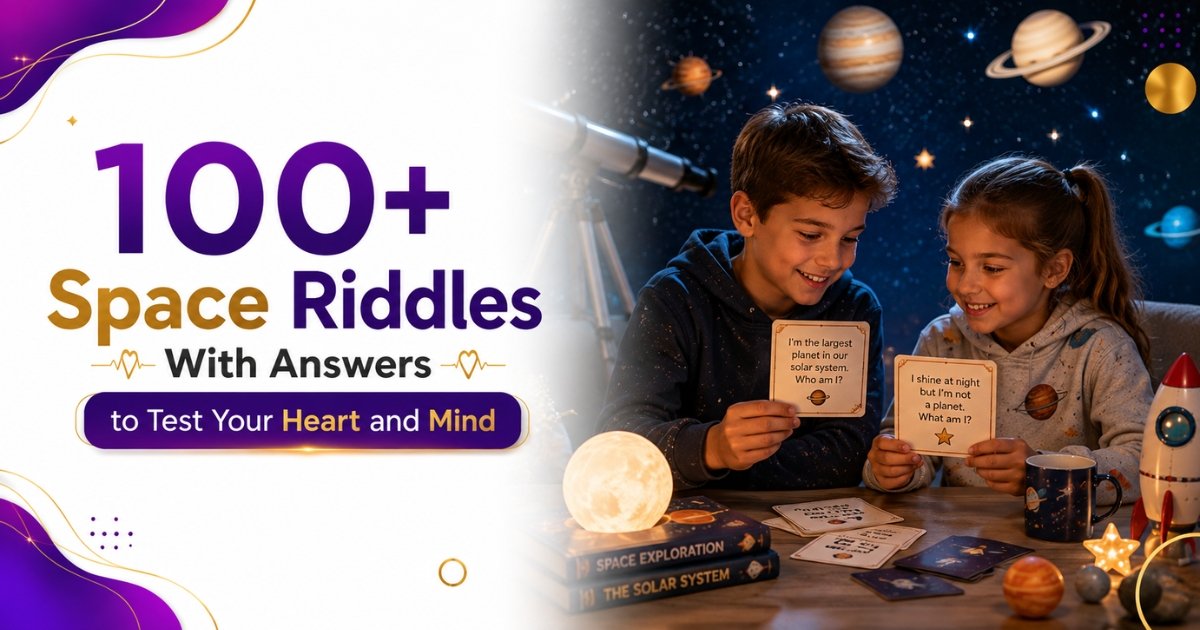
100 Space Riddles for Kids: Planets and Stars
Space riddles are short brain teasers built around planets, stars, astronauts, and other cosmic objects. They combine science learning with wordplay and wonder, making them a fun way to explore the solar system.
Below you’ll find 100 original space riddles for kids, sorted by difficulty and theme, each with its answer.
How Space Riddles Help Kids Learn About the Universe?
When a child works out that “I have rings but no fingers” points to Saturn, they’re not just solving a puzzle, they’re locking in a real astronomy fact through active thinking instead of passive reading.
Concepts like gravity, orbits, and light-years are hard for young kids to picture, but wrapping them in a playful clue “I pull you down, but you can never see me” gives the idea a concrete, memorable shape.
How to Use These Riddles at Home or in the Classroom?
These space riddles for kids work well in a few simple settings, and you don’t need a formal lesson plan to use them.
- As an astronomy warm-up: Read a Medium or Hard riddle before a solar system lesson to get kids thinking about planetary features before you name them.
- As a car-ride or road-trip game: Easy riddles are perfect for keeping kids engaged during long drives, especially on the way to or from a planetarium.
- As a birthday party activity: String together a mix of Easy and Funny riddles for a space-themed party game or scavenger hunt clue.
- As a bedtime or sleepover game: Hard riddles about black holes and galaxies make a great late-night challenge for older kids and tweens.
- As a classroom transition: Use a riddle to settle a room after recess or before starting independent science work.
Easy Space Riddles for Kids
These riddles about space point at the most familiar objects in the night sky and in a young astronaut’s toolkit, perfect for ages 6 to 8 or as a fast warm-up for any age.
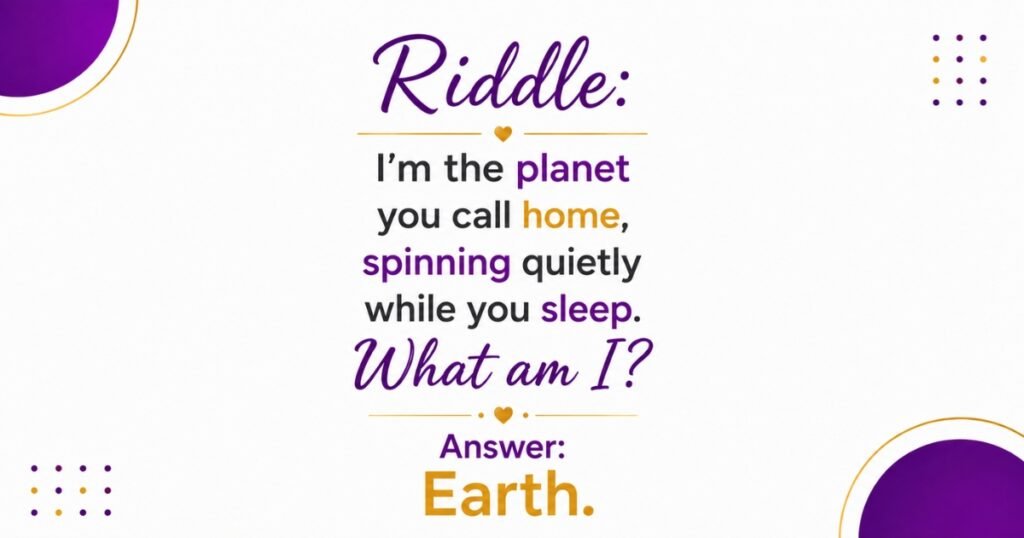
- Riddle: I’m the planet you call home, spinning quietly while you sleep. What am I?
Answer: Earth.
Difficulty: Easy
Explanation: A direct clue about rotation gives away the planet kids know best their own. - Riddle: I glow at night, but I don’t make my own light. What am I?
Answer: The Moon.
Difficulty: Easy
Explanation: Introduces the science fact that the Moon reflects sunlight rather than producing its own glow. - Riddle: I’m a giant ball of burning gas that lights up your whole day. What am I?
Answer: The Sun.
Difficulty: Easy
Explanation: Uses “burning gas” as a simple, accurate description a young child can picture. - Riddle: I twinkle at night, but during the day I disappear from sight. What am I?
Answer: A star.
Difficulty: Easy
Explanation: Plays on the everyday observation that stars are only visible after dark. - Riddle: I turn black and fill up with tiny lights once the Sun goes down. What am I?
Answer: The night sky.
Difficulty: Easy
Explanation: A color-change riddle that rewards kids who picture the sky shifting from blue to black. - Riddle: I blast off with fire and smoke, carrying people far from home. What am I?
Answer: A rocket.
Difficulty: Easy
Explanation: Straightforward action clues (fire, smoke, blast off) point directly to the object. - Riddle: I float in space wearing a big helmet, far from the ground. What am I?
Answer: An astronaut.
Difficulty: Easy
Explanation: Combines two visual clues floating and a helmet that only overlap in one answer. - Riddle: I keep an astronaut breathing and safe, but I’m not a house. What am I?
Answer: A spacesuit.
Difficulty: Easy
Explanation: Rules out an obvious wrong answer (“a house”) before landing on the correct one. - Riddle: I make faraway stars look close, but I never leave the ground. What am I?
Answer: A telescope.
Difficulty: Easy
Explanation: Contrasts distance (“faraway”) with the tool’s fixed position, a simple logical trick. - Riddle: I circle the Earth and send signals down, but I’m not a bird. What am I?
Answer: A satellite.
Difficulty: Easy
Explanation: Uses “circle” to hint at orbiting motion while ruling out a living creature. - Riddle: I carry astronauts through space, but I have no wheels or wings. What am I?
Answer: A spaceship.
Difficulty: Easy
Explanation: Removes typical vehicle features (wheels, wings) to sharpen the final answer. - Riddle: I’m a ball of ice and dust with a glowing tail behind me. What am I?
Answer: A comet.
Difficulty: Easy
Explanation: Uses the visual “tail” as the defining clue, a feature most kids have seen in pictures. - Riddle: I’m covered in red dust and named after the god of war. What am I?
Answer: Mars.
Difficulty: Easy
Explanation: Combines a visual fact (red dust) with a well-known nickname clue. - Riddle: I’m the hottest planet, even though I’m not closest to the Sun. What am I?
Answer: Venus.
Difficulty: Easy
Explanation: Sets up a surprising fact (hottest, but not closest) that most kids find memorable. - Riddle: I’m small, fast, and always closest to the Sun. What am I?
Answer: Mercury.
Difficulty: Easy
Explanation: Uses size and position as the two simplest identifying clues. - Riddle: I protect an astronaut’s head, and I have a clear window built right in. What am I? Answer: A space helmet.
Difficulty: Easy
Explanation: Points to the visor as the identifying feature, a detail young kids notice in pictures. - Riddle: I was left behind on the Moon and I’m still there today. What am I?
Answer: A footprint on the Moon.
Difficulty: Easy
Explanation: Introduces the real science fact that footprints on the Moon don’t erode without wind or rain. - Riddle: I get smaller and smaller until a rocket finally lifts off. What am I?
Answer: A countdown.
Difficulty: Easy
Explanation: Uses the idea of numbers “getting smaller” as the defining clue for a launch countdown. - Riddle: I’m the flat, open spot where a rocket waits before it flies. What am I?
Answer: A launch pad.
Difficulty: Easy
Explanation: Describes location and function together, a simple spatial riddle. - Riddle: I float above Earth, and astronauts can live inside me for months. What am I? Answer: A space station.
Difficulty: Easy
Explanation: Uses duration (“for months”) to distinguish this from a quick rocket ride.
Medium Space Riddles About the Solar System
These space riddles with answers ask kids to think a little further, covering the outer planets and the science behind how space works. They fit well for grades 3 through 5.
- Riddle: I’m the largest planet, with a giant red storm that’s lasted for centuries. What am I? Answer: Jupiter.
Difficulty: Medium
Explanation: Combines size and a specific feature (the Great Red Spot) that requires prior knowledge to solve quickly. - Riddle: I’m famous for my icy rings, and I’m the second-largest planet. What am I?
Answer: Saturn.
Difficulty: Medium
Explanation: Requires the child to separate this planet from Jupiter using rings as the distinguishing clue. - Riddle: I spin on my side like a rolling ball instead of standing up straight. What am I? Answer: Uranus.
Difficulty: Medium
Explanation: Uses an unusual, specific fact (its sideways tilt) that fewer kids know offhand. - Riddle: I’m the windiest planet, with storms faster than anywhere else in the solar system. What am I?
Answer: Neptune.
Difficulty: Medium
Explanation: Uses a superlative fact (fastest winds) as the key identifier. - Riddle: I used to be called a planet, but now I’m known as a dwarf. What am I?
Answer: Pluto.
Difficulty: Medium
Explanation: References a real astronomy update (Pluto’s reclassification in 2006), rewarding kids who know the history. - Riddle: I’m a rocky chunk that orbits the Sun but never grew big enough to be a planet. What am I?
Answer: An asteroid.
Difficulty: Medium
Explanation: Defines the object by what it isn’t (a planet) as much as what it is. - Riddle: I light up the sky with dozens of streaks when Earth passes through space dust. What am I?
Answer: A meteor shower.
Difficulty: Medium
Explanation: Explains the cause (Earth passing through debris) as part of the clue itself. - Riddle: I’m the path a planet follows as it circles the Sun. What am I?
Answer: An orbit.
Difficulty: Medium
Explanation: A direct definitional riddle that tests vocabulary rather than logic. - Riddle: I pull you down to the ground, but you can never see me. What am I?
Answer: Gravity.
Difficulty: Medium
Explanation: Uses invisibility as the twist, since gravity’s effect is obvious but the force itself isn’t. - Riddle: I change my shape every few nights, from a sliver to a full circle and back again. What am I?
Answer: Moon phases.
Difficulty: Medium
Explanation: Describes a repeating cycle, asking the child to connect changing appearance with a scientific pattern. - Riddle: I happen when the Moon slides between the Earth and the Sun, turning day briefly to night. What am I?
Answer: An eclipse.
Difficulty: Medium
Explanation: Explains the mechanism directly, testing comprehension more than wordplay. - Riddle: I’m a group of stars that form a shape in the sky, like a bear or a hunter. What am I? Answer: A constellation.
Difficulty: Medium
Explanation: Uses familiar shape examples (bear, hunter) to hint at well-known constellations. - Riddle: I’m the galaxy that holds our entire solar system, named after a creamy dessert. What am I?
Answer: The Milky Way.
Difficulty: Medium
Explanation: Uses the literal meaning of the name as a memorable wordplay clue. - Riddle: I’m a giant collection of stars, planets, and dust, held together by gravity. What am I? Answer: A galaxy.
Difficulty: Medium
Explanation: A definitional riddle that separates “galaxy” from the more specific “Milky Way” in riddle 33. - Riddle: I travel millions of miles to warm your face on a sunny day. What am I?
Answer: Sunlight.
Difficulty: Medium
Explanation: Adds a distance fact to a familiar daily experience, linking science to something kids feel. - Riddle: I follow you everywhere on a sunny day, but I disappear the moment clouds roll in. What am I?
Answer: A shadow.
Difficulty: Medium
Explanation: Uses cause and effect (sunlight blocked by clouds) as the key logical step. - Riddle: I’m the invisible line a planet spins around, tilted just enough to create the seasons. What am I?
Answer: Earth’s axis.
Difficulty: Medium
Explanation: Connects an abstract concept (a spin line) to a real-world outcome (seasons). - Riddle: I happen once every 24 hours and give you day and night. What am I?
Answer: Earth’s rotation.
Difficulty: Medium
Explanation: Uses a specific number (24 hours) to distinguish rotation from the longer yearly cycle. - Riddle: I take 365 days to complete, and I’m the reason you have a birthday every year. What am I?
Answer: Earth’s revolution (a year).
Difficulty: Medium
Explanation: Ties an abstract orbital fact to something personally meaningful a birthday. - Riddle: I wrap around Earth and give you air to breathe, but you can’t see my edges. What am I?
Answer: The atmosphere.
Difficulty: Medium
Explanation: Uses invisibility again as the twist, this time applied to breathable air rather than gravity. - Riddle: I carry an astronaut’s air supply on their back during a spacewalk. What am I? Answer: An oxygen tank.
Difficulty: Medium
Explanation: A straightforward function riddle that reinforces a key survival fact about space travel. - Riddle: I’m the feeling astronauts get when they float instead of stand. What am I?
Answer: Zero gravity. - Difficulty: Medium
Explanation: Connects a sensation (floating) to the scientific term that explains it. - Riddle: I happen when an astronaut leaves the spacecraft to work outside in open space. What am I?
Answer: A spacewalk.
Difficulty: Medium
Explanation: A definitional riddle describing the activity rather than the equipment involved. - Riddle: I’m a piece of rock from space that survives the fall and lands on the ground. What am I?
Answer: A meteorite.
Difficulty: Medium
Explanation: Distinguishes this term from “meteor” (riddle 27’s shower) by focusing on the object that actually lands. - Riddle: I’m a ring of rocky leftovers between Mars and Jupiter. What am I?
Answer: The asteroid belt.
Difficulty: Medium
Explanation: Uses specific location (between Mars and Jupiter) as the defining detail.
Hard Space Riddles for Kids
These space riddle reach into deep-space concepts like black holes, light-years, and the edge of the universe. They’re best for grade 5 and up, or for a family challenge night.
- Riddle: I pull in everything nearby, even light, and nothing can ever escape me. What am I? Answer: A black hole.
Difficulty: Hard
Explanation: Requires understanding of an abstract force (extreme gravity) rather than a visible object. - Riddle: I’m a star’s final explosion, bright enough to outshine an entire galaxy for a while. What am I?
Answer: A supernova.
Difficulty: Hard
Explanation: Uses scale (“outshine an entire galaxy”) to convey a concept too big to picture directly. - Riddle: I measure distance, not time, even though my name has “year” in it. What am I? Answer: A light-year.
Difficulty: Hard
Explanation: Directly addresses a common misconception, testing whether kids know the term’s real meaning. - Riddle: I’m the speed a rocket needs to break free from a planet’s pull forever. What am I? Answer: Escape velocity.
Difficulty: Hard
Explanation: Combines two concepts, speed and gravity into a single technical term. - Riddle: I’m a theoretical shortcut through space and time that no one has ever proven exists. What am I?
Answer: A wormhole.
Difficulty: Hard
Explanation: Introduces the idea of an unproven scientific theory, adding nuance for older kids. - Riddle: I’m a giant cloud of gas and dust where new stars are born. What am I?
Answer: A nebula.
Difficulty: Hard
Explanation: Uses “born” as a metaphor for star formation, a concept that needs prior context to solve. - Riddle: I’m a star nearing the end of its life, swelling up much bigger and cooler than before. What am I?
Answer: A red giant.
Difficulty: Hard
Explanation: Describes a stage in the star life cycle, requiring some background knowledge of stellar evolution. - Riddle: Scientists know I exist because of gravity’s pull, but no telescope has ever actually seen me. What am I?
Answer: Dark matter.
Difficulty: Hard
Explanation: Tests understanding that something can be scientifically real without being directly observable. - Riddle: I hold every galaxy, every star, and everything that has ever existed inside me. What am I?
Answer: The universe.
Difficulty: Hard
Explanation: Uses scale as the primary clue, asking kids to think at the largest possible level. - Riddle: I’m the moment scientists believe the entire universe began, billions of years ago. What am I?
Answer: The Big Bang.
Difficulty: Hard
Explanation: Requires knowledge of a specific scientific theory rather than logical deduction alone. - Riddle: I’m a planet that orbits a star outside our own solar system. What am I?
Answer: An exoplanet.
Difficulty: Hard
Explanation: Tests precise vocabulary the prefix “exo-” is the key to solving it. - Riddle: I’m the fabric that bends around anything heavy, including planets and stars. What am I?
Answer: Space-time.
Difficulty: Hard
Explanation: Introduces a genuinely advanced physics concept in simplified, kid-friendly language. - Riddle: I’m the invisible boundary around a black hole where nothing can turn back once it’s crossed. What am I?
Answer: An event horizon.
Difficulty: Hard
Explanation: Builds on riddle 46’s black hole concept, adding a layer of technical detail. - Riddle: I’m a stream of charged particles that flows out from the Sun and causes auroras on Earth. What am I?
Answer: Solar wind.
Difficulty: Hard
Explanation: Connects an invisible phenomenon to a visible result (auroras), helping kids infer the cause. - Riddle: I’m old equipment and broken satellite parts still floating around Earth today. What am I?
Answer: Space debris.
Difficulty: Hard
Explanation: Introduces a modern, real-world issue in space exploration rather than a natural phenomenon. - Riddle: I’m the line on a planet that separates daylight from darkness at any given moment. What am I?
Answer: The terminator line.
Difficulty: Hard
Explanation: Uses a technical astronomy term for something kids have actually seen the edge of daylight on a globe. - Riddle: I’m smaller and cooler than most stars, but I still shine on my own. What am I? Answer: A dwarf star.
Difficulty: Hard
Explanation: Requires distinguishing between planet-sized “dwarfs” (like Pluto) and star-sized ones. - Riddle: I’m actually two stars, locked together, circling a shared point in space. What am I? Answer: A binary star system.
Difficulty: Hard
Explanation: Tests whether kids can picture two objects orbiting a shared center rather than one orbiting the other. - Riddle: I’m a distant, icy region past Neptune where Pluto and other small worlds live. What am I?
Answer: The Kuiper Belt.
Difficulty: Hard
Explanation: Builds on Pluto’s riddle (25) by locating it within a broader, lesser-known region. - Riddle: I’m the empty space between star systems, colder and darker than anywhere on Earth. What am I?
Answer: Interstellar space.
Difficulty: Hard
Explanation: Uses comparison (colder and darker than Earth) to help kids grasp an environment they’ll never experience directly.
Funny Space Riddles and Jokes for Kids
Once the thinking space jokes for kids are done, these lighter ones are pure silliness a great reward after a science lesson or homework session.

- Riddle: Why did the astronaut break up with the Moon?
Answer: Because he needed more space.
Difficulty: Easy
Explanation: A pun on “space,” using its literal and relationship-related meanings at once. - Riddle: Why did the Sun refuse to go to college?
Answer: Because it already had a million degrees.
Difficulty: Easy
Explanation: Wordplay on “degrees” meaning both temperature and academic achievement. - Riddle: Why don’t aliens ever visit our solar system?
Answer: Because they read the reviews, and it only had one star.
Difficulty: Easy
Explanation: A pun on “star rating” reviews versus an actual star riddles in space. - Riddle: What kind of music do planets like to listen to?
Answer: Nep-tunes.
Difficulty: Easy
Explanation: A sound-alike pun blending “Neptune” with “tunes.” - Riddle: Why did the rocket lose its job?
Answer: Because it kept getting fired.
Difficulty: Easy - Explanation: Double meaning of “fired” launched into space versus fired from a job.
- Riddle: How do you organize a party in outer space?
Answer: You planet.
Difficulty: Easy
Explanation: A pun blending “plan it” with “planet.” - Riddle: Why did the astronaut’s sandwich win an award?
Answer: Because it was truly out of this world.
Difficulty: Easy
Explanation: Uses a common expression (“out of this world”) literally, since the sandwich actually left Earth. - Riddle: What do you call an alien who tells great jokes?
Answer: A comedi-alien.
Difficulty: Easy
Explanation: A blended word combining “comedian” and “alien” for a playful sound-alike space joke. - Riddle: Why did the star show up late to the party?
Answer: Because it took light-years to get ready.
Difficulty: Easy
Explanation: Plays on the scientific meaning of “light-year” as if it were literal preparation time. - Riddle: What did Saturn say to the other planets at the reunion?
Answer: I’ll bring the rings, you bring the snacks.
Difficulty: Easy
Explanation: Personifies Saturn’s rings as a party accessory, an example of playful misdirection. - Riddle: Why did Mars never win the school talent show?
Answer: Because everyone said its performance was a little too dusty.
Difficulty: Easy
Explanation: A pun on “dusty,” referencing both a lackluster performance and Mars’s literal red dust. - Riddle: Why did the astronaut bring a ladder into space?
Answer: To reach the high notes during karaoke night.
Difficulty: Easy
Explanation: Absurd misdirection the setup implies a practical reason, but the punchline is purely silly. - Riddle: What do you call a black hole that tells jokes?
Answer: A real gravity-puller.
Difficulty: Easy
Explanation: A pun on “gravity” meaning both the physical force and comedic charisma. - Riddle: Why did the comet break up with the asteroid?
Answer: Because it needed someone less rocky.
Difficulty: Easy
Explanation: Double meaning of “rocky,” describing both an asteroid’s material and a difficult relationship. - Riddle: What’s an astronaut’s favorite key on the keyboard?
Answer: The space bar.
Difficulty: Easy
Explanation: A direct pun connecting a keyboard’s spacebar to an astronaut’s profession. - Riddle: Why did the Moon skip dinner?
Answer: Because it was already full.
Difficulty: Easy
Explanation: Uses “full” in its double sense a full moon phase and a full stomach. - Riddle: Why did the alien get a parking ticket?
Answer: Because it parked its spaceship at a meteor.
Difficulty: Easy
Explanation: A sound-alike pun swapping “meter” for “meteor.” - Riddle: What do you call a tired planet?
Answer: A little Nep-tune out.
Difficulty: Easy
Explanation: Blends “Neptune” with “tuned out,” a layered sound-alike pun for older kids. - Riddle: Why did the astronomer bring a sandwich to the observatory?
Answer: Because studying the stars can make you hungry for space between meals.
Difficulty: Easy
Explanation: A playful double meaning of “space between meals,” referencing both hunger and outer space. - Riddle: Why did the spaceship break up with the comet?
Answer: Because it felt like it was always chasing a tail.
Difficulty: Easy
Explanation: A pun on “chasing a tail,” referencing a comet’s tail and a one-sided relationship.
Riddles About Astronauts, Rockets, and Space Travel
This final set focuses on the people and machines that make space exploration possible, a great fit for kids who are curious about becoming astronauts themselves.
- Riddle: I coordinate every rocket launch from a room full of screens back on Earth. What am I?
Answer: Mission control.
Difficulty: Medium
Explanation: Uses function and location together to point to a specific, real NASA setting. - Riddle: I’m dried out and sealed in a pouch so I don’t float away during a meal in orbit. What am I?
Answer: Space food.
Difficulty: Medium
Explanation: Explains the real reason astronaut food is freeze-dried, tying science to a practical detail. - Riddle: I drive across the red dust of Mars, but no person has ever sat behind my wheel. What am I?
Answer: A Mars rover.
Difficulty: Medium
Explanation: Rules out a human driver, pointing toward a remote-controlled robotic vehicle instead. - Riddle: I’m the part of a spacecraft that brings astronauts safely back through Earth’s atmosphere. What am I?
Answer: A re-entry capsule.
Difficulty: Hard
Explanation: Requires understanding the return journey, not just the launch, making it more advanced than a typical rocket riddle. - Riddle: I connect an astronaut to their spacecraft so they don’t drift away during a spacewalk. What am I?
Answer: A tether cord.
Difficulty: Medium
Explanation: Uses a safety-focused clue, reinforcing why spacewalks require careful equipment. - Riddle: I prepare astronauts for zero gravity long before they ever leave the ground. What am I? Answer: Astronaut training.
Difficulty: Medium
Explanation: Points to preparation rather than equipment, a subtle shift in riddle focus. - Riddle: I carry an astronaut’s voice all the way back down to Earth. What am I?
Answer: Communication radio.
Difficulty: Medium
Explanation: Uses distance and sound together to identify a specific piece of equipment. - Riddle: I happen when a spacecraft lands in the ocean at the end of a mission. What am I? Answer: A splashdown.
Difficulty: Medium
Explanation: Combines “splash” and “down” as literal clues for a nautical landing method. - Riddle: I’m worn tight during launch to keep an astronaut safe from sudden pressure changes. What am I?
Answer: A flight suit.
Difficulty: Medium
Explanation: Distinguishes this from a full spacesuit by focusing specifically on the launch and landing phase. - Riddle: I hold the liquid power that lifts a rocket off the ground. What am I?
Answer: A fuel tank.
Difficulty: Easy
Explanation: A straightforward function riddle connecting stored fuel to the act of lifting off. - Riddle: I’m the exact order of steps that happens right before a rocket leaves the ground. What am I?
Answer: A launch sequence.
Difficulty: Medium
Explanation: Distinguishes an ordered process from the countdown number itself (riddle 18). - Riddle: I stick an astronaut’s feet to the floor of a spacecraft where gravity can’t help. What am I?
Answer: Gravity boots (magnetic boots).
Difficulty: Hard
Explanation: Requires understanding that magnets, not gravity, solve the floating problem in space. - Riddle: I happened in 1969, when two astronauts first stepped onto another world. What am I?
Answer: A Moon landing.
Difficulty: Medium
Explanation: Uses a specific historical date, rewarding kids who connect the riddle to real history. - Riddle: I fall away from a rocket once my fuel runs out, helping it fly higher and lighter. What am I?
Answer: A rocket booster.
Difficulty: Medium
Explanation: Explains the staged-launch process, a detail many kids don’t know until they hear it explained. - Riddle: I open above a returning capsule so it can drift gently down instead of crashing. What am I?
Answer: A parachute.
Difficulty: Easy
Explanation: Closes the riddle set on a safe landing, tying the whole journey from launch pad to splashdown full circle.
More Riddles to Explore
If you enjoyed guessing your way through the solar system, there’s plenty more to explore beyond space.
Since Saturn’s rings came up in this list, our Ring Riddles collection is a fun next stop for more riddles built around circles, loops, and things that wrap around.
If concepts like light-years, day-night cycles, and orbits caught your interest, our Time Riddles page digs into clocks, calendars, and other riddles about how we measure time.
And if you’re curious how riddle traditions differ around the world, our Chinese Riddles collection is a great way to see how wordplay and clever clues take shape in a different culture.
Mailbox riddles have transcended mere curiosity; they represent a fusion of problem-solving and community engagement. These riddles can be powerful tools for enhancing creativity and critical thinking.
Conclusion
These 100 space riddles for kids are meant to be mixed and matched rather than read straight through.
Save a handful of Easy riddles for the car ride to school, pull out the Hard section for a weekend family challenge, or use a Funny riddle to wrap up a science lesson with a laugh.
FAQS
What are Some Good Space Riddles?
Good space riddles connect a real astronomy fact like Saturn’s rings or the Moon’s reflected light to a short, playful clue kids can solve without any outside help. The Easy and Medium riddles above, built around planets and basic space concepts, tend to work best for a general audience.
How do Riddles Help Kids Learn About Space?
Riddles turn passive facts into active thinking. Working out that “I pull you down, but you can never see me” means gravity helps a child remember the concept far longer than reading the definition alone, because they had to reason their way to the answer.
What Age Group are Space Riddles Good For?
Most space riddles suit kids ages 6 through 12. Easy riddles fit ages 6–8, Medium and Astronaut riddles work for grades 3–5, and Hard riddles about black holes and light-years are best for grade 5 and up or a family challenge night.
What is a Fun Riddle About the Moon?
A simple option is: “I glow at night, but I don’t make my own light. What am I?” The answer is the Moon, and it introduces the real science fact that moonlight is actually reflected sunlight.
How Many Planets are in Our Solar System?
There are eight official planets in our solar system: Mercury, Venus, Earth, Mars, Jupiter, Saturn, Uranus, and Neptune. Pluto was reclassified as a dwarf planet in 2006, which is why several riddles above treat it separately.