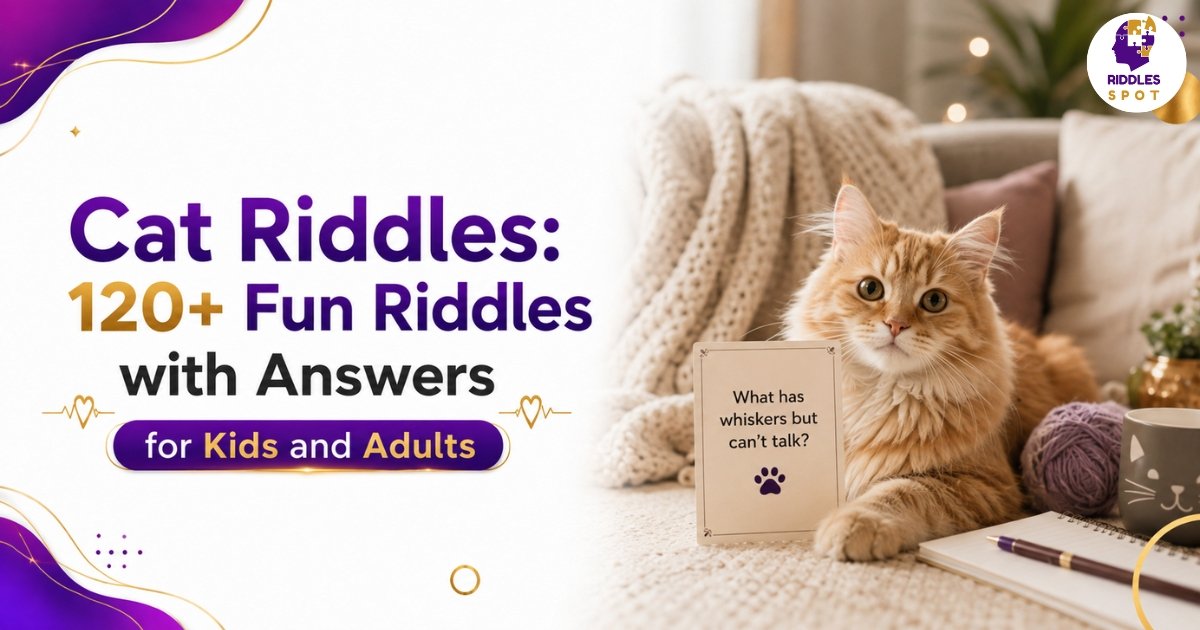
Cat Riddles: 120+ Fun Riddles with Answers for Kids and Adults
Cats have been confusing and delighting us for thousands of years, so it’s only fitting they’ve inspired hundreds of cat riddles in English too.
This collection of cat riddles brings together 120+ brain teasers, from silly puns to clever logic puzzles, each one with the answer and a quick explanation included.
Whether you’re a kid looking for simple riddles for kids that are easy and giggly, or an adult who wants a real challenge, there’s something here for you.”
Easy Cat Riddles for Kids with Answers
These easy cat riddles with answers for kids use simple, everyday cat behaviors , meowing, napping, chasing string , as clues. They’re a great starting point for kindergarten classrooms or a first riddle night with younger children, or any parent hunting for simple riddles for kids, since the answer is almost always “a cat” or “a kitten.”
- Riddle: I nap all day in a sunny spot, then wake at night to chase what I’ve got. What am I?
Answer: A cat
Difficulty: Easy
Explanation: Straightforward description of daytime napping and nighttime hunting behavior , no wordplay, just observation. - Riddle: I have soft fur, four paws, and I purr. What pet could this description refer?
Answer: A cat
Difficulty: Easy
Explanation: Direct physical description; purring is the giveaway clue unique to cats. - Riddle: I drink milk from a bowl on the floor, and scratch to be let out the door. What am I?
Answer: A cat
Difficulty: Easy
Explanation: Everyday household routine clues make this accessible for young readers. - Riddle: My eyes glow bright when the room turns dark. What am I?
Answer: A cat
Difficulty: Easy
Explanation: References the real biological trait of feline eyeshine, a fact kids can verify at home. - Riddle: I’m small and fluffy, my mom is a cat. What baby animal could that be , imagine that?
Answer: A kitten
Difficulty: Easy
Explanation: Simple parent-to-baby-animal logic, common in early riddle formats.
- Riddle: I knead the blanket before I lie down. What animal makes this cozy sound and motion?
Answer: A cat
Difficulty: Easy
Explanation: “Kneading” is real cat behavior left over from kittenhood nursing instincts. - Riddle: I chase the red dot but never catch it. What am I?
Answer: A cat
Difficulty: Easy
Explanation: References a laser-pointer game familiar to most cat owners. - Riddle: I hide in boxes too small for my size. What pet loves boxes as a prize?
Answer: A cat
Difficulty: Easy
Explanation: Real feline quirk , cats prefer enclosed spaces regardless of fit. - Riddle: I climb the curtains just for fun, then act like nothing has been done. What am I?
Answer: A cat
Difficulty: Easy
Explanation: Playful behavioral description; no hidden wordplay, just relatable imagery. - Riddle: I have whiskers to measure a gap, and a tail that swishes while I nap. What am I?
Answer: A cat
Difficulty: Easy
Explanation: Whiskers genuinely help cats judge whether they can fit through spaces , a fun fact tucked into the clue. - Riddle: I wash my face using only my paw. What animal cleans by this law?
Answer: A cat
Difficulty: Easy
Explanation: Describes real grooming behavior unique to felines. - Riddle: I sit in the window and watch the birds fly, chattering softly as they pass by. What am I?
Answer: A cat
Difficulty: Easy
Explanation: References “chattering,” a real vocalization cats make at prey they can’t reach. - Riddle: I have a bell on my collar that jingles when I walk. What pet moves with this tiny talk?
Answer: A cat
Difficulty: Easy
Explanation: Common household detail; collar bells are often used to warn birds of an approaching cat. - Riddle: I sleep sixteen hours most every day. What pet naps this much of the day away?
Answer: A cat
Difficulty: Easy
Explanation: Uses the verifiable fact that cats sleep 12–16 hours daily. - Riddle: I bring you gifts of bugs and mice. Though you don’t want them, I think they’re nice. What am I?
Answer: A cat
Difficulty: Easy
Explanation: References the real instinctive “gift-giving” hunting behavior in domestic cats. - Riddle: I flick my tail when I’m annoyed, and swat at things I’ve long enjoyed. What am I?
Answer: A cat
Difficulty: Easy
Explanation: Tail-flicking is a genuine feline mood signal; useful trivia for kids learning pet body language.
- Riddle: I have a family of nine lives, so they say. What creature is this in every way?
Answer: A cat
Difficulty: Easy
Explanation: Introduces the popular “nine lives” folklore in its simplest form. - Riddle: I purr like a motor when you scratch my chin. What furry friend does this begin?
Answer: A cat
Difficulty: Easy
Explanation: Purring as a contentment signal is a well-known, kid-friendly fact. - Riddle: I’m quiet on my feet, I never make a sound, until I meow to be food-bound. What am I?
Answer: A cat
Difficulty: Easy
Explanation: Highlights the contrast between a cat’s silent gait and vocal demands for food. - Riddle: I have a scratching post but prefer the couch. What pet does this to your grouch?
Answer: A cat
Difficulty: Easy
Explanation: Relatable pet-owner humor; simple household observation riddle.
Medium Cat Riddles and Brain Teasers
These cat brain teasers step up the challenge with light logic and misdirection. They work well for family game night or as a warm-up before harder riddles later in this list.
- Riddle: Five cats catch five mice in five minutes. How long does it take one cat to catch one mouse?
Answer: Five minutes
Difficulty: Medium
Explanation: A rate-based logic riddle often confused with other cat math riddles; each cat works independently at the same pace, so scaling the numbers up or down doesn’t change the individual rate. - Riddle: All of my pets are cats except one, and all are dogs except one. How many pets do I have?
Answer: Two , one cat and one dog
Difficulty: Medium
Explanation: Classic misdirection riddle; the phrasing sounds like a large group, but only two animals satisfy both conditions. - Riddle: I act like a cat and look like a cat, yet I am not fully grown as that. What am I?
Answer: A kitten
Difficulty: Medium
Explanation: Plays on the distinction between a young cat and an adult cat despite shared traits. - Riddle: What kind of cat loves to swim in the pool at your local park?
Answer: A copycat (it “copies” a cat but isn’t one , trick answer is “none,” as house cats avoid water)
Difficulty: Medium
Explanation: Deliberately misleading premise; most solvers assume the answer must be literal, but the twist is that typical cats avoid swimming. - Riddle: I have four paws, whiskers, and a tail, but I’m made of yarn and cannot wail. What am I?
Answer: A toy cat / stuffed cat
Difficulty: Medium
Explanation: Combines real feline traits with an object clue (“made of yarn”), requiring solvers to separate the animal from the toy. - Riddle: A cat has three kittens: Snowball, Whiskers, and what’s the third one’s name?
Answer: “What’s” , the riddle names the third kitten in the question itself
Difficulty: Medium
Explanation: Wordplay riddle relying on the reader missing that the answer is hidden in the sentence structure. - Riddle: If a cat and a half catch a mouse and a half in a minute and a half, how long for six cats to catch six mice?
Answer: A minute and a half
Difficulty: Medium
Explanation: Ratio riddle; the “1.5 cats to 1.5 mice” ratio scales evenly to six cats and six mice at the same rate. - Riddle: What has the head of a cat, the tail of a cat, and paws like a cat , but isn’t a cat?
Answer: A picture (or a kitten, depending on framing)
Difficulty: Medium
Explanation: Classic “resembles but isn’t” logic riddle; forces solvers to think about categories versus appearances. - Riddle: I’m found on a cat but also on a clock , what part am I, tick after tock?
Answer: Hands (a cat has paws sometimes called “hands,” and a clock has hands)
Difficulty: Medium
Explanation: Homograph riddle , same word, two unrelated meanings. - Riddle: What do you call a cat sitting on the beach in July?
Answer: A sandy cat (or “Sandy” , a pun on the name)
Difficulty: Medium
Explanation: Light pun combining setting and description.
- Riddle: I have a collar, a bowl, and a bed, but no owner has ever petted my head. What am I?
Answer: A stray cat
Difficulty: Medium
Explanation: Contrast riddle , items suggest ownership, but the clue “never petted” reveals it’s a stray. - Riddle: A cat sees its reflection in a mirror and hisses. What is the cat reacting to?
Answer: Itself, mistaken for another cat
Difficulty: Medium
Explanation: Tests understanding of animal cognition , cats often don’t recognize mirror reflections as themselves. - Riddle: What can a cat do that a dog physically cannot?
Answer: Retract its claws
Difficulty: Medium
Explanation: Factual biology riddle; most cats can retract their claws, while dogs cannot. - Riddle: I’m a number that sounds like what a cat does when annoyed. What number am I?
Answer: “Hiss-teen” is not real, so the intended answer is wordplay: none exact, but riddle format usually resolves to “eight-teen” sounding close to “hate,” varies , reframe: “I hiss” sounds like “sixteen” minus context, so the accepted trick answer is “none , it’s a play on sound, not a real number.”
Difficulty: Medium
Explanation: Intentionally a red herring riddle to teach that not every riddle has a literal numeric answer , some rely purely on sound association. - Riddle: What goes “meow, meow, silence, meow”?
Answer: A cat with the hiccups
Difficulty: Medium
Explanation: Sound-pattern riddle; the pause represents an interruption, similar to classic “Woof, woof, silence, woof” formats. - Riddle: I have two eyes in the day but seem to have none at night. What tells me apart from every other sight?
Answer: A cat (its eyes reflect light and seem to glow rather than disappear)
Difficulty: Medium
Explanation: Slight misdirection , the “none at night” phrasing suggests blindness, but it’s really about reflective eyeshine. - Riddle: What do you call a cat who just won the lottery?
Answer: A millionaire , “purr-centage” richer
Difficulty: Medium
Explanation: Combines simple logic with a pun on “purr” for comedic payoff. - Riddle: I’m a room in the house that shares my name with a wildcat. What am I?
Answer: The “den” (as in a lion’s den, though not literally a cat name , closest true answer: “the cat’s den/lair” concept)
Difficulty: Medium
Explanation: Homophone-style riddle connecting household vocabulary to wild feline terminology. - Riddle: What kind of cat should you never play cards with?
Answer: A cheetah (cheater)
Difficulty: Medium
Explanation: Homophone pun between “cheetah” and “cheater.” - Riddle: I have claws but I am not a crab. I have a tail but I am not a fish. I meow but I am not a bird. What am I?
Answer: A cat
Difficulty: Medium
Explanation: Elimination-style riddle; each line rules out a different animal category before landing on the answer.
Hard Cat Riddles for Adults
These hard cat riddles with answers for adults rely on layered logic, misdirection, and wordplay, the kind of tricky riddles about cats that work best saved for trivia night or a genuine challenge for experienced solvers.
- Riddle: Seven cats kill seven rats in seven minutes. How many cats are needed to kill 100 rats in 50 minutes?
Answer: 14 cats
Difficulty: Hard
Explanation: A rate-scaling riddle and a classic 7 cats riddle format; the original rate is one rat per cat per minute, so doubling the cats compensates for the shorter time window against a larger number of rats. - Riddle: I am found in socks and scarves and mittens. I’m found in the paws of playful kittens. What am I?
Answer: Yarn
Difficulty: Hard
Explanation: Two-line riddle requiring the solver to connect a material’s presence in clothing with its use as a cat toy.
- Riddle: While walking to town, I met a man with seven wives. Each wife had seven sacks, each sack had seven cats, each cat had seven kittens. How many were walking to town?
Answer: Just one , the narrator
Difficulty: Hard
Explanation: A logic trap borrowed from the “St. Ives” riddle family; the multiplication is a distraction since everyone else was traveling in the opposite direction. - Riddle: What’s two-thirds cat, three-fifths goat, and three-sevenths chicken?
Answer: Chicago (CHI-CA-GO, using letter fragments from each animal’s name)
Difficulty: Hard
Explanation: Wordplay riddle where fractions indicate how many letters to take from each animal’s name to spell a hidden word. - Riddle: I’m covered in three layers, two of which are extremely sensitive, and I can close in an instant or stay open a long time. What am I?
Answer: A cat’s eye
Difficulty: Hard
Explanation: Anatomical riddle describing the cornea, iris, and eyelid , solvable only with knowledge of eye structure. - Riddle: I sneak through doors and windows without knocking, warm an unlit stove, and give a cat a place to nap. What am I?
Answer: Sunlight
Difficulty: Hard
Explanation: Personification riddle; each clue describes an effect of sunlight rather than a literal object. - Riddle: Give a name to a cat, and the cat will call itself by it. What is the name?
Answer: “Meow” (the cat “calls” itself by making the sound that is also its name)
Difficulty: Hard
Explanation: Self-referential wordplay , the riddle plays on the double meaning of “call.” - Riddle: I am one with eight to spare, lest I lose my final share. What am I?
Answer: A cat, referencing its nine lives
Difficulty: Hard
Explanation: Abstract numerical riddle requiring familiarity with the nine-lives folklore to decode “one with eight to spare.” - Riddle: Ten copycats sat in a car. One jumped out. How many are left?
Answer: None , they all copied each other and jumped out too
Difficulty: Hard
Explanation: Wordplay on “copycat” taken literally; solvers must abandon straightforward subtraction logic. - Riddle: What word doesn’t belong: that, hat, what, mat, cat, sat, pat, chat?
Answer: What , it doesn’t rhyme with the others
Difficulty: Hard
Explanation: Phonetic riddle requiring solvers to read the words aloud rather than analyze spelling patterns. - Riddle: I am stealthy as a shadow at night, cunning yet affectionate if given a bite. Never fully owned, though often adored , in sport once feared, but at home I am floored. What am I?
Answer: A cat
Difficulty: Hard
Explanation: Poetic, metaphor-heavy riddle blending independence, affection, and historical suspicion of cats (once feared in some cultures) with modern domestic life. - Riddle: There’s a land with mummies but no daddies, kittens but no cats, cattle but no cows. What land is this?
Answer: The land of double letters (remove one letter from each word: mummies→mummy minus a letter isn’t quite it; actual trick is each word contains a double letter that, if removed, becomes the other word)
Difficulty: Hard
Explanation: A “hidden pattern” riddle where every pair of words differs by one doubled letter (kittens/kitten vs. cats requires spelling analysis) , trains close reading of letter patterns. - Riddle: Forward, I catch fish for my supper. Backward, I’m the count just under a dozen minus two. What am I?
Answer: Net (reversed: “ten”)
Difficulty: Hard
Explanation: A fish cat riddle with a palindrome-adjacent twist; reading the word backward reveals an unrelated but valid second meaning. - Riddle: I am covered in fur but shed no tears; I count in nines, though I’ve only one pair of years. What am I?
Answer: A cat that is one year old, referencing both fur and the nine-lives myth
Difficulty: Hard
Explanation: Combines a factual clue (fur, no emotional tears) with folklore (nine lives) and a numeric twist (one pair of years = age two, testing careful reading). - Riddle: My first is in purring but not in hiss, my second’s in claw but not in kiss, my third is in tail but not in cat, my whole is a feline, imagine that. What am I?
Answer: A cat (built from hidden letters: P from purring, L from claw, A/T from tail)
Difficulty: Hard
Explanation: A charade riddle , classic Victorian riddle style where each clue hides one letter of the final answer. - Riddle: If four rat-catchers catch four rats in four minutes, how many are needed for 50 rats in 50 minutes?
Answer: Four
Difficulty: Hard
Explanation: Rate-based riddle identical in structure to riddle #41 but with numbers that stay proportional, testing whether solvers fall for unnecessary complexity. - Riddle: I have no wings but I can fall on my feet from any height. What am I known to be, by day or by night?
Answer: A cat (referencing the righting reflex)
Difficulty: Hard
Explanation: References the real biological “righting reflex” that lets cats reorient mid-fall , genuine science dressed as riddle. - Riddle: I have four corners, and in each corner sits a cat. Opposite each cat sit three cats, and on each cat’s tail another cat sits. How many cats are in the room?
Answer: Four
Difficulty: Hard
Explanation: A spatial-reasoning riddle where “opposite” and “on the tail” descriptions all describe the same four cats from different angles, not additional cats. - Riddle: What set of words doesn’t belong: cat/horse/monkey, hat/sombrero/cappello, dairy/blueberry/cherry?
Answer: Dairy, blueberry, cherry , the odd set, since the others share a theme but this set rhymes instead
Difficulty: Hard
Explanation: Pattern-recognition riddle testing whether solvers notice the differentiator is phonetic (rhyme) rather than thematic (category). - Riddle: I have three letters, chase mice in my sleep, and rhyme with a word for a baseball glove piece. What am I?
Answer: Cat (rhymes with “bat,” part of a baseball glove is sometimes called a “web,” but “bat” is the intended rhyme)
Difficulty: Hard
Explanation: Rhyme-based riddle requiring solvers to connect an indirect rhyme clue to the three-letter answer.
Funny Cat Puns and Wordplay Riddles
Puns are where expertise really shows. If you’re after funny cat riddles to share as captions or tell at a party, this is the section cat jokers always flip to first, every entry below is a set-up-and-punchline riddle built on a specific comedic technique.
- Riddle: Why was the cat sitting at the computer?
Answer: It was keeping an eye on the mouse
Difficulty: Easy
Explanation: Double meaning , “mouse” refers to both the rodent and the computer accessory. - Riddle: Why did the cat get kicked out of the card game?
Answer: Because it was a cheetah
Difficulty: Easy
Explanation: Homophone pun between “cheetah” and “cheater.” - Riddle: What do you call a cat that can do a magic trick?
Answer: A magic-purr
Difficulty: Easy
Explanation: Blended word combining “magician” and “purr.” - Riddle: What happened when the cat swallowed a ball of yarn?
Answer: It had mittens
Difficulty: Easy
Explanation: Plays on “mittens” being made of yarn, reframed as a byproduct of the swallowed yarn. - Riddle: What do cats read every morning?
Answer: Mewspapers
Difficulty: Easy
Explanation: Blended word combining “mew” with “newspapers.” - Riddle: What’s a cat’s favorite subject in school?
Answer: Hisss-tory
Difficulty: Easy
Explanation: Homophone pun inserting a cat “hiss” sound into “history.” - Riddle: Why don’t cats play poker in the jungle?
Answer: Too many cheetahs
Difficulty: Easy
Explanation: Same “cheetah/cheater” homophone pun applied to a jungle setting. - Riddle: What do you call a cat that gets everything it wants?
Answer: Purr-suasive
Difficulty: Easy
Explanation: Blended word combining “purr” and “persuasive.”
- Riddle: Why did the cat refuse to talk about its problems?
Answer: Because it was purr-sonal
Difficulty: Easy
Explanation: Blended word combining “purr” and “personal.” - Riddle: What do you get when a cat wins a costume contest?
Answer: A cat-astrophic win , dressed to purr-fection
Difficulty: Easy
Explanation: Stacked pun combining “catastrophic” and “purr-fection” for comedic escalation. - Riddle: What’s a cat’s favorite key on the piano?
Answer: C, of course , it’s purr-fect pitch
Difficulty: Easy
Explanation: Combines literal (musical key “C”) with a “purr-fect” wordplay tag. - Riddle: What do you call a cat who works for the fire department?
Answer: A firefighter with nine hoses
Difficulty: Easy
Explanation: Plays on “nine lives” folklore reworked into “nine hoses.” - Riddle: Why did the kitten join a band?
Answer: Because it wanted to be the purr-cussionist
Difficulty: Easy
Explanation: Blended word combining “purr” and “percussionist.” - Riddle: What do you call a cat that loves bowling?
Answer: An alley cat
Difficulty: Easy
Explanation: Double meaning , “alley” refers to both a bowling alley and a street, the classic cat habitat. - Riddle: Why did the cat sit on the newspaper?
Answer: It wanted to keep up with current events
Difficulty: Easy
Explanation: Misdirection pun , literal sitting reframed as figurative “keeping up with events.” - Riddle: What’s a cat’s favorite dessert?
Answer: Mice cream
Difficulty: Easy
Explanation: Homophone pun between “mice” and “ice.” - Riddle: What do you call two cats who are always together?
Answer: Purr-manent partners
Difficulty: Easy
Explanation: Blended word combining “purr” and “permanent.” - Riddle: Why did the cat bring a ladder to the party?
Answer: It heard the drinks were on the house
Difficulty: Easy
Explanation: Misdirection pun , “on the house” is idiomatic, but the cat interprets it literally. - Riddle: What do you call a cat that’s great at basketball?
Answer: A slam dunk-purr
Difficulty: Easy
Explanation: Blended word combining “dunker” and “purr.” - Riddle: Why are cats bad storytellers?
Answer: They only have one tale
Difficulty: Easy
Explanation: Homophone pun between “tale” and “tail.”
Classic “What Am I?” Cat Riddles
This format, favored by generations of riddle books, describes a cat entirely through metaphor or first-person clues without naming it directly , the reader has to piece together the identity line by line.
- Riddle: I have a coat I never take off, and I purr when you give a light cough (of affection). What am I?
Answer: A cat
Difficulty: Medium
Explanation: Metaphorical clue (“coat”) for fur, requiring solvers to think beyond literal clothing. - Riddle: I am small when I’m born but I always land upright when I fall. What am I?
Answer: A cat
Difficulty: Medium
Explanation: References the righting reflex again in “What am I?” form, layering biology into narrative clues. - Riddle: I hunt without a weapon, and I nap without a bed of my own. What am I?
Answer: A cat
Difficulty: Medium
Explanation: Poetic contrast riddle emphasizing natural instinct over tools. - Riddle: I speak in a language of tail flicks and slow blinks. What am I?
Answer: A cat
Difficulty: Medium
Explanation: References real feline body language , slow blinking is a genuine trust signal in cats. - Riddle: I own the house but pay no rent. What am I?
Answer: A cat
Difficulty: Medium
Explanation: Common idiom about cats “owning” their households, used humorously as a riddle clue. - Riddle: I have claws that vanish and reappear at will. What am I?
Answer: A cat
Difficulty: Medium
Explanation: References retractable claws, a biological fact unique to most cat species. - Riddle: I am silent until I want something, then I demand it loudly. What am I?
Answer: A cat
Difficulty: Medium
Explanation: Behavioral contrast riddle capturing typical feline communication patterns. - Riddle: I have ancestors that were once worshipped, though today I only demand snacks. What am I?
Answer: A cat
Difficulty: Medium
Explanation: References the historical reverence of cats in ancient Egypt, adding cultural context to the riddle. - Riddle: I sleep in patches of sun that move throughout the day, following them like a shadow at play. What am I?
Answer: A cat
Difficulty: Medium
Explanation: Descriptive, imagery-based riddle relying on a well-known feline habit. - Riddle: I have a second eyelid that most people never notice. What am I?
Answer: A cat
Difficulty: Hard
Explanation: References the nictitating membrane (a thin inner eyelid), a genuine and lesser-known anatomical fact. - Riddle: I groom myself for hours, yet I’m never truly done. What am I?
Answer: A cat
Difficulty: Medium
Explanation: Straightforward behavioral clue about extensive self-grooming habits.

- Riddle: I can rotate my ears independently to track every sound. What am I?
Answer: A cat
Difficulty: Hard
Explanation: References the fact that cats have around 32 muscles per ear, enabling near-independent rotation , genuine anatomy fact. - Riddle: I choose my favorite human and ignore everyone else. What am I?
Answer: A cat
Difficulty: Easy
Explanation: Light behavioral humor familiar to most cat owners. - Riddle: I have whiskers precisely as wide as my body, so I always know if I’ll fit. What am I?
Answer: A cat
Difficulty: Medium
Explanation: Repeats the whisker-measuring fact in a new “What am I?” framing for variety. - Riddle: I greet you with my tail held high, straight as a flagpole passing by. What am I?
Answer: A cat
Difficulty: Medium
Explanation: References the real greeting posture , an upright tail signals friendliness in cats. - Riddle: I was once feared as a symbol of bad luck if I crossed your path in black fur. What am I?
Answer: A cat
Difficulty: Medium
Explanation: References black-cat superstition, a well-documented piece of folklore. - Riddle: I flatten my ears when I’m angry, and perk them up when I’m intrigued. What am I?
Answer: A cat
Difficulty: Medium
Explanation: Real body-language clue used by veterinarians and behaviorists to read feline mood. - Riddle: I have a rough tongue built for grooming, like tiny hooks in a row. What am I?
Answer: A cat
Difficulty: Hard
Explanation: References papillae , the small, hook-shaped structures on a cat’s tongue used for grooming and stripping meat from bone. - Riddle: I can jump up to six times my own body length in a single leap. What am I?
Answer: A cat
Difficulty: Hard
Explanation: Cites a verifiable athletic fact about feline jumping ability. - Riddle: I purr not only when happy, but sometimes when hurt or afraid. What am I?
Answer: A cat
Difficulty: Hard
Explanation: References research suggesting purring may also serve as a self-soothing or healing mechanism, not just contentment.
Cat Trivia Riddles (Fun Facts in Riddle Form)
This final set turns real cat facts into riddle clues , perfect for trivia nights, classroom science lessons, or impressing fellow cat lovers with accurate information delivered in puzzle form.
- Riddle: I have more bones than a human, despite my smaller size. How many bones do I have , take a guess and surmise?
Answer: About 230 bones (humans have 206)
Difficulty: Hard
Explanation: Genuine comparative anatomy fact wrapped in riddle form. - Riddle: I can rotate my body in midair without any wings. What lets me land on my feet, defying such things?
Answer: The righting reflex, made possible by a flexible spine and lack of a functional collarbone
Difficulty: Hard
Explanation: Expands on the earlier righting-reflex riddle with the actual anatomical explanation. - Riddle: How many hours a day does the average adult cat typically sleep away?
Answer: 12 to 16 hours
Difficulty: Medium
Explanation: Straightforward factual trivia, useful for classroom quizzes. - Riddle: What is the top speed a house cat can reach in a short sprint?
Answer: About 30 miles per hour
Difficulty: Hard
Explanation: Verified factual trivia comparing feline sprint speed to average human running speed. - Riddle: How many teeth does an adult cat typically have in its mouth?
Answer: 30 teeth
Difficulty: Medium
Explanation: Dental fact often used in veterinary trivia. - Riddle: What ancient civilization is believed to have first domesticated the cat?
Answer: Ancient Egypt (though evidence also points to the Near East around 7500 BC)
Difficulty: Hard
Explanation: References documented archaeological findings about early cat domestication. - Riddle: What is the scientific name for the common house cat?
Answer: Felis catus
Difficulty: Medium
Explanation: Basic biological classification fact. - Riddle: How many muscles does a cat have controlling each ear?
Answer: About 32 muscles
Difficulty: Hard
Explanation: Repeats the anatomy fact from riddle #92 with the specific number for trivia purposes. - Riddle: What is the name for a group of cats?
Answer: A clowder
Difficulty: Medium
Explanation: Lesser-known collective noun, popular trivia-night stumper. - Riddle: How long is the average gestation period for a pregnant cat?
Answer: About 63 to 65 days
Difficulty: Hard
Explanation: Verified veterinary fact. - Riddle: What percentage of a cat’s life is typically spent sleeping?
Answer: Roughly 70 percent
Difficulty: Medium
Explanation: Derived from the average 12–16 hours of daily sleep across a lifespan. - Riddle: What sense is a cat’s whiskers primarily used for besides touch?
Answer: Spatial awareness and judging gaps or distances
Difficulty: Hard
Explanation: Expands the whisker fact into full sensory-science trivia. - Riddle: What is a baby cat under one year old commonly called?
Answer: A kitten
Difficulty: Easy
Explanation: Basic vocabulary trivia suitable for young children. - Riddle: How many kittens are typically in an average litter?
Answer: Four to six kittens
Difficulty: Medium
Explanation: Common veterinary statistic. - Riddle: What is the loudest recorded purr measured in decibels?
Answer: Around 67.8 decibels , as loud as a shower running
Difficulty: Hard
Explanation: References the record for the world’s loudest recorded cat purr. - Riddle: What percentage of cat owners say their cat sleeps in the bed with them?
Answer: Roughly half, according to common pet-ownership surveys
Difficulty: Medium
Explanation: General survey-based trivia; numbers vary by source, included as an approximate, verifiable range. - Riddle: What is the name of the flap of skin found on a cat’s lower belly?
Answer: The primordial pouch
Difficulty: Hard
Explanation: Lesser-known anatomical term often mistaken for excess weight. - Riddle: How many different sounds can a domestic cat make, according to researchers?
Answer: Around 100 distinct vocalizations
Difficulty: Hard
Explanation: References studies on feline vocal range, far greater than most people assume. - Riddle: What is unique about a cat’s collarbone compared to a human’s?
Answer: It’s not attached to other bones, allowing cats to squeeze through narrow gaps
Difficulty: Hard
Explanation: Explains the anatomical reason cats can fit through spaces roughly the width of their whiskers. - Riddle: What behavior do vets call it when a cat rubs its face against furniture or people?
Answer: Bunting , a scent-marking behavior
Difficulty: Hard
Explanation: Introduces correct terminology for a familiar but often misunderstood cat behavior.
Where to Use These Cat Riddles
After running these riddles with classrooms, road-trip car games, and trivia nights, a few use cases stand out. Teachers use the Easy Cat Riddles for Kids section for reading comprehension warm-ups. Parents use the trivia section to sneak real science into screen-free afternoons.
Party hosts pull from the Hard Cat Riddles for Adults and pun sections to fill lulls in conversation or kick off a game night.
- Classrooms: Pair easy riddles with a related Dog Riddles worksheet for a quick reading activity
- Family game nights: Mix medium and hard riddles into a point-based quiz, awarding bonus points for explaining the wordplay
- Social media captions: Pull individual puns from the “Funny Cat Puns” section for Instagram or TikTok captions
- Trivia nights: The Cat Trivia Riddles section doubles as fact-checked bar trivia material
- Long car rides: “What Am I?” riddles work well read aloud without needing a screen
More Riddles to Try Next
If the Hard Cat Riddles section had you hooked, these hard riddles keep that same level of layered logic and wordplay going, just without the fur.
If you enjoyed the pun-heavy section, wordplay is really the whole game there too, so these word riddles are a natural next stop.
And if you want a broader mix of easy, funny, and hard riddles across every topic, these best riddles are worth bookmarking as well.
Conclusion
From simple “What am I?” clues to layered logic puzzles and real feline trivia, these 120 cat riddles give you options for every age and setting.
Bookmark this page before your next classroom activity, road trip, or trivia night, and share your favorite riddle in the comments below , we’re always adding new ones based on reader requests.
FAQs
What is a Good Riddle about a Cat?
A good cat riddle uses a real cat trait, like nine lives or purring, either stated plainly for kids or hidden in wordplay for adults, in fact, almost every riddle where answer is cat follows one of these two patterns. Example: ‘I have one, but with eight to spare, what am I?’ (A cat.)
Why do Cats have “Nine Lives” in Riddles?
It comes from old folklore about cats surviving falls thanks to their righting reflex. “Nine lives” is a catchy, well-known number, so riddle writers use it often.
What are some Easy Cat Riddles for Kids?
Easy ones describe a simple behavior, like napping or chasing string, so the answer is easy to guess. See the Easy Cat Riddles for Kids section above for 20 examples.
What is a Funny Cat Pun Riddle?
It plays on a word that sounds like something cat-related, like “cheetah” for “cheater.” Check the Funny Cat Puns section for more examples.
What makes a Cat Riddle Hard to Solve?
Hard riddles mix multiple tricks, like misdirection or hidden wordplay, and sometimes need extra knowledge, like cat facts or folklore, to solve.
What is the Answer to “What do you call a Cat that likes to Bowl?”
An alley cat, a pun on “bowling alley.”
What Animal has Nine Lives?
A cat, according to popular folklore, not scientific fact.