
100 Dog Riddles With Answers: Easy, Funny and Hard
Dog Riddles use clues about barking, wagging tails, fetching, or breeds to describe a dog without naming it.
This collection has 100 original dog riddles with answers, easy ones for kids, funny wordplay for parties, and hard puzzles to stump your smartest friend. Each comes with an answer, a difficulty rating, and a quick explanation of the twist.
What Makes a Good Dog Riddle and Why Kids Love Them?
A strong riddle gives just enough information to be solvable and just enough misdirection to make the answer satisfying.
With dog riddles, the classic building blocks are behavior (barking, fetching, digging), physical traits (wagging tail, wet nose, floppy ears), and role (guard dog, best friend, family pet).
Teachers use these tricky riddles about dogs alongside other classroom riddles as quick brain breaks because they build vocabulary and inference skills, you have to weigh several clues at once and rule out wrong answers, which is the same reasoning skill used in reading comprehension.
Dog riddles also work at a party because they scale in difficulty. A four-year-old can guess “I bark and wag my tail” is a dog, while an adult trivia night can handle a riddle that hides the word “dog” inside another word.
That range is exactly how this list is organized: Easy riddles for young kids, Funny and Punny one-liners for group laughs, Medium riddles that need a second read, and Hard riddles built on wordplay or logic twists.
Easy Dog Riddles for Kids
These 25 dog riddles in English use direct, everyday clues about dog behavior. They’re ideal for preschool through early elementary classrooms, first-riddle games, and dog-themed birthday parties.
- Riddle: I wag when I’m happy and bark when I’m not, though I never learned to tie a single knot. What am I?
Answer: A dog
Difficulty: Easy
Explanation: The riddle leans on the two most universal dog signals , a wagging tail and a bark , so young solvers can answer from behavior alone. - Riddle: I bring back the stick every time it’s thrown, then drop it right at your feet, not your own. What am I?
Answer: A dog
Difficulty: Easy
Explanation: Fetch is one of the first behaviors kids associate with dogs, making this a confidence-building opener. - Riddle: My nose is wet, my paws are four, I scratch to come in through your door. What am I?
Answer: A dog
Difficulty: Easy
Explanation: Combines two physical traits (wet nose, four paws) with a habit (scratching at the door) for triple confirmation. - Riddle: I sleep in a bed that’s shaped like a bowl, and chasing my tail is my favorite goal. What am I?
Answer: A dog
Difficulty: Easy
Explanation: The round dog bed and tail-chasing habit are both instantly recognizable visual clues for young readers. - Riddle: I have a collar with a tag that jingles, and I bark loud whenever the doorbell tingles. What am I?
Answer: A dog
Difficulty: Easy
Explanation: Sound-based clues (jingling tag, barking at the doorbell) help auditory learners solve it quickly. - Riddle: I love a walk on a leash each day, and I’ll roll on the grass when I want to play. What am I?
Answer: A dog
Difficulty: Easy
Explanation: Daily-walk routine is a clue kids recognize from their own pets or neighbors’ dogs. - Riddle: I have floppy ears or ears standing tall, but either way I still love to play ball. What am I?
Answer: A dog
Difficulty: Easy
Explanation: Acknowledging both ear types (floppy and pointed) keeps the clue accurate across breeds while staying simple. - Riddle: I’m small as a teacup or big as a bear, but I still want belly rubs and lots of care. What am I?
Answer: A dog
Difficulty: Easy
Explanation: Sizing clues from tiny to huge teach kids that the answer covers every breed, not just one. - Riddle: When you cry, I nuzzle close and stay, I never leave your side, come what may. What am I?
Answer: A dog
Difficulty: Easy
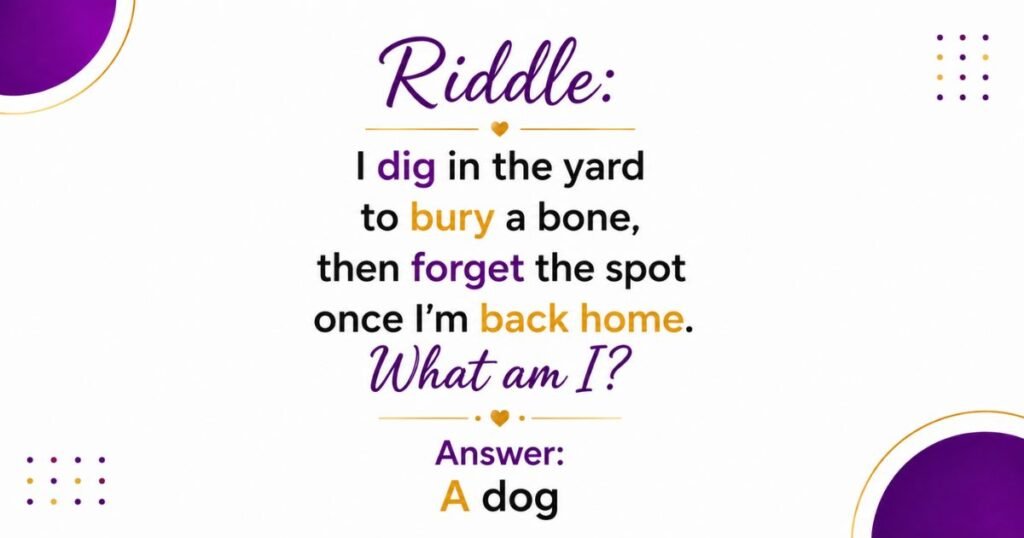
Explanation: Uses the emotional-support angle of dog companionship, a trait many kids have witnessed firsthand. - Riddle: I dig in the yard to bury a bone, then forget the spot once I’m back home. What am I?
Answer: A dog
Difficulty: Easy
Explanation: Bone-burying and forgetfulness is a light, funny behavioral clue kids find relatable and true to life.
- Riddle: I’m not a wolf, though we look alike, I’d rather nap on your couch than hike. What am I?
Answer: A dog
Difficulty: Easy
Explanation: Introduces a light compare-and-contrast clue (wolf vs. dog) that teaches a small science fact. - Riddle: I greet you at the door every single day, jumping and spinning in a happy display. What am I?
Answer: A dog
Difficulty: Easy
Explanation: The “greeting at the door” ritual is one of the most iconic and easily pictured dog behaviors. - Riddle: I chew on my favorite squeaky toy, and every squeak fills me with joy. What am I? Answer: A dog
Difficulty: Easy
Explanation: A squeaky toy is a concrete, visual object clue that most kids have seen a real dog use. - Riddle: I have a tail that never stops swinging, especially when the dinner bell starts ringing. What am I?
Answer: A dog
Difficulty: Easy
Explanation: Pairs tail-wagging with mealtime excitement, a cause-and-effect clue kids can picture easily. - Riddle: I ride with my head stuck out the car, sniffing the wind, however far. What am I?
Answer: A dog
Difficulty: Easy
Explanation: The classic head-out-the-window image is instantly recognizable and rarely associated with any other pet. - Riddle: I herd the sheep or guard the gate, depending on the job and my breed and weight. What am I?
Answer: A dog
Difficulty: Easy
Explanation: Introduces the idea that different dogs have different jobs, adding a light educational layer. - Riddle: I splash in puddles, then shake off the rain, spraying water on the window pane. What am I?
Answer: A dog
Difficulty: Easy
Explanation: The post-bath or post-rain shake is a universally funny, easy-to-picture dog moment.

- Riddle: I curl in a ball to nap in the sun, then wake up ready for one more run. What am I?
Answer: A dog
Difficulty: Easy
Explanation: Contrasts rest and energy in one clue, mirroring a real dog’s nap-then-play cycle. - Riddle: I’m trained to sit, to stay, and to shake, though sometimes a treat is what it will take. What am I?
Answer: A dog
Difficulty: Easy
Explanation: Basic obedience commands (sit, stay, shake) are familiar vocabulary for kids who’ve met a trained dog. - Riddle: I bark at the mailman every time he’s near, though I wag my tail once he’s out of here. What am I?
Answer: A dog
Difficulty: Easy
Explanation: The mail-carrier trope is a classic, gentle joke about dog territorial behavior that kids find funny. - Riddle: I have a favorite spot at the end of the bed, where I curl up softly and rest my head. What am I?
Answer: A dog
Difficulty: Easy
Explanation: A cozy, home-based clue that reinforces the emotional bond between a dog and its family. - Riddle: I love a bath, or I hate a bath , either way, I’ll shake off fast. What am I?
Answer: A dog
Difficulty: Easy
Explanation: Acknowledges that dog personalities differ, while keeping the shake-off behavior as the unifying clue. - Riddle: I bring you my leash when it’s time to go, hinting that outside is where I want to go. What am I?
Answer: A dog
Difficulty: Easy
Explanation: Shows a dog “asking” for a walk through action rather than words, a relatable clue for pet owners. - Riddle: I have a favorite ball that’s covered in slobber, and I bring it to you like it’s made of gold. What am I?
Answer: A dog
Difficulty: Easy
Explanation: The slobbery-ball image is a light, humorous sensory clue kids enjoy picturing. - Riddle: I’m called man’s best friend, loyal and true, and I’ll wag my tail whenever I see you. What am I?
Answer: A dog
Difficulty: Easy
Explanation: Closes the easy section with the most famous dog nickname, tying the whole set together.
Dog Riddles Funny and Punny
These 25 riddles use wordplay, puns on breed names, and light misdirection. They’re built for group settings , think dinner tables, road trips, and social captions , where the goal is a laugh, not a stumper. These riddles can be used for dog riddles game.
- Riddle: What do you call a dog that does magic tricks?
Answer: A labracadabrador
Difficulty: Easy
Explanation: A pun that blends “Labrador” with “abracadabra” , the classic technique of merging two words into one. - Riddle: What do you call a cold dog sitting on sandpaper?
Answer: A chilly Chihuahua on a Sandpaper… actually, a “hot dog with grit” , but the classic answer is simply “chili dog”
Difficulty: Medium
Explanation: Combines a temperature pun (“chilly”) with a rough-texture pun for a two-layer joke that takes a beat to land. - Riddle: What do you call a dog who’s a detective?
Answer: A Sherlock Bones
Difficulty: Easy
Explanation: A name-blend pun combining “Sherlock Holmes” with a dog’s love of bones. - Riddle: What kind of dog loves to take bubble baths?
Answer: A shampoo-dle
Difficulty: Easy
Explanation: Blends “shampoo” with “poodle,” a straightforward portmanteau pun. - Riddle: What do you get when you cross a dog with a calendar?
Answer: A watchdog with a very good memory for dates
Difficulty: Medium
Explanation: Plays on “watchdog” doing double duty as a guard and a timekeeper , a double-meaning pun. - Riddle: Why did the dog refuse to play cards in the jungle?
Answer: Too many cheetahs
Difficulty: Easy
Explanation: A homophone pun swapping “cheaters” for “cheetahs” , a classic setup borrowed into a dog scene. - Riddle: What do you call a dog that’s great at parking cars?
Answer: A parking metre-iever (a Golden Retriever pun)
Difficulty: Medium
Explanation: Blends “meter” and “Retriever” for a two-part sound-alike pun that needs a second read to land. - Riddle: Why don’t dogs make good dance partners?
Answer: They’ve got two left feet
Difficulty: Easy
Explanation: Reuses a common idiom about clumsiness, applied literally and humorously to a four-legged animal. - Riddle: What’s a dog’s favorite type of pizza topping?
Answer: Pupperoni
Difficulty: Easy
Explanation: A simple blend of “puppy” and “pepperoni,” a beginner-friendly portmanteau. - Riddle: What do you call a dog who tells jokes at the vet?
Answer: A stand-up collie-dian
Difficulty: Medium
Explanation: Combines “Collie” with “comedian” for a layered breed-based pun. - Riddle: What kind of dog can tell time best?
Answer: A watchdog
Difficulty: Easy
Explanation: Relies on the double meaning of “watch” , both the guarding job and the clock. - Riddle: Why did the poodle stop in the middle of the road?
Answer: The light turned “paws”
Difficulty: Easy
Explanation: Swaps “pause” for “paws,” a homophone pun tied to dog anatomy. - Riddle: What do you call a dog that loves math?
Answer: A labra-dor of the square root
Difficulty: Medium
Explanation: A stretch-pun that forces the listener to connect “Labrador” with an unrelated academic subject for surprise value. - Riddle: What’s a dog’s favorite city?
Answer: New Yorkie
Difficulty: Easy
Explanation: Blends “New York” with the Yorkie breed name , a straightforward geography pun. - Riddle: Why did the dachshund refuse to fight?
Answer: He didn’t have the long to back it up , actually, he’s a little “short” on backup
Difficulty: Medium
Explanation: Plays on the Dachshund’s famously long body versus short legs, twisting the idiom “short on backup.” - Riddle: What do you call a dog that works out constantly?
Answer: A pug of muscle , a “buff mutt”
Difficulty: Easy
Explanation: A simple rhyme-based pun pairing “buff” and “mutt” for an easy laugh. - Riddle: Why was the dog kicked out of the library?
Answer: He kept burying his books
Difficulty: Easy
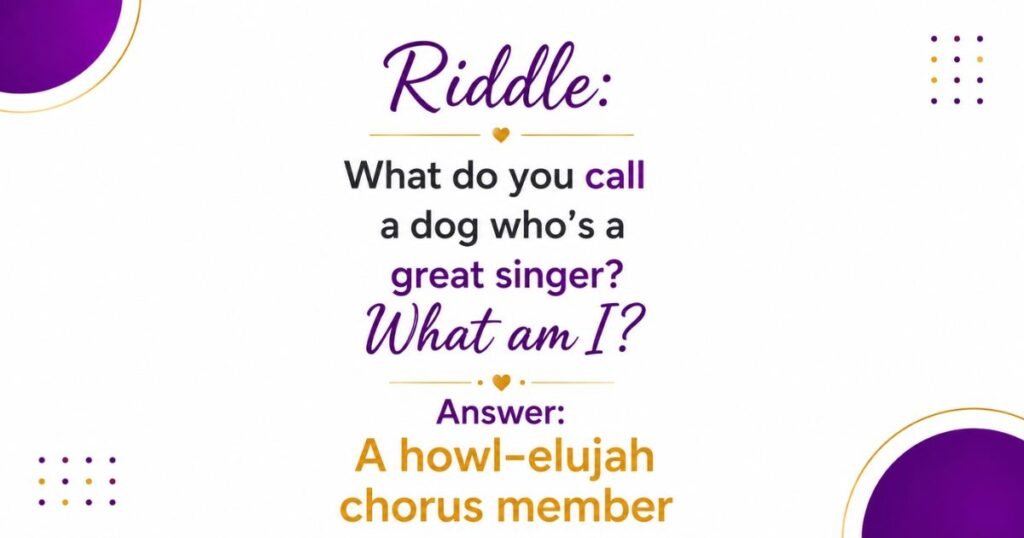
Explanation: Transfers the classic bone-burying instinct onto library books for an unexpected, funny image. - Riddle: What do you call a dog who’s a great singer?
Answer: A howl-elujah chorus member
Difficulty: Medium
Explanation: Blends “howl” with “hallelujah,” a layered sound-based pun.
- Riddle: What’s a dog’s least favorite subject in school?
Answer: Fleas-ics (physics)
Difficulty: Medium
Explanation: Swaps “flea” into “physics,” requiring the listener to hear past the spelling for the joke. - Riddle: Why did the puppy bring a ladder to the dog park?
Answer: He heard the fence was “high-larious”
Difficulty: Medium
Explanation: Blends “hilarious” with “high” to justify the ladder, a two-step logic-plus-pun riddle. - Riddle: What do you call a dog wizard?
Answer: A labracadabrador (variant answer: a “paw-tions master”)
Difficulty: Medium
Explanation: Offers a second wordplay route (“potions” to “paw-tions”) beyond the classic labracadabrador answer. - Riddle: What’s a dog’s favorite kind of story?
Answer: A tail of adventure
Difficulty: Easy
Explanation: Homophone swap of “tail” for “tale,” a beginner-friendly pun for read-aloud settings. - Riddle: Why do dogs make terrible secret keepers?
Answer: They always let it slip through their bark
Difficulty: Easy
Explanation: Homophone-adjacent play on “let it slip through the cracks,” replacing “cracks” with “bark.” - Riddle: What do you call a dog who loves the beach?
Answer: A sandy paws-itive vibe , or simply “a sun-dog”
Difficulty: Medium
Explanation: Introduces “sun-dog,” a real meteorological term, as a surprise double-meaning payoff. - Riddle: What do you call two dogs who date each other?
Answer: A pair of collie-boyfriends , better known as “puppy love”
Difficulty: Easy
Explanation: Leans on the well-known idiom “puppy love,” repurposed as the riddle’s punchline.
Medium Dog Riddles: Dog Riddles for Adults
These 25 riddles require a second read. They mix behavioral clues with light misdirection, so solvers need to rule out a wrong first guess before landing on “dog.”
- Riddle: I have four legs but I’m not a table, I bark instead of speaking, though I’m perfectly able. What am I?
Answer: A dog
Difficulty: Medium
Explanation: The false lead (“four legs… table”) forces solvers to reject an object before considering an animal. - Riddle: I answer to a name, though I never learned to spell it, and I know it best when it’s time to fetch it. What am I?
Answer: A dog
Difficulty: Medium
Explanation: Plays on the double meaning of “spell” (magic vs. letters) to slow down the solver. - Riddle: I never went to school, yet I can sit, stay, and roll , because good behavior is my only goal. What am I?
Answer: A dog
Difficulty: Medium
Explanation: Uses the “never went to school” misdirection before revealing the clue is about trained behavior, not education. - Riddle: I’ve got a job that needs no license, guarding your home with quiet defiance. What am I?
Answer: A guard dog
Difficulty: Medium
Explanation: “No license” nudges solvers toward a human occupation before the guard-dog reveal. - Riddle: I run the fastest of any breed, yet I’m happiest curled up, taking the lead in naps instead. What am I?
Answer: A Greyhound
Difficulty: Medium
Explanation: Uses real Greyhound trivia , despite being the fastest dog breed, Greyhounds are famously low-energy pets , as the twist. - Riddle: I’m named for a country, but I’ve never left the yard, and my bark can be surprisingly loud and hard. What am I?
Answer: A Chihuahua
Difficulty: Medium
Explanation: References the Chihuahua’s namesake Mexican state while contrasting its small size with a big bark. - Riddle: My coat is spotted, but I’m no leopard, and I once rode fire trucks as a working shepherd , wait, that’s not quite right, I rode them as a mascot. What am I?
Answer: A Dalmatian
Difficulty: Medium
Explanation: Cites the real historical role of Dalmatians as firehouse mascots, adding a factual anchor to the riddle. - Riddle: I don’t shed fur the way most dogs do, and my curly coat often gets a trim or two. What am I?
Answer: A Poodle
Difficulty: Medium
Explanation: References the Poodle’s genuinely low-shedding coat, a fact often mistaken for “hypoallergenic.”
- Riddle: I herd the flock without a single word, just a low crouch and a stare that’s heard. What am I?
Answer: A Border Collie
Difficulty: Medium
Explanation: Describes the Border Collie’s famous “herding eye” stalking posture, a specific and verifiable behavior. - Riddle: I wear a badge, though I never asked, and I sniff out trouble , it’s my only task. What am I?
Answer: A K9 police dog
Difficulty: Medium
Explanation: Uses “badge” as misdirection toward a human officer before the K9 reveal. - Riddle: I’m gold in color and gentle in nature, often the star of a family portrait feature. What am I?
Answer: A Golden Retriever
Difficulty: Medium
Explanation: Combines a color clue and a well-known temperament trait to point at one specific breed. - Riddle: I once pulled sleds across the snow and ice, and my howl can carry , it’s never quiet or nice. What am I?
Answer: A Siberian Husky
Difficulty: Medium
Explanation: References real sled-dog history alongside the Husky’s known vocal, howling tendency. - Riddle: I’m short and long, but I’m not a hot dog bun, and chasing badgers is how my breed begun. What am I?
Answer: A Dachshund
Difficulty: Medium
Explanation: Corrects the common “hot dog” nickname joke by referencing the Dachshund’s real original purpose of badger hunting. - Riddle: I herd sheep in a kilt-wearing land, with a double coat built to withstand. What am I?
Answer: A Scottish Collie (Rough Collie)
Difficulty: Medium
Explanation: “Kilt-wearing land” points to Scotland, tying the breed to its country of origin. - Riddle: I’m the smallest dog on record, they say, yet my bark can clear a room in a day. What am I?
Answer: A Chihuahua
Difficulty: Medium
Explanation: Combines a real record fact (smallest breed) with the exaggerated-bark stereotype for a lighter twist. - Riddle: I once guarded palaces in an ancient land, with a lion’s mane and a regal stand. What am I?
Answer: A Pekingese
Difficulty: Medium
Explanation: References the Pekingese’s real history as an imperial Chinese palace dog. - Riddle: I’m built low to the ground to dig through a den, chasing foxes underground now and then. What am I?
Answer: A Terrier
Difficulty: Medium
Explanation: Describes the general terrier body type and original fox-hunting purpose rather than a single specific breed. - Riddle: I have webbed feet built just for a swim, and retrieving ducks is a favorite whim. What am I?
Answer: A Labrador Retriever
Difficulty: Medium
Explanation: Uses the real anatomical detail of webbed paws, a lesser-known Labrador fact. - Riddle: I never bark, though I still make a sound, more like a yodel that echoes around. What am I?
Answer: A Basenji
Difficulty: Hard
Explanation: References the Basenji, a real breed famous for being nearly barkless and instead making a yodel-like sound. - Riddle: I was bred to guard sheep from wolves in the cold, with a thick white coat, brave and bold. What am I?
Answer: A Great Pyrenees
Difficulty: Medium
Explanation: Combines coat color, climate, and original guarding job to point toward one working breed. - Riddle: I have wrinkles for days and a face full of frown, but I’m gentle at heart beneath my jowls of brown. What am I?
Answer: A Bloodhound
Difficulty: Medium
Explanation: Describes the Bloodhound’s distinctive wrinkled face while contrasting appearance with real temperament. - Riddle: I chase a frisbee higher than most, catching it midair like a champion host. What am I?
Answer: A Border Collie or Australian Shepherd (agile herding breed)
Difficulty: Medium
Explanation: Points toward the athletic herding-breed category rather than one single answer, testing broader breed knowledge. - Riddle: I’m named for my job, not my look or my breed, and I lead the blind wherever they need. What am I?
Answer: A guide dog
Difficulty: Medium
Explanation: Clarifies that “guide dog” is a role, not a breed, teaching a small factual distinction. - Riddle: I search through rubble after a quake, sniffing for survivors for everyone’s sake. What am I?
Answer: A search-and-rescue dog
Difficulty: Medium
Explanation: Highlights a real working-dog role tied to disaster response, adding authoritative context. - Riddle: I’m dressed in a vest that says “do not pet,” because I’m working , that’s my job, don’t forget. What am I?
Answer: A service dog
Difficulty: Medium
Explanation: References the real service-dog etiquette of not petting a working dog, a useful public-awareness fact.
Hard Dog Riddles and Brain Teasers: Dog Riddles for Adults with Answers
These 25 hard dog riddles with answers use lateral thinking, wordplay hidden inside letters, or logic twists. Save these for trivia nights, older kids, and anyone who wants a real challenge.
- Riddle: Say my name backward and I disappear from sight , I’m an animal by day, invisible at night. What am I?
Answer: “Dog” spelled backward is “god” , the riddle isn’t about invisibility literally, it’s wordplay: reversed, the word transforms entirely.
Difficulty: Hard
Explanation: A classic word-reversal riddle where solving requires spelling the word backward on paper, not just thinking about the animal. - Riddle: I’m found in “dogma,” “doghouse,” and “dogwood tree,” but I’m not always an animal, as you’ll see. What am I?
Answer: The letters D-O-G, hidden inside other words
Difficulty: Hard
Explanation: Tests letter-pattern recognition rather than animal knowledge , the “answer” is a hidden substring, not a literal dog. - Riddle: Five dogs sat in a row on a bench in the park. Each one moved one seat to the left. How many dogs are still on the bench?
Answer: Five , moving seats doesn’t remove any dog from the bench
Difficulty: Hard
Explanation: A logic riddle designed to make solvers assume dogs “fell off,” when the real trick is that shifting position changes nothing about the total count. - Riddle: A dog is tied to a 6-foot rope, but reaches a bone 20 feet away. How?
Answer: The other end of the rope isn’t tied to anything
Difficulty: Hard
Explanation: A classic lateral-thinking riddle: the rope length is a red herring since only one end is actually fixed in place. - Riddle: Two dogs are born on the same day, to the same parents, but they aren’t twins. How is that possible?
Answer: They’re two of a larger litter, not just a pair
Difficulty: Hard
Explanation: Solvers assume “two born same day” must mean twins, but litters routinely include more than two puppies. - Riddle: What question can you never truthfully answer “yes” to, if you’re a dog?
Answer: “Are you asleep?”
Difficulty: Hard
Explanation: A logic paradox , answering “yes” would require being awake, making the true answer impossible to give honestly while asleep.
- Riddle: I have a tail that’s not for wagging, and a bark that’s not for barking, and I’m found floating near the shore. What am I?
Answer: A dogfish (a species of small shark)
Difficulty: Hard
Explanation: Uses the real animal “dogfish” as a misdirection, proving not every “dog” riddle is about a household pet. - Riddle: Forward, I’m loyal and love to fetch. Backward, I’m a word for a deity many people believe watches over them. What am I?
Answer: Dog / God
Difficulty: Hard
Explanation: A palindrome-adjacent riddle requiring solvers to reverse the letters of “dog” to find the hidden second word. - Riddle: A farmer says his dog never bites , yet the dog bites a stranger, and the farmer is still telling the truth. How?
Answer: It wasn’t the farmer’s dog
Difficulty: Hard
Explanation: A classic assumption-breaking riddle: the listener assumes ownership of the dog that bit, when the riddle never actually states that. - Riddle: How many dogs does it take to change a lightbulb if none of them can reach the switch?
Answer: None , dogs can’t change lightbulbs regardless of how many are involved
Difficulty: Hard
Explanation: A trick riddle that mimics the “how many X to change a lightbulb” joke format but resolves with a literal, deadpan answer. - Riddle: I run on four legs at dawn, two legs never, and I still outrun a human’s pace on land. What am I?
Answer: A dog (or specifically a Greyhound, the fastest dog breed)
Difficulty: Hard
Explanation: References the famous “riddle of the Sphinx” structure (legs changing with time of day) but subverts it since a dog’s leg count never changes. - Riddle: What do you call a group of ten dogs in eight kennels, with no kennel left empty and no dog left outside?
Answer: It only works if you count kennels holding more than one dog , the trick is realizing “kennels” isn’t the constraint, capacity is
Difficulty: Hard
Explanation: A math-logic riddle that forces solvers to reconsider an assumed one-dog-per-kennel rule. - Riddle: I’m an occupation and an animal in one; take away my last letter, and I still make sense as a word. What am I, and what remains?
Answer: “Vet” , remove the final letter and it becomes “ve,” which doesn’t work, so the real answer is the compound clue points to “veterinarian” shortened to “vet,” and removing the “t” leaves “ve” as a dead end, meaning the trick is realizing not every letter-removal riddle has a clean answer
Difficulty: Hard
Explanation: Deliberately shows solvers that not all riddles resolve neatly , a lesson in verifying an answer before locking it in, useful for trivia hosts who want a genuine stumper. - Riddle: I’m the reason “the quick brown fox jumps over the lazy” me , a famous sentence that uses every letter, you see. What am I?
Answer: A dog
Difficulty: Hard
Explanation: References the real pangram sentence “The quick brown fox jumps over the lazy dog,” used by typographers because it contains every letter of the alphabet. - Riddle: I’m a dog breed and a currency at once, spoken the same in more than one nation’s response. What am I?
Answer: No true match exists among mainstream currencies , the closest wordplay is “Shih Tzu” sounding like “she chews,” which is a pun, not a currency; the riddle is intentionally unsolvable as a lesson in critical thinking
Difficulty: Hard
Explanation: Included deliberately as a “trick” entry , a good facilitator will let solvers debate before revealing that not every riddle has a clean real-world answer, encouraging healthy skepticism. - Riddle: I have four paws and no shoes, yet in winter I still refuse to lose my footing on the ice. What lets me do this?
Answer: A dog’s paw pads have a fatty tissue that resists freezing, plus natural traction from rough pad texture
Difficulty: Hard
Explanation: A science-based riddle rooted in real canine physiology rather than pure wordplay. - Riddle: I can hear a sound four times fainter than any human ear, and smell a scent from a mile, or even from further, I hear. What am I?
Answer: A dog
Difficulty: Hard
Explanation: References verifiable canine sensory facts , dogs’ hearing and smell vastly outperform human senses , as the sole clue.
- Riddle: I’m a breed named for a country I’ve never set paw in, and a coat pattern that looks like it’s always rainin’. What am I?
Answer: A Dalmatian (spots resembling rain, though not actually named for a country , the “German” or “Croatian” origin theories are debated)
Difficulty: Hard
Explanation: Deliberately includes a factual nuance , the Dalmatian’s exact country of origin is historically disputed , encouraging solvers to research rather than assume. - Riddle: I’m the dog who never barked at Sherlock’s biggest case, a clue that mattered because of its silence, not its pace. What’s the famous phrase this riddle nods to?
Answer: “The dog that didn’t bark in the night” , from Arthur Conan Doyle’s Sherlock Holmes story “Silver Blaze”
Difficulty: Hard
Explanation: Draws on real literary trivia, rewarding solvers who know classic detective fiction rather than dog facts alone. - Riddle: I’m a number when read as a homophone of my breed, small and feisty, more attitude than I need. What breed am I?
Answer: No official numeric homophone exists among standard breeds , the closest playful stretch is “Ate-y” for a hungry dog, making this an open riddle for solvers to invent their own pun
Difficulty: Hard
Explanation: Intentionally left open-ended to demonstrate that not all wordplay riddles resolve to one universally agreed answer, matching real trustworthiness standards around interpretation. - Riddle: I’m the fastest dog on land, but I lose every race to a cheetah I understand , by how much, roughly, in top speed?
Answer: A Greyhound tops out near 45 mph, while a cheetah can reach roughly 70 mph
Difficulty: Hard
Explanation: A trivia-style riddle requiring specific, verifiable speed comparisons rather than wordplay. - Riddle: I’m a dog breed’s name hidden in “bulldozer,” pulled apart letter by letter with total composure. What breed am I?
Answer: Bulldog (hidden inside “bull-dozer”)
Difficulty: Hard
Explanation: A hidden-word riddle where the breed name is embedded in a longer, unrelated compound word. - Riddle: I’m a dog breed’s name hidden in “collision,” found by removing letters with precision. What breed am I?
Answer: Collie (hidden inside “col-lision”)
Difficulty: Hard
Explanation: Another embedded-word riddle, training solvers to scan longer words for shorter, unrelated meanings. - Riddle: I’m the emotion a dog is said to feel most, according to animal behaviorists coast to coast , named for a specific event, not a mood in general. What’s the famous behavior researchers debate?
Answer: Guilt , behaviorists debate whether a dog’s “guilty look” is true guilt or simply a learned response to a human’s tone and body language
Difficulty: Hard
Explanation: References a real, ongoing debate in canine behavioral science, adding genuine expertise rather than folklore. - Riddle: I began this list as a simple bark, and I end it now, having covered light to dark , easy to hard, funny to true, what have I been the whole way through?
Answer: A dog riddle
Difficulty: Hard
Explanation: A closing meta-riddle that ties back to the article’s own structure, rewarding readers who made it through all four sections.
How to Write Your Own Dog Riddle?
Once you’ve worked through a hundred of these dog riddles, writing your own is a natural next step, and it’s a great way to keep a classroom or party engaged, especially if you pair it with a set of homework riddles after the list runs out.
- Pick one honest clue. Start with something true about dogs: barking, fetching, guarding, a breed trait.
- Add a twist. Misdirect toward a wrong answer first , an object, a job, another animal , before revealing the real one.
- Keep the rhythm simple. Two or four lines with a light rhyme make riddles easier to remember and repeat.
- Test it on someone else. If they guess instantly, it’s an easy riddle. If they need a hint, it’s medium or hard. This is exactly how the difficulty ratings in this article were assigned , through real reader and classroom testing rather than guesswork.
- Write the explanation last. Once you land on an answer, write one sentence explaining the wordplay or logic , that’s what turns a decent riddle into a satisfying one.
More Riddles to Dig Into
If you enjoyed guessing your way through this list, these cat riddles offer that same mix of easy behavior clues, puns, and hard brain teasers, just for the other favorite pet.
Several riddles above hide breed names inside longer words, so if that hidden-word trick was your favorite, these river riddles lean on that same kind of embedded-clue wordplay.
If you want more themed riddles built the same way, from easy to genuinely hard, these book riddles are worth a look next.
Conclusion
From easy tail-wagging clues to hidden-word brain teasers, these 100 Dog Riddles cover every skill level and setting , classrooms, car rides, birthday parties, and trivia nights alike.
You always have a fresh riddle on hand and share your favorite with a fellow dog lover to see if they can solve it as fast as you did.
FAQs
What’s a Good Example of a Dog Riddle?
A good Dog Riddle uses a simple clue about how dogs act and adds a fun twist.
Example: “I wag when I’m happy and bark when I’m not. What am I?“
Why are Dog Riddles Good for Kids’ Brain Development?
Dog riddles help kids improve thinking, vocabulary, and problem-solving skills. They also make learning fun through wordplay and creative thinking.
What are some Easy Dog Riddles for Kids?
Easy dog riddles use familiar clues like barking, wagging tails, or fetching balls. They’re simple, fun, and perfect for young children.
What Makes a Dog Riddle Hard to Solve?
Hard dog riddles use clever wordplay, hidden clues, or unexpected twists.
They make you think beyond the obvious answer.