Best Riddles With Answers: 100 Fun and Tricky Brain Teasers
Best riddles are all about that satisfying “aha” moment when a clever twist of logic or wordplay finally clicks. They’re a simple way to spark curiosity, challenge your thinking, and bring plenty of laughs to family gatherings, classrooms, parties, or casual game nights.
This collection of 100 best riddles includes easy, funny, tricky, and challenging brain teasers for different ages and skill levels. Whether you need a quick icebreaker or a puzzle that can stump your friends, you’ll find plenty of clever riddles to test your wit and keep everyone guessing.
What Makes a Riddle One of the “Best Riddles”?
A great riddle does two things at once: it hides the answer in plain sight, and it makes the solver feel smart the moment they see it. That’s the core of good riddle-writing, whether the riddle relies on a pun, a false assumption, or simple misdirection.
The riddle of the Sphinx from Greek mythology asking what walks on four legs in the morning, two at noon, and three in the evening is often cited as the archetype: it hides a simple answer (a human, crawling, walking, then using a cane) behind poetic language.
Riddles also scale in difficulty. Easy riddles for young kids rely on obvious wordplay (“What has a face but no eyes?” a clock). Harder riddles use misdirection, forcing the solver to question an assumption baked into the question itself.
Best riddles for adults often lean on this misdirection technique, since adults are more prone to overthinking a simple logic trap.
Easy Riddles (Best Riddles for Kids)
These are the best riddles for kids ages 4–8, or anyone who wants a gentle warm-up before the harder stuff. They rely on straightforward wordplay and familiar objects.
- Riddle: What has to be broken before you can use it?
Answer: An egg.
Difficulty: Easy
Explanation: Plays on the double meaning of “broken” usually negative, here it’s a necessary first step. - Riddle: What has a face but no eyes, and hands but no arms?
Answer: A clock.
Difficulty: Easy
Explanation: Repurposes body-part words (“face,” “hands”) as object parts. - Riddle: What gets wetter the more it dries?
Answer: A towel.
Difficulty: Easy
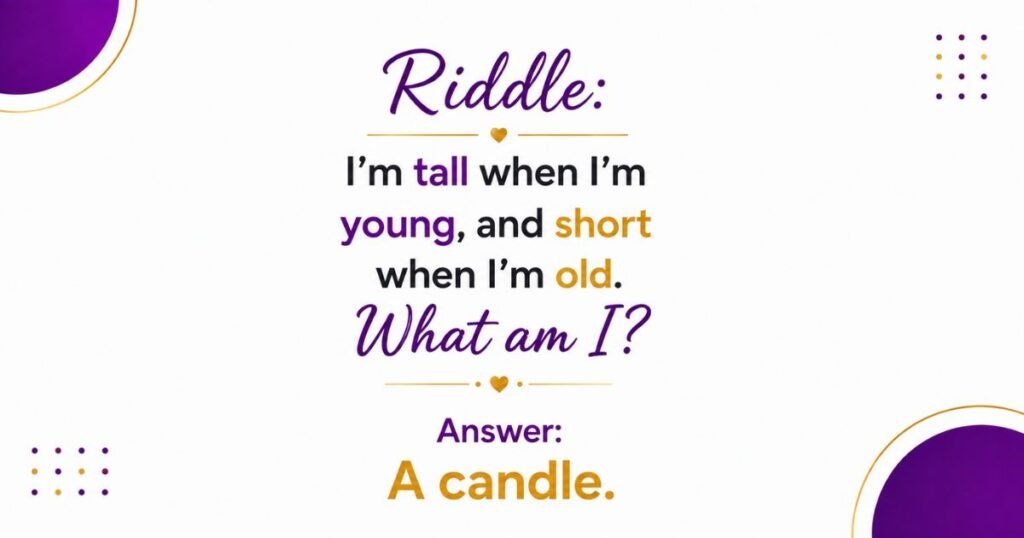
Explanation: A paradox riddle the object’s job (drying things) is the opposite of its own state. - Riddle: I’m tall when I’m young, and short when I’m old. What am I?
Answer: A candle.
Difficulty: Easy
Explanation: Reverses the usual “young = short, old = tall” growth pattern kids expect. - Riddle: What has many keys but can’t open a single lock?
Answer: A piano.
Difficulty: Easy
Explanation: Double meaning of “keys” (piano keys vs. door keys). - Riddle: What has one eye but cannot see?
Answer: A needle.
Difficulty: Easy
Explanation: Reuses the word “eye” for the needle’s hole.
- Riddle: What can travel around the world while staying in a corner?
Answer: A stamp.
Difficulty: Easy
Explanation: Contrasts “traveling the world” with staying fixed on an envelope’s corner. - Riddle: What has a neck but no head?
Answer: A bottle.
Difficulty: Easy
Explanation: Body-part language mapped onto an everyday object. - Riddle: I have branches but no fruit, trunk, or leaves. What am I?
Answer: A bank.
Difficulty: Easy
Explanation: Tree vocabulary reused for a financial institution’s “branches.” - Riddle: What kind of room has no doors or windows?
Answer: A mushroom.
Difficulty: Easy
Explanation: Hides the word “room” inside “mushroom.” - Riddle: What has a bottom at the top?
Answer: Your legs.
Difficulty: Easy
Explanation: Positional wordplay “bottom” refers to the body part, not the lowest point. - Riddle: What month of the year has 28 days?
Answer: All of them.
Difficulty: Easy
Explanation: A logic trap every month has at least 28 days, not just February. - Riddle: What has to be broken before it can be counted on?
Answer: A promise.
Difficulty: Easy
Explanation: Reuses “broken” again with a different, abstract noun. - Riddle: What has hands but cannot clap?
Answer: A clock.
Difficulty: Easy
Explanation: A companion riddle to #2, reinforcing the “clock has body parts” pattern. - Riddle: What gets bigger the more you take away from it?
Answer: A hole.
Difficulty: Easy
Explanation: Paradox: removing material makes the hole itself larger. - Riddle: What has teeth but cannot bite?
Answer: A comb.
Difficulty: Easy
Explanation: Reuses anatomical vocabulary for a tool. - Riddle: What can you catch but not throw?
Answer: A cold.
Difficulty: Easy
Explanation: “Catch” shifts meaning from sports to illness. - Riddle: What is full of holes but still holds water?
Answer: A sponge.
Difficulty: Easy
Explanation: Contradiction resolved once you picture the object. - Riddle: What has a ring but no finger?
Answer: A telephone.
Difficulty: Easy
Explanation: “Ring” as a sound versus “ring” as jewelry. - Riddle: What kind of coat is always wet when you put it on?
Answer: A coat of paint.
Difficulty: Easy
Explanation: Swaps “coat” the clothing item for “coat” the layer of paint. - Riddle: What has a head and a tail but no body?
Answer: A coin.
Difficulty: Easy
Explanation: “Heads and tails” from coin flipping, reused literally. - Riddle: What can fill a room but takes up no space?
Answer: Light.
Difficulty: Easy
Explanation: Kids often first guess a physical object, then realize light isn’t physical matter. - Riddle: What runs but never walks, has a mouth but never talks?
Answer: A river.
Difficulty: Easy
Explanation: “Runs” and “mouth” reused as river vocabulary (river mouth). - Riddle: What has an eye, but cannot see, and lives in the ocean?
Answer: A hurricane.
Difficulty: Easy
Explanation: Ties the “eye” wordplay pattern to a weather phenomenon instead of an object. - Riddle: What goes up but never comes down?
Answer: Your age.
Difficulty: Easy
Explanation: Subverts the expectation of a physical object rising.
Medium Riddles for Family Game Night
Once the easy set clicks, these medium riddles add a light logic step the answer isn’t instant, but it isn’t a trick question either.
- Riddle: The more you take, the more you leave behind. What am I?
Answer: Footsteps.
Difficulty: Medium
Explanation: A paradox riddle that requires picturing walking, not physical objects. - Riddle: I have cities but no houses, forests but no trees, and rivers but no water. What am I?
Answer: A map.
Difficulty: Medium
Explanation: Lists real-world features that only exist as symbols on a map. - Riddle: What has many rings but no fingers?
Answer: A tree trunk.
Difficulty: Medium
Explanation: “Rings” refers to tree growth rings, not jewelry a callback to the coin riddle’s pattern.
- Riddle: What can you break without ever touching it?
Answer: A promise (or silence).
Difficulty: Medium
Explanation: Forces the solver to think abstractly rather than physically. - Riddle: I speak without a mouth and hear without ears. What am I?
Answer: An echo.
Difficulty: Medium
Explanation: Personifies a sound phenomenon using human senses. - Riddle: What has a bed but never sleeps, and a mouth but never eats?
Answer: A river.
Difficulty: Medium
Explanation: Combines two river-vocabulary tricks (bed and mouth) in one riddle. - Riddle: What comes once in a minute, twice in a moment, but never in a thousand years?
Answer: The letter M.
Difficulty: Medium
Explanation: A letter-counting riddle count occurrences of the letter, not units of time. - Riddle: What can you keep after giving it to someone?
Answer: Your word (a promise), or your word in a conversation.
Difficulty: Medium
Explanation: Plays on the idiom “give your word.” - Riddle: The person who makes it, sells it. The person who buys it never uses it. The person who uses it never knows they’re using it. What is it?
Answer: A coffin.
Difficulty: Medium
Explanation: A classic three-clue lateral riddle that requires working backward from each clause. - Riddle: What has a thumb and four fingers but isn’t alive?
Answer: A glove.
Difficulty: Medium
Explanation: Body-part vocabulary applied to clothing shaped like a hand. - Riddle: What five-letter word becomes shorter when you add two letters to it?
Answer: Short (add “er” to get “shorter”).
Difficulty: Medium
Explanation: A wordplay riddle where the meaning describes the word itself. - Riddle: I’m light as a feather, yet the strongest person can’t hold me for more than a few minutes. What am I?
Answer: Your breath.
Difficulty: Medium
Explanation: Contrasts physical lightness with the impossible task of holding it. - Riddle: What kind of tree can you carry in your hand?
Answer: A palm (as in the palm of your hand).
Difficulty: Medium
Explanation: Double meaning of “palm” as both tree and body part. - Riddle: What has a face that changes but a name that stays the same?
Answer: A clock (or the moon).
Difficulty: Medium
Explanation: Requires the solver to think of something whose appearance shifts predictably. - Riddle: Forward I am heavy, but backward I am not. What am I?
Answer: The word “ton” (reversed: “not”).
Difficulty: Medium
Explanation: A palindrome-style wordplay riddle based on spelling backward. - Riddle: What begins with an E, ends with an E, but only has one letter in it?
Answer: An envelope.
Difficulty: Medium
Explanation: “Letter” is a double meaning alphabet letter vs. mailed letter. - Riddle: What has 13 hearts but no other organs?
Answer: A deck of cards.
Difficulty: Medium
Explanation: “Hearts” refers to the card suit, not anatomy. - Riddle: I have keys but open no locks. I have space but no room. You can enter, but you can’t go outside. What am I?
Answer: A keyboard.
Difficulty: Medium
Explanation: Chains three wordplay tricks (keys, space, enter) unique to a keyboard. - Riddle: What can be cracked, made, told, and played?
Answer: A joke.
Difficulty: Medium
Explanation: Tests vocabulary flexibility each verb pairs naturally with “joke.” - Riddle: Where does today come before yesterday?
Answer: In the dictionary.
Difficulty: Medium
Explanation: Alphabetical order, not chronological order, resolves the paradox. - Riddle: What invention lets you look right through a wall?
Answer: A window.
Difficulty: Medium
Explanation: A simple lateral answer that feels like it should be more complex. - Riddle: What is so fragile that saying its name breaks it?
Answer: Silence.
Difficulty: Medium
Explanation: The act of answering the riddle out loud demonstrates the answer. - Riddle: What has words but never speaks?
Answer: A book.
Difficulty: Medium
Explanation: Straightforward but requires separating “words” from “speech.” - Riddle: What kind of band never plays music?
Answer: A rubber band.
Difficulty: Medium
Explanation: “Band” as a musical group vs. an elastic loop. - Riddle: What has a spine but no bones?
Answer: A book.
Difficulty: Medium
Explanation: Anatomical vocabulary applied to a book’s binding.
Tricky Wordplay Riddles
This group leans hardest on puns, double meanings, and homophones the trademark of the best riddles for adults who enjoy language tricks.
- Riddle: What word is spelled incorrectly in every single dictionary?
Answer: “Incorrectly.”
Difficulty: Tricky
Explanation: A self-referential riddle the word itself is spelled correctly, but “incorrectly” is the literal word being asked for. - Riddle: What has four wheels and flies?
Answer: A garbage truck.
Difficulty: Tricky
Explanation: “Flies” as in insects, not flight a misdirection on the verb. - Riddle: What can be measured but has no length, width, or height?
Answer: Temperature.
Difficulty: Tricky
Explanation: Solvers default to physical dimensions before considering a non-spatial measurement.
- Riddle: What English word retains the same pronunciation after you take away four of its five letters?
Answer: Queue.
Difficulty: Tricky
Explanation: Removing “ueue” still leaves “Q,” pronounced identically. - Riddle: What word becomes a new word when read backward, referring to a female sheep both ways?
Answer: Ewe (backward: “ewe” is a palindrome trick riddle “ewe” reversed is still recognized phonetically as “you”).
Difficulty: Tricky
Explanation: Plays on the homophone between “ewe” and “you.” - Riddle: What can you hold in your left hand but never in your right?
Answer: Your right hand.
Difficulty: Tricky
Explanation: A logic loop the object being held is the hand itself. - Riddle: I am not alive, but I grow. I don’t have lungs, but I need air. What am I?
Answer: Fire.
Difficulty: Tricky
Explanation: Personifies fire’s need for oxygen without calling it “alive.” - Riddle: What has one head, one foot, and four legs?
Answer: A bed.
Difficulty: Tricky
Explanation: “Head,” “foot,” and “legs” all describe bed parts, not a creature. - Riddle: What can run but never walks, has a bank but no money?
Answer: A river.
Difficulty: Tricky
Explanation: “Bank” pivots from finance to geography, extending the earlier river riddles. - Riddle: Which word in the dictionary is spelled the same forward, backward, and upside down?
Answer: “Swims” (approximately, in certain fonts) commonly accepted answer is “SWIMS.”
Difficulty: Tricky
Explanation: A visual riddle relying on symmetrical letterforms, not just spelling. - Riddle: What goes through cities and fields but never moves?
Answer: A road.
Difficulty: Tricky
Explanation: “Goes through” describes a path’s route, not motion. - Riddle: What kind of cup doesn’t hold water?
Answer: A cupcake.
Difficulty: Tricky
Explanation: Compound-word riddle “cup” is embedded in an unrelated noun. - Riddle: What always ends everything?
Answer: The letter G.
Difficulty: Tricky
Explanation: Literal reading of the word “everything,” which ends in G. - Riddle: What has hands, doesn’t hold anything, and has no arms?
Answer: A clock.
Difficulty: Tricky
Explanation: A more layered version of the earlier clock riddles, adding a “hold” misdirection. - Riddle: I follow you all day but disappear at night. What am I?
Answer: Your shadow.
Difficulty: Tricky
Explanation: Ties disappearance to the absence of light rather than an object vanishing. - Riddle: What has a golden head and a golden tail but no golden body?
Answer: A coin.
Difficulty: Tricky
Explanation: Extends the earlier coin riddle by adding “golden” as a distractor. - Riddle: What can be broken but is never held, and built but never touched?
Answer: A record (as in “breaking a record”).
Difficulty: Tricky
Explanation: Abstract achievement described using physical verbs. - Riddle: What word looks the same upside down and backward?
Answer: “NOON.”
Difficulty: Tricky
Explanation: A palindrome that also has 180-degree rotational symmetry in block letters. - Riddle: What can point in every direction but can’t reach anything on its own?
Answer: A finger (or a compass needle).
Difficulty: Tricky
Explanation: Two valid answers make this a good discussion riddle about interpretation. - Riddle: What has a bottom, but no seat, and legs, but doesn’t walk?
Answer: A pair of pants (trousers).
Difficulty: Tricky
Explanation: Combines two prior body-part tricks (bottom, legs) into a clothing item. - Riddle: What has a golden crown but is not royalty, and sits on your head every single day?
Answer: Your hair.
Difficulty: Tricky
Explanation: “Crown” pivots from royalty to the crown of the head a common misdirection in wordplay riddles. - Riddle: What six-letter word still sounds exactly the same after you remove one letter from it?
Answer: “Plumb” removing the silent B leaves “plum,” which sounds identical out loud.
Difficulty: Tricky
Explanation: Silent letters make the spelling change invisible to the ear, so the pronunciation never shifts. - Riddle: What travels the world but stays in one spot?
Answer: A stamp (companion to riddle #7, reframed for adults with less obvious phrasing). Difficulty: Tricky
Explanation: Removes the direct “corner” clue from riddle #7 to make it harder. - Riddle: What is easy to get into but hard to get out of?
Answer: Trouble.
Difficulty: Tricky
Explanation: An abstract-noun riddle relying on common idiom. - Riddle: What can you serve but never eat?
Answer: A volleyball serve (or a tennis serve).
Difficulty: Tricky
Explanation: “Serve” shifts from food service to sports terminology.
Hard Brain-Teaser Riddles (Best Riddles to Stump Your Friends)
The final 25 are true lateral-thinking riddles. They rely on questioning an assumption embedded in the setup itself the hallmark of the hardest riddles.
- Riddle: A man is found dead in a locked room with no windows. The only things in the room are a puddle of water and a rope hanging from the ceiling. How did he die?
Answer: He stood on a block of ice, hanged himself, and the ice melted.
Difficulty: Hard
Explanation: Classic lateral-thinking riddle the “missing” object (the ice) had to disappear, not the murder weapon. - Riddle: A woman shoots her husband, then holds him underwater for five minutes, then hangs him. Five minutes later they enjoy dinner together. How?
Answer: She’s a photographer she shot a photo of him, developed it in water, then hung it to dry.
Difficulty: Hard
Explanation: Relies entirely on the double meanings of “shoots,” “holds underwater,” and “hangs.” - Riddle: Two fathers and two sons go fishing. Each catches exactly one fish, yet they only bring home three fish total. How?
Answer: They are grandfather, father, and son three people, not four.
Difficulty: Hard
Explanation: Challenges the assumption that “two fathers and two sons” means four separate people. - Riddle: A man pushes his car to a hotel and tells the owner he’s bankrupt. Why?
Answer: He’s playing Monopoly.
Difficulty: Hard
Explanation: Recontextualizes serious-sounding language into a board game setting.
- Riddle: You see a boat filled with people, yet there isn’t a single person on board. How is that possible?
Answer: Everyone on the boat is married there’s no single person.
Difficulty: Hard
Explanation: “Single” is a pun on marital status, not “just one.” - Riddle: What is at the end of a rainbow?
Answer: The letter W.
Difficulty: Hard
Explanation: A literal spelling riddle disguised as a whimsical question. - Riddle: A man walks into a bar and asks for a glass of water. The bartender pulls out a gun. The man says “thank you” and leaves. Why?
Answer: The man had hiccups; the shock of the gun cured them.
Difficulty: Hard
Explanation: A story-riddle that requires inferring an unstated detail (hiccups) from the resolution. - Riddle: What can you never eat for breakfast, even though its name suggests otherwise?
Answer: Dinner (or lunch).
Difficulty: Hard
Explanation: Plays on the literal impossibility of a meal name matching the time of day. - Riddle: I am not alive, yet I can die. I do not have lungs, yet I need air to survive. What am I? Answer: Fire (a harder variant of riddle #57 with “die” added).
Difficulty: Hard
Explanation: Adds a second life/death clue, increasing the personification misdirection. - Riddle: How can a pants pocket be empty and still have something in it?
Answer: It has a hole in it.
Difficulty: Hard
Explanation: “Something” is the hole itself, not an object. - Riddle: A man lives on the 12th floor. Every morning he takes the elevator to the ground floor. Every evening, he takes the elevator back up but only to the 8th floor, then walks the rest except on rainy days, when he goes straight to 12. Why?
Answer: He’s too short to reach the button for the 12th floor, but he can reach it with an umbrella on rainy days.
Difficulty: Hard
Explanation: A famous Sam Loyd–style lateral riddle relying on an unstated physical limitation. - Riddle: What building has the most stories?
Answer: A library.
Difficulty: Hard
Explanation: “Stories” means both building floors and narrative tales. - Riddle: A father’s child is not his son. Who is it?
Answer: His daughter.
Difficulty: Hard
Explanation: A misdirection riddle that plays on the assumption riddles about “fathers” involve sons. - Riddle: What can travel faster than light?
Answer: The thought of traveling faster than light or, more classically, nothing.
Difficulty: Hard
Explanation: Tests understanding that nothing physical outpaces light, so the answer must be abstract. - Riddle: I have no life, but I can die. What am I?
Answer: A battery.
Difficulty: Hard
Explanation: A modern variant of the “fire” riddle pattern applied to everyday electronics. - Riddle: What word contains 26 letters but only has three syllables?
Answer: “Alphabet.”
Difficulty: Hard
Explanation: Literal wordplay the word itself refers to all 26 letters. - Riddle: How far can a fox run into a forest?
Answer: Halfway after that, it’s running out of the forest.
Difficulty: Hard
Explanation: A geometry-of-language riddle that flips at the midpoint of the journey. - Riddle: A girl falls off a 25-foot ladder but doesn’t get hurt. How?
Answer: She fell off the bottom step.
Difficulty: Hard
Explanation: Assumes the fall happened from the top; the riddle never states that. - Riddle: What has many needles but doesn’t sew?
Answer: A pine tree (or a Christmas tree).
Difficulty: Hard
Explanation: “Needles” reused for pine leaves rather than sewing tools. - Riddle: Before Mount Everest was discovered, what was the tallest mountain on Earth?
Answer: Still Mount Everest it was always the tallest, just undiscovered.
Difficulty: Hard
Explanation: A logic riddle separating “discovery” from “existence.” - Riddle: What is greater than God, more evil than the devil, the poor have it, the rich need it, and if you eat it, you’ll die?
Answer: Nothing.
Difficulty: Hard
Explanation: Every clause is literally true when “nothing” is substituted for the blank. - Riddle: A man is looking at a photo. Someone asks whose photo it is. He says, “Brothers and sisters, I have none. But this man’s father is my father’s son.” Who is in the photo?
Answer: His own son.
Difficulty: Hard
Explanation: A genealogy riddle that requires tracing the family tree step by step. - Riddle: What kind of room has no walls, floor, or ceiling?
Answer: A mushroom (reused as a harder callback with no visual clue given).
Difficulty: Hard
Explanation: Strips the earlier hint pattern to make the wordplay less obvious. - Riddle: You’re in a race and you overtake the person in second place. What place are you in now?
Answer: Second place.
Difficulty: Hard
Explanation: A logic trap overtaking second place means taking their position, not first place. - Riddle: What English word has three consecutive double letters?
Answer: “Bookkeeper” (oo, kk, ee).
Difficulty: Hard
Explanation: A spelling riddle that rewards careful letter-by-letter scanning.
Keep the Riddle Streak Going
If this list left you wanting more, RiddleSpot has plenty to keep the momentum going. For a gentler set to run through with younger kids, our Disney Riddles collection sticks to the same short, visual style as the easy riddles above.
If the wordplay and double-meaning riddles in the Tricky section were your favorite, our Word Riddles collection has over 110 more puzzles built entirely around that kind of language trick.
And for a quicker round that doesn’t need the setup of the lateral-thinking brain teasers, our Short Riddles page is built for fast, one-line stumpers you can fire off back-to-back.
How to Use These Riddles in Classrooms, Parties, and Road Trips?
Riddles work best in short bursts. In classroom settings, three to five riddles at the start of class serve as a focus-building warm-up plenty for one sitting, especially with younger kids.
For long car rides, the Easy and Medium sections above are the strongest picks, since they don’t require pen and paper.
For adult game nights or team-building icebreakers, the Tricky Wordplay and Hard Brain-Teaser sections create the kind of friendly competition that keeps a group engaged for a full round.
Conclusion
The best riddles aren’t the ones with the most obscure answers, they’re the ones that make you rethink an assumption you didn’t know you were making. This list of 100 riddles is built to work for every age and skill level, from gentle wordplay to genuine lateral-thinking stumpers.
Start with the easy classics to warm up the room, then work your way up to the hard brain-teasers once the group is locked in. Bookmark this page, share your favorite with a friend who thinks they’re unstoppable, and let us know which one actually stumped you.
FAQs
What are the Best Riddles of all time?
Classic riddles like the Sphinx’s riddle and “What has to be broken before you can use it?” rank among the best. They pair simple language with a genuinely surprising twist.
What is a Good Hard Riddle with an Answer?
“Two fathers and two sons go fishing, each catches one fish, yet they only bring home three fish. How?” The answer grandfather, father, and son challenges an assumption about family structure.
What Makes a Riddle a “Good” Riddle?
A good riddle hides its answer through wordplay, misdirection, or a challenged assumption, not obscure trivia. The best ones feel obvious in hindsight, which creates the satisfying “aha.”
Are Riddles Good for Kids’ Brain Development?
Yes riddles build lateral thinking, patience, and vocabulary flexibility. They also give kids practice sitting with an unsolved problem instead of giving up right away.
What is the Hardest Riddle in the World?
There’s no single agreed-upon answer, since difficulty depends on the solver’s familiarity with riddle patterns. Multi-step lateral riddles are commonly cited as the toughest for first-timers.