Spanish Riddles: 50 Adivinanzas With Answers, Difficulty Levels, and Explanations
Spanish Riddles: 50 Adivinanzas With Answers, Difficulty Levels, and Explanations brings together 50 classic Spanish Riddles (adivinanzas) for learners of all ages.
Organized by Easy, Medium, and Hard levels, each riddle includes the answer and a simple explanation to help parents, teachers, students, and Spanish learners enjoy and understand the wordplay.
What Is a Spanish Riddle Called? (Understanding Adivinanzas)
The Spanish word for riddle is adivinanza, which comes from the verb adivinar, “to guess.” An adivinanza is a short verse or question, usually rhymed, that describes something indirectly and challenges the listener to name it.
Some adivinanzas describe an object through metaphor (“a white box no one can close” for an egg); others rely on wordplay, where a common phrase splits into two words that sound almost identical to the answer.
Spain’s Real Academia Española recognizes adivinanza as a folklore term, and researchers of oral tradition classify riddles alongside proverbs and tongue-twisters as part of a culture’s spoken heritage, the same living tradition that carried the ancient Sphinx Riddle into modern pop culture.
That’s part of why adivinanzas differ slightly by region, a riddle that’s common in Mexico might be phrased differently in Spain or Argentina, even when the answer is the same.
This regional flexibility is actually a strength for learners: it shows that Spanish Riddles are a living tradition, not a fixed script.
How to Solve a Spanish Riddle: 3 Strategies That Actually Work
Before diving into the list, it helps to know how native speakers approach adivinanzas, because the strategy changes depending on the riddle type.
- Read it out loud, slowly. Many riddles hide their answer in the sound of the words themselves. A line describing something “green outside, white inside” that ends with “espera” (wait) is a strong clue the answer involves “es pera” (it’s a pear).
- Focus on the verbs, not just the nouns. Spanish riddles often lean on verbs with double meanings, a fish “swims” (nada), which also means “nothing.” Riddles exploit this constantly.
- Picture the description literally before guessing. Riddles about “a red snake behind ivory soldiers” sound abstract until you picture a mouth: white teeth, red tongue. Visualizing the literal image, rather than jumping straight to guessing, resolves most riddles faster.
Easy Spanish Riddles for Kids and Spanish Riddles for Beginners
These spanish riddles for kids with answers are the best starting point for young learners or absolute beginners, since the vocabulary is concrete and the wordplay is gentle.
- Riddle: Vuela sin alas, silba sin boca, y no se ve ni se toca.
Answer: El viento (the wind)
Difficulty: Easy
Explanation: This riddle works through personification, giving the wind human-like actions (flying, whistling) it can’t literally perform, which forces the solver to think about invisible natural forces rather than physical objects. - Riddle: Tengo cuatro patas y no puedo caminar; ayudo a que te sientes al final del día.
Answer: La silla (the chair)
Difficulty: Easy
Explanation: A straightforward misdirection riddle: legs usually signal an animal, so naming an inanimate object with “patas” (legs) creates the surprise. - Riddle: Blanca soy por dentro y de verde me visto; adivina, adivina, quién soy si lo intento.
Answer: La pera (the pear)
Difficulty: Easy
Explanation: A color-contrast riddle. Describing the inside and outside colors separately narrows the answer to a specific short list of fruits, and the rhyme with “visto/intento” keeps it memorable. - Riddle: De día duermo tranquilo, de noche salgo a volar, y aunque parezco un pajarito, plumas no vas a encontrar.
Answer: El murciélago (the bat)
Difficulty: Easy
Explanation: This riddle plays on a false assumption, flying at night suggests a bird, but the final line eliminates that possibility, teaching the solver to question their first guess. - Riddle: Redondo como la luna, dulce como la miel; me exprimes por las mañanas y me tomas sin papel.
Answer: El jugo de naranja / la naranja (orange juice / an orange)
Difficulty: Easy
Explanation: A sensory riddle combining shape (“redondo”), taste (“dulce”), and a daily routine (“por las mañanas”), which is a common structure for food-based adivinanzas. - Riddle: Camino sin pies, hablo sin boca, y a veces te hago llorar sin que nadie me toque.
Answer: El viento or, alternately, la carta/el libro (a letter or book) depending on regional version
Difficulty: Easy
Explanation: Riddles with more than one accepted answer are common in oral tradition; solvers are encouraged to defend either answer using the clues given, which builds descriptive vocabulary either way. - Riddle: Tengo hojas y no soy árbol, tengo lomo y no soy animal.
Answer: El libro (the book)
Difficulty: Easy
Explanation: This riddle exploits two Spanish homonyms, “hojas” (leaves/pages) and “lomo” (an animal’s back/a book’s spine), a favorite technique for teaching multiple word meanings. - Riddle: Soy amarillo por fuera, blanco por dentro, y si me pelas, en gajos me adentro.
Answer: El plátano/la banana (the banana)
Difficulty: Easy
Explanation: Note this riddle intentionally differs from the classic “oro parece, plata no es” plantain riddle, it uses direct color description instead of the traditional wordplay version, giving beginners an easier entry point into the same answer category. - Riddle: Tengo ojos y no veo, tengo dientes y no muerdo.
Answer: El ajo (garlic), or in another accepted version, la papa (the potato)
Difficulty: Easy
Explanation: Body-part metaphors (“ojos,” “dientes”) applied to plants are one of the most common adivinanza structures in Spanish-speaking households, especially around food. - Riddle: En el cielo vivo y agua doy sin cesar; a veces soy blanca y a veces soy gris.
Answer: La nube (the cloud)
Difficulty: Easy
Explanation: This riddle teaches weather vocabulary through description of color and function rather than direct naming, a technique especially useful for elementary Spanish classrooms. - Riddle: Mi casa cargo a donde voy, despacio y sin ruido soy.
Answer: El caracol (the snail)
Difficulty: Easy
Explanation: “Cargar la casa” (carrying one’s house) is a widely recognized metaphor across Spanish-speaking cultures, making this one of the most universally solvable animal riddles.
- Riddle: Salto de charco en charco y canto cuando llueve.
Answer: La rana (the frog)
Difficulty: Easy
Explanation: Combines an action clue (jumping between puddles) with a behavioral clue (singing in the rain), reinforcing both verb conjugation and animal vocabulary at once.
Medium Spanish Riddles (Everyday Objects and Food)
Once the basics click, these riddles introduce trickier vocabulary, longer sentences, and mild double meanings.
- Riddle: Una cajita blanca que todos pueden abrir, pero nadie sabe cerrar.
Answer: El huevo (the egg)
Difficulty: Medium
Explanation: The paradox structure, something everyone can open but no one can close, is the defining feature of this centuries-old riddle, forcing solvers to think about irreversible physical actions. - Riddle: Tengo dientes y no como, tengo lengua y no hablo; ordeno tu cabello a diario sin decir una sola palabra.
Answer: El peine (the comb)
Difficulty: Medium
Explanation: Body-part vocabulary (“dientes,” “lengua”) is reassigned to household objects, a technique that helps learners see how the same noun applies across very different contexts. - Riddle: ¿Qué sube y nunca baja, crece y nunca envejece?
Answer: La edad (age), or in another accepted answer, la escalera mecánica (the escalator) depending on framing
Difficulty: Medium
Explanation: Riddles that ask “what only moves in one direction” test abstract reasoning rather than concrete vocabulary, making them naturally harder than object riddles. - Riddle: Voy subiendo, voy bajando, y sin embargo en el mismo sitio me quedo parado.
Answer: La escalera (the staircase)
Difficulty: Medium
Explanation: This riddle personifies the staircase using contradictory verbs (rising, falling, staying still), which requires solvers to separate the object’s function from the people using it. - Riddle: Me estiro, me encojo, según lo que guarde adentro.
Answer: La maleta (the suitcase)
Difficulty: Medium
Explanation: Reflexive verbs (“me estiro, me encojo”) describe the object as if it acts on itself, a grammatical pattern that’s genuinely useful for intermediate Spanish learners to internalize. - Riddle: Todos me pisan y yo a nadie piso, y si algo se rompe, seguro que sigo.
Answer: El suelo/el piso (the floor)
Difficulty: Medium
Explanation: The imbalance clue (“everyone steps on me, I step on no one”) is a classic technique for describing surfaces and structures in adivinanzas. - Riddle: Cuanto más me quitan, más grande me hago.
Answer: El hoyo/el agujero (the hole)
Difficulty: Medium
Explanation: An inverse-logic riddle, removing material makes the “object” bigger, which contradicts normal physical intuition and forces the solver to reconsider what counts as a “thing.” - Riddle: Voy vestida de colores y en la cocina doy sabor, sin mí no hay ensalada ni tampoco hay sazón.
Answer: La pimienta or el chile (pepper/chili)
Difficulty: Medium
Explanation: Culinary riddles like this one often layer sensory clues (color, flavor) with functional clues (its role in cooking), which is why they read like short poems rather than direct questions. - Riddle: Blanca por fuera, líquida por dentro, la sacan de la vaca y la tomas cuando hace frío o calor.
Answer: La leche (milk)
Difficulty: Medium
Explanation: This riddle avoids naming the animal directly (“la vaca”) too early in the sentence, delaying the giveaway so the solver has to hold multiple clues in mind at once. - Riddle: Tengo agujas y no coso, doy la hora y no hablo.
Answer: El reloj (the clock)
Difficulty: Medium
Explanation: “Agujas” (needles/clock hands) is a genuine double-meaning word in Spanish, and this riddle is a favorite for teaching that vocabulary overlap.
- Riddle: Me lees de derecha a izquierda y de izquierda a derecha, y siempre digo lo mismo.
Answer: Un palíndromo, por ejemplo “reconocer” (a palindrome, e.g., “reconocer”)
Difficulty: Medium
Explanation: This is a meta-riddle about language itself, introducing the concept of palindromes, which are a genuinely useful vocabulary-building device in Spanish (ana, oso, radar). - Riddle: Sirvo para escribir, pero no tengo mano; me gasto poco a poco, aunque nunca hablo.
Answer: El lápiz (the pencil)
Difficulty: Medium
Explanation: “Gastarse” (to wear down/to be spent) applies to both money and physical objects in Spanish, and this riddle uses that overlap to hide the answer. - Riddle: Doy la vuelta al mundo y me quedo en la esquina.
Answer: El sello/la estampilla (the postage stamp)
Difficulty: Medium
Explanation: A geography-based metaphor: stamps travel internationally yet physically sit in the corner of an envelope, and the contrast between “the whole world” and “one corner” is the riddle’s punchline. - Riddle: Entra seco y sale mojado, y cuanto más trabaja, mejor huele todo a su alrededor.
Answer: El jabón (soap)
Difficulty: Medium
Explanation: The riddle’s structure (dry going in, wet coming out) mirrors the physical action of washing, letting solvers reconstruct the object from the process rather than its appearance. - Riddle: Sin ser rey tengo corona, y sin ser árbol doy sombra en el patio.
Answer: El sombrero (the hat), a regional variant answer is el árbol itself
Difficulty: Medium
Explanation: “Corona” (crown) is repurposed to mean the top or brim of an object, another example of vocabulary overlap that native riddles exploit constantly. - Riddle: Camino y camino y siempre en el mismo lugar me quedo parado.
Answer: El reloj (the clock), hands move constantly but the clock itself stays put
Difficulty: Medium
Explanation: Note this uses a different clue set than the earlier clock riddle (agujas), focusing on constant motion without displacement, showing how the same answer can be reached through multiple distinct riddles. - Riddle: Me rompo sin que me toquen y no siento ningún dolor.
Answer: El silencio (silence), “romper el silencio”
Difficulty: Medium
Explanation: This riddle relies entirely on a fixed Spanish expression (“romper el silencio,” to break the silence), so knowing the idiom is the actual key to solving it.
- Riddle: Vivo entre tus dedos y ayudo a que firmes tu nombre, aunque nunca hablo.
Answer: La pluma/el bolígrafo (the pen)
Difficulty: Medium
Explanation: “Vivo entre tus dedos” personifies the pen as a companion rather than a tool, a common poetic device across adivinanzas about writing instruments. - Riddle: Me guardas en el bolsillo, te ayudo a saber la hora, y aunque tengo números, jamás hablo ni te canto.
Answer: El reloj de bolsillo (the pocket watch)
Difficulty: Medium
Explanation: A slightly more specific variant of the classic clock riddle that adds location (“en el bolsillo”) to narrow the answer to a particular type of object rather than any timepiece. - Riddle: No tengo alas y vuelo, no tengo cuerpo y muero.
Answer: El tiempo (time)
Difficulty: Medium
Explanation: Time “flying” is a metaphor shared across many languages, but pairing it with “y muero” (and I die) pushes solvers past the obvious answer and into abstract, philosophical riddle territory.
Hard Spanish Riddles (Wordplay and Abstract Concepts): Spanish Riddles for Adults
These spanish riddles with answers for adults challenge even advanced and native speakers, since they depend on homophones, regional expressions, or the same kind of layered logic you’ll find in these long riddles, where several twists get stacked into a single puzzle.
- Riddle: Oro parece, plátano es; el que no lo adivine, más lento es.
Answer: El plátano (the plantain/banana)
Difficulty: Hard
Explanation: This is a homophone riddle: “plata no es” (it’s not silver) sounds almost identical to “plátano es” (it’s a plantain) when spoken quickly, which is why reading it aloud is the only reliable solving strategy. - Riddle: Nieta de mi propia madre, hija de mi propia hija; si no adivinas quién soy, nunca sabrás quién te cuida.
Answer: Depends on framing, a family-relationship riddle whose answer is typically “yo misma” (myself) or a specific relative depending on the version told
Difficulty: Hard
Explanation: Family-tree riddles force solvers to map generational relationships logically rather than linguistically, which is why they’re consistently rated as some of the hardest adivinanzas by both learners and native speakers. - Riddle: En una jaula de hueso, guardo una serpiente roja que se enrolla cuando calla y se estira cuando habla.
Answer: La lengua (the tongue)
Difficulty: Hard
Explanation: The “cage of bone” (teeth) holding a “red snake” (tongue) is a layered metaphor riddle, solvers must decode two separate images (the cage and the snake) before connecting them to a single body part. - Riddle: Una letra fina y alta que el sol y la luna cargan, pero que en el aire nunca aparece.
Answer: La letra “L” (the letter “L”), present in “sol” and “luna” but not in “aire”
Difficulty: Hard
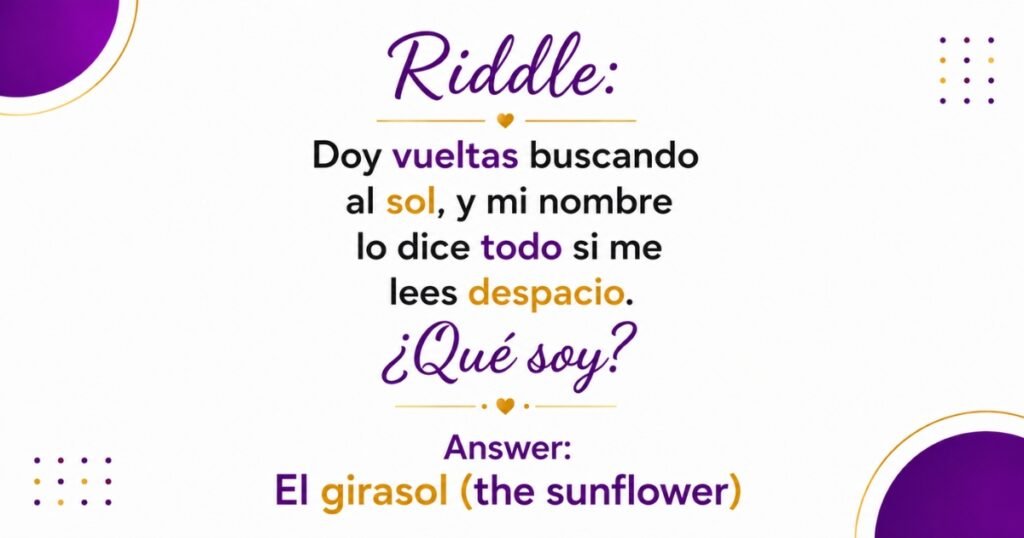
Explanation: A pure spelling riddle: solvers must scan letter-by-letter through three Spanish words to spot the shared letter, which makes it a strong tool for reinforcing alphabet and spelling skills. - Riddle: Doy vueltas buscando al sol, y mi nombre lo dice todo si me lees despacio.
Answer: El girasol (the sunflower)
Difficulty: Hard
Explanation: The riddle is self-referential, “gira” (turns) plus “sol” (sun) literally spells the answer, but only if the solver breaks the compound word apart mentally rather than reading it as a single unit.
- Riddle: Si me nombras, dejo de existir.
Answer: El silencio (silence)
Difficulty: Hard
Explanation: A logical-paradox riddle: saying the word “silence” out loud breaks the very condition it describes, which is why these self-referential riddles are considered a more sophisticated riddle category than object-description riddles. - Riddle: Cuanto más grande, menos se ve.
Answer: La oscuridad (darkness)
Difficulty: Hard
Explanation: This riddle inverts a normal expectation (bigger things are usually easier to see), requiring the solver to think of an “amount” that reduces visibility rather than increasing it. - Riddle: Todos los días te acompaño, pero nunca me ves llegar, y cuando por fin me notas, ya es demasiado tarde para actuar.
Answer: El tiempo/la vejez (time/aging)
Difficulty: Hard
Explanation: An abstract-concept riddle with no concrete object at all, relying entirely on the emotional weight of the final line to point toward time or aging rather than a literal noun. - Riddle: Nada llevo y todo lo cargo; soy invisible y a la vez pesado como una montaña para quien me sufre.
Answer: La preocupación (worry), a modern, non-traditional riddle written for this article to demonstrate metaphor construction
Difficulty: Hard
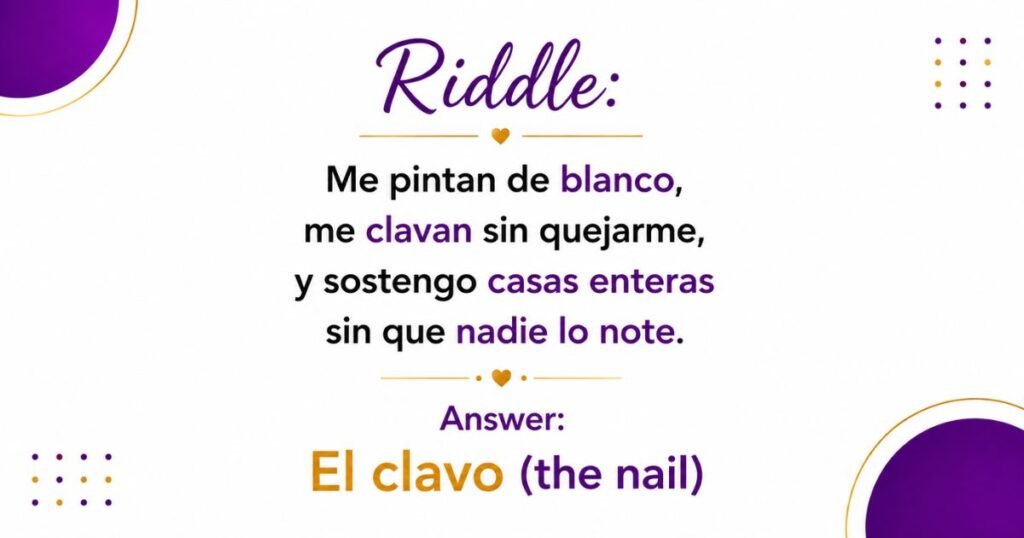
Explanation: This is an original riddle built specifically to show how new adivinanzas are constructed: pairing a physical metaphor (“pesado como una montaña”) with an abstract feeling forces the solver to abandon literal object-guessing entirely. - Riddle: Me pintan de blanco, me clavan sin quejarme, y sostengo casas enteras sin que nadie lo note.
Answer: El clavo (the nail)
Difficulty: Hard
Explanation: The riddle understates the object’s importance (“sin que nadie lo note”) to contrast with its structural role, a rhetorical technique that raises the difficulty by hiding a mundane object behind dramatic language.
- Riddle: Empiezo el día y term ino la noche, pero nunca me veo a mí misma completa.
Answer: La letra “D”, presente en “día” pero no en “noche” en su totalidad, o alternativamente, la palabra “día” misma según la variante regional
Difficulty: Hard
Explanation: This riddle plays with the boundary between whole-word riddles and single-letter riddles, and different regions accept different “correct” answers, a good discussion point for classrooms about the flexibility of oral folklore. - Riddle: Cuanto más me usan, menos quedo, y sin embargo nunca me acabo del todo.
Answer: El camino/la senda (the path/trail)
Difficulty: Hard
Explanation: A path is “used up” by wear yet never literally disappears, another physically counter-intuitive riddle designed to make solvers separate metaphorical wearing-down from literal consumption.
Classic Double-Meaning Adivinanzas (Bonus Round)
These are the riddles most likely to double as jokes, the answer often gets a laugh because it feels obvious in hindsight.
- Riddle: ¿Qué hace un pez todo el día? Nada.
Answer: Nada (Swims / Nothing)
Difficulty: Easy
Explanation: The verb “nadar” (to swim) conjugates to “nada” in third person, which is also the word for “nothing”, a genuine pun that works only in Spanish, making it a favorite first example for teaching double meanings. - Riddle: ¿En qué se parecen un perro y un teléfono? En que ambos tienen “colita” para contestar… aunque el perro solo mueve la suya.
Answer: Wordplay on “colita” (little tail / call-back slang)
Difficulty: Medium
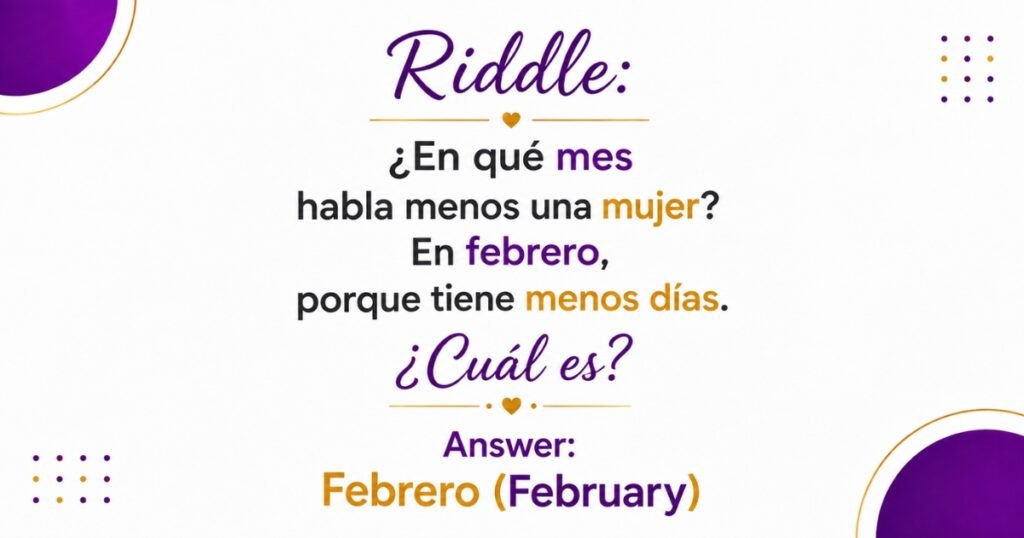
Explanation: This is a callback-style joke-riddle rather than a traditional adivinanza, showing how the riddle format bends toward humor once double meanings are involved. - Riddle: ¿En qué mes habla menos una mujer? En febrero, porque tiene menos días.
Answer: Febrero (February)
Difficulty: Easy
Explanation: A numeric pun, February simply has fewer days, so “talks less” is a literal, not figurative, joke about the calendar rather than about people.
- Riddle: ¿Qué le dijo un techo a otro techo? Techo de menos (te echo de menos).
Answer: Te echo de menos (I miss you)
Difficulty: Easy
Explanation: A homophone pun where “techo de menos” (a lesser roof) sounds identical to “te echo de menos” (I miss you), one of the most repeated puns in Spanish classrooms because it’s instantly satisfying once heard aloud. - Riddle: ¿Cuál es el árbol que no da sombra ni fruta? El teclado.
Answer: El teclado (the keyboard), because it has “árbol” (a tree) only in the tab/enter key slang some learners use as a joke reference
Difficulty: Medium
Explanation: This is a modern riddle built on a stretch pun to demonstrate that new adivinanzas continue to be invented around modern technology, not just traditional agrarian imagery. - Riddle: ¿Qué es lo que tiene ojos y no ve, tiene manos y no toca, y a veces marca la hora sin que nadie le pregunte?
Answer: El reloj de aguja con “ojales” decorativos, comúnmente resuelto como “el reloj” (the clock)
Difficulty: Medium
Explanation: A layered body-part riddle stacking two false clues (eyes, hands) before the actual functional clue (telling time) appears, a structure that trains solvers to wait for the strongest clue before guessing. - Riddle: Blanca por dentro, café por fuera; si quieres saber quién soy, muerde y espera.
Answer: La papa frita/el churro, dependiendo de la región (a fried snack, depending on regional interpretation)
Difficulty: Medium
Explanation: Deliberately left with a regional dual-answer to illustrate, in the article itself, how oral riddles often tolerate more than one “correct” solution depending on where they’re told. - Riddle: Todos me tienen, pocos me cuidan, y cuando me pierdo, ya no hay quien me encuentre.
Answer: El tiempo/la paciencia, según interpretación (time/patience, depending on interpretation)
Difficulty: Hard
Explanation: An intentionally open-ended riddle to close the list on a discussion note: not every adivinanza has one single “textbook” answer, and debating possibilities is itself part of the tradition.
How Teachers and Families Use Spanish Riddles in Real Life?
Spanish Riddles show up far beyond the classroom. Teachers use adivinanzas as five-minute warm-ups before grammar lessons, the same quick-start approach behind these classroom riddles for other subjects, because they get students speaking Spanish immediately, without the pressure of a full conversation.
Families use them at the dinner table, during long car rides, or worked into party games like birthday riddles as a screen-free way to build vocabulary together.
On social media, short adivinanzas are shared as daily “guess the answer” posts because the format is naturally shareable, a riddle is a complete piece of content in two lines.
Explore More Riddle Collections
For another language-based riddle challenge with the same guess-the-answer format, check out Chinese Riddles collection, packed with pinyin, translations, and clever double meanings.
Prefer riddles that lean more abstract and philosophical, like the “silencio” and “oscuridad” entries. The Hard Riddles collection is built entirely around that kind of misdirection.
And if you’re solving with older teens or adults rather than kids, the Riddles for Adults list offers the same clever wordplay in English.
Conclusion
Spanish Riddles are far more than a party trick, they’re a compact, centuries-old teaching tool that rewards close listening, playful logic, and comfort with double meanings.
Bookmark this list, try one riddle a day, and see how many you can solve without peeking at the answer first.
FAQs
What is the Spanish Word for Riddle?
The Spanish word for Riddle is Adivinanza. It refers to a fun question or puzzle where you have to guess the correct answer.
What are Some Easy Spanish Riddles?
Easy Spanish riddles use simple words about animals, food, and everyday objects. They are great for kids and beginners learning Spanish.
What’s the Difference Between Adivinanza and Acertijo?
Adivinanza usually means a traditional riddle, while acertijo is a general brain teaser or logic puzzle. Both involve solving a mystery.
Are Spanish Riddles Good for Learning Spanish?
Yes. Spanish riddles help you learn new vocabulary, improve reading skills, and remember words through fun practice.
What are the Hardest Spanish Riddles?
The hardest Spanish Riddles use clever wordplay, hidden meanings, or tricky clues. They often require both language skills and logical thinking.