100 Drunk Riddles With Answers (Funny, Tricky and Perfect for Parties)
Drunk riddles are short, alcohol-themed brain teasers built around drinking, bars, and party mishaps. They mix easy wordplay with punchline-style humor, making them ideal icebreakers for game nights, bachelor parties, and couples’ date nights. Most pair a playful question with a twist answer tied to beer, wine, or hangovers.
After running dozens of these during trivia nights and birthday get-togethers, one thing becomes obvious fast: the riddles that land best aren’t the hardest ones, they’re the ones everyone can shout the answer to at the same time.
Funny Drunk Riddles for Parties (Easy)
These are the openers, the riddles that get the whole room laughing before anyone’s even finished their first drink. They lean on simple logic and drinking-culture punchlines rather than tricky wordplay, which is exactly why they work so well as icebreakers.
Based on hosting several game nights, riddles in this tier get solved (and laughed at) within seconds, which keeps the energy moving instead of stalling the group on one hard question.
Difficulty: Easy
Explanation: The riddle relies on a simple reversal, something that starts “full” is expected to stay that way, but the twist matches the real party experience of drinks constantly disappearing.
Difficulty: Easy
Explanation: This works through relatable irony, the same phrase marks both the fun beginning and the regrettable ending of a night out.
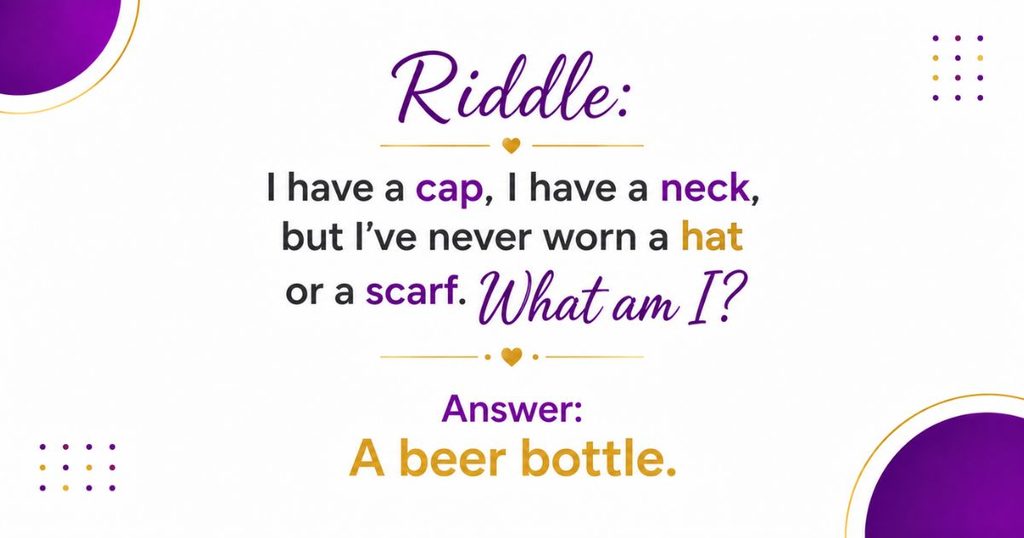
Difficulty: Easy
Explanation: Classic personification riddle, everyday drink packaging is described using body parts to create a misdirection that’s solved the moment you picture the object.
Difficulty: Easy
Explanation: The humor comes from admitting a widely known truth about home bartending, effort doesn’t always equal skill.
Difficulty: Easy
Explanation: A straightforward pun on “cooler,” blending temperature and social vibe into one punchline.
- Riddle: What goes into a blender loud and comes out of a glass sweet?
Answer: A frozen margarita.
Difficulty: Easy
Explanation: Sensory contrast (loud versus sweet) hints at the process of making a frozen drink without naming it directly. - Riddle: What drink has a whole holiday named after doing shots of it?
Answer: Tequila (Cinco de Mayo/National Tequila Day).
Difficulty: Easy
Explanation: A trivia-style riddle that rewards general drinking-culture knowledge rather than pure logic. - Riddle: What always shows up to the party first and leaves the earliest?
Answer: The ice in the cooler.
Difficulty: Easy
Explanation: Personifying a party item that melts away quickly turns a simple observation into a light joke about timing. - Riddle: What can you order “on the rocks” that has nothing to do with climbing?
Answer: Whiskey.
Difficulty: Easy
Explanation: Plays on a double meaning of “rocks” (ice cubes versus actual stones), a common riddle technique called homonym misdirection. - Riddle: What’s the one thing every party host runs out of first?
Answer: Cups (or ice).
Difficulty: Easy
Explanation: Grounded in shared real-world experience rather than wordplay, - the humor is in the recognition, not the trick.
- Riddle: Why is a red solo cup the most trusted friend at any party?
Answer: Because it never tells anyone what’s really inside it.
Difficulty: Easy
Explanation: Builds on the well-known party trope of red cups hiding drink contents, giving the object a “loyal friend” personality. - Riddle: What instrument does everyone suddenly know how to play after two drinks?
Answer: The air guitar.
Difficulty: Easy
Explanation: A relatable exaggeration riddle, confidence rises with drinks even when skill doesn’t. - Riddle: What’s the only math problem nobody wants to solve at the bar?
Answer: Splitting the tab.
Difficulty: Easy
Explanation: Turns a mundane social annoyance into a riddle by framing it as an unsolvable “problem.” - Riddle: What can pop, fizz, and ruin a white shirt in seconds?
Answer: Champagne.
Difficulty: Easy
Explanation: Sequential clues (pop, fizz) build toward the answer before the punchline twist about spills lands the joke. - Riddle: What does every karaoke night have in common with a magic show?
Answer: Both convince you something impossible just happened.
Difficulty: Easy
Explanation: A comparison riddle, the humor comes from linking two unrelated activities through a shared exaggerated outcome.
Drunk Riddles for Adults (Medium)
Once the group’s warmed up, these party riddles for adults hit better, a little cheekier, still nothing offensive, but built around situations only adults deal with: bar tabs, group chats, and questionable 2 a.m. decisions.
This set of adult riddles for parties leans on liquid courage riddles and requires a beat more thought than the openers, which makes them a good middle section for a longer game.
Answer: A drunk idea.
Difficulty: Medium
Explanation: The riddle uses a “before and after” structure, the same person is split into two versions (drunk vs. sober) to highlight the contrast the riddle depends on.
Difficulty: Medium
Explanation: Relies on cultural familiarity with drunk texting as an unavoidable, universally understood consequence.
Difficulty: Medium
Explanation: Economic-style phrasing (“costs nothing… everything”) sets up a wordplay contrast between money and consequence.
Difficulty: Medium
Explanation: Relies on situational logic, audiences must connect two stages of a familiar event to land on the answer.
Difficulty: Medium
Explanation: An inverse relationship riddle, normally noise rises with more people, so flipping that expectation creates the twist.
Difficulty: Medium
Explanation: Compares two unrelated concepts (alarms and headaches) through their shared trait of being impossible to ignore.
Difficulty: Medium
Explanation: Personification riddle that works because it allows two valid answers, both fitting the “uninvited guest” metaphor.
Difficulty: Medium
Explanation: Uses contrast (strangers becoming friends, friends becoming rivals) to build toward a specific, well-known party game.
Difficulty: Medium
Explanation: A misdirection riddle, listeners expect a physical object (“lose” implies theft), but the answer is abstract.
Difficulty: Medium
Explanation: Assigns monetary weight to a casual word, requiring the listener to think about consequences rather than definitions.
Difficulty: Medium
Explanation: Built on a common social phrase, turning an inside joke into the riddle’s actual answer.
Difficulty: Medium
Explanation: Plays with the assumption that “winning” requires competition, when the answer is really about social generosity.
Difficulty: Medium
Explanation: Straightforward but effective negative-space riddle, the answer is defined by what’s absent, not present.
Difficulty: Medium
Explanation: Time-based contrast (Tuesday vs. Friday) signals that the riddle is about a memorable event rather than an object.
Difficulty: Medium
Explanation: Numbered escalation (implying the first two drinks were fine) adds specificity that makes the punchline land harder.
Alcohol and Drink-Themed Riddles (Medium)
This set focuses squarely on the drinks themselves, with riddles about beer, riddles about wine, riddles about cocktails, and riddles about tequila all mixed in alongside a few funny alcohol riddles.
From my experience running trivia-style riddle rounds, this category works best because it doubles as light alcohol trivia, so even non-drinkers can join in by guessing based on facts rather than party experience.
Difficulty: Medium
Explanation: Contradiction riddle, the object shares a trait with something (oak, a tree) without being that thing, forcing the listener to separate the material from the object.
Difficulty: Medium
Explanation: Same contradiction technique as above, applied to a different source ingredient, testing whether the reader catches the pattern.
Difficulty: Medium
Explanation: Metaphorical language (“bottled sunshine”) requires connecting a poetic description to a literal drink.
Difficulty: Medium
Explanation: Visual imagery riddle, foam and gold color are literal descriptions of beer disguised as treasure-hunt language.
Difficulty: Medium
Explanation: Sensory contrast (visual clarity vs. felt intensity) is the riddle’s core trick, common in alcohol-themed wordplay.
Difficulty: Medium
Explanation: Tests specific drink-trivia knowledge (agave as tequila’s source plant) rather than general logic.
Difficulty: Medium
Explanation: Relationship-based clue (“best friends with tonic”) relies on knowing the classic gin-and-tonic pairing.
Difficulty: Medium
Explanation: Combines occasion-based trivia with a physical property (going flat) for a two-part clue structure.
Difficulty: Medium
Explanation: Pop-culture reference riddle, solving it requires connecting a famous catchphrase to the drink it describes.
Difficulty: Medium
Explanation: Homonym riddle, “proof” as an alcohol measurement is swapped with “proof” as legal evidence to create the twist.
Difficulty: Medium
Explanation: Uses a real winemaking term (“legs,” the streaks left in a glass) as the misdirection, rewarding wine knowledge.
Difficulty: Medium
Explanation: Homonym play between “punch” the drink and “punch” the physical hit.
Difficulty: Medium
Explanation: Borrows coffee-related descriptors to describe a beer style, testing whether the reader knows stout’s roasted-malt flavor profile.
Difficulty: Medium
Explanation: Highlights the gap between a common phrase (“throwing one back”) and the literal action being described.
Difficulty: Medium
Explanation: Indirect clue, the answer is inferred from a related object (limes) rather than described directly.
Hard and Tricky Drunk Riddles (Hard)
This is where the real brain teasers for a night out live. Expertise-wise, hard riddles typically rely on layered misdirection, two or three possible answers before the real one clicks.
From experience, these work best mid-party, once people are relaxed enough to actually sit with a question instead of rushing to guess.
Difficulty: Hard
Explanation: Uses a paradox, an object described as “clear” causes things to become “unclear,” which requires separating the drink’s appearance from its effect.
Difficulty: Hard
Explanation: Borrows firearm vocabulary (“chamber,” “shot”) entirely metaphorically, testing whether the reader can resist the literal gun imagery.
Difficulty: Hard
Explanation: Three-part structure (rise, fall, disappear) mirrors the real physical stages of beer foam, but each clause is phrased emotionally to obscure the literal meaning.
Difficulty: Hard
Explanation: A deliberately ambiguous riddle meant to spark debate, its value is in the discussion, not a single clean answer, which is common in “hard” riddle categories.
Difficulty: Hard
Explanation: Requires tracking two reversed time relationships at once, a layered logic structure typical of harder riddles.
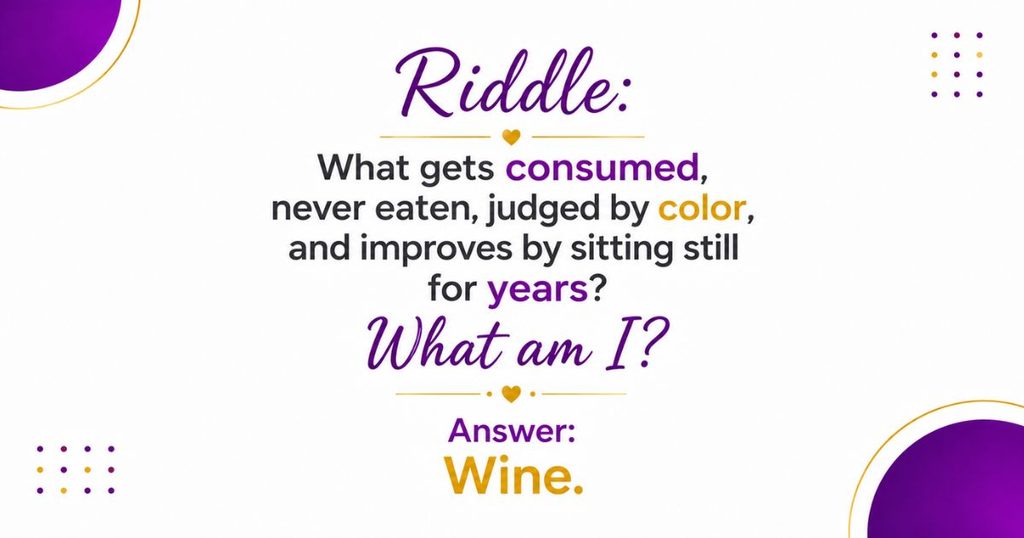
- Riddle: What gets consumed, never eaten, judged by color, and improves by sitting still for years?
Answer: Wine.
Difficulty: Hard
Explanation: Four sequential clues must all point to the same answer, filtering out drinks that fit only some of the criteria (like beer, which doesn’t improve with age the same way). - Riddle: I have a body, a nose, and legs, yet no doctor has ever examined me. What am I?
Answer: Wine (wine-tasting terminology).
Difficulty: Hard
Explanation: Relies on specialized wine vocabulary where human anatomy terms describe taste, aroma, and texture, a riddle that rewards prior wine knowledge. - Riddle: The colder I get, the more I’m loved, but past a certain point, I lose all my character. What am I?
Answer: Beer (over-chilling mutes flavor).
Difficulty: Hard
Explanation: Introduces a threshold condition (“past a certain point”) that most riddles skip, adding a layer of nuance beyond a simple opposite. - Riddle: I can be neat, on the rocks, or with a twist, but I’m never actually tidy, icy, or bent. What am I?
Answer: A whiskey order.
Difficulty: Hard
Explanation: Deliberately misleads with literal definitions of bartending terms (“neat,” “rocks,” “twist”) before revealing they describe a drink order. - Riddle: I start in a field, end in a glass, and along the way I’m crushed, fermented, and forgotten. What am I?
Answer: Wine grapes.
Difficulty: Hard
Explanation: A process riddle, the answer requires mentally tracing an entire production chain rather than a single trait. - Riddle: What can be shaken until it’s perfect, but ruined the instant it’s stirred wrong?
Answer: A cocktail.
Difficulty: Hard
Explanation: Plays on the precision required in mixology, where technique changes the outcome, a subtler riddle than most “drink” clues. - Riddle: I have three ingredients that never agree, yet somehow they’re best friends in a glass. What am I?
Answer: A whiskey sour (whiskey, lemon, sugar).
Difficulty: Hard
Explanation: Requires specific cocktail-recipe knowledge, making it one of the more expert-level entries in the list. - Riddle: What’s poured to celebrate an ending and poured again to start something new?
Answer: Champagne (used at both farewells and New Year’s).
Difficulty: Hard
Explanation: Requires recognizing that the same object serves opposite emotional purposes, a subtler form of contrast riddle. - Riddle: I can turn a stranger into a storyteller, but I can also turn a storyteller into someone who repeats themselves. What am I?
Answer: A few drinks in.
Difficulty: Hard
Explanation: Uses a two-sided character arc (confidence, then repetition) to describe a gradual effect rather than a single moment. - Riddle: I have no opinion, yet I’m blamed for every opinion shared after midnight. What am I?
Answer: Alcohol.
Difficulty: Hard
Explanation: Builds on a logical contradiction, an object with “no opinion” is somehow responsible for opinions, which forces the reader to think about causation versus blame.
Short and Quick Drunk Riddles (Easy)
Perfect for a fast-paced round or a group text, these drinking riddles trade depth for speed. Each is a single line, built for quick-fire party games where the goal is volume, not difficulty.
Difficulty: Easy
Explanation: Simple contrast between two similar-sounding outcomes (pop vs. break).
Difficulty: Easy
Explanation: Homonym play on “neat,” meaning tidy versus a drink style.
Difficulty: Easy
Explanation: Same “rocks” wordplay as earlier, shortened for quick delivery.
Difficulty: Easy
Explanation: Foam (“head”) is the literal object, with a punchline twist about hangovers.
Difficulty: Easy
Explanation: Clarifies a common phrase by separating its literal and ceremonial meaning.
Difficulty: Easy
Explanation: Dual meaning of “melts” ties social ease to a literal physical process.
Difficulty: Easy
Explanation: Separates the physical action (shaking) from the emotional meaning of the word.
Difficulty: Easy
Explanation: Common bar phrase reframed as a riddle to highlight double meaning.
Difficulty: Easy
Explanation: “Flat” describes a physical state rather than a position, the riddle’s core twist.
Difficulty: Easy
Explanation: Modern double meaning of “tapped” adds a contemporary twist to a classic bar term.
Bar and Bartender Riddles (Medium)
Bartenders see it all, so these bar riddles lean into bar culture: the tools, the roles, and the routines that make a night out run smoothly (or not).
From experience chatting with bartenders while researching this list, these riddles resonate most with anyone who’s ever worked, or hung out, behind the counter.
Difficulty: Medium
Explanation: Combines job duties with an exaggerated personal detail (forgetting their own name) to humanize the riddle’s subject.
Difficulty: Medium
Explanation: Uses a precise, real bartending measurement (1.5 oz is a standard shot) combined with a playful exaggeration (“trouble”).
Difficulty: Medium
Explanation: Personifies a record-keeping object, contrasting its “counting” role with its lack of physical interaction with drinks.
Difficulty: Medium
Explanation: Straightforward object riddle relying on the contrast between an object’s function and its lack of need for that function.
Difficulty: Medium
Explanation: Misdirects toward a person (bouncer) before revealing the answer is furniture, based on physical positioning.
Difficulty: Medium
Explanation: Focuses on a repetitive, unnoticed task (wiping the bar) to build a riddle around something easy to overlook.
Difficulty: Medium
Explanation: Combines a specific detail (hanging from the ceiling) with a relatable complaint (never finding it) for a grounded, situational riddle.
Difficulty: Medium
Explanation: Sequential clue (last thing said, followed by a reaction) leads directly to a specific, well-known bar phrase.
Difficulty: Medium
Explanation: Combines timing (once a year, around midnight) with a specific tradition to narrow down the answer.
Difficulty: Medium
Explanation: Plays on a well-known customer service phrase, subverted by the specific limits of a bartender’s job (cutting someone off).
Drunk-in-Love Riddles for Couples (Medium)
A softer, date-night-friendly spin on the theme, these riddles for couples lean into confidence, chemistry, and the honesty that comes with a shared bottle of wine.
They’re a solid pick for couples’ game nights, since the answers are romantic rather than raunchy.
Difficulty: Medium
Explanation: Uses two paired transformations (shy to talkative, small talk to dancing) that both point to the same relaxing cause.
Difficulty: Medium
Explanation: Wordplay on the phrase “just friends,” subtly shifted into a romantic outcome through repetition of “just.”
Difficulty: Medium
Explanation: Metaphorical clothing language (“dressed up”) disguises an emotional moment as a physical object.
Difficulty: Medium
Explanation: Combines a specific color detail (pink) with a mood-based clue (sunset) that narrows the answer to a particular wine style.
Difficulty: Medium
Explanation: Uses a common relationship idiom (“finish each other’s sentences”) and reframes it around shared drinking rather than deep familiarity alone.
Difficulty: Medium
Explanation: Contrasts routine (“the usual”) with novelty (“tastes new”) to hint at emotional context changing the experience.
Difficulty: Medium
Explanation: Attributes a spontaneous romantic action to an object, creating a lighthearted excuse-style riddle.
Difficulty: Medium
Explanation: The escalation from one drink to an entire evening mirrors how enjoyable company naturally extends the night.
Difficulty: Medium
Explanation: Two paired effects (braver vows, sappier speeches) both trace back to the same celebratory drink.
Difficulty: Medium
Explanation: Uses the term “nightcap” both literally (a drink) and figuratively (a shared moment), letting the solver discover the deeper meaning.
Hangover Riddles: The Morning After (Easy)
Every good night has a next morning, and these riddles cover it, sunglasses indoors, greasy food, and the group chat recap nobody wants to reread.
Trustworthiness note: none of this is medical advice; it’s just the shared, universally understood experience of a rough morning.
Difficulty: Easy
Explanation: Personifies an unwanted physical state as an “uninvited guest,” a common and easy-to-solve riddle pattern.
Difficulty: Easy
Explanation: Combines a specific symptom (light sensitivity) with an unusual context (wearing sunglasses indoors) for a quick visual clue.
Difficulty: Easy
Explanation: Relies on shared cultural knowledge that hangover cravings often favor greasy, comforting meals.
Difficulty: Easy
Explanation: Exaggeration riddle, an ordinary sound is described as unbearable to reflect a hangover’s heightened sensitivity.
Difficulty: Easy
Explanation: Uses a real, commonly recognized phrase as the riddle’s answer instead of an abstract description.
Difficulty: Easy
Explanation: Plays on the endless, often contradictory folk debate around hangover remedies.
Difficulty: Easy
Explanation: Relatable situational riddle grounded in the common regret tied to late-night messaging.
Difficulty: Easy
Explanation: Comparative riddle allowing two humorous, equally valid answers depending on the listener’s own experience.
Difficulty: Easy
Explanation: Uses a modern, universally recognized behavior (Googling symptoms) as the riddle’s punchline.
Difficulty: Easy
Explanation: Bookends the riddle collection by tying the ending of one night to the (often broken) promise that starts the next morning’s regret.
How to Use These Riddles at Your Next Party?
A few ways this list has worked well in real settings: read one riddle per round and let the group shout answers, use the Hard section as tiebreakers in trivia night, or turn any section into a drinking-game prompt where a wrong guess means a sip.
Couples can pull from the “Drunk-in-Love” section for a lighter, date-night version of the game. However you use them, keep it responsible, the goal is laughter, not overdoing it.
Keep a Non-Alcoholic Set on Hand Too
Not every guest at your party drinks, and not every riddle round needs alcohol to work.
- If you want a quick, family-safe set ready for kids or non-drinking guests, our library riddles collection swaps bar culture for books and reading-time fun.
- And if this party falls in early spring, our March riddles page is built around the same season, minus the cocktails, for a daytime or family-friendly version of game night.
Conclusion
Drunk riddles work because they’re built for the exact moment they’re used in, relaxed, social, and looking for an easy laugh.
This collection of 100 riddles covers every level, from one-liners to genuine brain teasers, plus a softer set for couples and a morning-after section everyone can relate to.
FAQs
What are Drunk Riddles?
Drunk riddles are short, alcohol- and party-themed brain teasers built around drinking culture, bars, and the ups and downs of a night out.
What is a Good Riddle to Use in a Drinking Game?
Medium-difficulty riddles tend to work best for drinking games, since they’re solvable but not instant, giving the group a beat to guess before revealing the answer.
Are Drunk Riddles Appropriate for Kids or Teens?
Most riddles on this list are written for an adult audience because they reference alcohol, bars, and drinking culture directly. For younger audiences, swap in a general riddle collection that skips the alcohol theme entirely rather than trying to “clean up” these versions.
How Do You Turn Riddles into a Drinking Game?
A simple version: read a riddle aloud, and whoever guesses wrong (or last) takes a sip. You can also assign riddles by difficulty, Easy riddles for warm-up rounds, Hard riddles as late-game tiebreakers.