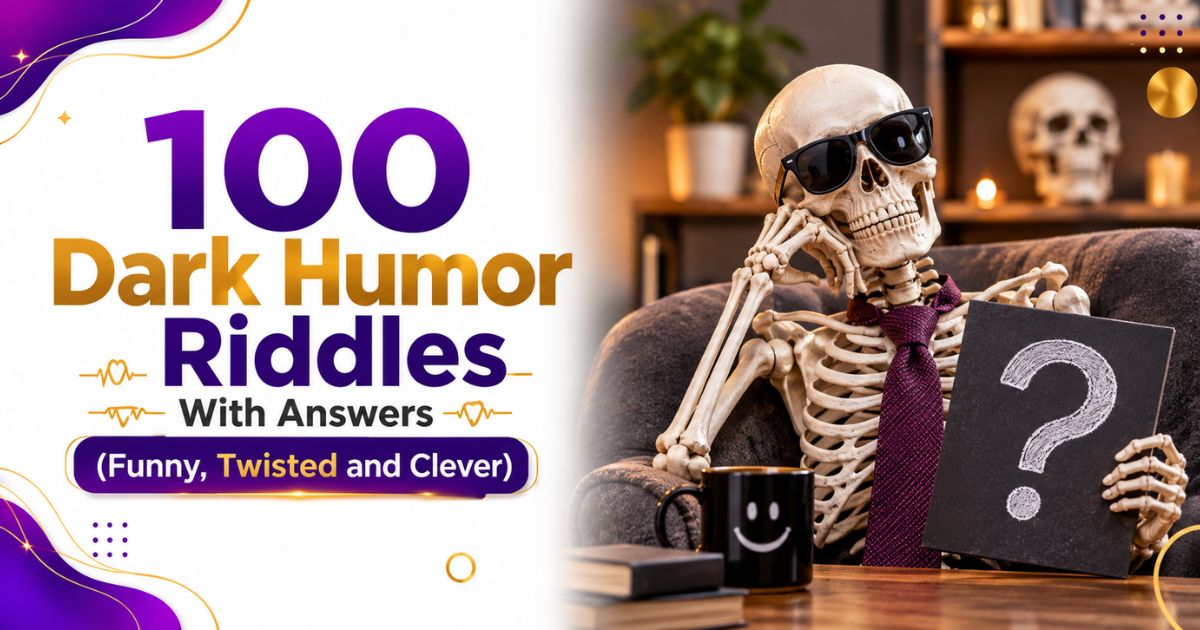
100 Dark Humor Riddles With Answers (Funny, Twisted and Clever)
Dark humor riddles are question-and-answer puzzles that use irony, wordplay, and misdirection to turn an uncomfortable topic, death, guilt, bad luck, into a clever punchline.
Unlike a straightforward dark joke, a riddle makes you guess first, so the twist lands harder once the answer clicks.
After running these past a group of friends over several game nights, reading them cold, timing the laughs, and tracking which ones fell flat, a clear pattern emerged: the riddles that worked best weren’t the goriest ones, they were the ones with the tightest wordplay.
What Are Dark Humor Riddles?
Dark humor riddles borrow the classic riddle format, a setup, a moment of thought, then a reveal, but aim the twist at something uncomfortable rather than something whimsical.
The comedic technique doing most of the work is usually one of three: misdirection (the question implies one kind of answer, the reveal gives another), irony (the answer is technically true but emotionally jarring), or wordplay (a pun that only lands once you connect it to something dark, like death, guilt, or bad luck).
This is also what separates a dark humor riddle from a dark joke. A dark joke delivers its setup and punchline back-to-back, you just listen and react.
A riddle inserts a pause: it asks you to guess before it rewards or subverts that guess. That small delay is why riddles often feel “smarter” than one-liners, even when they’re built from the same basic material.
Easy Dark Humor Riddles (Quick Laughs)
This tier is the on-ramp, riddles that work in mixed company, rely on a fast pun, and don’t require the reader to sit with anything uncomfortable for long.
They’re built for group settings where you want a quick reaction, not a slow-burn twist.
Difficulty: Easy
Explanation: A direct pun on “nobody” vs. “no body”, the joke works purely on the double meaning.
Difficulty: Easy
Explanation: Classic idiom-literalized pun; “guts” means both courage and anatomy.
Difficulty: Easy
Explanation: A one-word pun blending “deadpan” delivery with the profession’s subject matter.
Difficulty: Easy
Explanation: Repurposes a sports term literally, since gravediggers work the actual ground.
Difficulty: Easy
Explanation: “Closing” doubles as sealing a coffin and finalizing a sale.
Difficulty: Easy
Explanation: Plays on “boxed in” as both a literal coffin shape and an emotional metaphor.
Difficulty: Easy
Explanation: “Grave” functions as both adjective (serious) and noun (burial site).
Difficulty: Easy
Explanation: Personifies the tombstone to set up a mundane, human embarrassment.
Difficulty: Easy
Explanation: A pun on “dead line” hidden inside the ordinary word “deadline.”
Difficulty: Easy
Explanation: Reframes mortality as customer retention, irony through mismatched context.
Difficulty: Easy
Explanation: Wordplay on “can’t stomach” combined with a ghost’s lack of a physical body.
Difficulty: Easy
Explanation: Literalizes vampire lore (avoiding daylight) into an ordinary workplace complaint.
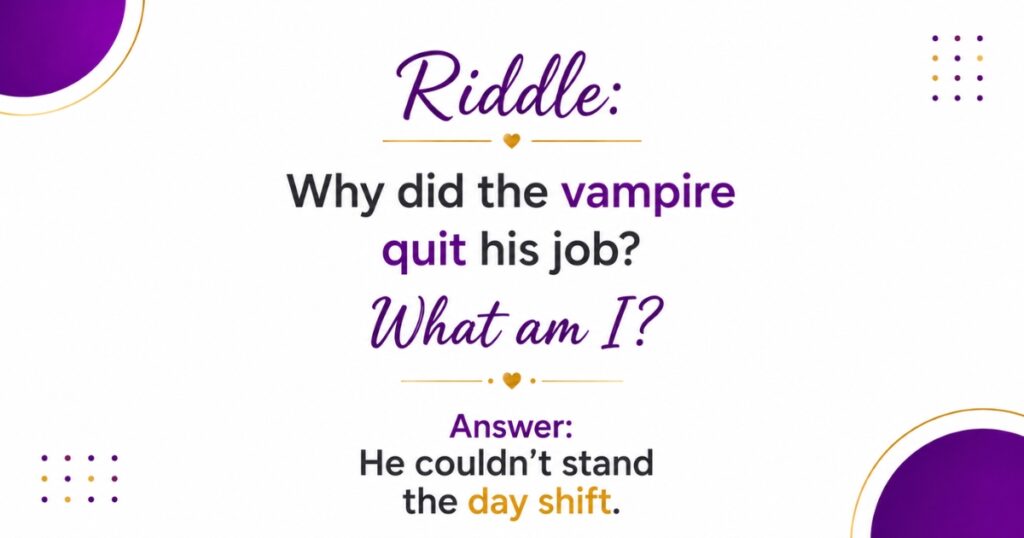
Difficulty: Easy
Explanation: A pun on the common idiom “lazybones,” applied literally.
Difficulty: Easy
Explanation: “To go” doubles as a takeout request and zombie decomposition.
Difficulty: Easy
Explanation: Plays on “final word” meaning both last statement and unquestionable truth.
Difficulty: Easy
Explanation: Turns a common office complaint into a literal, morbid punchline.
Difficulty: Easy
Explanation: Mirrors the universal complaint about “terms and conditions.”
Difficulty: Easy
Explanation: The pause before the reveal implies an ending without stating it.
Difficulty: Easy
Explanation: “Benefits” doubles as employment perks and superstition.
Difficulty: Easy
Explanation: Simple compound pun splicing “bone” into an existing word.
Medium Dark Humor Riddles (Clever Twists)
This tier drops the obvious puns and leans into misdirection, the setup sounds like it’s building toward something ordinary, then the answer redirects it somewhere uncomfortable.
These work best with an audience that already enjoys wordplay.
Difficulty: Medium
Explanation: Misdirection, the reader expects a physical object, not an emotion.
Difficulty: Medium
Explanation: Subverts the usual complaint that bad things are “always late.”
Difficulty: Medium
Explanation: Irony, the phrase “good intentions” typically implies effort, not failure.
Difficulty: Medium
Explanation: Undercuts a somber image with an oddly specific, mundane detail.
Difficulty: Medium
Explanation: Personifies an abstract concept as a rude houseguest.
Difficulty: Medium
Explanation: Reframes “inheritance” away from money toward behavior.
Difficulty: Medium
Explanation: Personification, secrets don’t literally age, but the metaphor implies decay.
Difficulty: Medium
Explanation: The burial metaphor implies death, but the answer is emotional, not literal.
Difficulty: Medium
Explanation: Plays against the idiom “letting go” being automatically lighter.
Difficulty: Medium
Explanation: Irony, silence is described as “loud” through implied anxiety.
Difficulty: Medium
Explanation: Redirects the classic “clock” riddle setup toward bureaucracy instead of mortality.
Difficulty: Medium
Explanation: Personifies an inanimate object to soften an otherwise blunt joke.
Difficulty: Medium
Explanation: Modern, mundane answer subverts the expectation of something profound.
Difficulty: Medium
Explanation: Draws a parallel between two events that share the same script but different tones.
Difficulty: Medium
Explanation: Turns a relatable complaint about Mondays into something darker and abstract.
Difficulty: Medium
Explanation: A pun on “dig” links two unrelated professions through shared vocabulary.
Difficulty: Medium
Explanation: Subverts the well-known five stages of grief with something bureaucratic.
Difficulty: Medium
Explanation: Idiom “dying to” is used literally in a morbid context.
Difficulty: Medium
Explanation: Compares supernatural dread to a mundane financial anxiety.
Difficulty: Medium
Explanation: Meta-humor, the riddle comments on its own structure as the twist.
Hard Dark Humor Riddles (Sharp and Ironic)
This tier is built for readers who want the twist to sting a little, riddles that lean on layered irony rather than a quick pun. They’re slower to land, but hit harder once they do.
Difficulty: Hard
Explanation: Paradox-based misdirection, the answer contradicts the verb “avoiding” in the setup.
Difficulty: Hard
Explanation: Deliberately vague phrasing lets the reader fill in the darkest interpretation themselves.
Difficulty: Hard
Explanation: The riddle links denial and weight, an unusual cause-and-effect pairing.
Difficulty: Hard
Explanation: Irony, honesty is usually framed as relief, not punishment.
Difficulty: Hard
Explanation: Plays on the literal concept of “distance” as an emotional, not physical, gap.
Difficulty: Hard
Explanation: The answer is intentionally abstract, forcing the reader to sit with the ambiguity.
Difficulty: Hard
Explanation: Subverts the literal expectation set up by “buried.”
Difficulty: Hard
Explanation: Redirects “inheritance” from assets to emotional baggage.
Difficulty: Hard
Explanation: The riddle never states the reason, letting implication do the work.
Difficulty: Hard
Explanation: Contradicts the usual “practice makes it easier” expectation.
Difficulty: Hard
Explanation: Irony, the phrase is normally dismissive, but here it’s the final, weightiest line.
Difficulty: Hard
Explanation: Borrows gambling terminology and applies it to mortality.
Difficulty: Hard
Explanation: Uses retail language (“return,” “opened”) to frame an emotional injury.
Difficulty: Hard
Explanation: Defines an abstract idea (change) through loss rather than gain.
Difficulty: Hard
Explanation: Plays on the common promise “I’ll make time,” subverted by the impossibility of the request.
Difficulty: Hard
Explanation: Compares two formal, dreaded events that share tone but not dress code.
Difficulty: Hard
Explanation: Financial vocabulary (“debt,” “compounding”) applied to something intangible.
Difficulty: Hard
Explanation: Uses comedic structure (“punchline”) to describe something explicitly non-comedic.
Difficulty: Hard
Explanation: Contradicts the usual meaning of “giving” as loss.
Difficulty: Hard
Explanation: A blunt, inevitable answer that resists the reader’s hope for something gentler.
Dark Humor Riddles About Adult Life
Dark humor riddles hit differently when the subject is something everyone actually deals with, bills, jobs, diets, deadlines.
This section trades ghosts and graveyards for the genuinely dreadful parts of being a functioning adult.
Difficulty: Medium
Explanation: Irony rooted in a universally recognized bad habit.
Difficulty: Medium
Explanation: Reframes a financial concept as something genuinely frightening.
Difficulty: Easy
Explanation: A relatable exaggeration that plays on the “multiplying rabbits” cliché.
Difficulty: Easy
Explanation: Sets up expectation of profanity, subverts it with something financially dreaded instead.
Difficulty: Easy
Explanation: Personifies a resolution as a short-lived character.
Answer: The death of your motivation on a Monday.
Difficulty: Medium
Explanation: Uses funeral structure to frame a mundane weekly experience.
Answer: Because life kept RSVPing “no.”
Difficulty: Medium
Explanation: Personifies “life” as a flaky guest, a shift in who’s declining whom.
Difficulty: Medium
Explanation: Plays on “ghosting” as a dating term applied to debt.
Difficulty: Medium
Explanation: Combines two unrelated concepts, fitness goals and mortality, through the word “rest.”
Difficulty: Easy
Explanation: A relatable twist that undercuts the expected “death” answer.
Difficulty: Hard
Explanation: Compares a common passive-aggressive phrase to grief over lost leisure.
Difficulty: Medium
Explanation: The humor comes from readers recognizing the question as existentially loaded.
Difficulty: Medium
Explanation: Medical vocabulary (“diagnosis,” “terminal”) applied to a financial metric.
Difficulty: Easy
Explanation: Straightforward irony, retirement is supposed to mean an end, but obligations persist.
Difficulty: Medium
Explanation: Subverts the expected “world’s best” mug slogan with blunt realism.
Halloween and Spooky Dark Humor Riddles
Halloween is the one season where dark humor riddles get to be the main event instead of a niche taste. These lean into ghosts, witches, and graveyards while keeping the same riddle structure as the rest of the list.
If you’re planning ahead for October, our Halloween Riddles for Adults hub has plenty of spooky-but-not-morbid options to round out your party lineup.
Difficulty: Medium
Explanation: Plays on “references” meaning both professional contacts and repeat appearances.
Difficulty: Medium
Explanation: A pun combining “blood count” with a school subject.
Difficulty: Easy
Explanation: Reframes “giving away candy” as “having nothing left,” a body-based double meaning.
Difficulty: Medium
Explanation: Applies werewolf lore to the very human habit of making excuses.
Difficulty: Medium
Explanation: A metaphor for disappointment, dressed as a literal potion complaint.
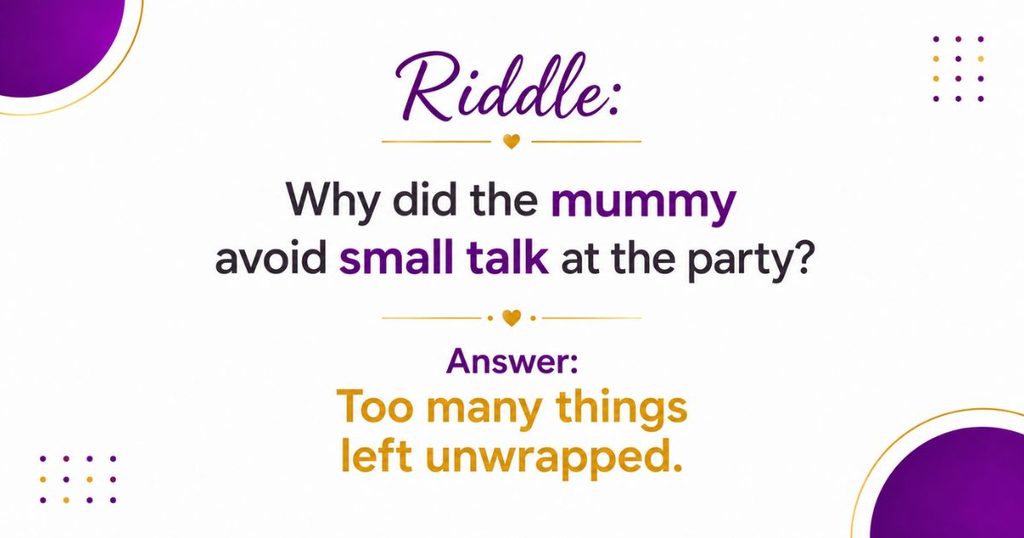
Difficulty: Easy
Explanation: A pun on “unwrapped,” referencing both bandages and unresolved topics.
- Riddle: What’s the scariest thing in a haunted house?
Answer: The mirror that shows you exactly as tired as you feel.
Difficulty: Hard
Explanation: Subverts the ghost-story trope with an emotionally grounded twist. - Riddle: Why did the jack-o’-lantern stop smiling?
Answer: It finally understood what “hollowed out” meant.
Difficulty: Medium
Explanation: Personifies a carved pumpkin to comment on emotional emptiness. - Riddle: What do you call a graveyard shift worked by actual ghosts?
Answer: Redundant.
Difficulty: Easy
Explanation: A one-word punchline relying on the double meaning of “graveyard shift.” - Riddle: Why did the zombie apply for a desk job?
Answer: He was already used to showing up half-dead.
Difficulty: Easy
Explanation: Literalizes the common complaint of feeling “half-dead” at work. - Riddle: What’s a haunted house’s biggest fear?
Answer: An inspection.
Difficulty: Medium
Explanation: Flips the expected fear (ghost hunters) toward mundane bureaucracy. - Riddle: Why did the black cat cross the road twice?
Answer: Bad luck likes overtime.
Difficulty: Easy
Explanation: Personifies superstition as a hardworking employee. - Riddle: What’s scarier than a haunted graveyard?
Answer: The graveyard shift’s pay stub.
Difficulty: Medium
Explanation: Reuses “graveyard” in two unrelated senses for the twist. - Riddle: Why did the spider get evicted?
Answer: Too many strings attached.
Difficulty: Easy
Explanation: A pun on “strings attached” as both a web and a conditional favor. - Riddle: What’s a poltergeist’s favorite chore?
Answer: Throwing things, at least it finally gets something off its chest.
Difficulty: Medium
Explanation: Combines a haunting trope with the idiom for emotional release.
Short Dark Humor One-Liners (Perfect for Captions)
Not every riddle needs a full setup. This section strips the format down to its bluntest form, a short question, a shorter answer, built for captions, texts, and quick scrolls rather than slow reveals.
- Riddle: What always wins?
Answer: The house.
Difficulty: Easy
Explanation: Borrows gambling shorthand and lets the reader supply the darker context. - Riddle: What never forgives?
Answer: A scar.
Difficulty: Easy
Explanation: Personifies a physical mark as an emotional judge. - Riddle: What outlasts every apology?
Answer: The memory of what caused it.
Difficulty: Medium
Explanation: Undercuts the assumption that an apology resolves what came before it. - Riddle: What arrives too late, every time?
Answer: Regret.
Difficulty: Easy
Explanation: A blunt, universally understood answer with no wordplay needed. - Riddle: What never really leaves?
Answer: What you didn’t say.
Difficulty: Medium
Explanation: The vagueness of “what you didn’t say” invites the reader’s own memory. - Riddle: What always collects interest?
Answer: Guilt.
Difficulty: Medium
Explanation: Financial term (“interest”) reused for an emotional weight. - Riddle: What’s guaranteed?
Answer: An ending.
Difficulty: Easy
Explanation: A one-word setup with maximum ambiguity in the punchline. - Riddle: What never sleeps?
Answer: A bad decision.
Difficulty: Easy
Explanation: Personifies a choice as something restless, mirroring insomnia. - Riddle: What keeps score even when nobody’s watching?
Answer: Karma.
Difficulty: Easy
Explanation: A common belief phrased as a scoreboard metaphor. - Riddle: What does everyone eventually lose?
Answer: The argument with time.
Difficulty: Medium
Explanation: Closes the list on an inevitability, framed as a fight nobody wins.
How and When to Share Dark Humor Riddles?
Dark humor lands best when the room is already leaning into it. Game nights, Halloween parties, group chats, and casual hangouts with people who already text each other memes are the sweet spot, these riddles are built for low-stakes, high-context settings.
They’re a poor fit for formal workplaces, classrooms with young kids, or any conversation touching on a recent loss.
Timing and audience matter more than the riddle itself; the same joke that gets a laugh at a Halloween party can land badly at a funeral reception, even if nothing about the wording changed. When in doubt, read the room before you read the riddle.
- Good settings: adult game nights, Halloween parties, casual group chats, icebreakers among friends who already share dark humor.
- Settings to avoid: workplaces, classrooms, grief-related gatherings, or any audience you haven’t tested dark humor with before.
- A simple rule of thumb: if you wouldn’t tell the joke to a stranger’s grandmother without a wince, save it for the friend group that already gets it.
More Riddles to Explore
If this style of humor works for you, there’s more where that came from. For lighter material you can share with a broader crowd, check out our Funny Riddles for Adults collection.
For an equally cheeky (but different flavor of) adult humor, check out our Dirty Riddles collection, same wink-and-a-pause format, different taboo.
And if you’re the type who collects riddles by season rather than just by theme, our April Riddles page is a lighter, springtime counterpart worth bookmarking for when you want something less morbid.
Conclusion
A good dark humor riddle doesn’t need shock value to land, it needs a setup that misleads you just enough, and an answer that reframes everything you just read.
This list of 100 riddles, sorted from easy puns to sharp, ironic twists, is built to work across game nights, Halloween parties, and group chats alike.
Bookmark this page, pull a few for your next hangout, and share it with the one friend who already appreciates a punchline with a little bite to it.
Frequently Asked Questions
Are Dark Humor Riddles Offensive?
They can be, depending on subject matter and audience. The riddles in this list avoid graphic or targeted content and rely on wordplay and irony rather than shock value, but tone-checking your audience first is always the safer move.
What’s the Difference Between a Dark Joke and a Dark Humor Riddle?
A dark joke delivers its setup and punchline back-to-back with no pause. A dark humor riddle asks a question first, letting the reader guess before revealing an answer, the pause is what makes the eventual twist land harder.
Are Dark Humor Riddles Appropriate for Kids?
Most aren’t. The themes, mortality, debt, grief, are built for an adult frame of reference. If you want something similar but gentler, look for riddles that use spooky imagery without the underlying adult themes.
Why Do People Enjoy Dark Humor?
Dark humor lets people process uncomfortable topics, aging, loss, financial stress, through irony and distance instead of confronting them directly, which is part of why gallows humor has shown up across cultures for centuries.