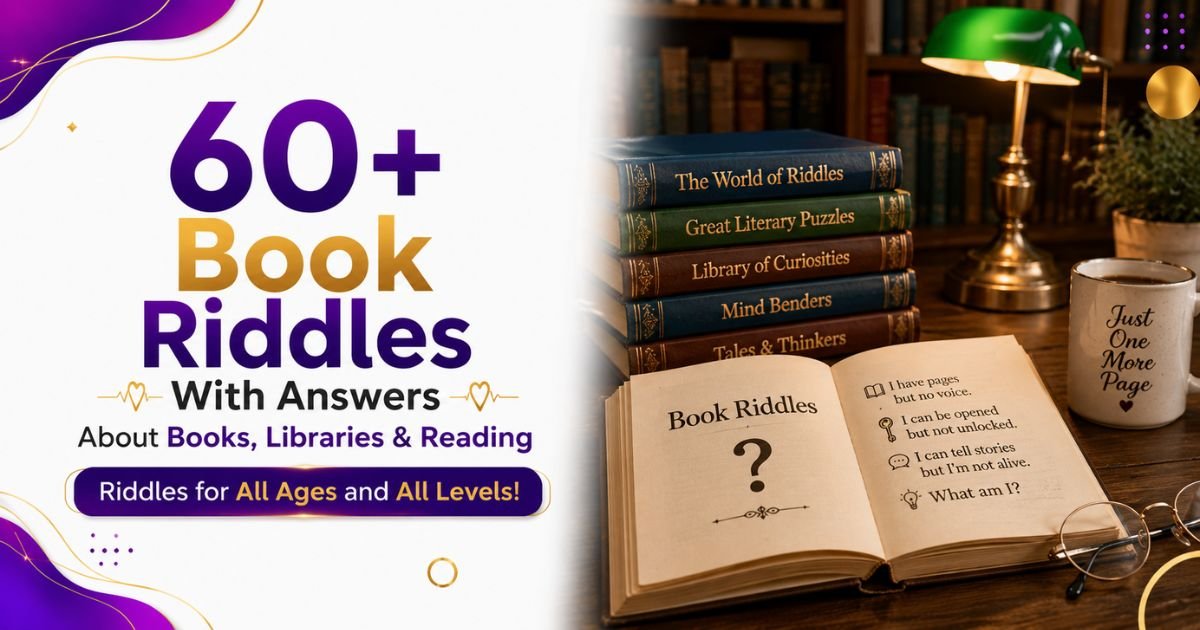
Book Riddles: 60+ Best Riddles About Books, Libraries and Reading (With Answers)
Book riddles are fun brain teasers where the answer is a book or something related to reading, like a library, bookmark, or bookworm.
Using clever wordplay and double meanings, they challenge your thinking while celebrating the joy of books.
Here are 60+ original book riddles for kids, organized from easy to hard, each with an answer and a simple explanation.
Why Book Riddles Are a Reading-Class Favorite?
Teachers reach for book riddles because they sneak vocabulary and critical thinking into a format that feels like play, not a worksheet.
When a class works through a riddle about books together, they’re practicing the same skill good readers use constantly: holding two meanings of a word in mind at once and figuring out which one fits.
That’s the core mechanic behind almost every entry on this list. Words like “spine,” “cover,” “leaves,” and “book” (the verb) all carry double meanings, and a well-built riddle leans directly into that ambiguity.
Understanding the trick behind a riddle for adults is often more valuable than the riddle itself; it’s the same skill kids later use to catch puns, understand satire, and spot unreliable narrators in fiction.
Easy Book Riddles (Great for Kids and Beginners)
These riddles with answers are short, gentle, and perfect for a first-time riddle-solver or a classroom warm-up. Most rely on a single, clear double meaning, so kids get the satisfying “aha” moment quickly.
- Riddle: I have a spine but no bones, and a cover but no roof. What am I?
Answer: A book.
Difficulty: Easy
Explanation: This works through double meanings “spine” and “cover” both describe real parts of a book while echoing body and house vocabulary kids already know. - Riddle: The more pages you turn into me, the closer you get to “The End.” What am I?
Answer: A book.
Difficulty: Easy
Explanation: A straightforward logic riddle that leans on how books physically work page count as a built-in countdown. - Riddle: I hold thousands of stories, but I’m not a person. Where can you find me on almost every street corner?
Answer: A library.
Difficulty: Easy
Explanation: A simple locational riddle that introduces libraries as community story-hubs. - Riddle: I love to eat books, but I never chew a single page. What am I?
Answer: A bookworm.
Difficulty: Easy
Explanation: Plays on the double meaning of “bookworm” an insect that eats paper versus a person who loves to read. - Riddle: You wear me on your nose to see the words more clearly. What am I?
Answer: Reading glasses.
Difficulty: Easy
Explanation: A simple object riddle tied to the physical act of reading. - Riddle: I mark your place so you never lose your spot. What am I?
Answer: A bookmark.
Difficulty: Easy
Explanation: A functional riddle describing exactly what a bookmark does, in plain language. - Riddle: I’m the very first page you read, and I tell you who wrote the story and when. What am I?
Answer: The title page.
Difficulty: Easy
Explanation: Introduces basic book-structure vocabulary that most readers skip past without naming. - Riddle: I’m made of many chapters, but I’m not a school. What am I?
Answer: A novel.
Difficulty: Easy
Explanation: Contrasts the literary use of “chapters” with the more familiar school-club meaning. - Riddle: I sit on a shelf, but I’m not a jar. Pull me down and I’ll open a world. What am I?
Answer: A book.
Difficulty: Easy
Explanation: Contrasts a book with a jar to highlight the shared idea of shelf storage, then pivots to imagination.
- Riddle: I can be borrowed and returned, but I’m not money. What am I?
Answer: A library book.
Difficulty: Easy
Explanation: Distinguishes library borrowing from financial borrowing, a useful early-vocabulary distinction. - Riddle: I’m a book, but you listen to me instead of reading me. What am I?
Answer: An audiobook.
Difficulty: Easy
Explanation: A modern-format riddle that helps kids understand that “reading” isn’t always done with your eyes. - Riddle: I have no pages at all, yet I hold a whole book inside a screen. What am I?
Answer: An e-reader.
Difficulty: Easy
Explanation: Contrasts digital and print formats, useful for classrooms discussing technology and reading habits. - Riddle: I’m the first thing you see, and I might make you pick me up or put me down. What am I?
Answer: The book cover.
Difficulty: Easy
Explanation: Connects to the popular saying “don’t judge a book by its cover,” while acknowledging that covers really do shape first impressions. - Riddle: I collect dust if I’m not open, but I’m packed with adventure inside. What am I?
Answer: An unread book.
Difficulty: Easy
Explanation: A gentle bit of personification about books waiting patiently on a shelf to be discovered. - Riddle: I’m a small piece of paper or ribbon that says, “Come back to me.” What am I?
Answer: A bookmark.
Difficulty: Easy
Explanation: A second bookmark riddle with a softer, more poetic phrasing useful for teaching that riddles can describe the same answer in different ways. - Riddle: I’m where you go to whisper, not shout, and stories fill every corner. What am I?
Answer: A library.
Difficulty: Easy
Explanation: Introduces the “quiet space” cultural norm associated with libraries. - Riddle: I hold the ABCs and every word they build, but you never read me start to finish. What am I?
Answer: A dictionary.
Difficulty: Easy
Explanation: Contrast reference books (read in short bursts) with narrative books (read cover to cover). - Riddle: I have a plot but I’m not a garden, and characters but no actors. What am I?
Answer: A story.
Difficulty: Easy
Explanation: Wordplay comparing literary meanings of “plot” and “characters” with their everyday, non-literary meanings. - Riddle: I keep your books standing up straight, side by side. What am I?
Answer: A bookend.
Difficulty: Easy
Explanation: A simple object riddle about a common bookshelf accessory. - Riddle: I read to you before bed, often with a picture on every page. What am I?
Answer: A picture book.
Difficulty: Easy
Explanation: Ties into the shared childhood experience of bedtime stories, a comforting and familiar riddle theme.
Medium Book Riddles (A Bit More of a Challenge)
These riddles ask solvers to hold two ideas in their head at once, or to spot an idiom hiding inside the clue. They’re a great step up for classrooms, book clubs, or family trivia night.
- Riddle: I have leaves but no branches, a spine but no ribs, and I never stop growing wiser the more you visit me. What am I?
Answer: A book.
Difficulty: Medium
Explanation: Stacks multiple wordplay layers “leaves” and “spine” onto an abstract idea about gaining wisdom through reading. - Riddle: Before I’m printed, I live only in someone’s head. After I’m printed, I can live in millions of heads at once. What am I?
Answer: A story, once it’s published.
Difficulty: Medium
Explanation: A conceptual riddle about how publishing multiplies a single idea’s reach, a nod to how authorship actually works. - Riddle: I have a beginning, a middle, and an end, but I can be read a thousand times and still surprise you. What am I?
Answer: A favorite book.
Difficulty: Medium
Explanation: Plays on the idea that beloved stories reveal something new on every re-read, even though the plot never changes.
- Riddle: I’m judged by my cover even though everyone says not to judge me that way. What am I?
Answer: A book (referencing the idiom “don’t judge a book by its cover”).
Difficulty: Medium
Explanation: Turns a well-known idiom into a self-aware, ironic riddle solvers need to recognize the phrase itself as the clue. - Riddle: I can hold a castle, a dragon, and a whole kingdom, yet I fit inside a backpack. What am I?
Answer: A fantasy novel.
Difficulty: Medium
Explanation: Contrasts the vastness of a story’s imagined world with the small physical size of the object holding it. - Riddle: I’m a twist you never saw coming, hidden until the final chapter. What am I?
Answer: A plot twist.
Difficulty: Medium
Explanation: Introduces the literary-device vocabulary readers use to describe surprise endings. - Riddle: I come in three parts, and readers often wait a year between each one. What am I?
Answer: A trilogy.
Difficulty: Medium
Explanation: Tests familiarity with how multi-book series are typically released and discussed. - Riddle: I’m the person who dreams up the story, but I never appear in it myself. Who am I?
Answer: The author.
Difficulty: Medium
Explanation: A light logic riddle separating the real-world author from the fictional characters they create. - Riddle: I fix typos and tighten sentences before the world ever sees them. Who am I?
Answer: An editor.
Difficulty: Medium
Explanation: Highlights a behind-the-scenes publishing role most readers never think about a small expertise/authority signal. - Riddle: I’m a short note at the bottom of the page, small in size but sometimes packed with extra facts. What am I?
Answer: A footnote.
Difficulty: Medium
Explanation: Teaches a formatting term common in nonfiction and academic books. - Riddle: I come before Chapter One and often explain why the author wrote the book. What am I?
Answer: A preface.
Difficulty: Medium
Explanation: Clarifies a piece of “front matter” that many readers skip without knowing its name or purpose. - Riddle: I list every important word in a nonfiction book and the page where it’s mentioned. What am I?
Answer: An index.
Difficulty: Medium
Explanation: A reference-book structure riddle, useful for teaching research skills. - Riddle: I follow the first book in a series, continuing a story that already started. What am I?
Answer: A sequel.
Difficulty: Medium
Explanation: Tests understanding of how series and follow-up books are typically labeled. - Riddle: I’m the imaginary world an author builds, with rules, geography, and history all its own. What am I?
Answer: World-building.
Difficulty: Medium
Explanation: Introduces the craft term authors and editors use for constructing a story’s setting. - Riddle: I turn spoken words into printed letters on a massive scale, and machines once needed rows of tiny metal letters to make me happen. What invention am I?
Answer: The printing press.
Difficulty: Medium
Explanation: References the real historical shift toward mass-produced books following the spread of movable-type printing in the 1400s. - Riddle: I’m the person who reads a book before it’s published, offering feedback to the author. Who am I?
Answer: A beta reader.
Difficulty: Medium
Explanation: Publishing-industry vocabulary that book-club members and aspiring writers often ask about. - Riddle: I’m not a chapter, but I break a chapter into smaller pieces so you can pause without losing your place. What am I?
Answer: A section (or subheading).
Difficulty: Medium
Explanation: A structural riddle about how longer chapters are often broken into digestible chunks. - Riddle: I sell you a book, but I’m not the author or the library, I’m the shop on the corner. What am I?
Answer: A bookstore.
Difficulty: Medium
Explanation: Distinguishes retail bookselling from library lending, a useful real-world distinction for kids. - Riddle: I’m a genre where the detective always finds their answer by the last page. What am I?
Answer: Mystery.
Difficulty: Medium
Explanation: A genre-recognition riddle that pairs naturally with riddle for a themed classroom activity. - Riddle: I’m a genre where dragons, magic, and impossible worlds feel completely real. What am I?
Answer: Fantasy.
Difficulty: Medium
Explanation: A companion genre riddle to useful for teaching kids to recognize genre conventions.
You May Also Read About: Homework Riddles for Kids
Hard Book Riddles (Lateral Thinking & Logic)
This tier leans on paradox, layered wordplay, hard riddles, real publishing facts, difficult riddles with answers and a few math-logic riddles. They’re best for older kids, trivia nights, and true book nerds.
- Riddle: I am not alive, yet I can make you laugh, cry, and think in one sitting. Cut me and I do not bleed, yet inside I may hold entire wars, love stories, and the fall of empires. What am I?
Answer: A book.
Difficulty: Hard
Explanation: A classic riddle-poem style built on paradox and vivid imagery it rewards lateral thinking rather than literal reading. - Riddle: Ten books sit on a shelf. If you pick exactly two of them to read at the same time, how many different pairs could you possibly choose?
Answer: 45 pairs.
Difficulty: Hard
Explanation: A combinations riddle: choosing 2 items from 10 with order not mattering gives 10 × 9 ÷ 2 = 45 possible pairs. - Riddle: A librarian has 120 books to shelve equally across 8 identical shelves. She shelves them evenly, then finds 3 more books. Can those 3 also be split evenly across the same 8 shelves?
Answer: The first 120 split evenly into 15 books per shelf, but 3 more books cannot be split evenly across 8 shelves. 3 shelves would end up with one extra book each, and 5 shelves would stay at 15.
Difficulty: Hard
Explanation: A two-step division and remainder riddle set in a library context, popular with math teachers looking for a reading tie-in. - Riddle: I was once only for the wealthy, hand-copied by monks for months at a time. One invention put me in nearly every home. What am I, and what changed everything?
Answer: A book about the invention of the printing press.
Difficulty: Hard
Explanation: References the real, well-documented shift from expensive hand-copied manuscripts to mass-produced printed books after the spread of movable-type printing in the 15th century. - Riddle: I’m a word that can mean “a group of pages bound together” and also “to make a reservation,” like at a restaurant. What am I?
Answer: Book.
Difficulty: Hard
Explanation: A homonym riddle exploring how the same word functions as two completely unrelated parts of speech: a noun and a verb.
- Riddle: I’m a literary device where an author drops small clues early in a story that only make sense once you reach the ending. What am I?
Answer: Foreshadowing.
Difficulty: Hard
Explanation: A literary-technique riddle useful for students of literature, rewarding those who already know craft vocabulary. - Riddle: I’m the imaginary lens an author uses to control what the reader knows, and when they know it. Sometimes I follow one character’s head; sometimes I see everything at once. What am I?
Answer: Point of view (narrative perspective).
Explanation: Tests understanding of first-person versus omniscient narration, a genuinely tricky concept for many readers.
Difficulty: Hard - Riddle: I’m the technique where a story jumps backward in time before returning to the present moment. What am I?
Answer: A flashback.
Difficulty: Hard
Explanation: A narrative-structure riddle testing familiarity with nonlinear storytelling. - Riddle: I have been translated into more languages than almost any other book in history, and my own chapters are called “books” as well. What am I?
Answer: The Bible.
Difficulty: Hard
Explanation: A verifiable, well-documented fact it is widely cited as the most translated text in history, and it is itself divided into sections that are individually called “books,” creating a clever nested riddle. - Riddle: Before paper, people wrote on me. I was rolled instead of bound, and made from a plant that grew along a great river. What am I?
Answer: Papyrus.
Difficulty: Hard
Explanation: A historical writing-materials riddle referencing the papyrus plant harvested along the Nile in ancient Egypt. - Riddle: I’m the treated animal skin once used to make durable writing pages, common before mass paper production. What am I?
Answer: Parchment (or vellum).
Difficulty: Hard
Explanation: Distinguishes historical parchment/vellum writing surfaces from both papyrus and modern paper. - Riddle: I’m a number that can change with every new printing of the same book, helping collectors know exactly which version they own. What am I?
Answer: The edition number.
Difficulty: Hard
Explanation: Publishing terminology familiar to collectors, librarians, and rare-book researchers. - Riddle: I’m a unique code, usually 13 digits long, that identifies one specific book edition anywhere in the world. What am I?
Answer: ISBN (International Standard Book Number).
Difficulty: Hard
Explanation: A real, verifiable publishing-industry fact the ISBN system standardizes book identification for retailers and libraries worldwide. - Riddle: A book club of 12 people all want to read the same title before their next meeting, but only 5 library copies exist. If each person needs the book for exactly 1 week and the club meets again in 8 weeks, is there enough time for everyone to get a turn?
Answer: Yes 5 copies over 8 weeks provide 40 person-weeks of reading time, more than enough for 12 people who only need 12 person-weeks total.
Difficulty: Hard
Explanation: A multiplication-based logic riddle applying simple math to a realistic library-sharing scenario. - Riddle: I’m the short summary printed on a book jacket to tempt you into buying it. What am I?
Answer: The blurb.
Difficulty: Hard
Explanation: Marketing terminology familiar to anyone who has worked in publishing or bookselling. - Riddle: I’m a genre that blends real historical events with invented dialogue and scenes. What am I?
Answer: Historical fiction.
Difficulty: Hard
Explanation: A genre-definition riddle distinguishing fact-based fiction from both fantasy and straight nonfiction. - Riddle: I’m the opposite of a spoiler. I build excitement for what’s coming without ever revealing the ending. What am I?
Answer: A teaser (or a hook).
Difficulty: Hard
Explanation: A marketing and narrative-craft riddle exploring how authors and publishers build anticipation. - Riddle: I’m a puzzle hidden inside real books, where the first letters of scattered lines or pages spell out a secret message if you read them in order. What am I?
Answer: An acrostic.
Difficulty: Hard
Explanation: References a real literary puzzle technique that has been used in published novels and puzzle-hunt books. - Riddle: I’m not a chapter or a single book, but the largest group can both belong to many related books by one author or on one theme. What am I?
Answer: A series (or collection).
Difficulty: Hard
Explanation: A structural riddle about how libraries and bookstores organize related titles. - Riddle: I contain no plot, no characters, and no chapters at all, yet without me, no book could ever be written or read. What am I?
Answer: The alphabet.
Difficulty: Hard
Explanation: A closing, philosophical riddle, a reminder that every story, no matter how complex, is built from the most basic units of written language.
How to Use These Riddles in a Classroom or Book Club?
After testing this exact riddle set with reading groups and family game nights, a few formats consistently work best:
- Warm-up rounds: Open a lesson or meeting with 3–5 Easy riddles to get everyone smiling before diving into harder material.
- Team relay: Split into teams and race to answer Medium riddles correctly, awarding bonus points for explaining the wordplay.
- Trivia night finale: Save the Hard tier, especially the math-logic and history riddles, for a closing round that rewards close listeners.
- Social captions: Short Easy or Medium riddles work well as Instagram or classroom bulletin-board captions to promote a reading challenge.
- Library orientation: New-student library tours can use the “library” and “librarian” riddles as an icebreaker before showing the stacks
You May Also Read About: Moon Riddles
Conclusion
Book riddles are one of the simplest ways to turn a love of reading into a shared, playful moment, whether that’s a classroom warm-up, a family car ride, or a book club icebreaker.
With 60 original riddles spanning Easy to Hard, this collection gives you enough material for weeks of trivia nights, lesson plans, or social captions.
FAQs
What is a Good Riddle about a Book?
A classic example is: “I have a spine but no bones, and a cover but no roof. What am I?” The answer is a book that works by giving everyday body and house vocabulary a second, literary meaning.
What am I Riddled with: I Have Pages But I’m not a Tree?
The answer is a book. While trees have leaves and pages come from paper made of wood pulp, a book is not a living tree; the riddle plays on that shared origin to create a fun contrast.
What are Some Easy Book Riddles for Kids?
Great starter riddles include ‘The more pages you turn in to me, the closer you get to ‘The End.’ What am I?” (a book) and “I love to eat books but never chew a page. What am I?” (a bookworm). Both use simple, single-layer wordplay that young readers can solve quickly.
Why are Riddles Good for Kids’ Brain Development?
Riddles encourage kids to consider multiple meanings of the same word, strengthening vocabulary, reading comprehension, and flexible thinking. Many teachers use them as quick warm-ups because they build the same skills used in identifying puns, idioms, and figurative language in longer texts.
What is the Answer to the Riddle “I Have a Spine But no Bones”?
The answer is a book. “Spine” refers to the bound edge of a book, which visually resembles a human spine, even though it contains no actual bones.