Chinese Riddles: 90+ Fun Brain Teasers With Answers
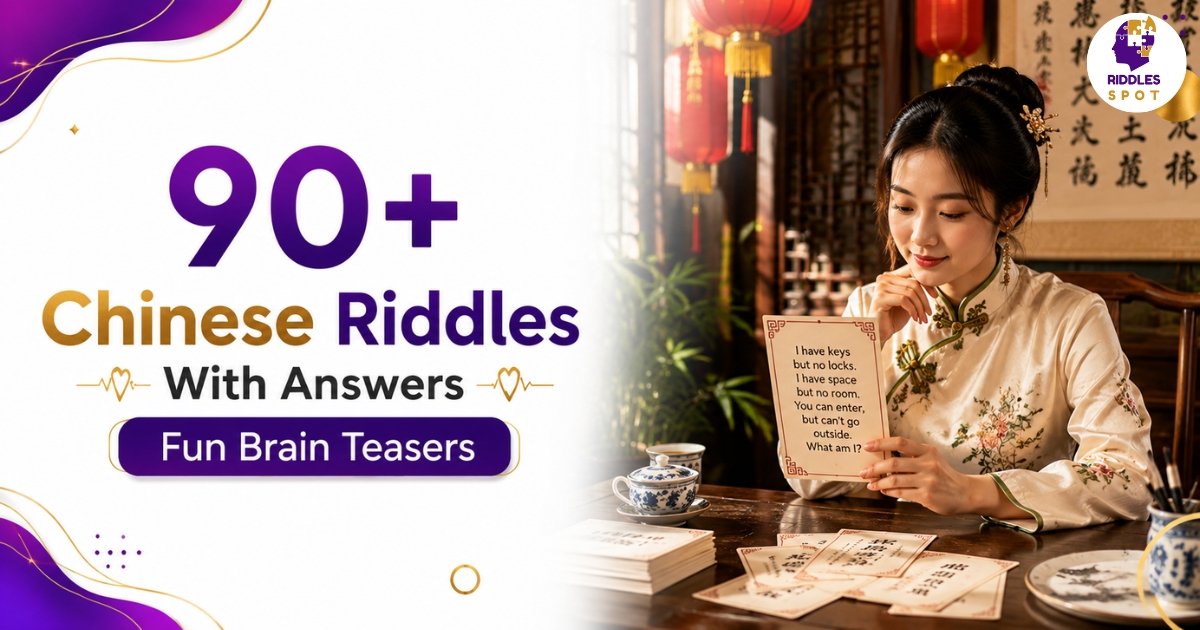
Famous Chinese Riddles, or mí yǔ (谜语), are short puzzles that describe something , an object, animal, or idea , without naming it, using wordplay and imagery. A special type, zì mí (字谜), asks you to guess a Chinese character.
Riddles have long been part of Lantern Festival traditions, and many use homophones, making them a fun way to learn Mandarin too.
This guide has 90+ riddles across nine themes, each with pinyin, an English translation, an answer, and a short explanation.
What Makes a Chinese Riddle Different From an English One?
Most English riddles lean on double meanings within a single language system. Chinese Riddles do that too, but they also lean on something English riddles can’t: a writing system where characters are built from smaller, meaningful pieces.
That’s what makes zì mí possible , you can riddle about the shape of a word, not just its meaning.
A character like 明 (bright) is visibly made of 日 (sun) and 月 (moon) sitting side by side, so a riddle can describe “the sun and the moon sharing a house” and mean the character itself, not an object.
The other big driver is tone and homophones. Mandarin has a relatively small set of syllable sounds reused across many different words, distinguished by tone.
That overlap is exactly the kind of ambiguity riddles thrive on , the same sound-shape can point to two unrelated meanings, and a riddle exploits that gap on purpose.
Easy Chinese Riddles With Answers
These are best chinese riddles for kids, or anyone testing the waters with their first Chinese Riddles.
Most rely on a simple physical description rather than wordplay, which makes them a gentle starting point before moving into character riddles further down.
- Riddle: Round like a ball, I sit in the sky and warm your face every morning.
Pinyin: Yuán yuán de qiú, guà zài tiānshàng, měi tiān zǎoshang wēnnuǎn nǐ de liǎn.
Answer: 太阳 (tàiyáng) , The sun
Difficulty: Easy
Explanation: A straightforward descriptive riddle with no wordplay , good for absolute beginners since the clues map directly onto the object. - Riddle: I have four legs but I never walk anywhere.
Pinyin: Wǒ yǒu sì tiáo tuǐ, dàn cónglái bú zǒulù.
Answer: 桌子 (zhuōzi) , A table
Difficulty: Easy
Explanation: Plays on the double meaning of “legs” (tuǐ), which in Chinese, like English, applies to furniture as well as bodies. - Riddle: White on the outside, soft on the inside, and you sleep with your head on me every night.
Pinyin: Wàimiàn bái, lǐmiàn ruǎn, nǐ měi wǎn dōu bǎ tóu fàng zài wǒ shàngmiàn.
Answer: 枕头 (zhěntou) , A pillow
Difficulty: Easy
Explanation: A simple sensory-description riddle, great chinese riddles with answers for kids just starting to learn household vocabulary. - Riddle: I have teeth but I never chew a single bite of food.
Pinyin: Wǒ yǒu yá, dàn cónglái bù chī yìkǒu fàn.
Answer: 梳子 (shūzi) , A comb
Difficulty: Easy
Explanation: Relies on the shared word for “teeth” (yá) used for both real teeth and comb teeth, a common riddle device in many languages.
- Riddle: I turn from green to yellow to red, and I never move from my branch until I’m picked.
Pinyin: Wǒ cóng lǜsè biàn dào huángsè zài biàn dào hóngsè, zài shùzhī shàng bù dòng zhídào bèi zhāi xià.
Answer: 苹果 (píngguǒ) , An apple
Difficulty: Easy
Explanation: A color-sequence riddle that doubles as basic color vocabulary practice. - Riddle: I have a round face and hands, but I never wave hello.
Pinyin: Wǒ yǒu yuán liǎn hé shǒu, dàn cónglái bù huī shǒu dǎ zhāohu.
Answer: 钟表 (zhōngbiǎo) , A clock
Difficulty: Easy
Explanation: Personifies clock hands (“shǒu” means both hand and clock-hand) for a gentle, low-stakes wordplay introduction. - Riddle: I live in your pocket, and I ring when someone wants to talk to you.
Pinyin: Wǒ zhù zài nǐ de kǒudài lǐ, yǒurén xiǎng gēn nǐ shuōhuà shí wǒ jiù xiǎng.
Answer: 手机 (shǒujī) , A cellphone
Difficulty: Easy
Explanation: A modern-life riddle with no wordplay trick, just familiar daily-object description. - Riddle: I’m full of pages but I never speak unless you open me.
Pinyin: Wǒ yǒu hěnduō yè, dàn nǐ bù dǎkāi wǒ jiù bù shuōhuà.
Answer: 书 (shū) , A book
Difficulty: Easy
Explanation: Personification riddle; teaches the measure word “yè” (page) alongside the object. - Riddle: I’m cold to the touch but I keep your food from spoiling.
Pinyin: Wǒ mō qǐlái hěn lěng, dàn wǒ ràng nǐ de shíwù bú huì huài.
Answer: 冰箱 (bīngxiāng) , A refrigerator
Difficulty: Easy
Explanation: Simple function-based riddle, useful for kitchen vocabulary practice. - Riddle: I hop instead of walking, and I have long ears and a short tail.
Pinyin: Wǒ tiào ér bù zǒu, wǒ yǒu chángchang de ěrduo hé duǎnduǎn de wěibā.
Answer: 兔子 (tùzi) , A rabbit
Difficulty: Easy
Explanation: Physical-trait riddle, a common structure across Chinese animal riddles and a good early vocabulary builder.
Animal Riddles in Chinese
Animal riddles are some of the oldest and most widespread in Chinese riddle tradition, and they show up constantly in classroom settings because the vocabulary is so practical.
- Riddle: I sleep all day, hunt all night, and wash my face without any water.
Answer: 猫 (māo) , A cat
Difficulty: Easy
Explanation: Describes real cat behavior (grooming, nocturnal hunting) without naming it , the classic riddle structure. - Riddle: I’m small, but I can carry things many times my own weight, and I never work alone.
Answer: 蚂蚁 (mǎyǐ) , An ant
Difficulty: Easy
Explanation: Highlights a real biological fact (ants can lift far beyond their body weight) as the riddle’s core clue. - Riddle: I have a long neck but no voice, and I eat leaves from the tallest trees.
Answer: 长颈鹿 (chángjǐnglù) , A giraffe
Difficulty: Easy
Explanation: Straightforward physical-description riddle; the character 长 (long) is literally in the animal’s name, a hint for learners. - Riddle: I carry my house on my back and I’m never in a hurry to get anywhere.
Answer: 乌龟 (wūguī) , A turtle
Difficulty: Easy
Explanation: Classic cross-cultural riddle motif (shell as house) that also appears in English riddle traditions. - Riddle: Black and white, I’m no zebra, and bamboo is basically my whole diet.
Answer: 熊猫 (xióngmāo) , A panda
Difficulty: Easy
Explanation: Trades on the panda’s status as a well-known cultural and national symbol, so the answer feels rewarding even though the clues are simple.
- Riddle: I have a mane but I’m not a horse, and I’m called the king where I live.
Answer: 狮子 (shīzi) , A lion
Difficulty: Medium
Explanation: Uses a “not a horse” misdirection to slow down the guesser before the “king” clue gives it away. - Riddle: I change my coat with the seasons, and hunters say I’m hardest to spot in snow.
Answer: 狐狸 (húli) , A fox (specifically pointing to an Arctic fox in coloring, though húli generally means fox)
Difficulty: Medium
Explanation: Introduces a seasonal-camouflage fact as the twist, requiring the solver to connect biology to the animal. - Riddle: I have eight legs, but I’m not an insect, and I can squeeze through a hole the size of a coin.
Answer: 章鱼 (zhāngyú) , An octopus
Difficulty: Medium
Explanation: The “not an insect” clue matters because Chinese sometimes groups small creatures loosely, so the riddle explicitly rules out the wrong category. - Riddle: I sing at night, not during the day, and rubbing my legs together makes my song.
Answer: 蟋蟀 (xīshuài) , A cricket
Difficulty: Medium
Explanation: References the real mechanism of cricket “singing” (stridulation), which surprises many solvers who assume it’s vocal. - Riddle: I have a pouch but I’m not a kangaroo, and pandas are actually my neighbors in the wild.
Answer: 大熊猫幼崽 , trick riddle; correct answer is 考拉 (kǎolā) , A koala
Difficulty: Hard
Explanation: A deliberate misdirection riddle , koalas don’t naturally live near pandas, so the “false clue” tests whether solvers know the geography, not just the animal.
Object and Household Riddles
- Riddle: I have a spine but no bones, and you turn my pages to find out what happens next.
Answer: 书 (shū) , A book
Difficulty: Easy
Explanation: Reuses “spine” imagery, a wordplay device that also works in English, showing how some riddle logic crosses language boundaries. - Riddle: I hold your tea but I can’t drink it myself.
Answer: 茶杯 (chábēi) , A teacup
Difficulty: Easy
Explanation: A function-based riddle that also introduces tea-culture vocabulary. - Riddle: I have one eye but I can’t see, and I help stitch your clothes back together.
Answer: 针 (zhēn) , A needle
Difficulty: Easy
Explanation: The “eye” of a needle is a shared metaphor across many languages, making this an accessible riddle for new learners. - Riddle: I open my mouth wide but I never eat, and I keep your coins safe until you’re ready to spend them.
Answer: 存钱罐 (cúnqiánguàn) , A piggy bank
Difficulty: Easy
Explanation: Personification riddle built around the “mouth” (slot) of a piggy bank. - Riddle: I have hands and a face, but I never wash either one.
Answer: 钟 (zhōng) , A clock
Difficulty: Easy
Explanation: Classic double-meaning riddle around “hands” and “face” as parts of a clock. - Riddle: I’m full of little holes, yet I still manage to hold water.
Answer: 海绵 (hǎimián) , A sponge
Difficulty: Easy
Explanation: A paradox riddle , the “flaw” (holes) is actually what makes the object useful, which is the twist that makes it satisfying.
- Riddle: I stand guard at your door but I never say a word, no matter who knocks.
Answer: 锁 (suǒ) , A lock
Difficulty: Easy
Explanation: Personifies a household object as a silent guardian, a common riddle framing across cultures. - Riddle: I shrink every time I’m used, and I disappear completely by the end of my life.
Answer: 蜡烛 (làzhú) , A candle
Difficulty: Medium
Explanation: A “life cycle” riddle, describing the candle from youth (tall) to old age (short) without naming fire or wax directly. - Riddle: I have many keys but I can’t unlock a single door.
Answer: 钢琴 (gāngqín) , A piano
Difficulty: Medium
Explanation: Trades on the double meaning of “key” , a common riddle across many languages, included here for comparison against the character riddles later in this list. - Riddle: I catch your reflection perfectly but I never remember a single face.
Answer: 镜子 (jìngzi) , A mirror
Difficulty: Medium
Explanation: A memory-paradox riddle: the mirror “sees” everything but retains nothing, which is the emotional hook of the puzzle.
Chinese Character Riddles (字谜 / Zì Mí)
This is the category most riddle lists skip entirely, and it’s genuinely the most distinctive form of Chinese riddle. A zì mí describes how a character looks , its component pieces , rather than what an object does.
Solving one means picturing the character’s shape in your head, piece by piece, until it clicks.
These are best attempted by people with at least basic familiarity with Chinese characters, though the explanations below make each one accessible even to total beginners.
- Riddle: The sun and the moon share the very same room. What character am I?
Answer: 明 (míng) , Bright
Difficulty: Medium
Explanation: 明 is literally built from 日 (sun) placed beside 月 (moon) , two light-givers combined equal “bright.” - Riddle: A person leans against a tree to rest for a while. What character am I?
Answer: 休 (xiū) , To rest
Difficulty: Medium
Explanation: 休 is 人 (person, shown as 亻) next to 木 (tree) , a picture of someone literally resting against a tree trunk. - Riddle: A woman holds her child close, and everyone agrees this is a fine thing. What character am I?
Answer: 好 (hǎo) , Good
Difficulty: Easy
Explanation: 好 combines 女 (woman) and 子 (child) , a mother and child together, symbolically meaning “good.” - Riddle: Plant one tree, then two, then a whole crowd of them, and you get a forest. What character am I, if I’m the crowd?
Answer: 森 (sēn) , Forest
Difficulty: Easy
Explanation: 木 (tree) repeated three times becomes 森, showing how Chinese characters can literally multiply meaning by repeating a component. - Riddle: One person alone is just a person, but stack three together and you get everyone. What character am I?
Answer: 众 (zhòng) , The masses, everyone
Difficulty: Easy
Explanation: 人 (person) tripled becomes 众, meaning “crowd” or “the masses” , quantity literally builds meaning. - Riddle: Take a field, add raw strength, and you get someone who works it. What character am I?
Answer: 男 (nán) , Man
Difficulty: Medium
Explanation: 男 is 田 (field) over 力 (strength) , historically, the character reflects farm labor associated with men. - Riddle: A mountain sits directly on top of a stone. What character am I?
Answer: 岩 (yán) , Rock, cliff
Difficulty: Medium
Explanation: 岩 stacks 山 (mountain) over 石 (stone), a literal visual pairing of two related landscape ideas. - Riddle: Two people walk side by side, following one another. What character am I?
Answer: 从 (cóng) , To follow
Difficulty: Easy
Explanation: 从 shows 人 (person) repeated twice, one behind the other , a simple visual metaphor for “following.” - Riddle: Put a mouth right next to a tree, and the result looks a little slow-witted. What character am I?
Answer: 呆 (dāi) , Dull, silly, stunned
Difficulty: Hard
Explanation: 呆 combines 口 (mouth) over 木 (tree) , the visual of a mouth stuck open, blank-faced like wood, gives the character its “dazed” meaning. - Riddle: Something small falls onto the earth and settles there. What character am I?
Answer: 尘 (chén) , Dust
Difficulty: Medium
Explanation: The simplified character 尘 combines 小 (small) over 土 (earth/soil) , small things settling on the ground, literally dust.
If this style of character-based wordplay is your favorite kind of puzzle, our collection of word riddles explores that same “shape and meaning” trick across other languages too.
Chinese Mythology and Zodiac Riddles: Chinese Riddles for Adults
- Riddle: I have no wings but I fly, no lungs but I breathe fire, and emperors once claimed me as their symbol.
Answer: 龙 (lóng) , Dragon
Difficulty: Easy
Explanation: References imperial symbolism directly, tying the riddle to real Chinese history rather than generic fantasy imagery. - Riddle: I burn to ash but I never truly die, and every few hundred years I rise again renewed.
Answer: 凤凰 (fènghuáng) , Phoenix
Difficulty: Medium
Explanation: Draws on the phoenix’s renewal myth, a symbol of rebirth and empresses in traditional Chinese iconography. - Riddle: I’m first in line among twelve animals, even though I’m neither the strongest nor the biggest.
Answer: 鼠 (shǔ) , Rat (first of the Chinese zodiac)
Difficulty: Medium
Explanation: Refers to the zodiac race legend, where the rat wins first place through cleverness rather than size or strength. - Riddle: I’m steady and patient, plowing fields long before machines existed, and I placed second in the great race.
Answer: 牛 (niú) , Ox
Difficulty: Medium
Explanation: Ties directly to the zodiac race myth and to the ox’s historical role in agricultural labor. - Riddle: I guard temple entrances in stone form, though no one has ever seen me alive.
Answer: 石狮 (shíshī) , Stone guardian lion
Difficulty: Medium
Explanation: References real architecture , stone lion statues outside temples and buildings , rather than the living animal. - Riddle: I control rain in old legends, and farmers once prayed to me before planting season.
Answer: 龙王 (lóngwáng) , The Dragon King
Difficulty: Hard
Explanation: A more specific mythological figure than the general dragon, tied to agricultural folk religion.
- Riddle: My eyes are painted last during my construction, because that’s the moment I’m believed to come alive.
Answer: 舞龙 (wǔlóng) / dragon costume for the dragon dance
Difficulty: Hard
Explanation: References the real ritual of “dotting the eyes” (点睛) during dragon costume construction, a genuine cultural practice. - Riddle: I balance two opposing forces, drawn as a circle split into swirling halves.
Answer: 阴阳 (yīnyáng) , Yin and yang
Difficulty: Medium
Explanation: Describes the actual visual symbol, not just the philosophical concept, so the answer can be reached through the image alone. - Riddle: I’m the twelfth and final animal in the zodiac race, arriving happy despite finishing last.
Answer: 猪 (zhū) , Pig
Difficulty: Easy
Explanation: Completes the zodiac-race riddle set; the pig’s placement is well known in the legend, making this a gentle finish. - Riddle: I twist through valleys made of stone, built not to attack but to keep others out.
Answer: 长城 (Chángchéng) , The Great Wall
Difficulty: Easy
Explanation: Uses “twist like a dragon” imagery deliberately, since the Great Wall is often poetically compared to a sleeping dragon across the landscape.
Chinese Riddles About Traditional Wisdom and Life
These riddles lean more abstract than the animal or object riddles above, closer in spirit to the reflective, values-driven puzzles you’ll find in our family riddles collection.
- Riddle: I grow richer the more I’m given away.
Answer: 智慧 (zhìhuì) , Wisdom
Difficulty: Medium
Explanation: A paradox riddle: unlike money, wisdom expands when shared rather than shrinking , a value often expressed in Chinese proverbs. - Riddle: I weigh nothing on a scale, yet a single sentence of mine can change someone’s whole day.
Answer: 一句话 (yí jù huà) , A single word / sentence (advice)
Difficulty: Medium
Explanation: Plays on “weight” as emotional impact rather than physical mass. - Riddle: I’m passed from grandparent to grandchild, but no one ever owns me outright.
Answer: 传统 (chuántǒng) , Tradition
Difficulty: Medium
Explanation: Frames tradition as something inherited collectively rather than possessed individually. - Riddle: I open doors that money cannot, and no lock has ever stopped me.
Answer: 教育 (jiàoyù) , Education
Difficulty: Medium
Explanation: Uses “opening doors” as a metaphor for opportunity, a very common framing in Chinese proverbs about learning. - Riddle: I have no wings, yet I travel from one dynasty to the next without ever stopping.
Answer: 故事 (gùshi) , A story
Difficulty: Medium
Explanation: Frames oral storytelling as a kind of travel across time rather than space. - Riddle: I scare away evil without saying a single word, just by wearing a painted face and a loud drumbeat.
Answer: 舞狮 (wǔshī) , The lion dance
Difficulty: Medium
Explanation: Describes the real function of the lion dance in Chinese New Year celebrations , driving away bad luck through noise and spectacle. - Riddle: I stand between heaven and earth in stone form, watching over centuries of visitors.
Answer: 佛像 (fóxiàng) , A Buddha statue
Difficulty: Medium
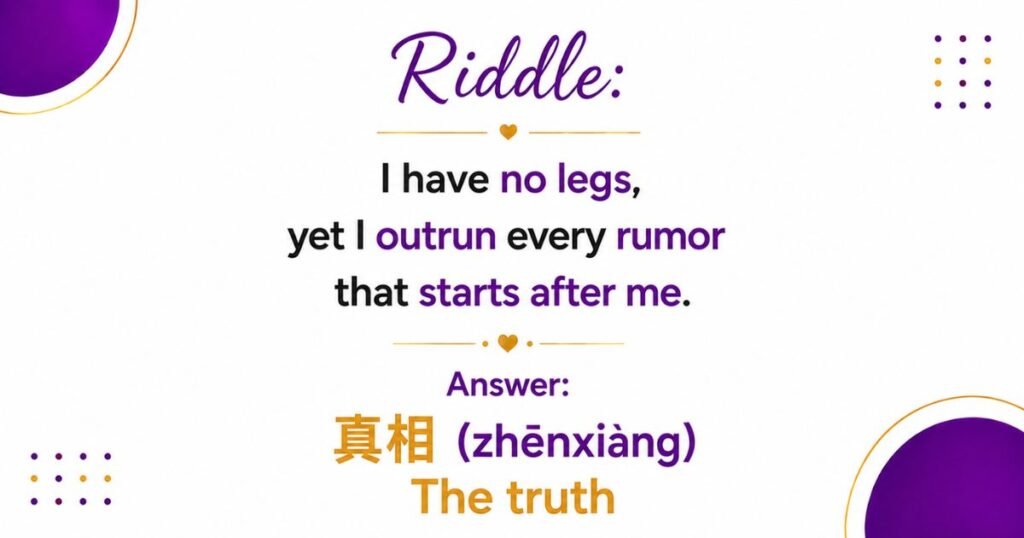
Explanation: Ties religious architecture to the “guardian” riddle motif seen elsewhere in this list. - Riddle: I have no legs, yet I outrun every rumor that starts after me.
Answer: 真相 (zhēnxiàng) , The truth
Difficulty: Hard
Explanation: A more abstract riddle built on the proverb-like idea that truth eventually outpaces gossip, despite starting later.
- Riddle: I cost nothing to give but can be the most valuable gift in someone’s darkest year.
Answer: 陪伴 (péibàn) , Companionship
Difficulty: Hard
Explanation: A values-based riddle reflecting the cultural emphasis on family presence over material gifts. - Riddle: I’m carved in stone to be remembered, but I only matter if I’m also lived by the people who read me.
Answer: 家训 (jiāxùn) , Family motto / house rules
Difficulty: Hard
Explanation: References the real tradition of carved family mottos in ancestral halls, meant to guide generations of behavior.
Chinese Riddles About Food
- Riddle: I’m folded like a tiny pocket and steamed until my filling is piping hot.
Answer: 饺子 (jiǎozi) , Dumplings
Difficulty: Easy
Explanation: Straightforward food-description riddle, useful for basic food vocabulary. - Riddle: I’m round, sweet, and shared only once a year under a very bright, very full moon.
Answer: 月饼 (yuèbǐng) , Mooncake
Difficulty: Easy
Explanation: Ties the food directly to the Mid-Autumn Festival, reinforcing cultural context alongside vocabulary. - Riddle: I’m long on purpose, because cutting me short is considered bad luck on your birthday.
Answer: 长寿面 (chángshòumiàn) , Longevity noodles
Difficulty: Medium
Explanation: Explains a genuine superstition , noodles are kept uncut to symbolize a long life. - Riddle: I bubble in a shared pot at the center of the table, and everyone dips something different into me.
Answer: 火锅 (huǒguō) , Hot pot
Difficulty: Easy
Explanation: Describes the communal-eating structure that makes hot pot culturally distinct, not just the food itself. - Riddle: I’m wrapped in bamboo leaves and steamed, and I’m eaten to remember an ancient poet who drowned.
Answer: 粽子 (zòngzi) , Sticky rice dumpling
Difficulty: Medium
Explanation: Ancient Chinese Riddles, References the Dragon Boat Festival’s origin story (the poet Qu Yuan), adding real historical context to the food. - Riddle: I’m golden, crunchy, and rolled tight before I’m fried to a crisp.
Answer: 春卷 (chūnjuǎn) , Spring rolls
Difficulty: Easy
Explanation: Simple sensory-description riddle for a familiar dish. - Riddle: I’m brewed from leaves, poured in tiny cups, and served to guests before any conversation begins.
Answer: 茶 (chá) , Tea
Difficulty: Easy
Explanation: Highlights tea’s social role as a hospitality ritual, not just a drink. - Riddle: I’m shaped like gold ingots, and eating me on New Year’s Eve is supposed to bring wealth.
Answer: 饺子 (jiǎozi) , Dumplings (again, but for their wealth symbolism this time)
Difficulty: Medium
Explanation: A second dumpling riddle, this time focused on their ingot-like shape and the wealth symbolism behind eating them at New Year. - Riddle: I’m sticky, chewy, and shaped into small balls for a festival named after the very first full moon of the lunar year.
Answer: 元宵 (yuánxiāo) , Sweet rice balls
Difficulty: Medium
Explanation: Names the Lantern Festival’s specific treat and links it to the calendar event that gives it its name. - Riddle: I taste bitter on my own, but I’m treasured in traditional medicine and stir-fry alike.
Answer: 苦瓜 (kǔguā) , Bitter melon
Difficulty: Medium
Explanation: Plays on the literal meaning of the character 苦 (bitter) built directly into the food’s name.
Chinese Riddles for Lantern Festival and Celebration
If lantern riddles and festival traditions are what drew you here, our broader holiday riddles collection covers celebrations from other cultures with that same festive, guess-the-object structure.
- Riddle: I’m written on paper, hung from a red frame, and waiting for someone clever enough to solve me.
Answer: 灯谜 (dēngmí) , Lantern riddle
Difficulty: Easy
Explanation: A riddle about riddles themselves , describing the literal object (a paper riddle strip) that gives this whole tradition its name. - Riddle: I glow without fire and I float when someone releases me into the night sky, carrying a wish upward.
Answer: 孔明灯 (Kǒngmíng dēng) , Sky lantern
Difficulty: Medium
Explanation: Named after the historical figure Zhuge Liang (courtesy name Kongming), credited in legend with inventing the sky lantern for signaling. - Riddle: I mark the fifteenth and final day of celebrations that started with a very loud midnight.
Answer: 元宵节 (Yuánxiāo Jié) , The Lantern Festival
Difficulty: Easy
Explanation: Anchors the riddle in the actual lunar calendar structure , 15 days after Chinese New Year. - Riddle: I explode with color and sound, and my invention is credited to a happy kitchen accident with saltpeter.
Answer: 烟花 (yānhuā) , Fireworks
Difficulty: Medium
Explanation: References the (popularly told) origin story of fireworks connected to early Chinese alchemy experiments. - Riddle: I’m red, folded, and handed to children with money hidden inside for good luck. Answer: 红包 (hóngbāo) , Red envelope
Difficulty: Easy
Explanation: Simple cultural-object riddle; red envelopes are one of the most recognizable New Year traditions. - Riddle: I leap and dance through the street on two hidden legs, chasing after a ball I’ll never quite catch.
Answer: 舞狮 (wǔshī) , Lion dance
Difficulty: Medium
Explanation: Describes the choreography of the lion dance, where performers chase a decorative ball as part of the routine. - Riddle: I race across the water powered by dozens of paddles moving in perfect rhythm.
Answer: 龙舟 (lóngzhōu) , Dragon boat
Difficulty: Easy
Explanation: Describes the physical mechanics of dragon boat racing without naming the festival directly. - Riddle: I hang on doorframes in bright red paper, carrying wishes for the coming year in matched pairs of poetry.
Answer: 春联 (chūnlián) , Spring Festival couplets
Difficulty: Medium
Explanation: Chinese new year riddles, References the specific poetic tradition of paired verses posted on doors during Chinese New Year. - Riddle: I mark the middle of autumn, when families gather to look up at the roundest moon of the year.
Answer: 中秋节 (Zhōngqiū Jié) , Mid-Autumn Festival
Difficulty: Easy
Explanation: Ties directly to the lunar calendar and the festival’s central ritual of moon-viewing. (chinese riddles mid autumn festival) - Riddle: I’m loud, red, and my job is to scare away a mythical beast said to fear noise and color.
Answer: 鞭炮 (biānpào) , Firecrackers
Difficulty: Medium
Explanation: References the Nian (年) monster legend, said to be frightened off by loud noises and the color red.
Modern and Fun Chinese Riddles
These work particularly well as a group activity, similar to the quick-fire format in our riddles to ask friends collection, great for a game night once you’ve worked through the traditional sections above.
- Riddle: I fit in your hand, but I hold more information than an entire ancient library.
Answer: 手机 (shǒujī) , A smartphone
Difficulty: Easy
Explanation: Contrasts modern technology with historical scale for a fun, contemporary twist. - Riddle: I connect a billion conversations at once, yet I have no mouth of my own.
Answer: 互联网 (hùliánwǎng) , The internet
Difficulty: Medium
Explanation: Personification riddle for an abstract modern concept, echoing older riddle structures (“mouth but no voice”). - Riddle: I learn from millions of examples but I’ve never actually lived a single day.
Answer: 人工智能 (réngōng zhìnéng) , Artificial intelligence
Difficulty: Medium
Explanation: A contemporary riddle that plays on the paradox of “learning” without lived experience. - Riddle: I glow through the night without a single flame inside me.
Answer: LED灯 (LED dēng) , An LED light
Difficulty: Easy
Explanation: Simple modern-object riddle contrasting with the earlier candle riddle for comparison. - Riddle: I steer myself down the road, and my “driver” never touches the wheel.
Answer: 自动驾驶汽车 (zìdòng jiàshǐ qìchē) , A self-driving car
Difficulty: Medium
Explanation: Modern technology riddle, useful for practicing longer compound vocabulary. - Riddle: I spread across the whole country in a single afternoon, and no one can predict exactly what I’ll be next week.
Answer: 网络热词 (wǎngluò rècí) , An internet buzzword / trending phrase
Difficulty: Hard
Explanation: A meta riddle about internet culture itself and how quickly slang spreads and changes. - Riddle: I count your steps all day but I never move on my own.
Answer: 智能手环 (zhìnéng shǒuhuán) , A smart bracelet / fitness tracker
Difficulty: Medium
Explanation: Personification riddle for a common modern wearable device. - Riddle: I have thousands of friends, yet I might never meet a single one of them in person.
Answer: 社交媒体 (shèjiāo méitǐ) , Social media
Difficulty: Medium
Explanation: A wry, slightly reflective riddle on modern digital relationships. - Riddle: I remember every password you type but I forget nothing you’d rather I did.
Answer: 云端 (yúnduān) , The cloud (cloud storage)
Difficulty: Hard
Explanation: Plays on the double meaning of “forgetting” as both a technical limitation and an emotional wish. - Riddle: I turn your voice into text before you even finish the sentence.
Answer: 语音识别 (yǔyīn shíbié) , Voice recognition
Difficulty: Medium
Explanation: Closes the modern-riddle set with a technology most readers use daily without thinking about how it works. - Riddle: I’m shared, liked, and forgotten within twenty-four hours, yet millions of people still stop to look at me each day.
Answer: 朋友圈动态 (péngyǒuquān dòngtài) , A social media status/post
Difficulty: Hard
Explanation: A closing meta-riddle reflecting on the fleeting nature of digital content, tying the collection back to how quickly modern life moves compared to centuries-old riddle traditions.
More Riddles to Try
If Chinese Riddles left you hungry for more, the collection of Amazing Riddles has 100 brain teasers built on the same kind of wordplay and misdirection you just practiced, just in English.
Prefer something with a bit more bite? Riddles for Adults leans harder into logic and clever twists for solvers who want a real challenge.
Riddles are also a great way to celebrate a holiday, so if the Lantern Festival riddles here were your favorite, Thanksgiving Riddles collection brings that same festive spirit to a different table.
If you’re curious how riddle traditions carry over into other languages and cultures, Spanish Riddles shows how wordplay and rhyme shape puzzles south of the border, while Greek Riddles traces its own riddles back to ainigma, the ancient Greek word for “riddle.”
Conclusion
Across nine categories and 90+ riddles, one pattern holds steady: whether the subject is a paper lantern from a thousand years ago or a smartphone from last year, Chinese Riddles work because they ask you to look twice at something ordinary.
The character riddles in particular are worth revisiting even after you’ve solved every other section here , once you start noticing how 明, 好, and 休 are built from smaller pieces, you’ll start seeing that logic everywhere in the language.
FAQs
What are Chinese Riddles called?
They’re called mí yǔ (谜语). Riddles that ask you to guess a Chinese character are called zì mí (字谜).
Are Chinese Riddles Hard to Solve?
Not usually. Riddles about animals or objects are easy, especially in English. Character riddles and homophone-based riddles are trickier since they need some knowledge of Chinese.
What is a Chinese Character Riddle (zi mi)?
It’s a riddle that describes a character’s shape or parts, not its meaning. For example, “sun and moon share a room” points to 明 (bright), made of 日 (sun) + 月 (moon).
When are Chinese Riddles Used?
Mostly during the Lantern Festival (元宵节), where they’re hung on lanterns for guests to guess. They’re also used in classrooms and family gatherings.
Are Chinese Riddles Good for Kids?
Yes. Simple riddles about animals, food, and objects work well for kids and are often used to teach vocabulary. Character riddles are better for older learners.
How do You Say “Riddle” in Chinese?
“Riddle” is mí yǔ (谜语). “Guess a riddle” is cāi mí yǔ (猜谜语).