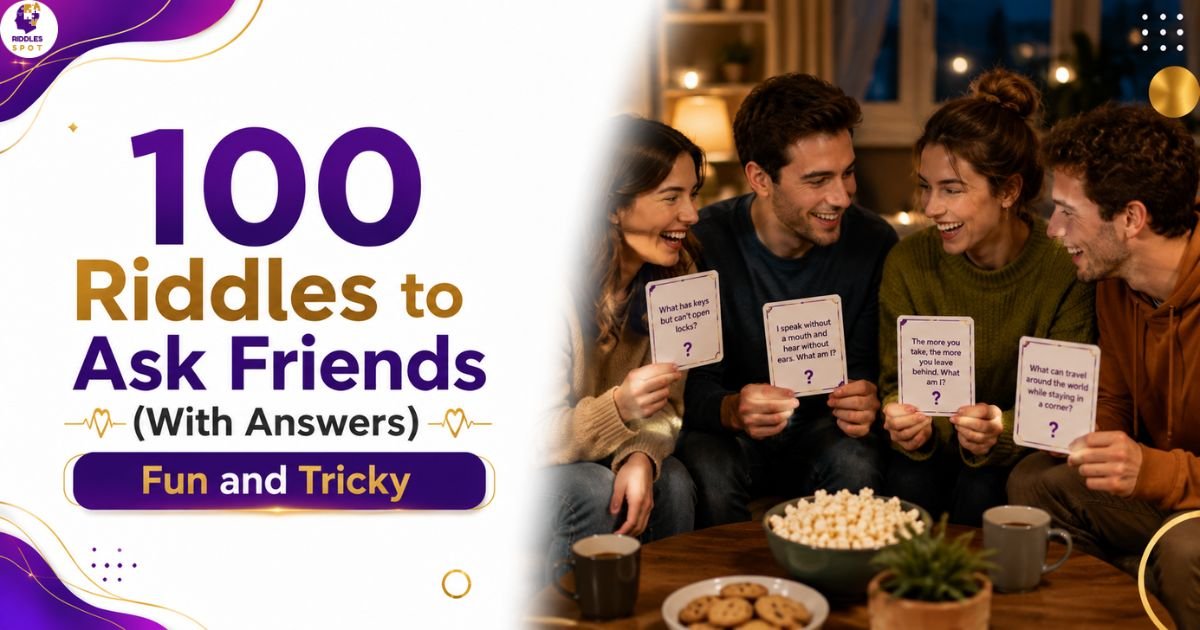
100 Riddles to Ask Friends (With Answers): Fun and Tricky
Riddles to ask friends are short, playful puzzles perfect for group chats, icebreakers, game nights, and riddles for parties. The best ones use wordplay, misdirection, or lateral thinking, and spark a quick laugh or debate once the answer lands; no special skills required.
Every riddle below has actually been tested in a group chat or at a game night, sorted into seven categories: funny one-liners, wordplay, quick easy ones, logic puzzles, group-chat material, game night riddles, and genuine stumpers, each with its answer, a difficulty rating, and a quick note on why it works.
Funny Riddles to Ask Friends
Start here if you want an easy laugh rather than a long argument. These work best read aloud, since the punchline lands harder out loud than typed.
- Riddle: What did the calendar say right after its page got ripped off?
Answer: “You’re really tearing me apart.”
Difficulty: Easy
Explanation: A joke-riddle built on a literal action (tearing a page) doubling as an emotional phrase. - Riddle: What do you call a fish with no eye?
Answer: A fsh
Difficulty: Easy
Explanation: Removing the letter “i” (which sounds like “eye”) from “fish” literally spells the answer. - Riddle: Why did the scarecrow win an award?
Answer: Because he was outstanding in his field.
Difficulty: Easy
Explanation: Double meaning of “outstanding” excellent, and literally standing out in a field. - Riddle: What has a bed but never actually sleeps in it?
Answer: A river.
Difficulty: Easy
Explanation: “Riverbed” reuses sleep vocabulary for a body of water. - Riddle: What did one wall say to the other wall?
Answer: “I’ll meet you at the corner.”
Difficulty: Easy
Explanation: Literal geometry turned into a friendly one-liner. - Riddle: Why don’t skeletons ever start fights with each other?
Answer: They don’t have the guts.
Difficulty: Easy
Explanation: “Guts” plays on both courage and the organs skeletons obviously lack. - Riddle: What has a thumb and four fingers but isn’t alive?
Answer: A glove.
Difficulty: Easy
Explanation: Body-part vocabulary describing an ordinary object. - Riddle: What kind of key can’t open any door but can open a banana?
Answer: A monkey.
Difficulty: Easy
Explanation: Pun on “mon-key” hidden inside “monkey.” - Riddle: What do you call a bear that gets caught in a rainstorm?
Answer: A drizzly bear.
Difficulty: Easy
Explanation: Pun blending “drizzle” with “grizzly.” - Riddle: Why did the golfer pack two pairs of pants before his round?
Answer: In case he got a hole in one.
Difficulty: Easy
Explanation: “Hole in one” doubles as a golf term and a wardrobe malfunction. - Riddle: What has legs but has never taken a single step?
Answer: A table.
Difficulty: Easy
Explanation: Furniture described with human-body vocabulary. - Riddle: What did the ocean say to the shore?
Answer: Nothing, it just waved.
Difficulty: Easy
Explanation: Double meaning of “wave” as a greeting and an ocean movement. - Riddle: What gets bigger every time you take something away from it?
Answer: A hole.
Difficulty: Easy
Explanation: A small paradox removal usually shrinks things, not grows them. - Riddle: Why was the broom late to the party?
Answer: It swept in.
Difficulty: Easy
Explanation: Pun on “swept in” sounding like “slept in.” - Riddle: What has one horn and delivers milk to your doorstep?
Answer: A milk truck.
Difficulty: Easy
Explanation: Misdirects toward a unicorn before landing on something mundane.
Tricky Wordplay Riddles
These reward friends who love puzzles, puns, and double meanings are great for a group that likes to argue over the “actual” answer.
- Riddle: I’m a fruit. Rearrange my letters and I become a word meaning “inexpensive.” What fruit am I?
Answer: Peach (an anagram of “cheap”).
Difficulty: Medium
Explanation: A clean anagram connecting two completely unrelated meanings. - Riddle: I’m six letters long. Drop my last letter and I’m a form of transportation. Drop my first letter and I’m water falling from the sky. What word am I?
Answer: Trains (train / rains).
Difficulty: Hard
Explanation: A rare double wordplay where trimming either end reveals a completely different word. - Riddle: I start with “I,” but slip an “A” in right after me and I become something you’d walk down at a wedding. What word am I?
Answer: Isle (becomes “aisle”).
Difficulty: Medium
Explanation: A homophone created by inserting a single letter. - Riddle: I sound exactly like a number, but I’m actually something you do at the finish line. What am I?
Answer: Won (sounds like “one”).
Difficulty: Easy
Explanation: Homophone pairing a number with a past-tense verb. - Riddle: What has a bark but no bite, and stands quietly in the yard?
Answer: A tree.
Difficulty: Easy
Explanation: “Bark” doubles between a dog’s sound and tree covering. - Riddle: What kind of coat has no sleeves, no buttons, and gets applied with a brush?
Answer: A coat of paint.
Difficulty: Easy
Explanation: “Coat” shifts meaning from clothing to a layer of paint. - Riddle: What can you serve but never eat, and always follow with a return?
Answer: A tennis serve.
Difficulty: Medium - Explanation: Sports vocabulary reused from food-serving language.
- Riddle: What kind of ring never fits on a finger, yet gets “exchanged” at a boxing match?
Answer: A boxing ring.
Difficulty: Easy
Explanation: “Ring” swaps jewelry for a sports arena. - Riddle: What has a spine but no bones, and pages but no windows?
Answer: A book.
Difficulty: Easy
Explanation: Body-part and building vocabulary both misdirect from an everyday object. - Riddle: What starts with a “P,” and is packed with thousands of “letters” that were never handwritten?
Answer: A post office.
Difficulty: Medium
Explanation: “Letters” doubles between alphabet characters and mail. - Riddle: What kind of band wraps around your finger but has never played a single note?
Answer: A rubber band (or a wedding band).
Difficulty: Easy
Explanation: “Band” shifts from a musical group to a circular object. - Riddle: What can be cracked, told, and played, without ever physically breaking in half?
Answer: A joke.
Explanation: Three mismatched verbs (“cracked,” “told,” “played”) all pair naturally with “joke.”
Difficulty: Medium - Riddle: What has a face and two hands, yet no arms or legs at all?
Answer: A clock.
Difficulty: Easy
Explanation: Personifies an object using only facial and hand vocabulary. - Riddle: What kind of cap is never worn on a head, yet still gets “put on” your spending?
Answer: A spending cap.
Difficulty: Medium
Explanation: “Cap” shifts from headwear to a financial limit. - Riddle: What has a bed, four legs, but never once needs to be tucked in at night?
Answer: A table.
Difficulty: Easy
Explanation: Sleep-related vocabulary misdirects from furniture back to furniture.
Quick Easy Riddles for a Fast Laugh
Perfect for when you want a riddle that lands in five seconds flat, no long pause, no overthinking required.
- Riddle: What has hands but can never wave hello?
Answer: A clock.
Difficulty: Easy
Explanation: Simple misdirection using body-part vocabulary. - Riddle: What kind of shoes do spies wear?
Answer: Sneakers.
Difficulty: Easy
Explanation: Pun on “sneak.” - Riddle: What gets sharper every time you actually use it?
Answer: Your wit.
Difficulty: Easy
Explanation: A small paradox: most tools are dull with use, not this one. - Riddle: What has a spine, a cover, and chapters, but isn’t a person?
Answer: A book.
Difficulty: Easy
Explanation: Friendly, low-difficulty warmup riddle. - Riddle: What kind of shorts do storm clouds wear?
Answer: Thunderwear.
Difficulty: Easy
Explanation: Playful compound pun blending “thunder” and “underwear.” - Riddle: What has to be broken before you can actually use it?
Answer: An egg.
Difficulty: Easy
Explanation: Simple paradox most things are ruined once broken, not this one. - Riddle: What has a tongue and a sole, yet never once walks on its own?
Answer: A shoe.
Difficulty: Easy
Explanation: Shoe parts described with body-part vocabulary. - Riddle: What kind of music do balloons hate the most?
Answer: Pop music.
Difficulty: Easy
Explanation: Pun on “pop.” - Riddle: What can you always count on, even without ever touching it?
Answer: Numbers.
Difficulty: Easy
Explanation: Plays on the idiom “count on” and literal counting. - Riddle: What has to be shuffled before it can ever tell you anything?
Answer: A deck of cards.
Difficulty: Easy
Explanation: Straightforward object riddle tied to preparation before use. - Riddle: What kind of tree always gets invited to the party?
Answer: A palm tree gives out high-fives.
Difficulty: Easy
Explanation: Playful anthropomorphism pun on “palm.” - Riddle: What always sleeps with its shoes on?
Answer: A horse.
Difficulty: Easy
Explanation: Pun on horseshoes. - Riddle: What has a ring that never rings, and a hand that never waves?
Answer: A clock.
Difficulty: Easy
Explanation: Double misdirection using “ring” (alarm) and “hand” (clock hand). - Riddle: What always falls in winter, yet is never actually hurt by the fall?
Answer: Snow.
Difficulty: Easy
Explanation: “Falls” shifts between weather and injury.
Logic and Lateral-Thinking Riddles
Save these logic riddles for friends and lateral thinking riddles for a friend group that likes to actually debate an answer for a few minutes. These reward careful listening over quick guessing.
- Riddle: A woman gives a stranger exact change for a bill without ever counting it or looking in her wallet. How does she know the amount is right?
Answer: She’s blind, and paper currency comes in different sizes for different denominations, so she identifies bills by touch.
Difficulty: Medium
Explanation: A real-world accessibility detail most people overlook. - Riddle: The power goes out in a man’s living room, and he calmly lights a candle and reads by its glow all evening without ever touching a match or lighter. How?
Answer: He lit it from an already-burning source, such as a stove burner or fireplace ember.
Difficulty: Medium
Explanation: Forces you to reconsider the assumption that “no tools” means there is no flame anywhere in the house. - Riddle: A delivery driver drops off ten packages on one street, yet only knocks on a single door. How does every package still reach the right home?
Answer: The address is one apartment building, and the single door leads to a shared lobby of mailboxes.
Difficulty: Medium
Explanation: Challenges the assumption that “ten houses” means ten separate standalone buildings. - Riddle: A man plays eight games of chess in one afternoon and wins every single one, despite not being a particularly skilled player. How?
Answer: He played eight different beginners, not the same strong opponent eight times.
Difficulty: Medium
Explanation: Challenges the assumption that repeated wins prove skill against a single tough rival. - Riddle: In a five-person foot race, you pass the runner currently in fourth place right before the finish line. What place do you finish in?
Answer: Fourth place you take the spot of the runner you just passed, not the position ahead of them.
Difficulty: Medium
Explanation: A logic trap around what “passing” someone actually changes. - Riddle: A woman has eight children. Exactly half of them are boys, and exactly half of them are girls, and no child is both. How is that possible?
Answer: Four boys and four girls the riddle only sounds tricky because it states “half” twice.
Difficulty: Easy
Explanation: Tests the assumption that repeating a fact must mean there’s a hidden contradiction. - Riddle: You’re locked in a windowless room with a single bulb, a coil of rope, a bucket, and a ladder. A hatch in the ceiling is just out of reach. How do you get through it and leave no trace behind?
Answer: Stand the bucket upside down on a table for height, use the ladder for the rest of the reach, then use the rope once through the hatch to pull the ladder and bucket up after you.
Difficulty: Hard
Explanation: An escape-style riddle that rewards combining multiple objects instead of picking just one. - Riddle: A groundskeeper waters one exact section of a huge lawn every single day, yet the untouched grass around it never looks worse for it. Why?
Answer: The lawn is artificial turf it never needs water at all, so the untouched sections are perfectly fine either way.
Difficulty: Medium
Explanation: Challenges the assumption that any lawn maintenance implies real, living grass. - Riddle: A coin lands on heads ten times in a row. What are the odds it lands on heads on the eleventh flip?
Answer: Still 50/50 each flip is completely independent of the last.
Difficulty: Easy
Explanation: A classic probability myth-buster that trips up even confident guessers. - Riddle: Three friends split a $30 hotel room, paying $10 each. The manager realizes the room was actually $25 and sends $5 back with the bellhop, who pockets $2 and returns $1 to each guest. Now each guest paid $9 (totaling $27), and the bellhop kept $2. That’s $29. Where did the missing dollar go?
Answer: There is no missing dollar. The $27 already includes the bellhop’s $2, so adding them together is the error, not a real shortfall.
Difficulty: Hard
Explanation: A famous arithmetic sleight-of-hand that feels like a real mystery but is really a framing trick. - Riddle: A man leaves his house, makes exactly three left turns, and ends up back home facing two masked figures. Who are they?
Answer: The catcher and the umpire he’s a baseball player rounding the bases back to home plate.
Difficulty: Medium
Explanation: A sports-themed lateral riddle that hides its setting until the final clue. - Riddle: A woman rides the elevator to the 12th floor every morning for work, but always walks down all 12 flights on her way home each night. Why?
Answer: She’s training for a marathon and uses the walk down as low-impact daily cardio, since descending is gentler on her joints than running up.
Difficulty: Medium
Explanation: Subverts the expectation of a “trick” answer with a genuinely practical one. - Riddle: Two friends order the exact same drink at a bar. One finishes it in seconds; the other sips it slowly for twenty minutes. Only the slow drinker ends up feeling sick. The drink wasn’t tampered with differently for either of them. What happened?
Answer: The ice in the glass had started to melt and dilute a substance already dissolved in the drink at the top, which the fast drinker never reached before finishing.
Difficulty: Hard
Explanation: Rewards careful attention to timing rather than assuming foul play. - Riddle: A father is exactly four times as old as his son today. In 20 years, he’ll be exactly twice as old. How old is each of them right now?
Answer: The son is 10 and the father is 40 (in 20 years: 30 and 60, which is exactly double).
Difficulty: Medium
Explanation: A clean algebra riddle that’s satisfying for math-minded friends to work through out loud.
Riddles Perfect for Group Chats and Riddles for Texting
Short enough to fit in one text bubble and relatable enough that your group chat will actually engage instead of scrolling past, perfect riddles for group chat.
- Riddle: What has thousands of “likes” but no friends of its own?
Answer: A social media post.
Difficulty: Easy
Explanation: A modern-life riddle built for the exact audience reading it. - Riddle: What gets left on read more than anything else on your phone?
Answer: A group chat notification.
Difficulty: Easy
Explanation: Relatable humor about texting habits. - Riddle: What can you send a hundred times a day, yet never actually mail?
Answer: A text message.
Difficulty: Easy
Explanation: Contrasts old and new meanings of “sending” something. - Riddle: What always says “typing…” but sometimes never finishes the sentence?
Answer: A group chat member.
Difficulty: Easy
Explanation: A playful nod to a universally relatable texting moment. - Riddle: What can go viral without ever leaving your couch?
Answer: A meme.
Difficulty: Easy
Explanation: Contrasts the medical and internet meanings of “viral.” - Riddle: What’s full of “haha,” even when nobody’s actually laughing out loud?
Answer: A group text conversation.
Difficulty: Easy
Explanation: Pokes fun at how rarely “lol” or “haha” reflect real laughter. - Riddle: What gets “left on read” but never actually gets forgotten?
Answer: An awkward text.
Difficulty: Easy
Explanation: Relatable to any friend group’s group chat history. - Riddle: What has a battery but no heartbeat, yet everyone panics when it dies?
Answer: A phone.
Difficulty: Easy
Explanation: Personifies a phone using “dies” and “battery.” - Riddle: What loads a photo instantly, but has never once used a darkroom?
Answer: A camera app.
Difficulty: Easy
Explanation: Contrasts modern digital photography with the old developing process. - Riddle: What has thousands of followers, yet has never taken a single step?
Answer: A social media account.
Difficulty: Easy
Explanation: Double meaning of “followers” people vs. an actual crowd. - Riddle: What can be “muted” without ever making a sound in the first place?
Answer: A group chat notification.
Difficulty: Easy
Explanation: Plays on a very specific, very modern annoyance. - Riddle: What can you “swipe” without ever touching a credit card?
Answer: A dating app profile.
Difficulty: Easy
Explanation: Modern double meaning of “swipe.” - Riddle: What can “crash” without ever being in an accident?
Answer: A phone app.
Difficulty: Easy
Explanation: Tech double meaning of “crash.” - Riddle: What can you “unsend,” even though everyone already saw it before you could?
Answer: A text message (that infamous two-second window).
Difficulty: Easy
Explanation: A universally relatable, funny group-chat riddle to close out the section.
Riddles for Game Night and Icebreakers
Read these aloud at the start of a hangout to warm the group up, or drop them mid-game as a bonus challenge between rounds.
- Riddle: What gets passed around a table but never eaten, and everyone hopes to hold the highest one?
Answer: A winning hand of cards.
Difficulty: Easy
Explanation: Double meaning of “hand” body part vs. card-game term. - Riddle: What can you roll but never bowl with, and everyone hopes lands on a six?
Answer: A die.
Difficulty: Easy
Explanation: Classic tabletop-game object riddle, perfect before a board game starts. - Riddle: What has squares but no shape, and letters but no words until you make them?
Answer: A Scrabble board.
Difficulty: Medium
Explanation: Great icebreaker for a word-game-loving friend group. - Riddle: What gets passed to the left, then the right, and never stays in one player’s hands for long?
Answer: The dice in a pass-and-play party game.
Difficulty: Easy
Explanation: Sets up the mechanics of a party game without naming it directly. - Riddle: What can bankrupt you at the table without ever touching real money?
Answer: Monopoly money.
Difficulty: Easy
Explanation: Playful nod to the emotional stakes of a board game night. - Riddle: What has 52 “friends,” but only one player can hold them all at once?
Answer: A deck of cards.
Difficulty: Easy
Explanation: Personifies a deck of cards as a small crowd. - Riddle: What always says “you sunk my…” but never actually gets wet?
Answer: A Battleship game board.
Difficulty: Medium
Explanation: Pop-culture-adjacent object riddle, a great icebreaker for nostalgic friend groups. - Riddle: What can steal your turn without ever being your actual opponent?
Answer: A “skip a turn” card.
Difficulty: Easy
Explanation: Fun for any card-game night with action cards. - Riddle: What has categories but no textbook, and rewards you for knowing genuinely useless facts?
Answer: A trivia game.
Difficulty: Easy
Explanation: A meta riddle that doubles as a segue into trivia night. - Riddle: What can you “pass” at the table without ever handing anyone anything?
Answer: Your turn.
Difficulty: Easy
Explanation: Double meaning of “pass” in tabletop games. - Riddle: What always keeps score, yet has never played a single round itself?
Answer: A scoreboard.
Difficulty: Easy
Explanation: Personifies a silent participant in every game night. - Riddle: What can “steal” a card legally, right in front of everyone at the table?
Answer: A steal mechanic in games like Rummy.
Difficulty: Medium
Explanation: Modern card-game vocabulary riddle for regular players. - Riddle: What has teams but no uniforms, and rounds but no boxing gloves?
Answer: A trivia or quiz night.
Difficulty: Easy
Explanation: Reframes “rounds” and “teams” outside a sports context. - Riddle: What always “wins” the game night argument, even when nobody at the table agrees with it?
Answer: The official rulebook.
Difficulty: Easy
Explanation: Relatable, funny closer for any group that argues rules mid-game.
Hard Riddles to Really Stump Your Friends
Save these for last, they take real thought, and a couple of them are worth debating over before anyone reveals the answer.
- Riddle: I have a golden crown but no throne, a hundred subjects but rule none. Peel me, and you’ll find I have layers, though I never speak. What am I?
Answer: An onion.
Difficulty: Hard
Explanation: Royal imagery repurposed to describe a mundane vegetable. - Riddle: The more you take out of me, the taller I grow. What am I?
Answer: A hole being dug deeper.
Difficulty: Medium
Explanation: “Taller” misdirects from the more intuitive answer, “deeper.” - Riddle: I have no lungs, yet I need air constantly. I have no mouth, yet a single wrong breath can end me instantly. What am I?
Answer: A candle flame.
Difficulty: Medium
Explanation: Personification stacked with two separate misleading clues. - Riddle: I’m always ahead of you, yet you can never catch me, touch me, or leave me behind no matter how fast you run. What am I?
Answer: The future.
Difficulty: Hard
Explanation: An abstract-concept riddle that rewards stepping away from literal objects. - Riddle: The person who needs me most is often the one least willing to admit it. I cost nothing to give, yet some people never receive enough of me in a lifetime. What am I?
Answer: Help (or support).
Difficulty: Hard
Explanation: An emotional-concept riddle that can spark real conversation at the table. - Riddle: I have a bed that’s never made, banks that never lend money, and a mouth that’s never fed. What am I?
Answer: A river.
Difficulty: Hard
Explanation: A harder version that stacks three separate double-meanings into one riddle. - Riddle: Cut off my head, and I become something you give freely. Cut off my tail, and I become a mark that never fully fades. What word am I?
Answer: Scare becomes “care” (head cut) and “scar” (tail cut).
Difficulty: Hard
Explanation: A layered wordplay riddle where trimming either end reveals a completely different, meaningful word. - Riddle: I’m not alive, but I can grow. I don’t have lungs, but I need oxygen constantly. I don’t have a mouth, but water kills me instantly. What am I?
Answer: Fire.
Difficulty: Medium
Explanation: A classic riddle rebuilt with fresh clue framing around growth and oxygen. - Riddle: I have branches but no leaves, a trunk but no roots, and I hold your money though I’m not a tree. What am I?
Answer: A bank.
Difficulty: Medium
Explanation: Nature vocabulary applied to a financial institution. - Riddle: I run through every conversation you’ve ever had, yet I’ve never once spoken a single word myself. What am I?
Answer: Time.
Difficulty: Hard
Explanation: An abstract riddle where the answer sits behind, not inside, the obvious clues. - Riddle: A father is exactly four times his son’s age today, and in 20 years he’ll be exactly twice his son’s age. If you already solved the earlier version of this riddle, here’s the twist: what are their ages in exactly 5 years from now?
Answer: The son will be 15 and the father will be 45.
Difficulty: Medium
Explanation: Builds on riddle #58’s math, rewarding friends who solved that one first. - Riddle: I have keys that open nothing at all, and I can play an entire song without a single string. What am I?
Answer: A piano.
Difficulty: Medium
Explanation: Contrasts “keys” (locks) with “keys” (music) and toys with the idea of “playing.” - Riddle: The one who creates me often shares me with the world for free, yet the one who steals me can be sued for millions. What am I?
Answer: An invention, once patented.
Difficulty: Hard
Explanation: An abstract riddle about intellectual property that’s genuinely tricky to land on. - Riddle: I have a spine, a cover, and chapters, yet I’ve never once told a story of my own. I only hold someone else’s. What am I?
Answer: A blank journal.
Difficulty: Hard
Explanation: A twist on the earlier “book” riddle, describing an empty one waiting to be filled with a satisfying final stumper.
How to Ask Riddles to Your Friends (Without Killing the Vibe)
Reading a riddle well matters almost as much as picking a good one.
- Read it slowly, once. Rushing the wording is the easiest way to accidentally give away the answer early.
- Set a light time limit. A minute or two keeps the energy up, long silences kill momentum fast.
- Offer one small hint before revealing. A category clue (“it’s an object,” “it’s a feeling”) keeps everyone engaged without spoiling it outright.
- Handle the Googler gracefully. If someone looks it up, let them explain the answer instead of just announcing it. It keeps them part of the fun instead of the buzzkill.
- Mix difficulty levels. Open with something easy, save the hard stumpers for when the group’s actually warmed up.
Want More Riddles for Your Next Hangout?
If the onion riddle and the other endgame stumpers above left your group a little rattled, our hard riddles to stump your friends collection has 100 more built for exactly that kind of table-silencing moment.
Prefer something that lands fast without the debate? The page is full of one- and two-line puzzles perfect for a quick round between games.
And if you just want a fresh batch of variety to keep the group guessing, Amazing Riddles rounds things out with a broader mix of wordplay and logic brain teasers for friends.
Conclusion
These 100 riddles to ask friends cover everything from a one-line joke you can fire off in a group chat to a genuine stumper worth debating over at game night.
The best part is you don’t need a special occasion to use them; a slow moment in a group chat, a lull between rounds of a board game, or the first few awkward minutes of a hangout are all fair game.
Start with the easy laughs to break the ice, work your way up to the wordplay riddles and answers and logic puzzles once everyone’s engaged, and save the hard stumpers for when your friends are ready to really dig in.
FAQs
What are Some Good Riddles to Ask your Friends?
Good ones mix wordplay, misdirection, and lateral thinking at a difficulty your group enjoys. The 100 above are grouped by type funny, tricky, quick, logic, group-chat, game-night, and hard.
How do you Ask a Riddle in a Group?
Read it once, slowly, and give the group a minute or two before hinting.
Keep score if you want a winner, and let the solver explain the answer rather than just announcing it.
What’s a Riddle that’s Hard to Solve But Fun to Ask Friends?
The onion riddle “golden crown but no throne, a hundred subjects but rule none” is a great pick. It’s hard enough to stump people, but lands with a satisfying “oh, of course” once solved.
What Should you do if Nobody in the Group can Solve the Riddle?
Offer one small hint, like the answer’s category (object, feeling, wordplay, or number). If the group’s still stuck after that, reveal the answer and move on to keep the energy up.
Are Riddles a Good Icebreaker for Parties?
Yes, short, easy riddles work well early on since they’re quick and inclusive for strangers. Save the harder ones for later, once the group has warmed up.