
Nature Riddles: 100 Fun Riddles With Answers for Kids and Adults
Nature riddles are short, puzzle-style questions about the outdoors, plants, animals, weather, and landscapes, that challenge a solver to guess the answer from clever clues. They blend wordplay with real environmental facts, making them a fun way for both kids and adults to sharpen critical thinking while learning about the natural world.
After testing riddles like these with classroom read-aloud groups, family camping trips, and rainy-day road trips, one pattern shows up every time: a single good nature riddle can spark a five-minute conversation about hibernation, photosynthesis, or why leaves change color, without anyone realizing they just learned something.
Below, you’ll find 100 completely original nature riddles, organized by difficulty and topic, each with an answer, a difficulty rating, and a short explanation of the logic or wordplay behind it.
What Are Some Easy Nature Riddles for Kids?
Easy nature riddles for kids lean on subjects children already know from daily life: rain, trees, the sun, snow paired with one clear clue and a satisfying “aha” moment. They’re best for ages 4–8, circle time, or the first few minutes of a nature walk before attention spans wander. Here are 15 to start with.
Difficulty: Easy
Explanation: A direct, everyday clue built from a weather event most children can picture and feel firsthand.
Difficulty: Easy
Explanation: Classic wordplay riddle contrasting the everyday meanings of “leaves” and “trunk.”
Difficulty: Easy
Explanation: A plain description of the sun’s two most familiar behaviors, with a safety fact built in.
Difficulty: Easy
Explanation: References the moon’s phases without naming them, keeping the language kid-friendly.
Difficulty: Easy
Explanation: Uses a bee’s favorite food source as the deciding clue.
Difficulty: Easy
Explanation: Ties texture, season, and touch together, three senses a child already associates with snow.

- Riddle: I’m loud and bright, I come after lightning, and I make you jump. What am I?
Answer: Thunder
Difficulty: Easy
Explanation: Sequences of a familiar storm event most kids have experienced firsthand. - Riddle: I have a shell on my back and I move very slowly. What am I?
Answer: Snail
Difficulty: Easy
Explanation: A simple physical-trait-plus-behavior riddle aimed at very young solvers. - Riddle: I buzz around flowers and make something sweet to eat. What am I?
Answer: Bee
Difficulty: Easy
Explanation: Connects sound (buzzing) and product (honey) for a quick, confident guess. - Riddle: I have branches but no arms, and birds build nests in me. What am I?
Answer: Tree
Difficulty: Easy
Explanation: Personifies a tree part and contrasts it with human anatomy for an easy laugh. - Riddle: I blow the leaves and cool your face, but you can never see me. What am I?
Answer: Wind
Difficulty: Easy
Explanation: A classic “invisible force” riddle format that works well for beginners. - Riddle: I hop on land and swim in ponds, and I say “ribbit” all night long. What am I?
Answer: Frog
Difficulty: Easy
Explanation: Combines habitat and sound clues so the answer clicks fast. - Riddle: I’m colorful and I arch across the sky after it rains. What am I?
Answer: Rainbow
Difficulty: Easy
Explanation: A visual, weather-timed clue that most children can picture instantly. - Riddle: I grow underground and I make you cry when you cut me. What am I?
Answer: Onion
Difficulty: Easy
Explanation: Uses a well-known kitchen effect to hint at a garden vegetable. - Riddle: I’m tall, green, and I turn into a giant tree from just a tiny seed. What am I?
Answer: Sapling
Difficulty: Easy
Explanation: Introduces the idea of growth from seed to tree in the simplest possible terms.
Nature Riddles With Answers: Medium Difficulty for Kids
Once kids are warmed up, medium riddles layer in a little more logic or a light science concept hibernation, pollination, tree rings, without requiring outside knowledge to solve. These work well for ages 8–12.
Difficulty: Medium
Explanation: Personification riddle; both “run” and “mouth” have double meanings tied to rivers.
Difficulty: Medium
Explanation: Compresses the color-change process of a leaf into a single sequential clue.
Difficulty: Medium
Explanation: References hibernation without naming the science term directly.
Difficulty: Medium
Explanation: Compresses metamorphosis into a two-step clue.
Difficulty: Medium
Explanation: Plays on scale countless small parts appearing as a single mass.
Difficulty: Medium
Explanation: Frames pollination as an accidental side effect, testing basic ecological knowledge.
Difficulty: Medium
Explanation: A pun on “rings” that tests whether kids know how tree growth rings form.
Difficulty: Medium
Explanation: Adds directionality to a familiar subject, nudging up the difficulty slightly.
Difficulty: Medium
Explanation: A deliberately ambiguous riddle vine and snake are both defensible answers.
Difficulty: Medium
Explanation: Introduces photosynthesis using a kitchen metaphor kids can relate to.
Difficulty: Medium
Explanation: Tests understanding of seasonal migration patterns.
Difficulty: Medium
Explanation: Frames a river’s path from source to mouth as a journey.
Difficulty: Medium
Explanation: Introduces bioluminescence as a natural, unpowered light source.
Difficulty: Medium
Explanation: Corrects the common misconception that spiders are insects.
Difficulty: Medium
Explanation: Highlights water retention as an ecological function of ground cover.
Hard Nature Riddles for Kids and Adults
Hard riddles trade familiar objects for processes and systems, the kind of ideas found in a middle-school or high-school science class. These work best for ages 10+ or as a genuine challenge for grown-ups.
Difficulty: Hard
Explanation: Requires the solver to think in systems rather than physical objects.
Difficulty: Hard
Explanation: Tests knowledge of a lesser-known ecological relationship type beyond predator and prey.
Difficulty: Hard
Explanation: Introduces decomposition as nature’s recycling system.
Difficulty: Hard
Explanation: Requires atmospheric science knowledge beyond simple weather facts.
Difficulty: Hard
Explanation: Plays on scale tiny organisms building something massive and ancient over time.
Difficulty: Hard
Explanation: Tests understanding of orographic (mountain-driven) weather patterns.
Difficulty: Hard
Explanation: Combines two defining rainforest facts evergreen canopy and biodiversity into one clue.
Difficulty: Hard
Explanation: References the fungal “wood wide web” that connects tree roots underground.
Difficulty: Hard
Explanation: Tests evolutionary biology vocabulary around geographic isolation.
Difficulty: Hard
Explanation: Adds a current-events angle glacial retreat to a geology riddle.
Difficulty: Hard
Explanation: Tests knowledge of regenerative biology in marine animals.
Difficulty: Hard
Explanation: Introduces plant hormones to advanced solvers who already know the basics of autumn color change.
Difficulty: Hard
Explanation: A statistic-based riddle that requires basic environmental science knowledge.
Difficulty: Hard
Explanation: Frames the water cycle as a closed loop for advanced solvers.
Difficulty: Hard
Explanation: Connects a familiar tool, the compass with deep-earth geophysics.
How Do Nature Riddles Help Kids Learn About the Environment?
Nature riddles work because solving a puzzle activates a small, real reward response in the brain the same as “got it!” feeling that makes games engaging, pointed at nature instead. When a child works out that “I turn sunlight into food” means a plant, they’ve just internalized photosynthesis without opening a textbook.
When “I sleep through winter” clicks like a bear, they’ve reinforced the concept of hibernation through play rather than memorization. Teachers who use riddles as five-minute warm-ups report that kids retain the underlying fact, not just the punchline because they had to reason their way to it themselves.
Nature Riddles About Animals in the Wild
Animals are consistently the most requested nature riddle topic familiar enough to feel approachable, varied enough to stay interesting through all 15 of these.
Difficulty: Easy
Explanation: Introduces hibernation using a relatable, slightly funny detail kids remember.
Difficulty: Easy
Explanation: Playful riddle highlighting a beaver’s natural construction instinct.
Difficulty: Medium
Explanation: Comparative riddle using human benchmarks to describe an extreme natural ability.
Difficulty: Medium
Explanation: Tests knowledge of unusual insect sensory organs.
Difficulty: Hard
Explanation: Corrects the common myth that all color-changing animals do it purely for camouflage.
Difficulty: Medium
Explanation: Contrast riddle pairing tiny size with extraordinary endurance.
Difficulty: Medium
Explanation: Personifies natural navigation as an internal tool.
Difficulty: Medium
Explanation: Tests knowledge of continuous growth and tooth replacement in sharks.
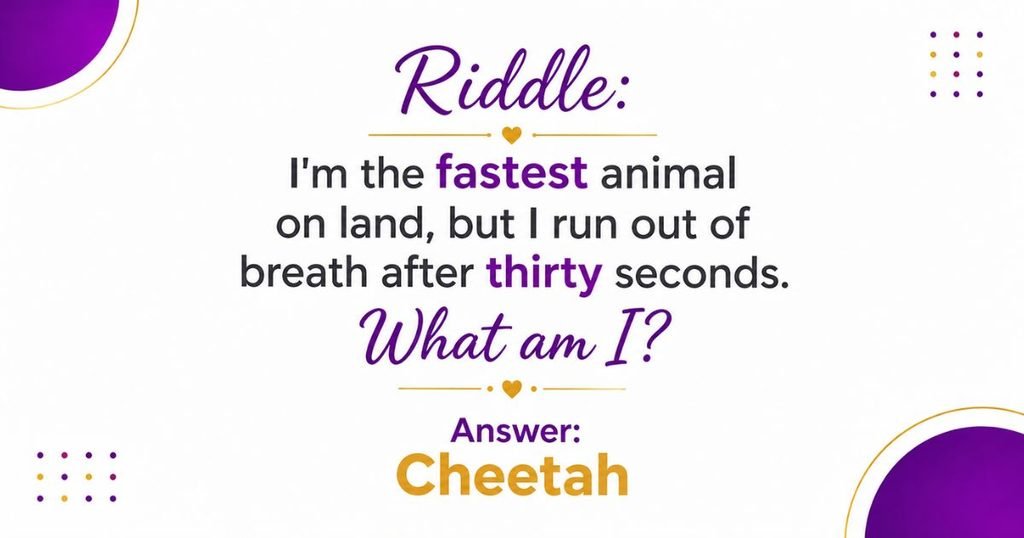
Difficulty: Easy
Explanation: Balances a well-known fact (fastest) with a lesser-known limitation.
Difficulty: Easy
Explanation: A simple, direct clue about marsupial anatomy.
Difficulty: Easy
Explanation: Highlights a defensive adaptation familiar to many kids from cartoons and nature shows.
Difficulty: Medium
Explanation: Introduces echolocation without naming the science term outright.
Difficulty: Hard
Explanation: A surprising longevity fact framed as a riddle to test broader animal knowledge.
Difficulty: Hard
Explanation: Combines three unusual octopus facts into one layered riddle.
Difficulty: Medium
Explanation: Highlights an underground animal’s indirect benefit to the plants growing above it.
Nature Riddles About Plants, Trees, and Flowers
Plants might seem like a quiet riddle topic, but the adaptations packed into this group carnivory, ancient lifespans, fire-triggered growth, surprise most adults as much as kids.
Difficulty: Easy
Explanation: Corrects the common misconception that a bare tree in winter is dead.
Difficulty: Easy
Explanation: A classic contrast riddle between a defense mechanism and a romantic tradition.
Difficulty: Hard
Explanation: Tests knowledge of rapid plant movement, a lesser-known botany fact.
Difficulty: Medium
Explanation: Introduces carnivorous plants as an adaptation to poor soil.
Difficulty: Hard
Explanation: A surprising-growth-rate riddle that tests plant biology knowledge.
Difficulty: Easy
Explanation: References heliotropism sun-tracking in kid-friendly terms.
Difficulty: Hard
Explanation: Tests knowledge of ancient, still-living plant species often called “living fossils.”
Difficulty: Medium
Explanation: Connects two seasonal facts about the same tree species.
Difficulty: Hard
Explanation: Tests knowledge of soil-free plants like orchids and bromeliads.
Difficulty: Easy
Explanation: A timing-based riddle about early spring blooms like crocuses and snowdrops.
Difficulty: Easy
Explanation: A simple, well-known adaptation riddle for a familiar desert plant.
Difficulty: Hard
Explanation: A surprising, slightly gross fact that raises both engagement and difficulty.
Difficulty: Medium
Explanation: Clarifies a common classification mistake between fungi and plants.
Difficulty: Hard
Explanation: Tests knowledge of fire-adapted plant reproduction.
Difficulty: Medium
Explanation: A gentle, poetic framing of a familiar forest floor object.
Nature Riddles About Weather, Sky, and Water
Weather riddles connect naturally to things kids and adults both notice every single day, which makes them some of the easiest to use spontaneously in the car, on a walk, or during an actual storm.
Difficulty: Medium
Explanation: Wordplay on “eye” combined with a real formation clue.
Difficulty: Easy
Explanation: A time-based riddle about a common early-morning phenomenon.
Difficulty: Medium
Explanation: Introduces a weather event with an added, memorable consequence.
Difficulty: Hard
Explanation: Tests understanding of temperature-driven fog formation.
Difficulty: Easy
Explanation: A simple, sensory riddle well suited to young solvers.
Difficulty: Easy
Explanation: A sequence riddle that touches on the idea that sound travels slower than light.
Difficulty: Medium
Explanation: Connects lunar gravity to a daily coastal pattern.
Difficulty: Medium
Explanation: Tests understanding of water vapor versus liquid water.
Difficulty: Easy
Explanation: A playful metaphor for two weather conditions overlapping.
Difficulty: Medium
Explanation: Introduces the visible condensation of breath as a nature riddle.
Difficulty: Medium
Explanation: A pop-culture reference paired with a real duration fact.
Difficulty: Hard
Explanation: A poetic clue for a rare natural light show few solvers have seen firsthand.
Difficulty: Medium
Explanation: A scale riddles individual smallness versus collective power.
Difficulty: Medium
Explanation: A statistic paired with a mystery angle to raise engagement.
Difficulty: Hard
Explanation: Tests knowledge of sublimation, a less-common state-change process.
Nature Riddles for Adults
Adult riddles trade kid-friendly framing for wit, metaphor, and a longer time horizon, geologic time, generational comparisons, and a little dark humor.
Difficulty: Medium
Explanation: Frames geologic time in a way built for an adult audience.
Difficulty: Medium
Explanation: Uses metaphorical “contract” language suited to grown-up readers.
Difficulty: Medium
Explanation: Ties a tree’s lifespan to human history for a sense of scale.
Difficulty: Hard
Explanation: A timely, adult-oriented riddle built around a generational comparison.
Difficulty: Hard
Explanation: Revisits the “wood wide web” concept with more literary, adult-level phrasing.
Difficulty: Easy
Explanation: A pun riddle aimed squarely at an adult sense of humor.
Difficulty: Hard
Explanation: A philosophical, adult-toned riddle about the planet’s role in life and death.
Difficulty: Medium
Explanation: A workplace metaphor mapped onto a natural seasonal cycle.
Difficulty: Hard
Explanation: An abstract, literary-style riddle for solvers who enjoy puzzle poetry.
Difficulty: Hard
Explanation: Combines geologic time with modern environmental awareness for a closing riddle.
Where Can You Use These Nature Riddles?
Printable, screen-free riddle cards are one of the most requested resources among elementary teachers, and for good reason they work anywhere a screen doesn’t. A few ways these 100 riddles hold up in the real world:
- Classrooms: Pair a riddle with the science unit it touches on a hibernation riddle right before a unit on animal adaptations lands differently than reading the fact cold.
- Scavenger hunts: Place one riddle per station; solving it reveals the next clue’s location.
- Camping trips: A stack of 15–20 medium riddles keeps a car or campfire circle engaged for a full evening.
- Family game night: Split easy, medium, and hard riddles across age groups so everyone gets a fair shot at winning.
- Icebreakers: A single hard or adult riddle works well to open a meeting or a dinner table conversation with a laugh.
For best results outdoors, print riddles on cardstock and laminate them; they’ll survive a season of scavenger hunts, camping trips, and backyard games.
Conclusion
Nature has been writing riddles longer than we have a leaf that isn’t dying when it falls, a fish that climbs trees, a tree that’s older than the pyramids. These 100 nature riddles are built to do more than fill a quiet afternoon: they’re small invitations to notice the water cycle, the food web, and the slow, patient math of erosion happening just outside the door.
Bookmark this page, share your favorite riddle with someone who loves the outdoors, and try stumping a kid or a grown-up with the hardest one on the list.
FAQs
What are Some Easy Nature Riddles for Kids?
Easy nature riddles for kids lean on familiar subjects like rain, trees, the sun, and flowers, paired with one clear, simple clue. A good example: “I fall from clouds, I’m cold and wet, I fill the puddles you jump in. What am I?” (Answer: Rain). These work best for ages 4–8 and are ideal for circle time or the start of a nature walk.
How do Nature Riddles Help Kids Learn About the Environment?
Nature’s riddles engage the brain’s reward system through puzzle-solving, working out that “I turn sunlight into food” means a plant helps a child internalize photosynthesis without a textbook. The reasoning process itself, not just the punchline, is what makes the concept stick.
What is a Good Nature Riddle With an Answer?
A strong nature riddle gives just enough detail to be solvable without giving away the answer immediately. For example: “I run without legs and I have a mouth that never speaks. What am I?” (Answer: River) works because it plays on double meanings of everyday words in an unexpected way.
What are Some Hard Nature Riddles About Animals and Plants?
Hard nature riddles introduce advanced concepts in an accessible way: echolocation in bats, regeneration in starfish, carnivorous adaptations in Venus flytraps, or ancient tree species like ginkgo. These are best for ages 10+ or as a genuine challenge for adults.
Where can You use Nature Riddles Besides Reading Them at Home?
Nature riddles work well in classrooms paired with science units, as clues in outdoor scavenger hunts, during camping trips and long car rides, and as icebreakers at the start of a family gathering or meeting.