
Sphinx Riddle: The Original Puzzle, Its Answer, and 100 More to Test Your Wit
The most famous sphinx riddle in history, and it’s still stumping people thousands of years after it was first asked in the myth of Oedipus.
After running these riddles with classroom groups and trivia nights for years, we’ve found that the sphinx riddle format, a short, poetic clue hiding a literal, everyday answer, is one of the most satisfying brain teasers to solve because the “aha” moment feels earned rather than lucky.
What Is the Original Riddle of the Sphinx?
In Greek mythology, the Sphinx was a creature with the body of a lion, the wings of an eagle, and the head of a woman, said to guard the road into the city of Thebes. She would stop every traveler and demand they answer her riddle; anyone who failed was killed.
The hero Oedipus was the first to solve it, freeing the city and, in the most famous twist of the myth, unknowingly setting the rest of his tragic story in motion.
The riddle itself: What creature walks on four legs in the morning, two legs at noon, and three legs in the evening? Oedipus answered “man“: as an infant we crawl on all fours, as an adult we walk upright on two legs, and in old age we lean on a cane, our third “leg.“
The riddle’s power comes from framing an entire human lifespan as a single day, which is why it has survived as the archetype for every sphinx riddle written since.
What Is the Answer to the Sphinx’s Riddle?
The accepted answer is “a human being.” The riddle maps three stages of life onto three “leg counts” during one metaphorical day:
- Morning (four legs): infancy, crawling on hands and knees
- Noon (two legs): adulthood, walking upright
- Evening (three legs): old age, walking with a cane
This is a classic example of an allegorical riddle: the “day” isn’t literal; it’s a stand-in for a lifetime. Recognizing that kind of substitution is the core skill for solving almost any sphinx riddle, and it’s a technique we lean on heavily in the 100 riddles below.
Why Did the Sphinx Ask Riddles?
Riddles in Greek mythology were often a test of cunning rather than brute strength, and the Sphinx specifically used hers as a gatekeeping device for travelers who couldn’t out-think a monster didn’t deserve to pass.
Scholars researching Greek folklore have noted that riddle contests like this appear across many ancient traditions, often symbolizing the idea that wisdom, not violence, is the true qualification for leadership (Oedipus’s reward for solving it was rule over Thebes).
The riddle format also let ancient storytellers embed a moral: hubris and cleverness are two edges of the same sword, which the rest of the Oedipus myth goes on to prove.
Are There Other Sphinx Riddles Besides the Famous One?
Yes, while the four-legs-two-legs-three-legs riddle is the only one directly attributed to the mythological Sphinx, the “sphinx riddle” has become a genre of its own: any riddle written in that same enigmatic, first-person or descriptive style, often featuring a mythical creature, a guarded threshold, or a life-or-death stake.
Egyptian mythology’s Great Sphinx of Giza is sometimes folded into the same tradition in modern pop culture, even though the historical monument itself isn’t tied to a specific riddle in ancient Egyptian texts; that association mostly comes from later films, games, and books. Below, we’ve written 100 new riddles in that same spirit, none borrowed from any existing source.
What Happened If You Got the Sphinx’s Riddle Wrong?
In the myth, failure was fatal for every traveler before Oedipus who guessed incorrectly was killed by the Sphinx, and by some tellings, she killed herself in disbelief after Oedipus finally solved it correctly.
That life-or-death stake is part of why the riddle has endured as a symbol of high-pressure problem-solving. Thankfully, the difficulty ratings below carry no such consequences; difficulty ratings are subjective and based on average audience feedback, not a guarantee of danger.
How to Solve a Sphinx Riddle: Quick Tips?
Before diving into the list, a few patterns will speed up your solving, whether you’re working through these with kids, at a party, or solo:
- Look for metaphor, not literal objects. “Legs” in the original riddle isn’t about legs; it’s about life stages.
- Read it as a description, not a question. Many sphinx riddles describe an object’s behavior (“I have a mouth but never talk”) rather than asking directly what it is.
- Count the clues. Most riddles give you 3–4 attributes; if your guess only satisfies two of them, keep looking.
- Say it out loud. Riddles built on puns and homophones often reveal themselves better spoken than read silently.
- Don’t overthink simple answers. Many “Easy” riddles below have surprisingly ordinary answers precisely because misdirection, not obscurity, is the trick.
- Sphinx Riddle in Oedipus Rex: This riddle doesn’t appear directly on stage in the play it’s only mentioned as a reference. Oedipus saved Thebes by answering the Sphinx’s riddle with “Man,” and as a reward he received the throne and marriage to Jocasta, which later becomes the foundation of the entire tragedy.
100 Original Sphinx Riddles, Organized by Difficulty
100 brand-new sphinx-style riddles, split into Easy, Medium, and Hard tiers, with a bonus Kids & Classroom set. Every riddle lists its answer, difficulty, and a short explanation of the wordplay or logic behind it.
Easy Sphinx Riddles
- Riddle: I have hands but cannot clap, and a face but cannot smile. What am I?
Answer: A clock
Difficulty: Easy
Explanation: Plays on the double meaning of “hands” and “face,” both literal clock parts reframed as human features. - Riddle: The more you take from me, the bigger I get. What am I?
Answer: A hole
Difficulty: Easy
Explanation: Straightforward logical inversion: removal usually shrinks things, but here removal is the act of creation. - Riddle: I have a neck but no head, and I wear a cap. What am I?
Answer: A bottle
Difficulty: Easy
Explanation: Anthropomorphizes ordinary object parts (neck, cap) to disguise a familiar item. - Riddle: I guard the gate, but I’m never seen. Turn the metal, and I let you through. What am I?
Answer: A lock
Difficulty: Easy
Explanation: Frames a mechanism as a silent guardian, echoing the Sphinx’s own gatekeeper role. - Riddle: What has a thumb and four fingers but isn’t alive?
Answer: A glove
Difficulty: Easy
Explanation: Uses body-part vocabulary for an object shaped like the body part it holds. - Riddle: I fall but never break. Night breaks me instead. What am I?
Answer: Daylight (or “day”)
Difficulty: Easy
Explanation: Personifies daylight “falling” (as in dusk) and being “broken” by nightfall. - Riddle: What gets wetter the more it dries?
Answer: A towel
Difficulty: Easy
Explanation: Classic paradox riddle: the tool for drying accumulates the very thing it removes. - Riddle: I have keys but open no doors. What am I?
Answer: A piano
Difficulty: Easy
Explanation: Relies on the double meaning of “keys” between locks and musical instruments. - Riddle: What travels the world while staying in one corner?
Answer: A stamp
Difficulty: Easy
Explanation: Contrasts the stamp’s stillness on an envelope with the journey the letter takes. - Riddle: I have a spine but no bones, and pages but no wings. What am I?
Answer: A book
Difficulty: Easy
Explanation: Borrowed anatomical terms (“spine,” “pages” evoking feathers) to mask an everyday object. - Riddle: What has one eye but cannot see?
Answer: A needle
Difficulty: Easy
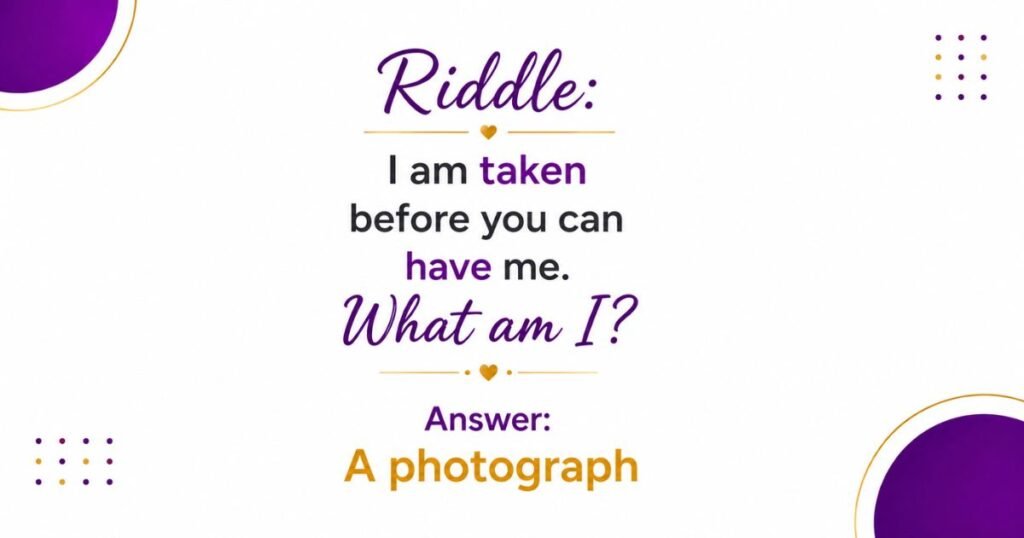
Explanation: The “eye” of a needle is a common English idiom turned into a visual riddle. - Riddle: I am taken before you can have me. What am I?
Answer: A photograph
Difficulty: Easy
Explanation: Plays on “taken” meaning both “captured” and “possessed.”
- Riddle: What has a ring but no finger?
Answer: A telephone
Difficulty: Easy
Explanation: Uses “ring” in its sound sense rather than its jewelry sense. - Riddle: I shrink every time I take a bath. What am I?
Answer: A bar of soap
Difficulty: Easy
Explanation: Reverses expectation; bathing normally cleans, not diminishes. - Riddle: What can you catch but never throw?
Answer: A cold
Difficulty: Easy
Explanation: Exploits the idiom “catch a cold” against the literal meaning of “catch.” - Riddle: I have branches but no fruit, trunk but no leaves. What am I?
Answer: A bank
Difficulty: Easy
Explanation: Uses tree vocabulary that also describes financial institutions and storage (“trunk”). - Riddle: What goes up but never comes down?
Answer: Your age
Difficulty: Easy
Explanation: A gentle paradox riddle; time-based answers rarely fit typical up/down physics. - Riddle: I have teeth but cannot bite. What am I?
Answer: A comb
Difficulty: Easy
Explanation: Body-part vocabulary transferred onto a household object with a similar shape. - Riddle: What kind of coat can only be put on when wet?
Answer: A coat of paint
Difficulty: Easy
Explanation: Uses “coat” in its material-layer sense rather than clothing. - Riddle: I have a bed but never sleep, a mouth but never eat. What am I?
Answer: A river
Difficulty: Easy
Explanation: Geographic terms (riverbed, river mouth) reused as body parts for misdirection. - Riddle: What can travel around the world while staying in the same spot?
Answer: A postage stamp
Difficulty: Easy
Explanation: Similar structure to riddle 9, reinforcing the “stillness that carries motion” pattern. - Riddle: What has a heart that doesn’t beat?
Answer: An artichoke
Difficulty: Easy
Explanation: Relies on “heart” as a culinary term rather than an organ. - Riddle: I am always in front of you but can’t be seen. What am I?
Answer: The future
Difficulty: Easy
Explanation: Abstract-concept riddle; “in front” is temporal, not spatial. - Riddle: What has legs but doesn’t walk?
Answer: A table
Difficulty: Easy
Explanation: Furniture vocabulary borrows anatomical terms to build the misdirection. - Riddle: I have a face and two hands but no arms or legs. What am I?
Answer: A clock
Difficulty: Easy
Explanation: A companion to riddle 1, reinforcing how clock vocabulary maps onto the human body. - Riddle (Sphinx Riddle – Oedipus): What walks on four legs in the morning, two legs at noon, and three legs in the evening?
Answer: Man (crawls as a baby, walks upright as an adult, uses a cane in old age).
Difficulty: Hard.
Explanation: This is the famous riddle from Greek mythology that the Sphinx asked travelers near Thebes Oedipus solved it by realizing “morning,” “noon,” and “evening” represent the stages of human life, not literal times of day.
Medium Sphinx Riddles
- Riddle: Two bodies have I, though joined as one. The more still I stand, the faster I run. What am I?
Answer: An hourglass
Difficulty: Medium
Explanation: The “two bodies” are the glass bulbs; standing still lets sand (time) run faster relative to you. - Riddle: I speak without a mouth and hear without ears. I have no body, but I come alive with wind. What am I?
Answer: An echo
Difficulty: Medium
Explanation: Personifies sound reflection, using “no body” to rule out the literal speaker. - Riddle: Cut me and I don’t cry, but you might. Slice through my many layers, and your eyes will water. What am I?
Answer: An onion
Difficulty: Medium
Explanation: Misdirection through “cry,” swapping the onion’s chemical irritant for emotional crying. - Riddle: The more of me there is, the less you see. What am I?
Answer: Darkness
Difficulty: Medium
Explanation: Inverse-quantity riddle; darkness isn’t a “thing” that blocks light; it’s the absence of it. - Riddle: I am not alive, yet I grow. I don’t have lungs, yet I need air. What am I?
Answer: Fire
Difficulty: Medium
Explanation: Fire mimics biological traits (growth, breathing) without being alive, a classic sphinx-style contradiction. - Riddle: Forward I am heavy, but backward I am not. What am I?
Answer: The word “ton” (spelled backward, “not”)
Difficulty: Medium
Explanation: A palindrome-style wordplay riddle where reversing letters changes meaning entirely. - Riddle: What has a golden head and a golden tail, but no golden body?
Answer: A coin
Difficulty: Medium
Explanation: “Head” and “tail” reference coin-flip terminology rather than an actual animal. - Riddle: I run, yet I have no legs. I roar, yet I have no throat. What am I?
Answer: A river (or a waterfall)
Difficulty: Medium
Explanation: Combines two separate metaphors (running water, roaring sound) into one composite creature-like clue. - Riddle: What can be broken without being touched?
Answer: A promise
Difficulty: Medium
Explanation: Abstract-noun riddle; “broken” applies to intangible commitments, not physical objects. - Riddle: The person who makes me doesn’t want me. The person who buys me doesn’t use me. The person who uses me doesn’t know it. What am I?
Answer: A coffin
Difficulty: Medium
Explanation: Three-clue structure forces you to consider the entire supply chain, not just the object itself. - Riddle: I fly without wings, and cry without eyes. Wherever I go, darkness follows. What am I?
Answer: A cloud
Difficulty: Medium
Explanation: Rain becomes “crying,” and the cloud’s shadow becomes “darkness following.” - Riddle: What word becomes shorter when you add two letters to it?
Answer: “Short” (add “-er” to make “shorter”)
Difficulty: Medium
Explanation: A meta-wordplay riddle that plays with the literal meaning of the answer word itself. - Riddle: I have cities but no houses, forests but no trees, and rivers but no water. What am I? Answer: A map
Difficulty: Medium
Explanation: Geographic vocabulary reused for a representation rather than the real thing. - Riddle: What can fill a room but takes up no space?
Answer: Light (or sound)
Difficulty: Medium
Explanation: Tests whether solvers can accept an intangible answer to a spatial-sounding question. - Riddle: I am always hungry and must always be fed. The finger I touch will soon turn red. What am I?
Answer: Fire
Difficulty: Medium
Explanation: Fire’s need for fuel is framed as hunger, with “turn red” hinting at burning. - Riddle: What kind of room has no doors or windows?
Answer: A mushroom
Difficulty: Medium
Explanation: Compound-word riddle; the answer hides inside the question itself (“mush-room”). - Riddle: I have no voice, yet I speak to you. I tell of all things that exist in the world. What am I?
Answer: A book
Difficulty: Medium
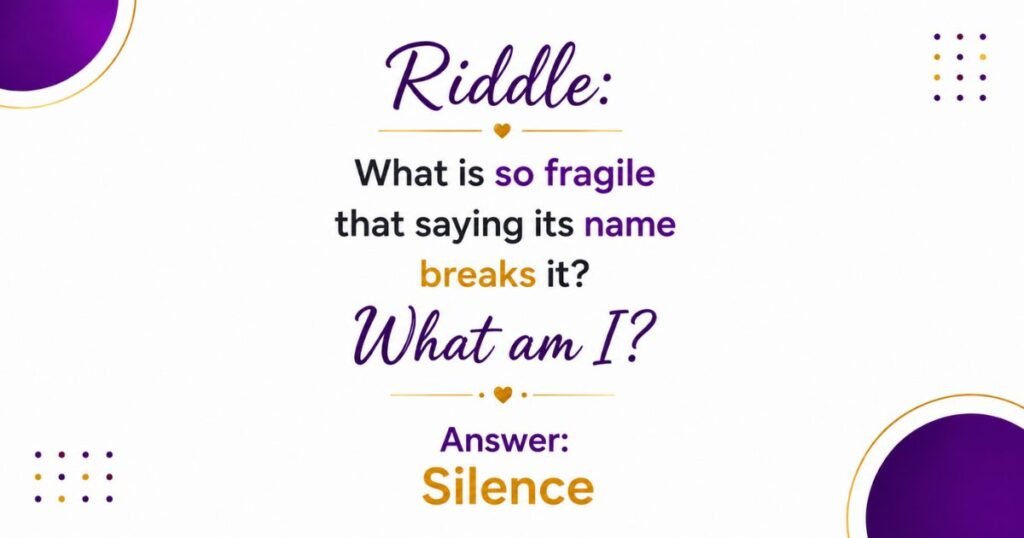
Explanation: Reframes reading as “listening,” a common personification trick in riddle writing. - Riddle: What is so fragile that saying its name breaks it?
Answer: Silence
Difficulty: Medium
Explanation: Self-referential riddle: the act of answering (“silence”) destroys the condition it names.
- Riddle: I have a bark but never bite, and grow taller with every year. What am I?
Answer: A tree
Difficulty: Medium
Explanation: Homophone misdirection between a dog’s bark and a tree’s bark. - Riddle: What building has the most stories?
Answer: A library
Difficulty: Medium
Explanation: Double meaning of “stories” as building floors versus narrative tales. - Riddle: I am lighter than a feather, yet the strongest person can’t hold me for long. What am I?
Answer: Your breath
Difficulty: Medium
Explanation: Contrasts physical lightness with the biological impossibility of holding it indefinitely. - Riddle: What has a spine, ribs, but no organs?
Answer: An umbrella
Difficulty: Medium
Explanation: Skeletal vocabulary applied to the mechanical structure of an umbrella. - Riddle: I follow you all day but vanish at night, and I’m never quite the same shape twice. What am I?
Answer: Your shadow
Difficulty: Medium
Explanation: Uses the shadow’s dependence on sunlight to create a “loyal companion” misdirection. - Riddle: What can you hold in your left hand but never in your right?
Answer: Your right hand
Difficulty: Medium
Explanation: A logic-trap riddle rather than a wordplay one; the answer is self-referential. - Riddle: I have no life, but I can die. What am I?
Answer: A battery
Difficulty: Medium
Explanation: “Die” is used in its mechanical sense (losing power) rather than biologically. - Riddle: What has many keys but can’t open a single lock?
Answer: A piano
Difficulty: Medium
Explanation: A harder companion to riddle 8, adding “many” to increase ambiguity before the reveal. - Riddle: I am full of holes but still hold water. What am I?
Answer: A sponge
Difficulty: Medium
Explanation: Counterintuitive physics riddle: holes usually mean leaks, not storage. - Riddle: What question can you never answer “yes” to honestly?
Answer: “Are you asleep?”
Difficulty: Medium
Explanation: A logic paradox; answering requires being awake, making “yes” impossible. - Riddle: I have a ring but no finger, a face but no eyes, and hands but no arms. What am I? Answer: A clock
Difficulty: Medium
Explanation: Combines three earlier misdirection techniques (ring, face, hands) into one denser riddle. - Riddle: What has an endless supply of letters but never runs out of pages?
Answer: The alphabet
Difficulty: Medium
Explanation: Distinguishes “letters” as characters versus “letters” as mail to mislead the solver. - Riddle: I can be cracked, made, told, and played. What am I?
Answer: A joke
Difficulty: Medium
Explanation: Verb-chain riddle; each verb applies to a different common phrase involving the same noun. - Riddle: What has a bottom at the top?
Answer: Your legs (or a pair of legs sitting cross-legged), commonly answered as “legs” or “a leg”
Difficulty: Medium
Explanation: Plays with spatial expectations of “bottom” and “top” using the body itself. - Riddle: I am not a season, but I have four parts, and each part changes the world around me. What am I?
Answer: A day (morning, noon, evening, night)
Difficulty: Medium
Explanation: A direct nod to the structure of the original Sphinx riddle’s life-stages framing. - Riddle: What can you break even if you never pick it up?
Answer: A record (as in a world record)
Difficulty: Medium
Explanation: “Break” applied to achievement rather than physical objects. - Riddle: I have a head, a tail, but no body, and I’m flipped, not thrown, to decide. What am I? Answer: A coin
Difficulty: Medium
Explanation: A harder variant of riddle 32 that adds the decision-making context as a second clue. - Riddle: I guard secrets older than sand, I rise with the flood of hidden truths and fade with their ebb, only the wise can hold onto what I reveal what am I?
Answer: Hidden knowledge (esoteric wisdom).
Difficulty: Hard.
Explanation: This entry in Sphinx riddle esoteric ebb blends the mythical guardian imagery of the Sphinx with the ebb-and-flow metaphor of tides, symbolizing how deep or hidden knowledge reveals itself only to those who seek it persistently.
Hard Sphinx Riddles
- Riddle: Three lives have I: gentle enough to soothe the skin, light enough to fill the sky, hard enough to crack stone. What am I?
Answer: Water (mist, cloud, ice)
Difficulty: Hard
Explanation: Requires recognizing three states of the same substance across three unrelated-sounding clues. - Riddle: I am lighter than what I am made of, and more of me is hidden than is seen. What am I?
Answer: An iceberg
Difficulty: Hard
Explanation: Uses buoyancy (lighter than solid ice mass in water context) and the “hidden mass” fact together. - Riddle: When I am full, I can point the way. When I am empty, nothing moves me. I have a face but never speak. What am I?
Answer: A compass
Difficulty: Hard
Explanation: “Full/empty” refers to magnetic charge or a filled needle housing; “face” nods to the compass dial. - Riddle: I am taken from a mine and shut in a wooden case, from which I am never released, yet almost everyone uses me. What am I?
Answer: Pencil lead (graphite)
Difficulty: Hard
Explanation: A layered riddle: “mine” (double meaning), “case” (the wood), and “never released” (it wears down, not detaches). - Riddle: What can be given to you, yet you keep it, but the giver still has it too?
Answer: A promise, or your word (also commonly answered as “information” or “a compliment”)
Difficulty: Hard
Explanation: Non-physical transfer riddle; abstract things can be shared without depleting the source. - Riddle: Alive without breath, cold as death, never thirsty, ever drinking. What am I?
Answer: A fish
Difficulty: Hard
Explanation: Uses paradoxes (alive without breath, always drinking yet never thirsty) tied to gill respiration. - Riddle: I dance without feet and sing without a mouth, and I disappear the moment you try to hold me. What am I?
Answer: A flame
Difficulty: Hard
Explanation: Multiple personifications (dancing, singing) layered before the “disappears when touched” reveal. - Riddle: I am the beginning of everything, the end of everywhere. I am the beginning of eternity, the end of time and space. What am I?
Answer: The letter “E”
Difficulty: Hard
Explanation: A pure wordplay riddle; each clue names a word that begins or ends with the letter E. - Riddle: What has roots that nobody sees, is taller than trees, and rises but never grows?
Answer: A mountain
Difficulty: Hard
Explanation: “Roots” is used geologically, and “rises but never grows” separates elevation from biological growth. - Riddle: I have no wings, but I can soar to the stars. I have no engine, but I can carry a thousand thoughts at once. What am I?
Answer: The imagination (or the mind)
Difficulty: Hard
Explanation: An abstract-concept riddle requiring solvers to abandon physical answers entirely. - Riddle: What weighs more, a pound of feathers dropped from a cliff or a pound of stones dropped from the same cliff?
Answer: They weigh the same (a pound is a pound); the trick lies in assuming shape or fall speed changes weight
Difficulty: Hard
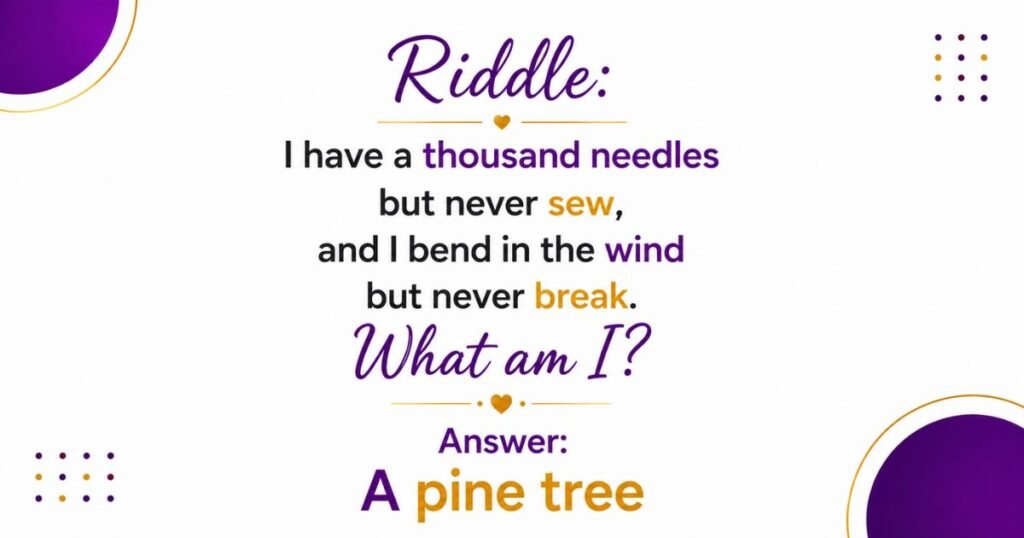
Explanation: A logic riddle disguised as a physics question; misdirection through irrelevant detail (the cliff). - Riddle: I have a thousand needles but never sew, and I bend in the wind but never break. What am I?
Answer: A pine tree
Difficulty: Hard
Explanation: “Needles” refers to pine needles rather than sewing tools, layered with a flexibility clue.
- Riddle: The one who builds it sells it. The one who buys it never sees it. The one who sees it never uses it. What is it?
Answer: A coffin (a harder rework of riddle 35 with an added clue)
Difficulty: Hard
Explanation: Adds a third stakeholder to increase the logical chain solvers must track. Difficulty ratings are subjective and based on average audience feedback. - Riddle: I have a voice of thunder but a body you can hold in one hand. What am I?
Answer: A smartphone (playing music/alarm) or a small speaker
Difficulty: Hard
Explanation: A modern-style sphinx riddle showing how the format adapts to contemporary objects. - Riddle: What can travel faster than light but never actually moves?
Answer: A shadow (its edge can theoretically sweep faster than light without the shadow itself moving matter)
Difficulty: Hard
Explanation: A physics-adjacent riddle built on the distinction between an object moving and a pattern shifting. - Riddle: I have four wings but cannot fly, and I never rest, yet I never travel far. What am I? Answer: A windmill
Difficulty: Hard
Explanation: “Wings” refers to blades, and “never rest yet never travel far” describes continuous rotation in place. - Riddle: What can be measured but has no length, weighed but has no mass, and stolen but never missed until it’s gone?
Answer: Time
Difficulty: Hard
Explanation: Three sequential paradoxes force solvers to keep abandoning physical assumptions. - Riddle: I have a crown, but I am not a king, and I sit atop something without a head. What am I
Answer: A tooth (a “crown” in dentistry)
Difficulty: Hard
Explanation: Uses a specialized vocabulary term (dental crown) most solvers won’t consider first. - Riddle: What runs around the whole yard without ever moving?
Answer: A fence
Difficulty: Hard
Explanation: “Runs” is used spatially (a fence “runs along” a border) rather than kinetically. - Riddle: I have a name that grows shorter as more people know it. What am I?
Answer: A secret
Difficulty: Hard
Explanation: Abstract riddle of a secret’s defining trait (its size or strength) diminishes with disclosure. - Riddle: What can be opened but never physically touched, and once opened can never fully close again?
Answer: The mind (or a discussion/possibility, once considered)
Difficulty: Hard
Explanation: Tests whether solvers accept a purely conceptual answer to a physically framed question. - Riddle: I have no wings, yet I am called a fly. I have no legs, yet I never fall. What am I? Answer: Time flying by (an abstract answer: “time,” referencing the phrase “time flies”). Difficulty: Hard
Explanation: Built entirely on the idiom “time flies,” disguised as a creature description. - Riddle: What kind of tree can you carry in your hand?
Answer: A palm (as in the palm of your hand)
Difficulty: Hard
Explanation: A pun riddle relying on the double meaning of “palm.” - Riddle: I have an army but no weapons, a battlefield but no soldiers, and yet wars are fought in my name every day. What am I?
Answer: Chess
Difficulty: Hard
Explanation: Reframes a board game’s terminology (army, battlefield) as literal warfare before the reveal. - Riddle: What question, once asked, can never be asked the same way again, no matter how many times you ask it?
Answer: “What’s the time?” (the answer always changes) or, more broadly, any question about the present moment
Difficulty: Hard
Explanation: A meta-riddle about impermanence, forcing solvers to think about time itself as the trick. - Riddle: What creature has one voice, yet becomes four-footed, two-footed, and three-footed in turn?
Answer: Man (crawling as an infant, walking as an adult, using a cane in old age).
Difficulty: Hard.
Explanation: This is a variation of the ancient Sphinx riddle the Sphinx riddle answer lies in recognizing that the changing number of “feet” represents different stages of human life, not a literal creature.
Bonus: Sphinx Riddles for Kids and Classrooms
- Riddle: What has four legs in the morning and doesn’t need coffee to get up?
Answer: A dog (or any four-legged pet)
Difficulty: Easy
Explanation: A playful, kid-friendly twist on the original sphinx riddle’s “four legs” clue. - Riddle: I live in a shell, but I’m not an egg, and I carry my house wherever I go. What am I? Answer: A snail (or turtle)
Difficulty: Easy
Explanation: Great for classroom nature units; pairs well with a lesson on animal adaptations. - Riddle: What has 26 letters but isn’t a word?
Answer: The alphabet
Difficulty: Easy
Explanation: A simple counting riddle ideal for early readers learning letter recognition. - Riddle: I have a lot of colors, but I’m not a rainbow, and I come out after every meal on your plate. What am I?
Answer: Leftover food (or a fruit salad) commonly accepted answer is “food”
Difficulty: Easy
Explanation: Encourages kids to think about everyday objects in unusual categories. - Riddle: What gets bigger the more you share it?
Answer: Happiness (or knowledge)
Difficulty: Easy
Explanation: A values-based riddle that works well for social-emotional learning discussions. - Riddle: I have twelve brothers, and we take turns each year. Who are we?
Answer: The months of the year
Difficulty: Medium
Explanation: Great for calendar and time-concept lessons in elementary classrooms. - Riddle: What has one head, one foot, and four legs, but isn’t an animal?
Answer: A bed
Difficulty: Medium
Explanation: Furniture vocabulary (headboard, footboard, legs) reframed as a creature. - Riddle: I can be cracked, I can be made, I can be told, and I can even be on you, but I’m not always funny. What am I?
Answer: A joke (a gentler version of riddle 56 for younger solvers)
Difficulty: Medium
Explanation: Same verb-chain trick as its adult counterpart, simplified for classroom use.
- Riddle: What word starts with “e,” ends with “e,” but only has one letter in it?
Answer: Envelope
Difficulty: Medium
Explanation: A spelling-focused wordplay riddle perfect for vocabulary-building activities. - Riddle: I am full of holes, yet I keep your feet warm. What am I?
Answer: A knitted sock
Difficulty: Easy
Explanation: Similar structure to the sponge riddle, simplified for younger audiences. - Riddle: What has a bottom, a top, and sides, but never any legs to stand on?
Answer: A box
Difficulty: Easy
Explanation: Reinforces spatial vocabulary while keeping the misdirection gentle for kids. - Riddle: I am not alive, but I grow. I don’t have a mouth, but water makes me bigger. What am I?
Answer: A sponge (or a plant, if used in a science lesson)
Difficulty: Easy
Explanation: Doubles as a science-class prompt about absorption and growth. - Riddle: What can you catch, hold, and lose, but never actually see?
Answer: Your breath
Difficulty: Medium
Explanation: A gentler rework of riddle 46, ideal for a phys-ed or health unit. - Riddle: I have a face but no eyes, hands but no fingers, and I hang on your classroom wall. What am I?
Answer: A clock
Difficulty: Easy
Explanation: The clock riddle reappears a final time, anchored in a specific classroom setting kids recognize. - Riddle: What walks on four legs in the morning, two legs at noon, and three legs in the evening?
Answer: A human being (the original riddle of the Sphinx)
Difficulty: Hard (conceptually, though simple once explained)
Explanation: We close where the tradition began the true riddle of the Sphinx, so every reader ends the list having “passed” the same test Oedipus did. - Riddle: I have a voice that never changes, yet I move on four legs, then two, then three what am I?
Answer: A human being.
Difficulty: Hard.
Explanation: The Sphinx riddle explained simply it describes the stages of human life: crawling on all fours as a baby, walking on two legs as an adult, and using a cane (the “third leg”) in old age.
Bringing Sphinx Riddles Into Real Life
These riddles hold up outside the page, too. Teachers have used graded riddle sets like this one as bell-ringer warm-ups or indoor-recess brain breaks; families use them as car-ride games on long trips; and trivia hosts often pull two or three Hard-tier riddles to break ties.
If you’re running these with a group, start everyone on the Easy tier; nothing kills momentum faster than opening with an unsolvable Hard riddle, and confidence built early carries solvers through the tougher ones later.
More Riddles for Serious Solvers
If the Hard Sphinx Riddles section had you sitting with the answer for a minute before it clicked, the Ring Riddles for Kids collection has more logic-driven, layered puzzles built for that same kind of thinking.
The book and spine riddles scattered throughout this list pair naturally with the Book Riddles collection, 60+ riddles built entirely around books, libraries, and reading.
And for a wider mix of curated riddle collections beyond mythology, browse the Chinese Riddles category for more themed sets like this one.
Conclusion
The Sphinx’s Riddle has survived for over two thousand years because it rewards the same skill every time: noticing that a question isn’t as literal as it sounds.
Whether you started with the classic four-legs riddle or jumped straight to the Hard tier, you now have 100 fresh riddles plus the reasoning behind each one to share, teach, or use to stump your next dinner guest.
Bookmark this page and come back whenever you need a new batch, and let us know in the comments which riddle stumped you the longest.
FAQs
What is the Original Riddle of the Sphinx?
The classic riddle asks what creature walks on four legs in the morning, two legs at noon, and three legs in the evening. A description of a human being crawling as an infant, walking as an adult, and using a cane in old age.
What is the Answer to the Sphinx’s Riddle?
A human being.” The riddle maps the three stages of a human life onto the three parts of a single day.
Why Did the Sphinx Ask Riddles?
In Greek mythology, the Sphinx guarded the road to Thebes and used her riddle to test travelers’ wisdom, killing anyone who answered incorrectly until Oedipus solved it and freed the city.
Are There Other Sphinx Riddles Besides the Famous one?
Yes, only one riddle is directly attributed to the mythological Sphinx, but “sphinx riddle” has become a genre describing any enigmatic, life-or-death-style brain teaser written in that same tradition.
What Happens If You Got the Sphinx’s Riddle Wrong?
In the myth, failure was fatal for every traveler before Oedipus. Today, of course, getting one of these riddles wrong just means trying the next one on the list.
A theme from the Sphinx Riddle in Gods of Egypt what must a traveler offer to pass through the gates guarded by the Sphinx?
The truth (an honest answer, not gold or force).
A challenge from Sphinx Riddles DD2 what must a traveler solve to earn the Sphinx’s reward?
A riddle testing wit and logic, not strength.