100 Best Riddles for Kids (With Answers and Explanations)
Every kid loves the moment a riddle finally “clicks”, that little spark of pride when the answer suddenly makes sense. This collection of 100 Best Riddles for Kids in English with answers is sorted into themed categories, from easy one-liners for younger kids to trickier lateral-thinking puzzles for older ones.
Each riddle comes with an answer, a difficulty rating, and a short explanation of the wordplay or logic behind it, so you’ll always know why it works.
If you’re looking for something for the classroom, a long car ride, or family game night, there’s something here for every age and skill level.
What Are Riddles, and Why Are They Good for Kids?
A riddle is a question or statement phrased so its true meaning is hidden, forcing the solver to look past the obvious answer. Riddles generally fall into two types: enigmas, which use descriptive, metaphor-like language (“I have a face but no eyes”), and conundrums, which rely on puns and double meanings for a punchline-style payoff.
Riddles have been around for thousands of years , one of the oldest surviving examples comes from ancient Mesopotamia and was recorded on clay tablets. That long history matters because it shows riddles aren’t just modern classroom filler; they’re one of humanity’s oldest tools for teaching people to think sideways instead of straight ahead.
For kids specifically, riddles for kids build three skills at once:
- Critical thinking, riddles train kids to question their first instinct, which is the foundation of every problem-solving skill they’ll use later in math, reading comprehension, and science.
- Vocabulary and language flexibility , wordplay riddles expose kids to puns, homophones, and double meanings, which strengthens reading skills in a low-pressure, high-fun context.
- Math fluency in disguise , number-based riddles reinforce arithmetic, logic, and number sense without ever feeling like a worksheet.
Easy Riddles for Kids: Easy Riddles with Answers
These short and simple riddles for kids are perfect for beginners, younger children, or as a quick warm-up before moving to trickier brain teasers. Each one uses a single, gentle misdirection , ideal for building a child’s confidence before you introduce harder riddles for kids.
- Riddle: What has hands but cannot clap?
Answer: A clock.
Difficulty: Easy
Explanation: The riddle uses the word “hands” in its literal, human sense to mislead , the answer relies on the object meaning of “clock hands.” - Riddle: What gets wetter the more it dries?
Answer: A towel.
Difficulty: Easy
Explanation: This is a simple paradox riddle , the towel absorbs water from whatever it’s drying, so drying something else makes it wetter. - Riddle: What has a face and two hands but no arms or legs?
Answer: A clock.
Difficulty: Easy
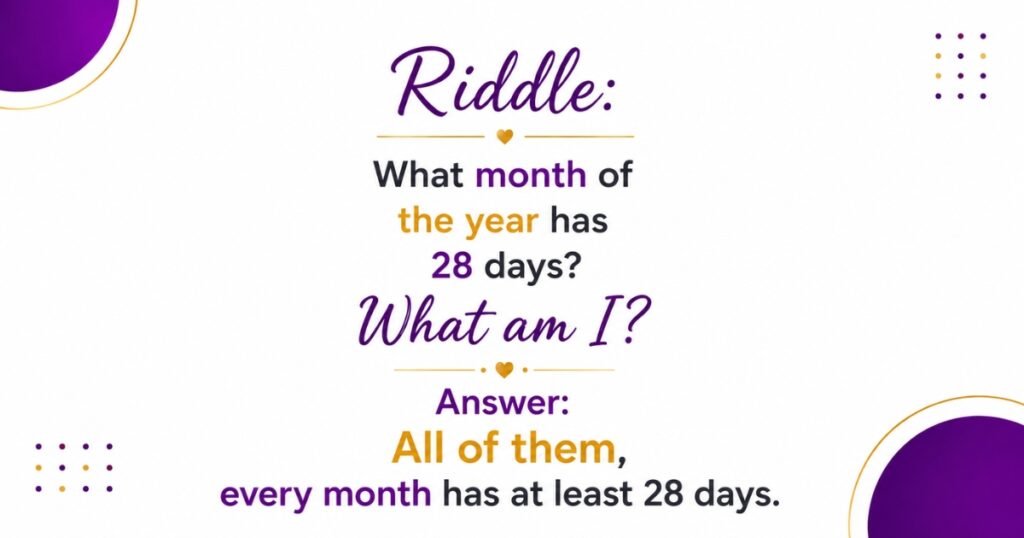
Explanation: Like riddle #1, this leans on the everyday object meaning of “face” and “hands,” teaching kids to spot when a word is being used two ways at once. - Riddle: What month of the year has 28 days?
Answer: All of them , every month has at least 28 days.
Difficulty: Easy
Explanation: A classic misdirection riddle: kids assume you’re asking about February specifically, when the literal answer applies to every month.
- Riddle: What goes up but never comes down?
Answer: Your age.
Difficulty: Easy
Explanation: Kids first picture something physical, like a balloon, before realizing the riddle means something abstract that only increases. - Riddle: What has to be broken before you can use it?
Answer: An egg.
Difficulty: Easy
Explanation: “Broken” usually sounds negative, so the riddle plays on the fact that breaking an egg is actually a necessary first step, not a mistake. - Riddle: What can you catch but never throw?
Answer: A cold.
Difficulty: Easy
Explanation: This riddle relies on a double meaning of “catch” , physically catching an object versus catching an illness. - Riddle: What has one eye but cannot see?
Answer: A needle.
Difficulty: Easy
Explanation: The “eye” of a needle is a great early vocabulary riddle, teaching kids that ordinary objects can have body-part names. - Riddle: What kind of room has no doors or windows?
Answer: A mushroom.
Difficulty: Easy
Explanation: A pure wordplay riddle , “mushroom” contains the word “room,” so the answer is really about breaking a word apart. - Riddle: What has many keys but can’t open a single lock?
Answer: A piano.
Difficulty: Easy
Explanation: This teaches kids that “keys” doesn’t always mean the metal kind , piano keys share the name but not the function. - Riddle: What has a neck but no head?
Answer: A bottle.
Difficulty: Easy
Explanation: Another body-part-on-an-object riddle that helps young kids build descriptive vocabulary and spatial reasoning. - Riddle: What belongs to you, but other people use it more than you do?
Answer: Your name.
Difficulty: Easy
Explanation: This gently introduces kids to the idea of ownership versus usage , a subtle logic twist appropriate for beginners.
Animal Riddles for Kids
Animal riddles for kids are a favorite for nature-loving children and work especially well for science units or zoo trips. These riddles combine descriptive clues with a fun payoff.
- Riddle: I have a trunk but I’m not a tree, big flapping ears, and I never forget. What am I?
Answer: An elephant.
Difficulty: Easy
Explanation: Straightforward descriptive riddle where each clue narrows down one specific animal, teaching kids to eliminate wrong guesses. - Riddle: The more of me there is, the less you see. What am I?
Answer: Darkness.
Difficulty: Medium
Explanation: Technically a nature riddle rather than an animal one, this teaches inverse relationships , more of the thing means less visibility. - Riddle: What has stripes but isn’t a zebra, and hops but isn’t a rabbit?
Answer: A chipmunk.
Difficulty: Medium
Explanation: This riddle uses negative clues (“isn’t a zebra”) to rule out obvious answers before pointing to the real one. - Riddle: What jumps when it walks but sits when it stands?
Answer: A kangaroo.
Difficulty: Easy
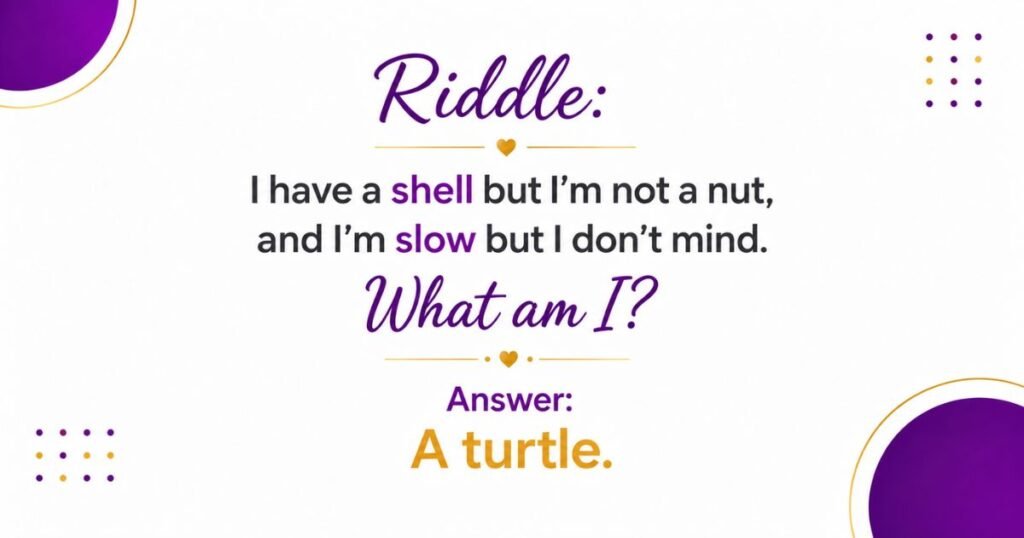
Explanation: The riddle contrasts two motion states, prompting kids to picture an animal’s specific movement pattern rather than guess randomly. - Riddle: I have a shell but I’m not a nut, and I’m slow but I don’t mind. What am I?
Answer: A turtle.
Difficulty: Easy
Explanation: Combines a false lead (“shell” suggests a nut) with a personality-based clue (“I don’t mind”) for a gentle logic exercise.
- Riddle: What animal is always at a baseball game?
Answer: A bat.
Difficulty: Easy
Explanation: A pun riddle , “bat” means both the flying mammal and the equipment used in baseball. - Riddle: What has a bill but never pays it?
Answer: A duck.
Difficulty: Medium
Explanation: This plays on “bill” meaning both a duck’s beak and a payment request, a great homophone lesson for kids learning multiple word meanings. - Riddle: What do you call a bear with no teeth?
Answer: A gummy bear.
Difficulty: Easy
Explanation: A pun riddle built entirely around the double meaning of “gummy” (soft/toothless versus the candy). - Riddle: I can fly without wings, and I cry without eyes. What am I?
Answer: A cloud.
Difficulty: Medium
Explanation: Though sky-themed rather than animal, this classic enigma riddle uses metaphor (“cry” for rain) to challenge literal thinking. - Riddle: What kind of dog keeps the best time?
Answer: A watchdog.
Difficulty: Easy
Explanation: Another compound-word riddle , “watchdog” splits into two meanings that don’t relate to actual timekeeping. - Riddle: What animal is always looking down when everyone else looks up?
Answer: A worm.
Difficulty: Medium
Explanation: Encourages kids to think about perspective and habitat rather than the animal’s appearance. - Riddle: Why do cows wear bells?
Answer: Because their horns don’t work.
Difficulty: Easy
Explanation: A pun-based joke-riddle relying on “horns” meaning both an animal’s horns and a car horn.
Funny Riddles for Kids
Funny riddles for kids double as jokes, so they’re ideal for lunchboxes, birthday parties, or anytime you need a guaranteed laugh. Most rely on puns, a comedic technique where a word’s two meanings collide for a surprise punchline.
- Riddle: What did the ocean say to the beach?
Answer: Nothing, it just waved.
Difficulty: Easy
Explanation: A pun on “waved,” referring to both an ocean wave and the gesture of waving hello. - Riddle: Why can’t you give Elsa a balloon?
Answer: Because she’ll let it go.
Difficulty: Easy
Explanation: Misdirection humor , kids expect a literal reason, but the punchline is a reference to a song lyric about letting go. - Riddle: What do you call cheese that isn’t yours?
Answer: Nacho cheese.
Difficulty: Easy
Explanation: A sound-alike pun: “nacho” sounds like “not your,” creating the joke. - Riddle: Why did the golfer bring two pairs of pants?
Answer: In case he got a hole in one.
Difficulty: Medium
Explanation: Relies on “hole in one” meaning both a golf term and a literal hole in clothing , a callback-style double meaning. - Riddle: What do you call a fish with no eyes?
Answer: A fsh.
Difficulty: Easy
Explanation: A visual/spelling pun , removing the letter “i” (which sounds like “eye”) from “fish.” - Riddle: Why did the cookie go to the doctor?
Answer: Because it felt crummy.
Difficulty: Easy
Explanation: “Crummy” doubles as both “feeling unwell” and “full of crumbs,” a pun kids find especially satisfying to explain. - Riddle: What has ears but cannot hear?
Answer: A cornfield.
Difficulty: Medium
Explanation: “Ears” of corn versus ears for hearing , a plant-based homophone riddle. - Riddle: Why don’t skeletons fight each other?
Answer: They don’t have the guts.
Difficulty: Easy
Explanation: A pun on “guts,” meaning both internal organs (which skeletons lack) and courage.
- Riddle: What’s orange and sounds like a parrot?
Answer: A carrot.
Difficulty: Easy
Explanation: A sound-alike riddle rather than a meaning-based one , the humor comes purely from rhyme. - Riddle: Why did the math book look sad?
Answer: It had too many problems.
Difficulty: Easy
Explanation: “Problems” means both math exercises and personal troubles, a classic school-themed double meaning. - Riddle: What did one wall say to the other wall?
Answer: I’ll meet you at the corner.
Difficulty: Easy
Explanation: A gentle personification joke rather than a wordplay pun, teaching kids that riddles don’t always need a hidden meaning to be funny. - Riddle: Why did the scarecrow win an award?
Answer: Because he was outstanding in his field.
Difficulty: Medium
Explanation: “Outstanding” means both excellent and literally standing out in a field , a two-layer pun.
Math Riddles for Kids
Math riddles for kids sneak arithmetic and logic practice into a game-like format, which is why teachers love using them as morning warm-ups or exit tickets.
- Riddle: If two’s company and three’s a crowd, what are four and five?
Answer: Nine.
Difficulty: Medium
Explanation: A wordplay riddle disguised as math , it’s really asking you to add 4 and 5, not analyze a crowd size. - Riddle: I am an odd number. Take away one letter and I become even. What number am I?
Answer: Seven , remove the “s” and it becomes “even.”
Difficulty: Hard
Explanation: This riddle plays on spelling rather than actual math, tricking kids who assume it’s asking about number values. - Riddle: A farmer has 15 sheep, and all but 8 run away. How many are left?
Answer: 8.
Difficulty: Medium
Explanation: “All but 8” means 8 remain , kids often subtract when they should simply identify the leftover number stated in the question. - Riddle: Can you write eight eights so they add up to exactly 1,000?
Answer: 888 + 88 + 8 + 8 + 8 = 1,000.
Difficulty: Hard
Explanation: A genuine arithmetic puzzle that rewards trial and error and reinforces place value. - Riddle: What three numbers give the same result whether you add or multiply them?
Answer: 1, 2, and 3 (1+2+3=6 and 1×2×3=6).
Difficulty: Hard
Explanation: This teaches kids that a small set of special numbers can satisfy two different operations at once. - Riddle: If a rooster lays an egg on the very top of a barn roof, which way does it roll?
Answer: Roosters don’t lay eggs , hens do.
Difficulty: Easy
Explanation: A classic lateral-thinking riddle that has nothing to do with the roof angle at all , it tests factual assumptions, not geometry. - Riddle: How many months have 28 days?
Answer: All 12 months.
Difficulty: Easy
Explanation: Similar to the calendar riddle above, this trains kids to read the question literally instead of assuming it means February. - Riddle: Mrs. Jones has six daughters, and each daughter has one brother. How many children does she have?
Answer: Seven , six girls sharing the same one brother.
Difficulty: Hard
Explanation: Kids often multiply 6 × 1 by mistake; the trick is realizing all six sisters share the same single brother. - Riddle: What number, when you subtract 5, gives you the same result as when you add 5?
Answer: There is no such number for real numbers other than working with zero pairs , this one is best used as a “trick question” to show that not every riddle has a clean answer, prompting discussion.
Difficulty: Hard
Explanation: This riddle teaches kids it’s okay for a math puzzle to lead to a dead end sometimes , spotting an impossible condition is itself a math skill. - Riddle: If you have 3 apples and you take away 2, how many do you have?
Answer: 2 , because you took them, so you have them now.
Difficulty: Medium
Explanation: A phrasing trick: kids assume the question asks how many are left, when it actually asks how many you now possess. - Riddle: What comes once in a minute, twice in a moment, but never in a thousand years?
Answer: The letter M.
Difficulty: Hard
Explanation: Not really about time at all , it’s a letter-counting riddle, teaching kids to look at spelling instead of meaning. - Riddle: Half of 8 is 4. What is half of infinity?
Answer: There’s no fixed answer , infinity can’t be halved the normal way, so this is a discussion riddle about how infinity behaves differently from regular numbers.
Difficulty: Hard
Explanation: This introduces older kids to the idea that some math concepts (like infinity) don’t follow the rules smaller numbers do.
“What Am I?” Riddles for Kids
“What am I” riddles for kids describe an object through metaphor, challenging kids to picture an item from its behavior rather than its name.
- Riddle: I have keys but no locks, space but no room. What am I?
Answer: A keyboard.
Difficulty: Medium
Explanation: Every clue reuses a word (“keys,” “space,” “room”) in its computer-related sense instead of its usual meaning. - Riddle: I have branches but no leaves, no trunk, and no fruit. What am I?
Answer: A bank.
Difficulty: Medium
Explanation: “Branches” is used in the business sense (bank branches), not the tree sense, teaching kids to consider industry-specific vocabulary. - Riddle: The more you take from me, the bigger I get. What am I?
Answer: A hole.
Difficulty: Medium
Explanation: An inverse-logic riddle , removing material usually shrinks something, but here it does the opposite. - Riddle: I have a spine but no bones. What am I?
Answer: A book.
Difficulty: Easy
Explanation: “Spine” applies to both a human back and a book’s binding, an easy first metaphor riddle for younger kids. - Riddle: I’m tall when I’m young and short when I’m old. What am I?
Answer: A candle (or a pencil).
Difficulty: Easy
Explanation: This riddle reverses the usual pattern kids expect (people get taller with age), which is exactly what makes it click once solved. - Riddle: I have a heart that doesn’t beat. What am I?
Answer: An artichoke (or a playing card).
Difficulty: Medium
Explanation: “Heart” is stripped of its biological meaning and applied to a plant’s center or a card suit instead. - Riddle: I’m always in front of you but can never be seen. What am I?
Answer: The future.
Difficulty: Medium
Explanation: A purely abstract riddle with no physical object at all, which is why kids often guess wrong before realizing the answer is a concept. - Riddle: The more you use me, the sharper I get. What am I?
Answer: Your brain.
Difficulty: Medium
Explanation: Unlike physical tools that dull with use, this riddle highlights how mental skills work in reverse , a nice tie-in to why riddles themselves are useful. - Riddle: I have a bed but never sleep, and a mouth but never eat. What am I?
Answer: A river.
Difficulty: Medium
Explanation: Combines two separate body-part metaphors (riverbed, river mouth) into one layered clue.
- Riddle: I have a face but no eyes, hands but no arms. What am I?
Answer: A clock.
Difficulty: Easy
Explanation: A slightly harder variant of riddle #3, useful for showing kids that the same object can be described multiple ways. - Riddle: I fly without wings and cry without eyes. Wherever I go, darkness follows. What am I?
Answer: A cloud.
Difficulty: Medium
Explanation: A poetic enigma riddle that layers three separate metaphors , flight, crying, and shadow , into a single description. - Riddle: I have a thumb and four fingers but I’m not alive. What am I?
Answer: A glove.
Difficulty: Easy
Explanation: Reuses hand-anatomy vocabulary for an inanimate object, reinforcing that shape can mimic body parts without being alive. - Riddle: I get shorter as I get older, but I never actually shrink in real life. What am I?
Answer: A candle.
Difficulty: Easy
Explanation: A close cousin to riddle #53, reinforcing the “opposite of expected growth” pattern until it becomes familiar.
Hard and Tricky Riddles for Kids
These hard riddles for kids with answers use heavier misdirection and lateral thinking, so they’re best for older kids, gifted learners, or family game nights where everyone wants a real challenge.
- Riddle: A man looks at a photograph and says, “Brothers and sisters, I have none, but that man’s father is my father’s son.” Who is in the photo?
Answer: His son.
Difficulty: Hard
Explanation: A classic family-logic riddle , “my father’s son” with no siblings means the speaker himself, so the photo shows his own child. - Riddle: What has to be broken, but is never actually picked up or touched?
Answer: A promise.
Difficulty: Hard
Explanation: This forces kids to abandon physical-object thinking entirely and consider an abstract concept instead. - Riddle: The person who makes it sells it. The person who buys it never uses it. The person who uses it never sees it. What is it?
Answer: A coffin.
Difficulty: Hard
Explanation: Each clue rules out a normal object relationship, forcing kids toward a solemn but logical answer through elimination. - Riddle: What word becomes shorter when you add two letters to it?
Answer: Short , add “er” to make “shorter.”
Difficulty: Hard
Explanation: A self-referential wordplay riddle where the answer describes its own transformation.
- Riddle: Two fathers and two sons sit down to eat eggs for breakfast. Everyone eats exactly one egg, and only three eggs are eaten in total. How?
Answer: They are a grandfather, father, and son , three people, but two father-son relationships.
Difficulty: Hard
Explanation: Kids assume “two fathers and two sons” means four people; the trick is that one person fills both the “father” and “son” role. - Riddle: What can travel all around the world while staying in a single corner?
Answer: A postage stamp.
Difficulty: Medium
Explanation: “Travel the world” suggests motion, but the object itself stays fixed in the corner of an envelope the whole time. - Riddle: I turn once, and what’s out can’t get in. I turn again, and what’s in can’t get out. What am I?
Answer: A key (in a lock).
Difficulty: Hard
Explanation: The riddle describes the function of locking and unlocking without naming the object, requiring kids to reason through cause and effect. - Riddle: What English word retains its pronunciation even after removing four of its five letters?
Answer: Queue , it’s pronounced the same as just “Q.”
Difficulty: Hard
Explanation: A spelling-and-sound riddle that only works in English, making it a fun way to talk about silent letters. - Riddle: A girl has as many brothers as sisters, but each brother has only half as many brothers as sisters. How many siblings are in the family?
Answer: 4 sisters and 3 brothers.
Difficulty: Hard
Explanation: This is a genuine algebra-style riddle; working backward from each sibling’s point of view is the key to solving it. - Riddle: What is so fragile that saying its name can break it?
Answer: Silence.
Difficulty: Medium
Explanation: An elegant abstract riddle , speaking the word “silence” out loud literally ends the silence, which is the joke of the answer. - Riddle: You see a boat full of people, but when you look again, there isn’t a single person on board. How?
Answer: They were all married , so no one on the boat is technically “single.”
Difficulty: Hard
Explanation: Relies entirely on the double meaning of “single” (unmarried vs. alone), a pun disguised as a logic riddle. - Riddle: What can you hold in your left hand but never in your right hand?
Answer: Your right hand.
Difficulty: Medium
Explanation: A physical-logic riddle rather than a wordplay one , kids have to reason through what’s actually possible with their own body. - Riddle: The day before yesterday I was 21, and next year I’ll turn 24. When is my birthday?
Answer: December 31st, and the riddle is being told on January 1st.
Difficulty: Hard
Explanation: This only works because of the specific timing of the statement relative to a birthday and New Year’s Day, a favorite for testing careful readers.
Food Riddles for Kids
Food riddles for kids are a natural fit for lunchtime, cooking activities, or grocery-store car rides, and they lean heavily on puns.
- Riddle: What has a head and a tail but no body?
Answer: A coin.
Difficulty: Easy
Explanation: Not actually food, but frequently grouped here because of its “flip a coin at lunch” association , it reuses animal vocabulary for an object shape. - Riddle: What kind of cheese is made backward?
Answer: Edam , “made” spelled backward is “edam,” a real type of cheese.
Difficulty: Medium
Explanation: A spelling-based pun that only works because “Edam” happens to be a real cheese name, doubling the surprise. - Riddle: What has a head, but never worries?
Answer: Lettuce.
Difficulty: Easy
Explanation: “Head” of lettuce plays on plant terminology that reuses a human body part, similar to “ears” of corn. - Riddle: I have no beginning, middle, or end. What food am I?
Answer: A donut.
Difficulty: Easy
Explanation: A shape riddle , a circle has no defined start or finish, which the donut’s ring shape illustrates perfectly. - Riddle: What kind of nut is the richest?
Answer: A cashew , sounds like “cash you.”
Difficulty: Easy
Explanation: A homophone pun where the nut’s name sounds like an unrelated money phrase. - Riddle: What has a golden treasure inside, but no hinges, lock, or key?
Answer: An egg.
Difficulty: Medium
Explanation: Descriptive metaphor riddle , the “golden treasure” is the yolk, and the shell needs no lock because it isn’t really a container in the traditional sense. - Riddle: What fruit is never sold alone at the store?
Answer: A banana , they usually come in bunches.
Difficulty: Easy
Explanation: Relies on real-world grocery knowledge rather than pure wordplay, making it a nice change of pace from pun-heavy riddles. - Riddle: Why did the tomato turn red?
Answer: Because it saw the salad dressing.
Difficulty: Easy
Explanation: A personification pun , “dressing” refers to both getting undressed (embarrassment) and salad dressing. - Riddle: What kind of vegetable does a librarian like best?
Answer: A quiet pea.
Difficulty: Easy
Explanation: A sound-alike pun on “quiet, please,” reworked into a vegetable name. - Riddle: What do you get when you cross a snowman and a vampire?
Answer: Frostbite.
Difficulty: Medium
Explanation: Combines two Halloween/winter icons into a single compound-word punchline, showing kids how riddles can blend two ideas. - Riddle: What did the grape say when it got stepped on?
Answer: Nothing, it just let out a little wine.
Difficulty: Medium
Explanation: A homophone pun on “wine” and “whine,” which requires kids to already know both meanings to fully land the joke. - Riddle: I’m sweet, I’m round, and people take pieces out of me on special days. What am I?
Answer: A birthday cake.
Difficulty: Easy
Explanation: A descriptive riddle that ties the object to a specific event, helping kids connect context clues to the final answer.
Holiday and Seasonal Riddles for Kids
Holiday riddles for kids are perfect for classroom parties, family road trips, and seasonal countdowns , swap them in as the calendar changes throughout the year.
- Riddle: What has ears but doesn’t need to hear at Halloween?
Answer: A jack-o’-lantern (a pumpkin carved with ears is unusual, but this works best as: a cornfield’s “ears” of corn during fall harvest).
Difficulty: Medium
Explanation: A seasonal twist on the “ears of corn” wordplay, reframed for autumn and Halloween settings. - Riddle: What kind of tree can you carry in your hand?
Answer: A palm , as in the palm of your hand.
Difficulty: Easy
Explanation: A pun that works for summer or tropical-themed units, reusing anatomy vocabulary for a plant name. - Riddle: What falls in winter but never gets hurt?
Answer: Snow.
Difficulty: Easy
Explanation: “Falls” usually implies an accident, but here it simply describes weather, teaching kids to separate literal and figurative meanings of the same verb. - Riddle: What do you call a snowman in July?
Answer: A puddle.
Difficulty: Easy
Explanation: A logic riddle rather than a pun , kids have to reason through what happens to snow in summer heat. - Riddle: What has a red nose, four legs, and delivers presents once a year?
Answer: Rudolph the reindeer.
Difficulty: Easy
Explanation: A straightforward descriptive riddle using well-known holiday imagery for younger kids just starting with riddles. - Riddle: I’m carved every October, I glow at night, but I’m actually a vegetable’s cousin. What am I?
Answer: A jack-o’-lantern.
Difficulty: Easy
Explanation: Combines seasonal timing, a physical trait (glowing), and a category clue (vegetable) into one layered riddle. - Riddle: What do you get when you cross a duck with a firework?
Answer: A firequacker.
Difficulty: Medium
Explanation: A blended-word pun combining “firecracker” and “quack” for a Fourth of July or New Year’s riddle. - Riddle: What has 12 legs, 4 wheels, and flies, but isn’t an insect?
Answer: Santa’s sleigh with his reindeer team.
Difficulty: Medium
Explanation: A composite-counting riddle where kids must add up parts (reindeer legs plus sleigh runners) to reach the total. - Riddle: What kind of tree do you keep in your house at wintertime?
Answer: A Christmas tree.
Difficulty: Easy
Explanation: A simple seasonal-association riddle appropriate for the youngest riddle-solvers. - Riddle: What flies without wings during springtime?
Answer: Time.
Difficulty: Medium
Explanation: An abstract riddle similar to “the future” , kids must abandon literal flight and think about how quickly a season passes. - Riddle: What has a heart that doesn’t beat, and gets given away every February?
Answer: A candy heart or paper valentine.
Difficulty: Easy
Explanation: Combines the “heart with no heartbeat” metaphor from earlier with a specific holiday clue (February) to narrow the answer. - Riddle: What kind of egg can’t crack, no matter how hard you try?
Answer: A plastic Easter egg.
Difficulty: Easy
Explanation: A logic riddle relying on material knowledge , kids have to recall that plastic behaves differently from a real eggshell. - Riddle: What holiday do mummies love best?
Answer: Halloween , because of all the wrap parties.
Difficulty: Medium
Explanation: A pun on “wrap,” referencing both a mummy’s bandages and a “wrap party,” a phrase older kids may need explained. - Riddle: What can you give away and still keep at the same time?
Answer: A cold, a smile, or a promise (multiple valid answers work).
Difficulty: Hard
Explanation: An open-ended abstract riddle to close the list, teaching kids that not every riddle has a single locked answer, sometimes the reasoning matters more than matching one “correct” word.
More Riddles for Kids to Explore
This list only scratches the surface of what riddles for kids and adults can cover. If your child liked the Holiday and Seasonal section, there’s a whole dedicated collection of holiday riddles built around every season on the calendar.
For something with a bit more heat and a campfire feel, these fire riddles make a fun follow-up.
And if you’re a teacher or parent looking to turn screen-free study time into a game, these homework riddles are made exactly for that.
Conclusion
Riddles for kids do double duty: they’re genuinely fun, and they quietly build the exact skills , critical thinking, vocabulary, and number sense , that kids need everywhere else in life.
Whether you pull a few easy riddles for a car ride or challenge an older kid with the hard riddles above, the goal is the same: get them to pause, question their first guess, and enjoy the moment the answer clicks.
Bookmark this page, pick a few favorites for your next classroom warm-up or family game night, and check back for more riddles for kids as we keep adding new categories.
FAQs
What are Good Riddles for Kids?
Short riddles with one clear twist, like “What has hands but can’t clap?” Younger kids do best with simple wordplay, while older kids enjoy riddles that need a few logical steps.
What Age are Riddles Appropriate for?
Easy riddles work well from age 5 and up. Medium and hard riddles are better suited to kids 8 and older, since they take more reasoning and vocabulary.
How do you explain a Riddle to a Child?
Read it slowly, let them guess without correcting them right away, then explain the answer step by step. Explaining why it works helps more than just giving the answer.
What is a Good Riddle to ask a Kid?
Simple ones with everyday objects work best, like “What has a face but no eyes?” (a clock). They’re easy to picture and fun to guess.
What are Riddles Good for?
Riddles build critical thinking, vocabulary, and problem-solving skills, all while feeling like a game instead of a lesson.
Why are Riddles Good for Kids’ Brains?
They teach kids to question their first guess and think from a different angle, which is a key part of critical thinking.