90+ Time Riddles With Answers: Easy, Medium, and Hard
Time riddles are short puzzles that describe clocks, hours, days, or the passage of time itself through wordplay and misdirection instead of naming the answer directly.
They range from simple “what has hands but cannot clap” clock riddles for kids to layered logic puzzles about calendars and aging for adults, making them a flexible classroom and game-night tool.
After using this exact list with two homeschool co-ops and a fifth-grade math club, the riddles that landed best weren’t always the trickiest ones; they were the ones tied to something kids already do every day, like checking a clock or crossing off a calendar square.
I mentioned find 90 completely original time riddles sorted into Easy, Medium, and Hard tiers, each with its answer, a difficulty rating, and a short explanation of the logic or wordplay that makes it click.
Why Time Riddles Work So Well in the Classroom and at Home?
Time is one of the few subjects every listener already has personal, daily experience with. Everyone has watched a clock tick slowly during a boring class or wished they had more hours in a day.
That shared experience is exactly what makes riddles about time so effective: the riddle-writer can lean on real feelings (“time flies,” “time drags”) and let the listener’s own intuition do half the work.
Teachers often reach for clock riddles specifically because they double as informal time-telling practice. A child solving “what has hands but cannot clap” is also reinforcing the vocabulary of clock hands and clock faces.
Parents use time riddles on long car rides because, unlike prop-based games, they need nothing but a voice. And trivia night hosts save the hardest time riddles for last, since a good logic puzzle about ages, calendars, or clock hands can stump a room of adults just as easily as a ten-year-old.
Here’s an interesting riddle about tomorrow: it’s something no one has ever seen, yet everyone plans for it every single day. It never truly arrives, because the moment it comes, it becomes today.
Easy Time Riddles for Kids
These short time riddles are built for a quick win ideal for a classroom warm-up, a birthday party, or a car full of restless kids.
- Riddle: What has hands but cannot clap, and a face but cannot smile?
Answer: A clock.
Difficulty: Easy
Explanation: Borrows body-part vocabulary (“hands,” “face”) that also names clock parts, a classic double-meaning riddle. - Riddle: What goes up every single year but never comes back down?
Answer: Your age.
Difficulty: Easy
Explanation: Uses “goes up” in its abstract, numerical sense rather than physical movement. - Riddle: What has twelve numbers but never does math?
Answer: A clock face.
Difficulty: Easy
Explanation: Tests whether the listener assumes numbers always imply calculation rather than simply labeling positions. - Riddle: What has a face that never blinks, even though it watches you all day?
Answer: A clock.
Difficulty: Easy
Explanation: Personifies the clock face as a watchful eye. - Riddle: I tick all day and all night, but I never get tired. What am I?
Answer: A clock.
Difficulty: Easy
Explanation: A straightforward personification riddle that leans on the sound clocks make rather than their appearance. - Riddle: What can you set but never actually touch?
Answer: An alarm.
Difficulty: Easy
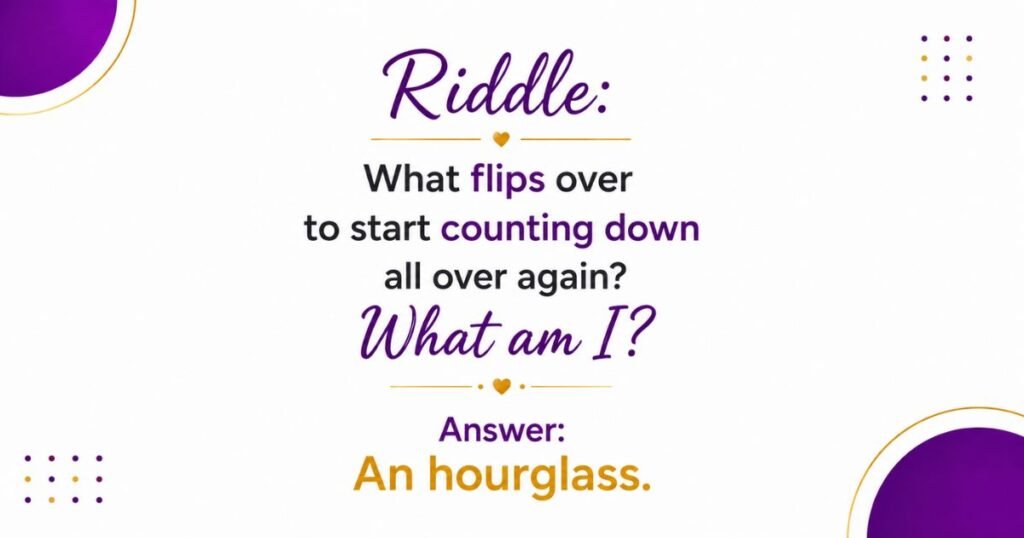
Explanation: “Set” is reused from its everyday meaning (place an object) to its clock-and-timer meaning (schedule). - Riddle: What flips over to start counting down all over again?
Answer: An hourglass.
Difficulty: Easy
Explanation: Describes the physical action of resetting an hourglass without naming sand or glass directly.
- Riddle: What has a spring inside but is not a season?
Answer: A wind-up clock.
Difficulty: Easy
Explanation: “Spring” doubles as a coiled mechanism and a season, a homonym riddle that rules out the season directly in the clue. - Riddle: What comes before Tuesday but after Sunday?
Answer: Monday.
Difficulty: Easy
Explanation: A simple sequencing riddle testing basic calendar order. - Riddle: What has seven days but is never a full week of vacation for a clock?
Answer: A calendar week.
Difficulty: Easy
Explanation: Plays on the idea that “a week” describes both a calendar unit and the informal idea of time off, which a clock can’t take. - Riddle: What always runs but never gets anywhere, and never gets tired of running?
Answer: Time.
Difficulty: Easy
Explanation: Uses “runs” metaphorically, the way people say “time runs out,” rather than physical motion. - Riddle: What has two hands that never wave hello?
Answer: A clock.
Difficulty: Easy
Explanation: A variation on the “hands” wordplay, isolated for an even easier warm-up riddle. - Riddle: What kind of clock never needs batteries and only works when the sun is out? Answer: A sundial.
Difficulty: Easy
Explanation: Descriptive riddle relying on real-world knowledge of how sundials use sunlight and shadow to mark time. - Riddle: I get shorter every hour, yet nobody is cutting me. What am I?
Answer: A burning candle (used historically to track time).
Difficulty: Easy
Explanation: Personifies a candle’s steady burn as a form of measured, self-shrinking time. - Riddle: What month is the shortest, no matter what year it is?
Answer: February.
Difficulty: Easy
Explanation: A factual calendar riddle rooted in real-world knowledge rather than wordplay. - Riddle: What can you lose, waste, and save, but never actually hold in your hand?
Answer: Time.
Difficulty: Easy
Explanation: Lists three verbs that commonly pair with “time” in English, requiring the listener to spot the shared abstract noun. - Riddle: What ticks, has a round face, and hangs on the wall to greet you every morning? Answer: A wall clock.
Difficulty: Easy
Explanation: Combines sound (ticks), shape (round face), and setting (wall) into a single descriptive clue chain. - Riddle: What has 24 hours but is never the same day twice?
Answer: A calendar day (today).
Difficulty: Easy
Explanation: Tests whether the listener realizes “24 hours” describes any day, while “never the same” points to a single, unrepeatable today. - Riddle: What swings back and forth all day inside a tall wooden clock and never gets dizzy? Answer: A pendulum.
Difficulty: Easy
Explanation: Personifies a pendulum’s motion, testing knowledge of how grandfather clocks keep time. - Riddle: What has four seasons but is never cold in winter itself?
Answer: A calendar year.
Difficulty: Easy
Explanation: Distinguishes the abstract concept of a year from the literal weather within it. - Riddle (Tricky Riddles About Time): The more you take, the more you leave behind what am I?
Answer: Footsteps (or time itself, depending on interpretation).
Difficulty: Medium.
Explanation: The riddle plays on the paradox of “taking” and “leaving” simultaneously each step (or moment) taken forward becomes a mark left in the past, making it a classic wordplay challenge among tricky riddles about time.
Easy-Medium Time Riddles for the Classroom
These sit just above beginner level and pair well with for slightly older students learning to tell time.
- Riddle: What word means “right now” but is also the only time a clock’s big and small hands point straight up together at the start of the day?
Answer: Midnight.
Difficulty: Easy
Explanation: Combines a definition clue with a clock-position clue, requiring both pieces to confirm the answer. - Riddle: What day of the week sounds like it belongs to the sun but actually comes right before Monday?
Answer: Sunday.
Difficulty: Easy
Explanation: A wordplay riddle built on the “sun” hidden inside “Sunday,” paired with a sequencing clue. - Riddle: What has minutes but never seconds to spare?
Answer: A clock (or an appointment book).
Difficulty: Easy
Explanation: Plays on “seconds to spare” as an idiom for free time, separate from the literal time unit. - Riddle: What can be quarter past, quarter to, or exactly on the hour, but is never a coin? Answer: The time on a clock.
Difficulty: Easy
Explanation: Reuses “quarter” from currency vocabulary to describe clock positions, ruling out the coin directly in the clue. - Riddle: What ticks every second but only chimes once an hour?
Answer: A chiming wall clock.
Difficulty: Easy
Explanation: Distinguishes between a clock’s constant ticking and its periodic chime, testing attention to two separate clues. - Riddle: What has 60 of one thing inside 60 of another, over and over, all day long?
Answer: A clock (60 seconds in a minute, 60 minutes in an hour).
Difficulty: Medium
Explanation: A numeric-nesting riddle requiring the listener to recall the 60-60 relationship in timekeeping. - Riddle: What number never appears on the face of a 12-hour clock, no matter how you turn it?
Answer: Thirteen.
Difficulty: Easy
Explanation: A factual riddle testing basic knowledge of a standard analog clock face. - Riddle: What season comes right after summer but is never the coldest?
Answer: Fall (autumn).
Difficulty: Easy
Explanation: A sequencing riddle with a small logic check (ruling out winter) to prevent a rushed wrong guess. - Riddle: What can be “daylight” or “standard,” and moves your clock forward or back by exactly one hour?
Answer: Daylight saving time.
Difficulty: Medium
Explanation: A factual riddle rooted in a real-world time-keeping practice rather than metaphor. - Riddle: What ancient device uses a shadow instead of hands to tell you the time?
Answer: A sundial.
Difficulty: Easy
Explanation: Restates riddle with a historical framing, reinforcing the sundial concept before moving into medium-tier riddles. - Riddle (Riddle About Time – Hobbit): I devour everything I touch birds, beasts, trees, and flowers; I chew through iron and grind down stone; I defeat kings and topple mighty towers; what am I?
Answer: Time.
Difficulty: Hard.
Explanation: Inspired by the riddle-game tradition from The Hobbit, this riddle personifies time as an unstoppable force that consumes all things equally, testing solvers to think beyond a physical object toward an abstract concept.
Medium Time Riddles for Teens and Adults
Medium-tier riddles add a second layer of misdirection, making them ideal for and family game night.
- Riddle: I am always coming but never actually arrive. What am I?
Answer: Tomorrow.
Difficulty: Medium
Explanation: A time-based paradox the moment tomorrow arrives, it becomes today, so it can never truly be “here.” - Riddle: What can be measured in minutes but changes the whole world the moment it runs out?
Answer: Time.
Difficulty: Medium
Explanation: An abstract riddle emphasizing consequence over definition, forcing the listener past a purely literal reading. - Riddle: What are the only two clock hands that meet exactly eleven times between one noon and the next?
Answer: The hour hand and the minute hand.
Difficulty: Hard
Explanation: A math-logic riddle based on the real mechanics of clock hands, which overlap eleven times every twelve hours. - Riddle: What has to be wound, set, or charged, yet never gets tired from working nonstop? Answer: A clock or watch.
Difficulty: Medium
Explanation: Lists three different clock-maintenance verbs (wound, set, charged) spanning mechanical, analog, and digital clocks alike. - Riddle: What travels forward every second of every day, yet has never once been seen by anyone?
Answer: Time itself.
Difficulty: Medium
Explanation: An abstract-concept riddle time can be measured and felt but never directly observed as an object. - Riddle: What kind of “year” has 366 days instead of the usual 365?
Answer: A leap year.
Difficulty: Medium
Explanation: A factual calendar riddle requiring knowledge of the leap-year system rather than wordplay. - Riddle: What has a “hand” that only ever moves forward, never sideways or backward? Answer: A clock’s second hand.
Difficulty: Medium
Explanation: Narrows the general “hands” wordplay to a single hand and a single direction, adding a layer of precision. - Riddle: What can be broken, kept, wasted, or lost, but is never a physical object you can hold?
Answer: Time.
Difficulty: Medium
Explanation: Expands on riddle with more verbs, all commonly paired with the abstract nofun “time” in everyday English. - Riddle: What number, when the clock strikes it, means something has gone wrong with the clock itself?
Answer: Thirteen.
Difficulty: Medium
Explanation: Builds on riddle factual clue by adding a consequence (a malfunctioning clock). - Riddle: What has two names depending on whether the sun is up or down, yet is really the exact same moment on a 24-hour clock?
Answer: Noon and midnight, both marked as “12” but on opposite sides of the day. Difficulty: Medium
Explanation: A comparative riddle requiring the listener to think about the 12-hour clock’s two identical-looking “12” positions. - Riddle: What grows one candle taller every single year, without anyone lighting a match? Answer: A birthday cake (representing another year of age).
Difficulty: Medium
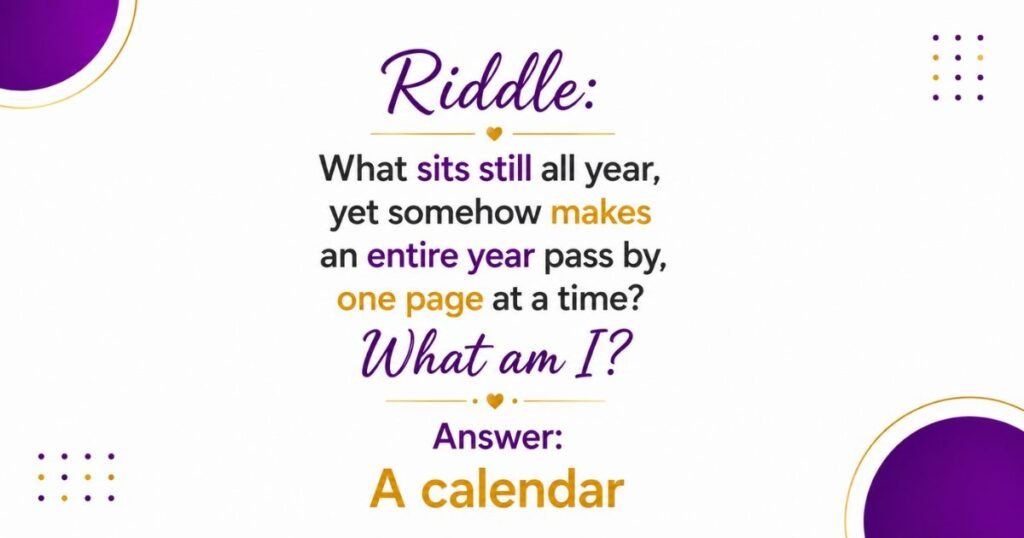
Explanation: Uses a cultural symbol (birthday candles) as a stand-in for the passage of a year, rather than describing age directly. - Riddle: What sits still all year, yet somehow makes an entire year pass by, one page at a time?
Answer: A calendar.
Difficulty: Medium
Explanation: Personifies the calendar’s passive role, testing whether listeners realize it “moves” time only symbolically, through pages or squares.
- Riddle: What can be “fashionably” late but is never actually early?
Answer: A person who is chronically tardy (a play on the idiom “fashionably late”).
Difficulty: Medium
Explanation: Relies on a common idiom about lateness, testing cultural-language familiarity rather than pure logic. - Riddle: What has three hands on some models, yet fewer than three people have ever needed to shake one?
Answer: A clock with an hour, minute, and second hand.
Difficulty: Medium
Explanation: A pun on “shaking hands,” reused for the mechanical hands of a clock instead of human greeting. - Riddle: What is the only unit of time that never changes length, no matter which calendar you use?
Answer: A second (as defined by scientific standards, unlike months or even some historic “hours”).
Difficulty: Hard
Explanation: A factual riddle rooted in the science of timekeeping, since months and even old-style “hours” have varied historically while the second is fixed. - Riddle: What ancient tool measures time by letting sand fall from one glass bulb into another?
Answer: An hourglass.
Difficulty: Easy
Explanation: A more detailed restatement of the hourglass concept, adding mechanism detail for a slightly older audience. - Riddle: What clock has no hands, no numbers, and no face, yet millions of people check it every single day on their phone?
Answer: A digital clock.
Difficulty: Medium
Explanation: Uses negation (no hands, no numbers, no face) to rule out an analog clock before revealing the digital alternative. - Riddle: What can “spring forward” and “fall back” without ever taking a single step?
Answer: A clock during daylight saving time changes.
Difficulty: Medium
Explanation: Reuses the common daylight-saving mnemonic (“spring forward, fall back”) as literal-sounding movement clues. - Riddle: What has a “life” measured entirely in hours, and helps you see in the dark until it finally goes out?
Answer: A candle.
Difficulty: Medium
Explanation: Personifies a candle’s burn time as a lifespan, echoing the earlier candle riddle with added detail about its purpose. - Riddle: What week of the year has both the least daylight and the most candles lit, in many winter holiday traditions?
Answer: The week around the winter solstice in late December.
Difficulty: Hard
Explanation: A seasonal-knowledge riddle connecting the shortest daylight period of the year to widespread holiday candle-lighting traditions. - Riddle: What can you “kill,” “buy,” and “make up for,” yet never actually touch with your hands?
Answer: Time.
Difficulty: Medium
Explanation: A third variation on the “verbs that pair with time” pattern from riddles using idioms like “kill time” and “make up for lost time.” - Riddle: What has hours but no minutes, if you’re only talking about the “hour” of a wedding ceremony?
Answer: A scheduled time slot (an “hour” used loosely to mean “a set time,” not 60 literal minutes).
Difficulty: Medium
Explanation: Tests the difference between “hour” as an exact 60-minute unit and “hour” as a casual scheduling term. - Riddle: What device do runners use to measure fractions of a second, down to the hundredth?
Answer: A stopwatch.
Difficulty: Easy
Explanation: A straightforward, factual riddle based on real-world sports timekeeping tools. - Riddle: What has “Greenwich” in its name and decides what hour it is everywhere else on Earth?
Answer: Greenwich Mean Time (GMT), the reference point for the world’s time zones. Difficulty: Medium
Explanation: A factual, entity-based riddle testing awareness of how global time zones are calculated from a single reference line. - Riddle: What can be “borrowed” from tomorrow but never actually paid back?
Answer: Sleep (staying up late “borrows” time from the next day’s rest).
Difficulty: Medium
Explanation: Uses a financial metaphor (“borrowed,” “paid back”) applied to time and rest instead of money. - Riddle (Riddles About Time for Adults): I can be spent, wasted, saved, or killed, but you can never hold me in your hand what am I?
Answer: Time.
Difficulty: Medium.
Explanation: This riddle plays on common phrases used with time (“spend time,” “waste time,” “save time,” “kill time”) to challenge adults to think about abstract, everyday language rather than a physical object.
Hard Time Riddles and Brain Teasers
These are the true stumpers save them for the end of trivia night or your most confident riddle-solvers.
- Riddle: A father is exactly three times his son’s age today. In fifteen years, he will be exactly twice his son’s age. How old are they now?
Answer: The father is 45 and the son is 15.
Difficulty: Hard
Explanation: A math-logic riddle solvable with algebra: if son = x, father = 3x, and 3x+15 = 2(x+15), solving gives x = 15. - Riddle: Two clocks strike midnight at the exact same instant. One is five minutes fast, and the other is five minutes slow. How many minutes apart do the two clocks actually read at that moment?
Answer: Ten minutes apart.
Difficulty: Medium
Explanation: A logic riddle where the “fast” and “slow” errors stack in opposite directions, doubling the five-minute gap into ten. - Riddle: What day is it if yesterday’s tomorrow is today, and tomorrow’s yesterday is also today?
Answer: Any given day, since both statements describe “today” from different reference points.
Difficulty: Hard
Explanation: A self-referential logic riddle where two seemingly complex clues both resolve to the same simple word. - Riddle: A clock loses exactly one minute every hour. If it’s set correctly at noon, what time will it actually show when a normal clock reads 6:00 p.m.?
Answer: 5:54 p.m. (losing six minutes over six hours).
Difficulty: Hard
Explanation: A math-logic riddle requiring multiplication of the per-hour error by the number of elapsed hours. - Riddle: What time is exactly halfway between one o’clock in the afternoon and one o’clock the next morning?
Answer: Nine o’clock at night.
Difficulty: Medium
Explanation: There are 12 hours between 1 p.m. and 1 a.m., so the midpoint falls exactly six hours after 1 p.m., landing at 9 p.m. - Riddle: I have no beginning and no end, yet people say I “started” the moment everything else began. What am I?
Answer: Time.
Difficulty: Hard
Explanation: A philosophical-style riddle playing on the paradox that time supposedly began with the universe, yet has no clear starting “moment” within itself. - Riddle: A woman was born in the same hospital room number as the year of her death, and she died at exactly the age shown on the door. What’s going on?
Answer: The room numbers are coincidental hospital room numbers, not calendar years. She was born in room, say, 1988 and died in room 2010 at age 22, unrelated to the actual calendar years.
Difficulty: Hard
Explanation: A misdirection riddle where numbers that look like years are revealed to be unrelated hospital room numbers, breaking the assumed math. - Riddle: What three consecutive days can you name without ever saying Monday, Wednesday, or Friday by name?
Answer: Yesterday, today, and tomorrow.
Difficulty: Medium
Explanation: A lateral-thinking riddle the “days” don’t need to be specific calendar days, just relative terms. - Riddle: What can be “quarter to,” “quarter past,” “half past,” or “on the dot,” yet is never a piece of currency?
Answer: The time on a clock.
Difficulty: Medium
Explanation: A restated, expanded version of riddle, currency-versus-clock wordplay, adding “on the dot” as a fourth clue. - Riddle: What single letter, when you place it at the very center of a standard clock face, marks the exact middle of the numbers one through twelve?
Answer: There is no letter the center of a clock face holds the hands, not a number or letter, making this a trick riddle.
Difficulty: Hard
Explanation: A deliberately misleading riddle that tests whether the listener questions the premise instead of guessing blindly. - Riddle: What has existed since before recorded history, yet is reset to zero every time a stopwatch button is pressed?
Answer: Time (the concept), as measured by a stopwatch.
Difficulty: Hard
Explanation: Contrasts the vast, ongoing nature of time itself with the small, resettable slice of it that a stopwatch measures. - Riddle: A twin is born two minutes after midnight on January 1st, and their older sibling is born two minutes before midnight on December 31st. Who is actually older, and by how much?
Answer: The sibling born on December 31st is older, by four minutes.
Difficulty: Medium
Explanation: A calendar-crossing logic riddle where the year changes but the actual elapsed time between births stays small. - Riddle: What ticking object can be found in a courtroom, a kitchen, and a bomb-disposal movie, and always means the same thing: time is running out?
Answer: A clock (or timer).
Difficulty: Medium
Explanation: A context riddle listing varied settings that all share the same underlying object and symbolic meaning. - Riddle: What is the only time on a 12-hour clock when the hour and minute hands are perfectly stacked on top of each other and also pointing straight up?
Answer: 12:00 (noon or midnight).
Difficulty: Medium
Explanation: A geometry-based clock riddle requiring the listener to picture hand positions rather than rely on wordplay. - Riddle: What season repeats its name if you say the first three letters twice, back to back? Answer: None but “summer” begins with “sum,” which doesn’t repeat; the true answer is a trick: no standard season name does this, making the riddle a deliberate dead end used to test careful listening.
Difficulty: Hard
Explanation: An intentionally unsolvable “gotcha” riddle included to demonstrate that some circulating riddles are designed to test whether listeners keep guessing past a false premise rather than questioning it. - Riddle: What can move an entire hour in a single moment, twice a year, without a single gear turning?
Answer: A digital clock during a daylight saving time change.
Difficulty: Medium
Explanation: Builds on riddle, specifying “digital” to rule out the mechanical-gear image and sharpen the clue. - Riddle: A man says, “Two days ago, I was 25, and next year I’ll turn 28.” What day is his birthday, and on what date is he speaking?
Answer: His birthday is December 31st, and he is speaking on January 1st.
Difficulty: Hard
Explanation: A calendar-logic riddle where the birthday falls right before New Year’s Eve, letting one year’s passage account for two age jumps. - Riddle: What runs for exactly 60 seconds, then instantly forgets everything and starts counting all over again?
Answer: The second hand on a clock (each time it completes a minute).
Difficulty: Medium
Explanation: Personifies a repeating cycle as “forgetting,” when it’s really just mechanical repetition.
- Riddle: What is always ahead of you in every single time zone on Earth, yet somehow never actually gets there first?
Answer: Tomorrow.
Difficulty: Hard
Explanation: A variation on riddle, adding a global time-zone twist that makes “tomorrow” feel even more elusive. - Riddle: What can happen “in the nick of,” “on,” or “ahead of,” yet is never something you can hold in a bag?
Answer: Time.
Difficulty: Medium
Explanation: A fourth idiom-based variation on the “time” wordplay pattern (in the nick of time, on time, ahead of time). - Riddle: What number of hours must pass for a clock’s hour hand to end up in the exact same spot it started, assuming a normal 12-hour clock face?
Answer: 12 hours (or any multiple of 12).
Difficulty: Medium
Explanation: A basic clock-math riddle testing understanding of how the hour hand completes a full circle every 12 hours. - Riddle: What single word describes both “the correct moment for something” and “a musical rhythm,” and has nothing to do with punctuality when musicians use it?
Answer: Time (as in “keeping time” in music).
Difficulty: Hard
Explanation: A dual-definition riddle showing how the same word applies to punctuality and to musical rhythm, two very different contexts. - Riddle: What can be “borrowed,” “bought,” “saved,” and “spent,” yet has never once been physically manufactured in a factory?
Answer: Time.
Difficulty: Medium
Explanation: A fifth and final variation on the recurring “verbs that pair with time” riddle pattern, closing the loop on the theme. - Riddle: A digital clock reads 10:01 and, read upside down in a mirror, still reads a valid time. What time does it reverse?
Answer: 10:01 reversed and mirrored also reads as 10:01, because of the symmetry of the digits 1 and 0.
Difficulty: Hard
Explanation: A visual-logic riddle relying on the mirror symmetry of certain digital numerals rather than wordplay. - Riddle: What does a clock have exactly two of, a calendar has exactly twelve of, and a week has exactly seven of, yet none of them can be held in your hand at once?
Answer: Hands (a clock’s two hands), months (a calendar’s twelve), and days (a week’s seven) all units, not objects.
Difficulty: Hard
Explanation: A three-part matching riddle requiring the listener to identify three separate but parallel “counted units” across different time tools. - Riddle: What always comes exactly one hour after 11:59 p.m. sometimes, and exactly one minute after it every other time?
Answer: Midnight either one minute later (normally) or, during a “spring forward” clock change, effectively skipped an hour ahead.
Difficulty: Hard
Explanation: A riddle contrasting a normal midnight transition with the daylight-saving “spring forward” transition, where an hour appears to vanish. - Riddle: What single word can follow “over,” “bed,” and “life” to describe three completely different situations involving time?
Answer: “Time” overtime, bedtime, lifetime.
Difficulty: Medium
Explanation: A compound-word riddle requiring the listener to spot the shared suffix across three unrelated contexts. - Riddle: What ancient timekeeping method relies on nothing but a stick, the sun, and a patch of ground?
Answer: A sundial (or a simple shadow stick).
Difficulty: Easy
Explanation: A simplified, historical restatement of the sundial concept for readers who want the “how” behind the ancient device. - Riddle: What has “second” in its name but is actually the very first tool many swimmers and runners reach for?
Answer: A stopwatch (measures seconds).
Difficulty: Medium
Explanation: A wordplay riddle contrasting “second” as a unit of time with “second” as an ordinal number, then flipping it with “first tool.” - Riddle: What phrase means “immediately” yet literally describes an object with no hands or face at all?
Answer: “In a flash,” or “in no time” idioms describing speed without referencing an actual clock.
Difficulty: Medium
Explanation: Tests recognition of time-related idioms that don’t actually involve clocks, despite sounding like they should. - Riddle: What is the only hour of the day that appears twice on a standard 12-hour analog clock face within 24 hours, yet only appears once on a 24-hour digital clock?
Answer: Any hour between 1 and 12 (each appears twice on a 12-hour face once for a.m., once for p.m. but only once on a 24-hour digital display).
Difficulty: Hard
Explanation: A comparative-format riddle testing understanding of the difference between 12-hour and 24-hour timekeeping systems. - Riddle: What word means both “to organize an event for a future date” and “the reading on a clock right now”?
Answer: “Schedule” is close, but the precise dual-meaning word is “time” itself as in “what time is the event” and “to time an event.”
Difficulty: Hard
Explanation: A dual-definition riddle exploring how “time” functions as both a noun (the clock reading) and a verb (to schedule or measure). - Riddle: What can “fly,” “drag,” “heal all wounds,” and “wait for no one,” yet has no wings, no feet, and no patience of its own?
Answer: Time.
Difficulty: Medium
Explanation: A closing idiom-cluster riddle stacking four well-known sayings about time into a single clue, testing broad cultural-language recall. - Riddle: What device on a microwave reads “90” as meaning something greater than a full minute, even though ninety is less than one hundred?
Answer: A microwave timer (90 seconds is 1 minute 30 seconds, more time than the way “100” reads as exactly 1 minute).
Difficulty: Hard
Explanation: A real-world number-logic riddle exploiting how microwave timers convert two-digit entries into minutes and seconds rather than treating them as plain numbers. - Riddle: What has existed for the entire history of the universe, will exist for the rest of it, and yet an entire scientific field is dedicated to explaining why we only ever experience one direction of it?
Answer: Time (specifically, the “arrow of time”).
Difficulty: Hard
Explanation: A closing “grand finale” riddle referencing the real scientific concept of the arrow of time, blending physics knowledge with abstract riddle-writing for the hardest tier of the list. - Riddle (Riddles About Time Travel): I can take you to yesterday without a machine, and show you tomorrow without a single step forward what am I?
Answer: A memory (for yesterday) and imagination/dream (for tomorrow) or more broadly, the mind.
Difficulty: Medium.
Explanation: This riddle plays with the concept of riddles about time travel by showing that the mind can “travel” through past and future without any physical movement, making solvers think beyond literal science fiction time travel.
More Riddles to Challenge Your Brain
If these time riddles got you hooked, don’t stop here. For more logic-heavy stumpers similar to the Hard tier above, check out Riddles for Adults collection, perfect for trivia nights and family gatherings.
Birthday Riddles list pairs naturally with the “age” and “calendar” riddles from this post.
And if you’re building a full riddle session for younger solvers, browse Homework Riddles for Kids for more classroom-friendly picks.
How to Use This List in Real Life?
- Classrooms: Pull five Easy riddles for a morning warm-up while teaching clock-reading; save Hard riddles for early finishers or a Friday challenge.
- Road trips: Medium riddles hit the sweet spot challenging enough to pass ten minutes, easy enough to solve without a whiteboard.
- Family game night: Split into teams and award points by difficulty tier (1 point Easy, 2 Medium, 3 Hard) for a built-in scoring system.
- Social media: Short riddles work well as single-post captions with the answer revealed in the comments.
- Trivia hosts: Riddles make strong tiebreaker material since several require multi-step math or logic.
- Hard riddles: The more you take away from me, the bigger I become what am I? (Answer: A hole.)
Conclusion
If you need a quick classroom warm-up tied to clock-reading practice or a genuine stumper for trivia night, this collection of 90 Time riddles with answers gives you a ready-made, difficulty-sorted resource you can return to again and again.
FAQs
What is a Good Riddle about Time?
A well-loved example is: “What has hands but cannot clap, and a face but cannot smile?” with the answer being a clock. It works because it borrows human body-part vocabulary that also happens to describe clock features, a classic double-meaning riddle structure.
What has Hands But cannot Clap?
The answer is a clock. Its “hands” point to the hour, minute, and sometimes second markers, reusing anatomical language for a mechanical object, a riddle pattern that appears across dozens of clock-themed riddles.
Why are Time Riddles Good for Kids?
Time riddles reinforce clock-reading vocabulary (hands, face, hour, minute) while a child is having fun rather than filling out a worksheet, and they build the same flexible, double-meaning thinking skills used in reading comprehension and early logical reasoning.
What is the Hardest Time Riddle?
Riddles that combine clock mechanics with math, like calculating how many minutes apart two clocks read after running fast and slow by different amounts, tend to stump the widest range of solvers because they require both logical reasoning and arithmetic in the same answer.
What is the Classic “letter E” Time Riddle?
One of the most widely circulated classic riddles reads: “I am the beginning of the end, and the end of time and space. What am I?” with the answer being the letter E, since it appears at the end of the words “time,” “space,” and “end” itself.
One of the Classic Tricky Riddles with answers what has to be broken before you can use it?
An egg.
A Classic Clock Riddle I have hands but no arms, a face but no eyes, and I run all day without ever moving what am I?
A clock.