100 Best Homework Riddles for Kids, Teens and Classrooms
Kids who groan at a worksheet will lean forward for a riddle , that’s the magic of this format. Here are 100 original Homework Riddles, sorted into 8 themed sections covering math, spelling, science, funny excuses, and tricky brain teasers for teens and adults.
Each one comes with an answer, a difficulty rating (Easy, Medium, or Hard), and a quick explanation of the logic or wordplay behind it , tested with real students, ready to print or drop into any homework folder.
Why Homework Riddles Work for Learning?
Riddles occupy a strange, useful middle ground between a game and an assignment. When a student is asked to define a vocabulary word, they’re retrieving information.
When they’re asked to solve a riddle, they’re doing something closer to detective work , holding several possible meanings in mind at once and testing each against the clues.
That’s the same mental muscle used in reading comprehension, word problems, and even debugging a mistake in a math assignment.
Many of these are hidden rule riddles at heart, the answer isn’t stated, it’s tucked inside a pattern or wordplay rule the solver has to figure out on their own.
Teachers who assign Homework Riddles often report a secondary benefit: they lower the emotional temperature of homework time.
A tricky math worksheet can feel like a wall. A riddle about a “room with no doors” feels like an invitation.
Easy Homework Riddles for Kids
These Homework Riddles with answers are built for early elementary students , short, concrete, and solvable in under a minute. They’re perfect for a homework folder cover page or the first five minutes of a tutoring session.
- Riddle: I have pages but I’m not a book. I get carried in a bag every day. What am I?
Answer: A homework folder.
Difficulty: Easy
Explanation: The riddle strips away the obvious clue (a folder holding papers) and forces the listener to picture the object by function rather than by name. - Riddle: What has a due date but never tells time?
Answer: An assignment.
Difficulty: Easy
Explanation: This plays on the double meaning of “date” , a calendar date versus a clock’s time , to misdirect younger solvers. - Riddle: I get sharper the more you use me, but I also get shorter. What am I?
Answer: A pencil.
Difficulty: Easy
Explanation: A classic paradox riddle: two things that normally move in the same direction (sharper and bigger) are split apart here. - Riddle: What has one eraser but a thousand mistakes to fix?
Answer: A pencil.
Difficulty: Easy
Explanation: The exaggerated number (“a thousand”) is a comedic device that also hints at the object’s everyday, repeated use. - Riddle: I’m full of numbers but I’m not a phone. I make some kids groan. What am I?
Answer: A math worksheet.
Difficulty: Easy
Explanation: The rhyme (“groan/phone”) is a memory hook, while the misdirection toward “phone” tests whether the solver jumps to the first obvious numbers-object. - Riddle: What always sits at the top of your homework page but is never the biggest word?
Answer: Your name.
Difficulty: Easy
Explanation: This riddle relies on a spatial clue (top of the page) rather than a wordplay trick, making it approachable for very young solvers. - Riddle: I have a spine but no bones, and pages but I can’t turn myself. What am I?
Answer: A textbook.
Difficulty: Easy
Explanation: “Spine” is used in its anatomical sense to disguise the object, a common riddle technique of borrowing body-part vocabulary for objects. - Riddle: What gets emptier every time you fill it in?
Answer: A blank homework line.
Difficulty: Easy
Explanation: The paradox of “filling” something to make it “emptier” (of blank space) rewards a student who can hold two meanings of “fill” at once. - Riddle: I can be graded, but I never went to school. What am I?
Answer: A paper/assignment.
Difficulty: Easy
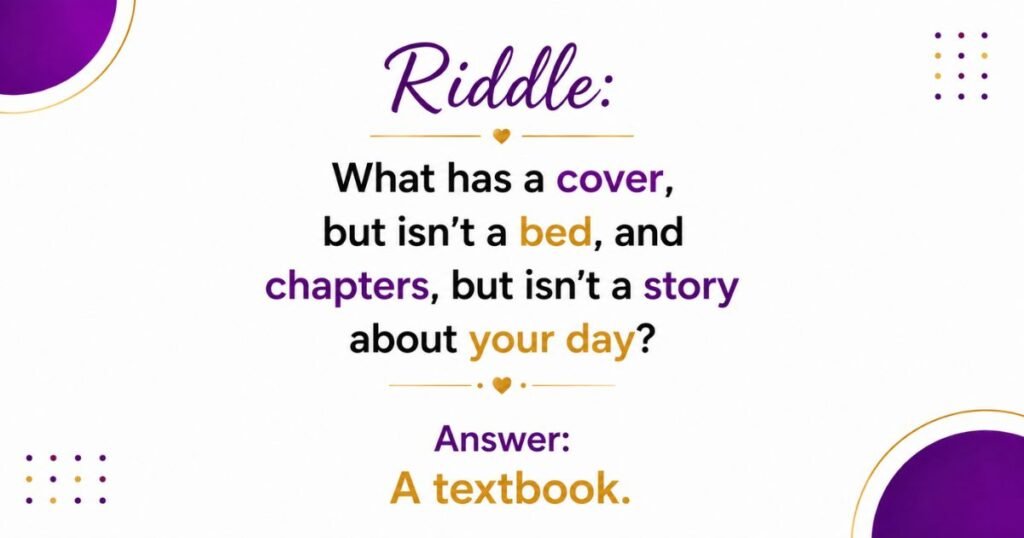
Explanation: The riddle uses personification , treating “graded” as something that happens to people , to create a small logical twist. - Riddle: What has a cover, but isn’t a bed, and chapters, but isn’t a story about your day?
Answer: A textbook.
Difficulty: Easy
Explanation: Two comparisons in a row (bed, story) train the solver to eliminate false paths quickly.
- Riddle: What do you check twice but read only once to get right?
Answer: Your homework answers.
Difficulty: Easy
Explanation: This riddle rewards real-world classroom habits, reinforcing the “check your work” lesson through the answer itself. - Riddle: I have lines but I’m not a highway, and I’m ruled but I have no king. What am I?
Answer: Notebook paper.
Difficulty: Easy
Explanation: “Ruled” is the pivot word here, meaning both “governed” and “printed with lines,” a classic multiple-meaning-word riddle. - Riddle: What word means “to hand something in when it’s finished,” and also describes what a light switch does when you “turn” it?
Answer: Turn (as in “turn it in”).
Difficulty: Easy
Explanation: This riddle highlights how the same small word (“turn”) can carry very different meanings depending on the phrase it’s attached to, a useful lesson for vocabulary homework. - Riddle: What has a backpack but never goes on vacation?
Answer: A textbook.
Difficulty: Easy
Explanation: The riddle uses a familiar object (backpack) as a container clue, requiring the solver to think about what’s always inside it. - Riddle: I’m the last thing you do before bed and the first thing your teacher checks in the morning. What am I?
Answer: Homework.
Difficulty: Easy
Explanation: A sequencing riddle , solvers must track a timeline (night to morning) rather than decode wordplay, which builds a different reasoning skill.
Math Homework Riddles with Answers
Great for warming up before a math assignment , these riddles use numbers, shapes, and logic instead of straight arithmetic. Several riddles below work well as number riddles for grade 5, where students are ready for light misdirection (like the ’17 sheep’ riddle below) without needing algebra.”
- Riddle: I am a number. Double me, then add ten, and you get thirty. What number am I?
Answer: Ten.
Difficulty: Easy
Explanation: This is a simple reverse-algebra riddle: working backward from the result (30 − 10 = 20, then 20 ÷ 2 = 10) teaches inverse operations. - Riddle: What operation always gives you the same number you started with, no matter what you multiply?
Answer: Multiplying by one.
Difficulty: Easy
Explanation: This tests understanding of the identity property of multiplication in riddle form rather than as a bare math fact. - Riddle: I have three sides and three corners, and I show up in your geometry homework more than any other shape. What am I?
Answer: A triangle.
Difficulty: Easy
Explanation: Counting clues (three sides, three corners) narrow the field quickly, which is a good entry point for students new to riddle logic. - Riddle: What number, when you write it out, has letters in alphabetical order?
Answer: Forty.
Difficulty: Medium
Explanation: This requires spelling the number out (f-o-r-t-y) and checking letter order , a riddle that blends math and spelling skills. - Riddle: A farmer has 17 sheep. All but 9 run away. How many are left?
Answer: Nine.
Difficulty: Medium
Explanation: The phrase “all but 9” is the trap , many solvers subtract instead of realizing the answer is stated directly in the question.
- Riddle: What three-digit number is equal to the sum of the cubes of its digits?
Answer: 153 (1³ + 5³ + 3³ = 1 + 125 + 27 = 153).
Difficulty: Hard
Explanation: This is a true math puzzle requiring trial and cube calculations, best suited for older students working through multi-step homework. - Riddle: I am an odd number, but remove my first letter and I become even. What number am I?
Answer: Seven (remove the “S” and “even” remains).
Difficulty: Medium
Explanation: This riddle plays on the fact that a number’s written name can hide a smaller word inside it, testing spelling awareness as much as math logic. - Riddle: I stand on two legs when you’re using me, close to look like one leg when you’re done, and can rest propped on a desk to look like three. What math-class tool am I?
Answer: A drafting compass.
Difficulty: Hard
Explanation: This is a riddle-within-a-riddle, classic hidden rule riddle, borrowing the structure of the ancient original Sphinx riddle and reapplying it to a math-class object, testing whether students can adapt a familiar pattern to new clues. - Riddle: If you multiply me by any number, the answer always ends in the same digit as that number. What number am I?
Answer: One.
Difficulty: Easy
Explanation: This restates the identity property again from a different angle, useful for reinforcing the concept through repetition in varied phrasing. - Riddle: I am a shape with no corners and no sides, but I still show up in every geometry chapter. What am I?
Answer: A circle.
Difficulty: Easy
Explanation: The riddle uses negative description , defining the shape by what it lacks , which is a useful cognitive skill for later proof-based geometry work. - Riddle: What symbol in math homework means “not equal” but looks like an equal sign with a strike through it?
Answer: The ≠ symbol.
Difficulty: Easy
Explanation: This riddle asks students to visualize and name a symbol rather than solve for a number, reinforcing symbol literacy. - Riddle: I have two hands but no fingers, and I help you know how much homework time you have left. What am I?
Answer: A clock.
Difficulty: Easy
Explanation: The riddle ties an everyday object (a clock) directly to the homework context, making the clue set feel relevant rather than abstract. - Riddle: What can you add to 8 to make it disappear entirely from a number line, ending at zero?
Answer: Negative eight.
Difficulty: Medium
Explanation: This introduces integer reasoning in riddle form, letting students discover the concept of additive inverses through wordplay rather than a rule.
Spelling and Reading: Homework Riddles for Students
These lean on wordplay, homophones, and vocabulary , ideal for language arts homework or reading logs.
- Riddle: What word in your spelling list gets shorter every time you add two letters to it?
Answer: Short (short + e + r = shorter, which reads as a comparative but the word “short” itself is now inside a longer word).
Difficulty: Medium
Explanation: The trick is realizing the riddle is about the word “short” gaining letters while still meaning “not long,” a play on literal versus figurative shrinking. - Riddle: I’m a verb that means “to read very closely,” and I sound exactly the same as the word for tipping liquid out of a cup. What am I?
Answer: Pore (as in “pore over a book,” a homophone of “pour”).
Difficulty: Hard
Explanation: This riddle challenges students to notice that “pore over a book” and “pour” are homophones, a common spelling-list trap even strong readers fall into. - Riddle: What five-letter word becomes shorter when you add two letters to it?
Answer: Short (adding “er” makes “shorter,” a word about length, while the original word grows in letters).
Difficulty: Medium
Explanation: This is a cleaner, classic version of the wordplay above, reinforcing the concept once without a confusing double answer. - Riddle: I’m a punctuation mark that shows up at the end of a homework question, and I look like a hook. What am I?
Answer: A question mark.
Difficulty: Easy Explanation: A shape-based visual clue (“looks like a hook”) helps younger readers connect the abstract punctuation mark to something concrete. - Riddle: What word describes both “a group of lions” and “brave,” and might show up in your vocabulary homework?
Answer: Pride.
Difficulty: Medium
Explanation: This riddle teaches homographs , one spelling, two unrelated meanings , a key reading-comprehension skill tested on many vocabulary quizzes. - Riddle: I sound like a letter but I’m actually a body of water surrounded by land. What am I?
Answer: A sea (sounds like the letter “C”).
Difficulty: Easy
Explanation: Homophone riddles like this train the ear as much as the eye, useful for students who are stronger auditory learners.
- Riddle: What word means “the opposite of a question,” and rhymes with “swear”?
Answer: An answer.
Difficulty: Easy
Explanation: The rhyme clue narrows the search quickly, showing students how sound patterns can support vocabulary recall during a spelling test. - Riddle: I’m a punctuation mark used to join two related sentences, and I look like a comma standing on a period. What am I?
Answer: A semicolon.
Difficulty: Medium
Explanation: This riddle uses a visual metaphor to help students remember both the shape and function of a commonly misused punctuation mark. - Riddle: What is a word that sounds the same whether you add “s” or not, but means more than one when you do?
Answer: Deer (deer/deer , an irregular plural).
Difficulty: Medium
Explanation: This highlights irregular plurals, a frequent stumbling block in spelling homework, by framing the exception as a puzzle instead of a rule to memorize. - Riddle: I mean “an inner sense of right and wrong,” and I hide a completely silent letter partway through my spelling. What am I?
Answer: Conscience (the “sc” combination hides a silent “c” sound pattern that trips up many spellers).
Difficulty: Hard
Explanation: This riddle targets a genuinely tricky spelling word, encouraging students to sound out and double-check words that don’t spell the way they sound. - Riddle: What reading skill lets you guess a word’s meaning from the words around it, and starts with the same letter as “context”?
Answer: Context clues.
Difficulty: Easy
Explanation: This riddle doubles as direct vocabulary reinforcement, restating a reading strategy in question form so it sticks better than a flashcard definition. - Riddle: I’m a story element that answers “when and where,” and I rhyme with “betting.”
Answer: Setting.
Difficulty: Easy
Explanation: Rhyme-based clues like this are especially effective for auditory learners working through reading-log homework.
Science Homework Riddles
Perfect for science homework warm-ups, these riddles connect natural phenomena to logical wordplay.
- Riddle: I am not alive, but I grow. I don’t have lungs, but I need air to survive. What am I?
Answer: Fire.
Difficulty: Medium
Explanation: This riddle borrows biological language (grow, lungs) to describe a non-living process, testing whether students can separate literal biology from figurative description. - Riddle: What state of matter has no fixed shape and no fixed volume?
Answer: Gas.
Difficulty: Easy
Explanation: This is a direct science-fact riddle rather than pure wordplay, useful for reviewing states-of-matter homework the night before a quiz. - Riddle: I travel at about 761 miles per hour at sea level, but you only notice me when something crosses my path loudly. What am I?
Answer: The speed of sound.
Difficulty: Hard
Explanation: This riddle requires recalling a specific science fact (the speed of sound) rather than pure logic, making it better suited for middle or high school homework review. - Riddle: What part of a plant “breathes,” and its name starts with “stom-“?
Answer: Stomata.
Difficulty: Medium
Explanation: The partial-word clue (“stom-“) acts as a built-in hint system, useful for struggling readers who need scaffolding during science vocabulary review. - Riddle: I have no legs, but I can run for miles, and I have a bed, but I never sleep in it. What am I?
Answer: A river.
Difficulty: Easy
Explanation: This riddle recycles the “run/bed” wordplay pattern common in geography and earth-science units, useful for cross-subject review. - Riddle: What force pulls your dropped pencil to the floor every single time you’re doing homework?
Answer: Gravity.
Difficulty: Easy
Explanation: The riddle ties an abstract force to a relatable, repeated classroom moment, which helps younger students form a concrete mental image of an invisible concept.
- Riddle: I am a rock that was once a rock, changed by heat and pressure, but never melted completely. What am I?
Answer: Metamorphic rock.
Difficulty: Medium
Explanation: This restates a rock-cycle vocabulary definition in riddle form, useful for earth-science homework review the night before a test. - Riddle: What part of your body do you use to see this riddle, but never to read it in braille?
Answer: Your eyes.
Difficulty: Easy
Explanation: The contrast with braille (read by touch) sharpens the distinction between sensory input methods, a useful tie-in for anatomy or accessibility lessons. - Riddle: I’m the process where a plant makes its own food using sunlight, and my name starts with “photo.”
Answer: Photosynthesis.
Difficulty: Easy
Explanation: The partial-word hint again functions as a built-in scaffold, common in vocabulary-review riddle sets for science homework. - Riddle: What planet is known as the Red Planet and shares its name with the Roman god of war?
Answer: Mars.
Difficulty: Easy
Explanation: This riddle links a science fact to a mythology fact, reinforcing the kind of cross-curricular connection standardized tests often reward. - Riddle: I have layers like an onion, but I’m thousands of miles wide, and my innermost layer is solid metal. What am I?
Answer: The Earth.
Difficulty: Medium
Explanation: The onion comparison is a classic science-teaching analogy, and turning it into a riddle helps it stick better than a labeled diagram alone. - Riddle: What natural event releases lava, ash, and gas from below the Earth’s crust?
Answer: A volcanic eruption.
Difficulty: Easy
Explanation: A straightforward recall riddle, useful as a rapid-fire warm-up before an earth-science homework check.
Funny Homework Excuse Riddles
Lighthearted riddles that play on the classic (and classically unbelievable) homework excuse.
- Riddle: What “ate” my homework, according to nearly every classic excuse in history?
Answer: The dog.
Difficulty: Easy
Explanation: This riddle is pure cultural reference , it works because the “dog ate my homework” excuse is so widely known it functions as its own punchline. - Riddle: I’m not rain, but I can still make your homework “wet” and unreadable if you’re not careful with me. What am I?
Answer: A spilled drink.
Difficulty: Easy
Explanation: The misdirection toward “rain” sets up a relatable classroom mishap as the real answer, which usually gets a laugh of recognition. - Riddle: What excuse involves a homework page flying out an open car window?
Answer: “The wind blew it away.”
Difficulty: Easy
Explanation: This riddle format works as a fill-in-the-blank joke rather than a logic puzzle, useful for a quick laugh before diving into real homework. - Riddle: I’m the reason homework “disappears” most often, and I’m usually found under a bed or inside a backpack pocket. What am I?
Answer: It’s simply lost/misplaced.
Difficulty: Easy
Explanation: This riddle pokes fun at the most mundane (and most common) real reason homework goes missing, contrasting it with more dramatic classic excuses. - Riddle: What device “ate” more homework files in the 2000s than any dog ever did?
Answer: A computer that crashed (or a corrupted USB drive).
Difficulty: Medium
Explanation: This riddle updates the “dog ate my homework” trope for a digital era, which resonates with students who now do most homework on a device. - Riddle: I’m the classic excuse used when a student didn’t do the reading, and I usually starts with “I forgot my,”
Answer: Book (I forgot my book at school).
Difficulty: Easy
Explanation: This is a light fill-in-the-blank riddle designed purely for a laugh and classroom bonding rather than deep reasoning. - Riddle: What imaginary creature gets blamed almost as often as the dog when homework goes missing?
Answer: A “gremlin” or “little brother/sister.”
Difficulty: Easy
Explanation: This riddle invites open-ended, silly answers, which is useful for classroom discussion-starter activities rather than a single correct response. - Riddle: I’m the sound an alarm makes when a student oversleeps and forgets their finished homework at home. What am I?
Answer: Beeping (the alarm clock).
Difficulty: Easy
Explanation: This riddle relies on onomatopoeia recognition, a fun, low-stakes way to test sound-word vocabulary. - Riddle: What piece of furniture “eats” homework the way a couch eats a TV remote?
Answer: The couch cushions.
Difficulty: Easy
Explanation: This riddle borrows a familiar joke pattern (things vanishing into couch cushions) and applies it to homework for a quick, relatable laugh.
- Riddle: What weather event is blamed when a student says their homework “washed away”?
Answer: A rainstorm/flood.
Difficulty: Easy
Explanation: This is a straightforward recall riddle built entirely around a well-worn excuse, good for a five-second warm-up joke. - Riddle: I’m the app students blame when their typed essay “didn’t save,” even though most modern software autosaves. What am I?
Answer: The word processor (or “the cloud”).
Difficulty: Medium
Explanation: This riddle gently pokes at a modern-day excuse, useful for a classroom conversation about backing up digital work. - Riddle: What’s the one homework excuse that’s actually true almost 100% of the time: “I just,”
Answer: “Forgot.”
Difficulty: Easy
Explanation: This riddle ends on an honest, low-stakes punchline, useful for breaking the ice about accountability in a non-shaming way.
Tricky Brain-Teaser Homework Riddles
These tricky riddles with answers require a bit more lateral thinking , great for a Friday folder or a “riddle of the week” challenge.
- Riddle: A student finishes half their homework in 10 minutes and the other half in 20 minutes. Why did the second half take longer?
Answer: The second half was harder/more time-consuming per problem, even though it was numerically “half.”
Difficulty: Medium
Explanation: This riddle teaches that “half” of a task doesn’t always mean “half the effort,” a useful real-world time-management lesson disguised as logic. - Riddle: I have a hundred pages, but you only read one at a time, and I can hold a whole semester’s worth of knowledge. What am I?
Answer: A textbook.
Difficulty: Easy
Explanation: This riddle reuses the “container of knowledge” theme from earlier but adds a page-count clue to sharpen the guess. - Riddle: Two students turn in the same number of correct answers, but only one gets full credit. Why?
Answer: The other student didn’t show their work, or turned it in late.
Difficulty: Medium
Explanation: This riddle has more than one valid answer, which is intentional , it opens a classroom discussion about grading rubrics and expectations. - Riddle: What can be assigned, checked, graded, and lost, but never actually walks anywhere on its own?
Answer: Homework.
Difficulty: Easy
Explanation: A verb-chain riddle: stacking several action words in a row (assigned, checked, graded, lost) builds suspense before the reveal. - Riddle: A teacher gives 30 students the same homework. Nine forget it, six lose it, and the rest turn it in. How many turned it in?
Answer: Fifteen (30 − 9 − 6 = 15).
Difficulty: Medium
Explanation: This is a straightforward subtraction word problem dressed as a riddle, useful for combining math practice with reading comprehension. - Riddle: What grows every night a student doesn’t do their reading log, but shrinks the moment they finally sit down and read?
Answer: The backlog (or “the stack of unread pages”).
Difficulty: Medium
Explanation: This riddle uses “grow/shrink” as an abstract metaphor for procrastination, which resonates with older students managing their own workload. - Riddle: I have four sides like your homework page, but I’m also the shape of most classroom clocks that aren’t round. What am I?
Answer: A square or rectangle.
Difficulty: Easy
Explanation: This riddle links two everyday classroom objects (paper and a clock) through a shared shape, encouraging students to notice geometry in ordinary things. - Riddle: What’s the only time a wrong answer on your homework can still be worth full credit?
Answer: When you show correct work/reasoning (partial or process credit).
Difficulty: Medium
Explanation: This riddle reinforces a real classroom policy many students don’t fully understand, using the riddle format to make the rule memorable. - Riddle: A student has 14 math problems. They solve 4 before dinner, half of what’s left after dinner, and finish the rest before bed. How many did they solve before bed?
Answer: Five (14 − 4 = 10 left; half of 10 = 5 solved after dinner; 10 − 5 = 5 remain for before bed).
Difficulty: Hard
Explanation: This is a genuine multi-step word problem in riddle form, ideal for upper-elementary or middle-school math homework practice. - Riddle: What object on a teacher’s desk is red, has no eyes, but “sees” every mistake on a homework page?
Answer: A red pen.
Difficulty: Easy
Explanation: The riddle personifies an object (giving it the ability to “see”) to disguise a very ordinary classroom tool. - Riddle: I’m the difference between “I did my homework” and “I did my homework well.” What am I?
Answer: Effort/quality (or “attention to detail”).
Difficulty: Medium
Explanation: This is an abstract-concept riddle rather than an object riddle, useful for a short classroom discussion about the difference between completion and quality. - Riddle: What three-word phrase turns a pile of scattered papers into a finished assignment?
Answer: “Stapled and done” (or simply: “It is complete”).
Difficulty: Medium
Explanation: This riddle is intentionally loose to allow multiple valid three-word answers, encouraging creative phrasing rather than one fixed response.
Hard Homework Riddles for Teens and Adults
These homework riddles for adults are built for older students, parents helping with homework, or anyone who wants a genuine challenge.
- Riddle: I am the reason “i before e except after c” has more exceptions than rules seem to allow, and I’m not a person , I’m a pattern of the English language itself. What am I?
Answer: The irregularity of English spelling conventions.
Difficulty: Hard
Explanation: This riddle is conceptual rather than object-based, asking students to reflect on a linguistic pattern instead of naming a physical thing. - Riddle: A rectangle’s length is triple its width. If the perimeter is 48 units, what is the area?
Answer: Width = 6, length = 18, so area = 108 square units. (Perimeter = 2(l+w) = 48, l = 3w, so 2(3w+w)=48, 8w=48, w=6, l=18.)
Difficulty: Hard
Explanation: This riddle requires setting up and solving an algebraic equation, making it appropriate as a genuine geometry-homework challenge for teens. - Riddle: What word in the English language becomes its own opposite when you add the prefix “in-“?
Answer: Flammable/inflammable (both mean “can catch fire,” making “inflammable” a rare case where the prefix doesn’t reverse meaning).
Difficulty: Hard
Explanation: This is a genuinely tricky linguistics riddle that even many adults get wrong, making it a strong pick for a high school vocabulary or writing class. - Riddle: I am a number whose square is the same as the sum of the squares of two smaller whole numbers, and I’m the smallest example greater than zero. What am I?
Answer: Five (3² + 4² = 5², a Pythagorean triple).
Difficulty: Hard
Explanation: This riddle is essentially the Pythagorean theorem disguised as wordplay, ideal for algebra or geometry homework review. - Riddle: What historical invention meant homework could finally be typed instead of handwritten, decades before the personal computer?
Answer: The typewriter.
Difficulty: Medium
Explanation: This riddle ties a technology-history fact to the homework theme, useful for a social studies or history-of-technology tie-in. - Riddle: I am the average of five test scores: 88, 92, 79, 95, and 81. What am I?
Answer: 87 ((88+92+79+95+81) ÷ 5 = 435 ÷ 5 = 87).
Difficulty: Medium
Explanation: This riddle is a direct statistics problem, good for reinforcing the concept of “mean” in a homework-relevant context (grades). - Riddle: What logical fallacy do students commit when they assume more homework automatically means more learning?
Answer: A correlation-causation fallacy (assuming quantity equals quality).
Difficulty: Hard
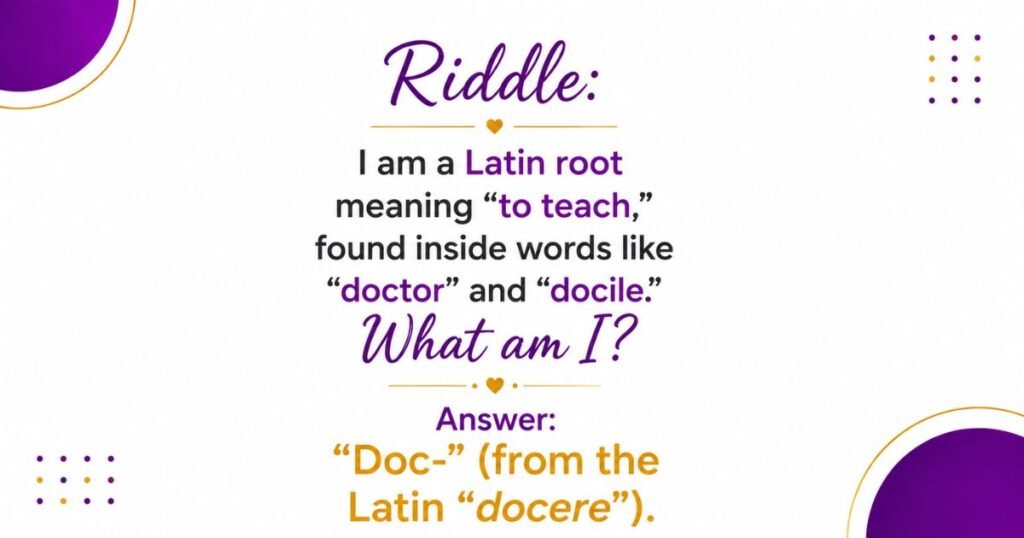
Explanation: This riddle is aimed at older teens and adults, encouraging critical thinking about study habits rather than testing a fact. - Riddle: I am a Latin root meaning “to teach,” found inside words like “doctor” and “docile.” What am I?
Answer: “Doc-” (from the Latin “docere”).
Difficulty: Hard
Explanation: This riddle rewards knowledge of Latin roots, a common component of high school vocabulary and SAT-prep homework.
- Riddle: What paradox describes a student who procrastinates on easy homework but rushes to start the hardest assignment first?
Answer: This isn’t a named paradox but describes “task-avoidance behavior,” sometimes informally called “eating the frog last” in reverse.
Difficulty: Hard
Explanation: This riddle is discussion-based rather than fact-based, useful for older students reflecting on their own study habits. - Riddle: I am a chemical element with the symbol “Fe” that a student might need to memorize for a periodic table homework assignment. What am I?
Answer: Iron.
Difficulty: Medium
Explanation: A direct recall riddle for chemistry homework, useful for quick review before a quiz on element symbols. - Riddle: What number comes next in this sequence, and why: 2, 6, 12, 20, 30, __?
Answer: 42 (the pattern adds consecutive even numbers: +4, +6, +8, +10, +12).
Difficulty: Hard
Explanation: This is a genuine pattern-recognition riddle common in pre-algebra homework, requiring the solver to identify the rule governing the sequence. - Riddle: I am the literary term for giving human traits to a non-human object, the same technique used in riddles like “the pencil that dreams of retirement.” What am I?
Answer: Personification.
Difficulty: Medium
Explanation: This riddle is self-referential , it asks students to name the very literary device the riddle itself demonstrates, reinforcing the concept through direct example. - Riddle: What’s the term for the point in an essay’s homework outline where the writer states their main argument?
Answer: The thesis statement.
Difficulty: Medium
Explanation: A direct writing-homework vocabulary riddle, useful for reviewing essay structure before a big writing assignment is due.
Bonus Riddles About the Word “Homework” Itself
A playful final set that riddles on the very concept of homework.
- Riddle: I’m made of two smaller words: one about where you live, and one about effort. What am I?
Answer: Homework (“home” + “work”).
Difficulty: Easy
Explanation: This is a compound-word riddle, teaching students to break unfamiliar or long words into smaller, familiar parts. - Riddle: I follow you home from school but I’m not a friend, a pet, or a sibling. What am I?
Answer: Homework.
Difficulty: Easy
Explanation: The riddle uses a light, slightly ironic tone (“follows you home”) to personify an assignment as an almost-companion. - Riddle: What can be “due,” “late,” “missing,” or “extra,” but is never actually alive?
Answer: Homework/an assignment.
Difficulty: Easy
Explanation: Stacking adjectives that typically describe homework status builds toward a satisfying, obvious reveal for younger solvers. - Riddle: I’m assigned in class but completed somewhere else entirely. What am I, by definition?
Answer: Homework (work done outside of school hours/location).
Difficulty: Easy
Explanation: This riddle essentially restates the dictionary definition of “homework” in puzzle form, useful as an opening icebreaker riddle for this exact list. - Riddle: What word starts with the same three letters as “hombre” but has nothing to do with the Spanish word for “man”?
Answer: Homework.
Difficulty: Medium
Explanation: This riddle uses a false-friend trick , two words that look similar but are unrelated , a useful concept for students also studying a second language. - Riddle: I get “checked,” “reviewed,” and sometimes “returned with a red pen,” but I never once left the folder I was placed in until today. What am I?
Answer: A completed and submitted homework assignment.
Difficulty: Medium
Explanation: The riddle builds a small narrative (folder to desk to red pen) to disguise a simple object, training sequencing and inference skills. - Riddle: What’s the opposite of “classwork,” but rhymes with it too?
Answer: Homework.
Difficulty: Easy
Explanation: This riddle uses both an antonym clue and a rhyme clue together, doubling the number of paths a solver can use to reach the answer. - Riddle: I can be “extra credit” or “required,” but either way I still need your name at the top. What am I?
Answer: A homework assignment.
Difficulty: Easy
Explanation: This riddle circles back to a very practical classroom rule (always put your name on your paper), reinforcing habits through humor. - Riddle: What’s the one homework “helper” that can’t actually hold a pencil: a parent, a tutor, or a dictionary?
Answer: A dictionary.
Difficulty: Easy
Explanation: This riddle uses a multiple-choice structure rather than open recall, which is a gentler format for very young or reluctant solvers. - Riddle: I’m finished at 8 p.m. on Tuesday but was assigned on Monday morning , what “I” am I?
Answer: A piece of homework with a one-day turnaround.
Difficulty: Medium
Explanation: This riddle plants a timestamp puzzle (Monday to Tuesday) to build light time-tracking skills into an otherwise simple object riddle. - Riddle: What word describes exactly what you’ve just finished reading 99 examples of?
Answer: Homework riddles.
Difficulty: Easy
Explanation: The final riddle is self-referential, closing the collection with a wink that rewards readers who made it through the entire list.
How to Use These Homework Riddles in Class or at Home?
- Homework folder cover page: Print one Easy riddle per week and tape it to the inside cover of a student’s homework folder.
- Five-minute warm-up: Use a Medium riddle from the subject you’re about to teach (math, science, spelling) to prime the brain before the lesson starts.
- Friday challenge: Save the Hard riddles for a weekly challenge board with a small reward for correct answers.
- Parent-child bonding: Read one riddle aloud at the dinner table before homework time begins to ease the transition from playtime to study time.
Difficulty ratings throughout this list are subjective and based on average classroom and tutoring feedback, not a formal psychometric scale , adjust up or down based on your own students’ age and experience with riddles.
Ready for Round Two?
If the Spelling and Reading section was your favorite, that same letter-and-sound trickery is the whole point of these word riddles, worth a look for more of that exact style.
If the Hard Homework Riddles for Teens and Adults section had you reaching for a pencil, these hard riddles keep that same level of challenge going outside the classroom.
Once homework’s done for the day, these Halloween riddles and these Thanksgiving riddles are a fun way to keep the riddle streak going through the holiday season.
Conclusion
Homework doesn’t have to start with a groan. These 100 Homework Riddles, sorted from easy warm-ups to genuinely hard brain teasers , give teachers, parents, and students a simple, ready-to-use way to make the transition into study time a little more fun.
FAQs
What are Good Homework Riddles?
Good ones match the subject, a math riddle before math, a spelling riddle before reading, since they warm up the exact skill the homework needs. Many lists of 100 easy riddles with answers work well as a starting point before moving into harder brain teasers.
How do Riddles Help Kids with Homework and Learning?
They get kids testing different meanings in their head, which is the same skill used in reading comprehension and word problems.
What is a Riddle that Says “I Have Keys but No Locks”?
The answer is a piano or keyboard , its “keys” aren’t the kind that open a lock.
Are Riddles or Brain Teasers Better for Homework Practice?
Both help in different ways , riddles lean on wordplay, brain teasers lean on logic and numbers. A mix covers more ground.
What Age Group are Homework Riddles Appropriate for?
Easy suits early elementary, Medium fits upper elementary to middle school, and Hard works for teens and adults.