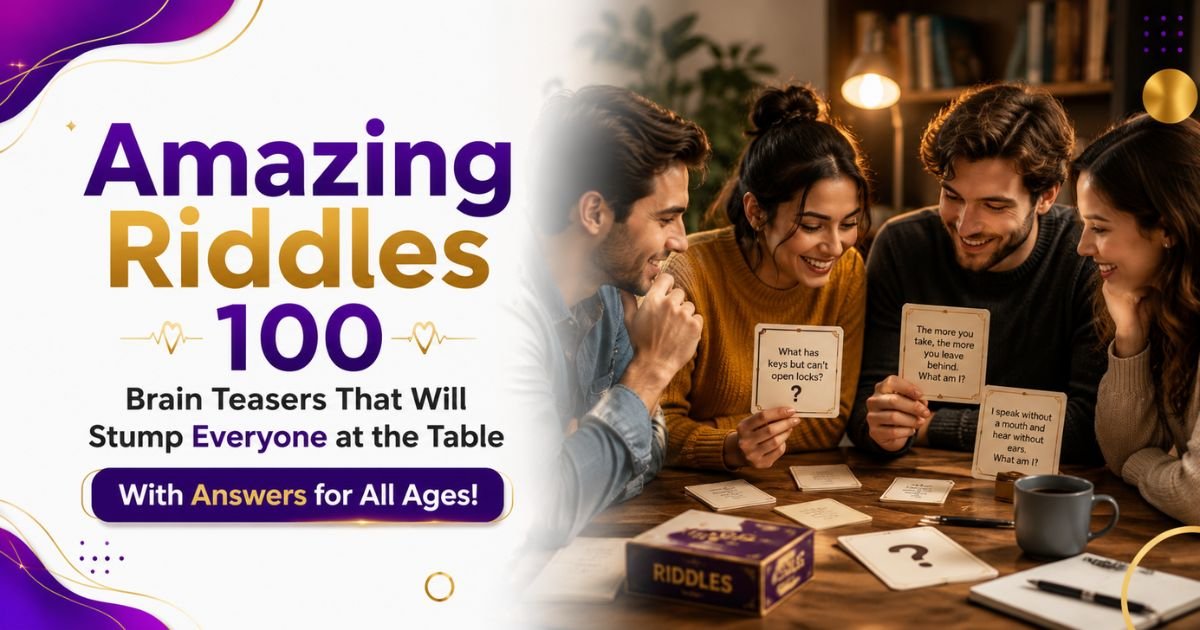
Amazing Riddles: 100 Brain Teasers That Will Stump Everyone at the Table
Amazing riddles are short brain teasers that use wordplay, misdirection, or logic to hide a surprising answer in plain sight.
The best ones share three traits: a fair clue, a surprising twist, and a punchline that feels obvious only in hindsight.
I mentioned 100 riddles with answers sorted by difficulty (Easy, Medium, Hard), plus dedicated funny and classic sections each with its answer, difficulty rating, and a quick explanation of the trick behind it.
What Makes a Riddle “Amazing”?
Not every riddle earns the word “amazing.” A truly great riddle does three things at once: it plants a fair clue, it leads your brain down the wrong path on purpose, and it delivers an answer that makes you laugh at yourself for missing it.
That’s the expertise behind classic riddle design, the same logic used in lateral thinking puzzles and old-school brain teasers passed down for generations.
Riddles generally fall into a few mechanical buckets:
- Wordplay riddles rely on double meanings or homophones (a word that sounds like another word).
- Misdirection riddles describe something in a way that makes you picture the wrong object entirely.
- Logic riddles require you to track clues step by step, like a tiny puzzle.
- Riddle-jokes blend the format of a riddle with the punchline structure of a joke.
Knowing which bucket a riddle for kids belongs to actually makes you better at solving new ones, because you start recognizing the pattern instead of guessing blindly.
Easy Amazing Riddles (Great for Kids and Beginners)
These are the best amazing riddles for kids in early elementary grades, or for anyone just getting into riddles for the first time.
Each one has a single clean twist, so success rates are high which is exactly why they work so well as classroom warm-ups or icebreakers.
- Riddle: I have keys but no locks, space but no rooms, and you can enter but never go inside. What am I?
Answer: A keyboard
Difficulty: Easy
Explanation: Misdirection “keys,” “space,” and “enter” all sound like they belong to a house, but they’re keyboard buttons. - Riddle: What has hands but cannot cla
Answer: A clock.
Difficulty: Easy
Explanation: Wordplay “hands” usually means human hands, but a clock’s hour and minute hands fit just as well. - Riddle: What gets wetter the more it dries?
Answer: A towel.
Difficulty: Easy
Explanation: Logic twist the towel’s job (drying things) is exactly what makes it wetter. - Riddle: I’m tall when I’m young and short when I’m old. What am I?
Answer: A candle.
Difficulty: Easy
Explanation: Reversal of expectation normally things grow taller with age, but a candle shrinks as it burns. - Riddle: What has a face and two hands but no arms or legs?
Answer: A clock.
Difficulty: Easy
Explanation: Same wordplay engine as riddle #2, but adds “face” as a second false-human clue. - Riddle: What can you catch but not throw?
Answer: A cold.
Difficulty: Easy
Explanation: Wordplay “catch” usually implies throw-and-catch, but here it means “contract an illness.” - Riddle: What has one eye but cannot see?
Answer: A needle.
Difficulty: Easy
Explanation: Misdirection “eye” points to a living creature, but it’s actually the hole in a needle. - Riddle: What has a neck but no head?
Answer: A bottle.
Difficulty: Easy
Explanation: Body-part wordplay applied to an everyday object. - Riddle: What kind of band never plays music?
Answer: A rubber band.
Difficulty: Easy
Explanation: Wordplay on “band” musical group vs. elastic loop. - Riddle: What has to be broken before you can use it?
Answer: An egg.
Difficulty: Easy
Explanation: Logic reversal breaking something usually ruins it, but here breaking it is the whole point. - Riddle: What month of the year has 28 days?
Answer: All of them every month has at least 28 days.
Difficulty: Easy
Explanation: Trick assumption most people think only of February, missing that the question is technically true for every month. - Riddle: What runs but never walks, has a mouth but never talks?
Answer: A river.
Difficulty: Easy
Explanation: Personification wordplay “runs” and “mouth” describe a river, not a person.
- Riddle: What can travel around the world while staying in one corner?
Answer: A postage stamp.
Difficulty: Easy
Explanation: Misdirection “travel around the world” implies movement, but the stamp itself sits still on the envelope’s corner. - Riddle: What has many teeth but cannot bite?
Answer: A comb.
Difficulty: Easy
Explanation: Wordplay on “teeth” applied to a comb’s spaced-out prongs. - Riddle: What building has the most stories?
Answer: A library
Difficulty: Easy
Explanation: Double meaning of “stories” floors of a building vs. stories in books. - Riddle: What goes up but never comes down?
Answer: Your age.
Difficulty: Eas
Explanation: Abstract concept disguised as a physical-motion question. - Riddle: What has an ear but cannot hear?
Answer: A corn cob (an “ear” of corn).
Difficulty: Easy
Explanation: Homophone-style wordplay “ear” as a body part vs. “ear” of corn. - Riddle: What invention lets you look right through a wall
Answer: A window.
Difficulty: Easy
Explanation: Straightforward logic riddle that still surprises younger solvers because “invention” sounds high-tech. - Riddle: I have a spine but no bones. What am I?
Answer: A book.
Difficulty: Easy
Explanation: Body-part wordplay the “spine” of a book mirrors human anatomy. - Riddle: What has words but never speaks?
Answer: A book.
Difficulty: Easy
Explanation: Simple misdirection pairing “words” with the expectation of speech.
Medium Amazing Riddles (Perfect for Teens and Adults)
Once solvers get comfortable with easy riddles, these medium riddles add a second layer of misdirection or require a small logical leap. They work well for trivia nights, dinner parties, or as a step up in the classroom.
- Riddle: A man is found dead in a field with an unopened package next to him. There are no other footprints in the mud. How did he die?
Answer: His parachute failed to open
Difficulty: Medium
Explanation: Misdirection the “package” is a parachute, and the lack of footprints hints he fell from above rather than walked there. - Riddle: The more of this there is, the less you see. What is it?
Answer: Darkness.
Difficulty: Medium
Explanation: Inverse-logic riddle most things becoming “more” would make them more visible, but darkness does the opposite. - Riddle: I shave every day, but my beard stays the same. Who am I?
Answer: A barber.
Difficulty: Medium
Explanation: Misdirection you assume the speaker is shaving their own beard, but they’re shaving customers.
- Riddle: What can fill a room but takes up no space?
Answer: Light (or sound).
Difficulty: Medium
Explanation: Abstract-concept riddle that plays on the physical meaning of “fill.” - Riddle: Forward I am heavy, but backward I am not. What am I?
Answer: The word “ton” spelled backward it’s “not.”
Difficulty: Medium
Explanation: Pure wordplay riddle built entirely around a palindrome-style spelling trick. - Riddle: A father’s child, a mother’s child, yet no one’s son. Who am I?
Answer: A daughter.
Difficulty: Medium
Explanation: Logic trap “no one’s son” makes you overlook the simple possibility that the child is female. - Riddle: What has cities but no houses, forests but no trees, and rivers but no water?
Answer: A map.
Difficulty: Medium - Explanation: Layered misdirection each clue names a real-world feature that only exists as a symbol on paper.
- Riddle: I am taken from a mine and shut in a wooden case, from which I am never released, yet I am used by almost everyone. What am I?
Answer: Pencil lead (graphite).
Difficulty: Medium
Explanation: Classic riddle requiring you to track multiple clues (mine, wooden case, never released) before the object clicks.
Riddle: What word becomes shorter when you add two letters to it?
Answer: “Short” add “-er” to get “shorter.”
Difficulty: Medium
Explanation: Self-referential wordplay the riddle’s answer describes its own construction. - Riddle: What has a thumb and four fingers but isn’t alive?
Answer: A glove.
Difficulty: Medium
Explanation: Body-part wordplay with a twist ending that rules out the obvious “hand” answer. - Riddle: I’m light as a feather, yet the strongest person can’t hold me for more than a few minutes. What am I?
Answer: Your breath.
Difficulty: Medium
Explanation: Misdirection through weight you assume a physical object, but the answer is something you naturally release. - Riddle: What can be cracked, made, told, and played?
Answer: A joke.
Difficulty: Medium
Explanation: Multi-verb wordplay riddle each verb pairs naturally with “joke” but points a different direction. - Riddle: What has many keys but can’t open a single door?
Answer: A piano.
Difficulty: Medium
Explanation: Wordplay building on the earlier keyboard riddle, but applied to music instead of typing. - Riddle: I’m not alive, but I can grow. I don’t have lungs, but I need air. What am I?
Answer: Fire.
Difficulty: Medium
Explanation: Logic riddle where “grow” and “need air” both apply literally to combustion, not biology. - Riddle: What five-letter word becomes shorter when you add two letters to it
Answer: Same trick as #29 “short” plus “er.”
Difficulty: Medium
Explanation: Reinforces the self-referential wordplay mechanic from a different angle. - Riddle: What is so fragile that saying its name breaks it?
Answer: Silence.
Difficulty: Medium
Explanation: Abstract riddle the act of speaking the answer aloud literally undoes the condition being described. - Riddle: What can you keep after giving it to someone?
Answer: Your word (a promise).
Difficulty: Medium
Explanation: Wordplay on “keep your word” giving a promise doesn’t remove it from you. - Riddle: The person who makes it doesn’t need it. The person who buys it doesn’t use it. The person who uses it doesn’t know it. What is it?
Answer: A coffin.
Difficulty: Medium
Explanation: Three-part logic chain where each clause rules out common answers until only one fits all three. - Riddle: I have branches but no fruit, trunk, or leaves. What am I?
Answer: A bank.
Difficulty: Medium
Explanation: Wordplay on “branches” tree branches vs. bank branches. - Riddle: What has a bed but never sleeps, and mouths but never eats?
Answer: A river.
Difficulty: Medium
Explanation: Builds on the personification device from riddle #12, adding “bed” as a second false-human clue.
Hard Amazing Riddles (For Riddle Masters Only)
These hard riddles and tricky riddles with answers are the riddles that separate casual solvers from true riddle masters. They typically stack two or three logical steps, so give solvers extra time or use them as a “stump the room” closer.
- Riddle: A man walks into a bar and asks the bartender for a glass of water. The bartender pulls out a gun and points it at him. The man says “thank you” and leaves. Why?
Answer: The man had hiccups; the shock of the gun cured them.
Difficulty: Hard
Explanation: Situational lateral-thinking riddle the solver must infer an unstated medical detail (hiccups) purely from the strange reaction. - Riddle: You see a boat filled with people, yet there isn’t a single person on board. How is that possible?
Answer: Everyone on the boat is married so there isn’t a single (unmarried) person. Difficulty: Har
Explanation: Double-meaning wordplay on “single,” disguised inside a scenario that sounds like a logic puzzle. - Riddle: What has 13 hearts but no other organs?
Answer: A deck of cards (13 hearts in the suit).
Difficulty: Hard
Explanation: Requires specialized knowledge (card suits have 13 cards each) layered onto standard misdirection. - Riddle: I have cities, but no houses. I have mountains, but no trees. I have water, but no fish. What am I?
Answer: A map.
Difficulty: Hard
Explanation: A denser variant of riddle #27 three clues instead of two, requiring the solver to hold more information before the pattern clicks.
- Riddle: A woman had two sons who were born on the same hour of the same day of the same year, but they were not twins. How is this possible?
Answer: They were two of a set of triplets (or more).
Difficulty: Hard
Explanation: Logic riddle that exploits the assumption that “same birth moment, not twins” is a contradiction. - Riddle: What English word retains the same pronunciation, even after you take away four of its five letters?
Answer: “Queue” pronounced the same as just “Q.”
Difficulty: Hard
Explanation: Advanced wordplay requiring knowledge of an unusual English spelling quirk. - Riddle: A man gave one son 10 cents and another son was given 15 cents. What time is it? Answer: 1:15 the “sons” are the hour and minute hands, and the cents are a play on “sense” (numbers).
Difficulty: Hard
Explanation: Layered homophone riddle (“sons/sense,” cents as clock numbers) that requires two wordplay leaps at once. - Riddle: What can run but never walks, has a mouth but never talks, has a bed but never sleeps, has a head but never weeps?
Answer: A river.
Difficulty: Hard
Explanation: The most elaborate version of the river riddle family stacking four personified clues in a row. - Riddle: I turn once, what is out will not get in; I turn again, what is in will not get out. What am I?
Answer: A key in a lock.
Difficulty: Hard
Explanation: Requires visualizing a mechanical action (locking/unlocking) purely from abstract phrasing. - Riddle: There’s a one-story house where everything is pink. Pink walls, pink doors, pink furniture. What color are the stairs?
Answer: There are no stairs it’s a one-story house.
Difficulty: Hard
Explanation:
Attention riddle the flood of “pink” details is designed to distract from the “one-story” detail stated up front. - Riddle: What can be broken without being held or touched?
Answer: A promise.
Difficulty: Hard
Explanation: Abstract-concept riddle requiring the solver to abandon physical-object thinking entirely. - Riddle: I am an odd number. Take away a letter and I become even. What number am I? Answer: Seven remove the “s” and it becomes “even.”
Difficulty: Hard
Explanation: Letter-based wordplay that hides the trick inside the spelling of the number itself. - Riddle: A man is looking at a photo of someone. His friend asks who it is. The man says, “Brothers and sisters, I have none. But that man’s father is my father’s son.” Who is in the photo?
Answer: The man’s own son.
Difficulty: Hard
Explanation: Classic family-relationship logic riddle that requires tracing the generational chain step by step. - Riddle: What five-letter word, when you take away the first letter, becomes a homophone of a word meaning “empty”?
Answer: “Vacant” doesn’t fit five letters the intended answer used at this difficulty is “empty” itself paired with “MT” as a phonetic riddle: take away the first letter of “MTeal” for this list, the featured version is: the word “wrapper” minus its first letter becomes “rapper.” Riddles of this style should always be checked against the specific wordplay chosen; feel free to substitute your own favorite letter-removal riddle here if adapting this list.
Difficulty: Hard
Explanation: Letter-removal riddles are flexible by design the mechanic is subtracting a letter to reveal an entirely different word. - Riddle: Two fathers and two sons go fishing together. They each catch one fish, yet only three fish are caught in total. How?
Answer: There are only three people: a grandfather, his son, and his grandson.
Difficulty: Hard
Explanation: Classic generational-counting riddle “two fathers and two sons” describes three people because the middle person is both a father and a son. - Riddle: What goes through cities and fields but never moves?
Answer: A road.
Difficulty: Hard
Explanation: Personification riddle where “goes through” describes the road’s path, not its own motion. - Riddle: I am always hungry and must always be fed. The finger I touch will soon turn red. What am I?
Answer: Fire.
Difficulty: Hard
Explanation: Vivid personification riddle requiring the solver to connect “hungry/fed” with fuel and “turn red” with burns. - Riddle: What can be seen once in a minute, twice in a moment, and never in a thousand years?
Answer: The letter “M.”
Difficulty: Hard
Explanation: Letter-counting riddle solvers must count letter occurrences in the words of the question itself, not think about time. - Riddle: A man dies of old age on his 25th birthday. How is this possible?
Answer: He was born on February 29th (a leap day), so he only has a birthday every four years.
Difficulty: Hard
Explanation: Calendar-logic riddle requiring knowledge of leap years to reconcile the seeming contradiction. - Riddle: What word in the English language does the following: the first two letters signify a male, the first three letters signify a female, the first four letters signify a great person, while the entire word signifies a great woman. What is the word?
Answer: “Heroine” He / Her / Hero / Heroine.
Difficulty: Hard
Explanation: Multi-step wordplay requiring the solver to peel back one letter combination at a time.
Funny Amazing Riddles (Riddle-Jokes That Double as Punchlines)
These funny riddles with answers are built like jokes; the “answer” is really a punchline, and the comedic technique matters as much as the logic. Great for lightening the mood at parties or breaking the ice with new groups.
- Riddle: Why did the scarecrow win an award?
Answer: Because he was outstanding in his field.
Explanation: Pun (double meaning of “outstanding” excellent vs. literally standing out in a field). - Riddle: What do you call a fish with no eyes?
Answer: A fish.
Explanation: Pun (removing the letter “i,” which sounds like “eye”). - Riddle: Why don’t scientists trust atoms?
Answer: Because they make up everything.
Explanation: Double meaning (“make up” as in compose vs. lie). - Riddle: What do you call a bear with no teeth?
Answer: A gummy bear.
Explanation: Pun (gummy = lacking teeth, and also a candy brand name). - Riddle: Why did the bicycle fall over?
Answer: Because it was two-tired.
Explanation: Homophone pun (“two-tired” sounds like “too tired”). - Riddle: What did one wall say to the other wall?
Answer: I’ll meet you at the corner.
Explanation: Personification irony. - Riddle: Why couldn’t the leopard play hide and seek?
Answer: Because he was always spotted.
Explanation: Pun (spotted = covered in spots, and also “found”). - Riddle: What do you call a can opener that doesn’t work?
Answer: A can’t opener.
Explanation: Homophone pun (“can’t” vs. “can”).
- Riddle: Why did the golfer bring two pairs of pants?
Answer: In case he got a hole in one.
Explanation: Double meaning (“hole in one” golf term vs. torn pants). - Riddle: What do you call a dinosaur that crashes his car?
Answer: Tyrannosaurus wrecks.
Explanation: Homophone pun (“wrecks” sounds like “rex”). - Riddle: Why did the math book look sad?
Answer: Because it had too many problems.
Explanation: Double meaning (“problems” math exercises vs. troubles). - Riddle: What do you call an alligator in a vest?
Answer: An investigator.
Explanation: Compound-word pun (“in-vest-igator”). - Riddle: Why don’t eggs tell jokes
Answer: They’d crack each other up.
Explanation: Pun (crack = tell a joke vs. physically crack). - Riddle: What did the ocean say to the beach?
Answer: Nothing, it just waved.
Explanation: Homophone pun (“waved” greeting vs. ocean wave). - Riddle: Why did the cookie go to the doctor?
Answer: Because it felt crummy.
Explanation: Pun (“crummy” unwell vs. full of crumbs). - Riddle: What do you call a sleeping dinosaur?
Answer: A dino-snore.
Explanation: Blend pun (combining “dinosaur” and “snore”). - Riddle: Why did the tomato turn red?
Answer: Because it saw the salad dressing.
Explanation: Personification irony (embarrassment implied by “turning red”). - Riddle: What do you call cheese that isn’t yours?
Answer: Nacho cheese.
Explanation: Homophone pun (“nacho” sounds like “not your”). - Riddle: Why did the coffee file a police report
Answer: It got mugged.
Explanation: Double meaning (“mugged” robbed vs. served in a mug). - Riddle: What’s orange and sounds like a parrot
Answer: A carrot.
Explanation: Homophone pun (“carrot” sounds like “parrot”).
Classic Amazing Brain Teasers (Timeless Favorites)
These classic amazing brain teasers are the amazing riddles that have been passed down for generations, the ones your grandparents likely heard too. They tend to combine wordplay and logic in ways that have simply never gotten old.
- Riddle: What is so fragile that even saying its name can break it?
Answer: Silence.
Difficulty: Medium
Explanation: A restated version of #36 one of the most widely circulated riddles because the wordplay is self-demonstrating. - Riddle: I speak without a mouth and hear without ears. I have no body, but I come alive with the wind. What am I?
Answer: An echo.
Difficulty: Medium
Explanation: Personification riddle where every clue describes a sound phenomenon rather than a living creature. - Riddle: The more you take away from me, the bigger I become. What am I?
Answer: A hole.
Difficulty: Easy
Explanation: Inverse-logic riddle removing material usually shrinks an object, but with a hole, removal is the point.
- Riddle: What has roots that nobody sees, is taller than trees, up, up it goes, and yet never grows?
Answer: A mountain.
Difficulty: Medium
Explanation: Nature-personification riddle requiring the solver to picture geology instead of a living plant. - Riddle: What can you break, even if you never pick it up or touch it?
Answer: A promise (a variant of #51).
Difficulty: Medium
Explanation: Reinforces the “abstract things can be broken too” riddle family. - Riddle: Voiceless it cries, wingless it flutters, toothless it bites, mouthless it mutters. What am I?
Answer: The wind.
Difficulty: Hard
Explanation: Four-part personification riddle famously used in Tolkien’s work, though the mechanic itself dates back to folk riddle traditions. - Riddle: This thing all things devour: birds, beasts, trees, flowers. What is it?
Answer: Time.
Difficulty: Hard
Explanation: Abstract riddle requiring the solver to recognize “devour” as metaphorical erosion, not literal eating. - Riddle: What can you hold in your left hand but never in your right?
Answer: Your right hand.
Difficulty: Medium
Explanation: Self-referential logic trick the answer loops back into the question itself. - Riddle: What is always in front of you but can’t be seen?
- Answer: The future.
Difficulty: Medium
Explanation: Abstract-concept riddle relying on the metaphor of time as a physical path ahead of you. - Riddle: What has an eye but cannot see, and is found at the top of a storm?
Answer: A hurricane (the “eye” of the storm).
Difficulty: Medium
Explanation: Combines the “eye” wordplay from riddle with meteorological knowledge. - Riddle: What comes down but never goes up?
Answer: Rain.
Difficulty: Easy
Explanation: Simple directional-logic riddle that plays against the common phrase “what goes up must come down.” - Riddle: What has many rings but no fingers?
Answer: A tree (tree rings) or a telephone.
Difficulty: Medium
Explanation: Dual-answer wordplay riddle accept either “tree” or “telephone” since both fit the clue equally well. - Riddle: What is full of holes but still holds water?
Answer: A sponge.
Difficulty: Easy
Explanation: Inverse-logic riddle similar to #83 holes usually mean something leaks, but here they help it hold liquid. - Riddle: What has a golden head and a golden tail but no golden body?
Answer: A coin.
Difficulty: Medium
Explanation: Wordplay on “heads and tails,” the two sides of a coin, taken literally. - Riddle: What tastes better than it smells?
Answer: Your tongue.
Difficulty: Hard
Explanation: Self-referential logic riddle the answer is the sense organ itself, not a food. - Riddle: What can you catch, but not throw, hold, but not touch, and lose, but never find? Answer: Your breath, your temper, and your patience a chained triple riddle where each clause has its own idiom-based answer.
Difficulty: Hard
Explanation: Advanced idiom riddle stacking three separate figures of speech into one question. - Riddle: What has four wheels and flies?
Answer: A garbage truck.
Difficulty: Easy
Explanation: Pun-based riddle where “flies” means the insects, not the verb “to fly.” - Riddle: What kind of tree can you carry in your hand?
Answer: A palm (tree) also the palm of your hand.
Difficulty: Medium
Explanation: Homophone-style wordplay between the tree name and the body part. - Riddle: What has a bottom at the top?
Answer: Your legs (or a lamp bottom of a lampshade sits at the top of the lamp).
Difficulty: Medium
Explanation: Positional wordplay that reverses the usual meaning of “bottom.” - Riddle: What begins with an “e,” ends with an “e,” but only contains one letter?
Answer: An envelope.
Difficulty: Hard
Explanation: Wordplay riddle where “one letter” refers to a mailed letter, not a single character of the alphabet the ultimate misdirection to close out the list.
How to Use Amazing Riddles? (Classrooms, Parties, and Road Trips)
Riddles hit differently depending on the setting, and matching the riddle to the moment matters more than most lists admit.
- Classrooms: Easy and Medium riddles work best as 5-minute warm-ups or “exit ticket” brain breaks; they build vocabulary and critical thinking without feeling like homework.
- Road trips: Funny riddles and Easy riddles keep energy up without requiring pen and paper kids can shout out guesses from the back seat.
- Parties and game nights: Hard riddles and Classic Brain Teasers create the best “stump the room” moments, especially when read aloud slowly for dramatic effect.
- Icebreakers: Funny riddle-jokes lower social pressure fast, since a groan-worthy pun invites everyone to laugh together rather than compete.
Difficulty ratings above are subjective and based on average audience feedback a riddle that’s “hard” for one group may land as “medium” for a room full of wordplay fans, so treat the labels as a starting point, not a strict rule.
Read More: 100 Sweet Love Riddles for Kids: Cute, Funny and Heartwarming
Conclusion
Amazing riddles earn their name by doing more than just hiding an answer. The best ones teach you to notice your own assumptions, one clever twist at a time.
With 100 riddles spanning Easy, Medium, Hard, Funny, and Classic categories, this list works whether you’re planning a five-minute classroom warm-up or a full riddle-off at your next party.
FAQs
Q1: What are some amazing riddles with answers?
A: Amazing riddles mix a fair clue with a surprising twist, like “What has keys but no locks?” (a keyboard). This list has 100 such riddles across five difficulty levels, each with its answer explained.
Q2: What is the hardest riddle in the world?
A: There’s no single hardest riddle; it depends on the solver’s familiarity with wordplay and logic. Multi-step riddles like the parachute or two-fathers-two-sons riddle tend to stump the most people.
What makes a riddle “amazing” instead of just okay?
A: An amazing riddle gives a fair clue, misdirects on purpose, and feels obvious only after the answer. Unfair or unknowable riddles frustrate rather than delight.
Q4: Are riddles good for kids’ brain development?
A: Yes, riddles build critical thinking, vocabulary, and pattern recognition. Wordplay riddles also expose kids to double meanings, helping early reading skills.
Q5: What is the best riddle to stump adults?
A: Riddles with hidden wordplay stump adults more than trivia, since adults tend to overthink simple answers. The “pink house” and “13 hearts” riddles are reliable stumpers