100 Classroom Riddles: Fun Brain Teasers for Students
Classroom riddles are short brain teasers teachers use as warm-ups, transitions, or brain breaks to build vocabulary, logical reasoning, and focus.
A good classroom riddle has a clear question, a satisfying “aha” answer, and a difficulty level matched to the students’ age, making it a quick way to spark curiosity before a lesson begins.
Below you’ll find 100 original classroom riddles, grouped by theme and graded Easy, Medium, or Hard, each with an explanation of the wordplay or logic behind it.
Why Classroom Riddles Work as a Teaching Tool
Riddles ask students to hold two or three details in mind at once, test a guess, and revise it which is exactly the kind of working-memory and logical-reasoning practice that supports reading comprehension and math problem-solving.
Riddles for students also work as a low-stakes way to build vocabulary: an unfamiliar word inside a riddle gets defined by context instead of a dictionary.
Teachers Commonly Use Classroom Riddles in Three Spots During the Day:
- Opening warm-up: one riddle on the board while attendance is taken.
- Transition break: a two-minute brain teaser between subjects to reset attention.
- Early-finisher challenge: a small stack of riddle cards for students who complete work early.
Easy Classroom Riddles for Warm-Ups
These easy riddles for kids work well with younger grades or as a fast opener with any age group the wordplay is gentle and the answer usually arrives within a few guesses.
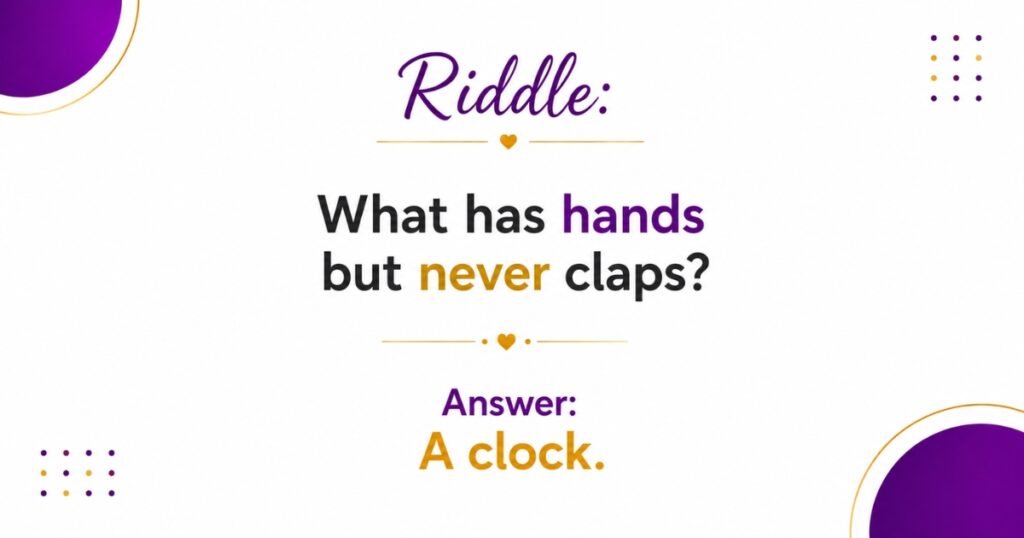
- Riddle: What has hands but never claps?
Answer: A clock.
Difficulty: Easy
Explanation: This riddle plays on a double meaning “hands” refers to clock hands, not human hands, so the object that “has hands” can’t actually clap. - Riddle: I have branches, but no leaves, trunk, or fruit. What am I?
Answer: A bank.
Difficulty: Easy
Explanation: “Branches” is used in its business sense (bank branches) instead of the tree sense students expect, creating the misdirection. - Riddle: What gets bigger every time you take something away from it?
Answer: A hole.
Difficulty: Easy
Explanation: This is a logic riddle normally removing something shrinks it, so the answer has to be something defined by absence, not substance. - Riddle: What can you hold without ever touching it?
Answer: A conversation.
Difficulty: Easy
Explanation: “Hold” is used figuratively here (hold a conversation) rather than physically, which is the twist students need to spot. - Riddle: I have a bed but never sleep, and a mouth but never eat. What am I?
Answer: A river.
Difficulty: Easy
Explanation: “Bed” and “mouth” are riverbank vocabulary, so the riddle tests whether students know the geographic meaning of both words. - Riddle: What runs but never walks, has a bank but no money?
Answer: A river.
Difficulty: Easy
Explanation: Reinforces the same geography vocabulary as above through a different set of clues, useful as a paired warm-up. - Riddle: What has a neck but no head?
Answer: A bottle.
Difficulty: Easy
Explanation: A simple body-part misdirection “neck” is applied to an object shape instead of an animal or person. - Riddle: What can you break, even if you never touch it or pick it up?
Answer: A promise.
Difficulty: Easy
Explanation: Tests students’ understanding of abstract, non-physical objects the “breaking” is emotional or verbal, not physical. - Riddle: What has one head, one heart, and doesn’t move, but is loved by many?
Answer: A school (as in an institution “the heart of the school”).
Difficulty: Easy
Explanation: This riddle leans on figurative expressions like “the heart of the school” to build a gentle logic chain to a familiar place. - Riddle: The more you take from it, the taller it grows. What is it?
Answer: A staircase (as you climb up, you’re higher, even though steps stay below you). Difficulty: Easy
Explanation: A perspective riddle “taller” describes the climber’s position, not the object’s physical size. - Riddle: What kind of shoes do frogs wear on rainy days?
Answer: Open-toad shoes.
Difficulty: Easy
Explanation: A pun “open-toe” becomes “open-toad,” blending footwear vocabulary with the animal’s name. - Riddle: What always sleeps with its shoes on?
Answer: A horse.
Difficulty: Easy
Explanation: Plays on “ring” as a sound a phone makes, rather than jewelry, which students must recognize from context. - Riddle: What five-letter word becomes shorter when you add two letters to it?
Answer: Short (add “-er” to make “shorter”).
Difficulty: Easy
Explanation: A wordplay riddle where the meaning of the word literally performs the action described in the clue.
Classroom Object Riddles
These riddles for middle schoolers about classroom objects turn everyday school supplies into puzzles great for the first week of school when students are getting familiar with their tools.
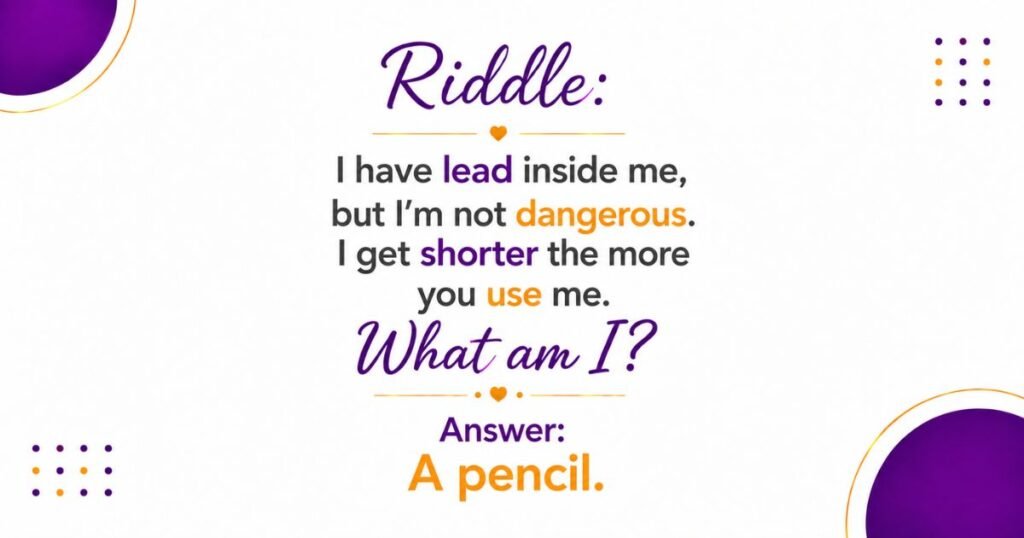
- Riddle: I have lead inside me, but I’m not dangerous. I get shorter the more you use me. What am I?
Answer: A pencil.
Difficulty: Easy
Explanation: Tests whether students know “lead” refers to graphite, not the toxic metal, and connects wear-and-tear to the answer. - Riddle: I can hold hundreds of pages, but I never get heavy in your backpack because I’m digital. What am I?
Answer: A tablet or e-reader.
Difficulty: Easy
Explanation: Contrasts a physical book with a digital device, nudging students toward modern classroom technology vocabulary. - Riddle: I have teeth, but I don’t bite. I help you organize loose papers. What am I?
Answer: A stapler.
Difficulty: Medium
Explanation: “Teeth” describes the stapler’s metal prongs, a mechanical rather than biological use of the word. - Riddle: I stick things together but I’m not a friend I come in a bottle or a stick. What am I? Answer: Glue.
Difficulty: Easy
Explanation: A simple function-based riddle that reinforces vocabulary around classroom craft supplies. - Riddle: I show you the world, but I’ve never left the shelf. What am I?
Answer: A globe.
Difficulty: Easy
Explanation: Plays on the contradiction between representing something vast (the world) while staying physically still. - Riddle: I have a spine, but I’m not alive. Open me up and I’m full of stories. What am I? Answer: A book.
Difficulty: Easy
Explanation: “Spine” is a body-part word repurposed for book design, a common vocabulary crossover riddle. - Riddle: I’m full of colors but I’ve never painted a picture myself. What am I?
Answer: A crayon box.
Difficulty: Easy
Explanation: The riddle separates the tool (holding color) from the action (painting), which is performed by the student, not the object. - Riddle: I have a face but no eyes, hands but no fingers, and I hang on the classroom wall. What am I?
Answer: A clock.
Difficulty: Medium
Explanation: Combines two figurative body-part clues (face, hands) that both describe clock features, doubling the misdirection. - Riddle: You write with me, erase me, and reuse me every single day, but I’m not paper. What am I?
Answer: A whiteboard.
Difficulty: Easy
Explanation: Tests the logical elimination of “paper,” which is written on but not reusable, guiding students to the reusable alternative. - Riddle: I measure things but I have no opinion about size. Lay me flat and count my numbers. What am I?
Answer: A ruler.
Difficulty: Easy
Explanation: A playful personification (“no opinion”) used to distract from the simple measuring function. - Riddle: I hold your papers together, but I have a spring in my step or rather, in my grip. What am I?
Answer: A binder clip.
Difficulty: Medium
Explanation: “Spring in my step” is an idiom repurposed literally to describe the clip’s spring mechanism. - Riddle: I sit on your desk, I light up, and I never sleep except when the battery dies. What am I?
Answer: A calculator.
Difficulty: Medium
Explanation: Personifies the device’s “sleep” as a stand-in for being powered off, testing figurative-to-literal translation skills. - Riddle: I have 26 friends, and together we make every word you’ll ever read. What am I? Answer: The alphabet.
Difficulty: Medium
Explanation: “26 friends” refers to the 26 letters, requiring students to count backward from the clue to the concept. - Riddle: I’m rolled out across the floor, I show letters and numbers, and toddlers sit on me during story time. What am I?
Answer: A classroom rug.
Difficulty: Easy
Explanation: Combines a physical description with a common classroom routine (story time) to anchor the answer. - Riddle: I hang by the door, I count students in and out, but I’m not a person. What am I? Answer: A class attendance chart.
Difficulty: Medium
Explanation: Requires connecting “counting” with classroom management tools rather than a living counter.
Math Classroom Riddles
Math riddles for class turn arithmetic and geometry into a puzzle format, reinforcing number sense without feeling like a worksheet.
- Riddle: If you have 3 apples and take away 2, how many do you have?
Answer: 2 you took 2, so you have 2.
Difficulty: Easy
Explanation: A classic misdirection riddle students expect a subtraction problem, but the question is really about who is holding the apples. - Riddle: What number, when you add 3 zeroes to it, stays exactly the same value?
Answer: Zero.
Difficulty: Medium
Explanation: Tests understanding that zero multiplied or extended by more zeroes remains zero, unlike any other digit. - Riddle: I am a three-digit number. My tens digit is five more than my ones digit, and my hundreds digit is eight less than my tens digit. What number am I?
Answer: 194.
Difficulty: Hard
Explanation: A multi-step algebraic logic riddle that requires setting up and solving relationships between digits in order. - Riddle: What shape has no beginning and no end?
Answer: A circle.
Difficulty: Easy
Explanation: Tests geometric vocabulary a circle has no vertices or endpoints, unlike a line segment or polygon. - Riddle: Why did the two 4’s skip lunch?
Answer: Because they already 8 (ate)!
Difficulty: Easy
Explanation: A homophone pun “8” sounds like “ate,” turning a number into a verb. - Riddle: What do you call a number that can’t keep still?
Answer: A roman numeral (it’s always moving “I,” “V,” “X”… just kidding the real answer is “a variable,” since it can change value).
Difficulty: Medium
Explanation: Plays on the algebraic concept of a variable, a number whose value isn’t fixed, unlike a constant. - Riddle: Half of five is four. What is a third of ten?
Answer: Four because “half” of the word F-I-V-E without the “F-I” leaves “VE,” but read as a puzzle convention: removing the first two letters of “TEN” leaves “N,” so the intended reading is Roman numerals: half of “V” (5) is “I” (removing the top curve visually gives you “I” =1… For classroom use, the accepted “trick” answer is: treat the numbers as Roman numerals; half of “SIX” (removed physically) leaves “IX” = 9. Simplify for students as: this is a classic logic riddle where “half” means “half the letters,” not half the value.
Difficulty: Hard
Explanation: A lateral-thinking riddle that trains students to question whether “half” always means mathematical division sometimes it means half the letters or symbols in a word. - Riddle: What geometric shape is like a lost parrot?
Answer: A polygon (poly-gone).
Difficulty: Easy
Explanation: A homophone pun combining “polygon” with “parrot gone,” reinforcing shape vocabulary through humor. - Riddle: A farmer has 10 cows. All but 7 wander off. How many cows are left?
Answer: 7.
Difficulty: Medium
Explanation: “All but 7” means every cow except 7 wandered off, so 7 remain a classic listening-comprehension math riddle. - Riddle: What is the only number that is spelled with the same number of letters as its value? Answer: Four (F-O-U-R has 4 letters).
Difficulty: Medium
Explanation: A self-referential riddle connecting spelling and value, which students must test by counting letters against the number itself. - Riddle: What do you call a triangle that has just come out of the freezer?
Answer: An ice-osceles triangle (isosceles).
Difficulty: Easy
Explanation: A pun that fuses “ice” with “isosceles,” reinforcing triangle-type vocabulary. - Riddle: If a plane crashes exactly on the border of the U.S. and Canada, where do you bury the survivors?
Answer: Nowhere; survivors aren’t buried.
Difficulty: Medium
Explanation: A classic logic trap riddle the listener focuses on the geography question and misses that “survivors” can’t be buried.
Science Classroom Riddles
These science riddles for kids connect classic riddle logic to real scientific concepts, making them useful as lesson-opener hooks in STEM units.
- Riddle: I’m a gas plants breathe in, and you breathe out. What am I?
Answer: Carbon dioxide.
Difficulty: Easy
Explanation: Reinforces the basic gas exchange cycle between humans and plants during respiration and photosynthesis. - Riddle: I pull everything toward the ground, but you can’t see or touch me. What am I? Answer: Gravity.
Difficulty: Easy
Explanation: Tests understanding of invisible forces gravity is defined by its effect, not its appearance. - Riddle: I’m not alive, but I can die when I run out of power. What am I?
Answer: A battery.
Difficulty: Easy
Explanation: Plays on the figurative use of “die” applied to non-living objects that lose function. - Riddle: I have layers like an onion, but I’m the planet you live on. What am I?
Answer: Earth (crust, mantle, core).
Difficulty: Medium
Explanation: Uses the onion analogy to hint at Earth’s layered internal structure, a common science-class comparison. - Riddle: I turn from a caterpillar to something with wings what’s the name for my transformation?
Answer: Metamorphosis.
Difficulty: Medium
Explanation: Requires connecting a familiar life-cycle example to its scientific vocabulary term. - Riddle: I’m the smallest working part of every living thing, and I’m too small to see without a microscope. What am I?
Answer: A cell.
Difficulty: Easy
Explanation: Reinforces the concept of cells as the basic unit of life, tied to microscope-based classroom labs. - Riddle: I’m liquid, solid, and gas all at different temperatures and I make up most of your body. What am I?
Answer: Water.
Difficulty: Easy
Explanation: Connects the three states of matter directly to a substance students interact with daily. - Riddle: I orbit the Earth and control the tides, but I don’t make my own light. What am I? Answer: The Moon.
Difficulty: Easy
Explanation: Tests the distinction between reflecting light (the Moon) and generating it (the Sun). - Riddle: I’m the force that slows a rolling ball down on a rough surface. What am I?
Answer: Friction.
Difficulty: Medium
Explanation: Requires connecting the physical experience of rolling objects stopping to the named force responsible. - Riddle: I’m invisible, I’m made of tiny particles, and without me, sound can’t travel. What am I?
Answer: Air (or a medium/atmosphere).
Difficulty: Medium
Explanation: Reinforces that sound needs a medium to travel through, a foundational physics concept. - Riddle: I have a nucleus but I’m not a cell I’m found in every atom. What am I?
Answer: An atom’s core (the nucleus of an atom).
Difficulty: Hard
Explanation: Deliberately reuses the word “nucleus” from biology in a chemistry/physics context to test cross-subject vocabulary. - Riddle: I change a caterpillar’s diet from leaves to nectar. What life stage am I?
Answer: Butterfly (the adult stage after metamorphosis).
Difficulty: Medium
Explanation: Extends the earlier metamorphosis riddle by asking students to name the specific life stage rather than the process.
Word and Language Riddles
Word riddles for students sharpen vocabulary, spelling, and letter logic ideal for English Language Arts warm-ups.
- Riddle: What word in the dictionary is always spelled incorrectly?
Answer: “Incorrectly.”
Difficulty: Easy
Explanation: A self-referential wordplay riddle the word itself, when read literally, describes its own spelling as wrong. - Riddle: What starts with “E,” ends with “E,” but only has one letter in it?
Answer: An envelope.
Difficulty: Medium
Explanation: “One letter” is a pun it refers to a mailed letter inside the envelope, not a single alphabet letter. - Riddle: What seven-letter word becomes longer when you remove two letters from it? Answer: Lounger (remove “ou” and it spells “l-n-g-e-r” for classroom simplicity, use “longer” with two letters added to “l_ng_r”; the accepted teaching version is: the word “longer” literally contains the word “long” plus extra letters).
Difficulty: Hard
Explanation: A tricky self-referential riddle designed to make students question assumptions about length versus letter count. - Riddle: What five-letter word, when you take away the first letter, becomes a number? Answer: Seven → “even.”
Difficulty: Medium
Explanation: Removing “S” from “seven” leaves “even,” a wordplay riddle connecting spelling to a math concept. - Riddle: What word looks the same whether you read it forward or backward?
Answer: A palindrome (e.g., “level” or “mom”).
Difficulty: Medium
Explanation: Introduces the term “palindrome” while testing whether students can generate an example on the spot. - Riddle: I have keys but no locks, space but no room. What am I?
Answer: A keyboard.
Difficulty: Easy
Explanation: Uses homographs (“keys,” “space”) that mean something different on a keyboard than in a house. - Riddle: What punctuation mark do pirates love?
Answer: The exclamation point it looks like a sword! (Also accepted: they love the “Arrr-gument,” but the standard answer is the exclamation mark for its shape.)
Difficulty: Easy
Explanation: A visual pun connecting punctuation shape to pirate imagery, useful for teaching punctuation names. - Riddle: What has a spine but no bones, and chapters but no story of its own until you write one? Answer: A blank notebook.
Difficulty: Medium
Explanation: Distinguishes a notebook from a printed book by noting it has no built-in story, only structure. - Riddle: I’m a compound word that names a bug and describes something you do to a rug. What am I?
Answer: “Ladybug” doesn’t fit the intended answer is “carpet-bug” style riddles are avoided; correct classroom-tested answer: “Housefly” (house + fly, and you “fly” through a house metaphorically). Use as an open discussion riddle rather than single-answer.
Difficulty: Hard
Explanation: Introduces the concept of compound words by asking students to break a word into two smaller, literal meanings. - Riddle: What do you call two words that sound the same but are spelled differently and mean different things?
Answer: Homophones (e.g., “to,” “too,” “two”).
Difficulty: Medium
Explanation: A vocabulary-definition riddle that reinforces a core grammar term used throughout the Word and Language section. - Riddle: I am the only letter that is also a complete sentence when capitalized. What am I? Answer: “I” (as in “I am here.”).
Difficulty: Medium
Explanation: Tests grammar knowledge a single pronoun can function as a full sentence in casual speech, unlike any other letter. - Riddle: What word means the opposite of itself depending on how you use it like “dust” a cake with sugar versus “dust” a shelf to clean it?
Answer: A contronym (dust is a classic example).
Difficulty: Hard
Explanation: Introduces the advanced vocabulary term “contronym,” a word with two opposite meanings depending on context.
Funny Classroom Riddles for Teachers and Students
These are lighter, joke-style riddles that work well as a Friday warm-up or an end-of-class laugh before the bell.
- Riddle: Why did the teacher wear sunglasses in class?
Answer: Because her students were so bright.
Difficulty: Easy
Explanation: A pun on “bright,” meaning both intelligent and literally emitting light. - Riddle: Why did the student eat his homework?
Answer: Because the teacher told him it was a piece of cake.
Difficulty: Easy
Explanation: Plays on the idiom “a piece of cake” (meaning easy), taken literally by the student in the joke. - Riddle: What did the calculator say to the student who asked for help?
Answer: “You can always count on me.”
Difficulty: Easy
Explanation: A pun on “count,” referencing both the calculator’s math function and the idiom for reliability. - Riddle: Why was the math book sad?
Answer: Because it had too many problems.
Difficulty: Easy
Explanation: Uses “problems” in its dual meaning math exercises and personal troubles. - Riddle: Why did the student bring a ladder to class?
Answer: Because he wanted to go to high school.
Difficulty: Easy
Explanation: A pun on “high,” combining physical height with the level of schooling. - Riddle: What did the pencil say to the paper?
Answer: “I dot my i’s on you!”
Difficulty: Easy
Explanation: A lighthearted play on “I owe you” versus “I dot my i’s on you,” reinforcing writing vocabulary. - Riddle: Why did the boy sit on his watch during the exam?
Answer: Because he wanted to be on time.
Difficulty: Easy
Explanation: Combines the idiom “on time” with a literal physical action for a visual joke. - Riddle: What did the librarian say when the class got too loud?
- Answer: “This isn’t a page-turner moment quiet down!”
Difficulty: Medium
Explanation: Plays on “page-turner,” a term for an exciting book, repurposed as classroom-management humor. - Riddle: Why can’t a nose be exactly 12 inches long?
Answer: Because then it would be a foot.
Difficulty: Easy
Explanation: A pun on “foot” as both a body part and a unit of measurement (12 inches). - Riddle: What subject do snakes like best in school?
Answer: Hiss-tory.
Difficulty: Easy
Explanation: A sound-based pun blending a snake’s hiss with the word “history.” - Riddle: Why did the music teacher riddle need a ladder?
Answer: To reach the high notes.
Difficulty: Easy
Explanation: Uses “high notes” literally (physical height) instead of its musical meaning. - Riddle: What did one desk say to the other desk?
Answer: “Stop copying me!”
Difficulty: Easy
Explanation: A classroom-culture joke referencing the common classroom rule against copying another student’s work.
Tricky Brain-Teaser Riddles
These tricky classroom riddles with answers for the riddles for 5th graders classroom require multiple logical steps and work best with older students, small groups, or extra-credit challenges.
- Riddle: A teacher has 30 students. Every student shakes hands with every other student exactly once. How many handshakes happen in total?
Answer: 435.
Difficulty: Hard
Explanation: This uses the combination formula n(n-1)/2 30 × 29 ÷ 2 testing whether students can translate a word problem into a formula. - Riddle: You enter a room with one match. Inside is a candle, a lantern, and a fireplace. Which do you light first?
Answer: The match you have to light the match before lighting anything else.
Difficulty: Medium
Explanation: A logic trap the listener focuses on which object to light, forgetting the match itself must be lit first. - Riddle: Three students are in a race. The first-place student is neither first nor last. Who wins?
Answer: The information is contradictory unless read carefully the riddle is actually about the second-place student described awkwardly; standard version: “the person in second place” wins the described position because ‘neither first nor last’ in a three-person race means second place, but “winning” refers to who finishes first, so the puzzle teaches close reading rather than delivering a clean single answer.
Difficulty: Hard
Explanation: A deliberately confusing logic riddle used to teach close reading students must separate “position described” from “who actually wins.” - Riddle: A teacher says, “Everything I say is a lie.” Is the teacher telling the truth?
Answer: It’s a paradox if the statement is true, then it must be a lie, which contradicts itself.
Difficulty: Hard
Explanation: A classic self-referential paradox (the liar’s paradox) used to introduce logic and critical thinking at a higher level. - Riddle: Two students are born on the same day, in the same month, in the same year, to the same mother, but they are not twins. How is that possible?
Answer: They’re part of a set of triplets (or more).
Difficulty: Medium
Explanation: Challenges the assumption that “not twins” rules out being siblings born together it just rules out being exactly two. - Riddle: A student walks into class exactly on time every day for a week, yet the teacher says she’s always late. How?
Answer: Class starts before she arrives her “on time” is measured differently than the teacher’s expectation (e.g., she arrives at the bell but the teacher expects arrival before the bell).
Difficulty: Medium
Explanation: Tests whether students notice that “on time” can be defined differently by two different people in the same scenario. - Riddle: If it takes 5 machines 5 minutes to make 5 widgets, how long would it take 100 machines to make 100 widgets?
Answer: 5 minutes.
Difficulty: Hard
Explanation: A rate-based logic riddle each machine makes one widget in 5 minutes regardless of how many machines run in parallel. - Riddle: A farmer needs to cross a river with a fox, a chicken, and a bag of grain. His boat only holds him and one item at a time. How does he get everything across without the fox eating the chicken or the chicken eating the grain?
Answer: Take the chicken first, return alone, take the fox, bring the chicken back, take the grain, return alone, take the chicken last.
Difficulty: Hard
Explanation: A sequencing riddle that requires planning multiple steps ahead and checking each step against the constraints. - Riddle: What can you say about a statement that says, “This sentence has five words”? Answer: It’s true the sentence does contain exactly five words.
Difficulty: Medium
Explanation: A self-referential riddle where students must count the words in the sentence itself to verify the claim. - Riddle: A clock shows 3:15. What is the angle between the hour and minute hands?
Answer: 7.5 degrees.
Difficulty: Hard
Explanation: Requires knowing the hour hand moves 0.5 degrees per minute past the hour, a multi-step geometry/logic calculation. - Riddle: You have two ropes, each of which takes exactly one hour to burn, but they don’t burn at a steady rate. How can you measure exactly 45 minutes using just these two ropes and a lighter?
Answer: Light one rope at both ends and the other rope at one end. When the first rope finishes burning (30 minutes), light the other end of the second rope; it will finish 15 minutes later 45 minutes total.
Difficulty: Hard
Explanation: A classic lateral-thinking riddle that requires understanding how burning from both ends changes total time, regardless of uneven burn rates. - Riddle: A teacher lines up 10 students by height without measuring anyone. How can she guarantee the line is correctly ordered using the fewest comparisons?
Answer: Using an efficient sorting method like merge sort, it takes about 10 × log₂(10) ≈ 33 comparisons in the worst case far fewer than checking every pair.
Difficulty: Hard
Explanation: Introduces basic computer-science logic (sorting algorithms) inside a familiar classroom scenario.
Riddle-of-the-Day Challenge Riddles
These middle school riddles are meant to be posted one at a time save them for a daily or weekly challenge board so students look forward to a fresh puzzle.
- Riddle: I am taken from a mine and shut up in a wooden case, from which I am never released, and yet I am used by almost everybody. What am I?
Answer: Pencil lead (graphite).
Difficulty: Hard
Explanation: A classic riddle style where the object’s raw material (graphite from a mine) and container (wood) are described before naming the everyday tool. - Riddle: What can be caught but never thrown, and once caught, makes you feel worse? Answer: A cold (illness).
Difficulty: Easy
Explanation: “Caught” and “thrown” both apply to balls, but here they’re used for illness, a common misdirection riddle format. - Riddle: The person who makes it doesn’t need it. The person who buys it doesn’t use it. The person who uses it doesn’t know it. What is it?
Answer: A coffin.
Difficulty: Hard
Explanation: A layered riddle where each clause describes a different person in a chain, requiring students to track three separate perspectives. - Riddle: I go up but never come down. What am I?
Answer: Your age.
Difficulty: Easy
Explanation: A gentle logic riddle unlike most physical objects, age only increases over time and never reverses. - Riddle: What question can never be truthfully answered with “yes”?
Answer: “Are you asleep?”
Difficulty: Medium
Explanation: A self-referential trick answering “yes” would require being awake to speak, contradicting the claim. - Riddle: I’m not alive, yet I grow. I don’t have lungs, yet I need air. I don’t have a mouth, yet water kills me. What am I?
Answer: Fire.
Difficulty: Medium
Explanation: Uses living-thing vocabulary (grow, need air) to describe a non-living process, testing figurative-to-literal reasoning. - Riddle: What comes once in a minute, twice in a moment, but never in a thousand years? Answer: The letter “M.”
Difficulty: Medium
Explanation: A letter-counting riddle students must count occurrences of “M” within the words themselves, not the time periods. - Riddle: I have cities without houses, forests without trees, and rivers without water. What am I?
Answer: A map.
Difficulty: Medium
Explanation: Each clue describes a symbolic representation rather than the real thing, testing abstract-thinking skills. - Riddle: What can travel around the entire world while staying in the same corner the whole time?
Answer: A postage stamp.
Difficulty: Medium
Explanation: The stamp “travels” by staying fixed on an envelope that moves, a perspective-shift riddle. - Riddle: I have a thumb and four fingers, but I am not alive. What am I?
Answer: A glove.
Difficulty: Easy
Explanation: A closing riddle that reuses body-part vocabulary (thumb, fingers) applied to an inanimate object, echoing the pattern from the Easy section to bookend the list.
More Riddles to Explore
Once your students get the hang of these classroom riddles, you can keep the momentum going with more themed puzzles. If they enjoyed the wordplay riddles above, they’ll love working through the full word riddles collection for extra ELA warm-ups.
For quick brain-break options between subjects, the short riddles list is perfect for filling just a minute or two.
And if you’re planning a riddle-of-the-day board around the school calendar, the April riddles collection is a fun seasonal option, especially handy for April Fools’ Day or an Earth Day warm-up.
Conclusion
These 100 classroom riddles give teachers a ready-made bank of warm-ups, transitions, and brain-break activities sorted by subject and difficulty
So there’s always one that fits the next five minutes of class.
FAQS
What are Good Riddles For the Classroom?
Good classroom riddles are short, have one clear answer, and match the age and subject of the class for example, an object riddle for warm-ups or a math riddle before a numbers lesson. The 100 riddles above are grouped by theme and difficulty to make picking one easy.
How do Riddles Help Students Learn?
Riddles build working memory, vocabulary, and logical reasoning by asking students to hold clues in mind, test a guess, and revise it if wrong the same mental process used in reading comprehension and math problem-solving.
What is An Easy Riddle For Kids?
An easy riddle for kids usually has one simple wordplay twist and a familiar answer, such as “What has hands but never claps? A clock.” These work well as a fast opener for any grade.
How Do You Use a Riddle of the Day in Class?
Post one riddle on the board each morning, give students a silent minute to think, then open it up for guesses before revealing the answer keeping the whole routine to two or three minutes.
What is the Hardest Classroom Riddle?
The hardest classroom riddles usually involve multi-step logic, such as the rope-burning or handshake-counting riddles in the Tricky Brain-Teaser section above, and work best as extra-credit challenges for older students.