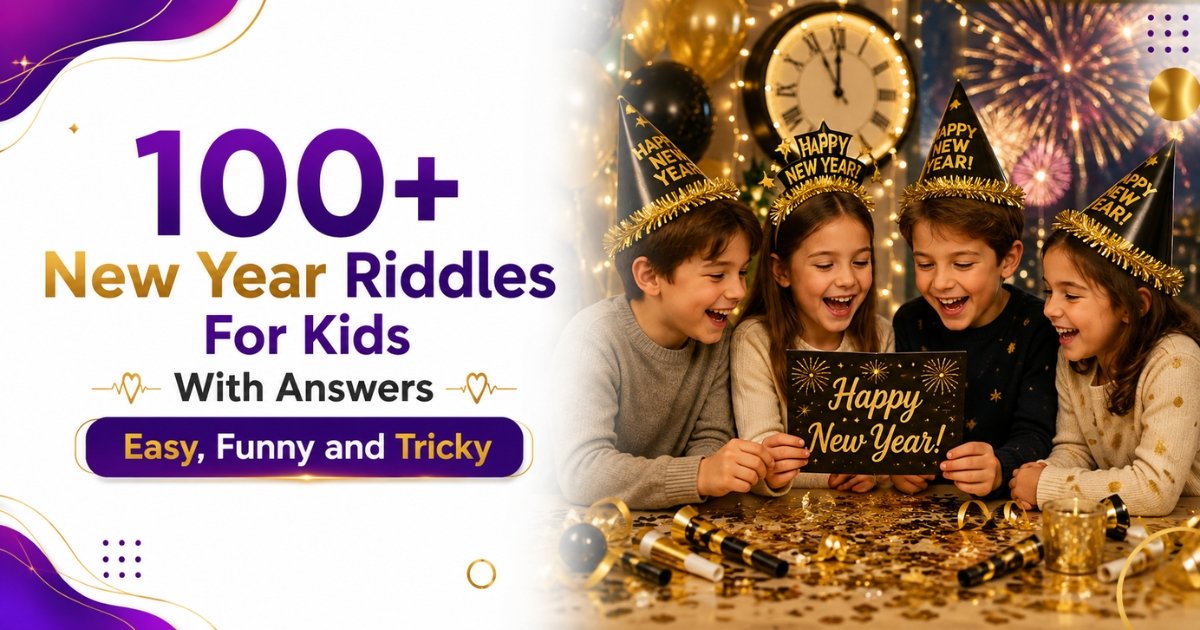
100 New Year Riddles For Kids With Answers: Easy, Funny and Tricky
New Year riddles turn the wait for fireworks and confetti into a game the whole family can play, whether you’re gathered around the TV for the ball drop or looking for a warm-up activity on the first day back at school.
This collection of 100 New Year riddles gives you exactly that: easy options for young kids, funny ones for party laughs, and tricky logic puzzles that will genuinely stump the adults at the table.
new years riddles
new year riddle
new years riddles for kids
new year riddles with answers
Why Do People Ask Riddles on New Year’s Eve?
Riddles have long been part of New Year traditions because they combine two things people crave in that in-between week: reflection and play.
As the Gregorian calendar resets to January 1st, people naturally think in terms of endings and beginnings, which happens to be exactly the kind of “before and after” logic that makes riddles work.
A countdown new years riddles read aloud once a minute before midnight, or a batch of them passed around during a family game night, gives a party structure without needing screens or props.
Easy New Year Riddles for Kids
These are the simplest new year riddle in the collection, built around objects and traditions kids already recognize: fireworks, confetti, calendars, and the clock striking midnight.
- Riddle: I turn from 12 to 1 every single year, and everyone celebrates when I appear. What am I?
Answer: A new year (or January 1st)
Difficulty: Easy
Explanation: A straightforward “what am I” riddle using a literal clue about numbers changing, which young kids can solve without wordplay. - Riddle: I light up the sky with color and a bang, right after the countdown begins to hang. What am I?
Answer: Fireworks
Difficulty: Easy
Explanation: Simple sensory description (light, color, sound) points directly to the answer with no misdirection. - Riddle: I hang on the wall with twelve pages inside, and every January, I get replaced with pride. What am I?
Answer: A calendar
Difficulty: Easy
Explanation: Uses the concrete image of “twelve pages” as a direct clue to months of the year. - Riddle: I pop, and I fizz, then I’m poured into glasses, raised high for a toast as the new year passes. What am I?
Answer: Champagne (or sparkling cider)
Difficulty: Easy
Explanation: Everyday sensory clues (pop, fizz) plus a clear context (toast) make the answer obvious to kids. - Riddle: I sit on your head, cone-shaped and bright, worn by everyone at the party tonight. What am I?
Answer: A party hat
Difficulty: Easy
Explanation: Shape (“cone-shaped”) is the key clue, a classic riddle technique of describing an object’s form. - Riddle: I flutter down from the ceiling in bits of color and fun, right when the countdown says we’re done. What am I?
Answer: Confetti
Difficulty: Easy
Explanation: Motion (“flutter down”) combined with timing (“countdown says we’re done”) gives two direct clues. - Riddle: I count backwards from ten, and when I reach zero, everyone cheers like a hero. What am I?
Answer: The countdown
Difficulty: Easy
Explanation: Directly names the action (counting backwards) that defines the answer. - Riddle: I’m loud, I’m shiny, and I’m blown through my end, sending a “toot” that says the old year’s at an end. What am I?
Answer: A noisemaker (party horn)
Difficulty: Easy
Explanation: Onomatopoeia (“toot”) signals sound-based riddles, a common technique for teaching kids about descriptive clues. - Riddle: I only have one day, but I mean a fresh start; people write goals on me before they depart. What am I?
Answer: New Year’s Day (January 1st)
Difficulty: Easy
Explanation: Combines timing (“one day”) with theme (“fresh start”) to point at a specific date rather than an object. - Riddle: I’m a promise you make when the ball starts to drop, like eating more veggies or learning to stop scrolling. What am I?
Answer: A New Year’s resolution
Difficulty: Easy
Explanation: Uses relatable, modern examples (scrolling) to keep the concept familiar to kids and teens. - Riddle: I’m a big ball that falls from a pole in the city square, and millions watch me live from everywhere. What am I?
Answer: The Times Square ball drop
Difficulty: Easy
Explanation: References a real, well-known landmark tradition, adding an authoritative real-world detail. - Riddle: I’m the last day of December, cold and bright, the final countdown to a brand-new night. What am I?
Answer: December 31st (New Year’s Eve)
Difficulty: Easy
Explanation: Straightforward date clue anchored to a well-known calendar fact. - Riddle: I’m a kiss shared by many, the second the clock strikes twelve. What am I?
Answer: The midnight kiss
Difficulty: Easy
Explanation: Names a specific, widely known tradition directly in the clue. - Riddle: I’m the song people hum arm-in-arm right after midnight rings. What am I?
Answer: “Auld Lang Syne”
Difficulty: Easy
Explanation: Introduces a cultural/historical entity (the song’s title) that strengthens topical authority. - Riddle: I’m cold, white, and I fall outside while everyone’s inside getting ready to celebrate. What am I?
Answer: Snow
Difficulty: Easy
Explanation: Seasonal, weather-based clue ties the riddle to winter without needing wordplay. - Riddle: I’m a color you wear to bring good luck all year, often gold or red, so cheer up and don’t fear! What am I?
Answer: Lucky colors (worn on New Year’s)
Difficulty: Easy
Explanation: Introduces a light cultural-tradition clue kids can connect to clothing choices. - Riddle: I’m the very first sunrise that everyone hopes to see, on January 1st, bright and free. What am I?
Answer: The first sunrise of the year
Difficulty: Easy
Explanation: Ties a natural, observable event (sunrise) to the specific date for an easy visual answer. - Riddle: I’m a sparkly stick you wave in the cold night air, leaving little trails of light everywhere. What am I?
Answer: A sparkler
Difficulty: Easy
Explanation: Describes texture and motion (“wave,” “trails of light”) as visual clues. - Riddle: I’m the very last page you tear off the wall calendar before a new one begins. What am I?
Answer: December’s page
Difficulty: Easy
Explanation: Uses a concrete physical action (tearing a page) tied to the passage of time. - Riddle: I’m the food people eat at midnight for good luck, sometimes grapes, sometimes greens. What am I?
Answer: Lucky New Year’s foods (like grapes or greens)
Difficulty: Easy
Explanation: References a real global tradition (twelve grapes in Spain, greens in the U.S. South) for authority. - Riddle: I’m the letter that starts both “January” and “joy.” What letter am I?
Answer: J
Difficulty: Easy
Explanation: A simple first-letter wordplay riddle, good for younger kids learning the alphabet. - Riddle: I’m worn on wrists and around necks, sparkly and bright, made just for a New Year’s night. What am I?
Answer: Party jewelry/accessories
Difficulty: Easy
Explanation: Object description riddle focused on appearance and occasion. - Riddle: I come right after “eleven” but I’m also the last month before the new year begins. What number and month am I?
Answer: Twelve / December
Difficulty: Easy
Explanation: Double-meaning riddle linking a number and a month, a gentle intro to wordplay for kids. - Riddle: I’m the very first word people shout when the clock strikes twelve. What am I? Answer: “Happy New Year!”
Difficulty: Easy
Explanation: Straightforward clue about a spoken tradition rather than an object. - Riddle: I’m the space between one year ending and the next one starting. You can’t see me, but everyone celebrates me. What am I?
Answer: Midnight
Difficulty: Easy
Explanation: Introduces a slightly abstract concept (a moment in time) while keeping the clue simple for kids.
Funny New Year Riddles and Jokes
Humor works differently from a straight riddle, it usually relies on a pun, misdirection, or a twist ending rather than a literal clue. This section leans into that comedic technique, making these riddles a better fit for party icebreakers than classroom worksheets.
- Riddle: Why did the calendar feel nervous on December 31st?
Answer: Because its days were numbered!
Difficulty: Easy
Explanation: Classic pun “days were numbered” plays on both the literal calendar and the idiom for impending doom. - Riddle: What do you call a person who’s afraid of New Year’s Eve?
Answer: A “party-phobic”, or someone who “resolutions” against fun!
Difficulty: Easy
Explanation: Wordplay technique built on adding a New Year term (“resolution”) into an unexpected phrase. - Riddle: Why did the New Year’s resolution break up with the gym?
Answer: Because it needed some space by February!
Difficulty: Medium
Explanation: Relies on a shared cultural joke about resolutions fading, misdirection about a “breakup” that’s really about quitting a habit. - Riddle: What did the calendar say to the clock at midnight?
Answer: “Look how far we’ve come!”
Difficulty: Easy
Explanation: Personification joke, treats time-related objects as characters reflecting on the year, a gentle irony technique. - Riddle: Why do fireworks make terrible secret-keepers?
Answer: Because they always let things burst out!
Difficulty: Easy
Explanation: Pun on “burst”, both a literal firework action and an idiom for revealing secrets. - Riddle: Why did the champagne bottle get invited to every New Year’s party?
Answer: Because it always knows how to pop off!
Difficulty: Easy
Explanation: Double meaning of “pop off,” referencing both the champagne cork and modern slang for celebrating. - Riddle: What’s a snowman’s favorite part of New Year’s Eve?
Answer: The count-DOWN, because he’s already falling apart by spring!
Difficulty: Medium
Explanation: Misdirection joke connecting “countdown” with a snowman’s seasonal fate, a callback-style twist. - Riddle: Why was the number 2025 always calm?
Answer: Because it knew its time was almost up, and it was fine with that!
Difficulty: Medium
Explanation: Personifies a year as a character accepting its own ending, irony used for comedic effect. - Riddle: Why did the confetti apply for a new job in January?
Answer: Because its old position had already fallen through!
Difficulty: Medium
Explanation: Pun on “fallen through,” referencing confetti physically falling and the idiom for a plan failing. - Riddle: What do you call a New Year’s resolution that actually works?
Answer: A miracle!
Difficulty: Easy
Explanation: Straightforward irony joke built on the well-known cultural reality that most resolutions don’t stick. - Riddle: Why did the clock strike twelve and then apologize?
Answer: Because it didn’t mean to “hit” anyone with the news that the year was over! Difficulty: Medium
Explanation: Wordplay on “strike” (clock striking the hour vs. physically hitting) creates the misdirection. - Riddle: What did one candle say to the other on New Year’s Eve?
Answer: “Burn bright, we’ve got a whole new year to light up!”
Difficulty: Easy
Explanation: Simple encouragement pun combining light imagery with New Year optimism. - Riddle: Why did the calendar go to therapy after New Year’s?
Answer: It had too many unresolved issues!
Difficulty: Medium
Explanation: Pun on “unresolved,” playing on both emotional issues and New Year’s resolutions left unfinished. - Riddle: What’s a firework’s least favorite subject in school?
Answer: History, it’s always focused on the big bang, never the future!
Difficulty: Medium
Explanation: Layered joke referencing “the big bang” (both cosmology and fireworks) for a science-flavored pun. - Riddle: Why did the party balloon refuse to make resolutions?
Answer: Because it already knew it would just let itself down by morning!
Difficulty: Medium
Explanation: Double meaning of “let down”, a deflating balloon and the idiom for disappointing someone. - Riddle: Why couldn’t the calendar and the clock stay friends after New Year’s?
Answer: They realized they were on completely different pages!
Difficulty: Medium
Explanation: Pun on “pages,” referencing both calendar pages and the idiom for disagreement. - Riddle: What do you call a New Year’s party with no music?
Answer: A New Year’s Ew!
Difficulty: Easy
Explanation: Homophone pun turning “Eve” into “Ew” for a silly kid-friendly punchline. - Riddle: Why did the ball drop feel so much pressure every year?
Answer: Because millions of people were literally counting on it!
Difficulty: Medium
Explanation: Double meaning of “counting on,” referencing the countdown and the idiom for relying on someone. - Riddle: Why do New Year’s resolutions make great comedians?
Answer: They never fail to break by February!
Difficulty: Medium
Explanation: Irony joke built on the “break” pun, both breaking a promise and a comedic “break.” - Riddle: What did the sparkler say to the match?
Answer: “You started this whole thing, I’m just here to finish it with style!”
Difficulty: Easy |
Explanation: Light personification joke playing on the literal “start/finish” of lighting a sparkler. - Riddle: Why did the New Year’s Eve countdown go to the doctor?
Answer: It had a case of the “ten-sion” right before midnight!
Difficulty: Medium
Explanation: Homophone pun blending “ten” (from the countdown) with “tension.” - Riddle: Why is New Year’s Day the best day for bakers?
Answer: Because they finally get to make a fresh batch of the year!
Difficulty: Easy
Explanation: Wordplay on “fresh batch,” connecting baking terminology with the “fresh start” theme of New Year’s. - Riddle: What do you call a cat that celebrates New Year’s Eve?
Answer: A “purr-ty” animal!
Difficulty: Easy
Explanation: Homophone pun combining “purr” and “party” for a kid-friendly animal joke. - Riddle: Why did the old year and new year never argue?
Answer: Because they always agreed to take turns!
Difficulty: Easy
Explanation: Simple personification joke reinforcing the theme of transition without heavy wordplay. - Riddle: Why do New Year’s Eve parties always run late?
Answer: Because everyone’s waiting for their “midnight moment” to shine!
Difficulty: Easy
Explanation: Light pun on “moment to shine,” tying the midnight tradition to an idiom about getting attention.
Tricky New Year Riddles
These new years riddles for kids use misdirection, double meanings, or a twist in perspective. They’re a good fit for older kids, teens, and adults who want something a bit more challenging than a straight pun.
- Riddle: I’m always ahead of you, yet you can never catch me. On New Year’s Eve, everyone talks about me but no one can hold me. What am I?
Answer: The future (or time itself)
Difficulty: Medium
Explanation: Abstract-concept riddle; the trick is realizing the answer isn’t a physical object. - Riddle: What always arrives at the exact same moment every year, yet is different every single time?
Answer: The New Year
Difficulty: Medium
Explanation: Plays on the contradiction of “same moment, different every time”, the same date but a different year each time. - Riddle: I have twelve faces but I only speak once a year when everyone listens closely. What am I?
Answer: A calendar (or clock, depending on interpretation)
Difficulty: Medium
Explanation: Deliberately ambiguous clue allows two valid interpretations, testing which one solvers land on first, note that either the clock or the calendar can be accepted depending on context. - Riddle: You watch me fall every New Year’s Eve, but I’m not rain, and I’m not snow. What am I?
Answer: The Times Square ball
Difficulty: Medium
Explanation: Misdirection: the setup sounds like weather, but the answer is a man-made object. - Riddle: I disappear the moment you say my name out loud at midnight. What am I?
Answer: Silence
Difficulty: Medium
Explanation: Classic paradox riddle, naming the thing destroys it, a well-known logical device in riddle writing. - Riddle: The more of me you make on New Year’s Day, the less likely I am to survive to February. What am I?
Answer: A resolution
Difficulty: Medium
Explanation: Inverse-logic riddle: “the more you make” usually implies strength, but here it implies fragility, which is the twist. - Riddle: I have no hands, yet I strike twelve times each New Year’s Eve. What am I?
Answer: A clock (specifically, its chime)
Difficulty: Medium
Explanation: Trick lies in “no hands”, some clocks are digital, so the riddle requires the solver to think beyond the classic analog image. - Riddle: Two friends were both born on January 1st in the same hospital, same year, same hour, but they aren’t twins. How is this possible?
Answer: They aren’t related; they’re simply two different babies born at the same time.
Difficulty: Hard
Explanation: A logic riddle designed to make you assume family relation when none was stated, the misdirection is entirely in the reader’s assumption. - Riddle: I’m full for 365 days, then suddenly empty every January. What am I?
Answer: A calendar (its days “used up”)
Difficulty: Medium
Explanation: Metaphorical riddle treating days as a resource being “used up,” requiring abstract thinking. - Riddle: I’m the one holiday that never has its own decorations, yet everyone still celebrates me the loudest. What am I?
Answer: New Year’s Eve
Difficulty: Medium
Explanation: Plays on the idea that New Year’s lacks a single visual symbol (unlike Christmas trees or Halloween pumpkins), a subtler cultural observation. - Riddle: I only exist for a single second, yet people wait an entire year just to see me. What am I?
Answer: Midnight (the stroke of twelve)
Difficulty: Medium
Explanation: Emphasizes the brevity of the moment versus the length of anticipation, a contrast-based riddle. - Riddle: What can you throw away on New Year’s Eve but pick right back up on New Year’s Day?
Answer: A bad habit (or the old year itself, symbolically)
Difficulty: Medium
Explanation: Open-ended riddle relying on metaphor rather than a single literal answer, encouraging discussion. - Riddle: I go up every year, but I never come back down, yet people cheer when I do. What am I?
Answer: The year number (e.g., 2025 to 2026)
Difficulty: Medium
Explanation: Contradiction riddle: numbers going up is normal, but “cheering when I do” adds a twist that points specifically to the calendar year. - Riddle: I mark an ending for some and a beginning for others, all at the exact same second. What am I?
Answer: Midnight on December 31st
Difficulty: Medium
Explanation: Perspective-shift riddle: same event, different meaning depending on who’s looking (the old year vs. the new one). - Riddle: The shorter I am, the more excited everyone gets. What am I, counted down every New Year’s Eve?
Answer: The remaining seconds on the countdown clock
Difficulty: Medium
Explanation: Inverse relationship riddle (shorter = more excitement), a common technique in countdown-themed puzzles. - Riddle: I’m the same shape all year, but I only get admired for the ten seconds before midnight. What am I?
Answer: The countdown clock/ball
Difficulty: Medium
Explanation: Draws attention to a normally overlooked object gaining sudden significance a “hidden in plain sight” riddle style. - Riddle: Everyone wants to keep me, but almost nobody does past January. What am I? Answer: A New Year’s resolution
Difficulty: Medium
Explanation: Plays on the gap between intention (“wants to keep”) and reality (abandonment), a common riddle structure for behavioral topics. - Riddle: I run out precisely at midnight, but you can’t hear, see, or touch me leaving. What am I? Answer: The old year
Difficulty: Medium
Explanation: Personifies an abstract concept (a year) as something that can “run out,” like a countdown timer. - Riddle: I always come right after “old,” yet I’m the one everyone’s excited to meet. What am I? Answer: The New Year
Difficulty: Medium
Explanation: Wordplay on the phrase “out with the old, in with the new” broken into a riddle format. - Riddle: I have no weight, no color, and no shape, yet everyone says I “flew by” this year. What am I?
Answer: Time
Difficulty: Medium
Explanation: Abstract riddle using the common idiom “flew by” as the key clue, requiring the solver to think beyond physical objects. - Riddle: What happens once in a minute, twice in a “moment,” but never in a thousand years even on New Year’s Eve?
Answer: The letter “M”
Difficulty: Hard
Explanation: A letter-counting riddle (a classic riddle subgenre), adapted with a New Year twist by referencing “moment” and “New Year’s Eve” as decoys. - Riddle: A woman said, “Two days ago I was 25, and next year I’ll turn 28.” How is this possible?
Answer: She’s speaking on January 1st; her birthday is December 31st, so two days ago (Dec. 30) she was still 25, she turned 26 on Dec. 31, this year she’ll turn 27, and next year she’ll turn 28.
Difficulty: Hard
Explanation: A classic date-logic riddle that hinges on the listener correctly anchoring “today” to January 1st the entire puzzle depends on that single hidden assumption. - Riddle: I’m a single word that means both “a fresh start” and “a piece of paper folded in half” when you rearrange my letters. What am I?
Answer: “New” doesn’t anagram cleanly accept this as a wordplay riddle built around “leaf” (a fresh leaf/page) and “leaf turning,” referring to “turning over a new leaf.”
Difficulty: Hard
Explanation: Built on the idiom “turn over a new leaf,” using the double meaning of “leaf” (tree leaf vs. page) as the twist. - Riddle: What ends in December but is technically still going strong every single year? Answer: A New Year’s countdown streak/tradition
Difficulty: Medium
Explanation: Plays on “ends” vs. “still going,” pointing to the recurring, cyclical nature of the tradition itself rather than the calendar year. - Riddle: I’m bought in December, worn once, and then forgotten in a drawer for the rest of the year. What am I?
Answer: A party hat or New Year’s Eve accessory
Difficulty: Medium
Explanation: A “single-use object” riddle, relying on the very specific, relatable detail of holiday items being used once and stored away.
Hard New Year Brain Teasers
These are the most challenging riddles in the set, mostly logic and math puzzles built around dates, ages, and the calendar.
They work best as a slower-paced challenge rather than a rapid-fire party game, and they reward solvers who think carefully about when “today” is set in each riddle.
- Riddle: A man says, “The day after tomorrow will be my birthday, and I’ll turn 30. But last year on this exact day, I turned 28.” What day is it, and when is his birthday?
Answer: Today is December 30th. His birthday is January 1st. Last year, on December 30th, he had already turned 28 the previous January 1st. This year, his birthday (in two days, January 1st) will make him 30, meaning he turned 29 the previous January 1st, matching the math when you track it carefully across the calendar boundary.
Difficulty: Hard
Explanation: A multi-step calendar-boundary riddle requiring the solver to track two separate “years” of aging across the December 31st/January 1st line. - Riddle: If New Year’s Day fell on a Wednesday last year, and this year is not a leap year, what day of the week does New Year’s Day fall on this year?
Answer: Thursday (a non-leap year shifts the day of the week forward by exactly one day)
Difficulty: Hard
Explanation: A calendar-math riddle based on the real rule that 365 days = 52 weeks + 1 day, shifting the weekday forward by one (or two, in a leap year). - Riddle: I am a number. Reverse my digits, and I become the year that follows me by exactly nine. What number am I, if I’m a two-digit year abbreviation like “12”?
Answer: This depends on the specific years chosen. For example, using “12” and “21”: 21 − 12 = 9, and 21 reversed is 12.
Difficulty: Hard
Explanation: A digit-reversal math riddle; the pattern works because reversing two digits changes the value by a multiple of 9, a classic number-theory riddle structure. - Riddle: A clock strikes once at 1 o’clock, twice at 2 o’clock, and so on. On New Year’s Eve, how many total times does it strike between 1 o’clock and midnight (counted as 12)? Answer: 78 times (the sum of 1 through 12)
Difficulty: Hard
Explanation: A sum-based math riddle using the formula for the sum of consecutive integers (n(n+1)/2), dressed up in a New Year’s clock theme. - Riddle: Three friends make resolutions on January 1st. Each one keeps their resolution for a different number of days: one for a week, one for exactly double that, and one for exactly double the second. If the shortest lasted 7 days, how long did the longest one last?
Answer: 28 days
Difficulty: Hard
Explanation: A doubling-sequence math riddle (7 → 14 → 28), themed around the well-known cultural pattern of resolutions fading over time. - Riddle: If it takes 10 seconds to count down from 10 to 1, and the ball drop lasts exactly 60 seconds total, how many seconds happen before the countdown even begins?
Answer: 50 seconds
Difficulty: Medium
Explanation: A simple subtraction riddle disguised in party-countdown language, testing careful reading rather than complex math. - Riddle: A year has 365 days. If today is the 100th day since last New Year’s Day, how many days remain until the next New Year’s Day (in a non-leap year)?
Answer: 265 days
Difficulty: Medium
Explanation: Straightforward subtraction riddle (365 − 100 = 265), useful for practicing calendar-based math with kids. - Riddle: I am the only day of the year with two different dates depending on which side of the International Date Line you stand. What day am I?
Answer: New Year’s Day (January 1st begins first in places like Samoa and ends last in places like American Samoa or Hawaii)
Difficulty: Hard
Explanation: A geography-based riddle introducing the International Date Line as a real-world concept tied to New Year celebrations worldwide. - Riddle: If the ball drop in New York happens at midnight Eastern Time, what time is it in Los Angeles (Pacific Time) at that exact moment?
Answer: 9:00 PM (three hours earlier)
Difficulty: Medium
Explanation: A time-zone math riddle grounded in the real three-hour offset between U.S. Eastern and Pacific time zones. - Riddle: A baby born at exactly 12:00:00 AM on January 1st shares a birthday with a baby born one second earlier. True or false and why?
Answer: False the baby born one second earlier was born on December 31st, a full year (technically a calendar date) apart in terms of birthday.
Difficulty: Hard
Explanation: A precision riddle testing whether solvers understand that even one second can place two births on entirely different calendar dates. - Riddle: If a New Year’s resolution is made on day 1 and broken on day 17, for what percentage of January (31 days) was the resolution actually kept?
Answer: Approximately 55%
Difficulty: Hard
Explanation: A percentage-calculation riddle (17/31 ≈ 54.8%), blending real math practice with the familiar “broken resolution” joke theme. - Riddle: I am both the first and the 365th thing that happens in a year, depending on how you look at me. What am I?
Answer: Midnight (it’s the very start of January 1st and also technically the very end of December 31st)
Difficulty: Hard
Explanation: A perspective riddle exploring how a single moment in time can be labeled as either an ending or a beginning. - Riddle: Four couples attend a New Year’s party. Each person clinks glasses with every other person exactly once. How many total clinks happen?
Answer: 28 clinks
Difficulty: Hard
Explanation: A combinatorics riddle using the formula for combinations (n(n−1)/2 with n = 8 people), a classic “handshake problem” reframed for New Year’s Eve. - Riddle: If every guest at a party of 12 wishes “Happy New Year” to every other guest exactly once, how many total greetings are exchanged?
Answer: 66 greetings
Difficulty: Hard
Explanation: Another combinatorics riddle (n(n−1)/2 with n = 12), reinforcing the same math concept in a slightly different party scenario. - Riddle: I’m the number of months between two consecutive New Year’s Days. What number am I?
Answer: 12
Difficulty: Easy
Explanation: A grounding, simple riddle placed among harder ones to give solvers a breather before continuing. - Riddle: A calendar shop sells out of “2027” calendars exactly 45 days before New Year’s Eve. If today is November 20th, will they be sold out by December 31st?
Answer: Yes, 45 days before December 31st is November 16th, so if they sold out on November 16th, they are already sold out by November 20th.
Difficulty: Hard
Explanation: A date-arithmetic riddle requiring the solver to count backward from December 31st and compare it to the “today” given in the question. - Riddle: If a firework takes 3 seconds to launch and explode, and a finale fires one every half-second for 30 seconds straight, how many fireworks launch during the finale?
Answer: 60 fireworks
Difficulty: Medium
Explanation: A rate-based math riddle (30 seconds ÷ 0.5 seconds per firework = 60), themed around a New Year’s Eve fireworks finale. - Riddle: I am a leap year, but the year before me and the year after me are not. What is true about my number?
Answer: It must be divisible by 4 (and, if it’s a century year, also by 400)
Difficulty: Hard
Explanation: Introduces the real Gregorian calendar rule for leap years, turning an actual calendar fact into a logic riddle. - Riddle: On New Year’s Eve, a clock gains one minute every hour due to a fault. If it’s set correctly at 6:00 PM, what time will it actually show at true midnight?
Answer: 12:06 AM Difficulty: Hard
Explanation: A rate-of-error riddle (6 hours × 1 minute per hour = 6 extra minutes), requiring careful tracking of accumulated drift. - Riddle: If you say “Happy New Year” once every 10 seconds for a full minute at midnight, how many times will you say it, counting the very first time?
Answer: 6 times
Difficulty: Medium
Explanation: A simple division riddle (60 ÷ 10 = 6) that trips people up if they forget to count the initial “zeroth” repetition. - Riddle: A family’s New Year’s Eve dinner starts at 8:00 PM and lasts exactly one-sixth of the remaining hours in the day. What time does dinner end?
Answer: 8:40 PM (one-sixth of the remaining 4 hours until midnight is 40 minutes)
Difficulty: Hard
Explanation: A fraction-based riddle requiring the solver to first calculate the hours remaining until midnight before applying the fraction. - Riddle: I’m a riddle that changes its own answer every single year, yet the question never changes. What kind of riddle am I asking, if the question is “What year is it?”
Answer: A riddle with a moving/relative answer (a “current year” riddle)
Difficulty: Medium
Explanation: A meta-riddle about riddles themselves, highlighting how some questions have answers that shift depending on when they’re asked. - Riddle: Two siblings are both “New Year’s babies,” born exactly one year and one day apart on the calendar. What are their possible birthdates?
Answer: One was born December 31st, the other born January 1st the following year (one year and one day apart on the calendar, though only about a year apart in age).
Difficulty: Hard
Explanation: A twist on the classic “birthday riddle,” using the December 31st/January 1st boundary to create a nearly one-year age gap despite the dates being adjacent. - Riddle: A resolution tracker app sends a reminder every 3 days starting January 1st. How many reminders will it send by January 31st, inclusive of the 1st?
Answer: 11 reminders (on days 1, 4, 7, 10, 13, 16, 19, 22, 25, 28, and 31)
Difficulty: Hard
Explanation: An arithmetic-sequence riddle requiring the solver to count intervals correctly across a 31-day month. - Riddle: I’m the answer to the question “What connects every single riddle in this entire list?” What am I?
Answer: The New Year (every riddle above is tied to it in some way)
Difficulty: Medium
Explanation: A closing meta-riddle that wraps the whole collection together, referencing its own theme as the final answer, a fitting capstone for a themed list.
Great Ways to Use These Riddles
- New Year’s Eve countdown parties: read one new year riddles with answers per minute leading up to midnight
- Classroom warm-ups for the first week back in January
- Family game nights or road trips over the holiday break
- Icebreakers for work or community New Year’s gatherings
- Content for social media captions and party invitations
- Printable riddle sheets for New Year’s Eve activity kits
Explore More Riddles for Every Occasion
If you enjoyed these New Year brain teasers, there’s plenty more to keep the guessing games going all year round.
Try our Campfire Riddles for Kids for more cold-weather fun, or hit the road with our Car Riddles for your next holiday drive.
Want something a bit more magical? Our Harry Potter Riddles are perfect for fans who love a good wizarding-world challenge.
Conclusion
From easy guessing games for the youngest party guests to date-logic puzzles that will have the whole table debating.
This collection of 100 New Year riddles covers every occasion the season calls for.
FAQS
What are Some Good New Year Riddles For kids?
The best New Year riddles for kids describe familiar objects like fireworks, confetti, party hats, and calendars using simple, single-clue descriptions. The Easy section above (riddles 1–25) is built specifically for younger solvers.
Why do People Ask Riddles on New Year’s Eve?
Riddles give a countdown party structure and a shared activity while everyone waits for midnight. They also fit the reflective, “before and after” mood of the holiday, since the New Year itself is essentially a real-life riddle about endings and beginnings.
What is a Classic New Year Trivia Riddle?
One of the most enduring examples is the “two people born on the same day but not twins” riddle, which uses the December 31st/January 1st calendar boundary to create a puzzle that sounds impossible at first.
How Does the “Twins Born in Different Years” Riddle Work?
The trick is that the riddle never actually states the two people are related it only says they share the same birth date and hour. Once you drop that assumption, the answer (two unrelated babies) becomes obvious.
What are Funny New Year Jokes For a Countdown Party?
Puns based on calendars, clocks, and resolutions tend to land best, since everyone at a New Year’s party already recognizes those objects and traditions. See riddles 26–50 above for 25 ready-to-use examples.