
100 Money Riddles with Answers (Easy to Hard) for Kids and Adults
Money riddles are short brain teasers built around coins, bills, banks, and spending, often using puns like calling a coin’s two sides a “head and a tail.”
After using these with elementary classrooms and family game nights, I’ve found wordplay riddles win over younger kids, while math and logic ones keep teens and adults hooked.
All 100 riddles, sorted Easy to Hard, each with its answer, a difficulty rating, and a quick explanation of the trick behind it.
What Are Money Riddles?
Money riddles are wordplay or logic puzzles that use coins, dollar bills, banks, and everyday spending habits as their subject matter. Like most riddle traditions, they lean on double meanings: a coin has a literal “head” (the design) and “tail” (the reverse side), so riddle writers turn that into a pun about animals or bodies. Others use logic, like classic coin-value puzzles that ask you to work backward from a total.
The tradition of using currency in wordplay is old: coins have carried “heads” and “tails” language for centuries because of the portraits and emblems stamped on them, which is exactly why so many coin riddles ask “what has a head and a tail but no body.” Understanding that a coin’s two faces are the setup is the key to solving most of them.
Why Money Riddles Are Great for Kids and Family Game Night?
Money riddles do double duty they’re entertaining, and they quietly introduce financial vocabulary like currency, value, and savings. In classroom settings, teachers often use them as a warm-up before a financial literacy lesson because the riddle format lowers the pressure; kids compete to guess rather than feeling tested.
- Classrooms: A quick riddle-of-the-day builds vocabulary before a money-management lesson
- Family game nights: Money riddles pair naturally with trivia night or road-trip games
- Allowance conversations: Riddles about saving and spending open the door to real talk about a piggy bank habit
- Social media: Short, punchy riddles perform well as caption or story content
Easy Money Riddles for Kids
These are the gentlest riddles in the collection, short setups, one clear pun, and answers most kids age 6+ can reach with a small hint.
- Riddle: I jingle in your pocket and have two sides, but I’m not a phone. What am I?
Answer: A coin.
Difficulty: Easy
Explanation: The riddle borrows the phrase “two sides” from phones/arguments and redirects it to a coin’s head and tail, a simple misdirection for young solvers. - Riddle: What do you call a place where money takes a nap?
Answer: A bank.
Difficulty: Easy
Explanation: A pun on “bank” the riddle personifies money “resting” somewhere safe, which is exactly what a bank does with savings. - Riddle: I can be saved, spent, or shared, but you can never eat me. What am I?
Answer: Money.
Difficulty: Easy
Explanation: Straightforward definition riddle it lists money’s three core actions (save, spend, share) then rules out a decoy (eating) to guide the answer. - Riddle: I have a face but no eyes, and a back but no legs. You keep me folded in your wallet. What am I?
Answer: A dollar bill.
Difficulty: Easy
Explanation: “Face” plays on the portrait printed on currency, while “back” refers to the reverse design classic body-part misdirection. - Riddle: Where does a piglet keep its allowance?
Answer: In a piggy bank.
Difficulty: Easy
Explanation: A direct pun connecting the animal (piglet) to the object shaped like it (piggy bank). - Riddle: I have many cents but I don’t make much sense. What am I?
Answer: A dollar’s worth of pennies.
Difficulty: Easy
Explanation: Homophone pun between “cents” and “sense,” a staple trick in kid-friendly wordplay riddles. - Riddle: What kind of money grows on trees?
Answer: Leave none, but “money doesn’t grow on trees” is the twist; the real answer kids love is “leaf-shaped play money” or simply “none!”
Difficulty: Easy
Explanation: This flips a common saying into a riddle, testing whether kids know the idiom “money doesn’t grow on trees.” - Riddle: I’m round, I’m flat, and I have a number stamped on my face. What am I?
Answer: A coin.
Difficulty: Easy
Explanation: A simple descriptive riddle using shape and printed value as clues. - Riddle: What do you call a bear with no money?
Answer: A poor bear (a “bare bear”).
Difficulty: Easy
Explanation: Homophone pun between “bare” and “bear.” - Riddle: I have four walls but no windows, and I only open for coins. What am I?
Answer: A piggy bank.
Difficulty: Easy
Explanation“Four walls, no windows” describes an enclosed shape, redirecting attention from “room” to a coin container. - Riddle: What did the dollar bill say when it broke into ten pieces?
Answer: “I’ve got a lot of change coming!”
Difficulty: Easy
Explanation: Double meaning of “change” coins versus a shift in circumstances. - Riddle: I can be counted, but I’m not a number. What am I?
Answer: Money.
Difficulty: Easy
Explanation: Plays on “counted” having two meanings mathematical counting versus counting cash. - Riddle: What is a squirrel’s favorite kind of money?
Answer: Acorn-y (currency)! A squirrel saves “nuts” the way people save cash.
Difficulty: Easy
Explanation: Pun blending “acorn” with “currency,” tailored for younger audiences who love animal jokes. - Riddle: I have value, but I’m not a lesson. What am I?
Answer: Money.
Difficulty: Easy
Explanation: Plays on the double meaning of “value” (worth vs. moral principle).
- Riddle: What kind of coin is always polite?
Answer: A “quarter” that says “pardon me” the wordplay is that a quarter always “excuses” itself to make change.
Difficulty: Easy
Explanation: Light personification riddle aimed at young kids; the humor lies in the coin behaving politely. - Riddle: I have ridges around my edge, but I’m not a mountain. What am I?
Answer: A coin (like a dime or quarter).
Difficulty: Easy
Explanation: References the ridged edge on many US coins, a real physical feature used to prevent shaving/counterfeiting historically. - Riddle: What do you call money that a ghost keeps?
Answer: Boo-ried treasure.
Difficulty: Easy
Explanation: Pun on “boo” (ghost sound) and “buried.” - Riddle: I can multiply without doing math. What am I?
Answer: Money in a savings account (it “grows” through interest).
Difficulty: Easy
Explanation: Introduces the concept of interest in a playful way money “multiplying” on its own over time. - Riddle: What did the coin say to the other coin?
Answer: “Let’s make some change together!”
Difficulty: Easy
Explanation: Double meaning of “change” coins versus making a difference. - Riddle: I’m made of paper, but you can’t write on me. What am I?
Answer: A dollar bill.
Difficulty: Easy
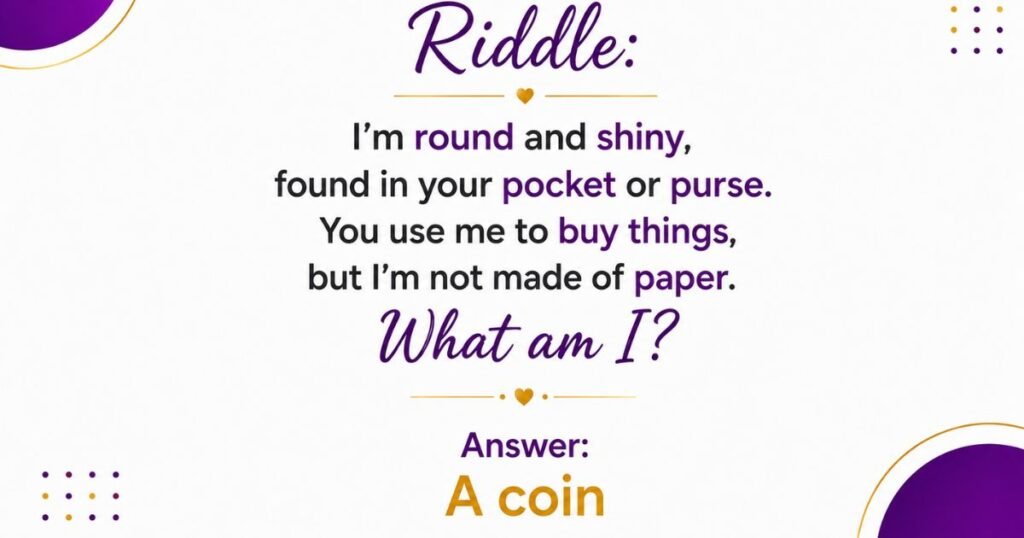
Explanation: Straightforward misdirection paper usually implies writing, but currency paper is off-limits. - Riddle: I jingle in your pocket, I’m round and shiny too, save me in a piggy bank what am I to you?
Answer: A coin (money)
Difficulty: Easy
Explanation: This is a simple money riddle for kids that uses familiar clues like jingling in a pocket and being kept in a piggy bank, helping young children easily connect the description to a coin.
Medium Money Riddles for Family Game Night
These riddles ask solvers to hold two clues in mind at once perfect for a family game night or classroom riddle-of-the-day with a slightly older crowd.
- Riddle: Two coins add up to 35 cents, and one of them is not a nickel. What are the two coins?
Answer: A quarter and a nickel.
Difficulty: Medium
Explanation: Classic logic misdirection “one is not a nickel” is true because the other coin is the nickel. - Riddle: Is an old $50 bill worth more than a brand-new one?
Answer: No they’re worth exactly the same, $50, regardless of age.
Difficulty: Medium
Explanation: A trick question that tests whether solvers confuse currency value with collectible/antique value. - Riddle: What has a hundred pennies but no legs to stand on?
Answer: A dollar’s worth of loose change in a jar.
Difficulty: Medium
Explanation: Combines a math fact (100 pennies = $1) with a visual riddle format. - Riddle: I travel the world, change hands constantly, yet I never wear out my welcome. What am I?
Answer: Money (currency).
Difficulty: Medium
Explanation: Personifies currency circulating through an economy “changing hands” is literal banking language. - Riddle: A wallet holds three bills worth $27 total, and no bill is worth the same. What could the bills be?
Answer: A $20, a $5, and a $2 bill (or $20 + $6 + $1 depending on denominations available). Difficulty: Medium
Explanation: Open logic puzzle solvers must find combinations of distinct denominations that sum correctly. - Riddle: What kind of bank never charges a fee?
Answer: A riverbank (or a blood bank) no financial fees apply because it’s not a financial institution.
Difficulty: Medium
Explanation: Homograph riddle “bank” has multiple unrelated meanings, and the punchline exploits that. - Riddle: I am a place with vaults, tellers, and interest, but I’m not always made of brick. What am I?
Answer: A bank (including online/digital banks).
Difficulty: Medium
Explanation: Updates the classic “bank” riddle for the digital-banking era, testing modern financial vocabulary. - Riddle: You start with $10. You spend half, then earn back a third of what’s left. How much do you have?
Answer: $6.67 (spend $5, left with $5, earn back $1.67).
Difficulty: Medium
Explanation: Two-step arithmetic riddle that reinforces fractions in a money context. - Riddle: What has a currency symbol but is never spent?
Answer: A keyboard key (the $ or € symbol).
Difficulty: Medium
Explanation: Redirects “currency symbol” away from actual money toward the printed character itself. - Riddle: I go up when the economy is strong and down when it’s weak, but I’m not a stock. What am I?
Answer: Consumer confidence (or currency exchange rate).
Difficulty: Medium
Explanation: Introduces an economic concept as the riddle’s answer rather than a physical object. - Riddle: Which weighs more: a pound of pennies or a pound of dollar bills?
Answer: They weigh the same one pound is one pound, regardless of what it’s made of. Difficulty: Medium
Explanation: A classic “weight vs. value” trick question that tests basic reasoning under a money theme. - Riddle: What has interest but never gets bored?
Answer: A savings account.
Difficulty: Medium
Explanation: Double meaning of “interest” curiosity versus the percentage a bank pays you. - Riddle: I am kept secret, used every day, and made of four digits. What am I?
Answer: A PIN number.
Difficulty: Medium
Explanation: Ties financial security (PIN codes) to riddle logic, reinforcing a real-world money-safety concept. - Riddle: If a soda costs $1.25 more than a candy bar, and together they cost $3.75, how much is the candy bar?
Answer: $1.25 (soda is $2.50, candy bar is $1.25).
Difficulty: Medium
Explanation: A budgeting-style algebra riddle disguised as a snack-shopping scenario. - Riddle: What do you call a rich cow?
Answer: A cash cow.
Difficulty: Medium
Explanation: Builds on the real idiom “cash cow,” teaching solvers common money slang. - Riddle: I have a limit, but I’m not a rule. Spend past me and you’ll owe more than you borrowed. What am I?
Answer: A credit card.
Difficulty: Medium
Explanation: Introduces the concept of a credit limit in riddle form, useful for teen financial-literacy lessons. - Riddle: What single word can follow “piggy,” “food,” and “blood” to make three different things people save?
Answer: Bank (piggy bank, food bank, blood bank).
Difficulty: Medium
Explanation: A compound-word riddle that shows how “bank” changes meaning depending on context. - Riddle: I’m a coin flipped nine times, landing on heads every time. What’s the chance the tenth flip is also heads?
Answer: Still 50% each flip is independent of the last.
Difficulty: Medium
Explanation: Classic probability riddle that corrects the “gambler’s fallacy” using a coin-flip setup. - Riddle: What do you call money that’s passed down in a family?
Answer: Inheritance.
Difficulty: Medium
Explanation: Straightforward vocabulary riddle introducing an important financial-literacy term. - Riddle: I shrink every year even if you never spend me, because prices keep rising. What economic force am I?
Answer: Inflation.
Difficulty: Medium
Explanation: Personifies inflation eroding purchasing power a real economic concept wrapped in riddle language. - Riddle: I can buy almost anything but not happiness, I grow in a bank but not in soil, and I disappear fastest when I’m needed most. What am I?
Answer: Money
Difficulty: Medium
Explanation: This works for both money riddles for adults and money riddles for kids since it mixes an easy financial clue (growing in a bank) with a thoughtful twist (buying happiness) that adults will appreciate more.
Hard Money Riddles and Brain Teasers for Adults
Bring these out when the easy ones stop being a challenge. Several require multi-step math or careful re-reading of the wording.
- Riddle: A bottle and a cork together cost $1.10. The bottle costs $1.00 more than the cork. How much is the cork?
Answer: 5 cents (bottle = $1.05, cork = $0.05).
Difficulty: Hard
Explanation: A famous cognitive-bias riddle most people instinctively answer 10 cents, which is wrong; the “$1 more” is relative to the cork, not zero. - Riddle: Five coworkers split a $200 bonus evenly. Each person gets 25% of the total. How is that possible?
Answer: It isn’t literally possible with five people at 25% each the riddle exposes a math error, since four people at 25% already equals 100%. With five, each actually gets 20%. Difficulty: Hard
Explanation: Tests whether solvers catch a false premise a step used in logic and critical-thinking exercises. - Riddle: Joe has ten coins totaling $1.19, yet he cannot make exact change for a dollar, half-dollar, quarter, dime, or nickel. What coins does he have?
Answer: One half-dollar, one quarter, four dimes, and four pennies.
Difficulty: Hard
Explanation: A constraint-satisfaction riddle every combination must be tested against five “cannot make change for” rules simultaneously. - Riddle: I have four qualities: I’m durable, divisible, portable, and hard to fake. What financial concept am I?
Answer: Money (specifically the properties of good currency).
Difficulty: Hard
Explanation: Draws on actual economics coursework these four traits are textbook criteria for effective currency. - Riddle: A shopkeeper is robbed of $100 from the register without noticing. Later, the thief returns, spends $70 of that same $100 on goods, and receives $30 in change. How much did the shopkeeper actually lose?
Answer: $100 the sale itself doesn’t create a second loss, since the thief paid with the shopkeeper’s own stolen money.
Difficulty: Hard
Explanation: A well-known logic trap; people often double-count the loss by adding the $70 sale on top of the theft. - Riddle: You have $29. You buy 4 items at $3 each and 4 items at $2 each, then spend the rest on one more item. How much did that last item cost?
Answer: $9 ($29 − $12 − $8 = $9).
Difficulty: Hard
Explanation: Multi-step subtraction riddle that mimics real budgeting math. - Riddle: I have two faces stamped from the same coin, yet no one has ever seen both faces of me at once. What am I?
Answer: A coin lying on a surface (only one face is ever visible at a time).
Difficulty: Hard
Explanation: A perspective riddle the trick is realizing “at once” refers to viewing angle, not the coin’s two literal sides. - Riddle: What financial instrument is created when someone promises to pay a debt at a future date, with proof but no cash exchanged yet?
Answer: A promissory note (or an IOU/bond).
Difficulty: Hard
Explanation: Introduces a real financial term through a definitional riddle format. - Riddle: If a $10 bill and a $1 bill are the only US denominations you can use, and you need to pay exactly $47 using the fewest bills possible, how many bills do you use?
Answer: 11 bills (four $10 bills + seven $1 bills = 4 + 7 = 11).
Difficulty: Hard
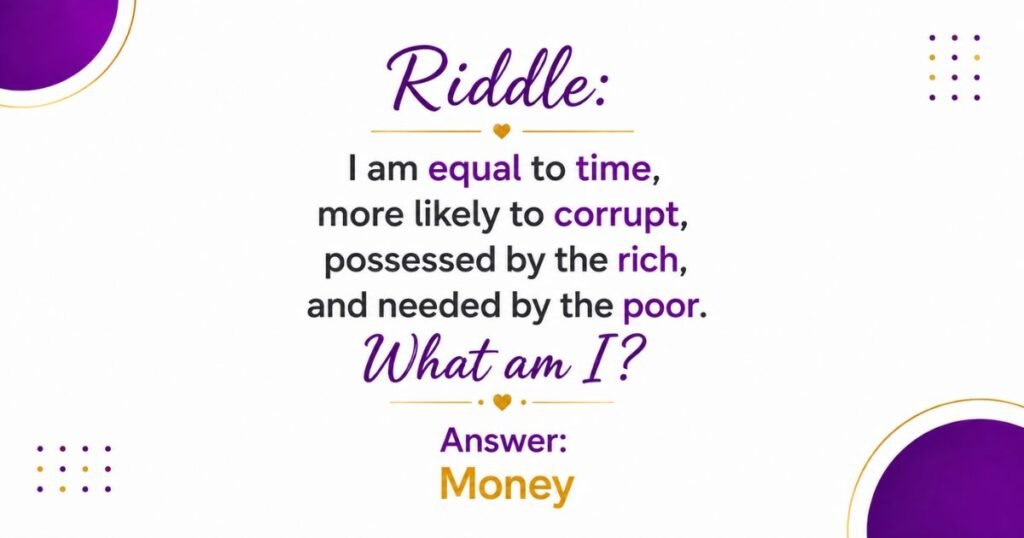
Explanation: A “greedy algorithm” style riddle solvers instinctively use the largest denomination first, then fill the remainder. - Riddle: I am equal to time, more likely to corrupt, possessed by the rich, and needed by the poor. What am I?
Answer: Money.
Difficulty: Hard
Explanation: A layered metaphor riddle referencing the classic saying “time is money,” requiring solvers to connect multiple abstract clues.
- Riddle: A man has $63 to give away and only six bills, none of which are $1 bills. What bills does he use?
Answer: One $50 bill, one $5 bill, and four $2 bills.
Difficulty: Hard
Explanation: Constraint riddle involving less-common denominations (like the $2 bill), forcing solvers outside their usual mental toolkit. - Riddle: I have a value that changes daily depending on what other countries think I’m worth. What am I?
Answer: A currency’s exchange rate.
Difficulty: Hard
Explanation: A finance-focused riddle introducing foreign exchange as a concept for older teens and adults. - Riddle: What can be earned, saved, invested, and lost, yet has no physical form when it’s digital?
Answer: Money (in the form of digital currency or bank balances).
Difficulty: Hard
Explanation: Modernized version of a classic riddle, updated to include cashless money. - Riddle: Two coins total $0.30, and one of them is not a dime. What are they?
Answer: A quarter and a nickel.
Difficulty: Hard
Explanation: Same misdirection family as riddle #21, but the totals and target coin are swapped to require re-solving from scratch. - Riddle: I can be short, long, or fixed, and businesses use me to plan repayment. What am I?
Answer: A loan term.
Difficulty: Hard
Explanation: Introduces real lending vocabulary (loan terms) through riddle logic. - Riddle: A collector has two coins marked “George I” and “George IV.” One is real, one is a forgery. Which one is fake?
Answer: The “George I” coin no monarch would be numbered “the First” while they’re reigning, since that title is only assigned in hindsight once a “George II” exists.
Difficulty: Hard
Explanation: A historical-logic riddle; the trick relies on understanding how regnal numbers are assigned. - Riddle: I have three US coins that are not a quarter, dime, or penny, and together they total 60 cents. What are they?
Answer: A half-dollar and two nickels.
Difficulty: Hard
Explanation: Requires knowledge of less-common denominations (the half-dollar coin) to solve. - Riddle: What is the difference between a dollar and a half, and thirty-five nickels?
Answer: Nothing thirty-five nickels equal $1.75, the same as “a dollar and a half” if read as $1.50… actually the riddle hinges on wordplay: “a dollar and a half” sounds like “thirty-five cents” when said quickly, which is the real trick.
Difficulty: Hard
Explanation: A verbal sound-alike riddle that only works when read aloud it plays with how “dollar-and-a-half” and “thirty-five” can be mumbled to sound similar. - Riddle: I’m made, but never told; I’m taken, but never known; and once you understand me, you no longer want me. What am I?
Answer: Counterfeit money
Difficulty: Hard
Explanation: A riddle-poem format each clause hints at secrecy and deception, core traits of counterfeit currency. - Riddle: My first part often greets guests at the front door. My second part is a breakfast grain. My third part is what everyone chases. Put together, I’m one of the fifty states. What am I?
Answer: Matrimony (MAT + RYE + MONEY) playing on the idea of a “united state” of marriage.
Difficulty: Hard
Explanation: A charade-style riddle combining three unrelated word fragments into a compound pun. - Riddle: I’m made of paper, worth a hundred trips to the store, I’ve got a face on me that’s over 200 years old what dollar bill am I?
Answer: A $100 bill
Difficulty: Easy
Explanation: This works across money riddles $100, money riddles for adults, and money riddles for kids since it uses a simple, direct clue (a face over 200 years old) that both age groups can quickly figure out.
Funny Money Riddles and One-Liners
Less brain strain, more groan-worthy laughs these work great as captions or a quick joke break.
- Riddle: Why don’t cows ever have any money?
Answer: Because farmers milk them dry.
Difficulty: Easy
Explanation: Pun technique: misdirection, connecting “milking a cow” to “milking someone for money.” - Riddle: Where does a snowman keep his cash?
Answer: In a snow bank.
Difficulty: Easy
Explanation: Straightforward compound-word pun combining “snow” and “bank.” - Riddle: Why is the moon like a dollar bill?
Answer: Because it has four quarters.
Difficulty: Easy
Explanation: Double meaning of “quarters” moon phases versus 25-cent coins. - Riddle: What did the dollar bill say to the four quarters?
Answer: “You’ve really changed!”
Difficulty: Easy
Explanation: Pun on “change” literal coin change versus a personal transformation. - Riddle: What do you get when you toss a penny and a quarter into the ocean?
Answer: Wet money or, less money, since you just threw it away.
Difficulty: Easy
Explanation: An anti-punchline riddle where the humor comes from stating the obvious. - Riddle: What did the British tourist lose after a week at the gym?
Answer: Pounds both weight and currency.
Difficulty: Medium
Explanation: Homograph pun exploiting the two meanings of “pounds” (weight and British currency). - Riddle: Why is a stale pie a lot like counterfeit money?
Answer: Because it’s not “currant” (current).
Difficulty: Medium
Explanation: Homophone pun between the fruit “currant” and the word “current.” - Riddle: What’s the easiest way to double your money?
Answer: Fold it in half and look at it in a mirror.
Difficulty: Easy
Explanation: Visual-trick punchline “doubling” is achieved through reflection, not math. - Riddle: What did the broke ghost say?
Answer: “I’m going through a rough spatial period” or more simply, “I’m too poor to haunt anyone properly!”
Difficulty: Easy
Explanation: Absurdist humor riddle, less about wordplay and more about an unexpected punchline twist. - Riddle: Why did the coin apply for a job?
Answer: Because it wanted to make some sense (cents).
Difficulty: Easy
Explanation: Homophone pun between “sense” and “cents.” - Riddle: What do you call a wealthy elf?
Answer: Welfy McCash or more simply, “well-off.”
Difficulty: Easy
Explanation: Wordplay riddle combining “wealthy” and “elf” for a silly portmanteau punchline. - Riddle: Why did the piggy bank go to therapy?
Answer: It had too much emotional baggage and not enough spare change.
Difficulty: Easy
Explanation: Anti-joke structure sets up a serious premise, then undercuts it with a money pun. - Riddle: What did one penny say to the other penny at the family reunion?
Answer: “Long time no see, we make perfect cents together!”
Difficulty: Easy
Explanation: Homophone pun on “sense/cents,” a repeat technique used across several riddles in this collection to reinforce the trick for kids. - Riddle: Why do vampires prefer blood money?
Answer: Because it’s the only currency that really speaks to them.
Difficulty: Easy
Explanation: Plays on the real idiom “blood money,” combined with vampire lore for a silly twist. - Riddle: What do you call a bank robber who only steals loose change?
Answer: A small-time crook.
Difficulty: Easy
Explanation: Idiom-based pun “small-time” usually means minor, but here it’s paired with literally small coins. - Riddle: Why did the dollar bill break up with the coin?
Answer: It said there was just no change happening in the relationship.
Difficulty: Easy
Explanation: Double meaning of “change” applied to a relationship metaphor. - Riddle: What’s a pirate’s favorite way to save money?
Answer: Buried treasure it’s a savings account with zero interest but great security. Difficulty: Easy
Explanation: Plays on real financial vocabulary (savings, interest, security) wrapped in a pirate joke. - Riddle: Why did the banker switch careers?
Answer: He lost interest.
Difficulty: Easy
Explanation: Double meaning of “interest” motivation versus the percentage banks pay on deposits. - Riddle: What do you call money that isn’t real?
Answer: Fake news no wait, funny money!
Difficulty: Easy
Explanation: Wordplay riddle building on the real slang term “funny money” for counterfeit or play currency. - Riddle: Why don’t skeletons ever have any money?
Answer: Because they’re all bone-dry broke.
Difficulty: Easy
Explanation: Combines the idiom “bone dry” with skeleton imagery for a silly visual pun. - Riddle: The more you spend me, the less of me you have, yet the more you invest me, the more I multiply. I’m not alive, but I have “growth.” What am I?
Answer: Money
Difficulty: Medium
Explanation: This fits money riddles with answers for adults since it uses a subtle contradiction (spending vs. investing) that requires a bit more thought than a simple kids’ riddle.
Math and Logic Money Riddles
These lean on arithmetic and probability rather than puns great for reinforcing math skills alongside financial literacy.
- Riddle: If you flip a coin and it lands on heads five times in a row, what’s the probability the next flip is heads?
Answer: 50%.
Difficulty: Medium
Explanation: Reinforces that each coin flip is an independent event; past results don’t change future odds. - Riddle: A jar has $5 in nickels. How many nickels are in the jar?
Answer: 100 nickels.
Difficulty: Easy
Explanation: Simple division: $5 ÷ $0.05 = 100. - Riddle: You save $2 the first week, and double your savings every week after. How much do you save in week 5?
Answer: $32 (week 1: $2, week 2: $4, week 3: $8, week 4: $16, week 5: $32).
Difficulty: Medium
Explanation: Introduces exponential growth using a savings example the same math behind compound interest. - Riddle: Would you rather have $1 million today, or a penny that doubles in value every day for 30 days?
Answer: The doubling penny after 30 days it’s worth over $5.3 million.
Difficulty: Hard
Explanation: Classic exponential-growth riddle that surprises most solvers who assume $1 million is automatically larger. - Riddle: A piggy bank holds only quarters and dimes, 20 coins total, worth $3.35. How many of each coin are there?
Answer: 7 quarters and 13 dimes.
Difficulty: Hard
Explanation: A system-of-equations riddle disguised as a word problem solvable with basic algebra or trial and error. - Riddle: If a candy costs 3 for $1, how many can you buy with $5?
Answer: 15 candies.
Difficulty: Easy
Explanation: Straightforward proportional-reasoning riddle. - Riddle: You have 18 white socks and 18 blue socks mixed in a drawer, but you need a matching pair in the dark. How many socks must you pull to guarantee a match?
Answer: 3 socks.
Difficulty: Medium
Explanation: A pigeonhole-principle riddle with only two colors, the third sock must match one of the first two. - Riddle: If a train ticket costs $12 and prices rise 8% next year, what’s the new price (to the nearest cent)?
Answer: $12.96.
Difficulty: Medium
Explanation: Introduces percentage-increase math using inflation as the real-world hook. - Riddle: A charity raises $840 split evenly among 7 local schools. How much does each school get?
Answer: $120.
Difficulty: Easy
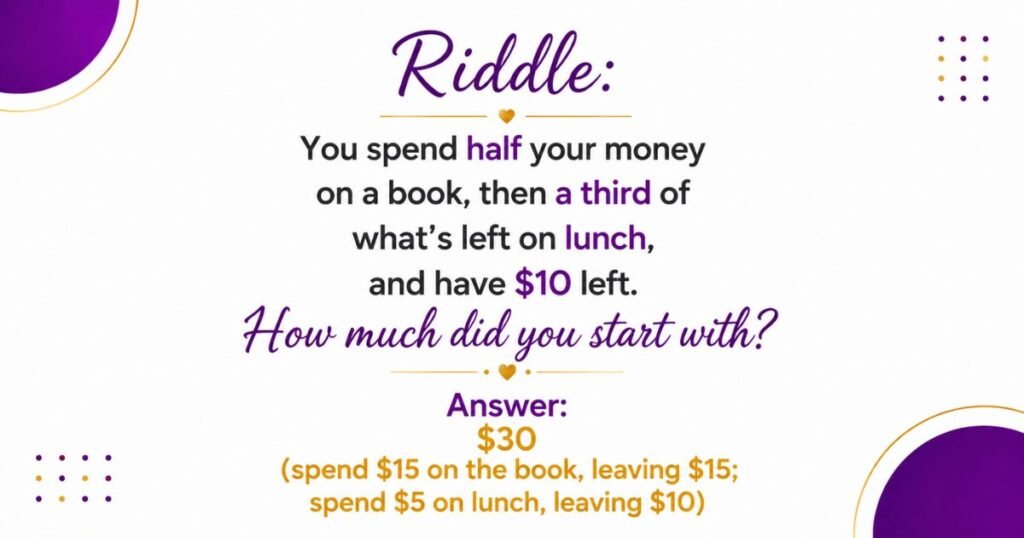
Explanation: Simple division riddle framed around a real-world budgeting scenario. - Riddle: You spend half your money on a book, then a third of what’s left on lunch, and have $10 left. How much did you start with?
Answer: $30 (spend $15 on the book, leaving $15; spend $5 on lunch, leaving $10). Difficulty: Hard
Explanation: A reverse-engineering riddle solvers must work backward through each fraction step.
- Riddle: If a stock price drops 20% then rises 20%, is it back to its original price?
Answer: No it ends lower, because the 20% gain is calculated on a smaller starting number. Difficulty: Hard
Explanation: A classic percentage-trap riddle that shows why percentage changes aren’t simply reversible. - Riddle: Two piggy banks together hold $45. One has $15 more than the other. How much is in each?
Answer: $15 and $30.
Difficulty: Medium
Explanation: Basic system-of-equations riddle solvable with simple substitution. - Riddle: If you save $50 a month for a year, how much will you have saved by December, assuming no interest?
Answer: $600.
Difficulty: Easy
Explanation: Simple multiplication riddle establishing the concept of consistent monthly saving. - Riddle: A vending machine only accepts quarters. A snack costs $1.75. How many quarters do you need?
Answer: 7 quarters.
Difficulty: Easy
Explanation: Basic division riddle reinforcing coin-value fluency. - Riddle: If you invest $100 at 5% simple interest per year, how much interest have you earned after 3 years?
Answer: $15.
Difficulty: Medium
Explanation: Introduces simple interest calculation (principal × rate × time), a foundational finance concept. - Riddle: You and 3 friends split a $360,000,000 lottery prize evenly. Each of you claims to have gotten 25% of the total. Is that possible for all 4 people to say?
Answer: Yes with exactly 4 people, 25% each adds up correctly to 100%.
Difficulty: Medium
Explanation: A companion riddle to that shows when the “25% each” math actually does work, reinforcing the earlier lesson by contrast. - Riddle: A wallet contains twice as many $1 bills as $5 bills, and the total value is $28. How many of each bill are there?
Answer: 4 five-dollar bills and 8 one-dollar bills.
Difficulty: Hard
Explanation: Algebraic riddle requiring solvers to set up and solve a simple equation with two variables. - Riddle: If a $250 jacket goes on sale for 30% off, then an extra 10% off the sale price, what’s the final cost?
Answer: $157.50.
Difficulty: Hard
Explanation: Stacked-discount riddle showing that successive percentage discounts don’t simply add together (30%+10% ≠ 40% off). - Riddle: You flip a fair coin 3 times. What is the probability you get exactly two heads?
Answer: 3/8 (37.5%).
Difficulty: Hard
Explanation: A probability riddle requiring solvers to count the combinations (HHT, HTH, THH) out of 8 total possible outcomes. - Riddle: A bank pays 4% interest, compounded annually, on a $1,000 deposit. How much is in the account after 2 years?
Answer: $1,081.60.
Difficulty: Hard
Explanation: Introduces compound interest math, where year two’s interest is calculated on the new balance ($1,040), not the original $1,000. - Riddle: Three friends split a bill, get a refund, but somehow one dollar mysteriously seems to vanish in the math. What confusing puzzle am I?
Answer: The missing dollar riddle
Difficulty: Hard
Explanation: This nods to the classic money riddle missing dollar puzzle, known for tricking people with clever number arrangement rather than an actual missing dollar the “trick” is in how the math is presented, not real money disappearing.
Tips for Using Money Riddles at Home or in the Classroom
- Start easy, build up: Open with a few Easy riddles to build confidence before moving into Medium and Hard tiers
- Use them as a financial-literacy warm-up: Riddles about interest, inflation, and loans double as gentle introductions to real concepts
- Turn it into a game: Time each round, or award points based on difficulty level to keep older and younger kids engaged together
- Encourage explanations, not just answers: Ask kids to explain why the answer works this reinforces the underlying wordplay or math skill
- Rotate categories: Mix a funny one-liner between two math riddles to keep energy up during longer sessions
More Brain Teasers to Test Your Math and Logic
If the Hard Money Riddles and Math and Logic sections above kept you thinking, Riddles for Adults collection has more probability puzzles, wordplay, and lateral-thinking challenges built for the same sharp-minded crowd.
And for a wider mix of curated riddle collections beyond money and math, browse Spanish Riddles category for more themed sets like this one.
Conclusion
Whether you’re running a classroom warm-up, filling a road trip, or just looking for a fun way to talk about money with your kids, these 100 money riddles cover every level from simple coin puns to compound-interest brain teasers.
Bookmark this page, pick a difficulty tier that fits your group, and work your way through the categories together. Got a favorite or a riddle of your own? Share it in the comments or pass this list along to a friend who loves a good challenge.
FAQs
What are Some Good Money Riddles for Kids?
Easy, short riddles work best for younger kids puzzles like “I have a head and a tail but nobody” (a coin) .
What is the Answer to “I have a Head and a Tail But no Body”?
The answer is a coin. The riddle plays on the fact that coins have a “heads” side (usually a portrait) and a “tails” side (usually a different design), even though neither side is an actual body part.
Why are Money Riddles Good for Teaching Financial literacy?
Money riddles introduce financial vocabulary like interest, inflation, savings, and currency in a low-pressure, game-like format. Kids and teens absorb these terms naturally while trying to solve the puzzle rather than through a lecture-style lesson.
What are Some Hard Money Riddles for Adults?
Riddles involving multi-step math, probability, or classic logic traps work well for adults for example, the “bottle and cork” or the doubling-penny both of which trick most solvers into an intuitive.
How do you Make up your own Money Riddle?
Start with a money-related object (a coin, bill, bank, or concept like interest) and find a word or phrase with a double meaning related to it like “change,” “interest,” or “bank.”
Is the Money Riddle Missing Pound based on real money loss?
No, it’s purely a logic and math trick no actual pound goes missing; it’s a puzzle about how numbers are grouped and presented.
What are Funny Riddles with Answers?
They’re lighthearted riddles built around jokes, wordplay, or silly twists, paired with their answers so readers get an instant laugh once they solve or read them.