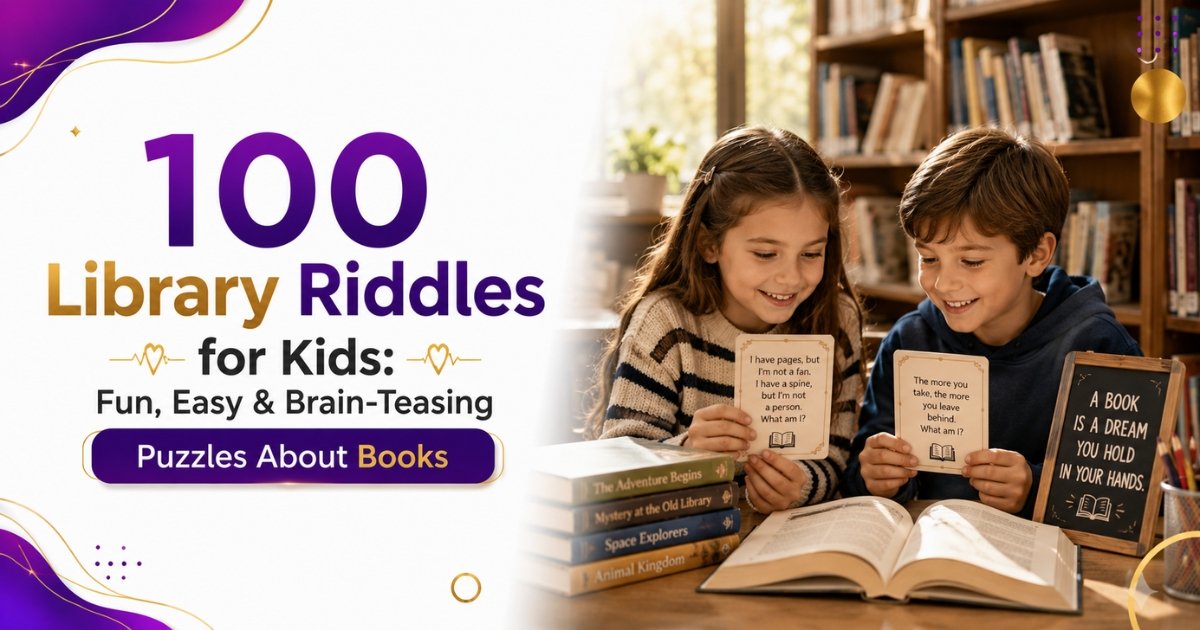
100 Library Riddles for Kids: Fun, Easy and Brain-Teasing Puzzles About Books
Library riddles are short brain teasers built around books, reading, and the library itself, usually pointing to an answer like “book,” “librarian,” or “bookshelf,” with plenty of funny riddles mixed in.
Below are 100 completely original library riddles for kids, sorted into 8 themed categories from easy to hard.
Why Library Riddles Help Kids and Why They’re Fun?
Riddles ask a child to hold two things in their head at once, the clue and a guess, and test that guess against the evidence before committing to an answer.
That’s the same skill used in reading comprehension, where a reader has to track a description across a page before the meaning clicks.
Easy Library Riddles for Kids
These riddles are the best library riddle for kids just getting started short, direct clues answerable in one guess. Use them first with younger children or as warm-ups before moving into the trickier categories below.
- Riddle: I have pages, a cover, and I never make a sound. What am I?
Answer: A book
Difficulty: Easy
Explanation: Straightforward descriptive clues about a book’s basic parts. - Riddle: I hold hundreds of books, but I’m not a store. What am I?
Answer: A library
Difficulty: Easy
Explanation: Simple place-riddle that distinguishes a library from a bookstore.
- Riddle: I sit on a shelf until someone picks me up to read. What am I?
Answer: A book
Difficulty: Easy
Explanation: Everyday object riddle told from the object’s point of view. - Riddle: I’m the quiet rule everyone follows near the bookshelves. What am I?
Answer: “Shhh” (silence)
Difficulty: Easy
Explanation: Abstract-concept riddle tied to a familiar library behavior. - Riddle: I help you find your page again after you close a book. What am I?
Answer: A bookmark
Difficulty: Easy
Explanation: Functional-object riddle based on purpose rather than appearance. - Riddle: I’m a small card that lets you borrow books for free. What am I?
Answer: A library card
Difficulty: Easy
Explanation: Practical object riddle introducing how borrowing works. - Riddle: I stand tall and hold rows of books in neat lines. What am I?
Answer: A bookshelf
Difficulty: Easy
Explanation: Descriptive object riddle focused on shape and function. - Riddle: I have a front cover, a back cover, and a story in between. What am I?
Answer: A book
Difficulty: Easy
Explanation: Structural description that reinforces basic book vocabulary. - Riddle: I’m the person who helps you find the perfect book to read. Who am I?
Answer: A librarian
Difficulty: Easy
Explanation: Person-based riddle introducing a key library role. - Riddle: I’m full of short stories made just for little kids, with big pictures. What am I?
Answer: A picture book
Difficulty: Easy
Explanation: Descriptive riddle distinguishing picture books from chapter books. - Riddle: I beep at the front desk whenever a book gets checked out. What am I?
Answer: A scanner
Difficulty: Easy
Explanation: Sensory clue (the beep) tied to a familiar library process. - Riddle: I’m the small sticker on a book’s spine that tells you where it belongs. What am I? Answer: A call number label
Difficulty: Easy
Explanation: Introduces the idea that every book has an “address” on the shelf. - Riddle: I’m a cart on wheels that carries returned books back to their shelves. What am I? Answer: A book cart
Difficulty: Easy
Explanation: Everyday library-object riddle based on function. - Riddle: I’m the day you have to bring your book back, or you might owe a fine. What am I? Answer: The due date
Difficulty: Easy
Explanation: Introduces the concept of borrowing with a deadline. - Riddle: I’m the cozy corner where kids sit and listen to a story read aloud. What am I? Answer: A story-time corner
Difficulty: Easy
Explanation: Place-based riddle tied to a common library program.
Book and Story Riddles
Once the warm-ups are done, this section of library riddles for kids leans into the parts of a story itself titles, authors, and endings, building real reading vocabulary along the way.
- Riddle: I have a spine, but I’ve never been to the doctor. What am I?
Answer: A book
Difficulty: Easy
Explanation: Classic pun on “spine” the binding edge of a book versus a body part. - Riddle: I can take you to a castle, the moon, or a jungle, all without leaving your chair. What am I?
Answer: A story
Difficulty: Easy
Explanation: Highlights how reading transports the imagination without physical movement. - Riddle: I begin with “Once upon a time” more often than any other kind of book. What am I? Answer: A fairy tale
Difficulty: Easy
Explanation: Uses a familiar opening phrase as the main clue. - Riddle: I’m the very first page of a book, before the story even begins. What am I?
Answer: The title page
Difficulty: Medium
Explanation: Introduces a specific book-structure term less commonly known by younger readers. - Riddle: I’m the short paragraph on the back cover that tells you what the book is about. What am I?
Answer: The blurb
Difficulty: Medium
Explanation: Teaches the term for a book’s promotional summary.
- Riddle: I’m a book written about someone’s real life, usually by that very same person. What am I?
Answer: An autobiography
Difficulty: Medium
Explanation: Distinguishes an autobiography from a biography written by someone else. - Riddle: I’m a made-up story, even though I might feel completely real. What am I?
Answer: Fiction
Difficulty: Medium
Explanation: Reinforces the fiction/nonfiction distinction used throughout libraries. - Riddle: I’m the opposite of fiction, everything inside me actually happened. What am I? Answer: Nonfiction
Difficulty: Medium
Explanation: Companion riddle to the fiction riddle above. - Riddle: I’m the artist who draws the pictures inside a picture book. Who am I?
Answer: An illustrator
Difficulty: Medium
Explanation: Introduces a role distinct from the author. - Riddle: I’m the paper jacket that wraps around a hardcover book to show off its cover art. What am I?
Answer: A dust jacket
Difficulty: Medium
Explanation: Names a specific book part many kids have handled but never labeled. - Riddle: I’m the very last part of a story, where everything gets wrapped up. What am I? Answer: The ending
Difficulty: Easy
Explanation: Simple structural riddle about story sequence. - Riddle: I’m a group of books that all follow the same characters, one after another. What am I? Answer: A book series
Difficulty: Easy
Explanation: Everyday reading-habit riddle familiar to most young readers. - Riddle: I’m the person whose name is printed on the cover because they wrote the story. Who am I?
Answer: An author
Difficulty: Easy
Explanation: Basic role-identification riddle. - Riddle: I’m a story so spooky it’s usually saved for October nights. What am I?
Answer: A horror story
Difficulty: Easy
Explanation: Genre riddle tied to a seasonal reading habit. - Riddle: I’m the moment in a story when something completely unexpected happens. What am I? Answer: A plot twist
Difficulty: Hard
Explanation: Abstract literary-device riddle aimed at more advanced readers.
Read More: 100 Sweet Love Riddles for Kids: Cute, Funny and Heartwarming
Funny Library Riddles
These fun riddles lean fully into puns. They’re built for reading aloud the punchline lands best when spoken, not just read silently.
- Riddle: Why did the book join the police?
Answer: Because it wanted to go undercover.
Difficulty: Medium
Explanation: Pun on “undercover” a book cover versus a secret police assignment. - Riddle: Why was the library book embarrassed?
Answer: Because it had lost its jacket.
Difficulty: Easy
Explanation: Pun on “jacket” a dust jacket versus an item of clothing. - Riddle: What did the librarian say when the noisy kid finally left?
Answer: “Well, that was novel.”
Difficulty: Hard
Explanation: Double meaning of “novel” a type of book versus something unusual. - Riddle: Why did the dictionary get top marks in school?
Answer: Because it had all the right words.
Difficulty: Medium
Explanation: Literal-meaning joke built on a dictionary’s actual purpose.
- Riddle: Why don’t books ever get lost?
Answer: Because they always know their place, on the shelf.
Difficulty: Easy
Explanation: Double meaning of “knowing your place,” literal and idiomatic. - Riddle: What’s a library’s favorite kind of math?
Answer: Fine-ance, figuring out the late fees.
Difficulty: Hard
Explanation: Blended-word pun combining “fine” (late fee) and “finance.” - Riddle: Why did the comic book feel super?
Answer: Because it was full of hero-ic tales.
Difficulty: Medium
Explanation: Pun stretching “heroic” to echo “hero,” matching the comic-book theme. - Riddle: What do you call a book about someone who checks out too many library books? Answer: A real page-turner.
Difficulty: Hard
Explanation: Double meaning of “page-turner” an exciting book versus someone constantly flipping pages. - Riddle: Why was the encyclopedia always so confident?
Answer: Because it knew everything.
Difficulty: Easy
Explanation: Simple, literal joke about an encyclopedia’s purpose. - Riddle: Why did the bookshelf apply for a promotion?
Answer: It felt it deserved more “shelf”-respect.
Difficulty: Hard
Explanation: Homophone pun on “self-respect” using “shelf.” - Riddle: Why did the librarian bring a ladder to work?
Answer: To reach the highest level of reading.
Difficulty: Medium
Explanation: Double meaning of “level” a physical shelf height versus a reading level. - Riddle: What’s a ghost’s favorite section of the library?
Answer: The “boo”-graphy section.
Difficulty: Medium
Explanation: Sound-alike pun swapping “bio” for “boo.” - Riddle: Why did the library stay busy during the storm?
Answer: Because it was the best place to “weather” a quiet afternoon.
Difficulty: Hard
Explanation: Double meaning of “weather” the storm versus the idiom “weather it out.” - Riddle: Why did the picture book win an award?
Answer: Because it was very illustrious.
Difficulty: Hard
Explanation: Pun linking “illustrious” (distinguished) to “illustrated.” - Riddle: Why do library books make terrible secret keepers?
Answer: Because they’re always getting checked.
Difficulty: Medium
Explanation: Double meaning of “checked” checked out of the library versus checked for secrets.
Librarian & Library Staff Riddles
Many of the best ones focus on the librarian, since that single role covers dozens of everyday library riddle tasks as shown below.
- Riddle: I know exactly where every book belongs, even in a library with a million titles. Who am I?
Answer: A librarian
Difficulty: Easy
Explanation: Straightforward role riddle about organizational expertise. - Riddle: I stamp a date inside your book so you remember when to bring it back. What am I? Answer: A due-date stamp
Difficulty: Easy
Explanation: Object riddle tied to the borrowing process.
- Riddle: I answer questions all day but almost never raise my voice. Who am I?
Answer: A librarian
Difficulty: Easy
Explanation: Behavior-based clue reinforcing library etiquette. - Riddle: I help kids pick their very first chapter book with just the right amount of adventure. Who am I?
Answer: A children’s librarian
Difficulty: Medium
Explanation: More specific role riddle, distinguishing a specialty within librarianship. - Riddle: I organize story time, puppet shows, and summer reading challenges. Who am I? Answer: A librarian
Difficulty: Medium
Explanation: Highlights the event-planning side of the job, not just shelving books. - Riddle: I’m the friendly reminder sent when your book is a few days late. What am I? Answer: An overdue notice
Difficulty: Medium
Explanation: Introduces real library-process vocabulary. - Riddle: I’m the small fee sometimes owed for returning a book past its due date. What am I? Answer: A late fine
Difficulty: Easy
Explanation: Simple concept riddle about library policy. - Riddle: I bring a book from another library when your local branch doesn’t have it. What am I?
Answer: An interlibrary loan
Difficulty: Hard
Explanation: Introduces an advanced library-science term for older readers. - Riddle: I’m the system that puts fiction books in order by the author’s last name. What am I? Answer: Alphabetical shelving
Difficulty: Medium
Explanation: Teaches how fiction is organized, distinct from the nonfiction system covered later. - Riddle: I greet every visitor at the front desk and check their books in and out. Who am I? Answer: A circulation librarian
Difficulty: Medium
Explanation: Names a specific librarian role tied to a real job title.
Library Objectsand Tools Riddles
- Riddle: I’m a drawer of cards, or a computer screen, that tells you exactly where a book lives. What am I?
Answer: A catalog
Difficulty: Medium
Explanation: Bridges the old card-catalog system with its modern digital version. - Riddle: I’m a set of numbers and letters on a book’s spine that tells you its exact shelf address. What am I?
Answer: A call number
Difficulty: Hard
Explanation: Reinforces the “shelf address” concept introduced earlier at a more technical level. - Riddle: I magnify tiny old newspaper print onto a big screen so you can read it clearly. What am I? Answer: A microfilm reader
Difficulty: Hard
Explanation: Introduces a specialized library machine most kids have never seen.
- Riddle: I’m a quiet little booth where you can plug in a laptop and work in peace. What am I? Answer: A study carrel
Difficulty: Medium
Explanation: Names a specific library furniture term. - Riddle: I quietly copy a page of a book onto a fresh sheet of paper. What am I?
Answer: A photocopier
Difficulty: Easy
Explanation: Everyday-object riddle based on function. - Riddle: I’m the small paper slip you leave inside a book to save your spot. What am I? Answer: A bookmark
Difficulty: Easy
Explanation: Simple functional-object riddle, reinforced from the easy section with new phrasing. - Riddle: I’m the tall ladder librarians use to reach the very top shelf safely. What am I? Answer: A library ladder
Difficulty: Easy
Explanation: Descriptive object riddle tied to library safety equipment. - Riddle: I’m the machine at the front desk that beeps once when a book gets checked out. What am I?
Answer: A barcode scanner
Difficulty: Easy
Explanation: Reinforces the earlier “scanner” riddle with a more specific term. - Riddle: I’m the box near the entrance where you can return books even after closing time. What am I?
Answer: A book drop
Difficulty: Medium
Explanation: Introduces an object many kids notice but rarely name correctly. - Riddle: I’m a digital version of a book you can read on a screen instead of paper. What am I? Answer: An e-book
Difficulty: Easy
Explanation: Modern-technology riddle contrasting print and digital reading.
Tricky Library Brain Teasers
The trickier the riddle, the more it forces a reader to slow down and reread carefully, exactly the skill that transfers to tackling a difficult paragraph in a book.
- Riddle: The more stories I hold, the heavier I get, yet I never grow legs to carry them. What am I?
Answer: A bookshelf
Difficulty: Medium
Explanation: Personification riddle building on cause and effect (more books = more weight). - Riddle: I have thousands of “leaves,” but I’m not a tree, and every one is covered in words. What am I?
Answer: A book
Difficulty: Medium
Explanation: Homophone wordplay “leaves” as an old term for pages versus tree leaves. - Riddle: I have a spine, a cover, and a thousand voices, yet I never speak out loud. What am I? Answer: A book
Difficulty: Medium
Explanation: Personification riddle referencing the many characters inside a story. - Riddle: What gets “checked” in a library but is never actually inspected?
Answer: A book (checked out)
Difficulty: Hard
Explanation: Wordplay on “checked” the borrowing process versus a physical inspection. - Riddle: I’m full of chapters, but I’ve never once been to school. What am I?
Answer: A book
Difficulty: Easy
Explanation: Simple wordplay contrasting “chapters” in a book with school class periods.

- Riddle: A library had 120 books on the new-release shelf on Monday. By Friday, only 12 remained, but none were lost, damaged, or thrown away. Where did the rest go?
Answer: They were checked out by readers.
Difficulty: Hard
Explanation: Logic riddle that tests the assumption that “missing” always means “lost.” - Riddle: I can be renewed just like a library book, but I’m not made of paper, I happen every January. What am I?
Answer: A resolution
Difficulty: Hard
Explanation: Lateral-thinking riddle linking the library concept of “renewal” to an unrelated context. - Riddle: I hold the entire alphabet in order, but I’m not a song. What am I?
Answer: A dictionary
Difficulty: Medium
Explanation: Misdirection riddle nudging solvers toward the alphabet song before revealing the real answer. - Riddle: What has many “stories” but isn’t a building, and many “chapters” but isn’t a school? Answer: A book
Difficulty: Medium
Explanation: Combines two separate puns, “stories” (floors vs. tales) and “chapters” into a single riddle. - Riddle: I open to reveal a whole new world, but I never actually move. What am I?
Answer: A book
Difficulty: Easy
Explanation: Simple paradox riddle contrasting stillness with imaginative movement.
Famous Authors and Real Library History Riddles
It’s the numbering system librarian Melvil Dewey invented in 1876 to organize nonfiction books by subject, and most public libraries still use a version of it today.
Steel magnate Andrew Carnegie did the riddles below turn both facts, along with a few famous authors, into playable clues.
- Riddle: I wrote about a boy wizard who discovers his true identity at platform 9¾. Who am I?
Answer: J.K. Rowling
Difficulty: Medium
Explanation: Real-author riddle tied to a widely recognized story detail. - Riddle: I created a detective who lived on Baker Street and solved mysteries with a magnifying glass. Who am I?
Answer: Arthur Conan Doyle
Difficulty: Medium
Explanation: Real-author riddle using a famous character’s address as the clue.
- Riddle: I wrote a story about a girl who falls down a rabbit hole into a very strange world. Who am I?
Answer: Lewis Carroll
Difficulty: Medium
Explanation: Descriptive-plot riddle pointing to a classic children’s book. - Riddle: I wrote about hobbits, wizards, and a powerful ring in a land called Middle-earth. Who am I?
Answer: J.R.R. Tolkien
Difficulty: Medium
Explanation: Setting-based riddle naming a well-known fantasy author. - Riddle: I wrote fairy tales about a mermaid, an ugly duckling, and a little match girl. Who am I?
Answer: Hans Christian Andersen
Difficulty: Hard
Explanation: Requires connecting three different famous fairy tales to a single author. - Riddle: I’m the printing invention that made books cheap enough for regular people to own for the first time. What am I?
Answer: The printing press
Difficulty: Hard
Explanation: Real historical fact, Johannes Gutenberg’s printing press revolutionized book access in the 1400s. - Riddle: I’m the librarian’s numbering system, invented in 1876, that organizes nonfiction books by subject. What am I?
Answer: The Dewey Decimal System
Difficulty: Hard
Explanation: Real, verifiable library-science fact directly answering the PAA question above. - Riddle: I’m the largest library in the world, located in Washington, D.C. What am I?
Answer: The Library of Congress
Difficulty: Hard
Explanation: Real, verifiable fact about the world’s largest library by collection size. - Riddle: I’m the wealthy businessman who funded the construction of over 2,500 public libraries around the world. Who am I?
Answer: Andrew Carnegie
Difficulty: Hard
Explanation: Real historical fact about the Carnegie library-building program of the late 1800s and early 1900s. - Riddle: I’m the week every April when librarians celebrate how much libraries matter to their communities. What am I?
Answer: National Library Week
Difficulty: Medium
Explanation: Introduces a real, dated observance many school libraries celebrate.
Library Sections and Reference Riddles
This final set of library riddles for kids doubles as a mini tour of the library itself, offering riddles with answers and riddles. that help older kids learn which section to visit for a school research project.
- Riddle: I hold maps of every country, ocean, and mountain range in the world. What am I? Answer: An atlas
Difficulty: Easy
Explanation: Descriptive reference-book riddle. - Riddle: I explain what a word means when you don’t recognize it. What am I?
Answer: A dictionary
Difficulty: Easy
Explanation: Basic reference-tool riddle. - Riddle: I’m full of short articles about everything from animals to outer space, organized alphabetically. What am I?
Answer: An encyclopedia
Difficulty: Medium
Explanation: Descriptive riddle distinguishing an encyclopedia from a dictionary.
- Riddle: I tell you which words mean almost the same thing as another word. What am I? Answer: A thesaurus
Difficulty: Medium
Explanation: Functional riddle for a less commonly named reference tool. - Riddle: I’m the section where you’ll find true stories about real people’s lives. What am I? Answer: The biography section
Difficulty: Easy
Explanation: Section-based riddle reinforcing the nonfiction theme. - Riddle: I’m the section packed with dragons, spells, and made-up magical worlds. What am I?
Answer: The fantasy section
Difficulty: Easy
Explanation: Genre-section riddle with vivid imagery clues. - Riddle: I’m the section where detectives, clues, and plot twists live. What am I?
Answer: The mystery section
Difficulty: Easy
Explanation: Genre-section riddle connecting back to the earlier plot-twist riddle. - Riddle: I’m the section where robots, spaceships, and future worlds are found. What am I? Answer: The science fiction section
Difficulty: Medium
Explanation: Genre-section riddle for a slightly less obvious category. - Riddle: I’m the section filled with rhyming lines and clever wordplay instead of long paragraphs. What am I?
Answer: The poetry section
Difficulty: Medium
Explanation: Format-based riddle distinguishing poetry from prose. - Riddle: I’m the section with facts you can look up quickly but usually can’t check out. What am I?
Answer: The reference section
Difficulty: Hard
Explanation: Introduces the real library policy that reference materials typically stay in the building. - Riddle: I’m the paper that comes out every single day, packed with the newest headlines. What am I?
Answer: A newspaper
Difficulty: Easy
Explanation: Everyday-object riddle based on publishing frequency. - Riddle: I come out monthly or weekly, with glossy pages and colorful pictures on a single topic. What am I?
Answer: A magazine
Difficulty: Medium
Explanation: Companion riddle to the newspaper riddle, distinguishing the two formats. - Riddle: I’m the section where kids find picture books with big pictures and just a few words per page. What am I?
Answer: The picture book section
Difficulty: Easy
Explanation: Age-appropriate section riddle for the youngest readers. - Riddle: I’m a paper record kept for many years to preserve history, old letters, maps, and photographs. What am I?
Answer: An archive
Difficulty: Hard
Explanation: Introduces a specialized library-science term for advanced readers. - Riddle: I’m the free area of the library where you can use a computer, connect to Wi-Fi, or print homework. What am I?
Answer: The computer section
Difficulty: Medium
Explanation: Modern-library riddle highlighting a resource beyond books.
Conclusion
Libraries pack more into one building than almost any other place kids visit, funny puns, real history, and a hundred different genres, all in one quiet room, the kind of mix that makes library riddles for kids, riddles for adults, book riddles, reading riddles, and librarian riddles so easy to build.
Use these 100 library riddles for kids as a classroom warm-up, a school library scavenger-hunt starter, or a book-club icebreaker, and lean on the difficulty ratings to match the right riddle to the right reader.
FAQS
What is a Good Riddle About a Library?
A good library riddle uses a familiar object or role, a book, a librarian, a bookshelf, and pairs it with a clue that has more than one possible reading, so the solver has to think past the obvious first guess.
What is the Dewey Decimal System?
It’s the numbering system librarian Melvil Dewey invented in 1876 to organize nonfiction books by subject, and most public libraries still use a version of it today.
Why are Libraries Important for Kids?
Libraries give kids free, unlimited access to books, a quiet space to focus, and resources like computers and Wi-Fi, all of which support reading skills and lifelong learning.
Who Funded Thousands of Public Libraries in the Early 1900s?
Steel magnate Andrew Carnegie funded the construction of more than 2,500 public libraries worldwide during the late 1800s and early 1900s.
Do Riddles Actually Help Improve Reading Skills?
Yes, library riddles build book-related vocabulary and train kids to catch double meanings and wordplay, a skill that transfers directly to reading comprehension.