Moon Riddles With Answers: 100 Fun Riddles About the Moon
Because the moon gives you so much to work with: it glows without making its own light, changes shape every night, and quietly controls the ocean tides from 238,000 miles away.
After reading these moon riddles aloud during three different stargazing nights with a group of 8-to-10-year-olds, the ones below are the riddles that got kids looking up at the actual sky afterward, not just guessing “the moon” and moving on.
This list of 100 riddles about the moon is organized by difficulty, so you can pick a gentle rhyme for a bedtime routine or a genuine science stumper for an adult trivia night.
All the moon riddles in English below come with a plain-language answer and explanation.
What Makes a Good Moon Riddle?
A moon riddle works the same way any good riddle does: it hides an obvious answer behind unfamiliar language.
Because the moon has so many distinct traits its phases, its glow, its pull on the tides writers can approach it from dozens of angles without repeating themselves.
The oldest moon riddles lean on simple description (“I shine at night but I’m not a star”), while modern moon riddles pull in real astronomy, like the fact that the moon is tidally locked and always shows Earth the same face.
That range is what makes moon riddles for kids different from moon riddles for adults. A five-year-old just needs a rhyme pointing at something round and glowing.
A teenager or adult, though, appreciates a riddle that smuggles in a genuine science fact like the moon drifting about 3.8 centimeters farther from Earth every year inside a clever turn of phrase.
Easy Moon Riddles for Kids
These are simple “what am I” style moon riddles, perfect for young kids just learning to connect a clue to an answer. Every riddle in this section has the same answer: the moon.
- Riddle: I glow at night but I’m not a lamp. What am I?
Answer: The moon.
Difficulty: Easy
Explanation: A direct contrast riddle something that glows but isn’t a man-made light source. - Riddle: I follow you home when the sky turns dark. What am I?
Answer: The moon.
Difficulty: Easy
Explanation: Plays on the childhood impression that the moon “follows” a moving car or walker.
- Riddle: I’m round some nights and just a sliver on others. What am I?
Answer: The moon.
Difficulty: Easy
Explanation: Introduces the idea of shape-changing without naming “phases” yet. - Riddle: I come out when the sun goes to sleep. What am I?
Answer: The moon.
Difficulty: Easy
Explanation: Personifies the sun and moon taking turns, a common way kids first learn day and night. - Riddle: I hang in the sky but I’m not a bird or a plane. What am I?
Answer: The moon.
Difficulty: Easy
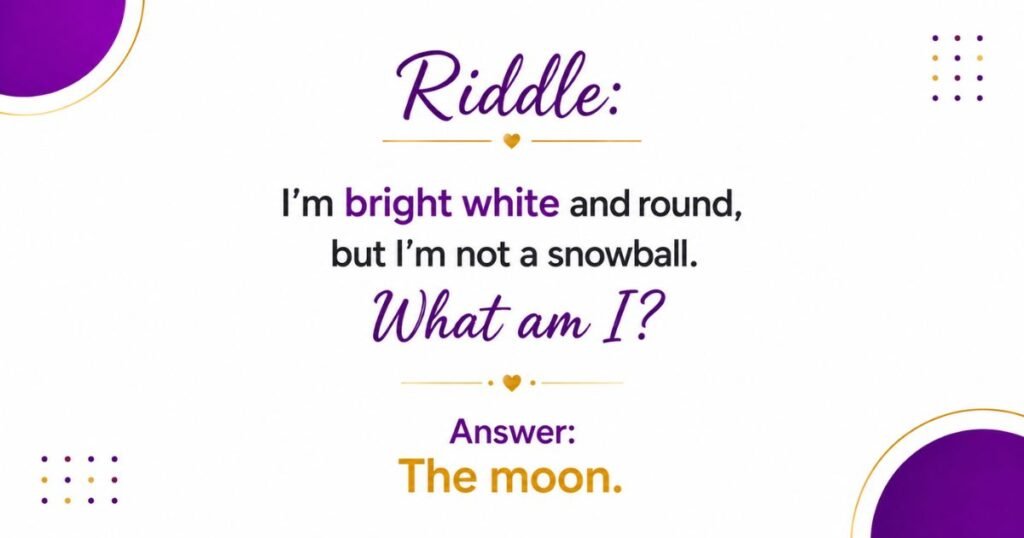
Explanation: A misdirection riddle ruling out the two most common “things in the sky” a child might guess first. - Riddle: I’m bright white and round, but I’m not a snowball. What am I?
Answer: The moon.
Difficulty: Easy
Explanation: Uses a familiar shape (a snowball) as a decoy before landing on the real answer. - Riddle: I help you see in the dark, but I’m not a flashlight. What am I?
Answer: The moon.
Difficulty: Easy
Explanation: Introduces the moon’s practical role in providing nighttime light. - Riddle: I have a face, but I never talk or smile. What am I?
Answer: The moon (the “man in the moon”).
Difficulty: Easy
Explanation: Refers to the shadow pattern people call the “man in the moon.” - Riddle: I’m in the sky every night, even when clouds hide me. What am I?
Answer: The moon.
Difficulty: Easy
Explanation: Teaches kids the moon is always present, even when it’s not visible. - Riddle: I’m silver in the sky but I’m not a coin. What am I?
Answer: The moon.
Difficulty: Easy
Explanation: A color-and-shape riddle using a coin as a familiar decoy object. - Riddle: I light up the night without any batteries. What am I?
Answer: The moon.
Difficulty: Easy
Explanation: A modern twist ruling out battery-powered lights as the source of the glow. - Riddle: I sit high above the trees but I never fall. What am I?
Answer: The moon.
Difficulty: Easy
Explanation: Plays on the idea of something “up high” that defies gravity from a child’s point of view. - Riddle: I’m the brightest thing in the sky once the sun is gone. What am I?
Answer: The moon.
Difficulty: Easy
Explanation: A comparison riddle that requires knowing the sun disappears at night. - Riddle: I show up in stories about wishes and lullabies. What am I?
Answer: The moon.
Difficulty: Easy
Explanation: Leans on cultural references (moon songs, bedtime stories) rather than physical clues. - Riddle: I don’t have legs, but I still seem to walk across the sky each night. What am I?
Answer: The moon.
Difficulty: Easy
Explanation: Describes the moon’s slow visible movement across the night sky. - Riddle: I share the sky with stars, but I’m much bigger and closer. What am I?
Answer: The moon.
Difficulty: Easy
Explanation: Introduces a simple size-and-distance comparison to stars. - Riddle: I’m round like a ball, but nobody can bounce me. What am I?
Answer: The moon.
Difficulty: Easy
Explanation: A playful, physical impossibility riddle for young kids. - Riddle: I’m made of rock, but I look like I’m made of light. What am I?
Answer: The moon.
Difficulty: Easy
Explanation: Introduces the fact that the moon is solid rock, despite its glowing appearance. - Riddle: I come out to play while you’re fast asleep. What am I?
Answer: The moon.
Difficulty: Easy
Explanation: A gentle bedtime-style riddle pairing the moon with sleep. - Riddle: I’m sometimes a circle and sometimes just a smile shape. What am I?
Answer: The moon.
Difficulty: Easy
Explanation: Introduces the crescent shape as a “smile” for young children. - Riddle: I light the path for night owls and campers alike. What am I?
Answer: The moon.
Difficulty: Easy
Explanation: Ties the moon to real nighttime activities like camping. - Riddle: I hang in the sky but you can never touch me, no matter how tall you grow. What am I?
Answer: The moon.
Difficulty: Easy
Explanation: A distance-based riddle appropriate for young children learning about “far away.” - Riddle: I’m the reason the night sky is never completely black. What am I?
Answer: The moon.
Difficulty: Easy
Explanation: Introduces the moon’s role in lighting the sky, contrasted with total darkness. - Riddle: I show up in nursery rhymes about cows and spoons. What am I?
Answer: The moon.
Difficulty: Easy
Explanation: References the “Hey Diddle Diddle” nursery rhyme without quoting it directly. - Riddle: I’m Earth’s closest neighbor in space. What am I?
Answer: The moon.
Difficulty: Easy
Explanation: A simple factual riddle introducing the idea of the moon as a nearby space object.
Moon Phase Riddles (Medium)
Looking specifically for full moon riddles? Riddles #27 and #34 below focus on the full moon phase. This section moves past “the moon” as a single answer and tests specific moon phases and related terms a gap most competitor lists skip entirely.
- Riddle: I’m the moon at my roundest, brightest, and best. What phase am I?
Answer: Full moon.
Difficulty: Medium
Explanation: Requires knowing “full moon” as a specific phase name, not just “the moon.” - Riddle: I’m the moon you can’t see at all, hiding between the sun and Earth. What phase am I?
Answer: New moon.
Difficulty: Medium
Explanation: Introduces the astronomy behind why the new moon phase looks invisible. - Riddle: I’m a thin curved sliver, often compared to a smile or a fingernail. What am I?
Answer: Crescent moon.
Difficulty: Medium
Explanation: Uses two common visual comparisons for the crescent shape. - Riddle: I’m growing bigger each night, on my way to becoming full. What am I doing?
Answer: Waxing.
Difficulty: Medium
Explanation: Tests the vocabulary word “waxing,” which many riddle lists skip in favor of just “the moon.”
- Riddle: I’m shrinking each night after being full, on my way to disappearing. What am I doing?
Answer: Waning.
Difficulty: Medium
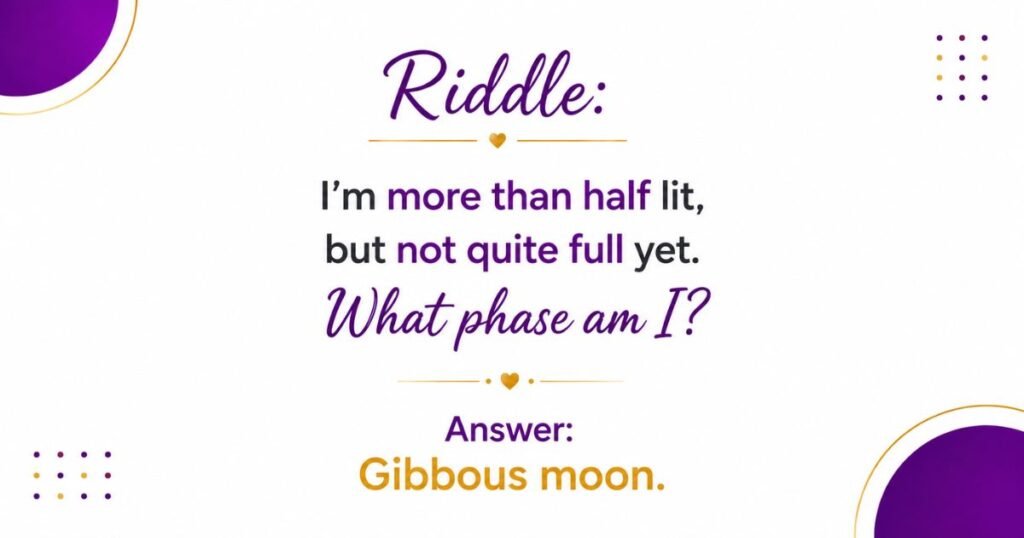
Explanation: The direct counterpart to “waxing,” reinforcing phase vocabulary. - Riddle: I’m more than half lit, but not quite full yet. What phase am I?
Answer: Gibbous moon.
Difficulty: Medium
Explanation: Introduces a lesser-known phase name most casual readers don’t know. - Riddle: I’m exactly half-lit, split clean down the middle. What phase am I?
Answer: Quarter moon (also called a half moon).
Difficulty: Medium
Explanation: Clarifies the naming confusion between “quarter” and “half” moon. - Riddle: I happen twice in one calendar month, which is rarer than you’d think. What am I?
Answer: A blue moon.
Difficulty: Medium
Explanation: Explains the real definition behind the idiom “once in a blue moon.” - Riddle: I look bigger and brighter than usual because I’m closer to Earth in my orbit. What am I?
Answer: A supermoon.
Difficulty: Medium
Explanation: Grounds the riddle in the real astronomical cause of a supermoon. - Riddle: I turn the moon a reddish color during a certain kind of eclipse. What event am I part of?
Answer: A total lunar eclipse (sometimes called a “blood moon”).
Difficulty: Medium
Explanation: Connects the color change to Earth’s shadow bending sunlight, without over-explaining the physics. - Riddle: I block the sun completely, but only from certain spots on Earth. What event involves me?
Answer: A total solar eclipse.
Difficulty: Medium
Explanation: Tests the difference between lunar and solar eclipses. - Riddle: I’m the dark side that Earth never sees, even though it’s not actually always dark. What am I called?
Answer: The far side of the moon.
Difficulty: Medium
Explanation: Clarifies the common misconception that the “dark side” is permanently dark rather than simply unseen from Earth. - Riddle: I’m the visible half that Earth always looks at, month after month. What am I called?
Answer: The near side of the moon.
Difficulty: Medium
Explanation: Pairs with riddle #37 to reinforce near-side/far-side vocabulary. - Riddle: I’m the imaginary line marking where day meets night on the moon’s surface. What am I?
Answer: The terminator.
Difficulty: Medium
Explanation: Introduces a genuine astronomy term unfamiliar to most casual readers. - Riddle: I’m the second full moon in a single month, and I’m rarer than most people realize. What am I?
Answer: A blue moon (companion riddle to #33, phrased differently for repetition without duplication).
Difficulty: Medium
Explanation: Reinforces the calendar-based definition from a different angle. - Riddle: I happen when a full moon lines up with the moon’s closest point to Earth. What am I?
Answer: A supermoon (companion to #34, phrased around orbital mechanics).
Difficulty: Medium
Explanation: Adds the technical detail of perigee (closest orbital point) without naming it directly. - Riddle: I’m the moon phase right after new, when just a thin edge starts to appear. What am I?
Answer: Waxing crescent.
Difficulty: Medium
Explanation: Combines two vocabulary words (waxing + crescent) into one specific phase name. - Riddle: I’m the moon phase right before new, when the last sliver is about to vanish. What am I?
Answer: Waning crescent.
Difficulty: Medium
Explanation: The mirror-image phase to #42, closing out the full lunar cycle. - Riddle: I’m the point in the moon’s orbit when it’s farthest from Earth. What am I called?
Answer: Apogee.
Difficulty: Medium
Explanation: Pairs with the supermoon riddles to introduce the opposite orbital term. - Riddle: I take about 29.5 days to go from empty to full and back again. What cycle am I?
Answer: The lunar cycle (or lunar month).
Difficulty: Medium
Explanation: States a real, verifiable astronomy fact as the riddle’s core clue. - Riddle: I’m the reason ancient calendars were often built around 12 to 13 of me each year. What am I?
Answer: A lunar month.
Difficulty: Medium
Explanation: Ties the lunar month to the historical origin of early calendars. - Riddle: I’m a full moon that appears smaller and dimmer because I’m farther from Earth. What am I?
Answer: A micromoon.
Difficulty: Medium
Explanation: The lesser-known opposite of a supermoon. - Riddle: I’m the moment the moon completely disappears into Earth’s shadow. What event am I?
Answer: Totality (during a total lunar eclipse).
Difficulty: Medium
Explanation: Introduces the specific term “totality” used by astronomers. - Riddle: I’m the glow that surrounds the moon during a partial eclipse, before totality hits. What phase of the event am I?
Answer: Partial eclipse.
Difficulty: Medium
Explanation: Distinguishes “partial” from “total” eclipse terminology. - Riddle: I happen every 29.5 days, and without me, sailors and farmers once struggled to keep track of time. What am I?
Answer: A full lunar cycle.
Difficulty: Medium
Explanation: Adds historical context (navigation and farming calendars) to the lunar cycle fact from #45.
Tricky Wordplay Moon Riddles
This set leans on puns, idioms, and double meanings tied to the moon the kind of riddle that rewards adults and older kids who enjoy language tricks.
- Riddle: What word describes both the sun disappearing behind the moon and the moon disappearing into Earth’s shadow?
Answer: Eclipse.
Difficulty: Tricky
Explanation: Tests whether the solver knows “eclipse” covers both solar and lunar events, not just one. - Riddle: What do you call the moon when it skips dessert?
Answer: A “new moon” (a pun on “no moon”).
Difficulty: Tricky
Explanation: A homophone-style pun between “new” and “no,” playing on the moon’s invisible phase. - Riddle: Why did the moon refuse to lend money?
Answer: Because it was already full (a pun on being “full” of light versus “full” financially).
Difficulty: Tricky
Explanation: Double meaning of “full” a lunar phase and a state of having enough resources. - Riddle: What did the astronaut say about the moon’s cooking?
Answer: It has no atmosphere (a pun on lacking “atmosphere” both literally and as in ambiance).
Difficulty: Tricky
Explanation: Uses “atmosphere” in its scientific sense and its social/ambiance sense at once. - Riddle: I’m the part of “moonlight” that isn’t actually light the moon makes itself. What am I?
Answer: Reflected sunlight.
Difficulty: Tricky
Explanation: Corrects the common assumption that the moon generates its own light. - Riddle: What do you call a moon that tells jokes?
Answer: A “comedian” or more playfully, a “lunar-tic” (a pun on “lunatic,” derived historically from “luna”).
Difficulty: Tricky
Explanation: References the real word origin of “lunatic,” once believed to be caused by the moon’s influence. - Riddle: I’m the shadow Earth casts that causes a lunar eclipse, but I’m not the moon itself. What am I?
Answer: Earth’s shadow (umbra).
Difficulty: Tricky
Explanation: Forces the solver to separate the moon from the actual cause of its eclipse color change.
- Riddle: What do sailors call the tide that’s strongest, tied to a full or new moon?
Answer: A spring tide.
Difficulty: Tricky
Explanation: “Spring” here refers to the tide “springing up,” not the season a common point of confusion. - Riddle: What do you call the weakest tide, occurring during a quarter moon?
Answer: A neap tide.
Difficulty: Tricky
Explanation: Pairs with #58 to complete the tide-vocabulary pair most riddle lists never mention. - Riddle: I’m the force the moon uses to move oceans without ever touching the water. What am I?
Answer: Gravity.
Difficulty: Tricky
Explanation: A “how does this work” riddle rather than a “what is it” riddle, testing scientific reasoning. - Riddle: What do you call it when the full moon makes people swear it changes behavior, even though studies don’t back it up?
Answer: The “lunar effect” (a myth, not a proven phenomenon).
Difficulty: Tricky
Explanation: Introduces the term for a widely believed but scientifically unsupported idea. - Riddle: I’m the name for the moon illusion that makes it look huge near the horizon, even though it’s the same size as when it’s overhead. What am I?
Answer: The moon illusion.
Difficulty: Tricky
Explanation: Clarifies that the size change is a perceptual trick, not an actual size difference. - Riddle: What’s the moon’s version of a nickname, borrowed from ancient Rome?
Answer: Luna.
Difficulty: Tricky
Explanation: Ties the Roman goddess name to the modern scientific root “lunar.” - Riddle: I’m the term for a moon orbiting a moon something our moon doesn’t have, as far as we know. What am I?
Answer: A moonmoon (informally) or sub-satellite.
Difficulty: Tricky
Explanation: A playful, lesser-known astronomy trivia term. - Riddle: What do you call the fine, powdery dust covering the moon’s surface?
Answer: Regolith (moon dust).
Difficulty: Tricky
Explanation: Introduces the scientific term for lunar soil, distinct from “sand” or “dirt.” - Riddle: I’m the name for a crater caused by an object slamming into the moon, not by anything Earthly. What am I?
Answer: An impact crater.
Difficulty: Tricky
Explanation: Clarifies the cause of the moon’s pockmarked surface. - Riddle: What do you call the dark, flat plains visible on the moon that early astronomers mistook for seas?
Answer: Maria (Latin for “seas”).
Difficulty: Tricky
Explanation: A genuine historical-scientific fact about how early observers misread the moon’s surface. - Riddle: I’m the fictional material some old stories claimed the moon was made of. What am I?
Answer: Green cheese.
Difficulty: Tricky
Explanation: References the old English idiom “the moon is made of green cheese,” a folklore riddle rather than a factual one. - Riddle: What do you call it when Earth, not the moon, blocks the sunlight during an eclipse?
Answer: A lunar eclipse (Earth blocks sunlight from reaching the moon).
Difficulty: Tricky
Explanation: Corrects a common mix-up between solar and lunar eclipse mechanics. - Riddle: I’m the calendar based entirely on the moon’s phases rather than the sun’s position. What am I?
Answer: A lunar calendar.
Difficulty: Tricky
Explanation: Distinguishes lunar calendars (like the Islamic calendar) from solar calendars. - Riddle: What do you call the moment the moon passes directly between the sun and Earth?
Answer: A new moon (or a solar eclipse, if the alignment is exact).
Difficulty: Tricky
Explanation: Tests whether the solver knows a new moon and a solar eclipse both involve this alignment, just at different precision levels. - Riddle: I’m the name for the point where the moon is closest to Earth in its orbit. What am I?
Answer: Perigee.
Difficulty: Tricky
Explanation: Completes the apogee/perigee pair introduced earlier in the phase section. - Riddle: What do you call a person who studies the moon and other celestial bodies?
Answer: An astronomer.
Difficulty: Tricky
Explanation: A simple definitional riddle testing basic science vocabulary. - Riddle: I’m the invisible pull that keeps the moon orbiting Earth instead of drifting into space. What am I?
Answer: Gravity (Earth’s gravitational pull).
Difficulty: Tricky
Explanation: A companion to riddle #60, applied to orbital mechanics instead of tides. - Riddle: What do you call the moon’s very slow spin, which matches its orbit so perfectly that we only ever see one face?
Answer: Tidal locking (synchronous rotation).
Difficulty: Tricky
Explanation: Sets up the deeper science explored fully in the hard section below.
Hard Science-Based Moon Riddles
These riddles use verified lunar facts and lateral thinking. They’re the best moon riddles for adults, astronomy fans, or older kids who want a genuine challenge.
- Riddle: I always show the same face to my neighbor, never once turning my back, though I never stop spinning. What am I, and what’s this called?
Answer: The moon; the phenomenon is called tidal locking.
Difficulty: Hard
Explanation: The moon’s rotation period matches its orbital period exactly, so the same “near side” always faces Earth. - Riddle: I’m moving away from my closest neighbor at about the speed a fingernail grows. What am I doing, and how fast?
Answer: The moon is drifting from Earth by about 3.8 centimeters per year.
Difficulty: Hard
Explanation: A verified NASA-tracked measurement from laser reflectors left on the moon during Apollo missions. - Riddle: Only 12 people in all of human history have ever walked on me. Who am I?
Answer: The moon.
Difficulty: Hard
Explanation: Refers to the 12 Apollo astronauts who walked on the lunar surface between 1969 and 1972.
- Riddle: I travel around my host at roughly 2,300 miles per hour, yet from the ground, I look like I’m barely moving. What am I?
Answer: The moon.
Difficulty: Hard
Explanation: Its orbital speed is fast in absolute terms, but its distance makes the movement appear slow to an observer on Earth. - Riddle: I don’t cause the tides alone my larger neighbor, the sun, helps too, but I do most of the work. Why is that?
Answer: Because the moon is much closer to Earth, its gravitational pull on the oceans is stronger than the sun’s, despite the sun being far more massive.
Difficulty: Hard
Explanation: A genuine physics fact proximity matters more than raw mass for tidal force. - Riddle: I have no wind, no rain, and no erosion, so footprints left on me could last millions of years. What am I?
Answer: The moon.
Difficulty: Hard
Explanation: Without an atmosphere, the moon has no weather to erase surface disturbances like footprints. - Riddle: I’m not a planet, yet without me, Earth’s tilt might wobble wildly over time. What role do I play?
Answer: The moon stabilizes Earth’s axial tilt.
Difficulty: Hard
Explanation: Scientists believe the moon’s gravity helps keep Earth’s tilt (and therefore its seasons) relatively steady. - Riddle: I’m the reason a day on Earth is roughly 24 hours instead of much shorter, according to how scientists believe Earth’s spin has slowed over time. What am I?
Answer: The moon (its gravitational drag has gradually slowed Earth’s rotation).
Difficulty: Hard
Explanation: Billions of years ago, Earth’s day was significantly shorter; lunar tidal friction is a major reason it has lengthened. - Riddle: I formed, according to the leading scientific theory, after a Mars-sized object slammed into a young Earth. What am I?
Answer: The moon (per the giant-impact hypothesis).
Difficulty: Hard
Explanation: The giant-impact hypothesis is the most widely accepted scientific explanation for the moon’s formation. - Riddle: I have quakes, just like Earth does, but mine are caused by tidal stress rather than shifting tectonic plates. What are these events called?
Answer: Moonquakes.
Difficulty: Hard
Explanation: Seismometers left by Apollo missions recorded genuine moonquakes, some caused by Earth’s gravitational pull. - Riddle: I have no magnetic field today, but rocks brought back from my surface suggest I once had one. What am I?
Answer: The moon.
Difficulty: Hard
Explanation: Lunar rock samples show signs of ancient magnetism, though the moon’s core no longer generates one. - Riddle: I appear larger when I’m low on the horizon, though a photograph proves I’m exactly the same size as when I’m high overhead. What’s this effect called?
Answer: The moon illusion.
Difficulty: Hard
Explanation: A well-documented perceptual effect, not an actual change in the moon’s apparent size, which a camera confirms stays constant. - Riddle: I have permanently shadowed craters near my poles that may hold frozen water, untouched by sunlight for billions of years. What am I?
Answer: The moon.
Difficulty: Hard
Explanation: Refers to real, scientifically confirmed ice deposits found in permanently shadowed polar craters. - Riddle: My surface temperature swings from over 250°F in sunlight to nearly -200°F in shadow, all without an atmosphere to soften the extremes. What am I?
Answer: The moon.
Difficulty: Hard
Explanation: Without an atmosphere to trap or distribute heat, temperature swings on the moon are far more extreme than on Earth. - Riddle: I’m named after a Roman goddess, but my English adjective form comes from the Latin word for the same idea. What’s the adjective?
Answer: Lunar (from “Luna”).
Difficulty: Hard
Explanation: Tests the etymological link between the Roman moon goddess Luna and the modern scientific term “lunar.” - Riddle: I’m large enough, relative to my host planet, that some scientists call the Earth-moon system a “double planet.” Why is that comparison made?
Answer: Because the moon is unusually large relative to Earth compared to most other planet-moon pairs in the solar system.
Difficulty: Hard
Explanation: The moon’s size relative to Earth is proportionally larger than nearly any other moon-to-planet ratio in the solar system, aside from Pluto and Charon. - Riddle: I reflect only about 12% of the sunlight that hits me, roughly the reflectivity of asphalt, yet I still light up the night sky. What am I?
Answer: The moon.
Difficulty: Hard
Explanation: The moon’s surface is actually quite dark; it only appears bright because of the contrast against the night sky. - Riddle: I don’t have rings like Saturn, but I do have a thin, temporary, almost undetectable layer of dust particles suspended above my surface. What is this called?
Answer: An exosphere (a very thin, transient lunar atmosphere).
Difficulty: Hard
Explanation: The moon technically has an extremely sparse exosphere, though it’s far too thin to be considered a true atmosphere. - Riddle: I’m responsible for a “supermoon” looking up to 14% larger and 30% brighter than my most distant counterpart. What causes this difference?
Answer: The moon’s elliptical orbit, which brings it closer (perigee) or farther (apogee) from Earth.
Difficulty: Hard
Explanation: The moon’s orbit isn’t a perfect circle, so its distance and apparent size genuinely varies month to month. - Riddle: I was the destination of the first crewed spacecraft to leave low-Earth orbit entirely, in 1968. What mission was this?
Answer: Apollo 8.
Difficulty: Hard
Explanation: Apollo 8 was the first crewed mission to orbit the moon, a year before Apollo 11’s landing. - Riddle: I’m the mission and date most associated with the first human footsteps on the moon. What are they?
Answer: Apollo 11, July 20, 1969.
Difficulty: Hard
Explanation: A verifiable historical fact anchoring the moon-landing riddles in this section. - Riddle: I’m the name for moon rock and soil samples brought back to Earth by astronauts for scientific study. What are they called?
Answer: Lunar samples (or moon rocks).
Difficulty: Hard
Explanation: Apollo missions returned hundreds of pounds of lunar material still studied by scientists today. - Riddle: I have no wind to spread sound, so on my surface, astronauts could only communicate by radio, even standing side by side. What natural feature causes this?
Answer: The moon’s lack of atmosphere.
Difficulty: Hard
Explanation: Sound requires a medium like air to travel; without an atmosphere, sound can’t carry across the lunar surface. - Riddle: I’m the reason astronauts on my surface weigh about a sixth of what they weigh on Earth. What property of mine causes this?
Answer: The moon’s lower gravity (about 1/6th of Earth’s gravity).
Difficulty: Hard
Explanation: The moon’s smaller mass gives it significantly weaker surface gravity than Earth’s. - Riddle: I’m the celestial body whose gravity, distance, phases, and orbit have inspired more riddles, poems, and myths across human history than almost any other object in the sky. What am I?
Answer: The moon.
Difficulty: Hard
Explanation: A closing, reflective riddle tying together every science fact and myth explored throughout the list.
Explore More: 100 Sweet Love Riddles for Kids: Cute, Funny and Heartwarming
How to Use Moon Riddles? (Classrooms, Bedtime, and Stargazing Nights)
Moon riddles work particularly well because they double as a light science lesson. In a classroom, three to five riddles from the Moon Phase section make a strong five-minute warm-up before an astronomy unit.
For bedtime, the Easy section’s gentle rhymes pair naturally with a nightly routine, especially near a window with a visible moon.
For stargazing nights or adult trivia, the Hard Science section holds up because every answer is backed by a verifiable fact rather than invented trivia.
Conclusion
The moon has inspired riddles for as long as people have looked up at the night sky, and this list of 100 moon related riddles gives you every angle: gentle rhymes for young kids, phase-specific puzzles for classroom learning, wordplay for language lovers, and genuine science stumpers for adults.
FAQs
What is a Riddle about the Moon?
A moon riddle is a short puzzle that describes the moon its glow, shape-changing phases, or pull on the tides without naming it directly. The solver guesses the answer from the clues given.
What is the Answer to “I have Phases but no Feelings”?
The answer is the moon. It plays on the moon’s changing appearance while personifying it as something that seems alive but isn’t.
Why Does the Moon only Show one Side to Earth?
Because the moon is tidally locked to Earth, its rotation period exactly matches its orbital period. So the same near side always faces us while the far side stays turned away.
What is a Good Hard Moon Riddle?
A strong hard moon riddle uses a real, verifiable fact like the moon drifting 3.8 centimeters farther from Earth each year. It dresses that fact in descriptive language instead of naming it directly.
Are Moon Riddles Good for Kids’ Science Learning?
Yes, moon riddles that reference real phases, tides, and lunar facts give kids a playful way to absorb genuine astronomy vocabulary alongside the fun of solving a puzzle.