100+ Amazing Escape Room Riddles: Clues With Answers to Test Your Group
100+ Amazing Escape Room Riddles are exactly what you need when your next puzzle trail calls for clues that actually work.
This collection gives you ready-to-use escape room riddles ideas and escape game riddles across five difficulty levels, complete with answers, difficulty ratings, and quick explanations for every single one, so you can test your group without second-guessing whether a riddle will land.
What Makes a Great Escape Room Riddle?
A good escape room riddle does three things at once: it hides the answer in plain sight, it rewards close reading rather than outside knowledge, and it connects logically to whatever prop or lock it’s meant to open.
Riddles that rely on obscure trivia frustrate players; riddles that are too literal get solved before the group even finishes reading them.
What are Good Riddles for an Escape Room?
The strongest Escape Room Riddles have one clear, concrete answer (a number, an object, or a short word) rather than an abstract concept. A riddle whose answer is “trust” is much harder to use as a clue than one whose answer is “seven,” because seven can be dialed into a padlock and trust can’t.
Escape room designers also lean on riddle “families”, wordplay, logic, misdirection, and cipher-adjacent riddles , because mixing types keeps a group from getting stuck in one mode of thinking. If every riddle in a room is a math riddle, players who struggle with numbers get left out.
The 100 riddles below are split into five themed sections so you can build a balanced game or just work through them for fun.
Easy Escape Room Riddles (Beginner-Friendly)
These are ideal escape room riddles with answers for kids, for the opening minutes of a game, for younger players, or for warming up a group before harder riddles arrive. Each of these escape room riddles for kids has a single, concrete object or idea as the answer, perfect for a first lockbox.
- Riddle: I have keys but no locks, space but no room, and you can enter but not go inside. What am I?
Answer: A keyboard
Difficulty: Easy
Explanation: The riddle repurposes ordinary words (“keys,” “space,” “enter”) that also happen to be keyboard terms, creating a double meaning players must spot. - Riddle: What gets wetter the more it dries?
Answer: A towel
Difficulty: Easy
Explanation: A paradox riddle , the answer seems contradictory until you realize the towel absorbs moisture from whatever it’s drying. - Riddle: What has a neck but no head?
Answer: A bottle
Difficulty: Easy
Explanation: Uses anatomical language for a household object, training players to think literally about figurative words. - Riddle: What can you catch but never throw?
Answer: A cold
Difficulty: Easy
Explanation: Relies on the double meaning of “catch” , physically catching an object versus catching an illness. - Riddle: What has one eye but cannot see?
Answer: A needle
Difficulty: Easy
Explanation: The “eye” of a needle is a well-known idiom; the riddle tests whether players recognize the term outside its usual context. - Riddle: What goes up but never comes down?
Answer: Your age
Difficulty: Easy
Explanation: A conceptual riddle rather than a physical one , it works because age only increases, unlike most “up” things. - Riddle: What has many teeth but cannot bite?
Answer: A comb
Difficulty: Easy
Explanation: Another anatomy-borrowing riddle; the misdirection comes from imagining an animal instead of an object. - Riddle: What runs but never walks?
Answer: A river
Difficulty: Easy
Explanation: “Runs” is used in its flowing-water sense rather than its locomotion sense, which most kids pick up quickly. - Riddle: What has legs but cannot walk?
Answer: A table
Difficulty: Easy
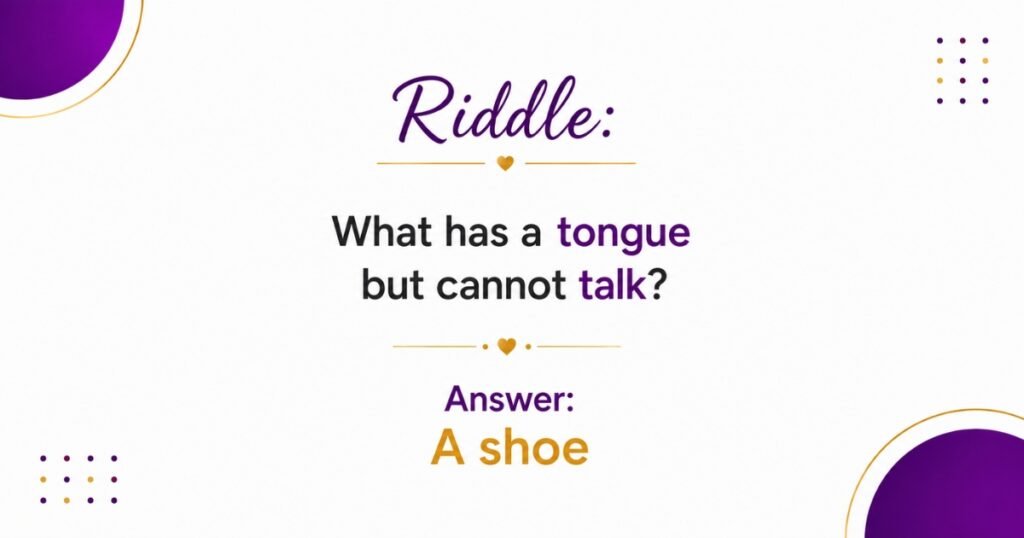
Explanation: Straightforward misdirection using furniture terminology that mirrors body parts. - Riddle: What has a tongue but cannot talk?
Answer: A shoe
Difficulty: Easy
Explanation: The “tongue” of a shoe is a familiar but rarely noticed term, making the reveal satisfying.
- Riddle: What has hands but cannot clap?
Answer: A clock
Difficulty: Easy
Explanation: Clock “hands” is a common phrase that becomes fresh again when placed in riddle form. - Riddle: What can travel around the world while staying in the same corner?
Answer: A postage stamp
Difficulty: Easy
Explanation: The riddle plays on scale , the stamp stays fixed on an envelope while the envelope itself travels globally. - Riddle: What has a heart that doesn’t beat?
Answer: An artichoke
Difficulty: Easy
Explanation: “Heart” refers to the edible center of the vegetable, not a biological organ , a gentle culinary misdirection. - Riddle: What has to be broken before you can use it?
Answer: An egg
Difficulty: Easy
Explanation: A simple logic riddle where the “breaking” is a prerequisite for function rather than a sign of damage. - Riddle: What goes through cities and fields but never actually moves?
Answer: A road
Difficulty: Easy
Explanation: Contrasts implied motion (“goes through”) with the static nature of infrastructure. - Riddle: What has a head and a tail but no body?
Answer: A coin
Difficulty: Easy
Explanation: Reuses “heads and tails” coin-flip terminology as a literal description. - Riddle: What can you keep even after you give it away?
Answer: Your word (a promise)
Difficulty: Easy
Explanation: An abstract riddle that works because a promise, unlike an object, isn’t diminished by sharing it. - Riddle: What kind of room has no doors or windows?
Answer: A mushroom
Difficulty: Easy
Explanation: A pure pun , the answer hides inside the word “room” itself (mush-ROOM). - Riddle: What has cities but no houses, forests but no trees, and rivers but no water?
Answer: A map
Difficulty: Easy
Explanation: Lists three features that exist only as symbols, guiding players toward a representation rather than a real place. - Riddle: What five-letter word becomes shorter when you add two letters to it?
Answer: “Short” (add “er” to make “shorter”)
Difficulty: Easy
Explanation: A meta-riddle where the answer describes its own transformation , a favorite opener for wordplay-minded groups.
Medium Escape Room Riddles (Brain-Teasing Challenges)
Once a group is warmed up, medium riddles introduce short logical leaps or two-step reasoning. These work well as the “second lock” in a game, requiring a bit more discussion time.
- Riddle: I am not alive, yet I grow. I don’t have lungs, yet I need air. I don’t have a mouth, yet water kills me. What am I?
Answer: Fire
Difficulty: Medium
Explanation: A layered riddle that rules out obvious living things one clue at a time, forcing players to reconsider each line as it’s added. - Riddle: The more you take from me, the bigger I become. What am I?
Answer: A hole
Difficulty: Medium
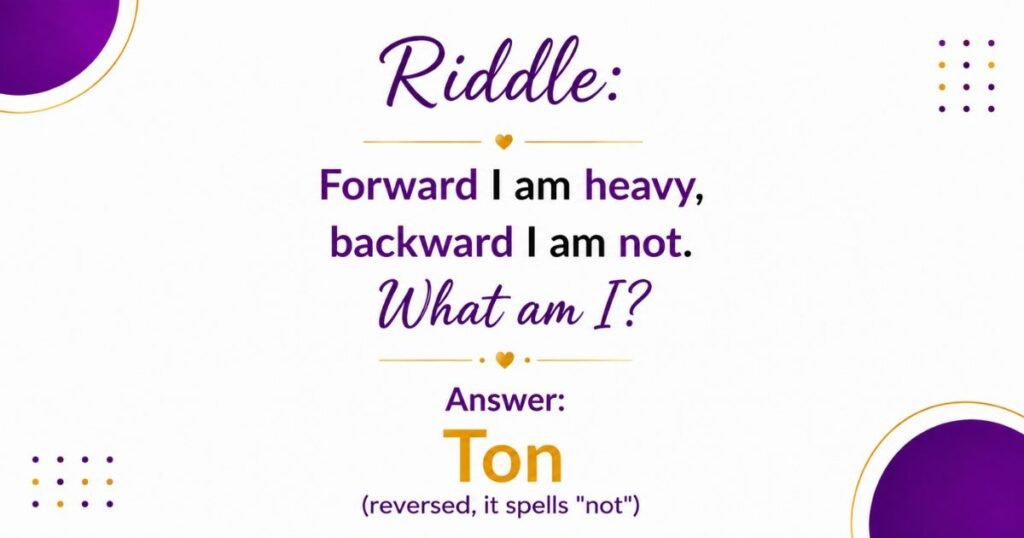
Explanation: A counterintuitive riddle , removal usually shrinks things, but digging a hole does the opposite. - Riddle: Forward I am heavy, backward I am not. What am I?
Answer: Ton (reversed, it spells “not”)
Difficulty: Medium
Explanation: A palindrome-adjacent wordplay riddle that requires players to physically reverse the letters of the answer.
- Riddle: I am always in front of you, yet you can never see me. What am I?
Answer: The future
Difficulty: Medium
Explanation: An abstract concept riddle that plays on the spatial metaphor of time. - Riddle: What can be cracked, made, told, and played, but never physically held?
Answer: A joke
Difficulty: Medium
Explanation: Uses four different verbs that all pair naturally with “joke,” a technique called verb-collocation misdirection. - Riddle: I have branches, but no trunk, leaves, or fruit. What am I?
Answer: A bank
Difficulty: Medium
Explanation: “Branch” as a financial term is less common than the botanical meaning, so the riddle rewards vocabulary flexibility. - Riddle: Voiceless I cry, wingless I flutter, toothless I bite, mouthless I mutter. What am I?
Answer: The wind
Difficulty: Medium
Explanation: A classical-style riddle using four contradictory pairs to describe a force rather than an object. - Riddle: A boat is full of people, yet there isn’t a single person on board. How is that possible?
Answer: Everyone on the boat is married , there isn’t one “single” person
Difficulty: Medium
Explanation: A pun riddle that exploits the double meaning of “single” (unmarried vs. solitary). - Riddle: What word in the dictionary is always spelled incorrectly?
Answer: “Incorrectly”
Difficulty: Medium
Explanation: A self-referential riddle , the word describes itself no matter how it’s spelled. - Riddle: If you drop me, I’m sure to crack, but give me a smile and I’ll always smile back. What am I?
Answer: A mirror
Difficulty: Medium
Explanation: Combines a literal property (fragility) with a figurative one (reflection) in the same riddle. - Riddle: What has many keys but can’t open a single lock?
Answer: A piano
Difficulty: Medium
Explanation: Reuses “key” terminology from a musical context rather than a security one, a common escape room misdirection. - Riddle: What kind of building has the most stories?
Answer: A library
Difficulty: Medium
Explanation: Plays on “stories” meaning both building floors and narrative tales. - Riddle: I follow you all day but disappear completely at night. What am I?
Answer: Your shadow
Difficulty: Medium
Explanation: A riddle grounded in observable physics , shadows require light, which explains the nighttime disappearance. - Riddle: Thirty white horses on a red hill; first they champ, then they stamp, then they stand still. What am I?
Answer: Teeth
Difficulty: Medium
Explanation: A traditional-style riddle using metaphor (horses = teeth, red hill = gums) rather than direct wordplay. - Riddle: What comes once in a minute, twice in a moment, but never in a thousand years?
Answer: The letter M
Difficulty: Medium
Explanation: A letter-counting riddle , players must count occurrences of letters within the words of the question itself. - Riddle: What has a spine but no bones?
Answer: A book
Difficulty: Medium
Explanation: Reuses anatomical vocabulary in a publishing context, a technique repeated intentionally across this list to build pattern recognition. - Riddle: The person who makes it doesn’t need it. The person who buys it doesn’t use it. The person who uses it never knows it. What is it?
Answer: A coffin
Difficulty: Medium
Explanation: A somber but classic three-clause riddle that requires players to think through each stakeholder in turn. - Riddle: I’m taken from a mine and shut in a wooden case, from which I’m never released, yet almost everyone uses me. What am I?
Answer: Pencil lead (graphite)
Difficulty: Medium
Explanation: Guides players through the manufacturing process of a pencil without naming it directly. - Riddle: What can fill an entire room but takes up no physical space?
Answer: Light
Difficulty: Medium
Explanation: A physics-adjacent riddle contrasting perceived “fullness” with actual volume. - Riddle: What has a ring but no finger?
Answer: A telephone
Difficulty: Medium
Explanation: Uses “ring” in its sound sense rather than its jewelry sense , a favorite for phone-themed escape rooms.
Hard Escape Room Riddles: Tricky Escape Room Riddles
Save these escape room questions and answers for adults for the final act of your game. Hard riddles demand multi-step logic, lateral thinking, or careful re-reading; they’re best introduced only after a group has built confidence on the easier tiers.
- Riddle: A man looks at a portrait and says, “Brothers and sisters I have none, but that man’s father is my father’s son.” Whose portrait is he looking at?
Answer: His own son
Difficulty: Hard
Explanation: “My father’s son” (with no siblings) refers to the speaker himself, so “that man’s father” is the speaker , meaning the portrait is of his son. - Riddle: Two fathers and two sons go fishing. Each catches exactly one fish, yet they bring home only three fish total. How is this possible?
Answer: They are a grandfather, a father, and a son , three people who count as “two fathers and two sons”
Difficulty: Hard
Explanation: The riddle hinges on one person occupying two roles simultaneously (both a father and a son), reducing the headcount from four to three. - Riddle: A clerk in a butcher shop is 5’10” tall. What does he weigh?
Answer: Meat
Difficulty: Hard
Explanation: A homophone riddle , “what does he weigh” is misheard as asking for a number, when the real answer is his profession’s product. - Riddle: I am an odd number. Take away one letter and I become even. What number am I?
Answer: Seven (remove the “s” to get “even”)
Difficulty: Hard
Explanation: A pure letter-manipulation riddle that requires players to think about the spelling of numbers, not their values. - Riddle: A man is found dead in an open field with an unopened package lying beside him. There are no other footprints in the mud besides his own. What was in the package?
Answer: A parachute that failed to open
Difficulty: Hard
Explanation: A mystery-style riddle where the absence of evidence (no other tracks, an open field) is the clue rather than any object described directly. - Riddle: Before Mount Everest was discovered, what was the tallest mountain in the world?
Answer: Mount Everest , it was always the tallest, discovery doesn’t change its height
Difficulty: Hard
Explanation: A logic trap that separates the act of discovery from the physical fact, catching players who assume “discovered” means “created.” - Riddle: A man pushes his car to a hotel and tells the owner he’s bankrupt. Why?
Answer: He’s playing the board game Monopoly
Difficulty: Hard
Explanation: Reframes familiar words (“car,” “hotel,” “bankrupt”) inside a completely different context, which players only see once they stop imagining a real street. - Riddle: What object has 13 hearts but no other organs?
Answer: A deck of playing cards
Difficulty: Hard
Explanation: Counts the number of heart-suited cards in a standard deck, testing specific knowledge alongside wordplay. - Riddle: I speak every language in the world without ever moving my mouth. What am I?
Answer: An echo
Difficulty: Hard
Explanation: A riddle built on repetition rather than translation , the echo “speaks” only by returning what it hears. - Riddle: What can be broken without ever being touched?
Answer: A promise
Difficulty: Hard
Explanation: An abstract riddle where “broken” applies to trust rather than a physical object, a step up in difficulty from more literal riddles. - Riddle: If two’s company and three’s a crowd, what are four and five?
Answer: Nine
Difficulty: Hard
Explanation: A trick riddle , after two wordplay-style clauses, players expect another pun but the actual answer is simple arithmetic.
- Riddle: I’m as light as a feather, yet even the strongest person alive can’t hold me for more than a few minutes. What am I?
Answer: Your breath
Difficulty: Hard
Explanation: Combines a physical property (lightness) with a biological limitation (you must exhale eventually), which many players overlook. - Riddle: A man is trapped in a room with two doors. One leads to freedom, the other to certain danger, but he can’t tell which is which. A guard stands at each door , one always tells the truth, the other always lies. What single question guarantees his escape?
Answer: Ask either guard, “What would the other guard say is the door to freedom?” , then choose the opposite door
Difficulty: Hard
Explanation: A classic logic puzzle: both guards’ answers converge on the same wrong door, so the true answer is always the opposite of whatever either one says. - Riddle: I have a golden head and a golden tail, but absolutely no body. What am I?
Answer: A coin
Difficulty: Hard
Explanation: Builds on “heads and tails” terminology from Riddle 16 but adds a material clue (golden) to narrow the answer further. - Riddle: The more of me you take, the more you leave behind. What am I?
Answer: Footsteps
Difficulty: Hard
Explanation: A paradox riddle similar to the hole riddle earlier, but applied to motion instead of excavation. - Riddle: What can you hold in your left hand but never in your right?
Answer: Your right elbow
Difficulty: Hard
Explanation: A physical-logic riddle that requires players to actually attempt the motion to realize why it’s impossible. - Riddle: A locked room contains only a table with a candle, a lighter, and a wool blanket sitting on it. The room is pitch dark. What do you light first?
Answer: The lighter
Difficulty: Hard
Explanation: A sequencing riddle , you cannot light the candle without first lighting the lighter, regardless of what else is in the room. - Riddle: I am always hungry and must constantly be fed. Whatever finger touches me will soon turn red. What am I?
Answer: Fire
Difficulty: Hard
Explanation: Uses “fed” and “hungry” as metaphors for fuel, then “turn red” as a warning about burns rather than blushing. - Riddle: Three switches sit outside a windowless room, each controlling one of three light bulbs inside. You may flip the switches however you like, but you can only enter the room once. How do you determine which switch controls which bulb?
Answer: Turn on switch one and leave it for several minutes, then turn it off and turn on switch two. Enter the room: the bulb that is on matches switch two, the bulb that is off but warm matches switch one, and the bulb that is off and cool matches switch three.
Difficulty: Hard
Explanation: A physics-based logic puzzle that requires players to use heat, not just light, as a third data point , a favorite for escape room finales. - Riddle: A five-digit code opens the final door. Each digit equals the sum of the two digits before it, and the sequence begins with 1, 1. What is the code?
Answer: 11235
Difficulty: Hard
Explanation: A Fibonacci-based riddle disguised as a lock code, rewarding players who recognize the number pattern rather than guessing randomly.
Wordplay and Pun-Based Escape Room Riddles
These funny escape room riddles and puns lighten the mood between tougher logic riddles and work especially well for lighthearted, comedy-themed rooms or family game nights. They’re quick to solve but still require players to think laterally.
- Riddle: What kind of key can open a banana instead of a door?
Answer: A monkey
Difficulty: Easy
Explanation: A homophone-style pun , “monk-EY” mimics the shape of the word “key” while referencing the classic banana-loving animal. - Riddle: What kind of coat can only be put on when it’s already wet?
Answer: A coat of paint
Difficulty: Easy
Explanation: Reinterprets “coat” as a layer of material rather than clothing. - Riddle: Why can’t a bicycle stand up on its own?
Answer: Because it’s two-tired
Difficulty: Easy
Explanation: A pun on “two-tired” sounding like “too tired,” reframing a mechanical fact as an emotional one. - Riddle: What has an ear but can never hear a single word?
Answer: A cornfield (an ear of corn)
Difficulty: Easy
Explanation: Reuses “ear” in its botanical sense, continuing this list’s pattern of anatomical misdirection. - Riddle: What kind of tree can comfortably fit in your hand?
Answer: A palm tree
Difficulty: Easy
Explanation: The pun relies on “palm” meaning both a hand’s surface and a tree species. - Riddle: Why did the math textbook look so sad sitting on the shelf?
Answer: Because it had too many problems
Difficulty: Easy
Explanation: A double meaning between mathematical “problems” and emotional troubles. - Riddle: I start with the letter E, end with the letter E, but only ever contain one letter inside. What am I?
Answer: An envelope
Difficulty: Medium
Explanation: A layered pun , “letter” refers both to the alphabet character and to mail, and the riddle plays with both meanings simultaneously. - Riddle: What can you serve, but never eat, drink, or give as a gift?
Answer: A tennis serve
Difficulty: Medium
Explanation: Narrows “serve” down through elimination, ruling out food and gift-giving contexts first. - Riddle: What kind of band never plays a single note of music?
Answer: A rubber band
Difficulty: Easy
Explanation: Plays on “band” meaning a musical group versus an elastic loop. - Riddle: What has a bark, but has never once bitten anyone?
Answer: A tree
Difficulty: Easy
Explanation: Reuses “bark” as tree exterior rather than a dog’s sound, a common opening pun for nature-themed rooms. - Riddle: What object is full of tiny holes yet still manages to hold water?
Answer: A sponge
Difficulty: Easy
Explanation: A logic-flavored pun , the holes seem disqualifying until you consider absorption instead of leakage. - Riddle: What kind of shoes do secret agents always wear?
Answer: Sneakers
Difficulty: Easy
Explanation: A pun on “sneak,” connecting stealth to footwear terminology.
- Riddle: What has a giant eye in its middle but has never been able to see anything?
Answer: A hurricane
Difficulty: Medium
Explanation: Uses meteorological terminology (“the eye of the storm”) as the misdirection. - Riddle: What kind of cheese is made by spelling it backward?
Answer: Edam (which is “made” spelled backward)
Difficulty: Medium
Explanation: A palindrome-style riddle requiring players to reverse letters, similar to the “ton/not” riddle earlier but applied to a real cheese name. - Riddle: What creature walks on four legs in the morning, two legs at noon, and three legs in the evening?
Answer: A human being (crawling as a baby, walking as an adult, using a cane in old age)
Difficulty: Hard
Explanation: The famous riddle of the Sphinx, included here as a bridge between wordplay and true lateral-thinking riddles , “morning, noon, and evening” represent life stages, not literal times of day. - Riddle: What common English word looks exactly the same whether you read it upside down or backward?
Answer: NOON
Difficulty: Medium
Explanation: A visual-pattern riddle that rewards players who physically flip the paper or their phone to test the word. - Riddle: What has one head, one foot, and four legs, yet has never once taken a step?
Answer: A bed
Difficulty: Medium
Explanation: Combines three separate body-part puns (headboard, footboard, bed legs) into one object. - Riddle: What runs but never walks, has a mouth but never talks, has a bed but never sleeps, and has a bank but never saves money?
Answer: A river
Difficulty: Medium
Explanation: A four-clause riddle that reuses several earlier misdirection techniques (mouth of a river, bed of a river, bank of a river) in a single combined riddle. - Riddle: What has a thumb and four fingers, yet is not a living hand?
Answer: A glove
Difficulty: Easy
Explanation: A straightforward object riddle that mirrors human anatomy without any hidden trick. - Riddle: What word starts with a “P,” ends with an “E,” and contains thousands of letters inside it?
Answer: Post Office
Difficulty: Medium
Explanation: “Letters” refers to mail rather than alphabet characters, a callback to the envelope riddle earlier in this section.
Number and Logic Escape Room Riddles
These are the escape room riddles to get to a number, ideal for keypad locks, dial combinations, and math-themed escape rooms. They lean on arithmetic, sequences, and pure logic rather than wordplay.
- Riddle: I am a number. Multiply me by any other number, and the answer always stays the same. What number am I?
Answer: Zero
Difficulty: Easy
Explanation: Tests basic multiplication rules in riddle form , a gentle entry point to the numbers section. - Riddle: I am a three-digit number. My tens digit is five more than my ones digit, and my hundreds digit is eight less than my tens digit. What number am I?
Answer: 194
Difficulty: Hard
Explanation: Requires players to set up and solve a small system of digit relationships step by step rather than guess. - Riddle: A farmer has 17 sheep. All but 9 of them die. How many sheep does he have left?
Answer: 9
Difficulty: Medium
Explanation: A phrasing trap , “all but 9” means 9 survive, not that 17 minus 9 remain. - Riddle: If it takes 5 machines 5 minutes to make 5 widgets, how long would it take 100 machines to make 100 widgets?
Answer: 5 minutes
Difficulty: Hard
Explanation: Each machine independently makes one widget in 5 minutes, so scaling both numbers together doesn’t change the time required. - Riddle: You have two ropes that each burn unevenly but take exactly one hour to burn completely. Using only these ropes and a lighter, how do you measure exactly 45 minutes?
Answer: Light both ends of the first rope and one end of the second rope at the same time. When the first rope finishes burning (30 minutes), light the second end of the second rope; it will finish 15 minutes later, for a total of 45 minutes.
Difficulty: Hard
Explanation: A classic timing puzzle that trains players to think about burn rate as a ratio rather than a fixed pace. - Riddle: What number comes next in this sequence: 1, 1, 2, 3, 5, 8, 13, ___?
Answer: 21
Difficulty: Medium
Explanation: Each number is the sum of the two before it , the Fibonacci sequence, a common escape room code source. - Riddle: A drawer holds 21 identical blue socks, 15 identical black socks, and 17 identical red socks, but the room is completely dark. What is the minimum number of socks you must pull out to guarantee a matching pair?
Answer: 4
Difficulty: Hard
Explanation: With only 3 colors, pulling 3 socks could give one of each color; a 4th sock must match one of the first three. - Riddle: How many times can you subtract the number 5 from 25?
Answer: Once , after that, it’s no longer 25
Difficulty: Medium
Explanation: A logic trap that catches players who assume the riddle wants repeated subtraction rather than a literal reading.
- Riddle: I am a number. If you double me and then add six, you get the same result as tripling me. What number am I?
Answer: 6
Difficulty: Medium
Explanation: Solving the simple equation 2x + 6 = 3x isolates x = 6, making this a gentle algebra-in-disguise riddle. - Riddle: Take a number, subtract 4, then multiply the result by 3 to get 9. What was the original number?
Answer: 7
Difficulty: Easy
Explanation: Working backward from the final result (9 ÷ 3 = 3, then 3 + 4 = 7) is faster than guessing. - Riddle: Two coins together add up to 30 cents, and one of them is definitely not a nickel. What are the two coins?
Answer: A quarter and a nickel , the quarter is the one that “is not a nickel”
Difficulty: Medium
Explanation: A phrasing trick: only one coin is specified as “not a nickel,” which leaves room for the other coin to be one. - Riddle: A clock’s hour and minute hands perfectly overlap at 12:00. At approximately what time do they next overlap?
Answer: About 1:05 and 27 seconds
Difficulty: Hard
Explanation: Because the minute hand moves faster than the hour hand, they only realign roughly every 65 minutes, not every 60. - Riddle: If three cats can catch three mice in three minutes, how many cats are needed to catch 100 mice in 100 minutes?
Answer: 3
Difficulty: Medium
Explanation: The rate stays constant (1 cat per mouse per 3 minutes), so scaling time proportionally means the number of cats never needs to change. - Riddle: Add my age today to my age exactly 10 years from now, and the total is 66. How old am I today?
Answer: 28
Difficulty: Medium
Explanation: Setting up the equation x + (x + 10) = 66 solves to x = 28, a straightforward algebra riddle for a keypad code. - Riddle: I have four sides, but only two of them are the same length, and I am not a square. What shape am I?
Answer: A rectangle
Difficulty: Easy
Explanation: A geometry riddle that eliminates the square specifically to prevent an easy guess. - Riddle: A jar of coins doubles in total value every single day and takes exactly 30 days to become completely full. On which day was the jar exactly half full?
Answer: Day 29
Difficulty: Hard
Explanation: Because the value doubles daily, the jar must have been half full just one day before becoming completely full , a classic exponential-growth trap. - Riddle: What comes next in this number sequence: 2, 6, 12, 20, 30, ___?
Answer: 42
Difficulty: Medium
Explanation: Each term follows the pattern n(n+1), so the sixth term is 6 × 7 = 42. - Riddle: Using only a 5-liter jug and a 3-liter jug (with no markings), how do you measure exactly 4 liters of water?
Answer: Fill the 5L jug, pour it into the 3L jug (leaving 2L in the 5L jug), empty the 3L jug, pour the remaining 2L into the 3L jug, refill the 5L jug completely, then top off the 3L jug (which only needs 1L) , leaving exactly 4L in the 5L jug.
Difficulty: Hard
Explanation: A multi-step water-transfer puzzle that’s a staple of escape room finales because it requires planning several moves ahead. - Riddle: A 4-digit code begins with 1, 1. Each following digit is the sum of the two digits before it. What is the full 4-digit code?
Answer: 1123
Difficulty: Medium
Explanation: A shorter version of the Fibonacci-code riddle earlier, useful for simpler keypad locks with fewer digits. - Riddle: If today is a Monday, what day of the week will it be exactly 100 days from now?
Answer: Wednesday
Difficulty: Medium
Explanation: Since 100 divided by 7 leaves a remainder of 2, counting two days forward from Monday lands on Wednesday.
How to Use These Riddles in Your Escape Room?
Riddles do more than test cleverness, they set the pace of your room. Used well, they give players a reason to slow down, talk to each other, and feel a real sense of payoff before moving on to the next physical challenge.
How many Riddles should be in One Escape Room?
Based on testing dozens of home and classroom setups, 2–4 riddles per 60-minute room is the sweet spot. Riddles are slower to solve as a group activity than physical search puzzles, so more than 4 tends to stall pacing and frustrate players who prefer hands-on tasks.
Reserve riddles for moments where a group needs to pause and think together rather than search the room.
What’s the Difference between a Riddle and a Puzzle in an Escape Room?
A riddle is a self-contained verbal question with one answer, solvable by reading alone. A puzzle usually requires manipulating a physical object , assembling pieces, aligning symbols, or using a tool , often using a riddle’s answer as one input. In practice, the strongest escape rooms treat riddles as the “brain” step and puzzles as the “hands” step, alternating between the two to keep every kind of player engaged.
A practical structure that works well:
- Open with 1 easy riddle to build confidence and momentum
- Use 1–2 medium riddles mid-game, paired with a physical prop (lockbox, cipher wheel, or UV flashlight)
- Save 1 hard riddle for the final door, ideally one that rewards everything the group has learned so far
- Sprinkle in 1–2 pun riddles between harder sections to keep the mood light
Tips for Solving Escape Room Riddles Under Time Pressure
The clock is what makes escape room riddles feel high-stakes, but rushing rarely helps. A few simple habits can keep your group thinking clearly even when the timer is ticking down.
How do you make an Escape Room Riddle harder?
The most reliable way is to add a second layer of translation between the riddle and its answer , for example, requiring players to convert a riddle’s word answer into a number using an A=1, B=2 cipher before it becomes usable.
Time pressure alone doesn’t make a riddle harder; it just makes an already-hard riddle feel harder, so difficulty should come from the riddle’s structure, not the clock.
Are Escape Room Riddles good for Kids?
Yes, with adjustments. Riddles for players ages 8–14 should have concrete, single-word or single-number answers (like the Easy tier above) rather than abstract concepts like “trust” or “the future.” Kids also benefit from a visible difficulty label , knowing a riddle is “Easy” reduces frustration and keeps younger players engaged rather than reliant on an adult to solve it for them.
When your group gets stuck, these strategies help without giving away the answer outright:
- Read the riddle aloud as a group , riddles are often written to be heard, not skimmed
- Identify which word is doing double duty (most riddles hinge on one word with two meanings)
- If it’s a number riddle, write out the math instead of solving it mentally under pressure
- Set a 2-minute cap per riddle before offering a hint, so momentum doesn’t stall the whole game
More Riddles to Keep the Game Going
If your group burns through these escape room riddles and wants more, there’s plenty to keep the momentum going. For players who like a real mental workout, Riddles for Adults collection leans harder into logic and misdirection than the easy tier above.
Running a classroom or kids’ party instead? My Homework Riddles and March Riddles picks are sized for younger solvers the same way the beginner-friendly riddles here are.
And if your group just wants to keep the streak alive after the timer runs out, Amazing Riddles has 100 more brain teasers built on the same wordplay and lateral-thinking tricks used throughout this list.
Conclusion
Escape Room Riddles remain one of the best escape room puzzles tools for game nights, classrooms, and DIY puzzle rooms because they scale from silly puns to genuine logic challenges without needing any special equipment.
FAQs
What are Good Riddles for an Escape Room?
Ones with a single, concrete answer, a number, object, or short word, that can unlock a lock or lead to a prop.
How many Riddles should be in one Escape Room?
About 2–4 per 60-minute game, mixed with physical puzzles so the pacing doesn’t feel repetitive.
How do you Solve Escape Room Riddles Quickly?
Read the riddle aloud, say the answer as a group instead of guessing, and try the most literal meaning first before looking for wordplay.
Where can I find Free Escape Room Riddles with Answers?
Lists like this one are a good start, just make sure the answers and difficulty ratings are included, not just the questions.
