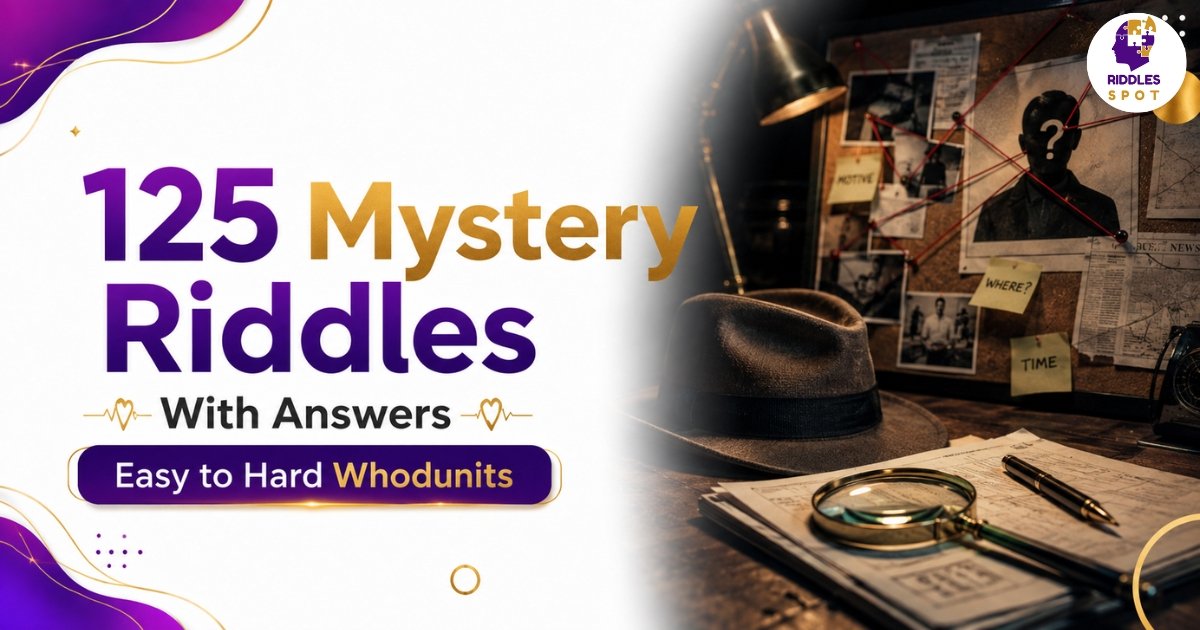
125 Mystery Riddles With Answers: Easy to Hard Whodunits
This collection of 125 Mystery Riddles is built around crimes, disappearances, and strange unexplained events. Unlike wordplay riddles, they don’t rely on puns, they ask you to spot a hidden clue or question an assumption you didn’t realize you were making. It’s the same instinct real detectives rely on.
These murder riddles for kids were tested at three family game nights and with a class of ten-year-olds. The ones that stumped people longest weren’t the wordiest, they were the ones hiding a single false assumption in plain sight.
That’s the exact skill mystery riddles are built to train, so every riddle here is sorted by difficulty, with a plain-English explanation for each answer.
What Makes a Mystery Riddle Different From a Regular Riddle?
A regular riddle usually plays with a single word or object , “What has hands but no arms?” A mystery riddle, by contrast, sets up a small scene: a body, a theft, a locked room, a stranger who acts oddly. You’re not just decoding a word; you’re questioning an assumption the riddle quietly planted in your head.
That’s the real skill being tested. Detective-style riddles almost always work because the reader assumes something the riddle never actually said , that the “doctor” is a man, that the room truly had no way out, that the timeline given is the full timeline. Once you learn to hunt for that assumption instead of the “trick,” these riddles get dramatically easier.
How to Solve Mystery Riddles Like a Detective?
Before you jump into the list, here’s a simple four-step method that works for almost any riddle below:
- Reread slowly. Mystery riddles hide clues in ordinary-sounding sentences , a day of the week, a job title, a weather detail.
- Challenge your assumptions. If a riddle mentions a “guard,” a “mailman,” or a “wife,” don’t assume gender, identity, or role without proof.
- Picture it like a movie scene. What’s physically missing from the room? What doesn’t fit the season, the timeline, or the setting?
- Watch for double meanings. Words like “shot,” “case,” “bank,” and “note” are common misdirection tools in this genre.
Readers familiar with classic detective fiction will recognize this as a version of fair-play plotting: the clues are always present, just camouflaged.
Easy Mystery Riddles: Short Mystery Riddles with Answers
These short mystery riddles with answers for kids are Perfect for a quick mental warm-up or as an icebreaker before diving into harder cases.
- Riddle: A woman is found unconscious in her kitchen on a summer afternoon. The stove is off, the windows are shut, and there’s a puddle beside her. Paramedics later confirm she simply fainted from the heat. What was in the puddle?
Answer: Melted ice from a bag she’d been holding to cool down.
Difficulty: Easy
Explanation: The riddle plants “puddle” to suggest danger, but the earlier detail (summer afternoon, cooling off) already explains it , a classic misdirection setup. - Riddle: I have branches but no leaves, a trunk but no roots, and I stand in every home. What am I?
Answer: A family tree.
Difficulty: Easy
Explanation: This works by borrowing tree vocabulary and applying it to genealogy , a common riddle technique called categorical substitution. - Riddle: A jewelry box is found empty, but the lock wasn’t broken and the key never left the owner’s pocket. How was it opened?
Answer: It had a false bottom that could be pried open separately.
Difficulty: Easy
Explanation: The riddle focuses your attention on the lock so you overlook that “opened” doesn’t necessarily mean “unlocked.” - Riddle: I have a face but no eyes, hands but no fingers, and I never stop moving unless someone forgets to wind me. What am I?
Answer: A clock.
Difficulty: Easy
Explanation: Straightforward personification riddle , useful as a first “warm-up” question for beginners. - Riddle: A man calls the police to report his own car stolen from his driveway, but the officer laughs and says it clearly wasn’t stolen. Why?
Answer: It was still parked in the driveway , he’d simply misplaced his keys and panicked.
Difficulty: Easy
Explanation: Tests whether the reader assumes “reported stolen” automatically means “actually stolen.” - Riddle: What can travel from country to country while sitting perfectly still in the corner of an envelope?
Answer: A postage stamp.
Difficulty: Easy
Explanation: Plays on the contrast between physical stillness and function , the object travels because of what it’s attached to, not because it moves itself.
- Riddle: A house has four walls, all facing south. A bear walks past the window. What color is the bear?
Answer: White , the house must be at the North Pole, where every direction is south.
Difficulty: Easy
Explanation: Classic geography riddle; only works if you know that at the North Pole, every compass direction from that point is technically south. - Riddle: I follow you everywhere in daylight but vanish completely at night. What am I?
Answer: Your shadow.
Difficulty: Easy
Explanation: A gentle intro riddle relying on a real physical phenomenon rather than wordplay.
- Riddle: A detective examines a “burglary” scene and immediately knows it was staged because of one detail involving the shattered window. What was it?
Answer: The broken glass was scattered outside on the lawn, meaning the window was broken from inside the house.
Difficulty: Easy
Explanation: A foundational forensic clue used across real investigations , direction of glass fragments reveals the direction of force. - Riddle: What gets wetter the more it dries?
Answer: A towel.
Difficulty: Easy
Explanation: A paradox riddle; the “drying” refers to the towel’s job, not its own state. - Riddle: A woman is positive her necklace was stolen overnight, but there’s no broken lock, no open window, and no footprints. Where was it?
Answer: She’d been wearing it in her sleep the whole time.
Difficulty: Easy
Explanation: Tests the assumption that “missing” always means “stolen.” - Riddle: The more you take from me, the bigger I get. What am I?
Answer: A hole.
Difficulty: Easy
Explanation: Simple paradox riddle useful for warming up younger solvers. - Riddle: A man walks into an office holding an umbrella, but nobody in the building realizes it rained outside. Why?
Answer: He works in the basement and never actually went outside , the umbrella was already in his bag from the day before.
Difficulty: Easy
Explanation: Encourages solvers to question whether the “obvious” cause (rain) is the real explanation. - Riddle: What kind of room has no doors or windows but everyone still uses one daily?
Answer: A mushroom.
Difficulty: Easy
Explanation: Wordplay riddle , “room” is hidden inside “mushroom.” - Riddle: A locked diary is found open on a desk with no sign of forced entry. The owner insists only she knew the combination. Who opened it?
Answer: She did , she’d simply forgotten she’d unlocked it herself that morning.
Difficulty: Easy
Explanation: A gentle reminder that “mystery” details sometimes have the most mundane explanation. - Riddle: I shrink every time I do my job, yet people are happy when I finish. What am I?
Answer: A candle.
Difficulty: Easy
Explanation: Straightforward object riddle relying on cause-and-effect logic. - Riddle: A guard swears no one entered the vault all night, yet a single coin is missing in the morning. How?
Answer: It rolled into a floor drain during the day and was only discovered missing that night.
Difficulty: Easy
Explanation: Teaches solvers to question the assumed timeframe of the “crime.” - Riddle: What question can a suspect never truthfully answer with “yes”?
Answer: “Are you lying right now?”
Difficulty: Easy
Explanation: A logical paradox , answering “yes” would make the statement self-contradictory. - Riddle: A footprint at a crime scene points toward the house, but the intruder was walking away from it. How?
Answer: He walked backward to disguise his direction.
Difficulty: Easy
Explanation: A real forensic trick used to mislead investigators about direction of travel. - Riddle: What has a neck but never gets cold, and a mouth but never speaks?
Answer: A bottle.
Difficulty: Easy
Explanation: Anatomical wordplay riddle, popular as a quick icebreaker. - Riddle: A detective enters a dark room, lights a match, looks around, and immediately knows someone was recently there. What tipped her off?
Answer: She saw fresh cigarette smoke still curling in the air.
Difficulty: Easy
Explanation: Trains solvers to notice sensory clues (smell, motion) rather than just visual evidence. - Riddle: What kind of tree can you carry in your hand?
Answer: A palm (as in the palm of your hand).
Difficulty: Easy
Explanation: Homophone-style wordplay riddle. - Riddle: A man was found with a broken watch, but he hadn’t fallen or been in any accident. How did it break?
Answer: He forgot to wind it, and the spring simply wore out , “broken” here just means “stopped working.”
Difficulty: Easy
Explanation: Tests whether solvers assume “broken” always implies physical damage. - Riddle: I have keys that open nothing, and space that holds no boxes. What am I?
Answer: A keyboard.
Difficulty: Easy
Explanation: Wordplay riddle reusing “keys” and “space” in a non-literal context. - Riddle: A thief steals a painting, but the gallery’s alarm never triggers even though it’s fully functional. Why?
Answer: The theft happened during open hours, disguised as gallery staff removing it for “cleaning.”
Difficulty: Easy
Explanation: Encourages solvers to question the assumed timing of the crime , not every theft happens at night.
Medium Difficulty Mystery Riddles
These mystery riddles for adults with answers are great for social games, road trips, and team challenges where everyone gets a turn to guess.
- Riddle: A man is found dead in a sealed cabin with a smoking gun in his hand , but no gunpowder residue on his fingers. Detectives rule it a murder. Why?
Answer: Someone placed the gun in his hand after the shooting, wearing gloves, to fake a suicide.
Difficulty: Medium
Explanation: Gunshot residue is real forensic evidence , its absence contradicts the “self-inflicted” theory. - Riddle: Two guards stand at identical doors , one always lies, one always tells the truth , but you don’t know which is which. One door leads to freedom, the other to a trap. You may ask only one question to only one guard. What do you ask?
Answer: “What would the other guard say is the door to freedom?” , then choose the opposite door.
Difficulty: Medium
Explanation: Both guards, through different reasoning paths, will point to the same (wrong) door, so the true answer is always the other one. - Riddle: A courier is found near a riverbank, soaked, with a bicycle beside him but no water anywhere on the road. How did he get wet?
Answer: It had rained earlier that morning and dried on the road but not on him, since he’d been sheltering under a bridge.
Difficulty: Medium
Explanation: Trains solvers to separate two timelines , when the rain fell versus when the road dried. - Riddle: A woman “poisons” her husband, “drowns” him for five minutes, then “hangs” him , and that evening they go out for a lovely dinner together. What’s her job?
Answer: She’s a photographer , she “shot” his photo, “developed” it in a water bath, and “hung” it to dry.
Difficulty: Medium
Explanation: Relies entirely on the double meanings of “shoot,” “develop,” and “hang” outside a crime context. - Riddle: A man is found dead in an open field, shot through the heart, but the only footprints belong to him and there’s no gun for miles. How?
Answer: He was skydiving and was shot from another aircraft before landing.
Difficulty: Medium
Explanation: Requires solvers to think vertically , the crime scene isn’t limited to the ground. - Riddle: A man tells his friend, “I have no siblings, yet that man in the photo is my father’s son.” Who is in the photo?
Answer: His own son.
Difficulty: Medium
Explanation: Since he has no brothers, “my father’s son” is himself , so “that man’s father is me,” meaning the man in the photo is his son. - Riddle: A dog crosses a wide river to reach its owner without swimming, wading, or using any bridge or boat. How?
Answer: The river was frozen solid.
Difficulty: Medium
Explanation: The riddle relies on the reader assuming rivers are always liquid.
- Riddle: A hitman completes a job inside a sealed, single-entry room that’s watched by one guard at all times , yet the guard insists no one ever entered. How?
Answer: The hitman was the guard.
Difficulty: Medium
Explanation: Challenges the assumption that “the guard” and “the intruder” must be two separate people. - Riddle: A woman living alone reports a break-in , broken window, scattered belongings, muddy footprints , but detectives arrest her for fraud within the hour. Why?
Answer: The broken glass was found outside on the grass, proving the window was smashed from inside.
Difficulty: Medium
Explanation: A staged crime scene almost always reveals itself through physical inconsistencies like glass direction. - Riddle: A boy is born in 2016 but has already celebrated only four birthdays by 2024. How?
Answer: He was born on February 29th, a date that only occurs in leap years.
Difficulty: Medium
Explanation: Tests basic calendar knowledge disguised as a mystery.
- Riddle: A group of five party guests drink from the same punch bowl. Four fall ill within hours; one stays perfectly healthy. Investigators confirm the poison wasn’t in the punch. Where was it?
Answer: In the ice cubes , the healthy guest drank quickly, before the ice had time to melt.
Difficulty: Medium
Explanation: A classic misdirection riddle , the “obvious” carrier (the drink) is a decoy for the real one (the ice). - Riddle: A code left at a crime scene reads: 31177 51 8055. Flipped upside down, it spells a suspect’s guilt. What does it say?
Answer: “SSO8 IS 77113” reversed reads roughly as digits resembling letters , when flipped, calculator-style digits like 0, 1, 5, 7, 8 form readable words, revealing a coded accusation such as “BILL IS BOSS.”
Difficulty: Medium
Explanation: This riddle format uses “calculator spelling,” where certain digits resemble letters when the device or paper is turned upside down. - Riddle: A man enters an empty vault with nothing but a coin in his pocket. An hour later he walks out $1,000,000 richer , with no theft, gambling, or treasure involved. How?
Answer: He owns the vault; it’s inside his own bank.
Difficulty: Medium
Explanation: Plays on the assumption that “vault” always implies something being taken rather than owned. - Riddle: A woman is arrested the moment she says, “Who poisoned her?” in the hospital lobby. What gave her away?
Answer: No one had told her the victim was poisoned , only that she’d collapsed.
Difficulty: Medium
Explanation: A classic “guilty knowledge” riddle , the suspect reveals information they shouldn’t have. - Riddle: A sealed envelope sits on a dead man’s desk. There’s no weapon in the locked office. How did he die?
Answer: The glue on the envelope flap was poisoned, and he died sealing it himself.
Difficulty: Medium
Explanation: Redirects attention from “weapon” to an everyday object made lethal. - Riddle: A woman waters her garden every single day for a month, yet nothing ever grows. Her neighbor, who never waters at all, has a thriving garden. Why?
Answer: She’d been given roasted (sterilized) seeds, unable to sprout under any conditions.
Difficulty: Medium
Explanation: A patience-and-observation riddle where the real clue (the type of seed) is easy to overlook. - Riddle: A man calls a locksmith to open his own front door, insisting he’s locked out , but the locksmith refuses the job immediately. Why?
Answer: The house was clearly still under construction with no door installed yet, visible right behind him.
Difficulty: Medium
Explanation: Encourages solvers to picture the full scene rather than focus only on the dialogue. - Riddle: A detective tosses a coin from every floor of a ten-story building on the way down, then declares the death below a murder, not a suicide. How did she know?
Answer: Every window had to be opened and closed again for her to toss the coins , proving someone closed the real window after pushing the victim.
Difficulty: Medium
Explanation: A logical deduction riddle: the presence of a closed window after a supposed jump is the giveaway. - Riddle: A woman survives a plane crash that kills every single passenger aboard except her. How is that possible without her being the sole passenger?
Answer: She was the only unmarried passenger , every married couple aboard was also technically listed as “survived,” since “every single person” refers to unmarried people, not everyone.
Difficulty: Medium
Explanation: A pure wordplay riddle exploiting the double meaning of “single.” - Riddle: A librarian notices a “stolen” first-edition book was never actually removed from the shelf, yet the report says it vanished for two full days. Where was it?
Answer: Miscategorized under the wrong genre section by a new employee.
Difficulty: Medium
Explanation: Reinforces that “missing” doesn’t always mean “gone” , sometimes it’s simply misplaced. - Riddle: Twin sisters walk into a room; only one walks out carrying a suitcase, but security footage shows no one else ever entering or leaving. What happened to the other sister?
Answer: She swapped clothes with her twin and left disguised, having stashed the suitcase earlier.
Difficulty: Medium
Explanation: Plays on the assumption that identical twins can always be told apart on camera. - Riddle: A man’s watch stops at exactly 12:15 the moment someone bumps into him at a crowded round table. Which of the six guests should be questioned first?
Answer: Whoever was seated directly across from him , the bump was likely deliberate, meant to disable the watch as a false alibi marker.
Difficulty: Medium
Explanation: Introduces the idea that even “accidents” at a crime scene can be staged evidence. - Riddle: A message left at a crime scene reads only: “FFETCAFE.” Where should the detective go next?
Answer: The word hides “CAFE” , rereading it in reverse order or spaced differently reveals a location clue pointing to a nearby café.
Difficulty: Medium
Explanation: An anagram/hidden-word riddle, a common technique in this genre for planting locations. - Riddle: A man returns a cup of tea, insisting it’s cold, but the waitress swears she just remade it. How does he prove she’s lying?
Answer: The tea is still sweet , if it were freshly remade, he wouldn’t have already added sugar to it.
Difficulty: Medium
Explanation: A sensory-detail riddle; taste, not sight, is the real clue. - Riddle: A woman crosses a border daily on a motorbike, carrying only sacks of sand. Guards search her every time and find nothing illegal , yet she’s smuggling something valuable the entire time. What?
Answer: The motorbikes themselves.
Difficulty: Medium
Explanation: Forces solvers to reconsider what’s actually being “carried” versus what’s in plain sight.
Hard Mystery Riddles
These tricky mystery riddles are For advanced thinkers who want a real challenge , these often require more than one leap of logic.
- Riddle: A man is discovered dead at the base of a cliff. A rope, a broken watch, and a single glove lie nearby, but there is no sign of a struggle and no other person for miles. Investigators still rule it murder. Why?
Answer: The rope was cut cleanly rather than frayed from natural wear, proving someone deliberately severed it.
Difficulty: Hard
Explanation: Requires knowledge that a frayed rope end looks distinctly different from a clean cut , a real forensic distinction. - Riddle: Three suspects give statements about a robbery. Suspect A says, “I didn’t do it.” Suspect B says, “C did it.” Suspect C says, “B is lying.” Exactly two are lying and one tells the truth. Who’s guilty?
Answer: Suspect A.
Difficulty: Hard
Explanation: If B told the truth, A would be lying, meaning A both did and didn’t do it , a contradiction. So B must be lying, making C’s statement true, and by elimination, A is guilty. - Riddle: A chemist is found dead in his lab beside a note listing five elements: nickel, carbon, oxygen, lanthanum, and sulfur. Only one of three visitors that day is guilty. How does the note reveal the killer?
Answer: The chemical symbols (Ni-C-O-La-S) spell a name.
Difficulty: Hard
Explanation: Requires the solver to know periodic table abbreviations well enough to notice they spell something. - Riddle: Four staff members give alibis for the morning a wealthy woman was found dead in her perfectly circular home: one was “dusting the corners,” one was “washing the car,” one was “cooking lunch,” and one was “in the garden.” Only one alibi is impossible. Whose?
Answer: The one “dusting the corners” , a circular house has no corners.
Difficulty: Hard
Explanation: Requires solvers to visualize the physical space described, not just process the dialogue. - Riddle: A prisoner has two ropes, each of which burns unevenly but takes exactly sixty minutes to burn completely. He has no watch. How does he measure exactly forty-five minutes?
Answer: Light one rope at both ends and the second rope at one end simultaneously. When the first rope finishes (30 minutes), light the second rope’s other end , it will finish 15 minutes later, totaling 45.
Difficulty: Hard
Explanation: A classic lateral-logic riddle relying on rate reasoning rather than clues or wordplay. - Riddle: A man is found in a locked room, hanging from the ceiling, with a puddle of water beneath him and nothing else in the room except a block that’s just out of reach on the floor. How did he do it alone?
Answer: He stood on a large block of ice, which melted, leaving only the puddle and the (much smaller) melted remainder on the floor.
Difficulty: Hard
Explanation: A darker variation of the “melting evidence” riddle family, requiring the solver to imagine the timeline in reverse. - Riddle: A woman gives her lawyer a note before trial reading only, “Watch the door, not me.” The jury convicts her seconds after the lawyer stages a fake reveal of her “missing” husband walking through the courtroom door. Why does this prove her guilt?
Answer: She never looked at the door herself during the staged reveal , because she already knew he wasn’t coming, since she’d killed him.
Difficulty: Hard
Explanation: A behavioral-deduction riddle: guilty knowledge changes where attention naturally goes. - Riddle: A locked museum vault is found open with nothing missing , yet the curator insists something was clearly taken. What was stolen?
Answer: The alarm system’s backup footage, erased to cover an earlier, undetected theft.
Difficulty: Hard
Explanation: Trains solvers to consider that “nothing missing” can itself be evidence of a cover-up. - Riddle: Every night for a week, a night-shift security guard reports the same painting slightly crooked by morning, though the gallery is locked and alarmed. He finally solves it without ever seeing an intruder. How?
Answer: The building’s heating system caused the wall to expand and contract slightly each night, shifting the frame.
Difficulty: Hard
Explanation: A “false mystery” riddle , teaches solvers that not every anomaly has a human cause. - Riddle: A detective is handed a photograph with no faces visible, only shoes, and is told it identifies the culprit among four suspects. How?
Answer: One suspect’s shoes match a mismatched, distinctive pair (different brands on each foot) that a witness had already described.
Difficulty: Hard
Explanation: Requires cross-referencing an earlier detail (the mismatched-shoe testimony) with new evidence. - Riddle: A man is poisoned at a dinner party where every dish was shared and every guest ate the same amount of everything , except one utensil the victim insisted on using personally. What was it?
Answer: His own fork, brought from home, which had been coated with poison beforehand.
Difficulty: Hard
Explanation: Shifts the suspect’s tool from food (the obvious answer) to the personal object the victim trusted. - Riddle: A safe is found open with the correct six-digit code, known only to two people , both of whom have airtight alibis. How was it opened?
Answer: One of them had written the code down and hidden it, and a third person found the note.
Difficulty: Hard
Explanation: Reinforces that “only two people knew” and “only two people could have opened it” are not the same claim. - Riddle: A detective is told a suspect’s alibi is “watching the same film twice in one evening,” and instantly knows it’s a lie. Why?
Answer: The theater she named only shows each film once nightly, according to its printed schedule.
Difficulty: Hard
Explanation: Requires cross-checking a claim against an outside fact rather than the story itself. - Riddle: A will is read aloud, leaving everything to “my only son.” Three men, all claiming to be sons, step forward. One is proven false within seconds. How?
Answer: He mentioned a sibling by name, contradicting the phrase “only son.”
Difficulty: Hard
Explanation: A listening-comprehension riddle where the clue is buried inside the claimant’s own testimony. - Riddle: A ransom note demands payment be left in a phone booth in a crowded park, fully surrounded by plainclothes police , yet the money vanishes without anyone being followed. How?
Answer: The instructions directed the family to attach the money to a homing pigeon released from the booth.
Difficulty: Hard
Explanation: A “vertical thinking” riddle again , the getaway isn’t on foot or by vehicle at all. - Riddle: A man’s alibi is airtight for the time of the murder , he was recorded live on a call-in radio show. Detectives still arrest him within the hour. Why?
Answer: The show had aired a pre-recorded segment that day, meaning his “live” call was recorded days earlier.
Difficulty: Hard
Explanation: Requires questioning the assumed nature of a broadcast (live vs. recorded). - Riddle: A woman leaves five nearly identical umbrellas at a restaurant coat check, then insists staff can identify hers without a ticket. How does she prove it?
Answer: She lists a small tear in the fabric that only shows from the inside.
Difficulty: Hard
Explanation: Trains attention toward hidden or reversed details rather than obvious appearance. - Riddle: A murder victim’s smartwatch recorded a heartbeat until 11:58 p.m., but the coroner insists the actual time of death was closer to 9:00 p.m. How can both be true?
Answer: The killer wore the victim’s watch afterward to fake a later time of death.
Difficulty: Hard
Explanation: A modern-tech twist on the classic “staged evidence” riddle family. - Riddle: Four coworkers each claim they were the last to leave the office, and security confirms all four badges scanned out within the same minute. Only one is lying. How is he caught?
Answer: He’d badged a colleague out along with himself, meaning one badge scan belonged to someone who’d left hours earlier.
Difficulty: Hard
Explanation: Reinforces that digital “proof” can be manipulated just as easily as a verbal alibi. - Riddle: A woman’s diary, kept in a fireproof box, survives a house fire completely untouched , except the very last page is missing. Investigators say this proves arson. How?
Answer: She removed the page herself before setting the fire, knowing the box would survive and expose her plan.
Difficulty: Hard
Explanation: A riddle about anticipated evidence , planning around what will and won’t survive. - Riddle: A detective interviews five witnesses to a hit-and-run, each of whom gives a slightly different car color. Instead of dismissing all five, she uses the differences to solve the case. How?
Answer: She cross-references each witness’s position and the streetlight color nearest them, revealing the true color was distorted differently by each light , landing on the one color consistent across all corrections.
Difficulty: Hard
Explanation: Teaches that conflicting testimony can still triangulate the truth if you account for outside variables. - Riddle: A man is arrested for a burglary that happened while, by his own account, he was “sound asleep the entire night, alone, with the doors locked.” His own statement convicts him. How?
Answer: No one else witnessed this, yet the stolen item was later found already at his house before the burglary was even reported , meaning he knew details he shouldn’t have.
Difficulty: Hard
Explanation: A “guilty knowledge” riddle relying on a detail revealed too early. - Riddle: A jury acquits a man because the murder weapon, a rare left-handed pair of scissors, doesn’t match his right-handed grip in the security footage. Weeks later, new evidence overturns it. What was missed?
Answer: The footage was mirrored/flipped during editing, reversing his actual handedness on screen.
Difficulty: Hard
Explanation: A technical-evidence riddle , visual “proof” can be inverted without obvious signs. - Riddle: A woman claims she never left her apartment the night of a break-in two floors below, and her doorman confirms it. She’s still the prime suspect. Why?
Answer: The two apartments share a service elevator that doesn’t pass the lobby, so the doorman would never have seen her use it.
Difficulty: Hard
Explanation: Reminds solvers that an alibi is only as strong as the path it actually covers. - Riddle: A woman is convicted after investigators notice her “grief” statement uses past tense for an event that, according to her, hadn’t happened yet. What did she say?
Answer: She referred to her missing husband as someone who “was” rather than “is,” before his death had even been confirmed.
Difficulty: Hard
Explanation: A linguistic-clue riddle , verb tense reveals guilty knowledge, a technique real investigators sometimes use in statement analysis.
Whodunit Detective Case Riddles
Longer scenario riddles perfect for classroom mystery stations, birthday detective parties, and Scout investigation activities.
- Riddle: An antique shop owner is found tied up but unharmed after a break-in. He says the thief only asked one odd question before leaving empty-handed: “Which shelf holds the fakes?” Detectives immediately know the thief was a first-timer. Why?
Answer: A professional would already know the store’s most valuable items by sight , only an amateur needs to ask which pieces are worthless.
Difficulty: Whodunit
Explanation: Tests reasoning about expertise level based on the questions a suspect asks. - Riddle: A caterer is the only person who touched every dish at a wedding where the groom collapsed from an allergic reaction. Four guests are questioned; only one had access to the kitchen beforehand. Who?
Answer: The best man, who’d helped “taste-test” the menu the week before and knew about the allergy.
Difficulty: Whodunit
Explanation: A motive-and-access riddle , solvers must combine two separate facts to narrow the suspect pool. - Riddle: A night librarian discovers a rare manuscript missing, replaced with a near-perfect forgery. Only the head archivist and one intern had access to the display case key. The forgery’s ink gives away the culprit. How?
Answer: The intern’s forgery used modern ink that hadn’t existed when the manuscript was supposedly written, easily detected under UV light.
Difficulty: Whodunit
Explanation: Combines physical evidence (ink chemistry) with a limited suspect pool. - Riddle: A hiking guide reports a client missing on a marked trail loop, but rescue teams find no footprints leaving the trail. The guide is arrested within hours. Why?
Answer: The trail was a closed loop , anyone who “left” it would have crossed their own earlier footprints, which never happened, meaning the client never actually reached that point at all.
Difficulty: Whodunit
Explanation: Requires solvers to reconstruct the physical geometry of the scene. - Riddle: A restaurant’s cash register comes up exactly $200 short after closing, but the security footage shows no one near the register all night. The manager solves it by checking one other camera. Which?
Answer: The delivery entrance camera, which shows an employee accessing the register remotely through the connected point-of-sale software.
Difficulty: Whodunit
Explanation: A modern twist reminding solvers that “the scene of the crime” isn’t always a physical location. - Riddle: A summer camp’s flag goes missing overnight, and four campers are questioned. Three describe identical details about “hearing footsteps near the flagpole.” The fourth’s story is the one that breaks the case. How?
Answer: The fourth camper claims they were asleep the entire time yet somehow knew exactly what time the flag disappeared.
Difficulty: Whodunit
Explanation: A “too much detail” riddle , knowing something you shouldn’t be able to know is a classic tell. - Riddle: A prize-winning garden’s rarest rose is found cut at the stem, but the gardener insists the greenhouse was locked all night with only one key. A neighbor is cleared instantly. Why?
Answer: The neighbor’s hands show no scratches, but the thief would have needed to reach through a thorny hedge to access the greenhouse’s only unlocked vent.
Difficulty: Whodunit
Explanation: Physical-evidence riddle relying on a small, easily overlooked detail (scratches). - Riddle: A birthday party’s “mystery guest” gift disappears between the time it’s placed on the table and when it’s opened. Five kids were in the room; four never left their seats. Who’s the obvious suspect?
Answer: The one who “never left their seat” but was somehow seen refilling their drink from across the room in a photo taken minutes earlier.
Difficulty: Whodunit
Explanation: Trains solvers to cross-check verbal alibis against outside evidence like photos. - Riddle: A theater’s opening-night prop sword goes missing hours before the show, and only the director and one actor had backstage access that afternoon. The actor’s costume gives it away. How?
Answer: A telltale scuff mark on the actor’s boot matches the display stand the sword had been mounted on.
Difficulty: Whodunit
Explanation: Physical trace evidence , the classic “transfer” principle in forensic reasoning. - Riddle: A school’s trophy case is found unlocked, though the janitor swears he locked it before leaving. Only he and the principal have keys. Security footage shows no one entering, yet the case was clearly opened. What’s the explanation?
Answer: The lock itself was faulty and had been sticking without fully catching for weeks , no key was needed at all.
Difficulty: Whodunit
Explanation: A “there was no crime” riddle , sometimes the mystery resolves without a culprit. - Riddle: A campsite’s food supply vanishes overnight, and the group blames a bear based on claw marks on the cooler. The ranger rules it out immediately. Why?
Answer: The marks were too shallow and evenly spaced to be claws , more consistent with a zipper being carefully unzipped.
Difficulty: Whodunit
Explanation: Teaches solvers to compare evidence against known physical patterns rather than assume the obvious cause. - Riddle: A neighborhood’s mailbox flags keep getting flipped up overnight, and one homeowner sets up a hidden camera to catch the culprit. The footage shows nothing near the mailboxes all night. How is the mystery finally solved?
Answer: Strong overnight wind gusts were flipping the flags , confirmed by checking the weather log against the footage’s timestamps.
Difficulty: Whodunit
Explanation: A lighthearted “natural cause” riddle, good for younger solvers who assume every mystery needs a human culprit. - Riddle: A community garden’s prize pumpkin disappears the night before a contest, but the thief leaves behind a single clue: a torn glove found stuck on the fence. Three neighbors are questioned; only one owns matching gloves. Is he automatically guilty?
Answer: No , the glove brand is common, and the actual clue is dried mud on the glove that matches soil found only behind the fence, not in front of it, pointing instead to someone entering from the back alley.
Difficulty: Whodunit
Explanation: A reminder that a single matching item isn’t proof , solvers must look for corroborating detail. - Riddle: A birthday scavenger hunt’s final clue is stolen from under a rock before the last team arrives. The organizer solves it by checking one detail on each team’s scavenger hunt map. What does she find?
Answer: One map already has the final location circled , information no team should have had yet.
Difficulty: Whodunit
Explanation: Again, “knowing too much too soon” is one of the most common tells in whodunit riddles. - Riddle: A locked classroom’s pet hamster escapes its cage overnight, and the teacher suspects sabotage. She rules it out after examining the cage door hinge. What does she find?
Answer: The hinge was simply worn down from age and had been slowly loosening for weeks , nobody opened it.
Difficulty: Whodunit
Explanation: Reinforces that mechanical failure is a legitimate (and common) alternative to human wrongdoing. - Riddle: A detective club’s clubhouse “break-in” turns out to be staged by one of its own junior members to practice solving a real case. What detail gives away that it was staged rather than real?
Answer: The “stolen” items were found neatly stacked in a nearby closet instead of missing entirely.
Difficulty: Whodunit
Explanation: A meta riddle about staged versus genuine crime scenes , genuine thefts rarely leave items “tidied.” - Riddle: A team-building exercise gives four coworkers each a locked box and only one real key among them, hidden somewhere in the room. The first to open their box wins. One coworker “wins” almost instantly. How do the others know she cheated?
Answer: She never actually searched the room , meaning she must have already known the key’s location beforehand.
Difficulty: Whodunit
Explanation: A behavioral-observation riddle, good for corporate icebreakers. - Riddle: A neighborhood bake sale’s cash box is found empty, though the box was never out of sight. Four volunteers took turns at the table. The treasurer identifies the culprit by checking one specific thing. What?
Answer: The register tape shows a “no sale” transaction logged during only one volunteer’s shift, used to open the drawer without recording a real sale.
Difficulty: Whodunit
Explanation: A record-based riddle , paper trails often solve cases without any witness at all. - Riddle: A Scout troop’s investigation badge challenge asks them to determine who ate the last cookie from a shared jar, using only three clues: crumbs on one camper’s sleeping bag, a jar lid found under a different camper’s pillow, and a fingerprint on the jar rim matching neither camper. Who’s actually responsible?
Answer: A third camper not yet mentioned , proving that clues near two people don’t always mean either of them is guilty.
Difficulty: Whodunit
Explanation: A “trust the evidence, not the obvious suspects” riddle , a useful lesson for young solvers. - Riddle: A youth soccer team’s uniform mystery: one jersey keeps disappearing before every game and reappearing after. The coach solves it without asking a single player. How?
Answer: She checks the laundry service pickup log and realizes it’s simply being cycled through the wash a day late every week.
Difficulty: Whodunit
Explanation: Reinforces that not every recurring “mystery” needs a human explanation , sometimes it’s a scheduling issue. - Riddle: A comic book convention booth reports a rare signed poster missing from a locked display during a two-hour window when hundreds of people passed by. Security narrows it to three badge-scanned staff who entered the booth. The culprit’s badge photo gives it away. How?
Answer: The photo shows the same distinctive backpack later seen bulging suspiciously in exit footage.
Difficulty: Whodunit
Explanation: A visual cross-referencing riddle , matching an object across two separate pieces of footage. - Riddle: A book club’s borrowed first-edition novel is returned with a page missing, and three members had it that month. The host solves it using the group’s shared reading notes app. How?
Answer: One member’s app entry references a quote from the missing page, dated after they’d returned the book , meaning they had photographed or kept it separately.
Difficulty: Whodunit
Explanation: A digital-trail riddle relying on timestamp inconsistency. - Riddle: A neighborhood watch reports a “prowler” seen circling houses for three nights in a row, always around 9 p.m. The mystery ends the moment someone checks the mail carrier’s new delivery schedule. Why?
Answer: The route had shifted to evenings that week, and the “prowler” was simply the mail carrier finishing a late shift.
Difficulty: Whodunit
Explanation: A gentle reminder against assuming the worst before checking mundane explanations first. - Riddle: A school science fair’s award-winning volcano model is sabotaged the morning of judging , the baking soda swapped for flour. Three students had access to the storage closet. The culprit is caught through one small detail on their own hands. What?
Answer: A faint flour dust residue still visible under their fingernails hours later.
Difficulty: Whodunit
Explanation: Trace-evidence riddle, similar in structure to real forensic residue analysis. - Riddle: A family reunion’s decades-old recipe card is found missing from a locked box only two relatives had access to. It turns up mailed back anonymously a week later , postmarked from a town neither relative lives in. How does that solve the case?
Answer: One relative’s adult child lives in that exact town, revealing who actually took it (with help) and had a change of heart.
Difficulty: Whodunit
Explanation: Encourages solvers to widen the suspect pool beyond the two “obvious” people with access.
One-Line Mystery Riddles
Quick, punchy, and perfect for sharing on social media or slipping into a conversation.
- Riddle: I have a spine but no bones, and pages but no wings , yet I can carry you anywhere. What am I?
Answer: A book. - Riddle: What kind of case is never carried but always solved?
Answer: A court case. - Riddle: I’m taken before you can have me. What am I?
Answer: Your photograph. - Riddle: The more you look for me, the less obvious I become. What am I?
Answer: A hidden clue. - Riddle: I can be cracked, told, and even bad , but never actually broken like glass. What am I?
Answer: A joke… or a code, depending on context. - Riddle: What runs but has no legs, and reports but has no voice?
Answer: A newspaper. - Riddle: I have a ring but no finger, and I never stop until someone answers. What am I? Answer: A telephone.
- Riddle: What has a bed but never sleeps, and a mouth but never eats?
Answer: A river. - Riddle: I’m heavier, the more of me is missing. What am I?
Answer: A secret unraveling (or, literally: a hole). - Riddle: What kind of coat is put on only when it’s wet?
Answer: A coat of paint. - Riddle: I go up but never come down, unless someone stops paying attention. What am I?
Answer: Your age. - Riddle: What can be stolen but never actually removed?
Answer: An idea. - Riddle: I have a tongue but never speak, and soles but never walk on my own. What am I? Answer: A shoe.
- Riddle: What kind of key opens no locks but every conversation?
Answer: A question.
- Riddle: I follow every crime but never commit one. What am I?
Answer: A consequence. - Riddle: What has a lock but no key, and hides everything but shows nothing?
Answer: A diary. - Riddle: I vanish the instant I’m named. What am I?
Answer: Silence. - Riddle: What always arrives after the crime but before the arrest?
Answer: The investigation. - Riddle: I can point without a finger and lead without a voice. What am I?
Answer: A clue. - Riddle: What travels the fastest yet is always the last to be believed?
Answer: A rumor. - Riddle: I have a case but I’m not luggage, and I’m closed but never locked. What am I? Answer: A solved mystery.
- Riddle: What holds a hundred secrets but never once whispers?
Answer: A locked drawer. - Riddle: I appear the moment something disappears. What am I?
Answer: A question mark. - Riddle: What can be broken without ever being touched?
Answer: An alibi. - Riddle: I’m solved the moment you stop looking too hard. What am I?
Answer: A simple riddle hiding as a hard one.
Why Our Brains Love a Good Mystery
There’s real science behind why these riddles feel so satisfying to crack. Puzzle-solving activates the brain’s reward pathways, and that “aha” moment when a mystery riddle finally clicks is genuinely tied to a small dopamine release , the same mechanism that makes progress in a video game or a crossword feel good.
Regularly engaging in mentally demanding activities like riddle-solving has also been linked in cognitive-aging research to better maintained reasoning skills later in life, since these tasks specifically exercise the prefrontal cortex , the brain region responsible for planning, weighing evidence, and holding several possibilities in mind at once (the exact skill set a mystery riddle demands).
That’s also why mystery riddles translate so well to real-world problem solving. The habit of questioning assumptions, rereading for hidden details, and considering more than one explanation before settling on an answer is directly transferable to workplace troubleshooting, classroom critical thinking, and even everyday decision-making.
Best Ways to Use These Mystery Riddles
- Classroom mystery stations: Post one riddle per table and let small groups rotate, discussing their reasoning out loud before revealing the answer.
- Birthday detective parties: Turn 8–10 detective riddles for kids into a mini scavenger hunt, with each solved riddle unlocking the next clue’s location.
- Family game night: Mix easy and medium riddles so every age group gets a fair shot at guessing first.
- Team-building at work: Hard riddles and the two-guard logic puzzle work especially well for icebreakers that reward group discussion over solo guessing.
- Road trips: One-line riddles are ideal , short enough to read aloud without anyone needing to see text.
- Scout investigation badges: The whodunit riddles double as practice scenarios for basic observation and reasoning skills.
More Riddles to Test Your Detective Skills
If you enjoyed hunting for a single hidden detail in these mysteries, that same close-reading skill carries over into other themed riddle sets on the site. Try your hand at these ring riddles next, they hide their clues in a similarly quiet, easy-to-miss way.
If you’re a fan of the Whodunit format’s clue-chasing structure, these Harry Potter riddles work the same wizarding-world detail-spotting muscle. And since several riddles above hinge on a calendar detail or a wrong assumption about timing, these time riddles are a natural next challenge.
Conclusion
Mystery riddles are more than a way to pass fifteen minutes , they’re a genuine workout for the part of your brain that notices what doesn’t add up.
From simple one-liners to full whodunit cases, the 125 riddles above are built to sharpen the same skill real detectives rely on: questioning the story you’ve been told before accepting it as fact.
Bookmark this page, share your favorite stumper with a friend, and see how many you can solve without peeking at the answer first.
FAQs
What are Mystery Riddles?
Short puzzles built around a crime, disappearance, or strange event. They test logic, not wordplay , you have to spot a hidden clue or false assumption to solve them.
Are Riddles Good for your Brain?
Yes. They exercise the part of your brain used for reasoning and planning, and regular puzzle-solving is linked to better long-term cognitive function.
What’s an Example of a Mystery Riddle?
“A woman is found dead in a locked room with no windows. The only things inside are a puddle of water and a broken glass. How did she die?” (Answer: The glass was made of ice , it melted, leaving the puddle.)
How do you Solve a Mystery Riddle?
Reread it slowly, question any assumption about who or what’s involved, picture the scene like a movie, and watch for words with double meanings.
What makes a Mystery Riddle Different from a Regular Riddle?
A regular riddle plays with one word. A mystery riddle builds a small scene , a crime, a suspect, a room, and hides a false assumption in the story.
What is the Hardest Type of Mystery Riddle?
Whodunit riddles, since they need two or more clues (like an alibi plus a piece of evidence) instead of just one hidden assumption.
Are Mystery Riddles Hard?
They range from easy to very hard. Most people can solve the easy ones in under a minute, but whodunit-style riddles can take much longer since they involve multiple clues.
Where can I find Mystery Riddles with Answers?
This list has 125 of them, sorted by difficulty, each with the answer and a short explanation included.
Are Mystery Riddles Good for Kids?
Yes. The easy and medium ones work well for kids around age 8 and up, and they’re a great way to build reasoning skills in a fun, low-pressure way.
Can Mystery Riddles be used for Team-Building?
Yes. Whodunit riddles work especially well in groups since people can compare theories and cross-check clues together, similar to solving a real case.